Vinyl Privacy Fence Options Compared for Florida Homes
The most common advice about vinyl privacy fencing starts with color, panel height and a lifetime warranty. That's the wrong order for a Florida property. Wind exposure and pool-barrier geometry should eliminate unsuitable designs before a homeowner compares finishes.
A tall solid fence can provide excellent screening, but it also requires a properly engineered support system. A lower or partially open fence may be the better investment where exposure, visibility rules or pool access requirements make an uninterrupted privacy wall impractical. The strongest vinyl privacy fence options aren't necessarily the tallest or heaviest. They're the ones whose design, installation details and approval paperwork match the property.
Table of Contents
- Vinyl Privacy Fence Styles at a Glance
- HOA Rules and Pool Barrier Limits to Check First
- Panel Construction, Colors and Textures Compared
- Vinyl Durability, Warranty and Florida Sun Exposure
- Wind Exposure and Which Panel Design Holds Up
- Cost and Maintenance Over the Life of the Fence
- Choose the Right Vinyl Privacy Fence and Confirm the Specs
Vinyl Privacy Fence Styles at a Glance
Vinyl privacy fence styles compared
| Style | Typical height | Screening and airflow | Typical price per linear foot | Best fit |
|---|---|---|---|---|
| Solid privacy panel | 6 ft standard, with 4 to 8 ft options | Full privacy, least airflow | $40 to $65 installed for 6 ft | Back yards, compliant pool perimeters, HOA privacy lines |
| Shadow-box or semi-privacy | Height selected from the approved product system | Alternating boards, filtered views, moderate airflow | Semi-privacy starts at $30 | Side yards where neighbors shouldn't see straight through |
| Picket or semi-privacy | Lower profile selected for containment and local height limits | Open or filtered views, more airflow | From $30 | Front yards, decorative borders, pet containment |
| Louvered privacy | Height set by available system and approved engineering | Angled slats filter views and allow some wind passage | Itemized system quote required | Windy or coastal lots needing street screening |
| Lattice-topped privacy | Privacy-height lower panel with an open cap, within approved overall height | Solid lower section, open top | Itemized panel-and-cap quote required | Eye-level privacy with more light overhead |
The table is a starting budget, not a quote. Slope, gates, old-fence removal, access and permit fees change the installed total, while specialty designs require confirmation of local availability.
What each style trades away
Solid privacy panels provide the clearest answer when screening is nonnegotiable. Interlocking tongue-and-groove boards close the sightlines between boards. The trade-off is the uninterrupted surface exposed to wind, not just the purchase price.
Shadow-box and semi-privacy systems sacrifice some visual isolation for airflow. Alternating boards can block a straight-on view while leaving diagonal sightlines. A showroom sample should be checked from an angle, not only from directly in front.
Practical rule: Privacy should be judged from the neighbor's likely viewing position, including patios, driveways and raised ground.
Picket designs suit boundaries where visibility is an advantage. They can define a front yard or contain an appropriately sized pet, but they aren't substitutes for a solid screen around an outdoor living area.
Louvered panels use angled slats to interrupt sightlines without closing the entire surface. Their usefulness depends on slat angle, spacing and orientation. A design that screens a street effectively may still allow a view from a higher neighboring property.
Lattice-topped panels retain screening below while admitting light above. The open cap doesn't turn the solid lower section into an open fence, and decorative lattice requires extra scrutiny near pools. The Florida fence product comparison identifies panel openness, reinforcement and spacing as practical considerations for exposed installations.
A useful shortlist contains a preferred screening style and a more open alternative. Both should survive the approval and engineering review before either becomes a purchase.
HOA Rules and Pool Barrier Limits to Check First
Written approval comes before material ordering. An HOA architectural committee may control material, color, height, placement and the appearance facing neighboring properties. A homeowner should obtain the actual guidelines, submission checklist and approval letter rather than rely on a neighbor's fence as evidence of permission.
A rejected application can delay scheduling and require revised drawings. The submission should identify the proposed style, finish, gate locations and property-line placement on the survey.
Pool barriers require a complete compliant installation
The Florida Building Code pool-barrier education materials specify a minimum 48-inch barrier, no more than 2 inches beneath it, and openings that won't pass a 4-inch sphere. They also prohibit features that could help a young child crawl under, squeeze through or climb over the barrier.
Florida pool barrier measurements for privacy panels
| Barrier element | Requirement | Why it matters for panel choice |
|---|---|---|
| Barrier height | At least 48 inches, measured from the side facing away from the pool | Establishes the minimum barrier height |
| Clearance beneath barrier | No more than 2 inches | Controls bottom-rail clearance over changing ground |
| Maximum opening | Must not pass a 4-inch sphere | Restricts panel gaps and decorative openings |
| Gate height | At least 48 inches | Requires a compliant gate assembly, not just matching panels |
| Gate latch position | At least 54 inches above gate bottom, or at least 3 inches below the top on the pool side | Determines compatible hardware placement |
The gate dimensions and latch arrangements appear in Florida's pool-gate code material, which also describes outward-opening, self-closing, self-latching and lockable gates.
A yard fence generally can't substitute for a separate pool barrier unless it sits on the pool perimeter and meets every applicable barrier provision. The Florida pool fence requirements guide provides additional planning context.
The permit-office checklist should include:
- Governing edition: Confirm the code and local amendments applicable to the permit.
- Barrier status: Distinguish permanent enclosure work from temporary construction protection.
- Gate operation: Confirm swing direction, latch arrangement and inspection expectations.
Panel Construction, Colors and Textures Compared
A solid-looking fence isn't necessarily made from solid material. Panel appearance and profile construction are different specifications, and both belong in the quote.
Construction before finish
Identify the profile. Standard vinyl fencing commonly uses hollow extruded components. Solid or cellular PVC uses a different internal structure and can provide a more substantial, wood-like feel. Weight alone doesn't establish structural suitability.
Check the fastening method. A screw driven into a hollow wall doesn't behave like a fastener engaging a reinforced post or an approved cellular-PVC connection. Gate hinges, brackets and accessories must use the connection details specified for that system.
Separate appearance from reinforcement. Thick-looking rails can conceal very different internal arrangements. The quote should name the product series and identify any required inserts rather than describing the fence only as premium vinyl.
White, tan, clay and gray are established choices, with additional shades available in some product lines. Smooth finishes provide a clean, uniform appearance; woodgrain textures suit properties seeking a timber-like finish without a recurring painting schedule. The vinyl fence color options guide helps narrow the visual choices before samples are submitted for approval.
Heat movement needs room
Dark surfaces can absorb more solar heat than light surfaces. Rails and boards need the manufacturer's specified movement allowances, especially in full sun. Tightening every connection until nothing can move isn't a quality installation technique if the system requires sliding clearance.
The current ASTM F964 profile specification addresses dimensional stability, warpage, weatherability and impact performance, making documented profile performance more useful than a color chip alone.
A showroom decision should answer:
- House match: Which sample works beside the actual trim, roof and paving?
- HOA acceptance: Which texture and shade have written approval?
- Named construction: Does the quote identify hollow, cellular or another specified profile?
- Repair compatibility: Can replacement components be matched to the selected product line?
A finish can improve appearance. It can't compensate for an unidentified structural system.
Vinyl Durability, Warranty and Florida Sun Exposure
ASTM F964 is a material-quality reference, not a hurricane guarantee. ASTM International's fencing-profile specification establishes requirements covering PVC material properties, dimensional tolerances, extrusion quality, weatherability and compliance testing. It provides a technical basis for comparing profiles beyond their appearance.
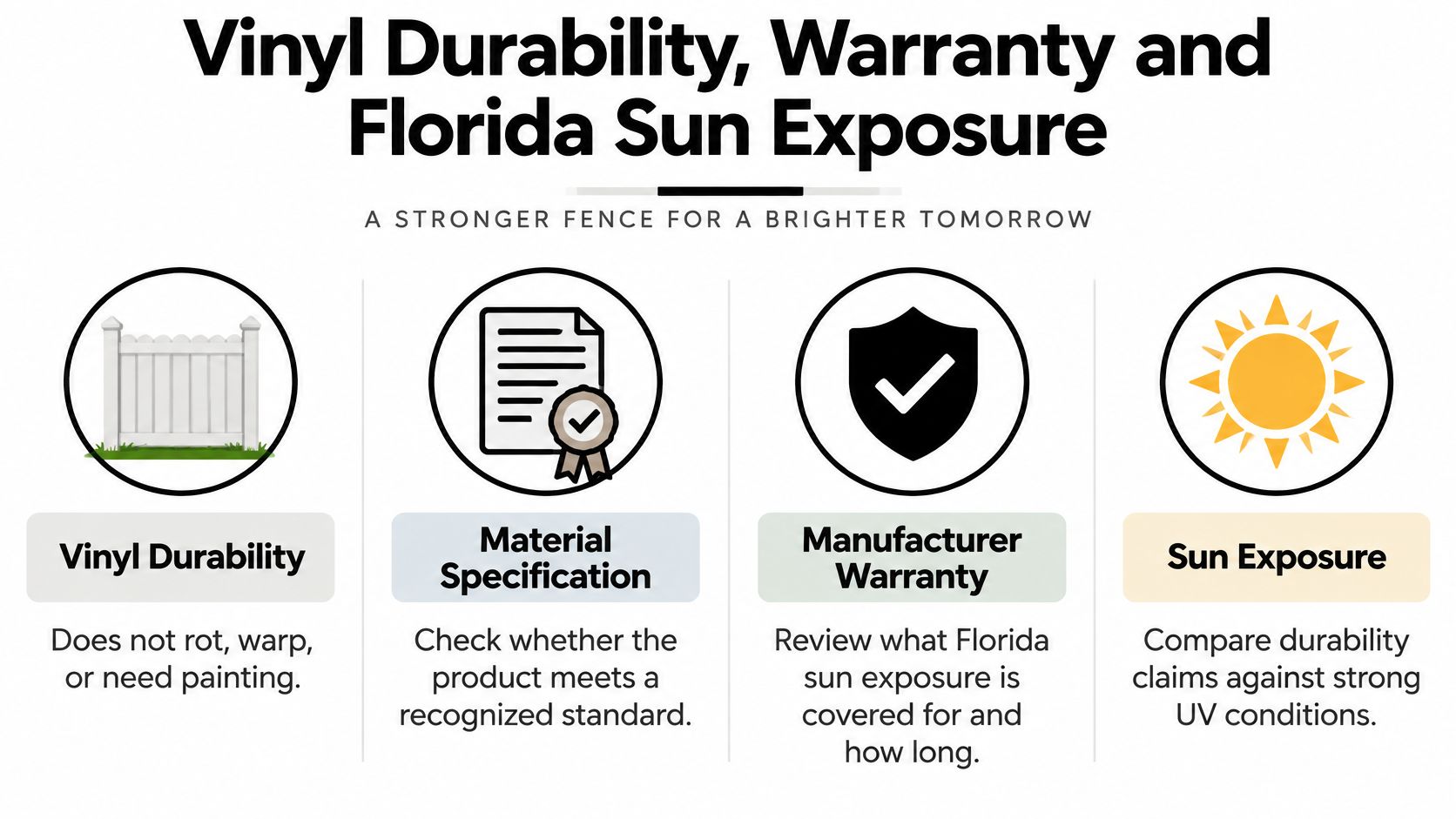
Vinyl doesn't rot or require the painting cycle associated with wood. Properly specified fencing is intended to maintain its shape, but an absolute promise that no vinyl component can ever distort would ignore heat movement, damage and installation errors.
Warranty coverage needs precise reading
The PVC manufacturer warranty associated with AlliedFenceAndGate.com™ covers cracking, splitting, peeling and significant fading for the life of the original installation. The written terms should still be retained with the contract so the owner has the actual claim procedure and coverage language.
Across products, warranty wording deserves careful comparison. Coverage duration alone doesn't explain whether labor, removal, replacement freight, impact damage or storm damage are included. Transfer rights and exclusions also need attention.
A warranty describes the manufacturer's obligations. Installation details determine how the fence transfers storm loads into the ground.
Sun exposure makes documented weathering performance important. A new sample can look excellent while revealing little about how the formulation will respond after prolonged outdoor exposure. Initial impact performance and performance after weather exposure are different checks.
The material specification also doesn't establish the assembled fence's wind-load capacity. Posts, rails, gates, connections and foundations must work together under the approved installation design.
Before signing, the contract file should contain:
- Profile specification: The identified product and its documented material compliance.
- Weathering and impact documentation: Manufacturer evidence relevant to the selected formulation and finish.
- Complete warranty text: Coverage, exclusions, claim requirements and any responsibility for replacement labor.
Those documents give an owner something concrete to compare. A verbal promise of lifetime durability doesn't.
Wind Exposure and Which Panel Design Holds Up
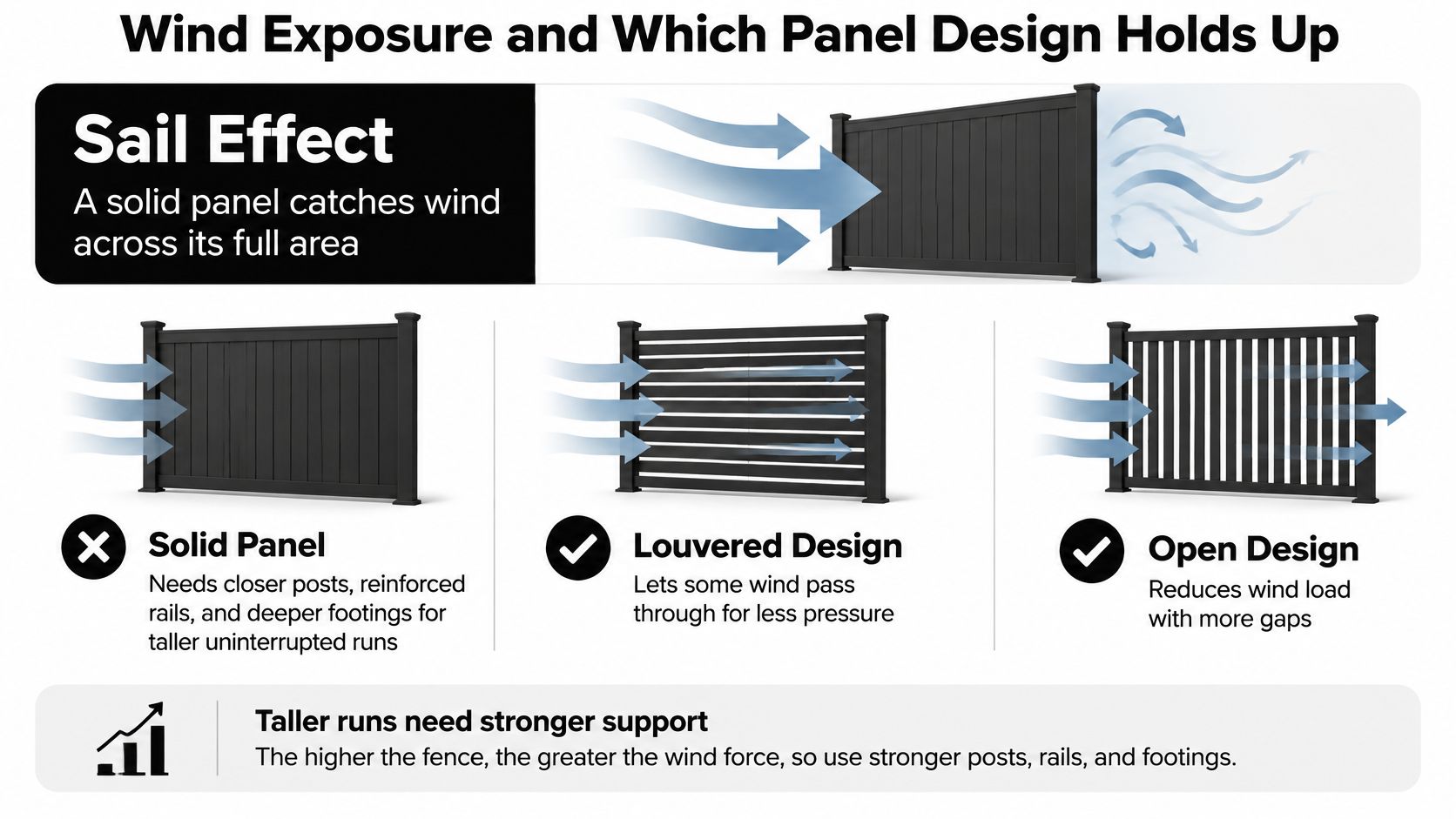
A solid panel catches wind across its full area. Taller uninterrupted runs can require closer posts, reinforced rails and larger or deeper footings than more open systems, but the approved engineering must set those details.
Panel design by wind exposure
| Site exposure | Design that usually holds up better | Engineering check to record |
|---|---|---|
| Open coastal lot with long runs | Engineered louvered or lattice-topped panels with reinforced rails | Tested wind pressure and maximum post spacing |
| Corner lot with exposed sides | Shorter solid sections with engineered returns where appropriate | Corner-post embedment and footing diameter and depth |
| Sheltered interior lot with mature tree cover | Solid panel with the reinforcement required by its approved system | Rail arrangement and gate reinforcement |
| Gate or swing section on any lot | Gate frame sized for hinge, latch and wind loads | Hardware rating and corrosion-resistant fasteners |
Tree cover isn't permission to reduce the design criteria. Likewise, a return or lattice cap doesn't automatically make a fence storm-ready. Panel geometry reduces exposure only within a properly designed assembly.
Record pressure and installation details
The cited Florida high-velocity hurricane-zone provisions identify 170 mph three-second gusts in Broward County and 175 mph in Miami-Dade County for structural calculations. Those jurisdiction-specific values must not be transferred automatically to Martin or Palm Beach County or treated as a current statewide fence rating.
A speed claim without its supporting installation details isn't enough. The project file should record:
- Assembly performance: Tested or engineered wind pressure and applicable exposure.
- Post layout: Maximum spacing, internal reinforcement and embedment.
- Foundation dimensions: Footing diameter, depth and relevant soil assumptions.
- Panel configuration: Rail arrangement, approved height and panel area.
- Gate design: Frame reinforcement and hinge-and-latch connections.
- Coastal hardware: Corrosion-resistant fasteners and compatible materials.
An engineer or permit reviewer should resolve unusual corners, long uninterrupted runs, exposed locations and changes from open fencing to solid panels. Existing chain-link posts shouldn't be assumed suitable for a privacy-panel conversion.
Where the budget won't support the required solid-fence assembly, a lower or open design can be the sensible answer. Vinyl isn't the right choice when the selected product lacks traceable engineering for the proposed location.
Cost and Maintenance Over the Life of the Fence
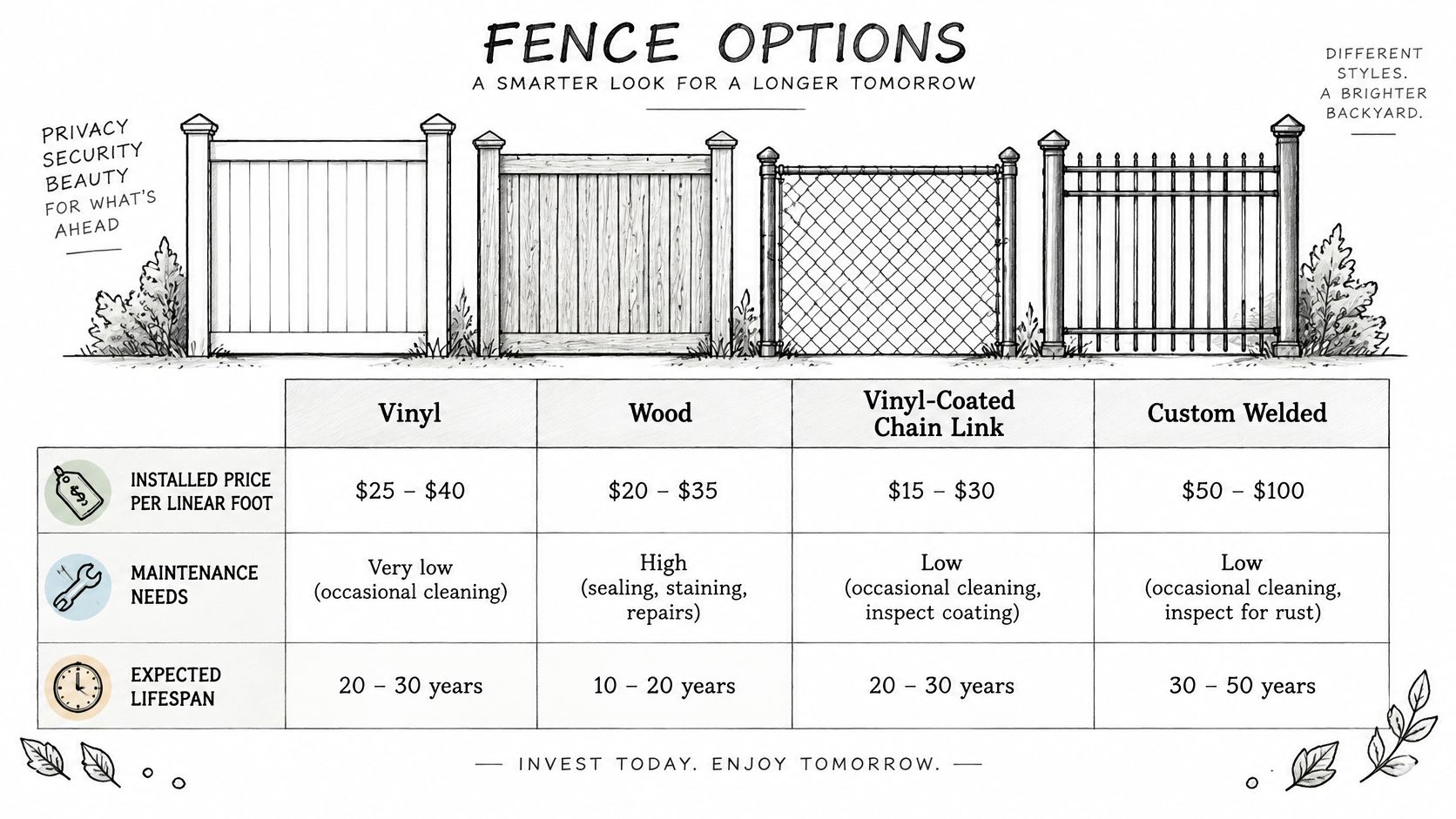
Cost, maintenance and lifespan by material
| Material | Price per linear foot | Maintenance | Typical lifespan |
|---|---|---|---|
| Vinyl privacy, 6 ft | $40 to $65 installed | Washing, inspection and gate adjustment; no painting | 20 to 30 years |
| Wood privacy, cedar or pressure-treated | Itemized species-and-layout quote required | High annual upkeep, including staining or sealing as appropriate | 10 to 20 years |
| Vinyl-coated chain link, 4 to 6 ft | $22 to $35 installed | Low, with coating and hardware checks | 20 to 30 years |
| Custom welded aluminum, 3 to 8 ft | Fabrication-and-installation quote required | Near-zero routine upkeep; inspect finish and connections | 30 to 50+ years |
These planning ranges describe different products, not equivalent privacy performance. Open chain link and decorative aluminum won't provide the same screening as solid vinyl without additional measures that may change wind loading.
Compare installed cost, upkeep and replacement
The useful calculation has three parts: installed cost, expected upkeep and the period of service being evaluated. Annualized cost equals the total of installation, maintenance and anticipated replacement expense divided by the comparison period.
A lower wood quote can lose its advantage if the owner repeatedly pays for preparation, stain and labor. Vinyl avoids that finishing cycle, but damaged components, gate adjustments and cleaning still require attention.
Budget check: Quotes should include the same gates, demolition, disposal and permit scope before their totals are compared.
The vinyl fencing cost guide helps identify scope items that can sit outside a headline linear-foot price. Slope treatment, grading, gate hardware, restricted access and utility-location coordination belong in the estimate.
For a hypothetical 150-foot backyard run, the stated vinyl range produces $6,000 to $9,750, while vinyl-coated chain link produces $3,300 to $5,250, before separately quoted extras. Those totals are simple footage calculations, not site quotes.
The cheaper option doesn't deliver equivalent privacy. The homeowner should first decide whether containment or screening is the actual requirement, then add documented upkeep allowances over a common ownership period.
Disposal deserves a line item
PVC's technical recyclability doesn't guarantee local recovery. A life-cycle case study of secondary fence boards illustrates why actual disposal practices matter when judging environmental outcomes. A demolition quote should identify whether usable sections will be retained and whether a suitable processor accepts the removed material.
Choose the Right Vinyl Privacy Fence and Confirm the Specs
The best choice starts with the property's hardest constraint. A finish preference can usually change; a pool access requirement or an unsupported wind-load assumption can stop the project.
Match the recommendation to the situation
Pool-side privacy: A solid panel is appropriate only as part of a compliant barrier with a self-closing, self-latching gate. PVC pool installations require proper spacing, a 48-inch minimum height and pool-code hardware to FL 515 standards. The permit review must settle the complete layout and gate operation.
For an HOA backyard requiring a wood look, woodgrain solid or lattice-topped panels deserve consideration. The architectural committee approves the appearance, not the installer, so a physical sample and written approval should precede ordering.
Windy or corner properties need an engineered comparison between solid and partially open systems. Louvered sections, reduced height or shorter approved runs may provide enough screening without committing the owner to an unnecessarily demanding solid wall.
A budget-first front or side yard often suits picket or semi-privacy fencing. Spending on full screening makes little sense where visibility is desirable or where local placement rules prevent a tall opaque fence.
Put the decision into a contract-ready file
- Collect approvals. Gather HOA guidelines, the property survey and permit requirements before selecting the final layout.
- Measure the site. Record the run with a measuring wheel or tape, mark corners, note grade changes and identify gate access needs.
- Secure specifications. Obtain the named profile, material-compliance documentation, site wind criteria, installation details and complete warranty.
- Compare matching quotes. Separate base footage, gates, removal, permitting and foundation requirements, then evaluate upkeep over the intended ownership period.
A standard-height PVC privacy budget should remain a planning allowance until the site details are resolved. The right contract identifies what will be installed, how it will be supported and which approvals must be completed.
#MartinCountyFencing #PalmBeachCountyFencing #TreasureCoastFencing #StLucieCountyFencing #IndianRiverCountyFencing #FloridaFencing #VinylFence #PrivacyFence #PVCFence #HOAFencing #PoolFence #FloridaHOA #WindLoad #FenceInstallation #PalmBeachFencing #PortStLucieFencing #FencingContractor #HomeImprovementFlorida
AlliedFenceAndGate.com™ offers PVC/vinyl fencing, pool safety gates and alternative fence materials across Florida's Treasure Coast and northern Palm Beach County, with permitting, utility locates and inspection coordination. Homeowners and property managers can visit AlliedFenceAndGate.com™ to begin a site-specific estimate with a survey, property photos and HOA requirements, then compare screening styles against the project's wind and pool-barrier constraints.
Related Fencing Services
Need a fence or gate on the Treasure Coast?
Licensed, insured, and bonded. Free estimates across Martin, St. Lucie, Indian River & Palm Beach counties.
Call (772) 530-3127