Florida Fence Products Compared
For most Florida homes, total installed cost lands between $25 and $150 per linear foot, depending on material, with aluminum at $28 to $150, vinyl at $25 to $48, chain link at $22 to $50, and wood at $25 to $45. Those ranges are only the starting point, because coastal exposure, pool-barrier requirements, permits, and site conditions can change which product makes financial sense.
A Treasure Coast homeowner may arrive at a showroom holding four samples, each one looking right for a different reason. Aluminum has the clean coastal appearance, vinyl offers privacy, chain link keeps the estimate controlled, and cedar brings warmth that manufactured materials can't quite reproduce. The practical question isn't which sample looks best. It's which fence will withstand the lot, satisfy the inspector, and remain affordable after the complete installation is priced.
Table of Contents
- Why Florida Fence Products Are a Different Decision
- How Coastal Climate Drives Material Choice
- Aluminum and Vinyl Compared for Florida Homes
- Chain Link and Cedar Board-on-Board Compared
- Florida Pool-Safety Code and Fence Product Specs
- Total Installed Cost Beyond the Per-Foot Price
- Matching Each Material to Florida Use Cases
- Choosing the Right Florida Fence Product
Why Florida Fence Products Are a Different Decision
A fence contractor assessing that showroom conversation would start with the property, not the color chart. A pool, salt exposure, prevailing wind, drainage, HOA rules, and access for installation can eliminate a material before aesthetics enter the discussion.
The published starting ranges show why buyers need an early reality check: aluminum runs from $28 to $150 per linear foot installed, vinyl from $25 to $48, chain link from $22 to $50, and wood from $25 to $45. These ranges are presented in Allied Fence and Gate's material pricing information and should be treated as planning bands, not guaranteed bids. A short, heavily gated project can cost more per foot than a long, unobstructed run because fixed preparation and hardware costs are spread across less fencing.
Practical rule: The cheapest material isn't automatically the cheapest project. A product that needs special pool hardware, corrosion-resistant components, engineered support, or additional review can change the final comparison.
Florida's foundational pool standard also narrows the field. Public pools require a minimum 48-inch-high fence or another approved substantial barrier, and the barrier must continue around the pool perimeter unless an adjacent structure blocks it, as described in the Florida pool-barrier code analysis. Pool gates must be self-closing and self-latching, with the latch placed at least 54 inches above the ground or pool-side floor under the cited requirements.
That means a decorative panel isn't useful if its openings, gate swing, latch, or height fail inspection. Buyers comparing Florida fence laws and permitting considerations should ask for a product specification, not just a photograph.
The right checklist begins with three filters:
- Exposure: Is the property near saltwater, exposed to strong wind, or relatively sheltered inland?
- Purpose: Does the fence need to provide privacy, contain pets, secure a commercial boundary, or enclose a pool?
- Total cost: What will permitting, gates, removal, access, and site preparation add?
The material decision becomes clearer once those filters are applied in that order.
How Coastal Climate Drives Material Choice
Florida's climate attacks a fence through several channels at once. Humidity keeps metal hardware damp, salt-laden air accelerates corrosion, intense sunlight degrades finishes, and repeated rain sends water into joints, post interiors, and fastener connections. On a coastal property, a product's appearance on installation day says less than its protection system and component quality.
The practical selection process starts with corrosion:
- Identify salt exposure. A home near the ocean, an inlet, or a saltwater canal needs more protection than a sheltered inland lot.
- Inspect every component. Posts, rails, hinges, screws, brackets, latches, and gate frames all need compatible corrosion resistance. A protected panel paired with weak fasteners still creates a failure point.
- Separate cosmetic wear from structural damage. Fading or chalking can be unattractive, but rust bleed, seized hinges, and weakened connections affect serviceability and inspection readiness.
- Match the finish to maintenance access. A fence hidden behind landscaping is harder to wash, inspect, and repair than one exposed along a driveway.
The Florida fence installation climate overview describes salt-laden air as a major reason corrosion resistance matters in state installations. Unprotected steel and basic ferrous components are especially vulnerable. Rust can bleed onto concrete below a post, stain pavers near a gate, and cause hardware to bind before the owner notices a broader problem.
Federal guidance takes a similarly material-focused approach. For corrosive or high-humidity environments, it recommends aluminum-coated steel fabric or PVC-coated fencing components, with framework upgrades to Class 2 aluminum piping or PVC-coated posts and rails, as outlined in the federal fencing corrosion-prevention guidance. A separate corrosion trial and marine-environment report identified fuse-bonded PVC as the strongest performer against corrosion at the tested sites and recommended vinyl-clad galvanized chain link and accessories where corrosion abatement is a concern.
Wood has a different failure pattern. Cedar can check, warp, and lose its finish when exposed to sun and moisture, while non-coated screws can corrode inside otherwise sound boards. Vinyl avoids rust but still needs a quality formulation and proper installation to prevent cracking, distortion, or unattractive surface aging.
The useful question isn't “Which material never fails?” No fence gets that guarantee in Florida. The useful question is which failure mode the owner can manage.
Aluminum and Vinyl Compared for Florida Homes
Aluminum and vinyl are often shortlisted together because both reduce routine painting and can work well around residential properties. They solve different problems, though. Aluminum favors open sightlines, lighter visual weight, and corrosion resistance, while vinyl/PVC favors privacy and a solid visual barrier.
| Attribute | Aluminum | Vinyl/PVC |
|---|---|---|
| Salt-air behavior | Resists rust when the finish and hardware are properly specified | Doesn't rust, but quality and UV protection matter |
| Privacy | Usually open picket or ornamental profiles | Strong choice for full or semi-privacy layouts |
| Wind design | Thin profiles can carry strong design ratings when engineered for the site | Taller solid panels need reinforced rails and careful post spacing |
| Pool use | Many systems are designed around pool-barrier layouts | Works when openings, height, and gate hardware meet code |
| Maintenance | Periodic washing and hardware checks | Periodic washing, with attention to impact damage |
| Main weakness | Higher purchase price on upgraded designs | Panels can crack under impact and need reinforcement |
A quality aluminum fence typically uses a powder-coated alloy such as 6005-T5 or a similar specification, with stainless or coated fasteners selected for the environment. The alloy designation alone doesn't prove a system is appropriate. Post size, rail construction, footing design, gate width, hinge quality, and product approval still matter, especially on an exposed coastal lot.
Vinyl should be evaluated with equal care. Virgin PVC with titanium dioxide UV protection is a more dependable specification than an unidentified recycled blend. Chalking, brittle surfaces, and color inconsistency are warning signs that the product may not be suitable for sustained Florida exposure. Solid vinyl also presents more surface area to wind, so taller sections need reinforced bottom rails, properly sized posts, and a layout that doesn't turn a privacy run into a sail.
The real comparison is maintenance type, not maintenance marketing. Aluminum and vinyl may avoid repainting, but both still need gate adjustment, fastener inspection, washing, and attention to impact damage.
A pool deck adds another distinction. Aluminum picket systems can make spacing and gate integration straightforward when the selected panel is designed for barrier use. Vinyl delivers privacy and can reduce visual exposure, but the installer must verify openings, clearances, gate swing, latch placement, and structural support.
Homeowners comparing profiles, colors, and layouts can review residential aluminum fencing options, then request the same level of specification for a vinyl proposal. A quote should identify the product family, finish, hardware, gate construction, and any required reinforcement rather than saying only “aluminum” or “vinyl.”
Chain Link and Cedar Board-on-Board Compared
Galvanized chain link and cedar board-on-board are not competing for exactly the same buyer. Chain link prioritizes boundary control, drainage, visibility, and cost. Cedar prioritizes privacy, warmth, and a more architectural backyard appearance.
| Criterion | Chain Link | Cedar Board-on-Board |
|---|---|---|
| Installed price range | $22 to $50 per linear foot | $25 to $45 per linear foot |
| Privacy | Open by default, with slats or windscreens available | Full privacy when properly overlapped |
| Rain and drainage | Drains freely through the mesh | Solid boards retain more wind and moisture |
| Salt exposure | Galvanizing or PVC coating provides the protection layer | Finish and fasteners require ongoing attention |
| Pool-barrier use | Can work with compliant mesh and gate hardware | Depends on exact spacing, height, and gate construction |
| Main maintenance issue | Coating and fittings need inspection | Staining, checking, warping, and fastener corrosion |
| Best fit | Perimeters, pets, utility areas, and controlled-access sites | Privacy-focused residential yards with maintenance commitment |
Chain link's zinc coating takes the first corrosion burden, which can make it practical on many Florida properties. Vinyl-coated galvanized mesh adds another protective layer and changes the visual character, especially when a darker finish is preferred. Slats and windscreens create privacy, but they also alter wind behavior. A solid-looking retrofit can place more pressure on posts and fittings than open mesh, so the installer should review the entire system instead of treating screening as a cosmetic add-on.
Cedar board-on-board provides a warmer result and hides neighboring activity, pool equipment, and service areas. It also asks more from the owner. In Florida sun, a stain program around 24 to 36 months is part of the material's expected care cycle, as reflected in the provided product guidance. South-facing runs can check and warp sooner, and ordinary screws can corrode behind the boards where replacement becomes inconvenient.
Cedar works best when the owner values privacy enough to maintain it. It works less well when the property sits close to surf and the owner expects a zero-maintenance enclosure.
Neither material receives automatic pool approval from its label alone. Chain link needs compliant mesh and gate hardware. Cedar requires verified picket spacing, barrier height, and a self-closing, self-latching gate. The inspector evaluates the installed configuration, not the material's reputation.
Florida Pool-Safety Code and Fence Product Specs
Pool fencing in Florida is a specification exercise. The statewide baseline requires a barrier at least 48 inches high, and the cited pool-gate rules require a gate to open outward away from the pool, close automatically, and latch securely. The release mechanism must be positioned so a young child can't reach it over the gate or through its openings, with the cited interpretation placing the latch at least 54 inches above the bottom of the gate when the release is located on the gate.
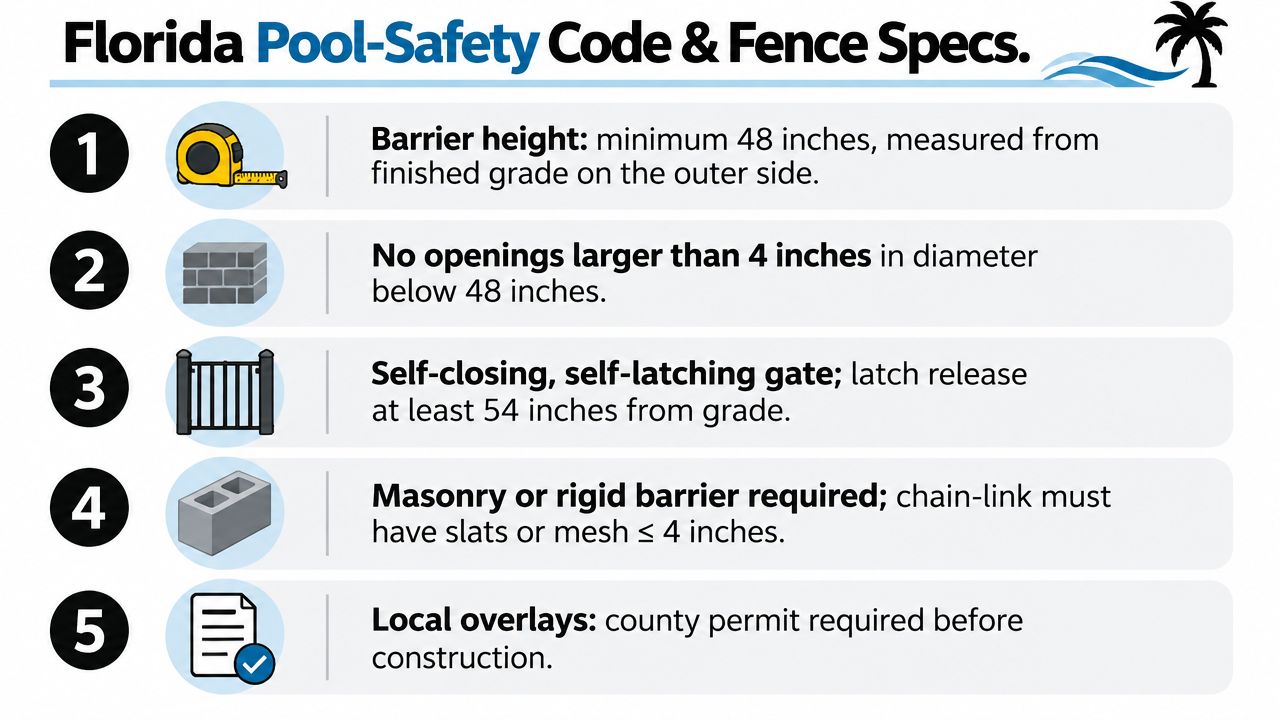
The Florida pool-access statute focuses on gate operation and child-resistant release design. Product selection therefore has to account for the complete opening, not just the panel. A gate that looks correct but swings inward, drags on the deck, or uses a reachable latch can fail the intended safety function.
The state's code framework also requires a continuous barrier around the pool perimeter unless an approved adjacent structure forms part of the enclosure. The federal and Florida code references supplied for this topic establish the importance of 48-inch barrier height and child-safety gate hardware, while local rules can add requirements.
The local overlay matters
Broward County's published pool-barrier packet illustrates why a statewide checklist isn't enough. The packet addresses self-closing and self-latching devices, exit alarms meeting UL 2017 in certain dwelling-wall configurations, and a local zoning requirement in unincorporated residential districts for a fence at least 5 feet high or an open-mesh screen enclosure.
That local overlay can change the panel, gate, alarm, and enclosure scope. A contractor should verify the governing city or county requirements before ordering materials, especially when a pool sits close to a property line or the barrier uses a wall, door, window, or screen enclosure as part of the protection system.
Total Installed Cost Beyond the Per-Foot Price
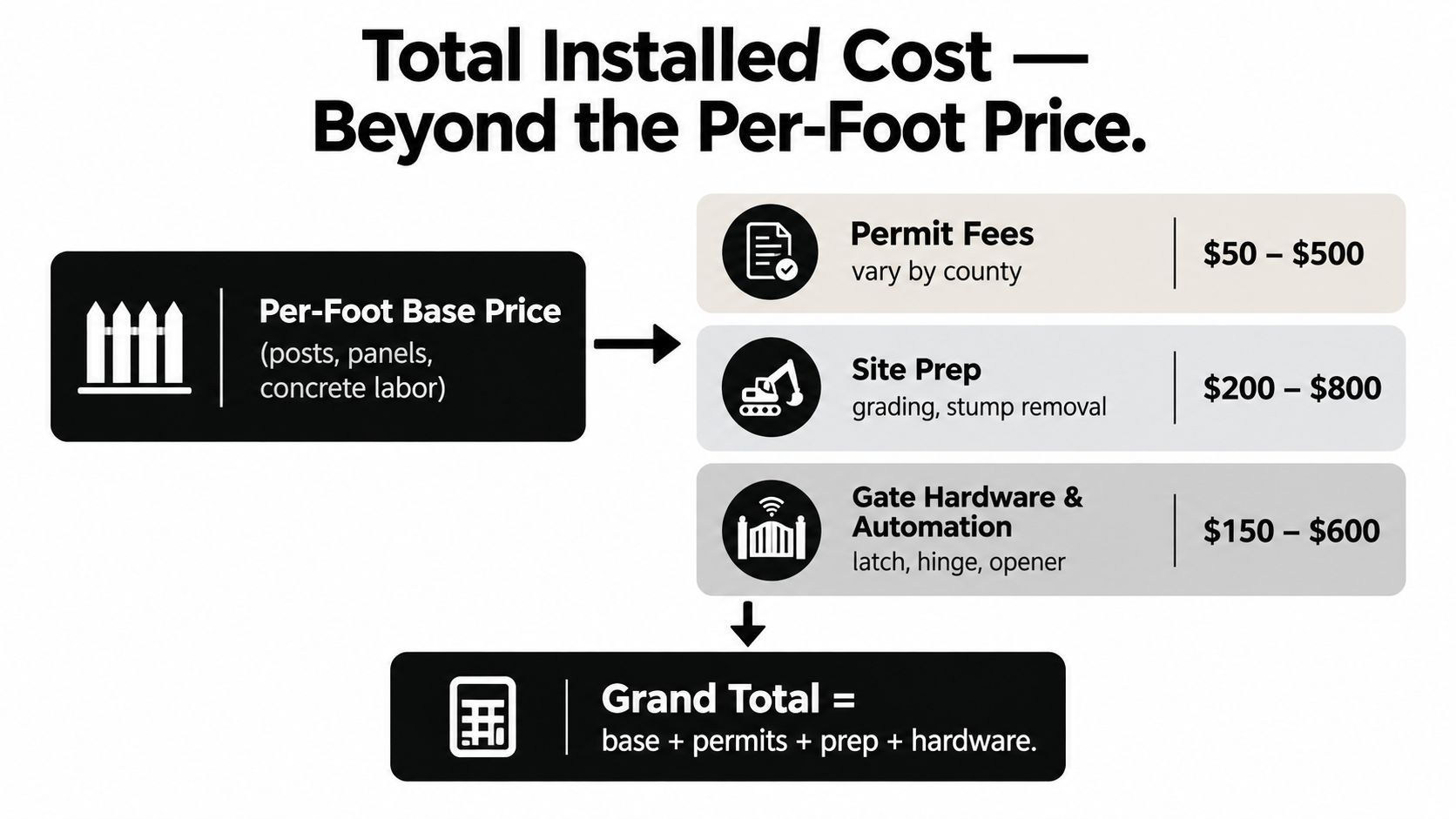
A per-foot quote generally describes the visible production work, posts, panels, concrete, and labor. It may not include every condition that affects the project. A buyer who compares only the material line can mistake a low base number for a low completed cost.
Permit pricing varies widely across Florida jurisdictions. The supplied market guidance cites examples ranging from roughly $38 plus a fee schedule in Orange County, $75 to $125 in Palm Beach County, and about $100 to $500 in Miami-Dade-area examples, based on the referenced Florida fence permit and pricing discussion. The same source notes that one municipal FAQ treats fence permits as a zoning matter rather than only a state building-code matter.
That variation is why a quote should identify the permitting jurisdiction and the approval assumptions. Pool barriers, HOA review, setbacks, surveys, and code-enforcement questions can all change the administrative workload.
Four budget checks before signing
- Permit scope: Confirm the fee, application responsibility, plan-review needs, and inspection coordination in writing.
- Utility clearance: Florida's One-Call system requires facility owners to mark underground utilities within 2 full business days after a locate request, and excavators must wait for marks or clearance before digging, according to the Florida 811 scheduling guidance.
- Site preparation: Ask whether roots, old footings, grading problems, rock, irrigation lines, and removal are included or excluded.
- Gate and removal work: Pool-rated latches, self-closing hinges, old-fence disposal, automation, and access-control equipment should appear as separate line items.
The fence installation cost guide is useful for building a first estimate, but a site visit remains necessary. A low-fee project with difficult access can carry a higher effective cost than a larger, straightforward run because preparation and compliance tasks don't scale neatly with linear footage.
Matching Each Material to Florida Use Cases
The strongest material choice changes with the property, not with a universal ranking. A coastal pool enclosure, a private suburban backyard, a commercial perimeter, and an urban infill lot each place different demands on the same four common Florida fence products.
| Use Case | Best Material | Why It Wins | Typical Spec |
|---|---|---|---|
| Coastal residential pool enclosure | Aluminum | Corrosion resistance, open profile, clean gate integration | Powder-coated aluminum, compliant picket spacing, self-closing and self-latching gate |
| Inland privacy backyard | Vinyl/PVC | Solid screening with low routine finish maintenance | Virgin PVC privacy panels, reinforced rails, compliant gate hardware where required |
| Commercial perimeter or dog run | Galvanized or PVC-coated chain link | Visibility, drainage, access control, and practical repair | Galvanized mesh, optional PVC coating, security gate, upgraded fittings |
| Urban infill privacy lot | Cedar board-on-board | Full screening and natural appearance | Cedar boards, coated fasteners, protected posts, planned stain maintenance |
Coastal pool enclosure
Aluminum usually fits a home close to saltwater when the owner wants an open view around a pool or raised spa. The selection still depends on coating quality, hardware, footing design, and local approval. Decorative appearance doesn't replace barrier compliance.
Inland privacy yard
Vinyl/PVC earns its place where the owner wants a solid boundary and doesn't want recurring staining. The installer must reinforce taller solid runs and account for wind exposure. A privacy fence still carries wind, even when the lot isn't directly on the coast.
Commercial perimeter
Chain link remains practical for commercial properties, service yards, dog runs, and temporary construction boundaries. PVC-coated galvanized mesh can improve the appearance and add corrosion protection, while access-controlled gates can separate pedestrian and vehicle movement without hiding the entire perimeter.
Urban infill property
Cedar board-on-board suits a smaller lot where privacy and warmth outweigh low maintenance. It should be paired with corrosion-resistant fasteners and a clear finish-care plan. Near surf, the owner should understand that the wood will demand more attention than an inland installation.
The decision rule is simple: match exposure zone, project type, and maintenance appetite before choosing a color or profile. Hybrid layouts can also make sense, such as aluminum around a pool and vinyl along a rear privacy boundary, provided the combined design satisfies local rules and the transition between materials is intentional.
Choosing the Right Florida Fence Product
A defensible shortlist comes from three decisions. The process should remove unsuitable products early rather than asking the homeowner to compare every style in a catalog.
First, classify the lot
A property near saltwater needs corrosion-resistant materials and hardware. A sheltered inland home may offer more flexibility for wood, vinyl, aluminum, or chain link. A commercial perimeter adds access control, security, delivery traffic, and possibly accessibility requirements.
Second, rank the purpose
A pool barrier puts height, openings, gate swing, latch reach, and self-closing hardware first. Privacy favors vinyl or cedar, but solid panels need a wind-aware layout. Pet containment may favor chain link or a carefully spaced picket system. Commercial security often requires stronger gates, controlled access, and a repairable perimeter.
Third, test the budget against the complete scope
The provided pricing bands place chain link and wood at the lower starting end, vinyl in a moderate range, and aluminum across a broad range that includes upgraded designs. A buyer should request three written quotes that separate material, labor, permitting, utility-locate coordination, site preparation, removal, and gates. Any pool-related bid that doesn't identify the self-closing, self-latching hardware deserves closer review.
The final contractor check is more important than a polished rendering. Request three local references, verify the current Florida license, and ask for wind-load and pool-code compliance documentation applicable to the proposed system. A contractor who can explain post construction, gate hardware, coating, permits, and inspection sequencing is offering more than a material sample.
AlliedFenceAndGate.com™ offers aluminum, PVC/vinyl, chain link, and wood fencing, along with pool safety gates, permitting support, 811 utility locates, and inspection coordination for Treasure Coast and northern Palm Beach County projects. Homeowners, property managers, and commercial owners can compare material scopes and request a site-based estimate through AlliedFenceAndGate.com™.
#MartinCountyFencing #PalmBeachCountyFencing #TreasureCoastFencing #StuartFencing #JupiterFencing #PortStLucieFencing #VeroBeachFencing #FloridaFencing #FloridaFenceProducts #AluminumFencing #VinylFencing #ChainLinkFencing #WoodFencing #PoolFence #PoolSafetyGate #CommercialFencing
Related Fencing Services
Need a fence or gate on the Treasure Coast?
Licensed, insured, and bonded. Free estimates across Martin, St. Lucie, Indian River & Palm Beach counties.
Call (772) 530-3127