Aluminum Pool Fence Installation for Florida Homes

A four-sided isolation fence separating the pool from the house and the rest of the yard reduces a young child's drowning risk by 83% compared with a three-sided property-line fence, according to guidance summarized by the U.S. Consumer Product Safety Commission drowning safety center. That single figure changes how aluminum pool fence installation should be judged. It's not a decorative run priced by the foot, it's a barrier built around the water itself.
Panels that look straight from the patio can still fail on finished height, bottom gap, gate swing, or a latch a child can reach. A crew lead measures those details on the outside face, after pavers, sod, and drainage work are final, and treats posts, panels, hinges, and latch as one system.
Table of Contents
- Florida Barrier Numbers That Decide a Pass
- Permits Setbacks and Neighbor Walls
- Salt Air Specs and a Rinse Schedule
- How to Set Posts and Hang Panels
- Commission the Gate as a Safety Device
- Book the Inspection and a Local Crew
Florida Barrier Numbers That Decide a Pass
Take this measurement card outside before ordering anything. Florida's framework is built around height, gaps, and climbability on the finished job, not on a catalog panel.
| Check | Required finished condition | Common fail |
|---|---|---|
| Outside height | At least 4 feet (48 inches) on the exterior face | Measured on the pool side or before final grade |
| Bottom gap | No more than 2 inches above finished grade | Slope, turf, or pavers open a crawl space |
| Opening size | A 4-inch sphere must not pass | Wide bays or gaps at walls and posts |
| Vertical spacing | Generally 1 3/4 inches maximum when rails are under 45 inches apart | Decorative 4-inch picket spacing used as if it were pool code |
| Horizontal rails | If closer than 45 inches, place them on the pool side | Yard-side rails become a ladder |
| Gate swing | Opens outward, away from the pool | Inward swing a child can push through |
| Latch | At least 54 inches above the bottom of the gate, or a protected pool-side release | Latch reachable over the top or through a gap |
| Layout | Continuous barrier around the pool, separate from a yard fence that does not itself comply | Three-sided fence still open to the house |
Read the statute as a field check
Under Florida's pool-safety statute in Chapter 515, a residential swimming-pool barrier must be at least 4 feet high on the outside and contain no gaps, openings, indentations, protrusions, or structural components that could let a young child crawl under, squeeze through, or climb over it. The same statute requires pool-access gates to open outward away from the pool, be self-closing, and use a self-latching locking device positioned so a young child cannot reach it over the gate or through an opening.
That language is why the inspector walks the exterior face. A panel sold as 48 inches can measure short if mulch, sod, or a deck overlay raises the outside grade, or if a retaining edge gives a child a step up. Nominal height doesn't pass. Finished height does.
Practical rule: Measure height and bottom clearance from the outside, at the lowest finished grade a child can stand on, after every surface is in.
Where the common miss happens
Crews get caught measuring the nominal picket on the pool side, or measuring before sod, pavers, and deck work change the grade. A bay that cleared the dirt by half an inch last week can sit over a crawl gap once the yard crew pulls soil away for drainage rock. Corners at house walls, screen cages, and equipment pads are the other weak spots, because a tight panel run can still leave a sphere-sized opening where the fence returns.
Horizontal rails deserve the same scrutiny. If rails sit closer than 45 inches apart on the yard side, they work as ladder rungs, so they belong on the pool side with tight vertical spacing. Decorative spacing copied from a front-yard fence isn't pool code.
Walk the outside face after final surfaces are in, tape and 4-inch sphere in hand. Treat posts, panels, hinges, and latch as one barrier system, and fix any bay that only passes on paper.
Permits Setbacks and Neighbor Walls
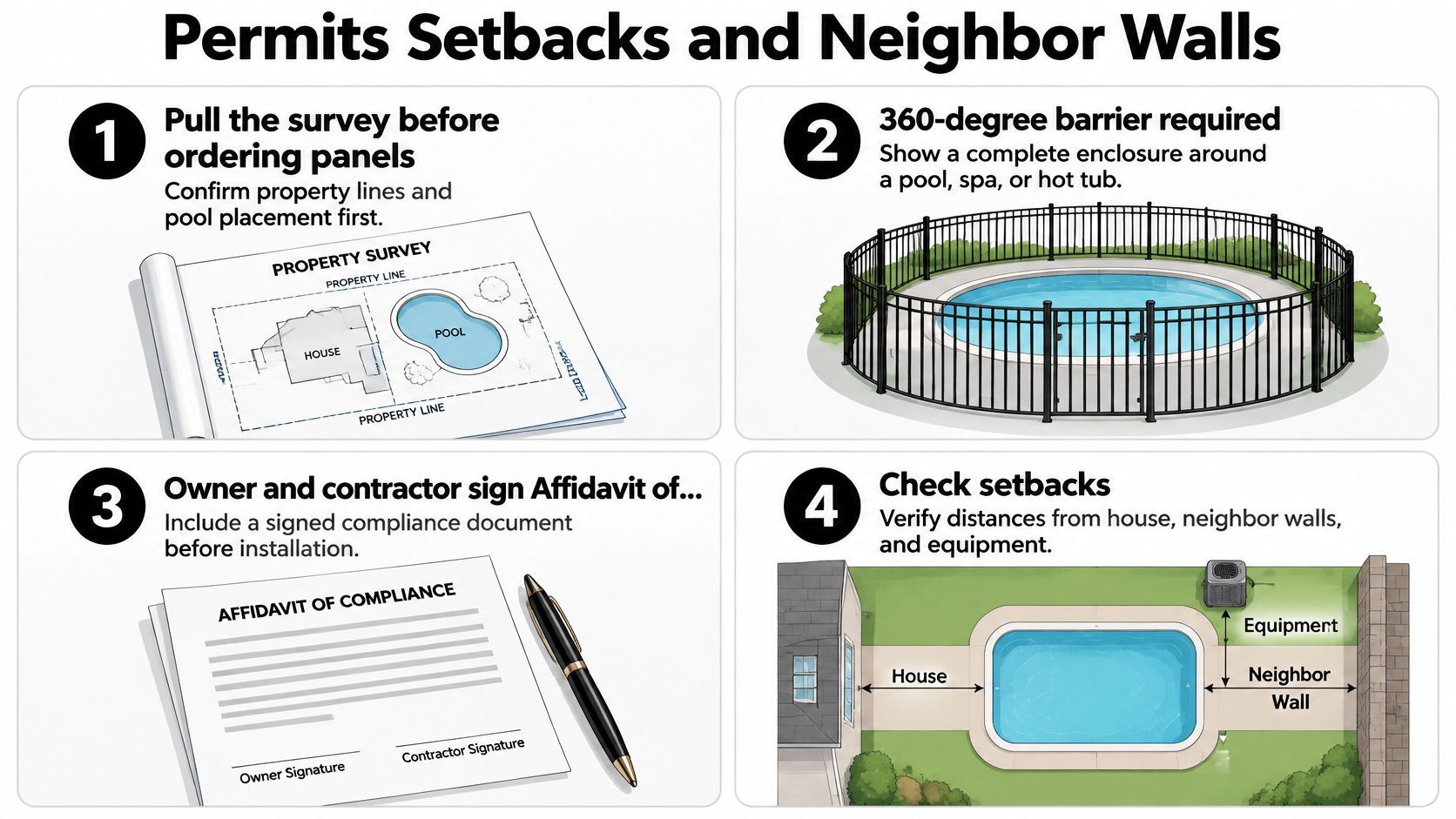
Pull the survey before ordering panels. A line drawn from memory can put posts in an easement, on a neighbor's land, or outside a setback, and aluminum panels cut for that wrong line don't get cheaper when they have to move.
Start with the county paperwork
Palm Beach County requires a 360-degree barrier around a pool, spa, or hot tub, and under the county's Pool Barrier Requirements and Process document, the property owner and contractor must sign an Affidavit of Understanding acknowledging that requirement with the pool application. If an existing fence or wall is used, compliance must be inspected before the Certificate of Completion is issued, and a neighbor's wall or fence may be used only through a recorded Pool Barrier Agreement submitted with the application.
Martin County adds site limits that move posts even when state dimensions are met. Its fence affidavit of compliance states fences may be limited to 6 feet on the property line and may not be placed within 25 feet of a navigable waterway except for specified shoreline-related configurations. The same affidavit bars placement across wetlands, preserve areas, or preserve-area easements without written authorization, requires letters from all utility companies if a fence crosses an easement, and requires corner-lot installations to remain within building setbacks and outside required sight triangles.
| Issue | Martin County | Palm Beach County |
|---|---|---|
| 360-degree barrier paperwork | Fence affidavit of compliance for site limits | Owner and contractor sign an Affidavit of Understanding with the pool application |
| Using an existing or neighbor fence | Must itself meet barrier rules; utility letters if it crosses an easement | Recorded Pool Barrier Agreement with the application; existing barrier inspected before Certificate of Completion |
| Property-line height | May be limited to 6 feet | Barrier still at least 4 feet; zoning controls the property-line run |
| Water and preserve areas | Not within 25 feet of a navigable waterway except specified shoreline setups; no wetlands or preserve easements without written authorization | Confirm before treating a seawall or neighbor wall as one side |
| Corners and sight lines | Stay inside building setbacks and outside required sight triangles | Property-line coordination is part of the permit |
Build the packet before the first hole
Say a Stuart or Jupiter backyard has a pool cage, a drainage easement along the rear line, and a seawall. The yard fence can't hold the barrier line without crossing the easement, so the aluminum fence steps inside the yard as a true isolation fence around the water. That's a layout decision, not a field improvisation, and it belongs on the survey submitted with the permit.
- Survey with the fence line marked: Show returns to the house or cage, gate location, and any easement crossings.
- County forms: The signed affidavit, plus a recorded Pool Barrier Agreement if a neighbor wall counts as one side.
- Utility letters and HOA approval: Get both in hand where they apply, then call 811 before any core drill or digging.
Homeowners sorting out the sequence can review the local fence permit requirements before materials are ordered. Confirm which form the county wants and whether a neighbor agreement is required, because a missing signature stops a Certificate of Completion as surely as a bad latch.
Salt Air Specs and a Rinse Schedule
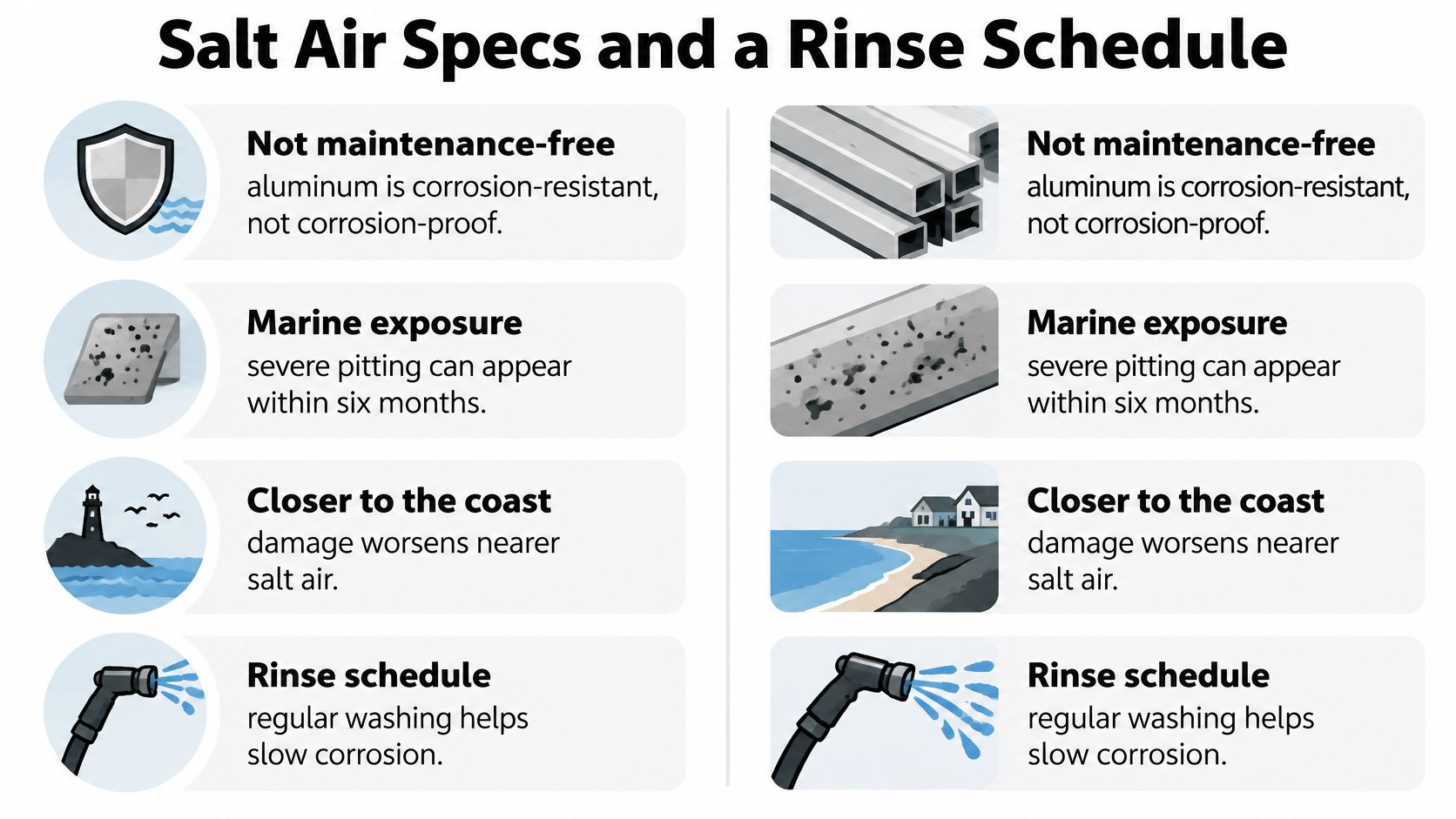
Aluminum is corrosion-resistant, not corrosion-proof, and treating it as maintenance-free is the fastest way to shorten a coastal fence's life. A beachfront or Intracoastal lot in Martin or northern Palm Beach County is a different specification from an inland subdivision, even when the panels look identical in a catalog.
What salt exposure actually does
Recent marine-exposure research published in the Journal of Materials Engineering and Performance found severe pitting corrosion on aluminum alloy after six months, with corrosion increasing significantly closer to the sea. The identified corrosion products included aluminum oxide, aluminum hydroxide, and aluminum chloride.
On a pool fence, that damage rarely starts with a picket falling over. Brackets, screws, hinges, and latch components deteriorate first while the panels still look straight. A fence can stay upright and still be unsafe if the latch spring seizes or a hinge drags.
| Site | What to specify | Rinse and check | First parts to watch |
|---|---|---|---|
| Beachfront | Marine-suitable alloy, powder coat, isolated fasteners, sealed cut edges | Freshwater rinse after salt spray and a monthly gate test | Hinges, latch, screws, post bases |
| Intracoastal | Same marine hardware; keep irrigation off the rails | Rinse weekly in the dry season and after blows | Latch spring and lower brackets |
| Inland subdivision | Standard powder-coated aluminum with stainless or hot-dip galvanized hardware | Rinse when pollen and sprinkler film build up; test the gate monthly | Hinge tension after the gate settles |
| Screened pool cage | Aluminum still needs pool-code gaps and a self-closing gate; screen is not the barrier | Check tracks and the gate after cage repairs | Bottom gap where deck meets the screen |
Specify for the site, then rinse on a schedule
- Alloy and coating: Ask for a marine-suitable alloy and powder coating suited to the distance from open water, and compare options against a plain inland spec before signing.
- Metal isolation: Isolate aluminum from dissimilar metals and use corrosion-resistant hardware, since mixed metals in a salt film invite galvanic attack at every screw.
- Cut edges: Seal or touch up every drilled or cut surface so bare metal isn't left exposed.
- Post bases: Keep mulch, soil, and irrigation overspray from packing at the base, where trapped salt and debris hold moisture against the post.
The guide to the best aluminum fence outlines finish and hardware choices worth comparing at quote stage. A workable rhythm is a freshwater rinse after salt spray, a monthly gate close-and-latch test, and a walk after storms or new landscaping to pull furniture, planters, and toys off the barrier so they don't become steps. Read the warranty for salt-exposure or harsh-cleaner exclusions before using acid or abrasive pads, and finalize the marine hardware before the quote, because it has to be ordered before posts are set.
How to Set Posts and Hang Panels
Panels don't make a fence straight. Plumb posts on a correctly staked line do, and every later measurement, from bottom gap to gate latch, depends on that first layout. The sequence below works on a deck, slab, or soil yard.
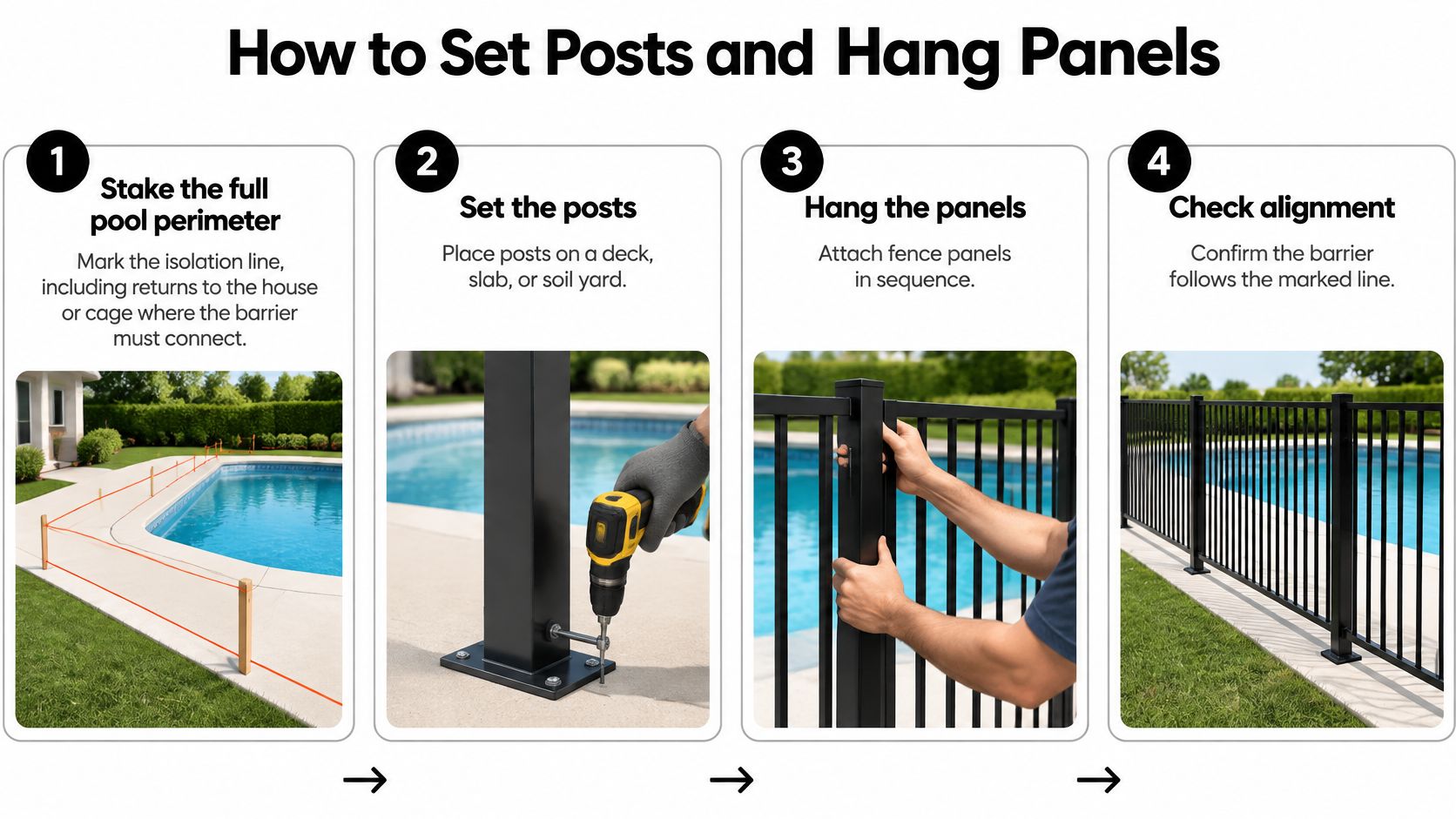
The eight-step sequence
- Stake the full isolation line: Mark the entire pool perimeter, including returns to the house or cage where the barrier must close, and flag utilities after the 811 locate.
- Shoot finished grade: Confirm deck and slab elevations so a slope doesn't open more than 2 inches under a panel once final surfaces land.
- Locate posts to real panel dimensions: Lay out spacing so standard panels stay square and the gate opening is framed for outward swing, not forced into a leftover gap.
- Core-drill or excavate: Use a core bit on concrete or an auger in soil, with holes sized to the post and substrate rather than a one-size guess.
- Set posts plumb and let them cure: Set aluminum posts in concrete or corrosion-compatible anchors, check plumb on two faces, and don't hang weight on fresh work.
- Hang panels without forcing alignment: Keep horizontals on the pool side when they're less than 45 inches apart, and keep vertical openings at or under 1 3/4 inches where that rule applies.
- Rack only within the system's limits: Don't rack a panel so hard that pickets bow or the bottom edge lifts off grade.
- Remeasure every bay at final grade: After sod, pavers, or drainage rock are in, check each bay with a tape on the outside face, a level on the posts, and a 4-inch test sphere.
The dimensional basis for that sequence matches the city of Palmetto Bay Standard Open Aluminum Fence Detail, which sets the barrier at at least 48 inches high when measured on the exterior side, allows no more than 2 inches of clearance above grade, and requires the fence to prevent passage of a 4-inch-diameter sphere.
The slope a flat drawing hides
Say a Palm City yard falls gently away from the pool deck. A 48-inch panel that clears the high side by half an inch can open a 3-inch crawl gap at the low side unless the line steps or the grade is built up. The drawing shows one level run. The yard doesn't agree, and the sphere test at final grade is what catches it.
Fix a drifting post before the next panel goes on. Corrections get harder with every bay hung off a bad reference.
On concrete, core-drilling embeds the post in the slab for a solid result, while surface mounting with a base plate and wedge anchors is faster and reversible but raises the fence slightly. On pavers, posts must reach through the bedding into a stable base or the structural slab, never anchor to pavers or a thin overlay alone. Specify stainless or hot-dip galvanized fasteners and aluminum posts so the first corrosion isn't at the base, and assemble the kit before starting: aluminum posts sized for panel weight and wind load, concrete or corrosion-compatible anchors, a core bit or auger, a plumb level, a tape, a 4-inch sphere, and the fasteners and hinges matched to the site's salt exposure.
Commission the Gate as a Safety Device
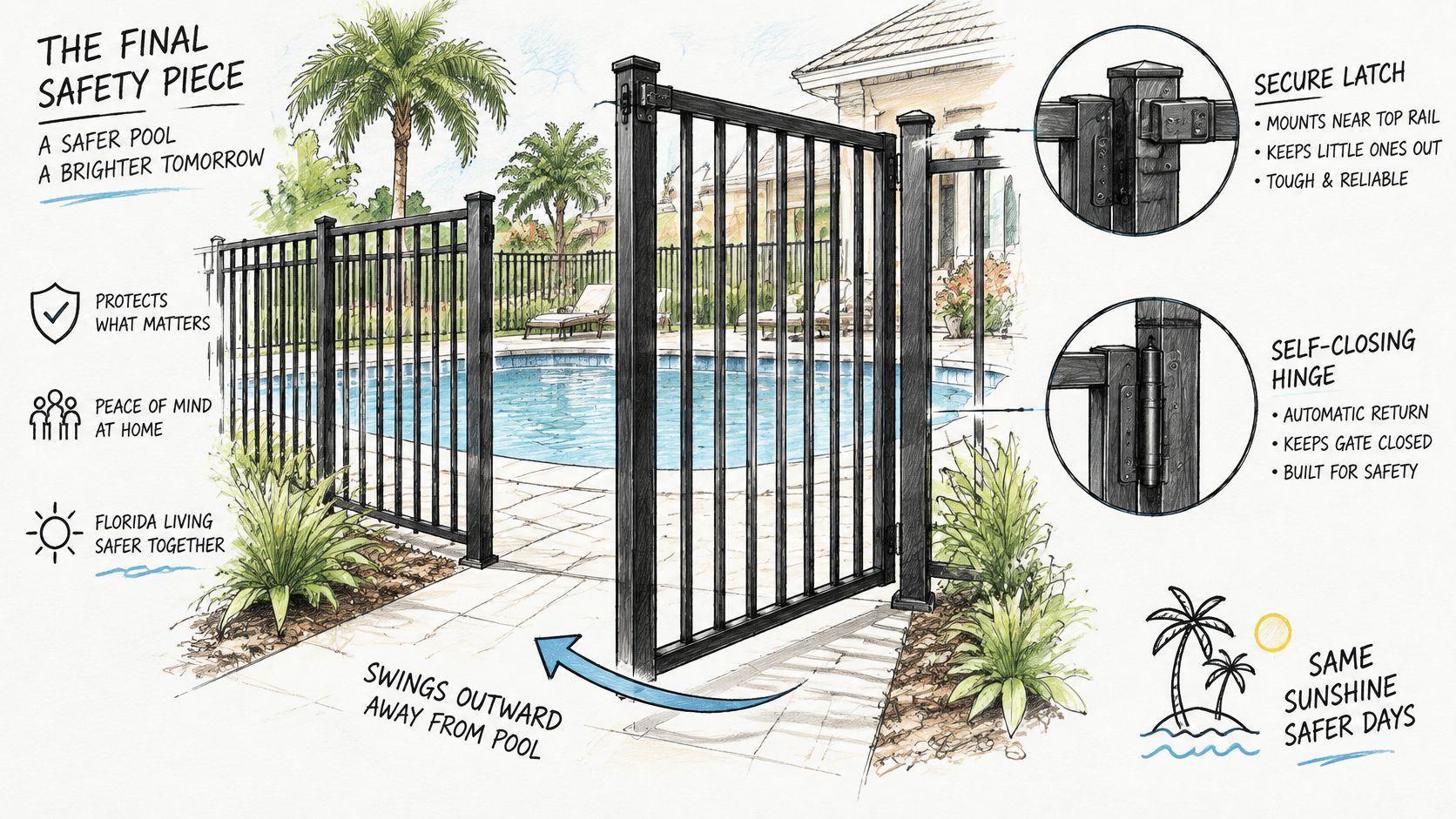
A pool barrier is only as dependable as its gate. The gate must close and latch by itself every time, even when wind or a small change in grade affects its movement.
Set the swing and the latch height first
Florida's pool-safety statute requires a pool access gate to swing outward, away from the pool, and to be self-closing and self-latching. The latch must be positioned at least 54 inches above the bottom of the gate. If the release is lower, it must be on the pool side and protected from a child reaching over or through the gate. Check the requirements in Florida's pool-safety statute, Chapter 515.
Stabilize the posts and level the gate frame before fitting the hinges and latch. Use self-closing pool-code hinges and a pool-code latch in stainless steel or marine-grade aluminum. For details on choosing and positioning the latch, see the pool safety gate latch guide.
Test it dynamically, not visually
- Test the closing action: Check that the gate closes and latches from fully open and from a narrow opening, without a push.
- Retest after finish work: Pavers, turf, concrete settlement, and drainage changes can make the gate drag or prevent the latch from meeting the strike.
- Check around a low release: Look for openings and decorative cutouts near the release that could let a child reach through or gain a foothold.
- Walk the routes around the barrier: Check screen doors, house doors, side gates, and walls for an unprotected way into the pool area.
A gate can look square yet hang open because of hinge drag, a shifted post, wind, or an obstructed swing. Test repeated close-and-latch cycles from different positions, and confirm that the gate latches without help. If it needs a shove, adjust the hinge, post, or strike before the barrier is put into use.
Book the Inspection and a Local Crew
A passed inspection isn't the finish line. It's the start of the handoff, and the paperwork assembled at this stage is what an inspector, a future buyer, or an insurance carrier asks for later.
Assemble the handoff packet
- Permit record: The permit card and the survey with the as-built fence line marked.
- County agreements: The signed affidavit, or the recorded Pool Barrier Agreement if a neighbor wall forms one side, plus any utility letters.
- Warranty terms: The product warranty with its salt-exposure and cleaning conditions, filed where the homeowner can find it.
- Test log: The outside-face walk checking height, bottom gap, sphere test, rails, gate swing, and latch engagement from several angles, with results written down.
Pull planters, furniture, and toys away from the fence so they can't become steps, and schedule a retest after storms, new landscaping, or paving near the barrier. The fence is one layer of protection, and it doesn't replace door alarms or supervision. For budget context, standard aluminum picket fence from AlliedFenceAndGate.com™ costs $28 to $50 per linear foot installed, and its gate hardware includes self-closing pool-code hinges and latches in stainless steel or marine-grade aluminum. Every pool fence AlliedFenceAndGate.com™ installs passes Martin County inspection.
When a licensed local crew earns the call
Hire a licensed local crew rather than a general fencer when the line crosses an easement, a slope, a pool cage, or a neighbor wall, when HOA color rules apply, or when the bidder can't show permit pulls, an 811 locate, and pool-code hardware specs in writing. Ask every bidder for a written scope listing post spacing, panel openings, gate hardware, and the marine-suitable finish, then compare quotes on those line items rather than on price per foot. A cheaper bid that swaps in a yard latch or skips the recorded neighbor agreement isn't cheaper after a failed inspection.
#MartinCountyFencing #PalmBeachCountyFencing #StuartFencing #PalmCityFencing #JensenBeachFencing #HobeSoundFencing #SewallsPointFencing #JupiterFencing #TequestaFencing #PalmBeachGardensFencing #PortStLucieFencing #TreasureCoastPoolFence #AluminumPoolFence #FloridaPoolCode #SelfClosingGate #PoolSafetyFence
AlliedFenceAndGate.com™ installs pool-code aluminum fencing across Martin County and northern Palm Beach County, handling permitting, 811 locates, and inspection coordination along with the build. Homeowners planning aluminum pool fence installation can get a written scope with gate hardware and finish specifications matched to the site's salt exposure. Visit AlliedFenceAndGate.com™ to request an estimate and review installed pricing before the first post hole is drilled.
Related Fencing Services
Need a fence or gate on the Treasure Coast?
Licensed, insured, and bonded. Free estimates across Martin, St. Lucie, Indian River & Palm Beach counties.
Call (772) 530-3127