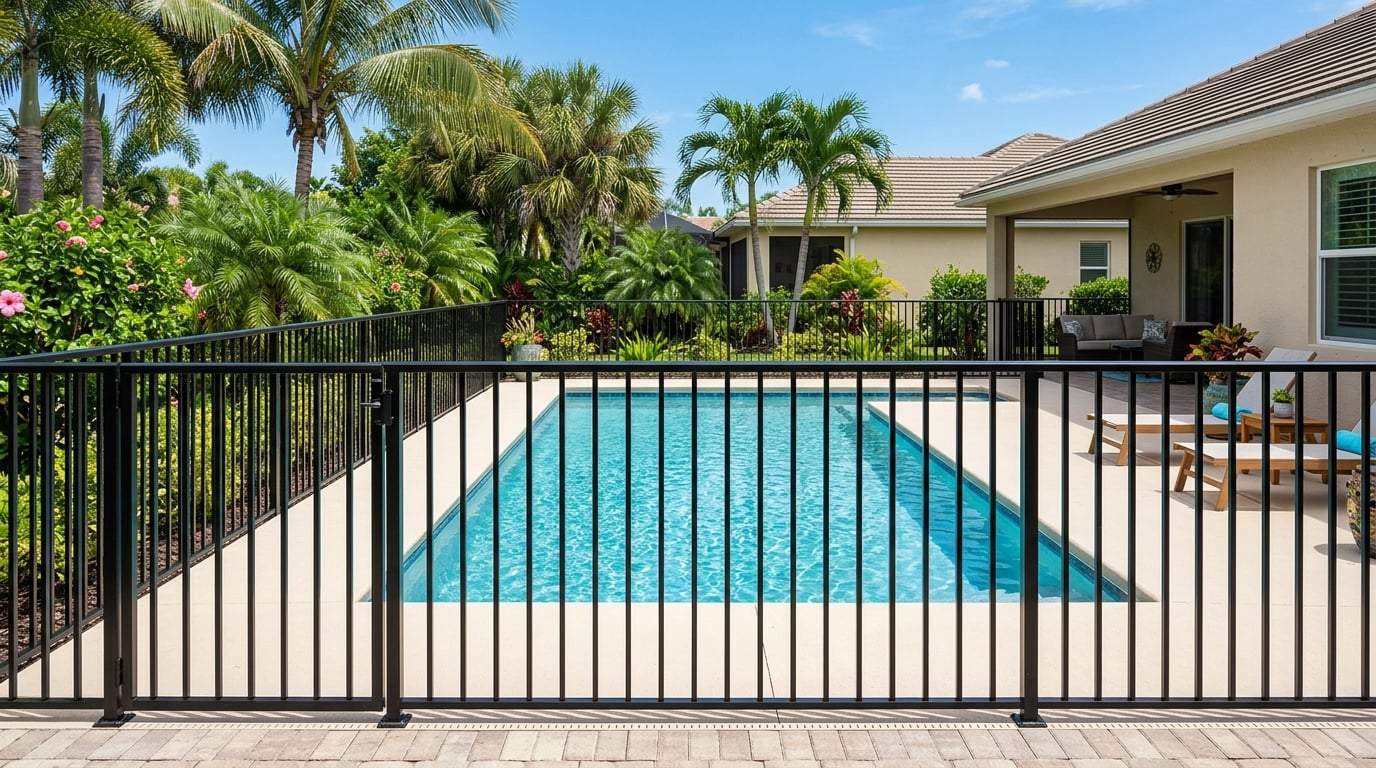
Florida has some of the strictest pool barrier laws in the country — for good reason. The state consistently leads the nation in child drowning incidents. Whether you're a homeowner installing a new pool, a property manager overseeing an HOA community pool, or a commercial developer, your pool fence must meet Florida Building Code Section 454 or you won't pass inspection. Period.
We install pool fencing across Martin, St. Lucie, Indian River, and Palm Beach Counties every single week. Here's exactly what code requires, what inspectors actually look for, and the mistakes that fail 90% of the time.
The Florida Pool Barrier Code at a Glance
Florida's Residential Swimming Pool Safety Act (Chapter 515, Florida Statutes) combined with Florida Building Code Section 454 establishes the minimum requirements. Here are the numbers that matter:
Critical Measurements
Gate Requirements — Where Most Inspections Fail
Pool fence gates are the #1 inspection failure point. Florida code is very specific about how gates must function:
Gate Code Requirements
- Must be SELF-CLOSING — gate returns to closed position from any open angle
- Must be SELF-LATCHING — latch engages automatically when gate closes
- Gate must open OUTWARD (away from pool area)
- Latch at 54" minimum on outside — OR on pool side with release 3" below gate top
- No lock that can remain in the unlocked position
- Hinges must not allow gate to be lifted off when closed
- Double gates: at least one leaf must be self-closing and self-latching
- Motorized/electric gates must comply with UL 325 safety standards
Pro tip from the field: We see the same gate failure every week — the self-closing mechanism (usually a spring hinge or hydraulic closer) loses tension within 6-12 months if it's a cheap model. We install Magna-Latch and TruClose hinges as standard because they actually hold up in Florida heat and salt air. The $30 you save on cheap hardware will cost you $250+ in re-inspection fees.
Material Comparison for Pool Fencing
Not all fence materials work equally well around pools. Here's what we recommend based on 20+ years of Florida installations:
| Material | Cost/LF Installed | Pros | Cons | Best For |
|---|---|---|---|---|
| Aluminum | $45 – $75 | Rust-proof, durable, adds property value, code-compliant spacing | Higher upfront cost | Permanent residential & commercial |
| Vinyl/PVC | $50 – $80 | Privacy, zero maintenance, durable | Can yellow with UV, privacy may block pool supervision | Privacy + pool barrier combo |
| Removable Mesh | $15 – $25 | Affordable, removable, fast install | Not permanent, less attractive, regular re-tensioning | Renters, temporary, budget |
| Chain Link | $20 – $35 | Cheap, strong, see-through | Climbable (needs privacy slats), rusts without vinyl coating | Budget commercial/HOA |
| Wood | $35 – $60 | Natural look, privacy | Rots in pool moisture, termites, blocks supervision, high maintenance | Not recommended for pool areas |
Our recommendation: Aluminum is the gold standard for pool fencing in Florida. It's rust-proof (critical around chlorine and salt), the picket spacing is engineered to meet the 4-inch sphere test, it's non-climbable in standard flat-top designs, and it adds genuine curb appeal and property value. That's why 80%+ of our pool fence installations are aluminum.
Common Inspection Failures We See Every Week
After installing thousands of pool barriers across the Treasure Coast, here are the inspection issues that trip up homeowners and even other contractors:
Top 8 Inspection Failures
❌ Gate doesn't self-close from every position
✅ Fix: Install quality self-closing hinges (TruClose or equivalent), test from 6", 45°, and 90° open
❌ Gap under fence exceeds 4 inches
✅ Fix: Grade the soil or use a bottom rail — especially on slopes and uneven Florida sand
❌ Climbable object within 4 feet of barrier
✅ Fix: Move A/C units, trash cans, planters, and pool equipment 4+ feet from the fence line
❌ Horizontal rails create a climbing ladder
✅ Fix: Use vertical picket design or ensure horizontal rails are 45"+ apart
❌ Gate latch too low on outside
✅ Fix: Latch must be 54" minimum on outside — our standard aluminum gates have it at 54"
❌ House wall used as barrier without door alarm
✅ Fix: Any door from the home leading to the pool area needs a ASTM F2208-compliant alarm
❌ Screen enclosure door doesn't self-close
✅ Fix: Add pneumatic or spring closer to all screen doors facing pool area
❌ Fence height measured incorrectly
✅ Fix: 48" is measured on the OUTSIDE (non-pool side) from finished grade — not from inside or from top of footer
Pool Fence Cost Breakdown by Project Type
Real pricing from our recent Treasure Coast installations (materials + labor, permits included):
| Project Type | Typical Perimeter | Material | Installed Cost |
|---|---|---|---|
| Residential pool (basic) | 120 – 160 LF | Aluminum 54" | $5,400 – $12,000 |
| Residential pool (premium) | 120 – 200 LF | Aluminum + decorative gate | $8,000 – $15,000 |
| HOA community pool | 200 – 400 LF | Commercial aluminum 60" | $15,000 – $30,000 |
| Hotel/resort pool | 300 – 600+ LF | Commercial aluminum + ADA gate | $25,000 – $50,000+ |
| Childcare facility pool | 100 – 200 LF | Aluminum 60" + alarms | $10,000 – $20,000 |
| Mesh temporary barrier | 80 – 150 LF | Removable mesh | $1,200 – $3,750 |
Commercial & Property Manager Considerations
If you manage an HOA, apartment complex, hotel, or commercial property with a pool, the requirements go beyond residential code:
- ADA compliance: Pool gates serving public/commercial pools must meet ADA accessibility requirements including 32" minimum clear opening width, accessible hardware (no tight grasping/pinching/twisting), and 60" minimum maneuvering clearance at gates. See our full ADA requirements guide →
- VGB Act compliance: The Virginia Graeme Baker Pool & Spa Safety Act requires compliant drain covers and, in some cases, safety vacuum release systems. This is separate from barrier code but required for public/commercial pools.
- Double-gated access: High-traffic commercial pools often need double-leaf gates with sequential closing and latching mechanisms — both leaves must independently meet self-closing requirements.
- Emergency access: Fire code may require that pool barriers do not impede emergency egress. Knox boxes or panic hardware may be required depending on occupancy classification.
- Insurance requirements: Commercial pool barriers often need to exceed minimum code to satisfy carrier requirements. We work with property managers to ensure installations meet both code AND carrier specifications. Learn about InsureFENCE℠ →
The Permit & Inspection Process
Here's what the process looks like when you hire a licensed contractor for pool fence installation in Martin, St. Lucie, Indian River, or Palm Beach County:
- Site assessment — We measure the pool perimeter, identify access points, check grade changes, and note any existing structures that affect barrier placement.
- Permit application — We pull the permit (included in our price) with a site plan showing barrier location, gate locations, and all measurements.
- Installation — Typical residential pool fence installs take 1-2 days. Commercial projects range from 3-10 days depending on scope.
- Inspection — County inspector verifies height, gate operation, gap measurements, and overall code compliance. We schedule the inspection and are present to address any questions.
- Certificate of Completion — Once passed, you receive a completion certificate. This is critical documentation for insurance and resale purposes.
Important: Using an unlicensed installer or DIY-ing your pool fence can result in failed inspections, fines, and — most critically — personal liability if a pool incident occurs. Florida courts have consistently held homeowners liable when pool barriers don't meet code, regardless of whether the pool was the homeowner's or a neighbor's child.
Existing Pool + New Fence: Retrofit Requirements
If you have an existing pool and need to add or replace the barrier:
- Current code applies — there is no grandfathering for pool barriers in Florida. If your existing barrier doesn't meet current code, it must be brought up to standard.
- Home sales trigger mandatory inspection — Florida law requires a pool safety inspection before any residential property with a pool can close. Failed barriers can delay or kill a sale.
- Insurance audits are increasing — carriers are actively inspecting pool barriers during policy renewals, especially after the 2024-2025 tightening of the Florida market. Non-compliant barriers can result in policy cancellation.
- Retrofit installations may need to account for existing landscaping, hardscaping, drainage, and underground utilities. Budget 10-15% more for retrofit vs. new construction.
Door Alarms as an Alternative (or Supplement)
Florida allows homeowners to use one of several safety options in addition to or instead of a full perimeter barrier:
- Full perimeter barrier (fence, wall, or screen enclosure) — the most common and what we recommend
- ASTM F2208-compliant door alarms on all home doors/windows leading to the pool area
- ASTM F1346-compliant safety cover on the pool itself
- Combination — barrier + alarms provides the highest level of protection
Our recommendation: A physical barrier is always superior to alarms alone. Alarms alert you after a door opens — a fence prevents unsupervised access entirely. For maximum safety, use both. Most insurance carriers also prefer physical barriers and may discount premiums for compliant pool fencing.
Frequently Asked Questions
How tall does a pool fence need to be in Florida?+
Do I need a self-closing gate on my pool fence in Florida?+
Can I use mesh pool fencing in Florida?+
What happens if my pool fence fails inspection in Florida?+
Does a screen enclosure count as a pool barrier in Florida?+
How much does a pool fence cost in Florida?+
Do I need a permit for a pool fence in Florida?+
Need a Code-Compliant Pool Fence?
We install pool fencing that passes inspection the first time — residential and commercial across Martin, St. Lucie, Indian River, and Palm Beach Counties. Free on-site estimates. FL License #U-22535.