Rubber Coated Chain Link: Florida Guide to Costs and Code
The most common advice about rubber coated chain link is to choose a dark finish and assume the fence won't rust. That advice overlooks the parts most likely to cause an expensive repair: exposed wire ends, lightly protected posts, scraped gate frames, and unsuitable hinges. On a coastal Florida property, the complete fence specification matters more than the coating's color or feel.
A cheaper roll of coated mesh doesn't necessarily produce a cheaper fence over its working life. Homeowners and property managers in Martin County and Palm Beach County get better value by comparing the steel, metallic protection, polymer bond, framework, hardware, and repair provisions together.
Table of Contents
- Rubber-Coated Compared With Vinyl and Galvanized Chain Link
- How the Coating Layers Protect Steel in Coastal Florida
- Where Rubber-Coated Chain Link Works Best
- Florida Pool Barrier Limits for Chain-Link Mesh
- Cost Warranty and Lifetime Value
- How to Install and Repair Coated Chain Link
- Confirm the Spec Before You Sign
Rubber-Coated Compared With Vinyl and Galvanized Chain Link
Rubber-coated chain link is generally polymer-coated steel, not a separate fence class, and ASTM F668 distinguishes Class 1 extruded coating, Class 2a extruded-and-adhered coating, and Class 2b fused-and-adhered coating. The word rubber alone doesn't identify the polymer or its bond to the underlying wire.
Rubber-coated, vinyl-coated and galvanized chain link compared
| Type | Protective layers | Coastal salt behavior | UV exposure | Maintenance | Typical use |
|---|---|---|---|---|---|
| Galvanized chain link | Zinc coating on steel | Zinc sacrifices itself; exposed edges and scratches need inspection for rust | Zinc isn't a polymer subject to UV breakdown; the surface can dull | Low; check for red rust at edges | Security fencing and budget boundaries |
| Vinyl-coated chain link | Zinc or aluminum coating under a PVC layer | Intact PVC blocks direct salt contact; deep damage exposes underlying metal | PVC can fade or chalk without suitable UV stabilization | Low; repair scratches promptly | Residential boundaries and pet containment |
| Rubber-coated chain link | Zinc or zinc-aluminum-coated steel under extruded or fused polymer | Bond class and coating integrity control barrier protection | Specify documented polymer UV stabilization | Low; inspect adhesion and cut edges | Pool perimeters, boundaries and sports enclosures |
Read the construction, not the label
The galvanized option leaves the metallic protection exposed. It avoids an outer polymer layer that could peel, but it also lacks that additional barrier against moisture and salt.
Vinyl-coated fabric adds PVC over metallic-coated wire. Rubber-coated products may use PVC or another conforming polymer, so the names can overlap rather than describe competing materials. A soft sample isn't proof of a durable bond, and a thick-looking finished wire doesn't establish the diameter of its steel core.
For a coastal quote, the useful comparison is equivalent core wire, equivalent mesh, and documented coating construction. Otherwise, a seemingly better price may buy less steel or an unspecified finish.
Buying rule: A color sample establishes appearance. A product specification establishes what the buyer is purchasing.
The buyer's questions should be direct:
- Coating class: Which class appears on the written material specification?
- Sun exposure: Does the manufacturer document UV stabilization for the actual polymer?
- Complete finish: Are posts, rails, gates, tension wire, and fittings included, or only the mesh?
How the Coating Layers Protect Steel in Coastal Florida
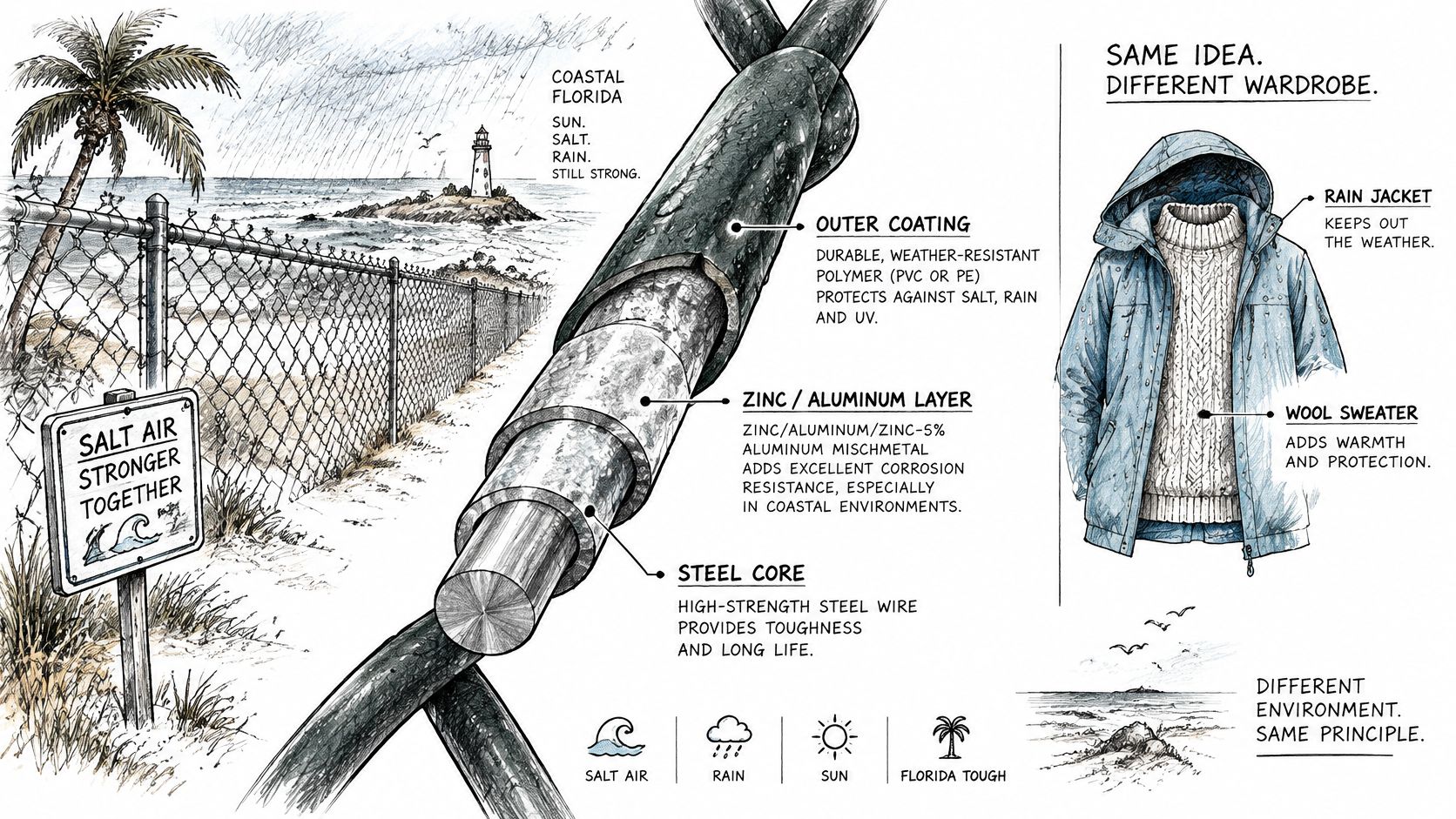
A coated wire works like a rain jacket over a wool sweater. The outer layer keeps much of the weather away, while the layer underneath continues providing protection when the jacket gets nicked. Neither layer substitutes for the structure beneath it.
The steel core supplies strength. Its metallic coating protects the steel, while the outer polymer adds a barrier against moisture and environmental exposure. Zinc provides sacrificial protection, but the underlying metallic coating still needs identification rather than being treated as interchangeable with every other metallic treatment.
What works in Florida, and what needs attention
The practical advantages are straightforward:
- Salt separation: Intact polymer keeps direct salt spray off the underlying metal.
- Flexibility: A suitable formulation accommodates movement without immediately splitting.
- Additional protection: The outer finish supplements metallic corrosion protection rather than replacing it.
The limitations deserve equal attention:
- Sunlight: Lower-grade polymers can degrade, fade, or chalk under prolonged UV exposure.
- Abrasive exposure: Windblown sand and repeated landscaping contact can wear the surface.
- Damaged edges: Cuts and scrapes create localized routes for moisture and salt.
- Surface temperature: Dark finishes become hot in direct sun, an important consideration beside regularly used gates.
What a coating test actually proves
The Master Halco Class 2b coated-wire specification lists ultimate elongation of 275% ± 5% and accelerated aging exposure of 1,500 hours at 145°F. The elongation result describes how far that specified polymer can stretch before rupture; it isn't a rating for the entire installed fence.
Accelerated aging is controlled laboratory exposure, not a conversion into years beside a Florida canal. It helps characterize the material, but it doesn't account for every installation scrape, irrigation pattern, salt deposit, or gate impact.
A useful submittal therefore identifies the actual product and its test documentation. The outer barrier remains effective only while its bond and vulnerable edges remain sound.
Where Rubber-Coated Chain Link Works Best
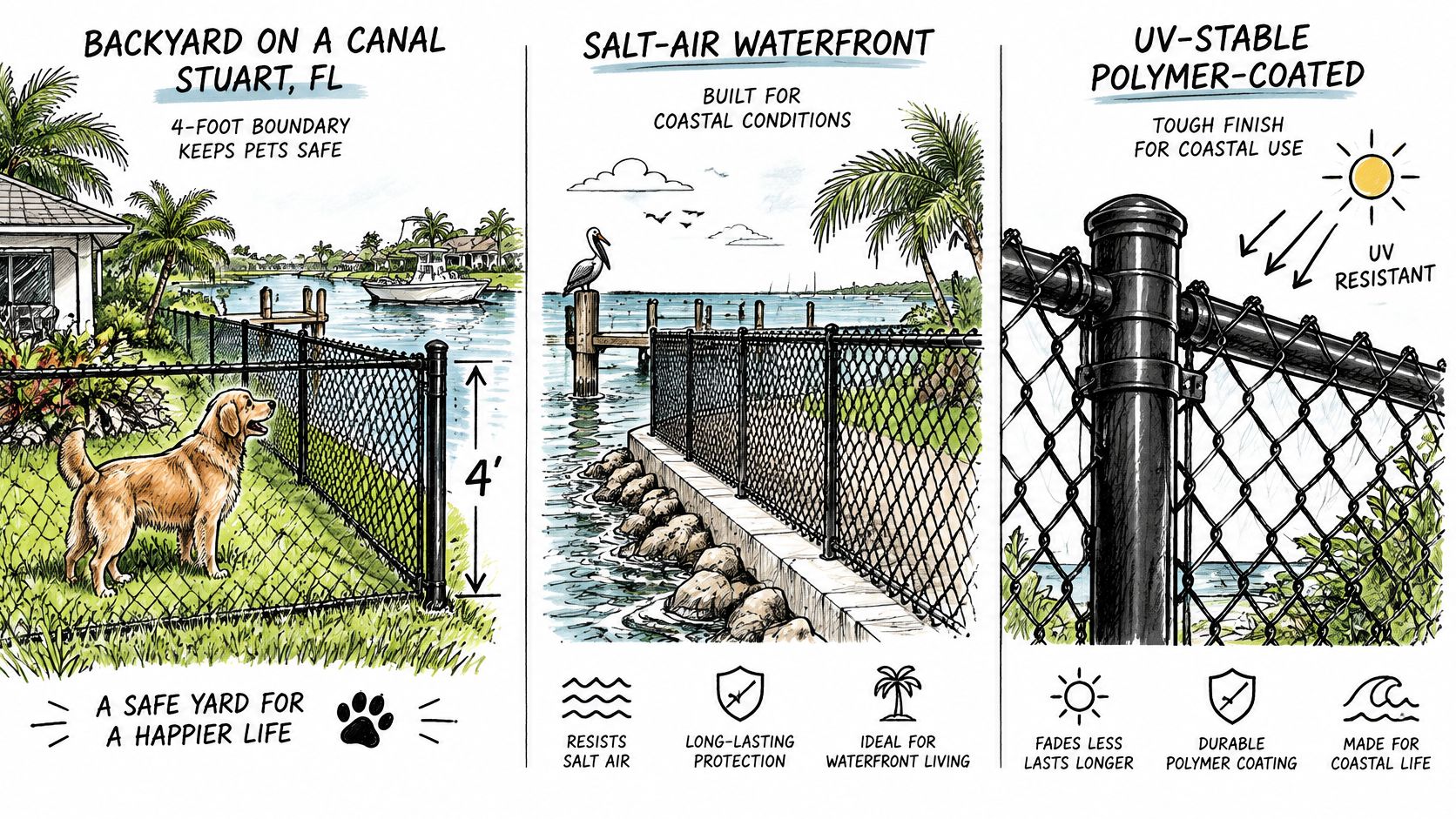
A canal-side backyard in Stuart is a sensible starting point. Consider a hypothetical boundary intended to contain a dog without blocking the water view: dark, UV-stabilized coated mesh can suit that purpose, provided the layout addresses the animal's behavior and the site's exposure.
The important details aren't cosmetic. The bottom needs to follow the grade without escape gaps, the gate needs to close securely, and landscaping equipment needs enough clearance to avoid repeatedly striking the fabric.
Different sites require different decisions
A pool perimeter changes the assignment from general containment to a regulated safety barrier. Coated chain link may be appropriate, but purchasing ordinary boundary mesh and adding a pool latch afterward isn't a reliable compliance strategy. The entire enclosure needs review before materials are ordered.
A tennis enclosure or backstop run needs attention to impact and abrasion. Ball contact, equipment handling, and repeated gate use make scuff resistance and repair access important. The coating doesn't determine post strength or replace structural design.
Commercial storage yards and HOA boundaries benefit from chain link's visibility and straightforward perimeter layout. Storage access may require a substantial gate opening, while an HOA may restrict material, color, placement, or screening. Approval needs to precede purchasing.
When another material makes more sense
For a decorative front boundary, aluminum may better suit the architecture. That's an appearance judgment, not evidence that coated chain link performs poorly.
For privacy, open mesh is the wrong starting assumption. Slats can add screening, but they also change how the fence receives wind, so the framework and site requirements need review before slats are added.
A useful decision screen asks:
- Purpose: Is the priority pet containment, pool safety, security, or appearance?
- Exposure: Will the fence receive direct salt spray, irrigation, or abrasive contact?
- Privacy: Is visibility desirable, or does the owner need screening?
- Restrictions: What do zoning, easements, pool requirements, and HOA documents permit?
Florida Pool Barrier Limits for Chain-Link Mesh
Florida pool barrier limits for chain-link fence
The mesh, public-pool, and access-gate limits below come from the Florida Building Code pool-barrier provisions; the residential height and barrier-separation requirements are stated in Florida's residential swimming-pool safety statute.
| Requirement | Limit | Notes |
|---|---|---|
| Maximum mesh opening | 2 1/4 in (57 mm) square | Standard chain-link mesh without slats |
| Mesh with slats at top or bottom | 1 3/4 in (44 mm) maximum opening | Slats must be fastened to reduce openings |
| Residential pool barrier height | At least 4 ft (48 in) on the outside | Measured from the outside ground level |
| Public pool barrier height | At least 48 in (1,219 mm) | Applies to public pools under the cited Florida Building Code provisions |
| Gate latch height | At least 54 in (1,372 mm) above the ground, or at least 3 in below the gate top | Use the applicable condition for the gate design, subject to departmental review |
| Gate construction | Self-closing, self-latching, lockable, at least 48 in high | Applies to dwelling, apartment, motel and hotel access gates under the cited provisions |
Check the enclosure as a safety system
The mesh row matters because a general-purpose fence opening isn't automatically suitable for a pool barrier. A product description that says pool fence doesn't replace a documented opening size.
The slat provision concerns reducing openings through properly fastened slats. Loose decorative inserts shouldn't be treated as a substitute for the specified arrangement.
Height needs checking from the approach side, including changes in grade. A nominal fabric height on an invoice doesn't establish the finished barrier height at every location.
Gate requirements also need their correct context. The cited public-pool provisions address particular access conditions; residential layouts require review under their applicable rules rather than borrowing an isolated latch dimension.
Check climbability and placement
A residential barrier must not contain gaps, openings, indentations, protrusions, or structural components that allow a young child to crawl under, squeeze through, or climb over it. Nearby equipment, changes in landscaping, and the way the enclosure meets a building deserve attention during plan review.
The barrier also needs sufficient separation from the water's edge so someone who penetrates it doesn't immediately fall into the pool. A rubber coating changes none of these safety obligations.
Pool-barrier approval concerns the finished enclosure, not just the mesh roll or the gate hardware package.
The chain-link fence around a pool guide provides additional planning context. Before ordering, the owner or installer should confirm dimensions, gate details, placement, and the currently adopted requirements with the local building department.
Cost Warranty and Lifetime Value
The lowest-priced coated mesh isn't automatically the lowest-cost fence. Installed cost includes the perimeter length, height, slope, soil conditions, removal, access, posts, gates, and permitting. A quote that describes only the fabric leaves too much of the actual project undefined.
A wide driveway gate can require more substantial supports and hardware than a pedestrian opening. Difficult digging, grade transitions, and old concrete removal can also change labor without changing the mesh product at all.
Compare the entire ownership cost
The Whole Building Design Guide identifies aluminum-coated steel fabric and PVC-coated zinc-coated steel fabric as the lowest-cost alternatives over a 30-year analysis period, while emphasizing corrosion resistance across vulnerable fence components. That finding supports a system-level comparison, not a promise that every coated product will be the least expensive choice at every property.
Consider competing proposals for a coastal storage yard. One names the mesh finish but leaves post treatment, gate hardware, and repair work unspecified; the other documents those components. The cheaper proposal may cost more after hardware replacement, coating repairs, and repeat labor.
Salt-exposed hinges, latches, and other moving parts deserve particular scrutiny. Their condition affects everyday operation, even when the surrounding mesh still looks acceptable.
Value test: Compare what each installed system includes before comparing its price per foot.
Read warranties as contracts, not lifespan predictions
Warranty paperwork should separate coating, fabric, framework, hardware, and installation labor. The owner needs to know who supplies replacement material, who pays removal and reinstallation, and what exclusions apply to coastal exposure, impact, or neglected damage.
A warranty isn't a guaranteed field service life. A long material term may provide limited financial help if labor, transport, and gate adjustments remain the owner's responsibility.
There isn't a universal installed price established for the informal rubber-coated product category. The chain-link installation cost-per-foot guide can help organize budgeting, but comparable itemized bids remain the useful purchasing tool.
End-of-life handling belongs in that comparison too. A local recycler should confirm whether it accepts polymer-coated steel, whether attachments need removal, and how rejected material must be disposed of.
The quote comparison should show:
- Materials: Mesh class, core wire, metallic protection, and framework coating.
- Access components: Gate frames, hinges, latches, and fasteners.
- Ownership obligations: Warranty exclusions, repair products, and replacement labor.
- Removal: Existing-fence disposal and eventual recycling options.
How to Install and Repair Coated Chain Link
Installation damage can undermine a well-selected coating before the fence enters service. The crew needs a confirmed material schedule, protected handling space, and a compatible repair product before opening the rolls.
Protect the finish throughout installation
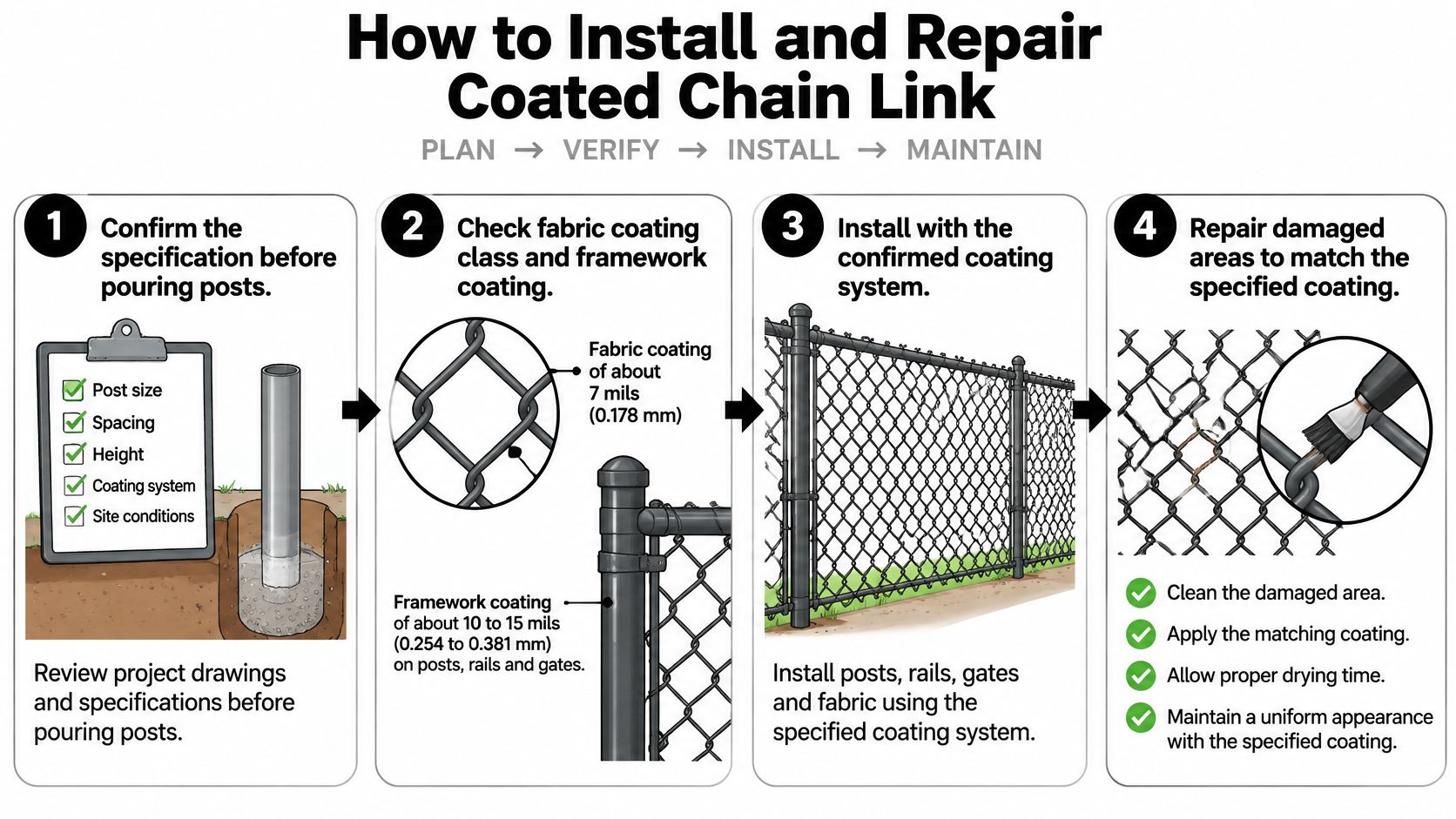
Confirm the specification before pouring posts. The published chain-link project specification provides approximately 7 mils (0.178 mm) for polymer-coated fabric and tension wire, and 10–15 mils (0.254–0.381 mm) for PVC or polyolefin framework coatings. These are specification examples, not universal thicknesses for every coating chemistry.
Set posts plumb and verify framework protection. Check the approved post, rail, and gate-frame schedule against delivered materials before concrete placement because buried or assembled components are harder to correct. Inspect cut pipe ends and attachment locations rather than judging only the visible finish.
Keep fabric off abrasive surfaces. Unroll onto clean protective sheeting or supports, not concrete or rough ground, because dragging scratches the polymer. Keep the roll away from excavated grit and sharp scrap.
Tension without cutting into the finish. Use the proper stretching equipment and secure ties snugly without crushing the coating. Excessive tie pressure creates localized damage at an attachment that otherwise looks complete.
Limit cuts and protect exposed ends. Cut wire only where the layout requires it, then treat exposed metal promptly with the manufacturer-compatible repair system. Ordinary color-matched spray paint isn't automatically a suitable corrosion repair.
Select compatible fasteners. Use stainless or appropriately protected hardware and isolation where the assembly requires it to limit dissimilar-metal corrosion. Stainless hardware still needs compatibility review; its name alone doesn't eliminate galvanic concerns.
Repair scratches before closing the job. Remove salt, dirt, and loose material, dry the surface, and lightly feather sound coating edges without enlarging the defect unnecessarily. Apply the specified repair coating and allow its required cure before rain, irrigation, or handling.
Maintain a visible inspection record
The chain-link fence installation guide helps organize the broader layout and installation sequence. Coating protection should remain a separate acceptance item rather than disappearing into a general completion check.
A practical maintenance routine is a six-month inspection, with additional checks after impacts or storms. This is a maintenance recommendation, not a manufacturer service-life claim.
- Adhesion: Look for lifted, split, or blistered polymer.
- Edges: Check cut wire, pipe ends, and scratches for red rust.
- Connections: Identify loose ties and abrasive contact points.
- Gates: Examine hinges and latches for staining, binding, or loose attachments.
Confirm the Spec Before You Sign
A quote is ready for approval when its material descriptions can be checked against the order. Missing information should produce a clarification, not an assumption that every dark-coated fence uses equivalent components.
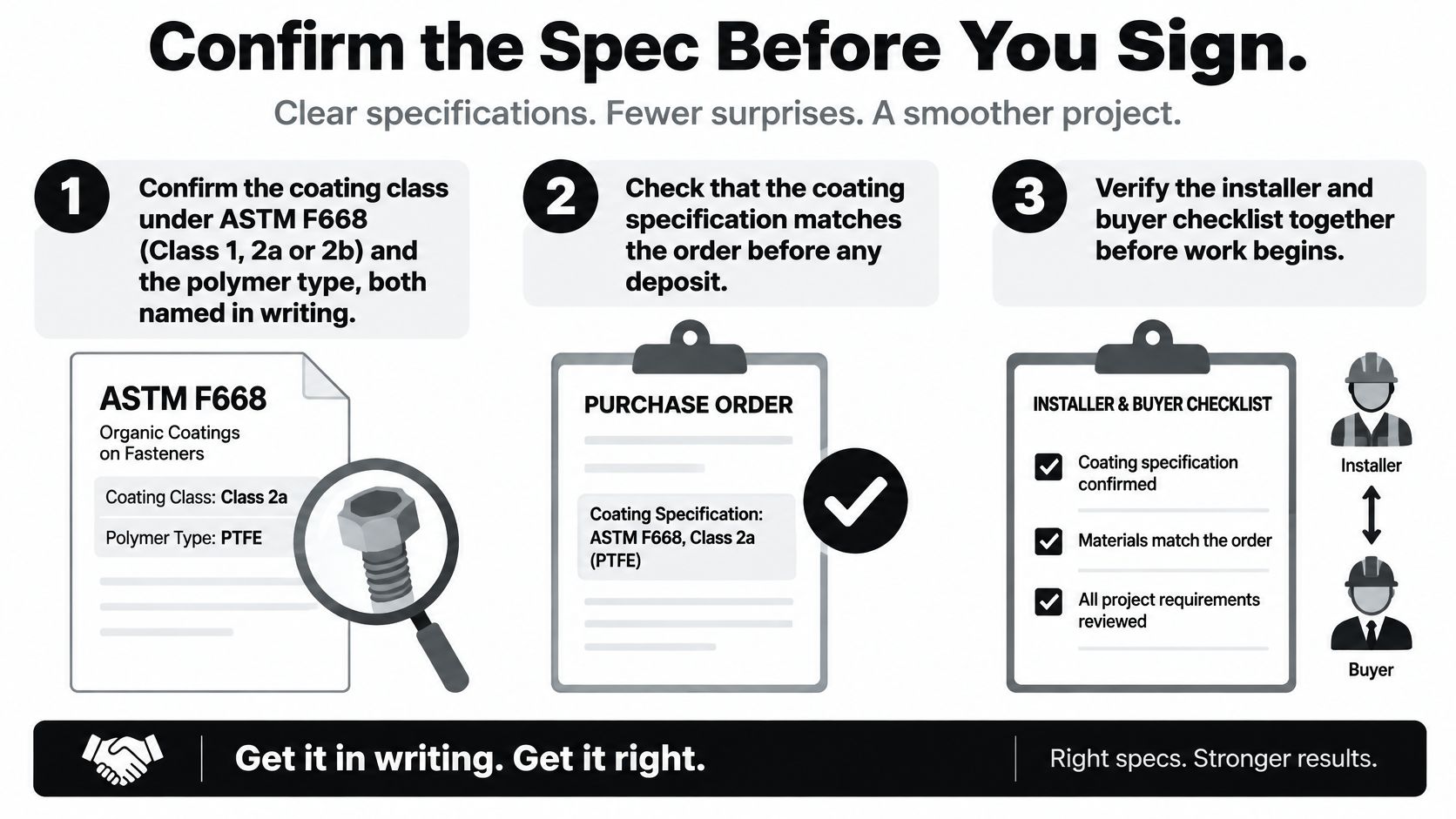
Buyer checklist for any rubber-coated chain link quote
| Check | What to Confirm | Why It Matters |
|---|---|---|
| Fabric coating class | The specified class and polymer named in writing | Bond construction affects resistance to separation after damage |
| Post and gate coating | Polymer type and thickness for the framework | Framework receives impact, clamp abrasion and cut-edge exposure |
| Gate hardware | Stainless or marine-grade hinges and latches | Moving components need particular attention in salt air |
| Wire size and mesh | Core wire gauge and opening written on the specification | Affects strength and pool-barrier compliance |
| Warranty coverage | Coating, fabric and labor terms listed separately | Identifies the actual coverage and responsible party |
| Repairability | Compatible repair coating available for the product | Makes localized scratch repair practical |
Make each approval a go-or-no-go decision
Color coordination is a separate check. ASTM F934 covers standard colors for polymer-coated fabric, tension wire, posts, rails, gate frames, and fittings. A coordinated appearance should be specified across those components, not assumed from a mesh sample.
Framework protection needs its own documentation. ASTM F1043 establishes steel framework strength and protective-coating requirements, classifies external coatings as Types A, B, and C and internal coatings as Types A, B, C, and D, and requires the specified zinc coating to be hot-dip applied. The quote should identify the applicable framework construction rather than merely saying coated posts.
For pool work, approval also requires a checked layout, appropriate mesh, compliant finished height, water-edge separation, and suitable self-closing, self-latching gates. HOA approval and written warranty terms belong in the file before a deposit, not after fabrication.
Put local pricing in its proper scope
AlliedFenceAndGate.com™ serves Martin and Palm Beach counties and lists vinyl-coated chain link at $22 to $35 per linear foot installed, with low-maintenance, 4-to-6-foot fencing and a stated lifespan of 20 to 30 years. Its chain-link offerings include 4-foot and 6-foot heights, with optional barbed wire for added security where permitted; those product descriptions aren't a site-specific coastal lifespan guarantee.
The final decision should compare the itemized proposal against the checklist line by line. An unexplained omission is a reason to clarify the proposal before signing.
#MartinCountyFL #PalmBeachCountyFL #StuartFL #PalmBeachFencing #ChainLinkFence #RubberCoatedChainLink #PoolFenceFlorida #FloridaPoolBarrier #CoastalFlorida #FloridaFencing #PoolSafety #FencingContractor
AlliedFenceAndGate.com™ offers coated chain-link installation and coordinates permitting, utility locates, and inspections across its Treasure Coast and northern Palm Beach County service area. Homeowners and property managers can visit AlliedFenceAndGate.com™ to use the online fence estimator for a ballpark figure, then send the itemized quote for review against the coating, framework, gate, and warranty checklist.
Related Fencing Services
Need a fence or gate on the Treasure Coast?
Licensed, insured, and bonded. Free estimates across Martin, St. Lucie, Indian River & Palm Beach counties.
Call (772) 530-3127