Chain Link Fence Around Pool: Florida Code Guide
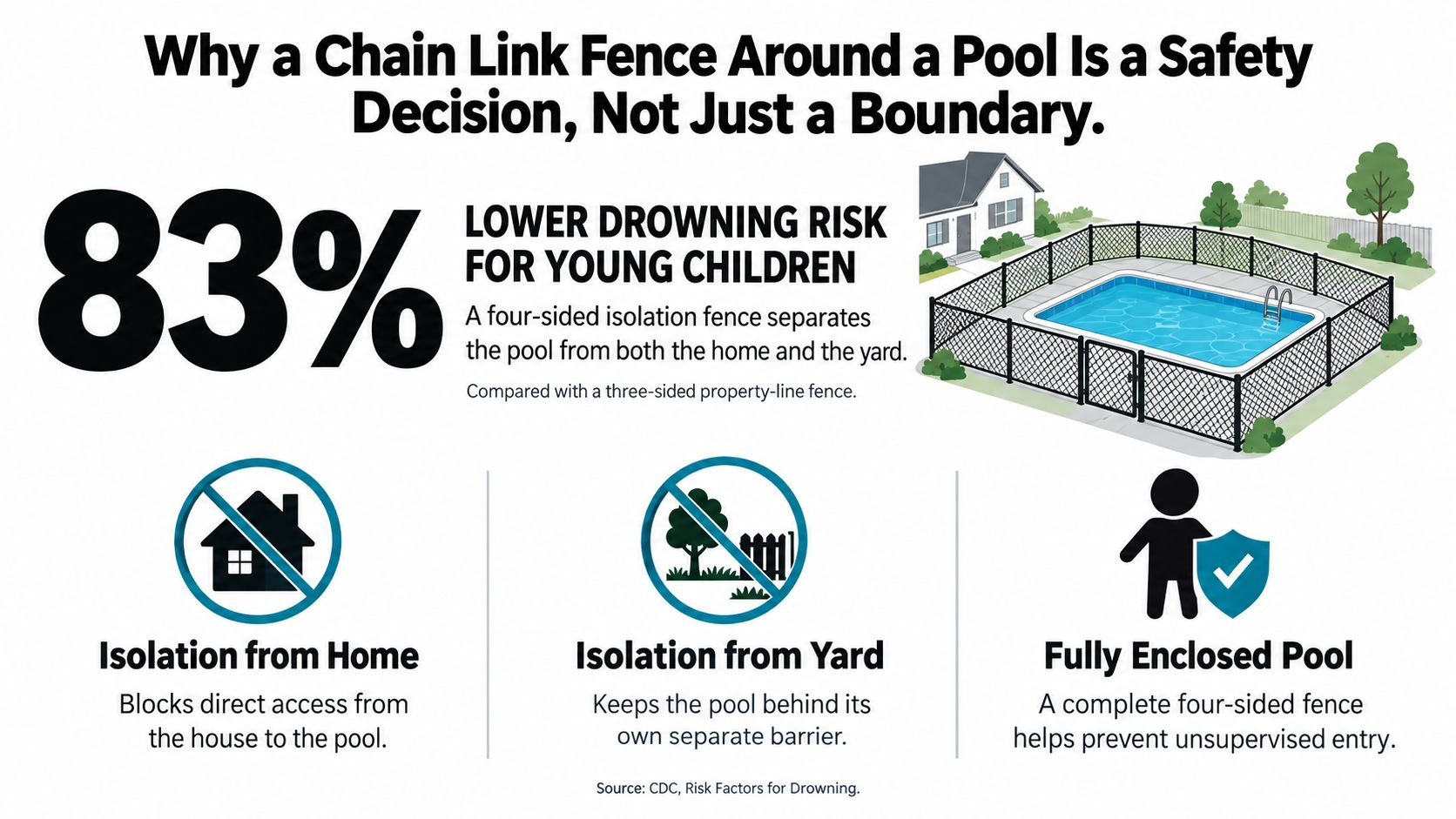
A four-sided isolation fence reduces a young child's drowning risk by 83% compared with three-sided fencing. A chain link fence around a pool can meet that safety standard when it forms a complete enclosure and its height, openings, bottom clearance, placement, and gate hardware are installed as one system.
That distinction matters in Florida. A pool fence is not a property-line marker or an attractive border around the deck. It must isolate the water from the house and the rest of the yard, then deny, delay, or detect unsupervised access when supervision lapses. Chain link deserves serious consideration because transparent mesh can preserve visibility while meeting the applicable barrier requirements, provided the installation is designed for pool use rather than copied from an ordinary yard fence.
Table of Contents
- Why a Chain Link Fence Around a Pool Is a Safety Decision, Not Just a Boundary
- Florida Building Code and Statute 515.29 Translated Into Chain Link Specs
- Self-Closing Self-Latching Gate Hardware That Passes Inspection
- Chain Link Compared With Other Pool Fence Materials
- Martin County and Palm Beach County Permit and Inspection Overlays
- Coastal Maintenance, Galvanization, and Privacy Upgrades
- Pulling It All Together and Getting the Job Done Right
Why a Chain Link Fence Around a Pool Is a Safety Decision, Not Just a Boundary
The 83% risk reduction comes from one design principle: four-sided isolation. The Centers for Disease Control and Prevention explains the safety value of four-sided pool fencing by distinguishing a complete enclosure from a three-sided barrier that leaves the pool connected to the home or the broader yard.
That distinction changes the first question on a pool job. It is not "Which fence looks right?" It is "Does every route to the water pass through a controlled barrier?" A property-line fence can leave a child with direct access from the back door. The house may form one side of the enclosure, but doors, windows, decks, furniture, and other access points can undermine the barrier. A dedicated pool enclosure creates a defined safety boundary independent of ordinary yard circulation.
What the barrier must accomplish
The CPSC reports that nearly 300 children under age 5 drown in swimming pools each year in the United States, according to its Consumer Product Safety Commission residential-pool guidance. That figure explains why a seemingly minor opening, a loose gate, or a climbable feature draws so much attention during inspection. Inspectors are not being picky. They are checking the exact failure paths that produce those numbers.
A compliant barrier has to address several failure paths at once:
- Passage: Openings must not allow a young child to squeeze through.
- Climbing: Mesh, rails, landscaping, equipment, and decorative features must not provide an easy route over the barrier.
- Gate operation: The gate must close and latch without relying on someone remembering to secure it.
- Placement: The enclosure must stand around the pool rather than leave the water exposed through a side route.
- Durability: Posts, fabric, hinges, and latches must keep performing after weather, settling, and daily use.
A tall fence is not automatically a safe fence. A child can pass through an oversized opening, use a damaged or slack section as a foothold, climb a feature beside the mesh, or push through a gate that doesn't latch. I have seen enclosures fail inspection on a single sagging gate while the rest of the run was flawless. The remaining decisions therefore become practical safety controls: height, mesh opening, bottom clearance, gate hardware, and distance from the water's edge.
Practical rule: Treat the fence, gate, grade, nearby structures, and landscaping as one pool-barrier system. An isolated defect can defeat an otherwise sound installation.
Florida Building Code and Statute 515.29 Translated Into Chain Link Specs
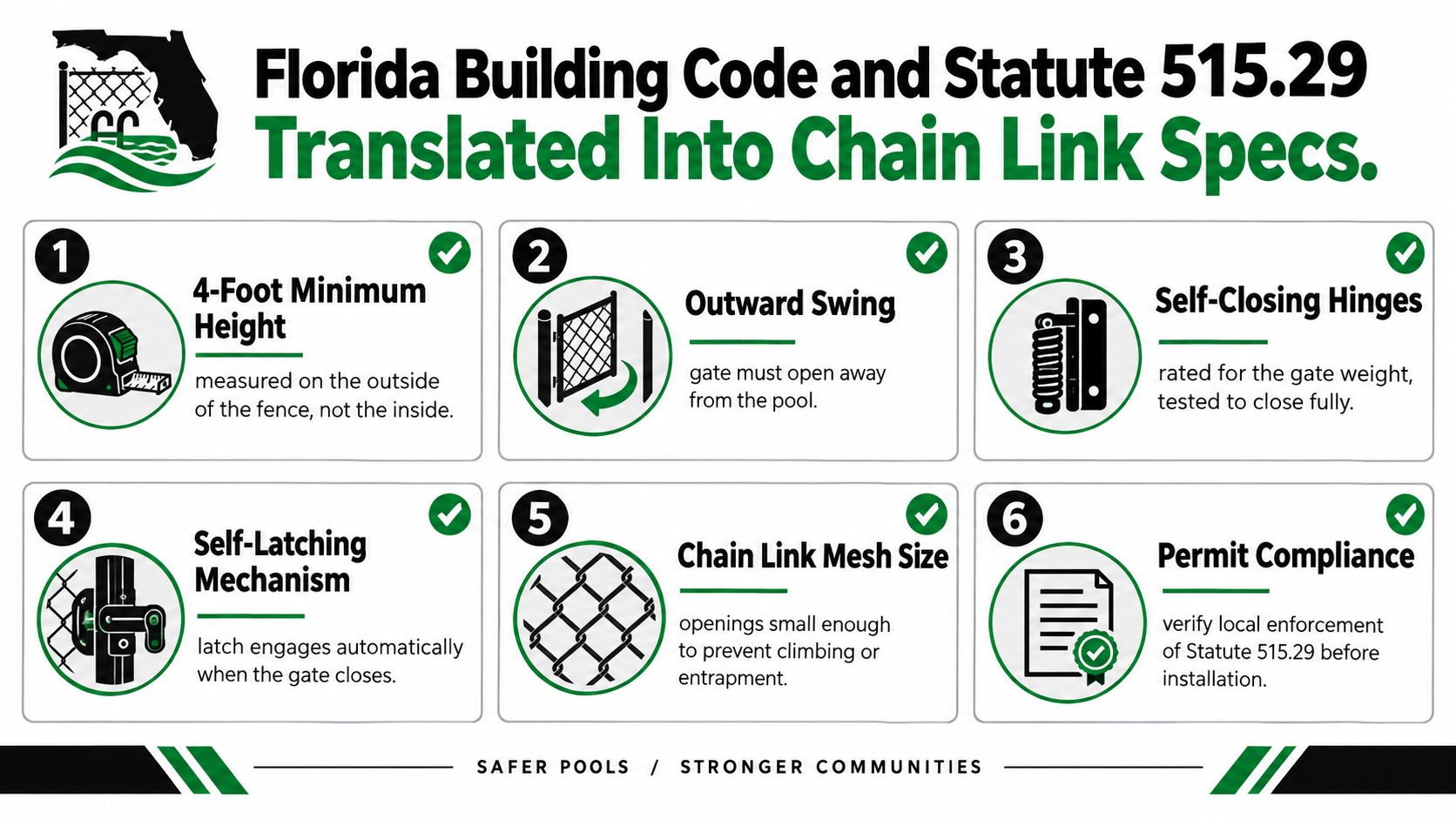
Florida Statute 515.29 establishes the statewide baseline. The Florida Legislature's residential pool-barrier statute requires a barrier to be at least 4 feet high when measured on the outside, to surround the pool perimeter, and to avoid gaps, openings, indentations, protrusions, or structural features that let a young child crawl underneath, squeeze through, or climb over it.
For chain link, those words translate into field measurements rather than a generic material choice. The fence must be laid out around the pool, not casually tied into a property enclosure that leaves the house functioning as an uncontrolled fourth side.
The measurements that control approval
Florida pool-barrier guidance specifies a 48-inch minimum height, a maximum 2-inch clearance between finished grade and the bottom of the barrier on the side facing away from the pool, and openings that can't pass a 4-inch-diameter sphere. The cited Florida material also allows chain-link mesh up to 2.25 inches square only when slats at the top or bottom reduce the openings to 1.75 inches or smaller. The Florida Building Commission pool-barrier outline provides these dimensional details.
The barrier should also be positioned at least 20 inches from the water's edge, subject to confirmation with the local building department. That setback affects more than the fence line. A contractor needs to evaluate coping, deck elevations, finished grade, retaining walls, landscaping, equipment, and any object a child could use to approach or climb the enclosure.
A chain link layout can fail even when the roll of fabric is labeled correctly. A slope may reduce the outside measurement at one post. Settled soil can create a bottom gap. A plant bed or raised deck can alter the effective grade. A gate may introduce a wider gap than the fence fabric. The site has to be measured after the relevant grading and pool-deck work is established.
Choosing mesh without creating a climbability problem
Standard diamond mesh provides footholds, so chain link is not automatically non-climbable because its openings pass the sphere test. The design must account for the local interpretation of climbability and for features on both sides of the barrier. Slats can reduce openings, but they must be installed without creating protrusions or convenient handholds.
Homeowners comparing residential fencing styles can review chain link fence height options, but pool work requires the local barrier requirements to control the final selection. The contractor should document the chosen mesh, any slat configuration, finished-grade measurements, and the location relative to the pool before setting posts.
Self-Closing Self-Latching Gate Hardware That Passes Inspection
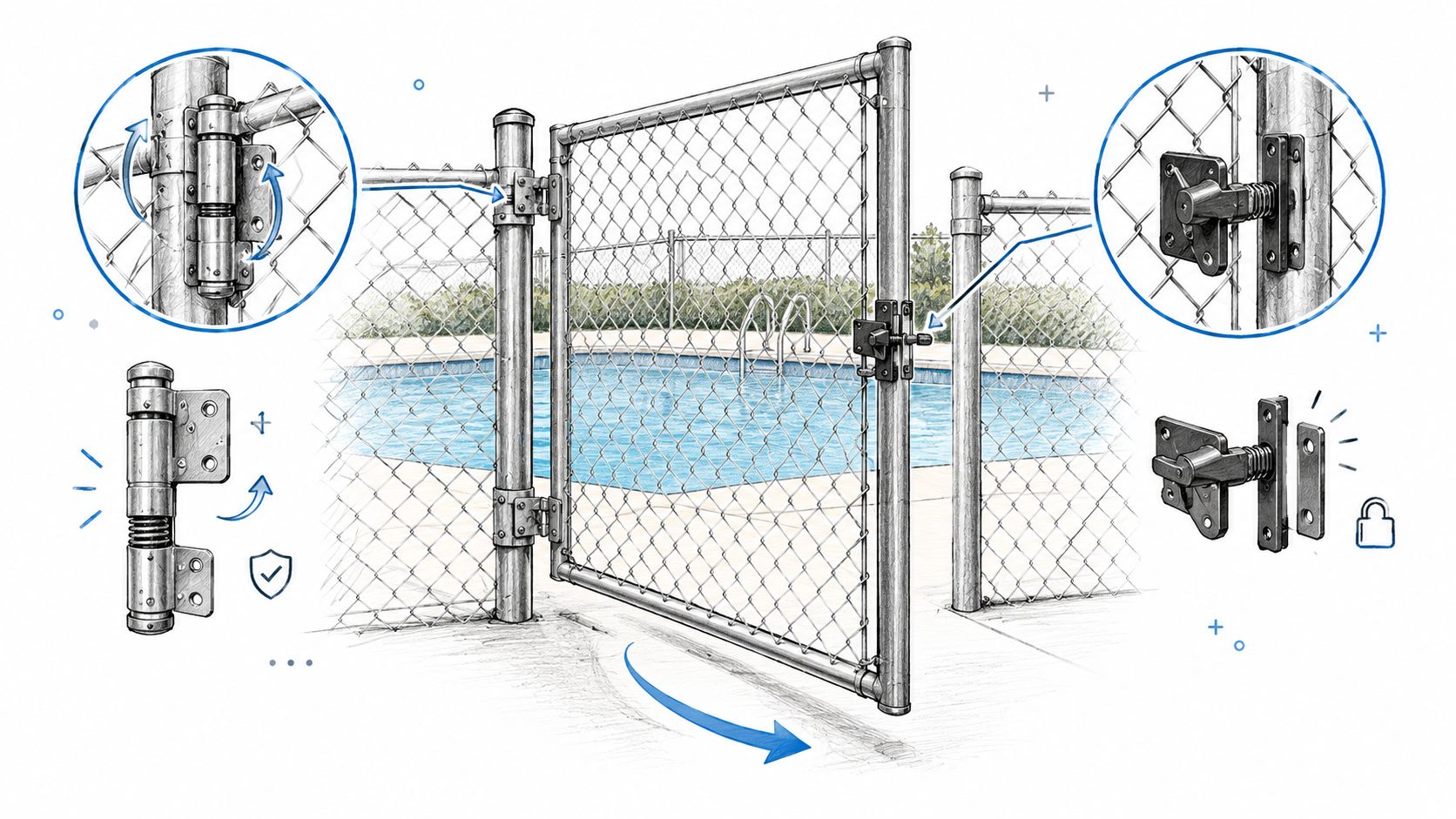
The gate is a separate subsystem, and it can compromise an otherwise compliant enclosure within seconds. A pool gate should open outward from the pool, close without manual assistance, and engage its latch automatically. A homeowner should not need to lift the gate, push it shut, or move a latch after each passage.
Hardware checks before inspection
Self-closing hinges need enough force for the gate's actual weight. They also have to overcome hinge friction, grade, and wind. A heavy chain-link gate can sag when its frame lacks adequate bracing, bringing the bottom corner too close to finished grade or changing the latch-side gap.
Before inspection, check the complete operating cycle:
- Swing direction: From the pool side, verify that the gate opens away from the water.
- Closing action: Release the gate from several open positions and confirm that it closes fully without assistance.
- Latch engagement: Make sure the latch catches automatically every time the gate closes.
- Frame alignment: Check for sag, twist, or a latch-side gap that changes as the gate moves.
- Obstructions: Remove props, stones, hoses, vegetation, and furniture that could hold the gate open.
- Latch access: Confirm that a young child cannot easily reach the release mechanism.
A gate may operate correctly after installation and fail later if a hinge binds, a post shifts, or the latch corrodes. Review the pool safety gate latch guidance before selecting hardware. The latch is part of the pool barrier, not just a convenience fitting.
The homeowner's release test
Open the gate, release it, and watch the entire cycle. The leaf should return to the closed position, the latch should engage, and the gate should not bounce back open. Repeat the test after normal weather exposure, not only immediately after installation.
Latch height and hardware details can vary by jurisdiction and barrier configuration. Confirm the final dimensions, latch location, and approved hardware with the local building department before ordering materials. Inspectors often test the installed gate itself, so a product label or contractor assurance cannot substitute for proper operation.
A gate that requires a hand to finish closing is not performing as a pool-barrier gate should.
Chain Link Compared With Other Pool Fence Materials
Chain link is a legitimate pool-barrier option when the design is treated as a safety system rather than an ordinary boundary fence. Properly installed, it provides four-sided isolation while preserving sightlines from the house and yard. That visibility can help adults monitor the water without turning the deck into a visually closed room.
The trade-offs are clear. Diamond mesh has a more industrial appearance than aluminum or vinyl, and its pattern can create footholds if the selected mesh and surrounding features do not meet barrier requirements. Coastal exposure also makes the steel coating, fittings, and installation details important. The following comparison uses Allied's published installed ranges, not a universal quote. Access, gates, grade changes, removal, permits, and finish choices can change the final price. See the published installed chain link price range for the source range.
Pool Fence Material Comparison
| Material | Typical Installed Cost (per ft) | Code Fit for Pool Barrier | Maintenance in Coastal FL |
|---|---|---|---|
| Chain link | $22–50 per ft | Can meet pool-barrier requirements when height, openings, clearance, placement, and gate hardware comply. Standard diamond mesh requires careful review for climbability. | Galvanized and vinyl-coated options respond differently to weather. Inspect mesh, posts, tension, and hardware for corrosion. |
| Aluminum | $28–150 per ft | Vertical-picket designs can meet sphere and height requirements when spacing and grade are correct. | Powder-coated aluminum generally avoids the rust concerns of exposed steel, but fasteners and gate hardware still need attention. |
| PVC or vinyl | $25–48 per ft | Solid panels can control openings effectively. The layout must still address climbable rails, gates, height, and clearance. | Low-maintenance panels can perform well, while hardware, posts, and storm exposure still require inspection. |
| Removable mesh panels | Varies by manufacturer and site | Can serve as a specialized pool barrier when the product and installation meet applicable requirements. Confirm local approval before selection. | Mesh, sleeves, connections, and removable hardware need routine checks, particularly after storms or deck work. |
Where chain link makes sense
Chain link suits properties where clear sightlines matter. Open mesh also avoids the solid wind face created by a privacy panel, although the fabric, posts, and fittings still need specifications suitable for coastal Florida.
Allied offers chain link in 4-foot and 6-foot heights, with optional barbed wire for security applications. Barbed wire is unsuitable for a residential pool barrier because it creates an injury hazard and does not replace compliant pool-barrier construction.
Aluminum generally offers the cleaner appearance and a stronger impression of permanence. Vinyl can provide privacy with less routine coating concern. Removable mesh may suit a deck where the owner needs a barrier that can be taken down under controlled conditions.
Chain link makes sense when visibility, practical installation, and a lower published starting range matter. Before choosing it, resolve the mesh opening, climbability, bottom clearance, coating, and hardware details with the building department and installer. The right comparison is not just material against material. It is whether the complete installed barrier will protect the pool and pass inspection.
Martin County and Palm Beach County Permit and Inspection Overlays
Statewide compliance is only the starting point on the Treasure Coast. County procedures determine whether the project is permitted, inspected, documented, and accepted as part of the pool enclosure.
Martin County requirements
Martin County's pool-enclosure requirements require a permit to construct a pool enclosure, whether or not the enclosure includes a slab. The county also states that fences used as pool barriers must be inspected by Martin County.
That means a homeowner shouldn't assume that an ordinary boundary-fence inspection covers the pool barrier. The enclosure needs to be presented as the safety component it is, with the layout and gate included in the review.
Martin County's materials also identify site conditions that can affect the project:
- Property-line height: A six-foot maximum applies to fences on the property line.
- Water conditions: Navigable waterways and wetlands may affect placement or approvals.
- Recorded constraints: Easements and property boundaries can restrict the fence route.
- Setbacks: The enclosure may need to respect applicable setbacks.
- Corner lots: Sight triangles can limit fence placement near the roadway.
A fence can satisfy the statewide barrier dimensions and still require a layout adjustment because of one of these local constraints. A site review should identify property lines, easements, drainage, water features, and road visibility before post locations are finalized.
Palm Beach County documentation
Palm Beach County requires a 360-degree barrier around a pool, spa, or hot tub. The county's pool-barrier requirements and process also require the owner and contractor to submit an Affidavit of Understanding acknowledging that requirement with the pool application.
An existing fence or wall can form part of the barrier only after Palm Beach County performs a code-compliance inspection before issuing the pool's Certificate of Completion. That is important when a homeowner wants to reuse a chain-link boundary fence instead of building a separate enclosure. The fence must be evaluated as part of the pool barrier, not accepted merely because it already exists.
A neighbor's wall or fence presents an ownership and documentation issue. Palm Beach County allows that arrangement only through a recorded Pool Barrier Agreement, signed by the property owner and recorded in the county's Official Records before submission.
County checkpoint: Permit documents, inspection records, ownership authorization, and the physical fence all need to agree. A compliant-looking fence can't cure missing documentation.
Coastal Maintenance, Galvanization, and Privacy Upgrades
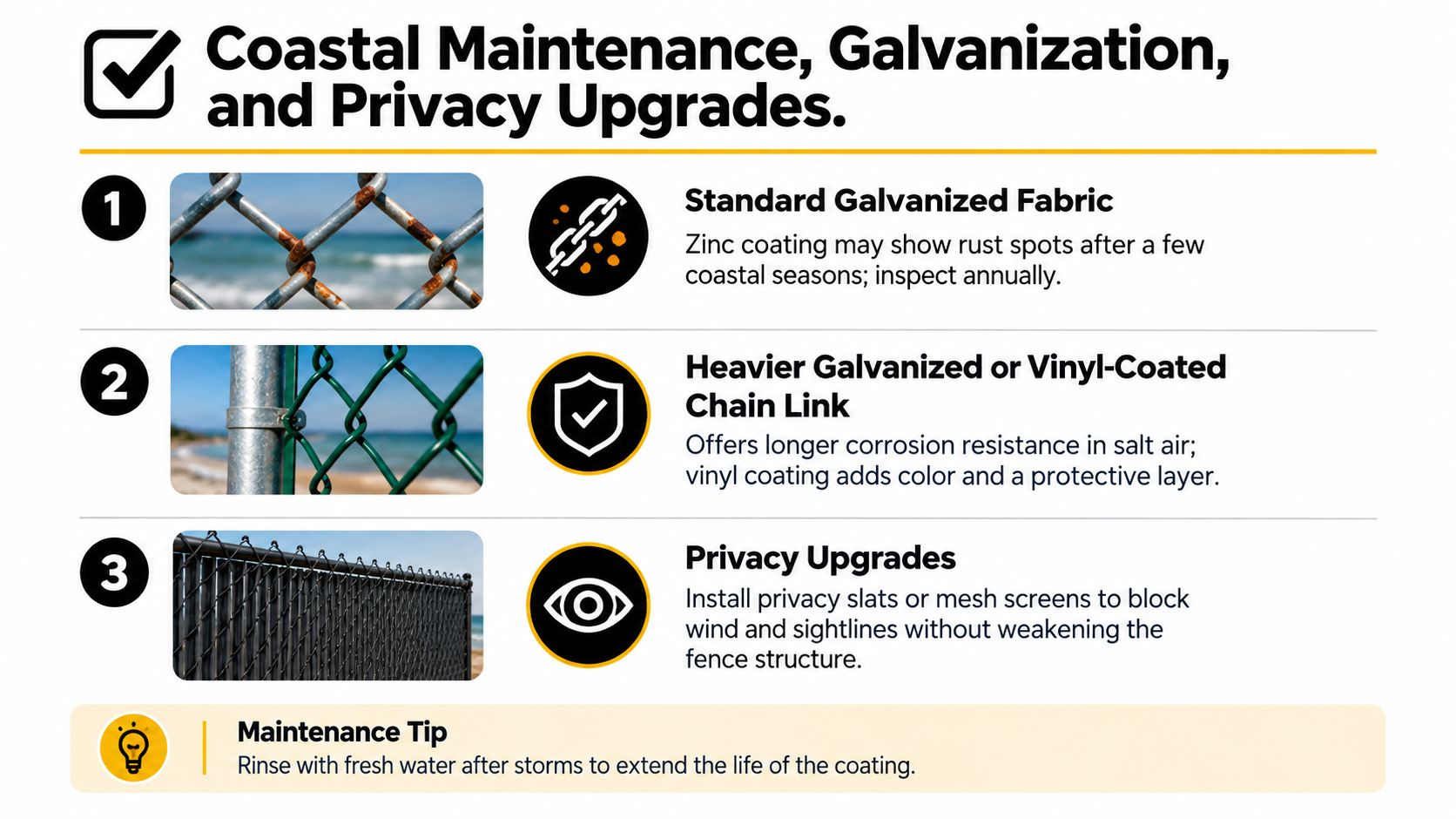
A chain link fence near the coast ages in layers. The mesh may continue looking sound while terminal posts, fittings, hinges, or latch components begin showing corrosion. Salt air, storm spray, pool chemicals, irrigation, and standing moisture all place different demands on the system.
A standard galvanized fabric can develop rust spots after coastal exposure, especially where the coating has been cut, scratched, or stressed. Heavier galvanized material or vinyl-coated chain link adds another level of protection and can provide a different appearance. The right specification depends on the site, exposure, budget, and the condition of the gate hardware.
What to inspect after installation
A property manager can use a short recurring inspection routine:
- Fabric: Look for rust, broken wires, loose tension, and distorted diamonds.
- Posts: Check terminal posts, line posts, caps, and connections for movement or corrosion.
- Bottom edge: Confirm that erosion or settling hasn't created an excessive clearance.
- Gate movement: Open and release the gate, then verify full closing and latch engagement.
- Hardware: Inspect hinges, latch components, fasteners, and protective coatings.
- Nearby growth: Trim vegetation that presses against the fence or interferes with the gate.
- After storms: Rinse exposed surfaces with fresh water and check for impact damage.
The vinyl-coated chain link information from Allied is relevant for homeowners weighing a protective coating against the more traditional galvanized appearance. Vinyl coating can add color and a protective layer, but it doesn't eliminate the need to inspect the structure beneath it.
Privacy without creating a code problem
Privacy slats and mesh screens can reduce sightlines, but they shouldn't be added casually to an approved barrier. Where Florida's cited chain-link allowance applies, slats at the top or bottom must reduce openings to 1.75 inches or smaller. The completed installation must still avoid climbable protrusions, loose components, and gate interference.
A privacy insert also changes wind loading. The contractor should check post size, frame bracing, fabric tension, and gate hardware rather than treating slats as a cosmetic add-on. Homeowners seeking full privacy may prefer Allied's cedar board-on-board wood option, while properties requiring accessible circulation can also need ADA handrails, ramp railings, stair handrails, or a fabricated pool safety gate.
Pulling It All Together and Getting the Job Done Right
A successful chain link fence around pool project follows a deliberate sequence:
- Define the isolation boundary. Keep the enclosure independent from uncontrolled routes through the home and yard.
- Confirm the measurements. Use the applicable height, opening, bottom-clearance, and water-edge requirements.
- Design the gate as a safety device. Specify outward swing, self-closing hinges, automatic latching, proper bracing, and child-resistant latch access.
- Select the material for the site. Balance visibility, appearance, coastal exposure, maintenance, and budget.
- Apply the county overlay. Verify Martin County or Palm Beach County permits, affidavits, inspections, agreements, setbacks, and property conditions.
- Plan maintenance. Give the owner or property manager a schedule for fabric, posts, grade, hinges, and latch checks.
A licensed, insured, and bonded contractor can also manage permitting, 811 utility locates, Notice of Commencement, and inspection coordination as part of the installation process. AlliedFenceAndGate.com™ provides those project services alongside chain link, aluminum, PVC/vinyl, wood fencing, pool safety gates, and ADA-compliant railings across Florida's Treasure Coast and northern Palm Beach County.
Before any post is set, the homeowner should confirm the exact barrier layout and gate hardware list with the local building department. That step protects the installation from avoidable corrections and keeps the fence functioning as a complete pool safety system rather than an ordinary boundary.
AlliedFenceAndGate.com™ can assess a pool enclosure site, specify chain link or another suitable barrier material, and coordinate permitting, utility locates, and inspection requirements. Visit AlliedFenceAndGate.com™ to discuss a code-aware pool fence and gate installation for a Martin County, Palm Beach County, or Treasure Coast property.
#MartinCountyFencing #PalmBeachCountyFencing #TreasureCoastFencing #StuartFencing #JensenBeachFencing #PalmCityFencing #PortStLucieFencing #JupiterFencing #PalmBeachFencing #PoolFencing #ChainLinkFence #ChainLinkPoolFence #PoolSafetyGate #FloridaFencing #FloridaPoolBarrier #FenceContractor #PoolEnclosure #CoastalFencing
Related Fencing Services
Need a fence or gate on the Treasure Coast?
Licensed, insured, and bonded. Free estimates across Martin, St. Lucie, Indian River & Palm Beach counties.
Call (772) 530-3127