Wire Fence Repairs: A Florida Homeowner's Guide
A storm cleared overnight, the dog's testing a sagging corner, and a limb is resting on wire that was tight last week. That's how most wire fence repairs start in Florida, not as a planned project but as a gap that won't wait. The expensive mistake is buying fabric before checking whether the posts, braces and hardware can still hold tension.
Table of Contents
- Diagnose the Damage Before You Buy Anything
- Tools, Materials and Permits to Sort Out First
- Patch or Replace Rusted Sections on Florida Coastal Fences
- How to Repair a Broken Run of Wire Fabric
- Replacing Posts and Rails Without Losing Alignment
- Cost and Time Estimates by Repair
- Decide Whether to Repair It Yourself or Call a Pro
Diagnose the Damage Before You Buy Anything
Walk the full run after any storm or impact, not just the visible break. The NRCS fence standard pairs a 20-year design life with at least annual inspection, event-driven inspections after storms, and faster follow-up where flooding, trees, livestock pressure or heavy vegetation increase risk. Weather, vegetation, erosion and animal or human access points are the recurring causes, so checks near trees, gates and low spots matter most.
Six defects to flag on the walk
Flag each defect with tape across a test stretch, then count affected bays and posts. A bay is the span between posts, and its condition decides the repair, not the single broken strand.
- Sagging strands: Push mid-span. Wire that moves easily has lost tension or stretched.
- Broken or torn wire: Note clean breaks versus fabric that's ripped across several diamonds.
- Leaning posts: Push at chest height. Movement at grade means the anchor, not the wire, failed first.
- Loose ties and staples: Missing fasteners let woven wire or chain link shift under load.
- Rust and flaking: Separate light surface color from pitting, holes and thinning metal.
- Gate drop: Open, close and latch it. A frame that drags points to hinges or a moving gate post.
Sorting rule: Put every defect into patch, reset or rebuild before pricing materials. Tensioning against a weak post deforms the whole bay.
| Symptom | Likely cause | Repair type | Skill level |
|---|---|---|---|
| Sagging strands between posts | Loose tension or stretched wire | Retension wire | Basic |
| Broken wire or torn fabric | Storm limb, animal or impact | Splice or fabric patch | Basic to moderate |
| Leaning line or corner post | Soil washout, rot or frost heave | Reset or replace post and anchor | Moderate |
| Loose or missing ties and staples | Wear and vibration | Re-tie or re-staple | Basic |
| Rust holes or flaking coating | Salt exposure or dissimilar metals | Assess; replace if section loss | Moderate |
| Gate sagging or not latching | Loose hinge or dropped frame | Hinge or latch repair | Moderate |
| Run down over several bays | Major storm or fallen tree | Full section rebuild | Professional |
A sag or loose tie is usually a one-afternoon retension or re-tie. Broken wire needs a splice or panel patch, while a leaning post changes the sequence completely because the anchor gets fixed before any wire work.
If three or more consecutive bays are damaged, or corner and end posts move, piecemeal patches stop making sense. Plan a rebuild of that run and photograph each flagged bay before dismantling anything.
Tools, Materials and Permits to Sort Out First
Gather the kit before releasing tension. Most stalled wire fence repairs stop at the same point, with wire cut and no stretcher, splice sleeve or matching fabric on hand.
Kit by job
| Repair | Core tools | Core materials | Key check |
|---|---|---|---|
| Retension sagging wire | Fence stretcher or come-along, pliers | Wire strainer clamps, tie wire | Tighten in small increments |
| Splice broken wire | Splicing tool, wire cutters | Matching gauge wire, splice sleeve | Match gauge and coating |
| Replace chain link fabric | Fence stretcher, bolt cutters | Matching fabric, tension bands, hog rings | Match mesh height and gauge |
| Reset a leaning post | Post driver or auger, level, tamping bar | Replacement post, compacted fill or concrete | Hole at least 6 inches wider than post; backfill in layers no thicker than 4 inches |
| Replace rusted hardware | Wrench set, drill | Stainless or hot-dip galvanized hardware | Avoid mixing incompatible metals |
| Repair a gate | Level, socket set, shims | Hinges, latch, hardware | Check hinge alignment before tightening |
Retensioning needs a fence stretcher or come-along, pliers and strainer clamps. Splicing needs matching gauge wire, sleeves sized for that gauge and proper cutters, while fabric work adds bolt cutters, tension bands and tie wire.
Post work adds a level, driver or auger and tamping bar. Cheap or mismatched fasteners are false economy on the coast, since they'll be the first parts to fail after the mesh looks new.
Paperwork and safety checks
Call 811 at least two full business days before digging to set or pull a post. Check HOA architectural guidelines before changing height or fabric style, and confirm local rules through the fence permit requirements guide and the county building department.
Wear gloves and eye protection and never stand in line with wire under tension. Release tension slowly, coil cut pieces immediately and drop broken wire and hardware into a bucket so sharp ends don't injure people, animals or mower tires.
Patch or Replace Rusted Sections on Florida Coastal Fences
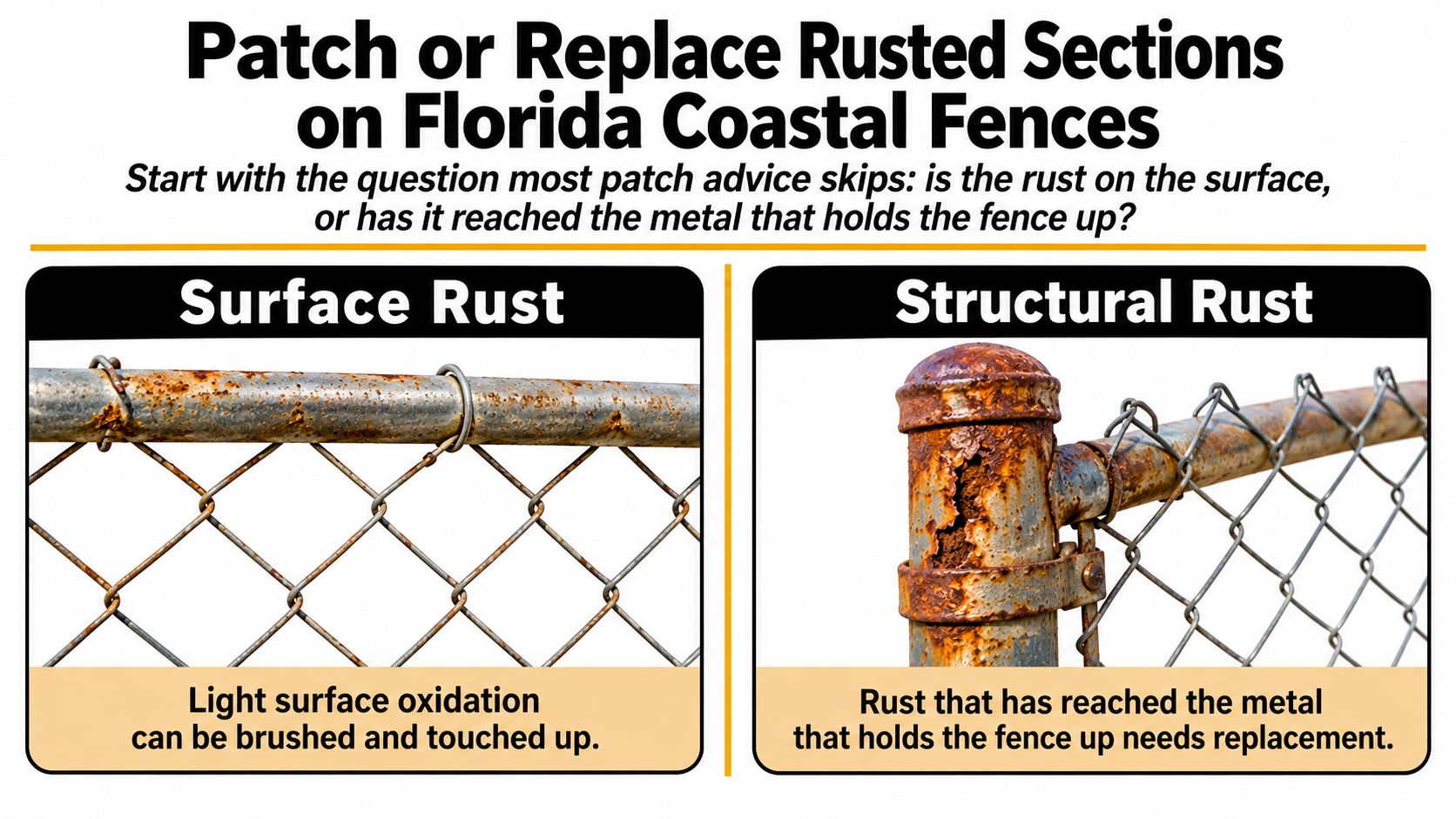
Start with one question. Is the rust sitting on the coating, or has it eaten into the metal that holds the fence up?
A U.S. Army engineering report states that standard galvanized chain-link fencing, including PVC-coated products, can experience severe corrosion in warm, humid, chloride-rich coastal locations in as little as five years. Paint doesn't restore lost section, and a bright new panel bolted to corroded posts only preserves a failing system.
Inspect components separately
Check mesh, posts at grade, tension bands, fittings, rails, welds and footings as separate parts. A post top can look clean while the base is heavily pitted under mulch or wet vegetation. Light oxidation brushes off and takes a zinc-rich touch-up, but holes, flaking that exposes thin metal, cracked welds or a post that moves are replacement calls.
The cheapest immediate repair can be the least economical option when corrosion has migrated into posts or connectors.
| Condition | Evidence on site | Action |
|---|---|---|
| Surface oxidation | Light powder, coating intact | Clean and touch up with zinc-rich primer |
| Coating breakdown | Flaking, pitting not through the metal | Wire brush, recoat, isolate dissimilar metals |
| Section loss at fittings | Holes or thinning at tension bands | Replace fittings with stainless or hot-dip galvanized parts |
| Post corrosion at grade | Post moves, base rotted or pitted | Replace post and footing |
| Rail or weld failure | Cracked weld or separated rail | Replace the component; do not weld over unknown history |
| Widespread mesh rust | Most of the fabric perforated | Replace the full run |
Use stainless or thicker hot-dip galvanized connectors and fasteners, and isolate dissimilar metals with a non-conductive barrier where they meet. Mixing plain steel screws into galvanized or aluminum parts speeds galvanic corrosion and stains the repair within a season.
For salt-exposed homes in Martin and Palm Beach counties, a mesh splice is reasonable only when posts and fittings are sound. If the table puts posts or connectors in replacement territory, reject the cheap patch early and price the structural work instead.
How to Repair a Broken Run of Wire Fabric
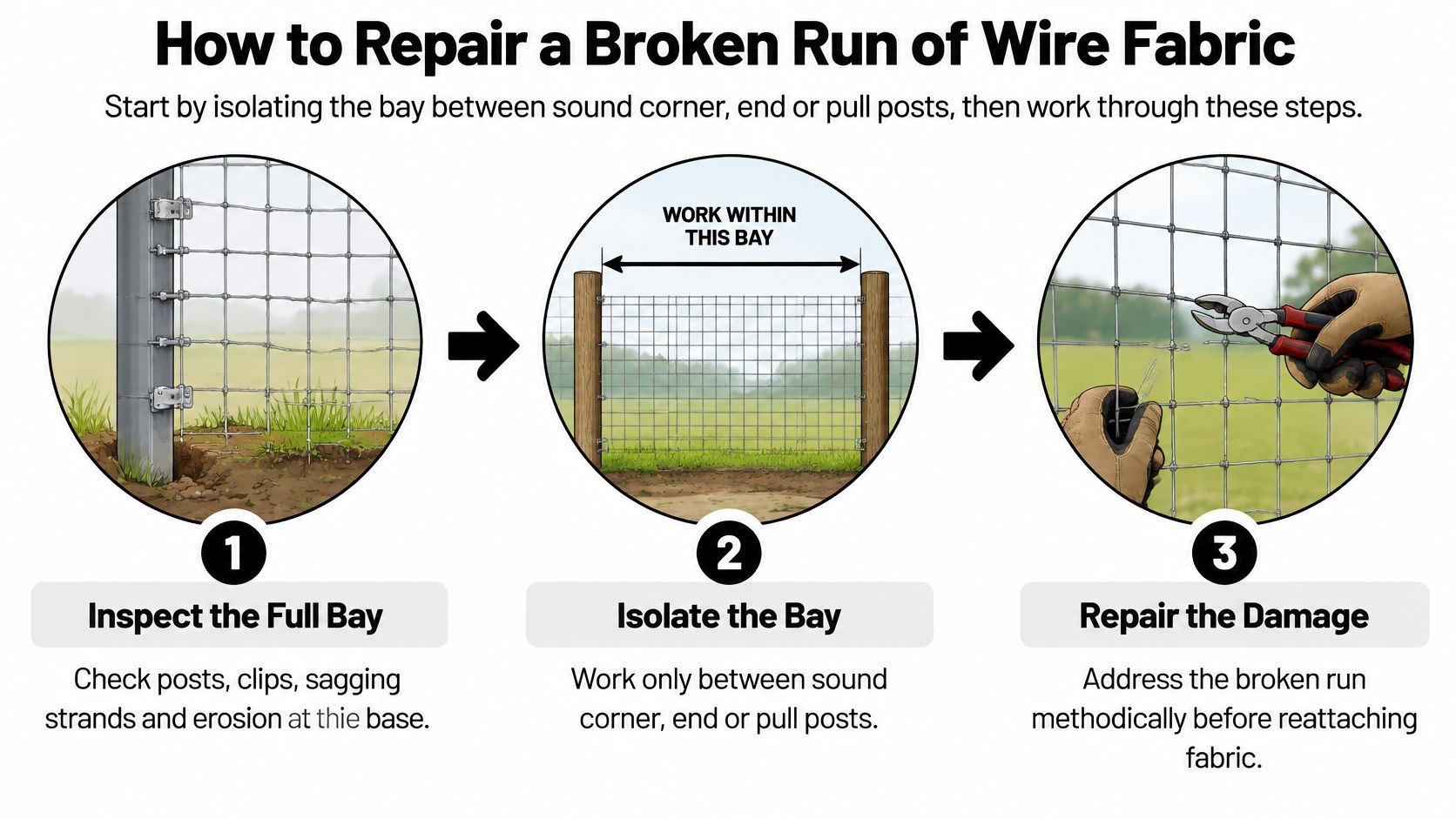
Isolate the damaged bay between sound corner, end or pull posts before cutting. The USDA field fence specifications call for no fewer than three tight wraps at end, corner, and pull posts, a detail that matters because a loose wrap lets the whole repair creep.
Work the bay in order
- Inspect the full bay: Check posts, anchors, clips, sagging strands and erosion at the base. A hidden lean will pull a new splice out of line.
- Replace unstable posts first: Don't tension against a weak anchor. It worsens deformation and can shift the brace assembly.
- Cut out damage cleanly: Use cutters rated for the wire, such as Knipex high-strength wire rope cutters, so ends aren't crushed or frayed. Remove bent wire back to straight, sound material.
- Install a properly sized splice: Use a Western Union splice or a manufacturer-approved sleeve with the correct tool. A sleeve sized for a different gauge is a common slip and will creep under load.
- Wrap at the anchor post: Make at least one complete wrap, use three tight wraps at end, corner and pull posts, then twist the free end tightly back onto the stretched wire.
- Fasten to line posts: On wood, drive staples diagonally with the grain on alternate horizontal strands. Staple snug enough to hold, not so tight it pinches or cuts the wire.
- Retension progressively: Pull from the brace assembly outward in small increments. Stop when mesh follows the terrain without bellying, then recheck alignment and gate clearance.
Standard woven-wire spacing and embedment also explain repeat failures. When spans are stretched too far or posts sit shallow, new wire inherits the old geometry problem and sags again despite a sound splice.
Chain link variation
Chain link uses tension bars, tension bands and hog rings instead of staples. Match fabric height, mesh size, gauge and coating before ordering, and check the guide to chain-link fencing rolls when sizing replacement material. Weave out the damaged vertical strand, weave in the patch section, reattach tension bands, then stretch from the terminal post outward until diamonds look even without distorting.
Don't over-tension to chase a drum-tight look. Fabric pulled until diamonds narrow puts constant load on terminal posts and pops ties at line posts.
Wildlife and livestock check
On rural runs, don't return every wire to its old height by reflex. The NRCS wildlife-friendly fences guidance recommends increasing separation between the top two wires to 12 inches to reduce entanglements. Clear sharp cut ends, preserve appropriate clearance under a bottom wire where small wildlife cross, and keep livestock containment as the deciding purpose.
Walk the bay again the next day. A splice that has slipped, staples that have loosened or a post that has rotated shows up quickly once the repair settles.
Replacing Posts and Rails Without Losing Alignment
A post that moves at grade gets replaced, not patched. The NRCS Fence-Wire specification requires postholes at least 6 inches larger than the post dimension and earth backfill tamped in layers no thicker than 4 inches, which is why dumped soil fails so fast.
Reset sequence
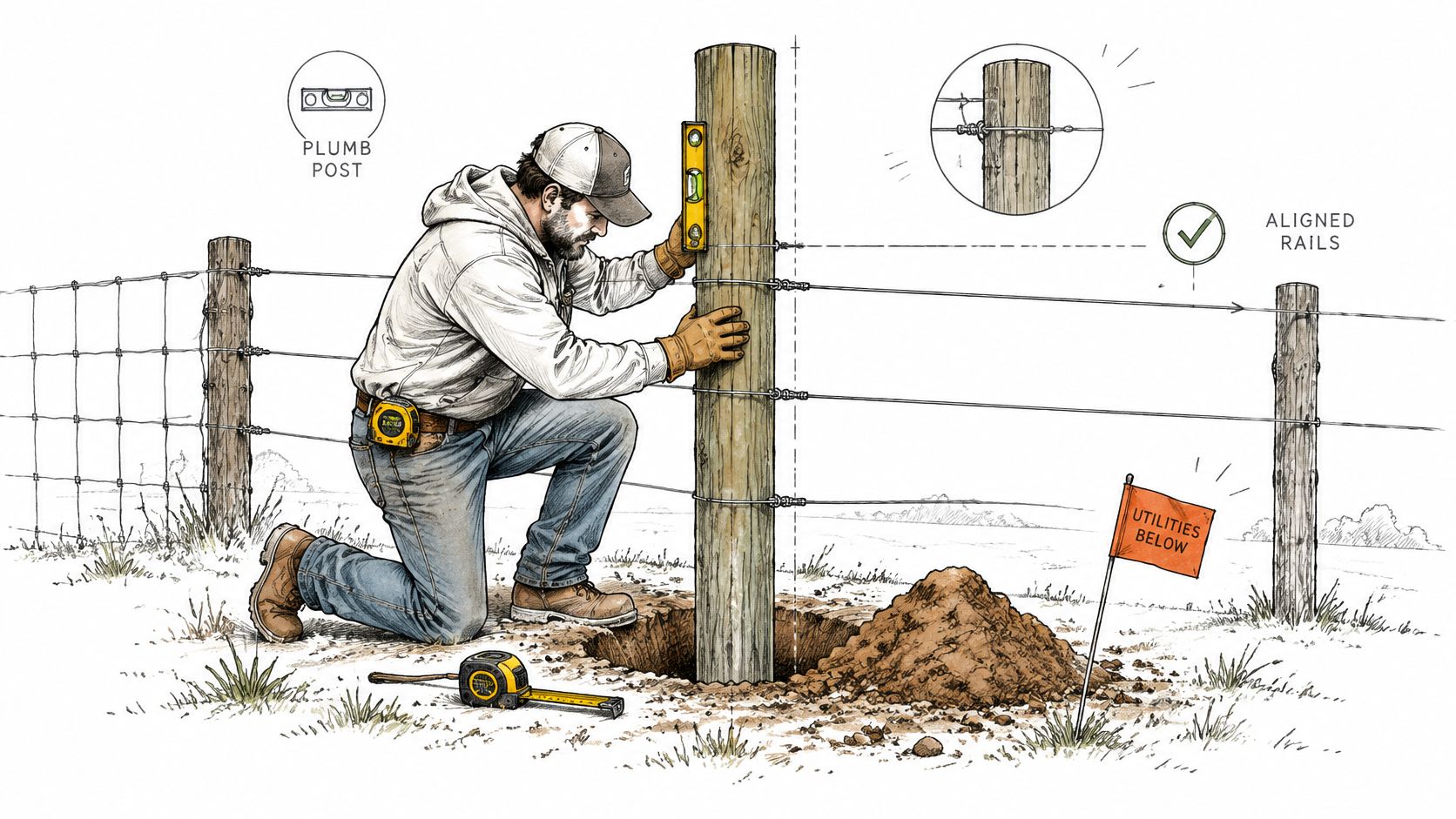
- Confirm locates: Verify the 811 ticket is complete and look for overhead lines before digging or driving.
- Inspect the old base: Remove loose soil and check for rot, corrosion, washout or heave to confirm why it failed.
- Dig wide enough: Size the hole at least 6 inches wider than the post so tamping or concrete can surround it evenly.
- Set plumb and brace: Hold the post on the string line, check two faces with a level and brace it before backfilling.
- Backfill in lifts: Tamp layers no thicker than 4 inches. Loose dumped soil settles into a hollow and the post leans again within a season.
- Reconnect strands independently: Restore original heights in sequence. At steel or concrete line posts, use two turns of 14-gauge galvanized wire or manufacturer clips.
- Align rails and document: Check top rail or bottom members, replace heavily corroded fasteners, then record plumbness, tension, splice integrity, mesh clearance and gate operation.
Terminal and gate posts carry more load than line posts. The chain-link fence post guide helps distinguish those roles, but on site the rule stays simple. A leaning gate post gets reset before the gate is rehung, never shimmed straight at the hinges.
Gate and pool barrier checkpoints
Square the frame, hinges and latch before final tightening. For pool barriers, the Florida pool barrier provisions require a barrier at least 48 inches high from the side facing away from the pool, with openings that do not allow passage of a 4-inch-diameter sphere. A lower replacement panel, missing fabric or widened gap underneath can fail inspection even when the repair looks tidy.
Gate rules are just as specific. The Florida Building Code pool syllabus requires access gates to be self-closing and self-latching and swing outward away from the pool, with no opening larger than one-half inch within 18 inches of the release mechanism. Replacing a latch while leaving nearby mesh gaps still leaves the repair noncompliant.
Check the fence again after the next storm. Fresh backfill, new splices and rehung gates all reveal movement early, while corrections are still small.
Cost and Time Estimates by Repair
Use these planning allowances to budget, then confirm them against local quotes because fabric gauge, access and post condition change the price quickly. They're working examples for wire fence repairs, not substitutes for a site walk.
- Retension one sagging bay: One to two hours, with materials under $100 for clamps and ties.
- Single wire splice: About one hour, with a sleeve or splice kit at roughly $20 to $60.
- Replace one chain-link fabric panel: Three to five hours, and roughly $150 to $400 in fabric, bands and hog rings.
- Reset one leaning post: Two to four hours, plus post and fill or concrete, often $60 to $150 per post.
- Full section rebuild: Priced by linear foot after a site walk, based on post count, gates and utility coordination.
Add the two full business days for an 811 locate to any digging job. Build in a follow-up walk after the next storm, since a cheap first pass that needs a second trip isn't cheap.
Decide Whether to Repair It Yourself or Call a Pro
Keep the job in-house when damage covers one or two bays, posts are sound and corrosion hasn't reached load-bearing parts. Retensioning, re-tying, a clean splice and a fabric patch on a straight run sit comfortably in that category.
Call a licensed, insured contractor when posts fail across a run, storm damage takes a whole side, gate hinges or operators have failed, a pool barrier must pass inspection, or HOA and permit rules apply. Fence repair at AlliedFenceAndGate.com covers storm damage, leaning posts, broken rails, rusted hardware and gate operators, with repairs for fences of any material and brand in its service area and service for all major gate operator brands.
Before calling: Photograph each flagged defect, note bay numbers from the walk, and keep the 811 ticket number ready if digging is planned.
Ask for license and insurance proof plus a written scope naming post work, splices, tensioning and hardware. When comparing paperwork, GetBill's guide to quotes and estimates explains why a fixed quote and a rough estimate don't offer the same protection. Gate repair diagnosis at AlliedFenceAndGate.com is done on-site, and the business carries common replacement parts for gate repairs, which avoids a diagnostic visit followed by a long parts delay.
#WireFenceRepairs #FloridaFenceRepair #TreasureCoastFencing #MartinCounty #PalmBeachCounty #StuartFL #JupiterFL #ChainLinkFence #FarmFencing #WeldedWireFence #CoastalFencing #FloridaHOA #811Locate #StormDamageFence #FenceContractor #FenceRepair
For storm-damaged wire, leaning posts, rusted hardware or a gate that no longer latches, AlliedFenceAndGate.com™ can walk the run, sort patch from rebuild and quote repair or replacement for chain link, welded wire and farm fence across the Treasure Coast. Visit AlliedFenceAndGate.com™ to request an assessment before a small gap becomes a full perimeter failure.
Related Fencing Services
Need a fence or gate on the Treasure Coast?
Licensed, insured, and bonded. Free estimates across Martin, St. Lucie, Indian River & Palm Beach counties.
Call (772) 530-3127