Pool Safety Fence Caps: Materials, Code Rules and Costs

A cracked cap on a pool fence post looks like a two minute cosmetic fix, and that's exactly how most homeowners treat it. The replacement gets ordered by post size and color, pushed on by hand, and forgotten. On a pool barrier, that approach misses the question. Pool safety fence caps sit at the top of a system that's judged on height, climbability, openings, and gate action, so a cap that overhangs, wobbles, or interferes with a latch isn't just untidy. It's part of the barrier geometry an inspector evaluates.
Table of Contents
- What Pool Safety Fence Caps Do and Where They Fit
- Florida Code Rules That Affect Caps
- Aluminum, Vinyl, Plastic and Stainless Steel Caps Compared
- How to Install Caps Without Weakening the Barrier
- Inspection and Maintenance Checklist for Caps
- What Caps and Cap Replacement Typically Cost
- Hire a Licensed Contractor for Your Pool Fence
What Pool Safety Fence Caps Do and Where They Fit
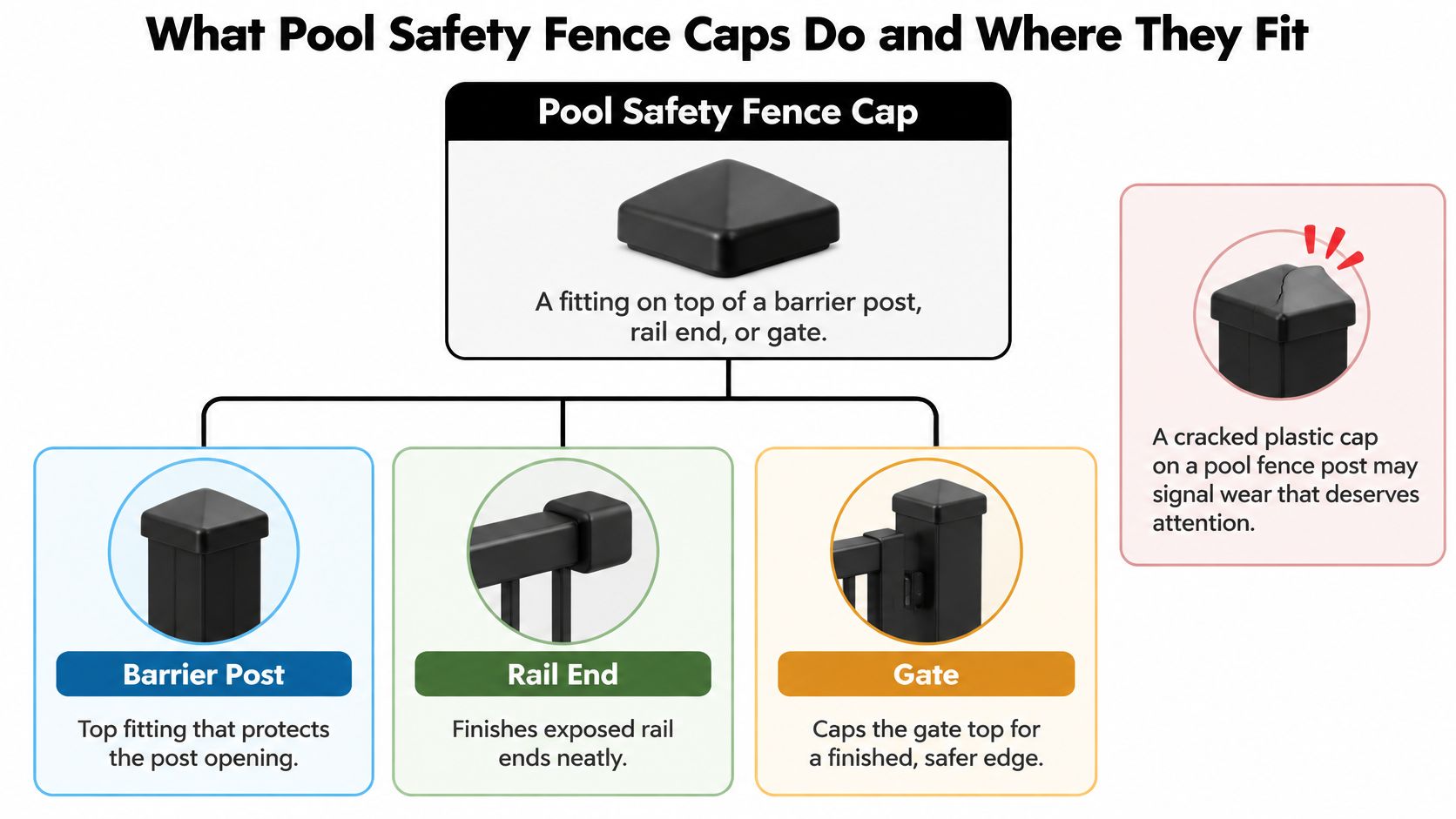
Pool safety fence caps are fittings that close the top of a barrier post, rail end, or gate post, and yes, they can affect barrier safety. A cap's shape, fit, and attachment can change whether a child can grip, climb, or pull at the top of the fence. Treat the cap as one component of a complete barrier, not as decoration bolted on after the safety decisions are made.
Say a homeowner finds a cracked plastic cap split along one corner after a summer of sun. The post underneath is open, rain can sit inside a hollow post, and the broken edge is sharp enough to catch skin. Worse, the loose piece lifts off with light finger pressure. That cap now presents three problems at once, water entry, a sharp edge, and a removable small part a child could pull free.
Why Shape Matters More Than Fit on the Post
Florida Statutes Section 515.29 evaluates the entire barrier for gaps, indentations, protrusions, or structural components that could let a young child crawl under, squeeze through, or climb over it. That language reaches the cap directly. An overhanging lip creates an underside ledge for fingers. A projecting pyramid or ball gives a hand something to wrap around. A loose snap-on piece can shift and open a gap that wasn't there on inspection day.
The homeowner question therefore isn't only what fits the post. It's whether the replacement changes climbability or the inspection outcome. A vendor label claiming pool code compliance doesn't answer that, because compliance belongs to the completed barrier, including how the cap relates to the climbable face.
Cap Styles and Their Climb Risk
| Cap style | Typical material | Climb risk | What to check |
|---|---|---|---|
| Flat post cap | Aluminum or vinyl | Low when flush and fixed | Flush fit, no gap, firm fastening |
| Pyramid or ball finial | Aluminum, vinyl or stone | Higher, can be gripped or stood on | Overhang and projection against the barrier profile |
| Loose snap-on cap | Plastic | Medium, can slip off or crack | Snug fit and no removable small part |
| Stainless steel cap | Stainless steel | Low when flush and fixed | Fastener heads and sharp edges |
A flat aluminum post cap that's flush and mechanically fixed is the straightforward option on most aluminum pool fences. Finials earn their place on garden fencing, but on a barrier they add projection exactly where a child reaching the top needs a grip. Snap-on plastic works only while it stays snug and intact, which Florida sun tends to shorten.
Three-question test: Is the cap flush with the post, is it fixed firmly, and can a child grip it or stand on it? Any wrong answer means the cap needs attention before the next swim, not at the next repaint.
Documenting cap style during permit and inspection reviews costs nothing and prevents arguments later. A photo of each cap type in place, matched to the post locations, shows the finished profile clearly.
Florida Code Rules That Affect Caps
Florida's starting point is simple. Florida Statutes Section 515.29 establishes a minimum outside barrier height of 4 feet for residential swimming pools, and the barrier may not contain gaps, openings, indentations, protrusions, or structural components that could let a young child crawl underneath, squeeze through, or climb over it. Height is measured on the outside face, the side a child approaches from, so grading changes and raised decking on that side matter.
A general yard fence counts as the pool barrier only when it sits on the pool perimeter and meets those requirements on its own. A property line fence that leaves a house door opening straight to the water doesn't become compliant because it looks substantial. The Florida pool fence requirements guide walks through how the perimeter layout is judged in practice.
Florida Barrier Requirements That Cap Work Must Respect
| Requirement | Florida rule | Why it matters for caps |
|---|---|---|
| Outside barrier height | At least 4 feet | A cap cannot make up for a short fence |
| Clearance under barrier | Typically 2 inches or less from finished grade on the outside | A cap should not change the bottom gap |
| Opening size | A 4-inch sphere must not pass through any gap | Gaps around caps and fittings count |
| Gate release height | At least 54 inches above the bottom of the gate, or unreachable from outside | A cap on the gate post must not block hinge travel or latch |
| Openings near gate release | No opening over 1/2 inch within 18 inches of the release | A loose or misaligned cap near the latch fails this rule |
| House door to pool | Self-closing, self-latching device with release at least 54 inches above the floor | Check the house door separately from the fence |
Each row ties back to cap decisions. A tall finial doesn't cure a short post, because the barrier height is the fence itself, not an ornament stacked on top. A cap that forms a horizontal ledge adds a climbing point the no-protrusion rule is written to prevent. Near the gate, a cap that rocks or sits crooked can open a gap within the protected zone around the release mechanism.
Inspectors review the completed barrier, not a parts list. They measure height, probe openings, cycle the gate, and look at the whole profile, caps included. A fence that passed with flat caps can draw questions after a homeowner swaps in decorative finials, even though the panels never changed.
The statute sets the state floor. Martin County and Palm Beach County building departments may apply additional requirements through local amendments and permit review, so the county's current checklist governs the job. Before ordering anything, measure the fence height outside, the clearance at grade, the gate release position, and any house door opening to the pool against the table. Caps come after those numbers check out.
Aluminum, Vinyl, Plastic and Stainless Steel Caps Compared
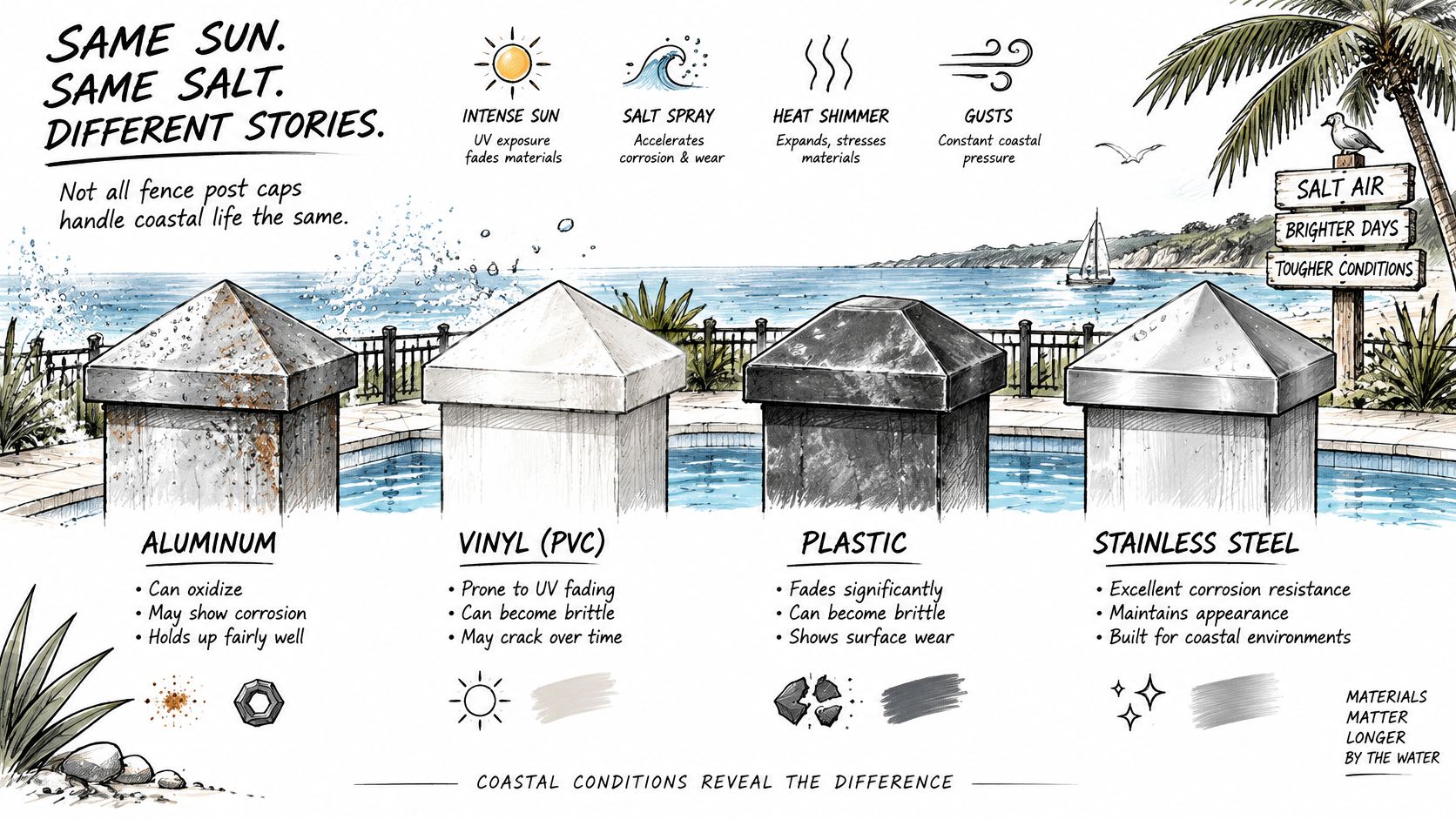
Coastal Florida is hard on exposed post tops. Salt-laden humidity settles on every horizontal surface, strong UV attacks polymers, heat cycling works fasteners loose, and storm winds test anything that isn't secured. A cap that performs fine inland can chalk, crack, or corrode its fasteners within a few seasons near the Treasure Coast shoreline.
Cap Materials for Coastal Florida Pools
| Material | Coastal Florida performance | Upkeep | Best fit |
|---|---|---|---|
| Aluminum | Rust-free when finished correctly; fasteners can corrode if metals differ | Rinse salt residue and check fasteners each year | Aluminum rail and picket pool fences |
| Vinyl (PVC) | Does not rust; can fade or crack under strong UV or hard impact | Wash and check for cracks after storms | Privacy and semi-privacy fences |
| Plastic | Does not rust; cheaper grades may become brittle in sun | Replace when brittle or faded | Budget or temporary post tops |
| Stainless steel | Grade 316 resists salt water better than grade 304 | Rinse salt residue and check fastener heads | Exposed posts close to the pool edge |
Aluminum is the default on aluminum pool fencing, and a properly finished cap won't rust. The weak point is the joint. Steel or zinc-plated fasteners driven into an aluminum post create dissimilar-metal contact, and salt moisture turns that contact into corrosion that stains and eventually loosens the cap. Matched aluminum or compatible stainless fasteners, seated without tearing the powder coat, prevent most of it.
Grades, UV, and the Details That Decide Lifespan
Stainless steel splits into two common grades. Grade 304 handles general outdoor exposure, while grade 316 contains added molybdenum that resists chloride pitting, which is why it's the usual specification near salt water and chlorinated pool splash. A 304 cap a few feet from a saltwater pool can tea-stain and pit around fastener heads while a 316 cap beside it stays clean.
Plastic caps cost the least and fail the soonest in sun. Cheap grades turn brittle, fade unevenly, and crack at the corners where they're pressed over the post. UV-stabilized plastic slows that considerably, so the specification on the packaging matters more than the color match. Vinyl caps don't rust and match PVC fencing cleanly, but they can crack under a hard impact, a ladder strike or wind-blown debris, and replacement color should match the fence run because faded and new vinyl side by side looks patchy.
Upkeep is light but not optional. A rinse-and-inspect routine, hosing salt residue off caps and post tops, then checking for white powder on aluminum, rust weep at fasteners, and hairline cracks in vinyl or plastic, catches deterioration while it's still a cap swap. The Florida fence products overview covers how these materials pair across full fence systems.
Choose a cap material that suits the fence post and the fastener metal, and never mix metals that corrode each other. The fastener choice quietly decides whether a good cap stays put.
How to Install Caps Without Weakening the Barrier
Installation is where a compliant fence becomes a noncompliant one. The CPSC pool barrier guidance identifies self-closing and self-latching gates as core protective measures, and Florida requires gates to open outward away from the pool with the release mechanism at least 54 inches above the bottom of the gate or otherwise unreachable from outside. A cap on a gate post that interferes with hinge travel, spring adjustment, or latch alignment undermines that protection every time the gate cycles.
The Installation Sequence
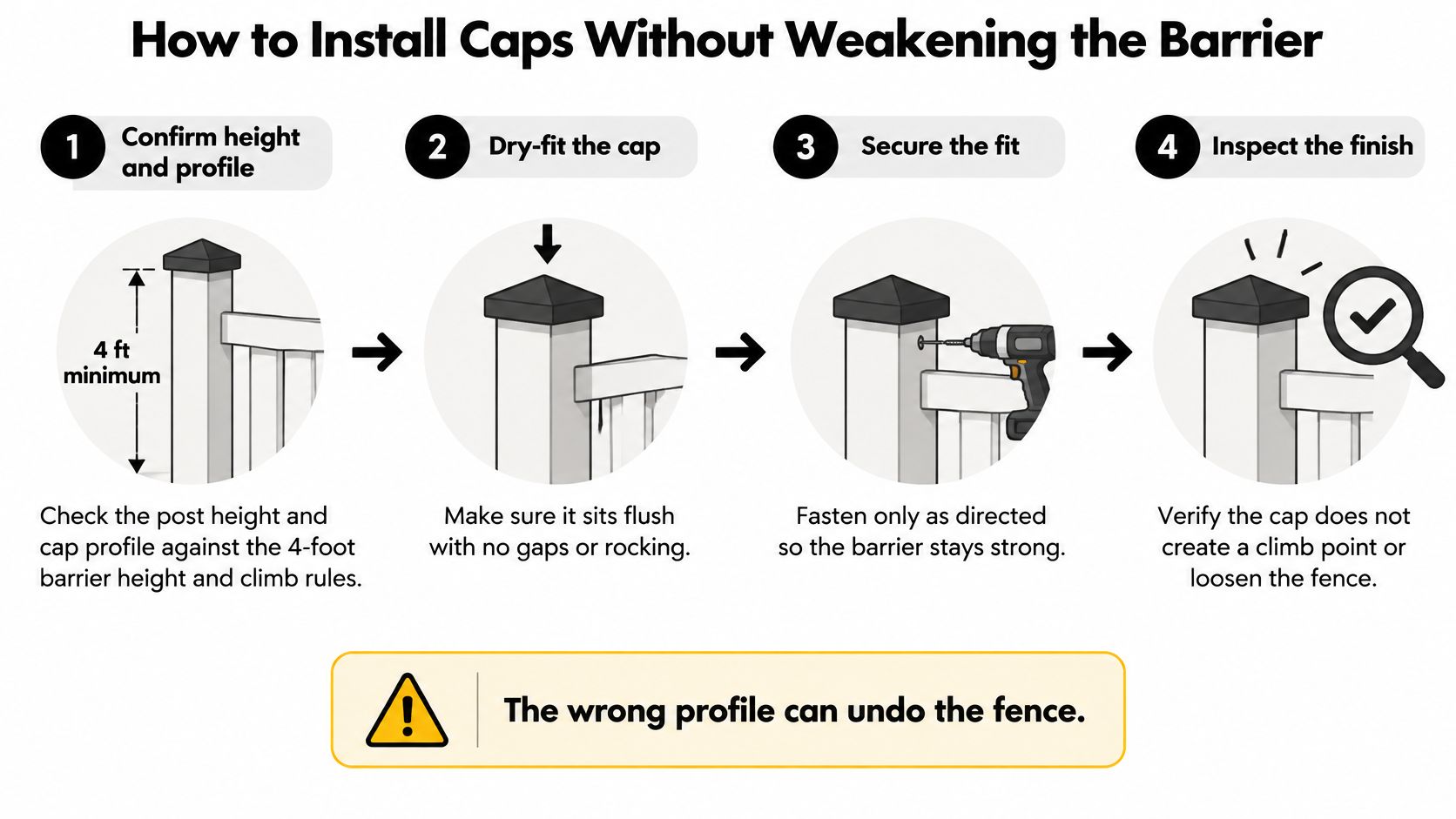
- Confirm height and profile: Measure post height against the barrier requirement and check the cap profile against the climb rules before anything is fastened. The common slip is ordering by post size alone and discovering the finial profile at the truck.
- Dry-fit every cap: Seat it fully and check for a flush fit with no ledge, gap, overhang, or rocking. A cap that rocks on a dry fit will work looser under wind and gate vibration.
- Fasten with matched hardware: Use corrosion-resistant fasteners matched to the post metal and drive them as the manufacturer directs. A cap pushed on rather than fastened is a cap waiting for the first storm.
- Seal the post top: Apply sealant or the manufacturer's bonding method to keep water out of hollow posts. Skipping this traps moisture that corrodes the post from inside, out of sight.
Gate posts get extra attention because they move. Steps five through eight separate a finished job from a callback.
- Check gate hardware clearance: Cycle the gate and confirm the cap doesn't rub the hinge, foul the spring, or shift latch alignment. A cap that kisses the latch on each swing will eventually loosen or knock the latch out of adjustment.
- Test self-closing action: Open the gate to every normal position, wide, halfway, barely ajar, release it, and confirm it closes and latches without help each time. Florida guidance permits no opening greater than 1/2 inch within 18 inches of the release mechanism, so check that zone with the gate latched.
- Run the sphere test: Pass a 4-inch test sphere around caps, posts, and fittings to confirm no gap accepts it. This catches the crooked cap that looks fine from the patio.
- Photograph the result: Record each cap type in place and the gate test so the permit and inspection file shows the finished condition.
A correct installation is easy to recognize. Caps sit flush and don't move under hand pressure, fastener heads are clean with no exposed sharp edges, and the gate closes and latches from any position. Nothing on the outside face offers a child's fingers or toes a purchase. If any element fails that description, the job isn't finished, regardless of how tidy it looks.
Inspection and Maintenance Checklist for Caps
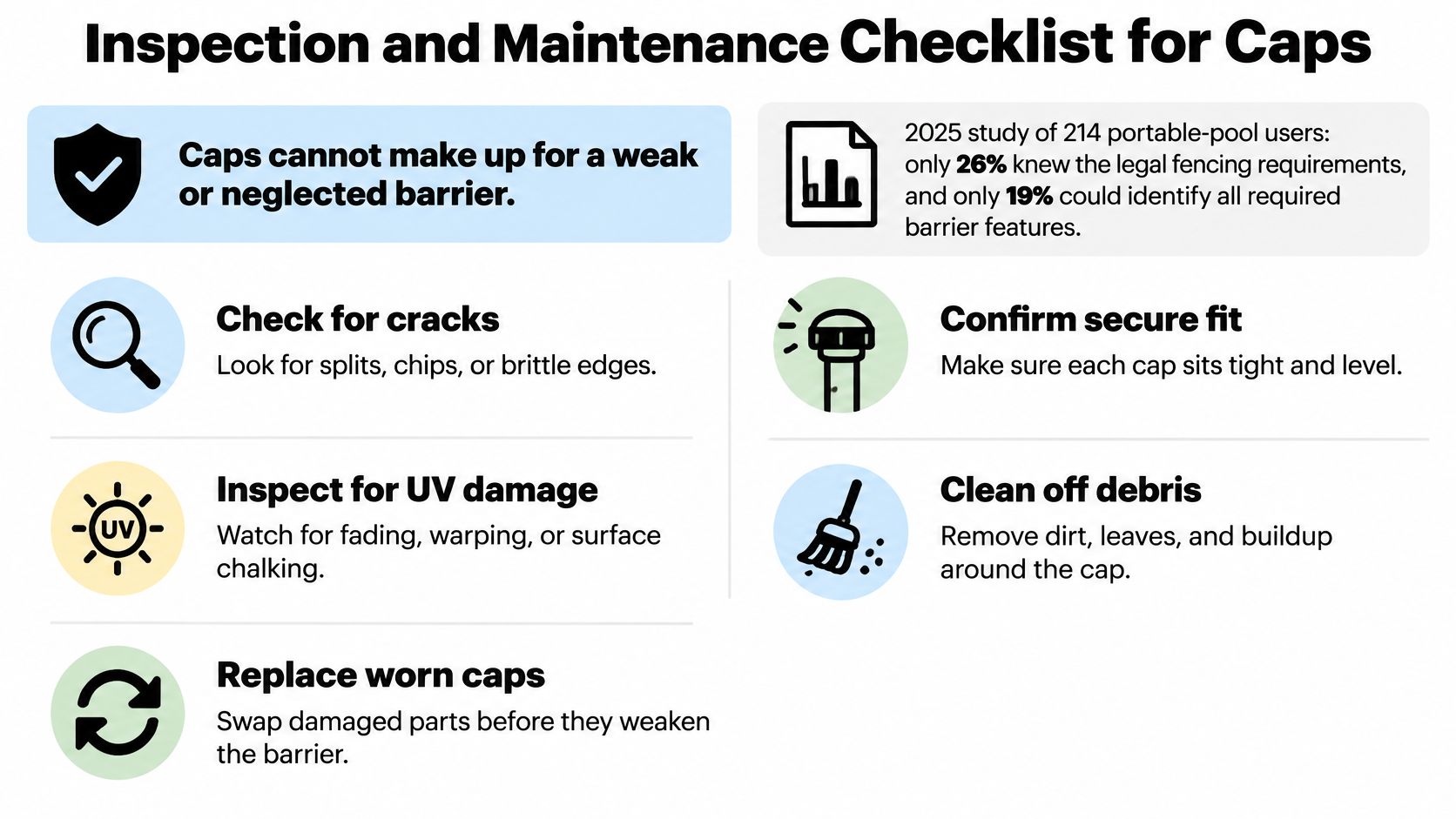
Caps can't compensate for a neglected barrier, and neglect is common. A 2025 study of 214 portable-pool users found that only 26% knew legal fencing requirements and only 19% reported fencing their portable pool, according to the study record on PubMed. Owners were far more familiar with supervision and storage than with fencing compliance. Temporary and shallow pools deserve the same barrier discipline as permanent ones, because the access risk doesn't scale down with water depth.
What to Check and How Often
- Monthly visual check: Walk the outside face looking for loose or wobbling caps, cracks, chalking or fading, sharp edges, and exposed fasteners.
- Monthly material check: Look for white powder or corrosion on aluminum post tops and rust weep around fastener heads, which signal dissimilar-metal trouble at the joint.
- Monthly gate check: Release the gate from several positions and confirm it self-closes and latches. A gate that needs a hip bump has already failed its job.
- After every named storm or heavy impact: Recheck cap movement, post plumb, and gaps under the barrier, since wind load and debris strikes shift components that looked fine the week before.
- Before the pool season opens: Run the full sequence, caps, openings, gate hardware, and house door device, and photograph the barrier in its corrected condition.
Cosmetic Swap or Safety-Critical Repair
A like-for-like cap replacement, same profile, same material class, same flush fit, is routine maintenance. A cap that changes the profile, height, or fit is a barrier change, and it should trigger a review of the whole enclosure before the new caps go on every post. That distinction protects homeowners who upgrade to decorative finials across an entire fence and unknowingly alter the climbable profile they were inspected under.
Florida's statute also considers a medically frail elderly person who could penetrate the barrier and fall into the water. Loose caps, sharp broken edges, and wobbling posts matter for a grandparent steadying themselves on a post top, not only for a climbing toddler.
Any cap replacement should trigger a review of the whole enclosure. It takes minutes, and it's the moment when shifted posts and tired gate springs actually get noticed.
What Caps and Cap Replacement Typically Cost
Caps are a small line item in pool fence work. The total moves with fence length, material, gate count, and permit scope, while caps themselves rarely decide between two bids. That proportion matters, because it means saving money on cap quality buys almost nothing and can cost a reinspection.
Cost Drivers for Cap and Fence Work
| Cost driver | Effect on price | What to request in a quote |
|---|---|---|
| Cap style | Flush caps cost less than custom finials | Caps listed as a separate line |
| Fence material | Changes the total more than the caps do | Price per foot by material |
| Gate hardware | Self-closing hinges and latches add cost | Hardware itemized and specified |
| Permit and inspection | Required for new pool barriers in Florida | Permit fee and inspection visit listed |
| Repair or replacement | A single cap swap costs far less than rebuilding a post | Scope of repair compared with full barrier review |
Consider two jobs side by side. A single cap swap on a sound post involves the cap, matched fasteners, sealant, and a gate and gap check while the installer is on site. A post rebuild involves cutting out a corroded or storm-shifted post, resetting it in concrete, reconnecting rails or pickets, realigning the adjacent gate if it's a gate post, and then capping it. The cap line is identical. Everything around it isn't, which is why quotes that blur repair scope into one lump sum can't be compared.
A cheaper cap is no saving when it introduces a climbing point an inspector flags, or when mismatched fasteners corrode and the cap loosens within a season. Rework after a failed inspection means a second visit, replacement parts, and another inspection appointment, easily erasing the original saving.
Ask for an itemized quote listing caps, gate hardware by type, permit fees, inspection visits, and removal of old material as separate lines. Gate hardware is often priced separately from the fence run, so get the hinge and latch specification in writing rather than accepting a verbal assurance. The pool safety fence cost breakdown explains how those lines build a total. Because pricing shifts with county, material, and site conditions such as slope, landscaping, and access, any figure not tied to a dated, site-specific quote for the property should be treated as a site estimate, not a published price.
Hire a Licensed Contractor for Your Pool Fence
A pool fence is a measured barrier, not a collection of interchangeable parts. The U.S. Centers for Disease Control and Prevention reports that a four-sided isolation fence reduces a young child's risk of drowning by 83% compared with a three-sided property-line fence. A cap contributes to the barrier's finished profile, but the fence layout, gates, and access points determine whether the enclosure works as intended.
When to Call a Licensed Contractor
- Gate or house door work: Hinges, latches, and door devices have specific measurements that must remain correct after installation.
- Profile changes: A cap that changes the fence's profile, height, or fit can affect the barrier and calls for a review.
- Storm or impact damage: Shifted posts and racked panels need structural correction before caps are fitted.
- Permit or HOA scope: New barriers and many replacements require permit coordination, inspection, and sometimes HOA approval before work begins.
In Martin County and Palm Beach County, permit and inspection coordination is part of the project. AlliedFenceAndGate.com™ installs PVC pool fencing with proper picket spacing, a 48 inch minimum height, and pool-code gate hardware to FL 515 standards. Gate hardware includes self-closing pool-code hinges and latches in stainless steel or marine-grade aluminum. Every pool fence the business installs passes Martin County inspection. Confirm the contractor's license, insurance, and written project scope before signing.
Ask who files for the permit and pays its fees, whether gate hardware is specified by type and finish, and who coordinates inspection. Also confirm that the proposed work includes a barrier review if the fence profile or fit will change. These details help separate a cosmetic adjustment from work that affects the enclosure's compliance.
For a cap-related concern, have the fence, gate, and house-door access points assessed before choosing a replacement part. Measure the existing barrier against applicable Florida requirements, correct any deficiencies, then select caps that fit the verified profile. A cap that looks right may still change how the barrier fits or functions.
#MartinCountyFencing #PalmBeachCountyFencing #StuartFLFencing #PalmCityFencing #JupiterFLFencing #PortStLucieFencing #TreasureCoastFencing #PoolFence #PoolSafetyFence #PoolFenceCaps #AluminumFencing #VinylFencing #PVCFencing #PoolGateHardware #FloridaPoolCode #FenceContractorFlorida
AlliedFenceAndGate.com™ installs pool safety fencing and self-closing gate hardware built to Florida pool code across the Treasure Coast and northern Palm Beach County, with permitting and inspection coordination as part of the project. Homeowners planning a pool fence can request a site-specific quote at AlliedFenceAndGate.com™.
Related Fencing Services
Need a fence or gate on the Treasure Coast?
Licensed, insured, and bonded. Free estimates across Martin, St. Lucie, Indian River & Palm Beach counties.
Call (772) 530-3127