Florida Privacy Fence Guide for Homeowners
A hurricane has taken out the rear fence, family is arriving in two days, and the fastest-looking solution is to order a six-foot privacy system and start digging. On Florida's Treasure Coast, that approach can create a second problem. The replacement may conflict with an HOA rule, exceed a local height limit, sit inside an easement, or fail inspection if it also serves as a pool barrier.
A Florida privacy fence is a three-layer project. The HOA Architectural Review Committee controls appearance and placement, the municipality controls permits and inspections, and the Florida Building Code controls safety, pool barriers, and wind performance. The material matters, but the approval sequence matters first.
Table of Contents
- What a Florida Privacy Fence Project Actually Involves
- Getting HOA Approval on the First Submission
- Florida Fence Code and Permit Triggers
- Comparing Privacy Fence Materials for Florida
- Storm, Wind Zone, and Coastal Durability
- Pool Code Requirements That Change the Design
- Why Full Solid Panels Are Not Always the Best Answer
- Budgeting Your Project and Next Steps
What a Florida Privacy Fence Project Actually Involves
After storm damage, a Port St. Lucie homeowner may want the old fence replaced immediately. A Treasure Coast installer first checks the site and approval path. The damaged fence may have been outside the true boundary, inside an easement, too close to a driveway or corner, or part of a pool enclosure. Ordering panels before resolving those conditions can leave materials unusable and the project stalled.
A Florida privacy fence is a three-layer project. HOA approval controls appearance and placement. Municipal review controls permits, site plans, and inspections. The Florida Building Code controls safety functions, pool barriers, and wind-related construction. Material selection comes after those layers are understood.
Florida's general fence provision requires fences or enclosures to be substantially constructed, at least 5 feet high, with a maximum 4-inch gap in the lower 2 feet under the cited statewide framework. Local rules still change the design. Orange County generally permits residential fences up to 8 feet in side and rear yards but limits front-yard fences to 4 feet. Miami-Dade generally caps fences at 6 feet and restricts chain link in front of the building line. The Florida fence and wall guidance shows why a “privacy fence rule” cannot be treated as one statewide design.
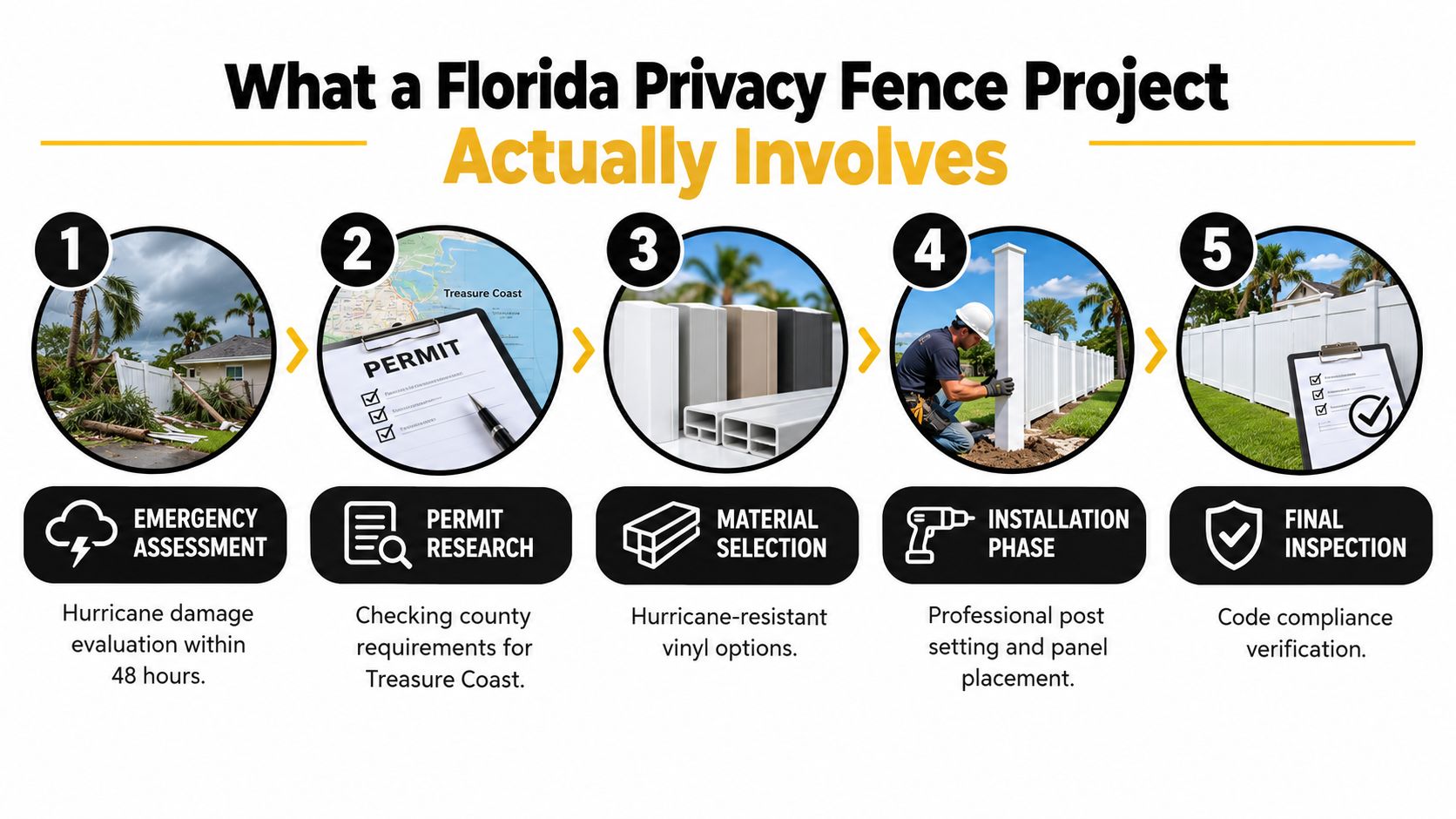
The sequence that prevents a stalled project
Use this order:
- Review the HOA rules. The ARC may set the color, style, height, gate design, and fence position, even when the city does not require a building permit.
- Confirm municipal requirements. The permitting office determines whether the project needs a permit, site plan, inspection, or supporting documents.
- Identify code functions. A fence serving as a pool barrier needs compliant gates and openings. A solid fence in a high-wind area may need a different structural design.
- Verify the property. Confirm boundaries, setbacks, easements, corner visibility, drainage, and utility locations before setting posts.
- Build only to the approved plan. Changing the height, color, gate location, or panel pattern can create a new violation.
Practical rule: HOA approval is not a building permit, and a permit exemption does not waive HOA rules, pool safety requirements, or local setbacks.
The Florida fence permit guidance for HOA and code questions explains why those approvals remain separate. Resolve each layer before ordering material, then install the fence to the approved layout.
Getting HOA Approval on the First Submission
An ARC reviewer needs to understand exactly what will be installed, where it will sit, and how it will look from neighboring properties. A vague application slows everyone down. A complete package gives the committee fewer reasons to return it for clarification.
Build the package before measuring for production
Start by downloading the community's current architectural guidelines PDF. Mark the approved height, style, color, material, gate design, and placement rules. Some communities accept a white vinyl privacy fence but reject a wood pattern. Others allow a particular aluminum profile but require a specific finish. The contractor should not order material until those restrictions are clear.
Next, prepare a scaled site plan. It should show:
- The home footprint: Include the house, pool, patios, sheds, air-conditioning equipment, and other fixed features.
- The property boundary: Use a current survey when available instead of estimating from landscaping or an old fence.
- The proposed footprint: Mark the fence line, gate locations, direction of gate swing, and distance from the home.
- Site constraints: Show easements, driveways, sidewalks, drainage areas, and corner visibility zones.
- Project specifications: State the material, color, height, post style, panel pattern, and gate hardware.
Photographs should cover the rear yard, side yards, frontage, neighboring fences, driveways, and every point where the proposed fence changes direction. Take images from multiple angles so the ARC can see the existing conditions rather than relying on one flattering view.
Submit details that answer the reviewer's questions
The ARC application should identify the homeowner, contractor, material supplier, fence height, color, style, gate count, and installation location. Attach the guideline excerpt, site plan, photographs, product sheet, and color sample. The Florida HOA fence approval guide can help homeowners organize the submission before sending it to the board.
The most common first-submission problems are predictable:
- Missing or generic site plans: A hand-drawn line without property features doesn't show compliance.
- Unlisted fence styles: An attractive design still fails if the ARC hasn't approved it.
- Unapproved colors: Manufacturer names and color codes should match the community palette.
- Excessive height: A taller fence needs a documented variance request, not an assumption that privacy justifies the change.
- Unclear gates: Reviewers need to see access points, swing direction, and hardware.
Save the approval email and the final approved drawings. The installation crew should receive the same version submitted to the ARC. If a municipal reviewer later requests a change, the HOA may need to review that change before construction continues.
Florida Fence Code and Permit Triggers
A privacy fence can clear HOA review and still stop at the permit counter. On Treasure Coast properties, the approval sequence has three layers: community rules, municipal requirements, and Florida Building Code conditions for pools and wind. Confirm each layer before ordering panels or setting posts.
Florida's statewide baseline cited earlier includes a fence or enclosure that is substantially constructed, at least 5 feet high, with no more than a 4-inch gap in the lower 2 feet. Local residential rules often result in 6-foot side-and-rear privacy fences and 4-foot front-yard fences, but the permitted design depends on the municipality, frontage, setbacks, easements, and neighboring use.
The municipal review can change the plan. Orlando requires a fence permit for commercial properties, residential properties with three or more dwelling units, fences taller than 6 feet, required pool or spa barriers, corner lots, and fences on or near a public easement. Its guidance generally limits front-yard fences to 4 feet and side, street-side, and rear fences to 6 feet, with additional conditions beside streets and commercial or industrial properties. Review the Orlando fence permit application guidance for the property's exact situation.
Comparison by jurisdiction
| Jurisdiction | Max Height, Side and Rear | Permit Trigger | Setback Rule |
|---|---|---|---|
| Florida statewide framework | At least 5 feet under the cited general fence provision | Local code determines the permit | Confirm local setbacks, easements, and frontage rules |
| Orange County | Typically up to 8 feet | Local review depends on height and location | Front yards typically limited to 4 feet |
| Miami-Dade | Generally capped at 6 feet | Local code and location conditions apply | Visibility rules can reduce height to 2.5 feet near intersections and driveways |
| Orlando | 6 feet in typical side and rear yards | Commercial property, three or more dwelling units, over 6 feet, pool barrier, corner lot, or public easement conditions | Front yards generally limited to 4 feet |
| Pinellas County | 6 feet in required side and rear setback areas | Confirm county and property-specific requirements | Certain decorative frontage conditions may allow 8 feet |
Pinellas County's fence and wall regulations illustrate why height and placement must be checked together. A fence may meet the height limit and still conflict with a right-of-way or required setback.
For a Treasure Coast installation, verify the proposed height and location first. Then check easements, sight triangles, frontage rules, and any pool or wind documentation required by the building department. Submit the site plan before excavation begins. Skipping that order can lead to redesign, inspection delays, or removal.
Comparing Privacy Fence Materials for Florida
Florida's heat, humidity, salt air, insects, and storm exposure punish weak material choices and weak installation details. No privacy fence wins every site. The best option depends on whether the property is inland or coastal, whether the HOA demands a particular appearance, and whether the fence must function as a pool barrier.
| Material | Privacy Level | Heat and UV | Salt Air | Wind Behavior | Maintenance | Cost / LF |
|---|---|---|---|---|---|---|
| Vinyl or PVC | High with privacy panels | Resists rot and insects, but direct sun can cause expansion | Generally suitable, with careful hardware selection | Solid panels create higher wind demand and can crack from impact | Low, no routine painting | Published starting range is $25 to $48 per foot at AlliedFenceAndGate.com™ |
| Aluminum | Low by itself, higher with privacy inserts | Performs well with a suitable finish | Strong choice for corrosion-sensitive locations | Open profiles allow airflow; inserts change the load | Low | Published starting range is $28 to $150 per foot |
| Cedar board-on-board | High | Natural wood moves, weathers, and needs protection | Can stain and weather faster in salt-heavy areas | Requires sound posts, rails, and attachment details | Sealing is a recurring task | Published starting range is $25 to $45 per foot |
| Chain link with slats or fabric | Moderate to high, depending on infill | Slats and fabric can fade or loosen | Coated systems perform better than unprotected components | Open mesh generally handles airflow better than solid panels | Moderate, with periodic repairs | Published starting range is $22 to $50 per foot |
Matching material to the lot
Vinyl is the practical inland default. PVC privacy panels resist rot and insects and don't require painting. The installer still needs to allow for movement in direct Florida sun, protect panels from equipment impacts, and use a post layout appropriate for the wind exposure. Vinyl is not a license to use light posts or wide unsupported spans.
Aluminum fits coastal and pool-adjacent applications. It resists corrosion better than ordinary ferrous metal and works well as an open frame. Aluminum doesn't provide full privacy without slats, inserts, or a separate privacy section, so the design must distinguish between a decorative pool enclosure and a true visual screen.
Cedar suits natural aesthetics and restrictive HOAs. Board-on-board construction delivers genuine privacy and can blend with communities that reject plastic-looking panels. It also demands disciplined maintenance. Moisture, mildew, and salt exposure make unfinished wood a poor choice for homeowners who want a hands-off fence.
Chain link is a budget and utility solution. Privacy slats or fabric improve screening, but the finished appearance remains more utilitarian than residential. It makes sense for service areas, rental properties, or projects where initial price controls the decision.
Storm, Wind Zone, and Coastal Durability
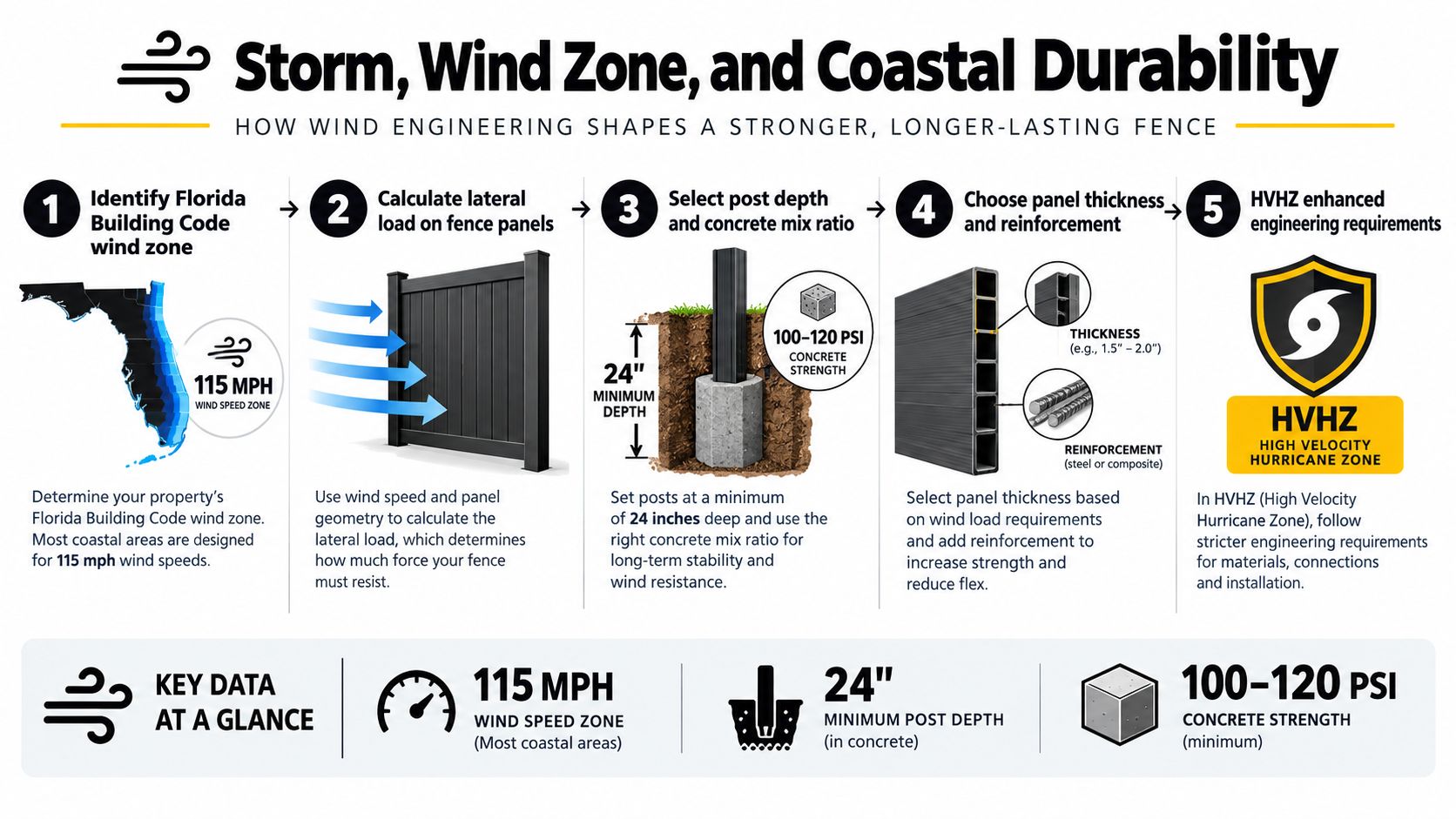
A privacy fence carries a different wind burden from an open decorative fence. A sealed panel gives wind fewer places to pass through, so the post size, embedment, connection method, and spacing must match the local design condition.
In Florida's High-Velocity Hurricane Zone, fences no higher than 6 feet may be designed for 75 mph fastest-mile wind speed or 115 mph 3-second gust, while wood fences must follow the code's specific wood-fence design provisions. The Florida residential fence guide also identifies much higher design wind speeds in Miami-Dade and Broward, reaching 165 to 186 mph depending on risk category.
That range changes the build before the first post is set. A Treasure Coast contractor should identify the applicable wind zone, determine whether the property has coastal exposure, select the panel and post system, and confirm whether an engineered design is required. A solid panel near an exposed shoreline shouldn't be priced or installed like an open picket fence inland.
What the installer should verify
- Wind classification: Confirm the local design condition rather than relying on a countywide guess.
- Panel exposure: Treat a fully solid run as a higher-load assembly than a slatted or shadow-box layout.
- Post design: Specify post size, spacing, embedment, concrete, rails, and fasteners as one system.
- Connection detailing: Gates and terminal posts need special attention because movement concentrates at corners and access points.
- Engineering documentation: Obtain a Florida professional engineer's sealed design when the local authority or site condition requires it.
The common shortcut is reducing post depth or widening the spacing to lower labor cost. That choice may leave the fence vulnerable to panel blowouts, leaning posts, and failed inspection. Wind design isn't an optional upgrade on an exposed Florida privacy fence. It is part of making the assembly installable and insurable.
Pool Code Requirements That Change the Design
A fence around a pool isn't merely a privacy fence with a gate added later. It becomes a pool barrier, and the barrier rules can override the preferred layout, gate position, latch, and opening pattern.
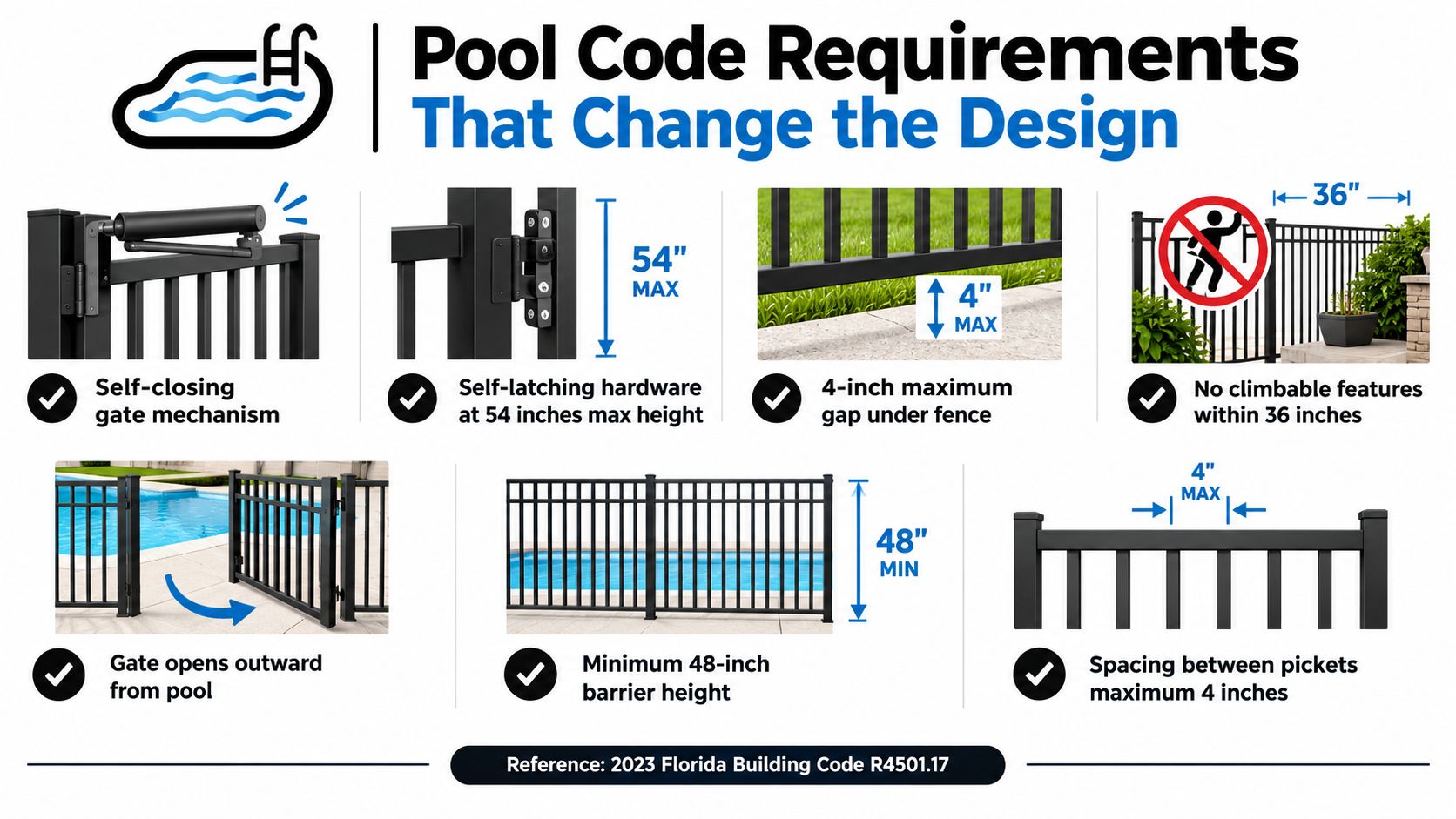
Florida pool barriers must fully surround the swimming pool and obstruct access from the residence or yard outside the barrier, as described in the Miami-Dade pool barrier presentation. Common requirements include a minimum barrier height of 48 inches, self-closing and self-latching gates, and a latch positioned on the pool side when the gate arrangement requires it. The Florida Building Code staff analysis explains that a pool gate must swing outward, away from the pool, and that the release mechanism must be positioned so a young child can't reach it over the top or through an opening.
The hardware specification matters as much as the panel. A standard waist-height thumb latch may work for a garden gate but fail as pool access hardware. Operable parts for certain self-locking gates must be mounted between 34 and 48 inches above the finished floor or ground, according to the Florida pool barrier code summary.
Specify the gate before ordering the fence
The quote should identify pool-rated self-latching hardware, self-closing hinges or gate springs, the swing direction, latch position, and the opening pattern. The pool barrier must not rely on a later hardware swap to pass inspection.
The Florida pool fence requirements guide is useful when comparing a privacy fence layout with a dedicated pool enclosure. A privacy fence may form part of the barrier, but the entire perimeter, including gates and transitions, must work as one compliant system.
A pool gate that looks secure can still fail if it closes slowly, latches inconsistently, swings toward the water, or places the release where a child can reach it.
Why Full Solid Panels Are Not Always the Best Answer
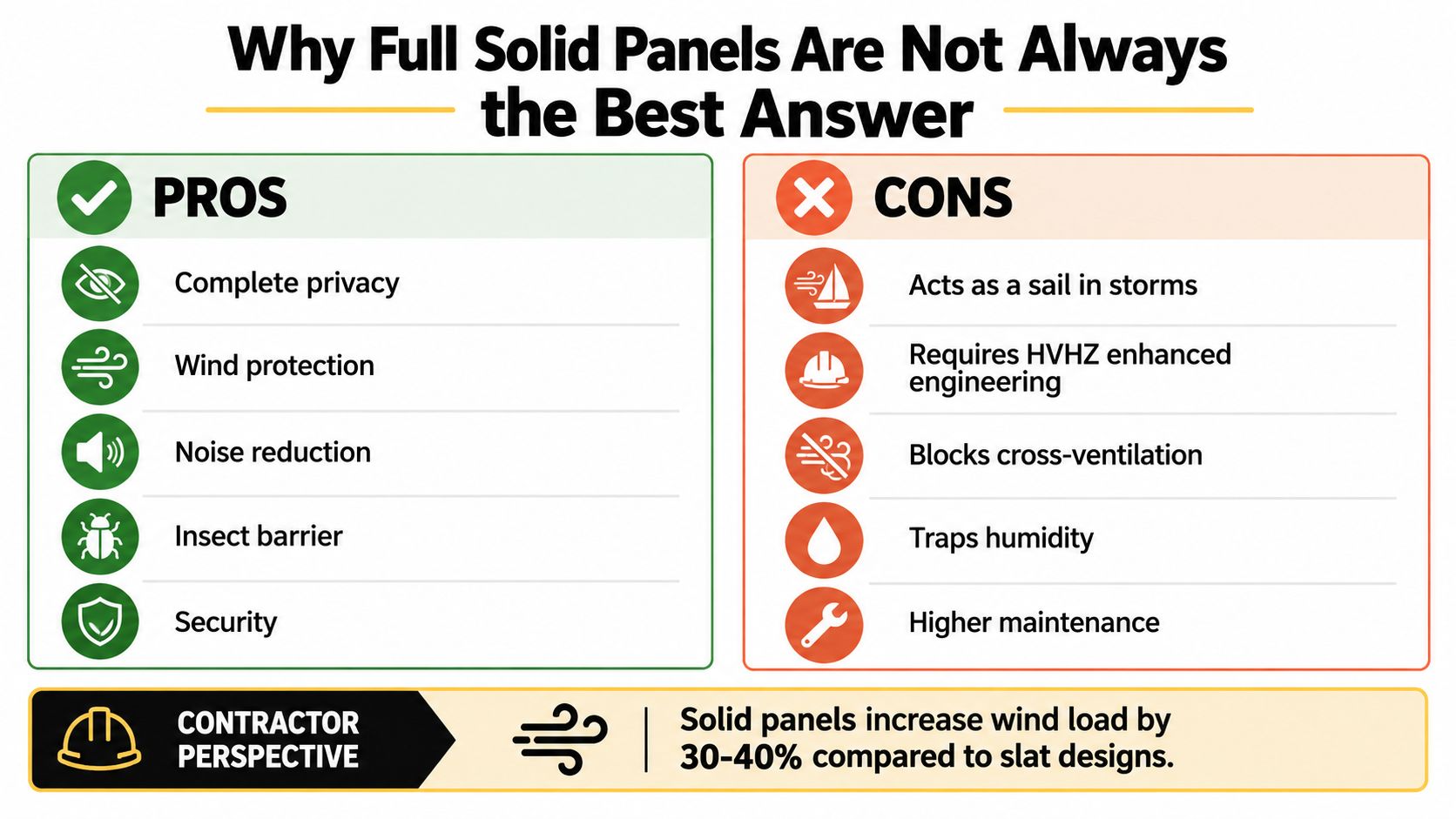
A fully sealed six-foot wall feels like the obvious privacy choice. On many Florida lots, it isn't the best default. Solid panels act more like a sail during afternoon storms, retain moisture against wood, reduce cross-ventilation, and place greater demands on posts and connections.
Filtered privacy often performs better. A shadow-box fence blocks direct sightlines while allowing some airflow. Board-on-board fencing with a topper can preserve privacy without creating one uninterrupted wall. Horizontal slats with controlled gaps, or an aluminum frame with privacy inserts, can provide screening while reducing the visual and structural mass of the fence.
Where each layout earns its place
- Shadow-box sections: Useful where the homeowner wants privacy from neighboring yards but still needs ventilation.
- Board-on-board with a topper: A strong compromise for HOA communities that prefer a residential appearance.
- Slatted privacy panels: Suitable for modern homes, pool decks, and yards where filtered light matters.
- Hybrid aluminum systems: Practical where corrosion resistance and a lighter visual frame matter more than uninterrupted screening.
- Full solid runs: Appropriate for zero-line-of-sight pool screening, busy corner lots, or a specific privacy need that justifies the added wind and maintenance burden.
The material trend is moving toward filtered privacy rather than universally sealed walls, according to United States fencing market research, which projects a 6.49% compound annual growth rate through 2031 for the Florida state market. That projection doesn't mean every property should use slats. It does support a more careful design conversation about airflow, light, corrosion, and storm exposure.
Solid panels also affect spacing. Near the coast, the installer may need tighter support spacing than an open design, which increases labor and material requirements. The right question isn't, "Which fence is most private?" It's, "How much privacy does this lot need, and what airflow can the structure safely preserve?"
Budgeting Your Project and Next Steps
A workable shortlist pairs the material with the site condition:
- Budget tier, vinyl: Low-maintenance privacy with a published starting range of $25 to $48 per foot from Allied's company information.
- Mid tier, cedar board-on-board: Natural full privacy with a published starting range of $25 to $45 per foot, plus ongoing sealing and stain maintenance.
- Premium tier, aluminum with privacy inserts: A corrosion-conscious hybrid with a published starting range of $28 to $150 per foot, depending on the system and fabrication.
Those are starting ranges, not a project quote. Gates, removal, terrain, access, wind requirements, pool hardware, permits, surveys, and HOA changes can all affect the final scope. A digital estimator can turn linear footage, material, gate count, and site conditions into a preliminary budget before a site visit. Allied's Digital Fence Estimator is one available tool for that early planning step.
The next 30 days should produce an approval-ready project:
- Pull the current HOA ARC guidelines.
- Order or locate the property survey.
- Photograph the proposed fence area.
- Confirm municipal height, setback, and permit requirements.
- Identify whether the fence will serve as a pool barrier.
- Specify self-closing and self-latching gate hardware early.
- Complete the estimator and schedule a site walkthrough.
- Arrange utility locating and inspection coordination before excavation.
AlliedFenceAndGate.com™ offers vinyl, aluminum, wood, chain link, pool safety gates, permitting support, utility locates, and digital estimating for Treasure Coast projects. Homeowners can organize the HOA, municipal, pool, and wind requirements in one planning conversation by visiting AlliedFenceAndGate.com™ and scheduling a site assessment. #MartinCountyFencing #PalmBeachCountyFencing #PortStLucieFencing #StuartFencing #JensenBeachFencing #PalmCityFencing #TreasureCoastFencing #FloridaPrivacyFence #VinylPrivacyFence #PoolFenceFlorida #HurricaneResistantFence #HOAFenceApproval #FloridaFenceContractor #PrivacyFenceInstallation
Related Fencing Services
Need a fence or gate on the Treasure Coast?
Licensed, insured, and bonded. Free estimates across Martin, St. Lucie, Indian River & Palm Beach counties.
Call (772) 530-3127