Aluminum Fence Post Guide: Types, Sizes, and Installation

A Treasure Coast homeowner can choose a beautiful aluminum fence, approve the panel style with an HOA, and still end up with a problem at the first gate. Salt air, pool splash, sandy soil, wind, and the repeated pulling of a swinging gate don't load every post in the same way. The right aluminum fence post depends on where it sits, what it supports, and how the finished fence must perform under Florida conditions.
Aluminum remains closely associated with corrosion-resistant fencing because it naturally forms a protective oxide layer. A Marine-Atmospheric Environment field study found relatively low corrosion losses for aluminum-coated and aluminum-alloy fencing systems during a three-year exposure period, while a later U.S. engineering report found little sign of corrosion on aluminum fencing after 12 months and identified it among the lowest life-cycle-cost options tested. That doesn't make every post interchangeable, or every coating suitable for a waterfront property.
Table of Contents
- Why Your Aluminum Fence Post Choice Matters More Than the Panels
- What an Aluminum Fence Post Actually Is
- Line, Corner, End, and Gate Posts Explained
- Sizes, Wall Thickness, and Alloy Grades Compared
- Coatings, Corrosion, and the Failure Modes Nobody Talks About
- Footing Depth, Spacing, and Code-Driven Installation
- Welded and Custom Posts Versus Standard Systems
- Choosing the Right Post for Your Project
Why Your Aluminum Fence Post Choice Matters More Than the Panels
A Treasure Coast homeowner once selected a standard residential aluminum post kit for a pool enclosure with a four-foot self-closing gate. The panels looked correct, the layout passed the design review, and the installation appeared clean. Within 18 months, the gate-side post had deflected, the latch no longer aligned cleanly, and the HOA flagged the failing gate condition.
The panels weren't the primary problem. The gate post was carrying hinge loads, latch loads, wind pressure, and repeated opening forces that a line post was never designed to absorb. Pool splash and coastal moisture added another layer of exposure around the hardware and footing.
The post carries the hidden work
Panels attract attention because they determine the fence's appearance. Posts handle the less visible work:
- Wind transfer: Pressure on the panel moves through rails, brackets, and the post into the footing.
- Gate torque: Hinges place a concentrated twisting force on gate posts instead of distributing the load across a long run.
- Environmental exposure: Salt spray, humid air, pool chemicals, and wet concrete affect connections and finishes.
- Alignment: A leaning or deflecting post changes panel spacing, latch position, and the fence line.
Aluminum's advantage is its durability-to-maintenance balance, not maximum impact strength. The engineering report linked above specifically supports that distinction. Aluminum often earns its place in pool enclosures, decorative borders, and coastal installations because it resists rust without demanding the same maintenance as ferrous steel.
Practical rule: Choose the posts first, then select a panel style that fits their capacity and spacing. Reversing that order creates attractive fences with weak points hidden at corners and gates.
A quote that lists one nominal post for every position deserves closer examination. Straight line posts, corners, ends, and gate posts don't experience the same forces. In Florida, the quiet decision behind the fence's service life is usually the post schedule, not the decorative infill.
What an Aluminum Fence Post Actually Is
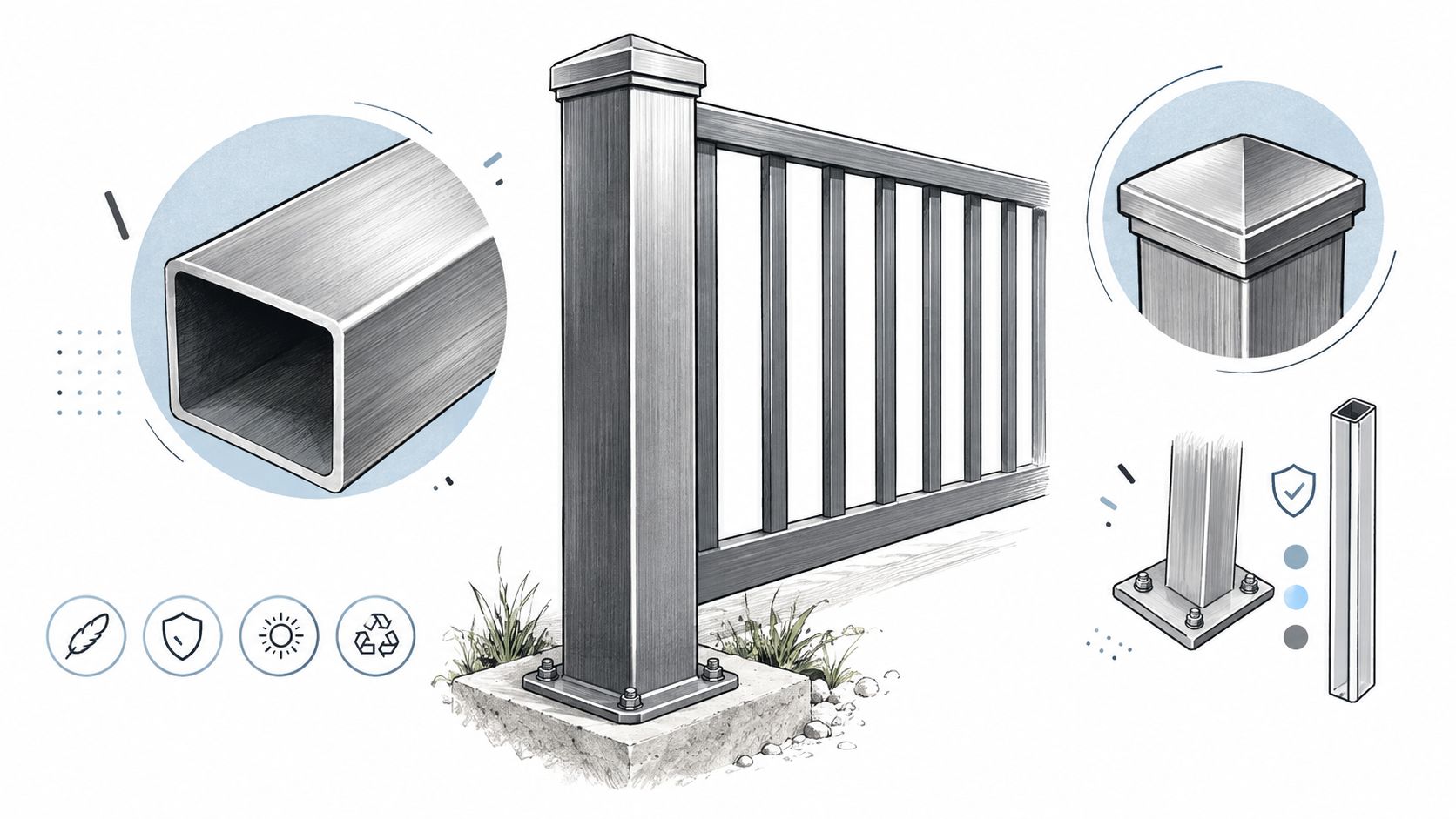
An aluminum fence post is generally a hollow, extruded structural tube. The extrusion is cut to length and then punched, notched, routed, drilled, or fitted with brackets so horizontal rails and panels can connect to it. The finished component also includes a coating, cap, and sometimes internal reinforcement, so a raw length of aluminum tubing isn't the same thing as a complete fencing post.
Wall thickness changes the feel
Nominal outside dimensions can mislead. A two-inch square post tells only part of the story. The wall thickness determines how much aluminum resists bending, and a hollow tube's shape determines how efficiently it handles side load.
A useful visual comparison is a dowel and a broomstick. A thin residential wall can feel closer to a stiff dowel when a panel pushes sideways. A thicker commercial wall behaves more like a broomstick, with more resistance to deflection. The comparison isn't a substitute for engineering calculations, but it helps explain why two posts with the same outside dimensions can perform differently.
Common ornamental and perimeter systems use extruded 6005-T5 or 6063-T6 and 6063-T5 members meeting ASTM B221. Some commercial specifications require a minimum yield strength of about 35,000 psi, as shown in this aluminum fence specification document. The same document's broader lesson is important: post size, alloy, temper, and loading condition belong together in the specification.
Raw extrusion versus finished post
A manufacturer may produce posts by:
- Punching and notching, which creates consistent openings for a standardized rail system.
- Routing channels, which allows rails or infill to slide into a shaped profile.
- Adding brackets, which gives the installer adjustment at corners and grades.
- Applying the finish, usually after surface preparation and before final assembly.
This article uses “post” to mean the in-ground structural member. It doesn't mean the decorative cap, finial, hinge, latch bracket, or surface-mount base. Those parts affect performance, but the post and its footing form the primary load path.
Line, Corner, End, and Gate Posts Explained
Every aluminum fencing system assigns posts by function, even when a sales quote uses simpler wording. A line post supports intermediate panel connections. A corner post changes direction. An end post terminates a run. A gate post carries concentrated hardware and deserves a separate structural decision.
Line posts usually handle the distributed load from the infill and rails. Corner posts resist uneven pull from two fence directions, especially where a run changes direction sharply. End posts deal with termination forces against a wall, another fence, or a final panel connection.
Gate posts are a different category
A swinging gate doesn't merely hang from a post. Its hinges create a lever arm, and each opening cycle transfers force into the post, footing, hinge fasteners, and adjacent panel. A four-foot gate can expose a light residential post to more concentrated movement than several feet of ordinary line fencing.
For that reason, a heavier 2.5-inch or 3-inch gate post, often with a wall up to 0.125 inch, may be more realistic than a standard two-inch line post. The exact choice depends on the gate frame, hardware, footing, wind exposure, and manufacturer load tables. A post that looks adequate while empty can deflect once a gate, latch, and hardware are installed.
| Post Type | Typical Size | Wall Thickness | Primary Load |
|---|---|---|---|
| Line post | Standard system profile | Light residential wall | Distributed panel and rail load |
| Corner post | Larger where two runs meet | Moderate to heavy | Uneven pull from changing directions |
| End post | Standard or reinforced profile | Depends on termination | Final panel, wall, or end connection |
| Gate post | 2.5-inch or 3-inch profile | Up to 0.125 inch in heavier specifications | Hinges, latch, gate weight, wind, and cyclic leverage |
A quote using the same post at every position may be convenient, but it hasn't necessarily priced the gate loads correctly.
Florida pool barriers add a code-sensitive requirement beyond structural sizing. The Miami-Dade pool barrier guidance states that access gates must be self-closing and self-latching, with the latch release at least 54 inches above grade on the outside side of the gate, or positioned so a young child can't reach it over or through the opening. A gate post that moves can turn a compliant latch into a failed inspection.
Sizes, Wall Thickness, and Alloy Grades Compared
Outside dimensions are useful, but they don't tell the whole story. A 2-inch by 2-inch, 2.5-inch by 2.5-inch, or 3-inch by 3-inch post must be evaluated alongside wall thickness, alloy, unsupported span, panel openness, gate weight, and local wind exposure.
A light wall can work well along a straight decorative pool enclosure where the panel is short, open, and supported at regular intervals. A heavier wall earns its cost at gate hinges, exposed corners, tall panels, solid privacy infill, and long unsupported sections. The governing issue is often deflection before rupture. Aluminum has a lower modulus than steel, so a post may bow or move noticeably even when it hasn't fractured.
Three common alloy choices
- 6063-T5: Common for extruded rails and panel systems where clean finishing and manufacturability matter.
- 6063-T6: Used in structural extrusions where increased temper strength supports a more demanding specification.
- 6005-T5: A practical option for heavier commercial framework and posts.
The government fencing knowledge resource identifies Class 2 aluminum pipe made to ASTM B429 from alloy 6063-T6 as a low initial-cost option for posts and rails. That supports aluminum's role as a corrosion-resistant framework material, but it doesn't eliminate the need to match the profile to the load.
Size is about loading condition
| Post Size | Wall Thickness | Common Alloy | Best For |
|---|---|---|---|
| 2-inch by 2-inch | Light residential wall | 6063-T5 | Straight decorative runs with open infill |
| 2.5-inch by 2.5-inch | Moderate wall | 6063-T5 or 6063-T6 | Residential boundaries, corners, and many pool layouts |
| 3-inch by 3-inch | Heavy wall, up to 0.125 inch in some specifications | 6005-T5 or 6063-T6 | Gate locations, commercial runs, and higher exposure |
A two-inch residential post may bow noticeably on a six-foot panel during a storm, especially where the panel presents a broad wind surface or the spacing is aggressive. That doesn't mean every straight run needs a commercial post. It means the decision shouldn't be based on fence height alone.
The practical rule is simple: loading condition usually matters more than nominal height. A short, solid gate can stress a post more severely than a taller open ornamental panel.
Coatings, Corrosion, and the Failure Modes Nobody Talks About
Aluminum doesn't form red rust like iron or steel, but “rust-free” doesn't mean “failure-proof.” Aluminum naturally creates a protective oxide layer, which is why it performs well in wet, humid, and coastal environments. The field corrosion study on fencing materials supports that advantage, but actual installations can still fail at connections, cut ends, footings, and damaged finishes.
Three paths to trouble
Galvanic corrosion develops when aluminum contacts dissimilar metals in the presence of moisture. Copper, bronze, and unprotected steel hardware can create a localized corrosion cell. Stainless fasteners or properly isolated aluminum hardware are sensible choices near salt air and pool environments.
Alkaline attack can occur where wet concrete and the aluminum post interact at the footing. Good detailing separates vulnerable finished surfaces from standing moisture and avoids leaving a rough, exposed concrete collar that traps water against the post.
Coating breakdown often begins with poor pretreatment, inconsistent film application, abrasion during installation, or ultraviolet exposure. A powder coat can look acceptable on installation day and still have a weak bond if the substrate wasn't prepared correctly.
Coating specifications deserve a real conversation
A technical specification cited by the fencing knowledge resource references polyester powder coating thickness of 80 to 100 microns and 1,000 or more hours of ISO 9227 salt-spray testing. Another commercial specification references more than 3,000 hours of ASTM B117 corrosion resistance for aluminum fence extrusions. Those benchmarks aren't a guarantee for every product, but they show why coating documentation matters in marine environments.
The AAMA coating classes also help separate basic finishes from more demanding options:
- AAMA 2603: Basic exterior performance, often suited to less aggressive exposure.
- AAMA 2604: A practical minimum for many poolside and coastal installations.
- AAMA 2605: A premium specification that can make sense for severe waterfront exposure.
At the quote stage, look for inconsistent gloss, visible mill substrate on cut ends, rough drilled openings, and mismatched colors between posts, panels, and gates. A contractor should also explain how the manufacturer treats field cuts and whether the powder-coat warranty transfers to the property owner.
Footing Depth, Spacing, and Code-Driven Installation
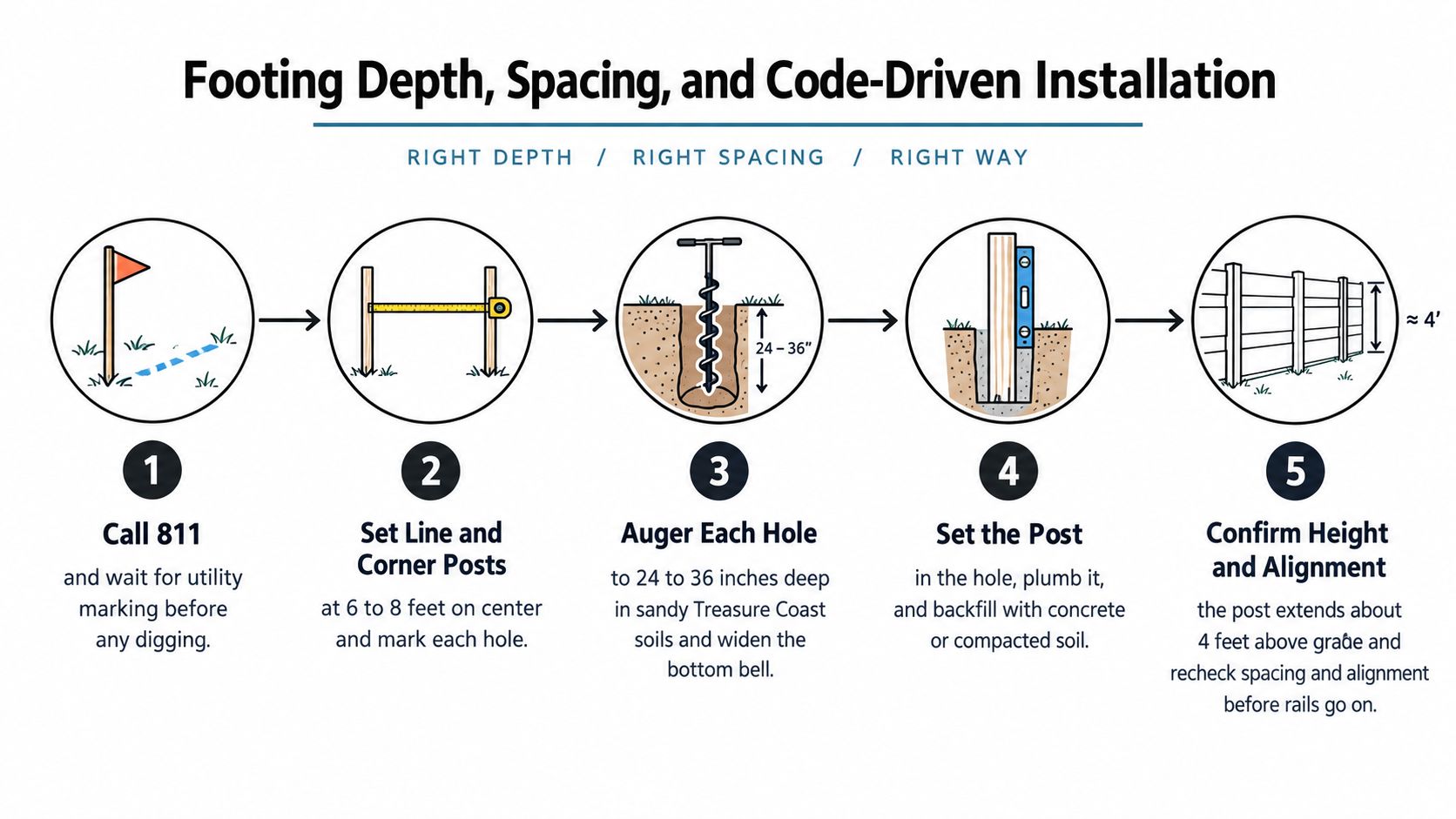
A sound post schedule starts before the auger arrives. In sandy Treasure Coast soils, residential aluminum posts are commonly planned around 24 to 30 inches of footing depth, while gate posts often need 36 inches or more because the gate concentrates movement at one location. The final design still depends on soil, wind exposure, gate size, local requirements, and the manufacturer's engineering tables.
Build the layout around the panel
Line and corner posts are often placed 6 to 8 feet on center, with the panel width plus roughly one-half inch of tolerance used to establish the actual layout. The tolerance gives installers room to fit panels without forcing rails into posts, but it shouldn't become a substitute for accurate measurement.
A bell-shaped hole can improve resistance to rotation in loose sand. Concrete placed so it sheds water away from the post base is generally preferable to a detail that leaves a moisture-trapping pocket. Gravel may help drainage in some settings, but it doesn't automatically provide the overturning resistance needed at a gate.
Before excavation, Florida guidance says anyone planning to dig should call 811 at least two business days before excavation, with the locate service provided free in the cited municipal guidance. The Florida excavation safety guidance should be part of the project record, not an afterthought.
Field sequence: Utility locate first, layout second, hole depth and footing design third, post alignment before concrete sets.
Pool fencing adds another code layer. Gate self-closing and self-latching requirements, latch height, opening limitations, and municipal inspection expectations can change the post and hardware schedule. In high-wind jurisdictions, the panel's openness, post spacing, anchorage, and footing all deserve review rather than reliance on a generic kit.
The aluminum pool fence guide is useful for connecting the enclosure layout with safety requirements. For the installation sequence itself, the aluminum fence installation guide provides a practical reference for concrete-set systems.
The layout, not the panel color or picket shape, determines whether the fence stays aligned and passes inspection. Posts must be plumb, centers must match the panel system, and gate footings must account for the forces that line posts never see.
Welded and Custom Posts Versus Standard Systems
Standard rackable aluminum systems solve most residential jobs efficiently. Pre-punched posts, adjustable brackets, factory finishes, and compatible panels reduce fabrication time and help preserve the manufacturer's warranty. They work especially well where the grade changes gradually and the fence follows a predictable layout.
Custom work earns its place when the site creates a problem that standard geometry can't solve cleanly. A steep grade transition, a gate leaf exceeding 5 feet, a non-standard HOA cap or finial, or a curved pool edge may justify a welded or fabricated post. A six-foot arched driveway gate shouldn't be forced onto a light standard post just to keep the material list uniform.
Compare total installed cost
A custom post can cost roughly two to four times the unit price of a standard post, according to the project planning parameters for this comparison. That figure isn't the total project price. Fabrication hours, welding, finishing, transport, field fitting, engineering review, and warranty treatment all affect the installed result.
| Factor | Standard Rackable Post | Welded or Custom Post |
|---|---|---|
| Unit price | Lower | Higher |
| Site adaptability | Good for regular grades and standard panels | Strong for curves, transitions, and unusual details |
| Installation | Faster with factory openings and brackets | More field fitting and fabrication |
| Finish warranty | Usually preserved within the system | Welding can burn through or compromise the finish |
| Engineering confidence | Based on a repeatable product system | Depends on design and fabrication quality |
| Best application | Typical residential and pool runs | Large gates, unusual geometry, and custom HOA details |
The wrong custom quote can waste money. Some contractors specify welded posts reflexively when a rackable bracket would follow the grade without a visible compromise. The wrong standard quote creates the opposite problem, especially at large gates or severe transitions.
The right question isn't “What does this post cost?” It's “What installation problem does this post prevent?”
For examples of fabricated aluminum gate and post work, the welded aluminum service shows the type of custom solution that belongs in a project-specific discussion. Customization should solve a measured site condition, not serve as a substitute for measuring the site.
Choosing the Right Post for Your Project
A homeowner doesn't need to become a structural engineer to challenge a vague fence quote. The estimator should be able to identify the post function, explain the profile, and show how the footing and hardware match the location.
Use this quote-review checklist
- Mark each function: Confirm which posts are line, corner, end, and gate posts. A single universal post may be appropriate for a small standard run, but it shouldn't be assumed.
- Ask for the wall thickness: Verify whether the quote specifies a light residential wall, a heavier 0.080-inch wall, or a post reaching 0.125 inch where gate mechanical advantage or wind exposure demands it.
- Confirm the alloy and finish: Look for 6005-T5, 6063-T5, or 6063-T6 as appropriate, along with the coating class, pretreatment details, and warranty terms.
- Check the hardware: Near salt air, pool splash, or wet service conditions, confirm that fasteners and washers isolate dissimilar metals.
- Review the layout: Match post centers to panel width and confirm the tolerance before holes are dug.
- Separate gate footing from line footing: Gate posts deserve deeper or more substantial support when the gate size and hardware create concentrated loads.
- Identify code triggers: Pool barriers, municipal wind requirements, HOA details, and inspection conditions can all change the post schedule.
- Question custom fabrication: Use welded or custom posts where curves, steep transitions, unusual caps, or large gates require them, not merely because a contractor prefers them.
AlliedFenceAndGate.com™ provides aluminum fence installation with concrete-set posts, permitting and inspection coordination, 811 utility locates, pool safety gates, and repair work such as straightening, re-welding, and panel replacement. Its digital estimator and project documentation tools can also help owners organize measurements and quote questions before an estimator visit.
A post that deflects after installation or pits at a connection can cost far more than the initial material saving. Aluminum posts aren't commodity parts that can be swapped freely between locations. The few minutes spent matching each post to its actual load can prevent a callback, a failed pool inspection, or a gate that never latches correctly.
For a Treasure Coast project, bring the site conditions into the estimator meeting: proximity to salt air, pool equipment and splash, sandy soil, gate width, HOA requirements, panel width, coating documentation, and footing details. Ask the contractor to identify each post type on the quote and explain why that post belongs in that location.
AlliedFenceAndGate.com™ can assess aluminum fence layouts for pool enclosures, HOA-approved boundaries, coastal properties, and gate-heavy installations across Martin and Palm Beach Counties. Visit AlliedFenceAndGate.com™ to review aluminum fencing services, use the digital estimator, and request a project quote that accounts for post selection, utility locates, permitting, and inspection coordination.
Related Fencing Services
Need a fence or gate on the Treasure Coast?
Licensed, insured, and bonded. Free estimates across Martin, St. Lucie, Indian River & Palm Beach counties.
Call (772) 530-3127