ADA Handrail Diameter: Codes, Measurements, and Grip Specs
The federal ADA circular handrail diameter range is 1.25 to 2 inches outside diameter. The common mistake is treating nominal pipe size as the actual outside diameter, which can lead installers to buy the wrong tubing.
That distinction causes more failed railing inspections than unusual profile shapes do. A tube marked with a nominal size may measure substantially differently with a caliper, and the finished coating, splice hardware, wall clearance, and brackets can change whether the installed handrail remains graspable. The U.S. Access Board ADA Standards provide the federal reference point, but a compliant installation also depends on field measurements and the applicable Florida code path.
Table of Contents
- What Diameter Is Allowed for ADA Handrails
- The 2010 ADA Diameter Range and What Each Number Means
- Nominal Pipe Size vs Outside Diameter on the Jobsite
- Circular and Non-Circular Grip Profiles Compared
- Knuckle Clearance, Edges, and Obstruction Rules
- Stair Handrail Diameter in Context
- Ramp Handrail Diameter in Context
- How the Florida Building Code Layers Onto ADA
- How to Measure ADA Handrail Diameter in the Field
- Why Diameter-Compliant Rails Still Get Rejected
- Quick-Reference Card for ADA Handrail Diameter
- Frequently Asked Questions About ADA Handrail Diameter
What Diameter Is Allowed for ADA Handrails
For a circular ADA handrail, the finished outside diameter must measure from 1.25 inches minimum to 2 inches maximum. A round rail below the lower limit may be difficult to grip securely, while a rail above the upper limit can prevent a user from wrapping the hand around the surface. The measurement applies to the gripping surface that people use, not merely to the material listed on a fabrication quote.
Nominal pipe sizing creates the first jobsite trap. A nominal 1.5-inch pipe isn't necessarily 1.5 inches outside diameter, so a material order based only on the label can produce an incorrect rail. Fabricators should confirm the manufacturer's actual outside diameter before cutting posts, ordering brackets, or preparing a submittal.
ADA also permits non-circular gripping surfaces. Those profiles use a 4-inch to 6.25-inch perimeter and a separate cross-section limit, rather than the circular diameter test. The applicable profile affects bracket selection, hand clearance, finishing tolerances, and how an inspector measures the rail.
Florida projects need a second review against the current Florida Building Code and any local inspection requirements. Commercial stairs and ramps also bring requirements for height, continuity, returns, and installation on both sides, so selecting a diameter is only the first measurement decision. The practical workflow is simple: identify the profile, measure the finished grip, check clearances, then document the result.
The 2010 ADA Diameter Range and What Each Number Means
The measurement starts with the finished grip, not the material order. Under §505.2 of the 2010 ADA Standards for Accessible Design, a circular handrail must have a finished outside diameter between 1.25 inches, or 32 mm, minimum, and 2 inches, or 51 mm, maximum. That range gives the user enough surface to close the hand around the rail while keeping the grip manageable.
For a non-circular profile, measure the finished gripping surface by perimeter, not diameter. The permitted range is 4 inches, or 100 mm, minimum, to 6.25 inches, or 159 mm, maximum. The profile's cross-section must also be no greater than 2.25 inches. Rounded corners count as part of the measured perimeter, so use the completed profile rather than relying on a bare-metal fabrication drawing.
| Profile Type | Measurement Basis | Minimum | Maximum |
|---|---|---|---|
| Circular | Finished outside diameter | 1.25 in, 32 mm | 2 in, 51 mm |
| Non-circular | Finished perimeter | 4 in, 100 mm | 6.25 in, 159 mm |
| Non-circular | Cross-section dimension | Not specified as a lower limit | 2.25 in |
Measure after powder coating, paint, or a sleeve is installed. Those finishes can change the gripping surface enough to affect a borderline result, and a tape measure may not show the same condition as a caliper or profile gauge.
Practical rule: A material certificate confirms what was purchased. A finished-rail measurement confirms what was installed.
Nominal Pipe Size vs Outside Diameter on the Jobsite
Nominal pipe labels identify a standard pipe designation, not the finished outside-diameter measurement. On an ADA handrail, that distinction affects bracket fit, end returns, collars, and the clearance available around the actual gripping surface.
A common commercial selection is nominal 1.25-inch IPS pipe, which has an outside diameter of about 1.66 inches. Nominal 1.5-inch IPS pipe measures about 1.90 inches outside diameter, keeping it within the federal circular grip range. The AISC handrail guidance warns that nominal pipe size and outside diameter are not interchangeable.
| Nominal Pipe Size | Actual Outside Diameter (in) | ADA Status, 1.25 to 2.00 in OD |
|---|---|---|
| 1 in nominal | 1.315 | Within the circular range |
| 1.25 in nominal | 1.660 | Within the circular range |
| 1.5 in nominal | 1.900 | Within the circular range |
The nominal 1.5-inch option remains common because its 1.900-inch outside diameter stays below the 2-inch ceiling while providing a substantial, familiar grip. Before approval, measure the supplied tube and confirm wall clearance, bracket fit, and return or collar compatibility. A shop drawing that lists only nominal size does not replace that field check.
The same rule applies to 304 and 316 stainless tubing, aluminum tube, steel pipe, and decorative sleeves. Specify and inspect the actual outside dimension. A purchase order that says only “1.5-inch handrail” leaves the fabricator and inspector with room for different interpretations.
Circular and Non-Circular Grip Profiles Compared
Circular profiles are usually the fastest to verify in the field. Place a caliper across the finished gripping surface, not the nominal pipe label, and record the outside diameter. The permitted circular range is 1.25 to 2 inches, measured on the installed grip under the original ADA design standards.
Non-circular profiles require more than one measurement. Their perimeter must be 4 to 6.25 inches, while no cross-section dimension may exceed 2.25 inches. Check the profile with a template or by measuring each relevant direction. Rounded edges and a usable grasp still matter. A rail can satisfy the perimeter calculation while sharp corners or hardware make the grip difficult to hold.
| Profile Type | Diameter / Dimension | Perimeter Range | Cross-Section Limit | Example |
|---|---|---|---|---|
| Circular | 1.25 to 2 in outside diameter | Not applicable | Not applicable | Round tube |
| Non-circular | Measured across the profile | 4 to 6.25 in | 2.25 in maximum | Rounded rectangular rail |
| Non-circular | Each relevant direction checked | 4 to 6.25 in | 2.25 in maximum | Square or shaped bar |
A 1.5-inch square bar may meet the perimeter rule. A 2-inch-wide rectangular bar with rounded edges may also comply if its other dimensions and perimeter fall within the limits. A 1.25 by 2.5-inch flat profile fails because its long dimension exceeds the 2.25-inch cross-section limit.
On Florida jobs, measure the fabricated rail rather than approving a profile from a shop drawing alone. Older drawings may use wording from the original ADA language, so confirm that the selected shape matches the applicable current standard before fabrication.
Knuckle Clearance, Edges, and Obstruction Rules
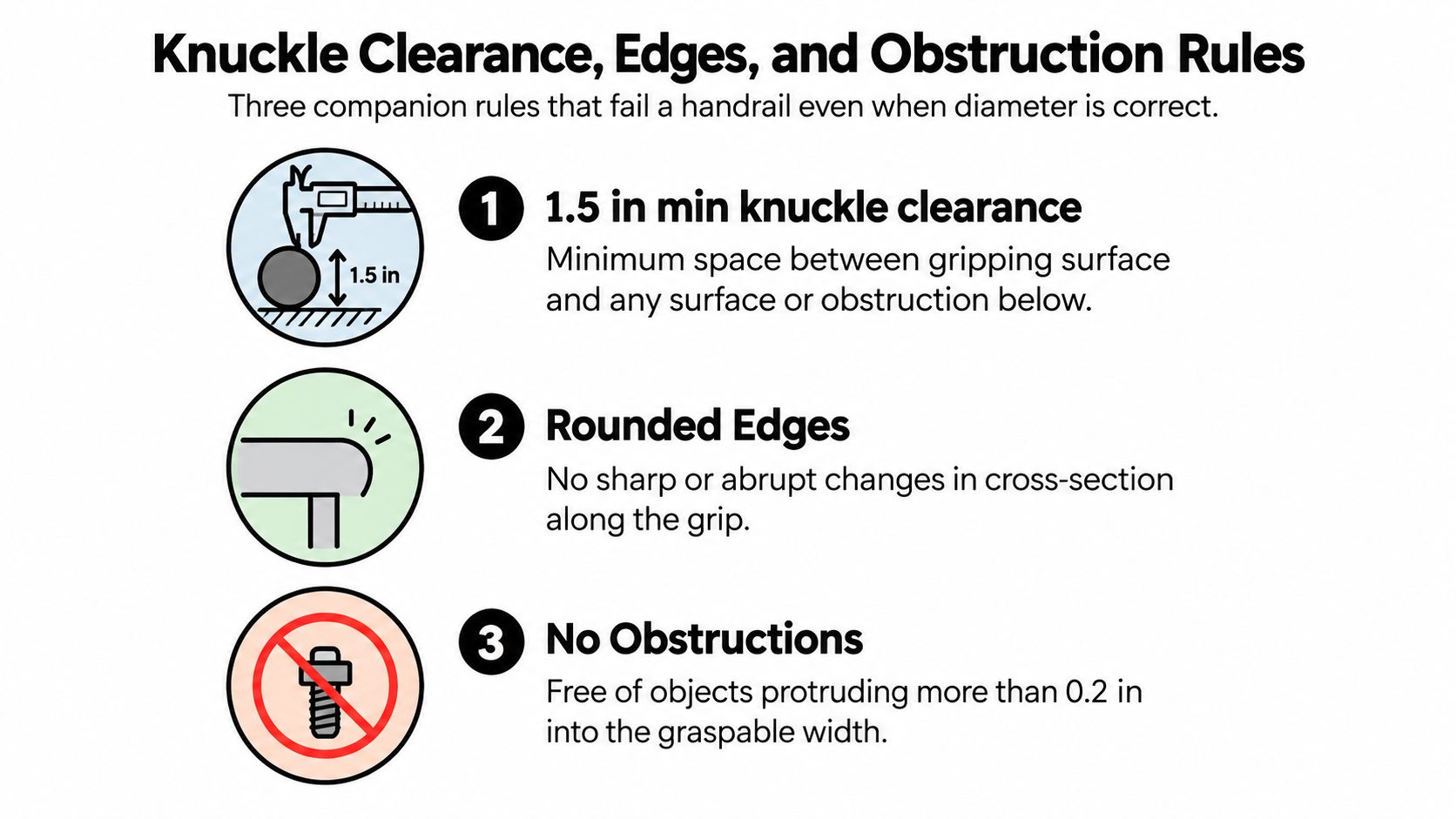
Correct outside diameter does not guarantee a usable handrail. Inspect the finished installation for 1.5 inches of clear space, rounded edges, and an unobstructed gripping surface. The 1.5-inch clear space comes from the ADA Standards' handrail clearance provisions. The AISC field reference illustrates why that space matters for knuckle movement.
Clearance beside the grip
Measure from the actual gripping surface to the nearest wall, guard, post, or other obstruction. Measure the installed rail, not only the nominal bracket dimension. A bracket specified as 1.25 inches off the wall can leave less than the required clearance once the tube's outside diameter, mounting plate, masonry irregularities, or finish thickness are included.
Florida installations deserve the same field check. Concrete masonry walls are rarely perfectly flat, and a rail that clears one point can pinch the knuckles farther along the run.
Edge treatment
Non-circular profiles need rounded edges and a continuous grasp. Blend welds, protect cut ends, and check decorative collars and termination plates for catching points. A profile can meet its dimensional rule while still being uncomfortable or unsafe to hold.
Brackets and interruptions
Keep the top and sides of the gripping surface clear. Obstruction beneath the rail is limited to 20 percent of the length of the gripping surface. Brackets that wrap too far under the tube can reduce usable grip area and trigger a correction, even when the rail's measured diameter complies.
Stair Handrail Diameter in Context
Stair handrail diameter is only one part of the stair inspection. The top of the gripping surface must be 34 to 38 inches above the stair nosing, and handrails are required on both sides of stairs under the Access Board's stairway guidance. A rail that starts at the correct height but drops through a volute or starting fitting can fall outside the permitted range at the point where users first reach for it.
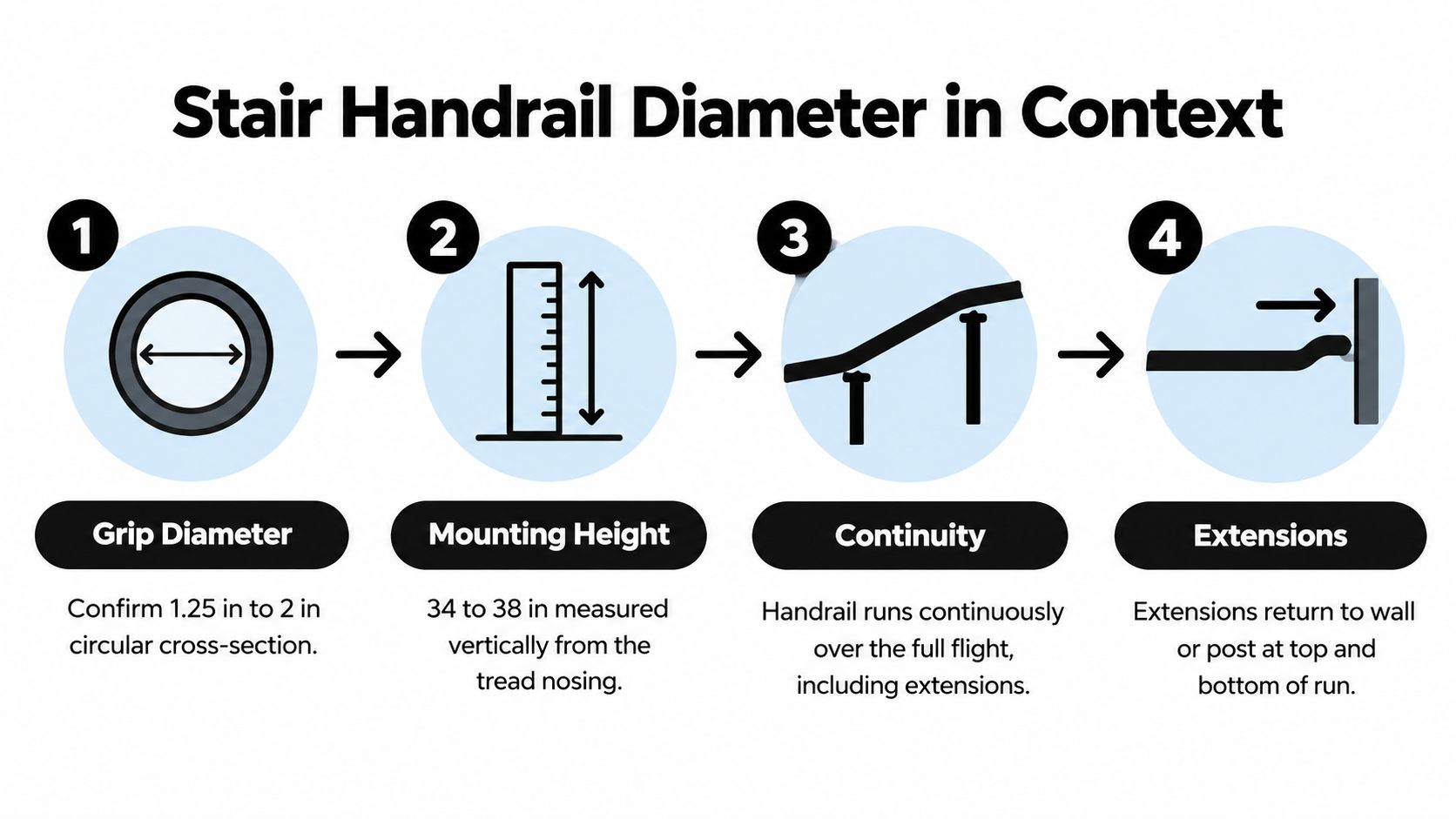
The gripping surface must remain continuous for the full length of each stair flight. Inside rails on switchback and dogleg stairs also need continuity, and the ends must return to a wall, guard, floor, or suitable post. Open tube ends and abrupt termination fittings create snag points for hands, clothing, and mobility aids.
A stair rail should be inspected as a complete path, not as a tube section sitting between two posts.
The same guidance limits interruptions on the gripping surface. Brackets, welds, and fittings can't occupy more than the permitted portion of the lower gripping area, and the top and sides need to stay clear. For many fabricated stairs, a round rail near the middle of the allowed diameter range offers the most forgiving installation, while square profiles require closer attention to edge rounding and perimeter.
A detailed project checklist can be compared against ADA stair handrail requirements before fabrication begins. The useful sequence is to set the rail line, verify the height at the nosing, confirm continuity, then check the finished grip and returns.
Ramp Handrail Diameter in Context
Ramp slope doesn't change the circular grip range. A compliant ramp handrail still uses a finished circular outside diameter from 1.25 to 2 inches, or a permitted non-circular profile. The Access Board requires handrails on both sides of ramps with a rise greater than 6 inches, so the rail diameter must be coordinated with the ramp width before posts are fixed.
The minimum clear width between handrails is 36 inches. Installers should measure between the inside faces of the completed handrails, not between post centerlines or unfinished framing. A larger outside diameter, an offset bracket, or a transition fitting can reduce usable width even when the ramp framing was laid out correctly.
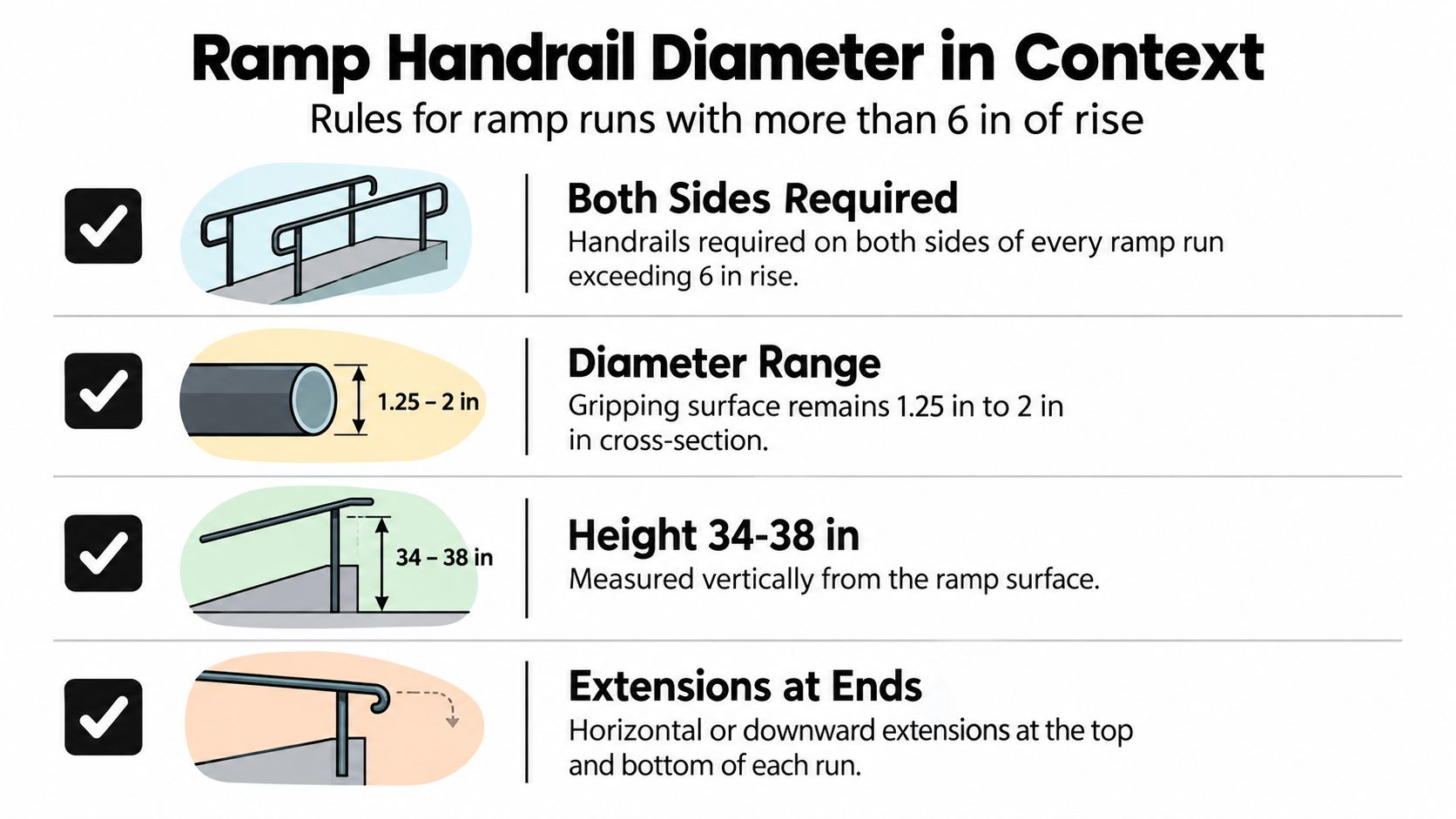
The Access Board also states that wide ramps don't require an intermediate or center handrail. Optional lower handrails for children aren't generally required, except that play-area ramps have specific recommendations, including a 28-inch maximum height and 9-inch minimum separation to reduce entrapment risk. Those lower rails need their own layout review and shouldn't be confused with the primary graspable rail.
For a project-specific ramp layout, the ADA ramp handrail requirements guide provides a useful companion reference. The field check should include both sides, clear width, finished grip, returns, and transitions at every slope break.
How the Florida Building Code Layers Onto ADA
Florida railing work needs more than a federal ADA printout in the truck. Commercial accessibility work should be checked against the current Florida Building Code, the adopted accessibility provisions, the project type, and local review comments. The federal diameter range is a strong starting point, but the permit set and inspection path control the final decision.
The residential distinction matters. A single-family home doesn't automatically become an ADA-covered facility just because it contains a stair or ramp. Residential projects can follow a different code framework from commercial work, while public, institutional, hospitality, and commercial facilities require a more careful accessibility review.
| Rule | 2010 ADA Standard | Florida Building Code |
|---|---|---|
| Circular grip | Use the federal accessible gripping-surface range | Confirm current adopted accessibility provisions |
| Non-circular grip | Check perimeter and cross-section limits | Confirm current adopted accessibility provisions |
| Stairs and ramps | Review height, continuity, returns, and side placement | Check state and local permit requirements |
| Field approval | Measure the finished installation | Coordinate with the local building official |
Treasure Coast contractors should also expect local reviewers to ask for clear dimensions on drawings and in inspection notes. Martin, St. Lucie, Indian River, and Palm Beach projects can differ in review workflow even when the underlying accessibility language is similar. A current code review is especially important when a project has an alteration, a mixed-use building, or an unusual ramp configuration.
For broader ramp planning, the wheelchair ramp requirements guide can help organize the permit conversation. The safest practice is to identify the governing code edition before material is ordered, then keep the approved detail and field measurements together.
How to Measure ADA Handrail Diameter in the Field
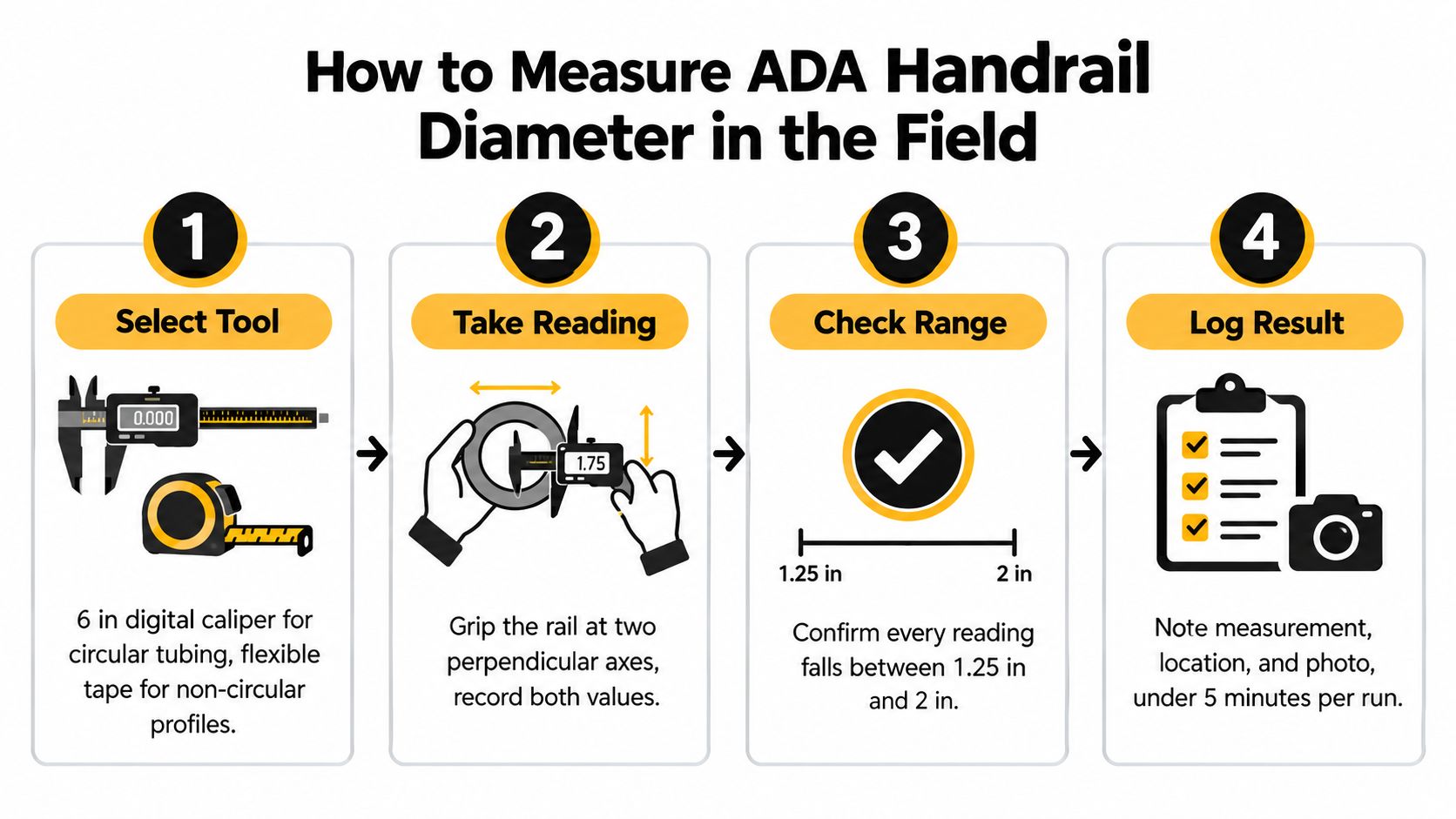
A reliable field check starts with the correct tool. Use a 6-inch digital caliper for circular tubing, a flexible seam tape for non-circular profiles, and a clearance gauge block sized for the required space beside the rail. The caliper should contact the finished surface without crushing a soft sleeve or being placed over a raised weld.
Field sequence
- Tag the run. Identify the stair flight or ramp run and note the profile, finish, and rail location.
- Measure the grip. Take readings near the top of the gripping surface, near each end, and at transitions or splices. For a round rail, check two perpendicular axes.
- Check the surrounding space. Test clearance beside the rail along the complete graspable area, including brackets and collars.
- Record the worst reading. Log the outside diameter or perimeter, location, finish condition, date, and installer or inspector initials.
The finished rail is the relevant object. Powder coat, paint, and wrap materials can increase the measured outside dimension, so raw-tube specifications shouldn't replace a post-finish reading. A photo of the caliper on the rail adds useful evidence when a plan reviewer later questions the submittal.
Why Diameter-Compliant Rails Still Get Rejected
Inspection failures usually occur at the interfaces, not in the middle of a straight tube. A caliper reading on an accessible rail can't compensate for a bracket that blocks the grasp, a return that leaves an open hook, or a splice that interrupts the user's hand path.
Common corrections include:
- Insufficient wall clearance: Replace a tight wall bracket with an offset standoff and recheck the finished gap.
- Sharp termination or weld: Blend the weld, round the termination, and remove any burr that catches a finger or gauge.
- Bracket intrusion: Select a bracket that supports the rail without wrapping into the prohibited portion of the gripping surface.
- Oversized finished grip: Measure after coating or sleeving and choose a smaller substrate when the finish pushes the rail beyond the maximum.
- Interrupted run: Relocate the newel, splice, or transition outside the grasping path, or redesign the rail so the gripping surface remains continuous.
- Incorrect profile documentation: Replace a nominal pipe callout with the actual outside diameter or measured perimeter on the shop drawing.
The most difficult correction is usually a width conflict on a ramp. If posts were set before the rail and brackets were selected, the installed handrail may reduce the clear passage. Checking the finished assembly before final anchoring costs less than relocating posts after inspection.
Quick-Reference Card for ADA Handrail Diameter
The following card is designed for a shop wall, job folder, or inspection tablet. It summarizes the measurements that should be confirmed on the finished assembly.
| Item | ADA Requirement |
|---|---|
| Circular grip | 1.25 to 2 inches finished outside diameter |
| Non-circular perimeter | 4 to 6.25 inches |
| Non-circular cross-section | 2.25 inches maximum |
| Wall and obstruction clearance | 1.5 inches minimum |
| Stair and ramp handrail height | 34 to 38 inches |
| Ramp clear width | 36 inches minimum between handrails |
| Bottom grip obstruction | No more than 20 percent of the gripping surface length |
| Grip edges | Rounded and free of sharp or abrasive elements |
| Handrail ends | Return to a wall, guard, floor, or suitable post |
| Stair continuity | Continuous for the full length of each flight |
| Ramp side placement | Both sides when the rise exceeds 6 inches |
The governing dimension is the finished ADA handrail diameter, not the nominal pipe name. The most dependable jobsite record pairs each measurement with a location and a photograph, especially where a splice, fitting, coating, or wall condition creates a possible inspection question.
Frequently Asked Questions About ADA Handrail Diameter
Does 1.5-inch Schedule 40 steel pipe qualify?
Yes, when its actual outside diameter is 1.900 inches, it falls within the permitted circular range. The installer should still verify the finished rail and adjacent clearance.
Is 2-inch nominal PVC pipe too large?
Nominal labels aren't enough to answer. Measure the actual outside diameter. Any finished circular rail above 2 inches exceeds the federal circular limit.
Does powder coat change the measurement?
Yes, any finish can change the finished outside dimension. Measure the coated rail rather than subtracting an assumed coating thickness.
Does a wood handrail count?
Yes, a wood rail can qualify when its finished circular cross-section measures within the permitted range and the installation meets the other graspability rules.
Can historic galvanized pipe be reused?
Possibly. Reuse requires inspection of the actual outside diameter, surface condition, sharp edges, continuity, returns, and structural attachment.
Do Type II commercial handrails trigger the diameter rule?
Yes. The horizontal grasping surface is the part that must satisfy the applicable profile and diameter requirements.
#MartinCountyFencing #PalmBeachCountyFencing #TreasureCoastRailings #FloridaRailing #ADAHandrails #ADAStairRailings #ADARampRailings #HandrailFabrication #AluminumRailings #CommercialRailings #AccessibilityConstruction #FloridaBuildingCode
AlliedFenceAndGate.com™ fabricates and installs ADA-compliant handrails for Florida stairs and ramps, with field measurement, permitting, documentation, and inspection coordination available for residential and commercial projects. Visit AlliedFenceAndGate.com™ to request a railing assessment and discuss the finished diameter, clearance, profile, and site conditions before fabrication.
Related Fencing Services
Need a fence or gate on the Treasure Coast?
Licensed, insured, and bonded. Free estimates across Martin, St. Lucie, Indian River & Palm Beach counties.
Call (772) 530-3127