Best Aluminum Fence for Coastal Florida Homes

The most popular advice about the best aluminum fence starts with brand rankings, attractive panels, and promises of maintenance-free ownership. That's the wrong starting point for coastal Florida. A handsome fence can still fail pool inspection, corrode around incompatible hardware, or rely on posts that don't match the site's wind exposure.
For Treasure Coast properties, the better purchase is a complete coastal system specification. The quote should identify the alloy and temper, coating system, hardware, structural assumptions, and approval documents. Appearance matters, but those details determine what gets approved and what remains serviceable in salt air.
Table of Contents
- Best Aluminum Fence Picks by Property Job
- Styles and Finishes That Pass Review
- Alloy Coatings and Salt Air Performance
- HOA Approval and Pool Barrier Rules
- Aluminum Fence Cost Ranges for 2026
- Footings Gates and Long-Term Upkeep
- Order the Spec and Book the Estimate
Best Aluminum Fence Picks by Property Job
The best aluminum fence on the Treasure Coast is the system that matches the property's job, not the winner of a national brand list. A pool enclosure, an HOA frontage, and an exposed Intracoastal boundary can look similar while requiring different gates, connections, and paperwork.
The practical starting point is the property's controlling requirement. For a pool, that's the barrier and gate layout. For street frontage, it's the architectural approval. For an exposed waterfront lot, it's the combination of finish durability and structural design.
Best Aluminum Fence by Treasure Coast Job
The heights below are selection targets, not blanket zoning permissions. The approved site plan and applicable barrier requirements control the finished installation.
| Property job | Winning style | Usual height | Why it wins |
|---|---|---|---|
| Pool or spa barrier | Three-rail open picket with a code-compliant gate | Pool-barrier minimum approved by the jurisdiction | Continuous enclosure, outward-closing gate layout, and low solidity |
| HOA front yard | Flat-top ornamental in black, bronze, or white | Height permitted by the architectural guidelines | Open views and a straightforward profile for architectural review |
| Salt-air or Intracoastal lot | Heavier architectural aluminum with documented powder coating | Approved boundary height supported by the structural design | Documented alloy, durable coating, and compatible or isolated hardware |
| Side or rear privacy | Closer pickets or aluminum privacy panels | Privacy height allowed by the board and jurisdiction | More screening, with wind loads explicitly addressed |
| Commercial perimeter | Heavy posts with specified gate hardware and operator | Height established by the security plan and permit | Engineered connections, access control, and a complete inspection package |
Installed pricing belongs beside these selections only after the contractor identifies the actual package. A generic per-foot allowance doesn't reveal whether gates, removal, structural details, or permit work are included.
Match the Package to the Exposure
An ordinary yard boundary generally benefits from an open-picket layout. It preserves visibility and avoids adding screening that the owner doesn't need. A pool package needs more than the same panel with a different latch: gate swing, closing action, grade clearance, and the entire enclosure must work together.
An HOA frontage calls for restraint. A flat-top profile is a sensible submission candidate, but black, bronze, and white shouldn't be treated as universally approved colors. The board's written palette controls.
Along the Intracoastal, Jensen Beach, Hobe Sound, Jupiter, and similarly exposed locations, the quote should identify a coastal-suitable finish and connection system. A heavier-looking panel isn't enough if its hinges, screws, and field cuts remain unspecified.
Privacy panels deserve separate treatment. Aluminum privacy fencing still catches wind. Changing the material from wood or vinyl doesn't eliminate the load created by a more solid surface.
Selection rule: A decorative panel with the wrong pool gate can fail inspection. An underspecified post on an exposed corner can fail the structural assumptions behind the permit.
The useful comparison is therefore package against package: the same footage, gate arrangement, exposure, finish, and approval scope. That comparison exposes meaningful differences that a brand photograph cannot.
Styles and Finishes That Pass Review
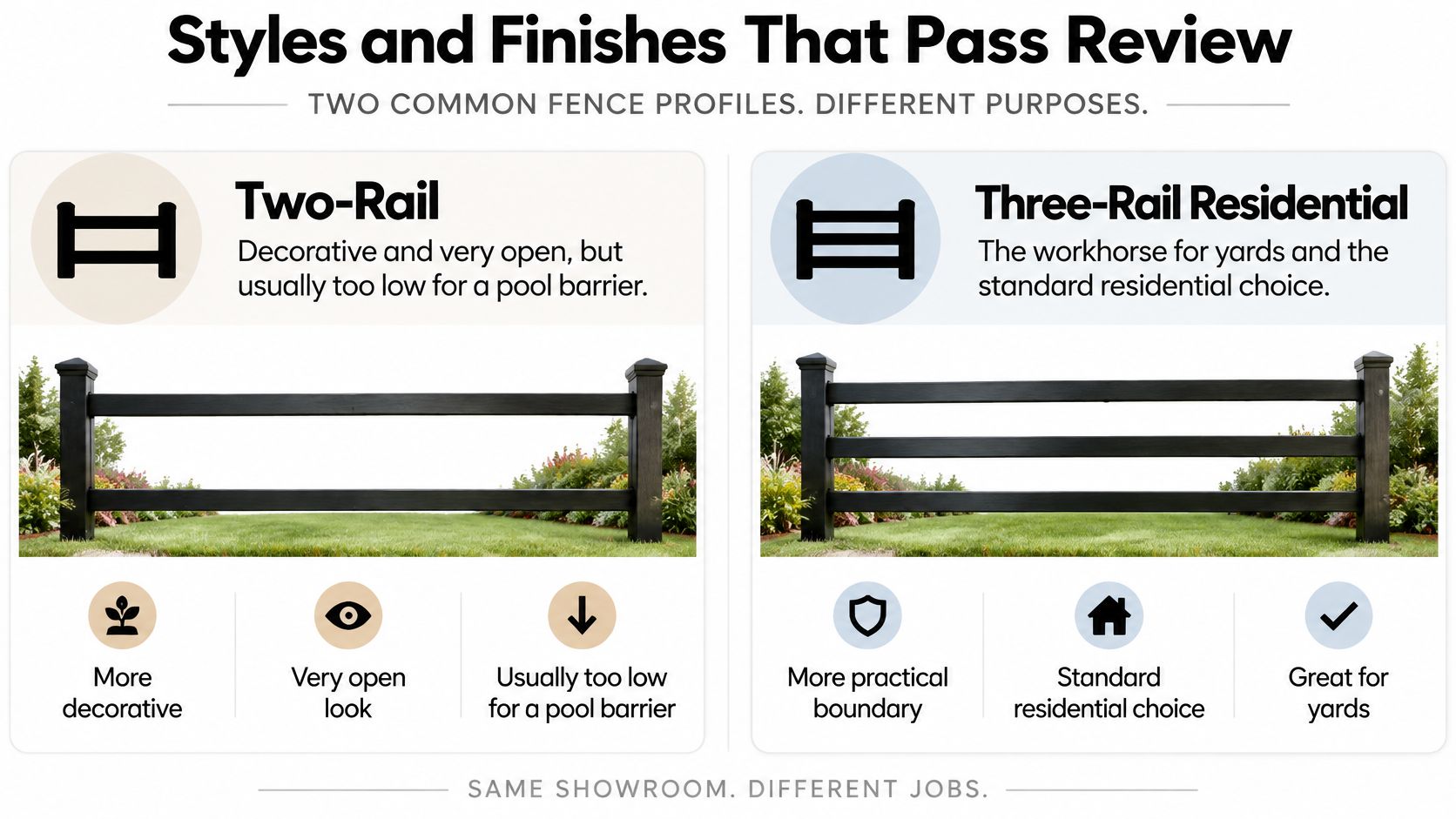
Showroom profiles can make very different fences look interchangeable. Rail count changes appearance, but it doesn't independently establish pool compliance or structural capacity. The actual height, openings, rail arrangement, and approved installation detail matter more than the product's decorative label.
Compare Profiles Before Selecting Ornament
Two-rail fencing reads light and decorative. It works well where the goal is visual definition rather than enclosure, but a low decorative version shouldn't be assumed suitable for a pool.
Three-rail residential fencing is the practical starting point for many yards and pool layouts. The additional rail creates a more defined boundary without necessarily making the fence visually heavy. Its suitability still depends on the complete approved profile.
A taller, additional-rail design can suit a rear boundary where the owner wants more presence. Puppy-picket configurations add closely spaced lower pickets for small animals, but pet containment doesn't establish pool compliance. Ground gaps and openings require their own review.
- Flat top: A restrained option for frontage submissions and contemporary architecture.
- Spear or finial top: A traditional appearance that needs explicit architectural acceptance, especially along pedestrian frontage.
- Closer pickets: Better visual screening and small-pet containment, with more material and greater solidity.
- Louvered or privacy panels: Useful for screening equipment or neighboring activity, provided the structural design addresses the additional wind-catching surface.
The aluminum fence design guide can help an owner compare profiles before requesting samples. A photo of the selected style should accompany the written description so the board, supplier, and installer aren't interpreting the same name differently.
Separate Finish From Style
A black flat-top panel describes appearance, not coating quality. Standard polyester powder coating and super-durable polyester are different purchasing discussions, even when their color samples look alike. The supplier should identify the actual coating product and its suitability for the exposure.
For humid Florida conditions, a documented super-durable system is a reasonable upgrade to evaluate. It shouldn't be accepted solely because a salesperson uses the word premium. Product documentation, pretreatment, application quality, and warranty exclusions matter.
Anodizing offers a metallic appearance rather than a painted color. It belongs in a specification where that appearance is intentional, not as an assumed substitute for any powder-coated product.
The HOA approves the visible color and profile. Coastal durability depends on the coating system, connection details, and treatment of exposed metal.
The quote should therefore name style, color, and coating standard separately. Aluminum fence in black is an incomplete description of the product being purchased.
Alloy Coatings and Salt Air Performance
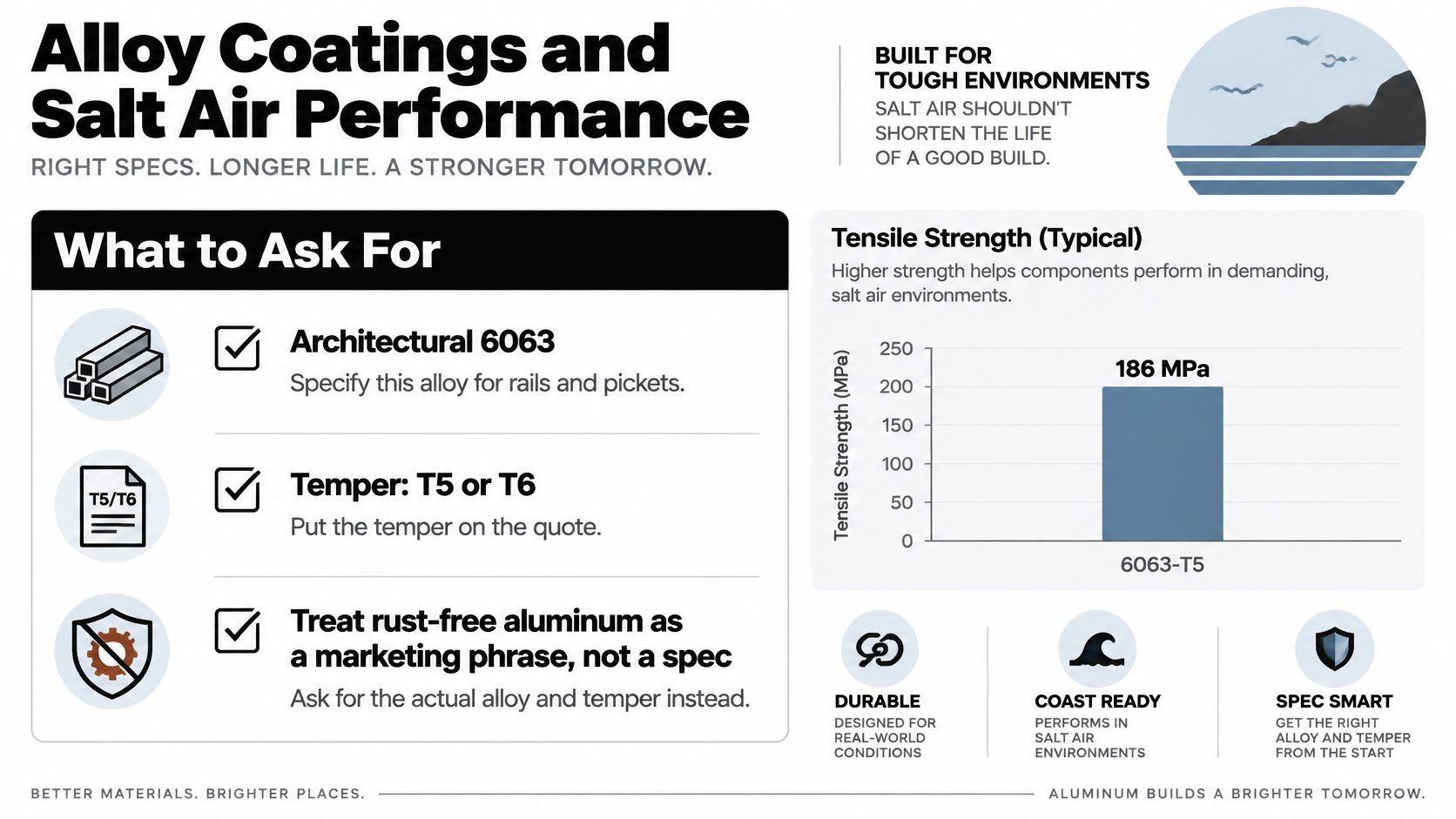
Rust-free aluminum is a marketing description, not a specification. Aluminum doesn't develop iron rust, but an aluminum assembly can still suffer corrosion, finish failure, or deterioration around unsuitable connections. Salt exposure makes those details especially important.
For rails and pickets, architectural aluminum with a documented temper provides a useful baseline. The supplier should also disclose section dimensions and wall thickness so the contractor can compare actual components rather than broad residential and commercial labels.
Specify the Metal and the Finished Section
The Gabrian architectural alloy technical sheet lists 6063-T5 at approximately 186 MPa tensile strength and 145 MPa yield strength, compared with 6063-T6 at approximately 241 MPa tensile strength and 214 MPa yield strength, and identifies the alloy as corrosion-resistant and readily anodized.
Those material properties help distinguish proposals, but they don't establish the capacity of a completed fence. A stronger temper cannot automatically compensate for a thinner wall, poorly designed weld, excessive post spacing, or an inadequately supported gate.
For a coastal quote, 6063-T5 or 6063-T6 is a practical architectural baseline when supported by the system design. If a fabricator proposes another alloy, the proper response is to request its properties and the relevant structural details, not reject it solely because its designation differs.
Require a Coating System, Not a Color Chip
The finish submittal should state the pretreatment, powder chemistry, applicable architectural coating standard, and warranty. If the proposal identifies AAMA 2604 or AAMA 2605, the supplier should provide documentation for that claim and identify which components receive the specified system.
A coating standard isn't the same thing as warranty coverage. Coastal-distance exclusions, buried ends, field modifications, and cleaning obligations may narrow what the manufacturer will cover.
- Alloy and temper: Identify the metal used in rails, pickets, posts, and gate frames.
- Section dimensions: Record wall thickness and connection details, not just outside dimensions.
- Coating documentation: Obtain the product name, pretreatment, standard, and written exclusions.
- Hardware compatibility: Specify suitable fasteners and isolation wherever dissimilar metals meet.
- Field-cut protection: Use the manufacturer's approved preparation and touch-up system.
- Drainage details: Keep designed drainage paths open rather than sealing water inside posts or rails.
Stainless steel hardware isn't a complete corrosion strategy by itself. In wet, salty conditions, stainless and aluminum may still need electrical isolation and careful connection detailing. Hinges, latches, screws, and gate-frame joints deserve the same scrutiny as the panel face.
A bare saw cut should never disappear into the installation without treatment. The correct repair method depends on the coating manufacturer, and its appearance may differ from the factory finish. That's a reason to plan cuts carefully, not to skip protection.
HOA Approval and Pool Barrier Rules
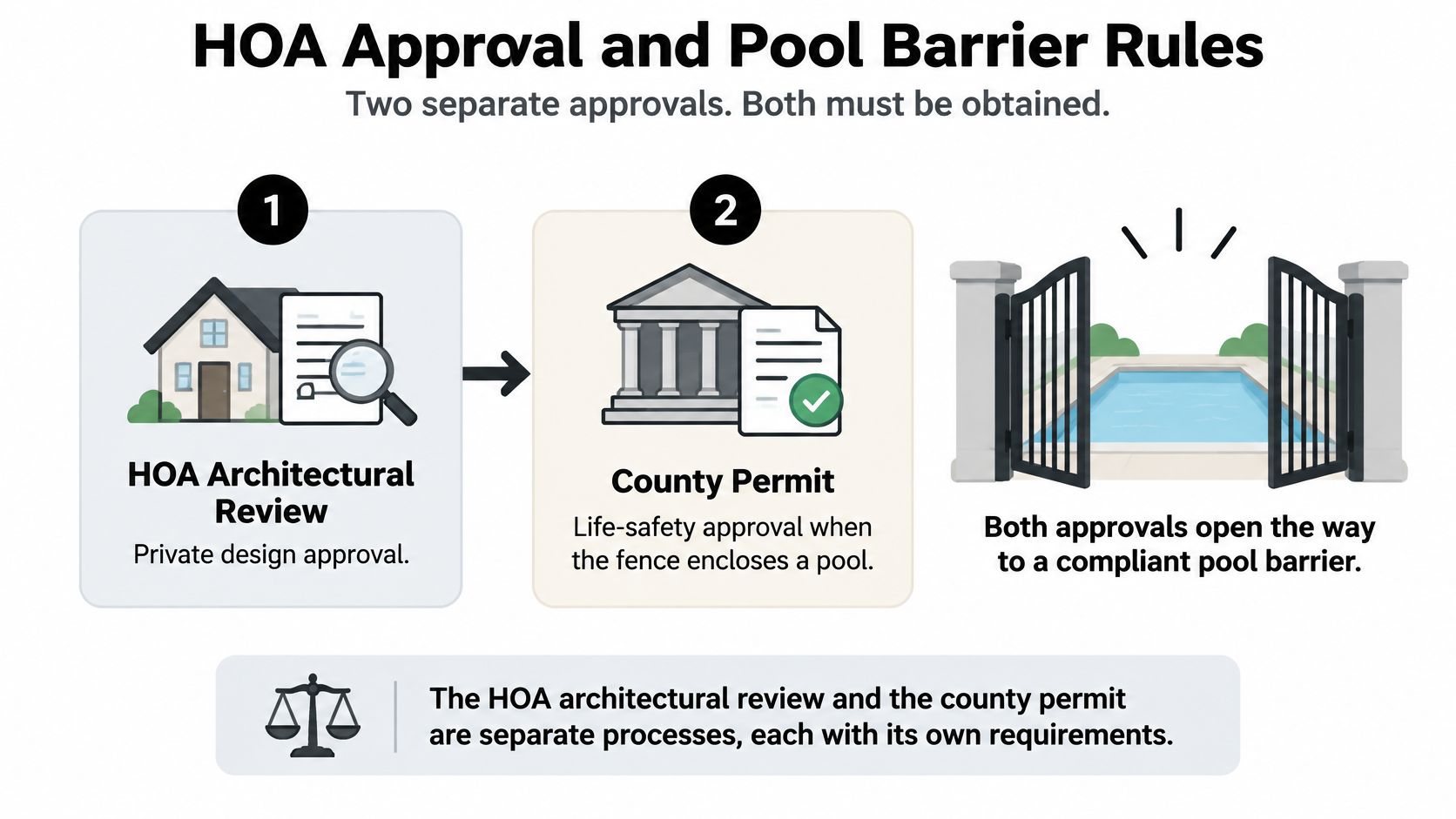
HOA approval and permit approval are separate decisions. The architectural committee controls private design requirements. The building authority evaluates the applicable construction and life-safety requirements, including pool barriers.
A neighbor's existing fence doesn't prove that the same design is currently permitted. It may have different approval conditions, a different installation date, or no connection to the proposed pool enclosure.
Assemble the Architectural Packet
A complete submission starts with the association's current written guidelines. The owner should obtain the application, permitted materials and colors, height rules, setback requirements, and any restrictions on decorative tops or gate locations.
The packet should include a marked survey or plot plan, fence elevation, color identification, and gate arrangement. Missing signatures, an unclear property line, or a profile that doesn't match the application can send the proposal back for revision. The Florida HOA fence approval guide provides a useful preparation checklist.
Confirm the Applicable Pool Detail
The Palmetto Bay standard open-aluminum fence detail identifies a continuous barrier at least 48 inches high and includes public-pool gate provisions requiring self-closing, self-latching, lockable gates that open away from the pool, with the latch at least 54 inches above the gate bottom or at least 3 inches below the top on the pool side.
Those public-pool provisions shouldn't be treated as a complete residential design rule. The reviewing jurisdiction must confirm the detail applicable to the particular property and pool.
Pool barrier dimensions that set the gate and fence layout
| Requirement | Minimum or rule | Affects |
|---|---|---|
| Barrier height | Continuous minimum established by the applicable pool detail | Fence height and grade layout |
| Gate closing | Self-closing and self-latching under the applicable detail | Hinge and closer selection |
| Gate lock | Lockable where required by the applicable detail | Latch hardware |
| Latch height | Elevated or pool-side protected location specified by the applicable detail | Latch position and access |
| Gate swing | Outward, away from the pool | Hinge side and post layout |
| Palm Beach County barrier | Complete enclosure around the pool, spa, or hot tub | Full perimeter design |
| Neighbor wall use | Recorded Pool Barrier Agreement required in Palm Beach County | Property-line documentation |
Palm Beach County's pool-barrier requirements require a 360-degree barrier around every pool, spa, or hot tub, inspection before the Certificate of Completion when a fence or wall forms the barrier, and a recorded Pool Barrier Agreement for qualifying use of a neighbor's wall or fence.
Martin County's fence compliance materials state that pool enclosures require a permit whether or not a slab is included and that fences serving as pool barriers must be inspected.
The permit coordinator should receive the HOA-approved layout before finalizing the submittal. Allied's permitting, Notice of Commencement preparation, and inspection coordination fit into that workflow, but they don't replace the owner's architectural approval.
Aluminum Fence Cost Ranges for 2026
A useful 2026 aluminum fence budget starts with a defined scope, not a national panel price multiplied by the property perimeter. The right comparison is a complete system for the job: fence sections, gates, finish, mounting, and any required engineering or permitting. A current written contractor estimate is needed for local installed pricing.
Compare Installed Packages on Equal Terms
2026 installed aluminum fence bid comparison
| Package | Price basis | What pushes the total up |
|---|---|---|
| Residential open picket | Written installed quote for the selected standard or upgraded package | Rail count, picket spacing, and installation conditions |
| Pool-code aluminum | Written installed quote covering the specified gate hardware and mounting | Self-closing hardware, deck work, and inspection scope |
| Coastal heavy spec | Written installed quote for the documented alloy, coating, and compatible hardware | Enhanced finish requirements and structural details |
| Commercial or custom weld | Written quote for the engineered base scope and any custom fabrication or access control | Post size, operators, engineering, and electrical coordination |
Use the table to compare bids, not as a published price schedule. Ask each contractor to price the same drawing and specification, then identify the scope behind each option. The aluminum fence price-per-foot guide can help frame the installed-budget discussion, but the proposal should state what its unit price includes and list separate items.
Identify the Costs Hidden by Footage
A long, accessible straight run has a different installation scope from short sections broken up by gates, corners, trees, and deck mounts. Dividing the project total by fence length can hide those differences. Compare the work item by item.
- Gate work: List the gate count, clear opening, swing, hardware, and any operator or electrical scope.
- Existing conditions: Include demolition, disposal, tree or stump work, and access restrictions.
- Mounting: Separate standard post installation from core drilling, anchoring, or deck repair.
- Layout: Account for grade changes, unusual corners, and unresolved property-line questions.
- Administration: State whether permitting, engineering, inspection visits, and association documents are included.
A pool self-closer is a separate hardware item, and a commercial operator is not included automatically with fence panels. Require both to appear clearly in the proposal. For a coastal system, also compare the specified alloy and temper, coating, and compatible hardware rather than treating “aluminum” as a complete specification.
Vinyl, chain link, and wood may serve different priorities. Their cheapest boundary configurations are not equivalent to a complete aluminum pool package. Compare assemblies intended to do the same job and meet the same approval requirements.
Budget check: A lower total means little unless the drawing, gates, finish, installation method, and exclusions match.
Confirm minimum charges, financing terms, deposits, and completion payments in the current contract. An instant estimator can provide a preliminary budget, but it does not define the approved construction scope or the final permit-dependent price.
Footings Gates and Long-Term Upkeep
Installation should begin with the survey and approved layout, not an auger. The crew needs the property line, gate locations, grade transitions, and pool-gate swing established before excavation. Utility locating belongs before digging, and Allied includes that coordination in its project workflow.
Post spacing and footing dimensions must follow the structural assumptions. A catalog photograph cannot establish the correct foundation for an exposed corner or a wide gate.
Read the Wind Assumptions
A public aluminum barrier permit calculation evaluated a 4-foot powder-coated picket barrier using ASCE 7-22 and the 2023 Florida Building Code, with 115-mph ultimate wind speed, Exposure C, Risk Category II, and 30% solidity; it calculated approximately 19.9 pounds per square foot and about 120 pounds per post for a 6-square-foot effective tributary area, using 2-by-2-inch, 0.062-inch-wall 6063-T6 posts.
That is a project example, not a universal post schedule. Its value is the chain of documented assumptions connecting the fence geometry to the post and foundation design.
The submittal should identify:
- Site exposure: Design wind speed, exposure category, and relevant site conditions.
- Fence geometry: Height, solidity, spacing, and changes in direction or grade.
- Structural components: Post section, connections, footing dimensions, and mounting method.
- Gate demands: Gate-frame capacity, hinge support, closer requirements, and operator loads where applicable.
Open pickets reduce wind-catching area compared with solid screening, but gates and terminal posts still need deliberate support. Core-drilled deck installations require an appropriate engineered mounting detail, compatible setting materials, and attention to the surrounding concrete.
Protect the Assembly After Installation
Maintenance should focus on washing and inspection rather than routine repainting. Fresh-water rinsing removes salt deposits; mild soap and a soft cloth address ordinary dirt without unnecessarily abrading the finish.
Sprinklers should be directed away from the fence. Designed drainage openings should remain clear, and damaged coating should receive the manufacturer's approved repair treatment. Pool-gate checks should include closing and latching from different opening positions, not merely a push from fully open.
At replacement, removable components make material recovery easier. The USGS aluminum summary reports approximately 3.6 million tons of aluminum recovered from purchased scrap in 2024, demonstrating an established recovery market, though not a fence-specific recycling rate.
Recyclability doesn't excuse early replacement. Documented materials, repairable connections, and consistent care remain the more useful ownership priorities.
Order the Spec and Book the Estimate
The buying decision should end with an agreed specification and a usable estimate, not another collection of product photographs. A contractor can price a clear scope more accurately than a general request for a coastal fence.
Follow a Clear Decision Path
Choose the property job. Identify whether the fence primarily serves pool safety, architectural frontage, privacy, ordinary enclosure, or commercial security. Mixed-use properties may require different assemblies along different boundaries.
Lock the controlling specification. A pool layout needs the applicable barrier detail and gate arrangement. Street frontage needs the approved appearance. A salt-exposed boundary needs documented metal, coating, and connection requirements.
Collect the estimating inputs. Prepare approximate footage, gate count and swing, a survey or useful property photographs, and the HOA guidelines. Mark existing fencing, deck areas, equipment, and access restrictions rather than leaving those conditions for the installer to discover.
Use the estimate to confirm scope. Run a preliminary estimator, then arrange the site visit needed to resolve mounting, grade, exposure, and permit questions. The first written proposal should match the selected property job before scheduling proceeds.
Allied Fence & Gate serves Martin County and Palm Beach County and offers an instant estimating workflow with PDF ballpark pricing. Its lot-plan tools support survey review, while its office coordinates permitting, the Notice of Commencement, utility locating, and inspections.
Owners should verify the contractor's current license, insurance, bonding, written warranty, and payment terms before signing. The estimate should also identify who supplies association approval and who responds to permit corrections.
The best aluminum fence is the one whose paperwork describes the same system the crew installs. A clear specification makes that result easier to verify before materials arrive.
#StuartFencing #PalmCityFencing #JensenBeachFencing #HobeSoundFencing #SewallsPointFencing #MartinCountyFencing #PortStLucieFencing #FortPierceFencing #PalmBeachGardensFencing #JupiterFencing #TequestaFencing #NorthPalmBeachFencing #PalmBeachCountyFencing #TreasureCoastFencing #AluminumFence #PoolFence #HOAFence #FloridaPoolBarrier #CoastalFence #FenceInstallation
AlliedFenceAndGate.com™ offers aluminum fence installation, custom gate work, estimating tools, and permit coordination for Treasure Coast and northern Palm Beach County properties. Homeowners can visit AlliedFenceAndGate.com™ to submit a survey, identify the required fence and gates, and request a site-specific estimate for a documented coastal system.
Related Fencing Services
Need a fence or gate on the Treasure Coast?
Licensed, insured, and bonded. Free estimates across Martin, St. Lucie, Indian River & Palm Beach counties.
Call (772) 530-3127