Aluminum Pool Fence Cost Per Foot in 2026
Installed aluminum pool fencing costs about $30–$60 per linear foot, putting a 100-foot enclosure near $3,000–$6,000 before site extras. Allied's published aluminum starting band is broader, $28–$150 per foot, so the table below separates pool-barrier pricing from boundary fencing, panel-only pricing, and project totals.
The useful question isn't which headline is lowest. It's whether competing prices include the same barrier layout, gate package, footing work, and approval responsibilities.
Table of Contents
- Aluminum Pool Fence Cost per Foot
- Why Pool Barriers Cost More Than Yard Fences
- The Line Items Inside an Installed Price
- When the Same Footage Costs More
- Sample Totals for Florida Pool Layouts
- Keep Change Orders Off the Bill
Aluminum Pool Fence Cost per Foot
Aluminum pool fence cost benchmarks for 2026
| Scope | Price basis | Typical range | What the number leaves out |
|---|---|---|---|
| Installed aluminum pool fence | Per linear foot | $30–$60 | Hard excavation, permits, demolition, landscape repair, premium gates |
| Ornamental aluminum boundary fence | Per linear foot installed | $15–$35 | Pool-barrier height, spacing, and self-latching hardware |
| Material-only aluminum panels | Per linear foot | $5–$20 | Posts, footings, labor, gates, permits, and inspection |
| Allied published aluminum, Treasure Coast | Per linear foot starting band | $28–$150 | Final gates, custom panels, deck work, and permit fees |
| 100-foot pool enclosure | Project total at $30–$60 | $3,000–$6,000 | Same extras as the per-foot pool row |
| 150-foot pool enclosure | Project total at $30–$60 | $4,500–$9,000 | Same extras as the per-foot pool row |
The national benchmarks in Fence My Pool's aluminum pool fence cost guide place installed pool fencing at $30–$60 per linear foot, ornamental aluminum at $15–$35 installed, and material-only panels at $5–$20, producing baseline totals of $3,000–$6,000 for 100 feet and $4,500–$9,000 for 150 feet. Allied's broader starting band covers aluminum fencing generally, not a guaranteed pool-enclosure package.
A linear foot measures the actual barrier route. It doesn't measure the pool's surface area, the patio's square footage, or the distance around the waterline. A fence that bends around equipment, connects to an approved existing barrier, or shifts outward to preserve a walkway needs its own measured layout.
Compare the finished enclosure, not the panel rack
A retail panel price answers a purchasing question. An installed price answers a construction question. The difference includes post placement, anchoring, gate operation, access for installation, and responsibility for delivering an inspection-ready enclosure.
Ordinary boundary fencing can also look almost identical to pool fencing in a photograph. That doesn't establish that its openings, installation clearances, or hardware suit the proposed pool layout. A homeowner comparing photographs rather than specifications can end up comparing different products.
The broader aluminum band shouldn't be treated as permission to apply its lowest endpoint to every pool. Custom fabrication and difficult mounting conditions belong in a different budget category from standard panels installed along an accessible fence line.
Budgeting rule: A low panel price isn't a low completed-project price until the missing installation work has been priced.
Normalize each proposal
The comparison starts with complete installed price divided by measured barrier footage. That produces an effective installed rate, but the contractor should still show gates and required hardware separately so those components remain visible.
Each proposal should identify:
- Measured route: The same fence alignment and termination points.
- Base installation: Standard panels, posts, footings, and assembly.
- Access package: Gate count, gate widths, hinges, closers, and latches.
- Site allowances: Known difficult work and clearly defined exclusions.
A lump-sum proposal isn't automatically unreasonable. The problem is an unexplained lump sum that prevents the homeowner from checking what will be built.
Why Pool Barriers Cost More Than Yard Fences
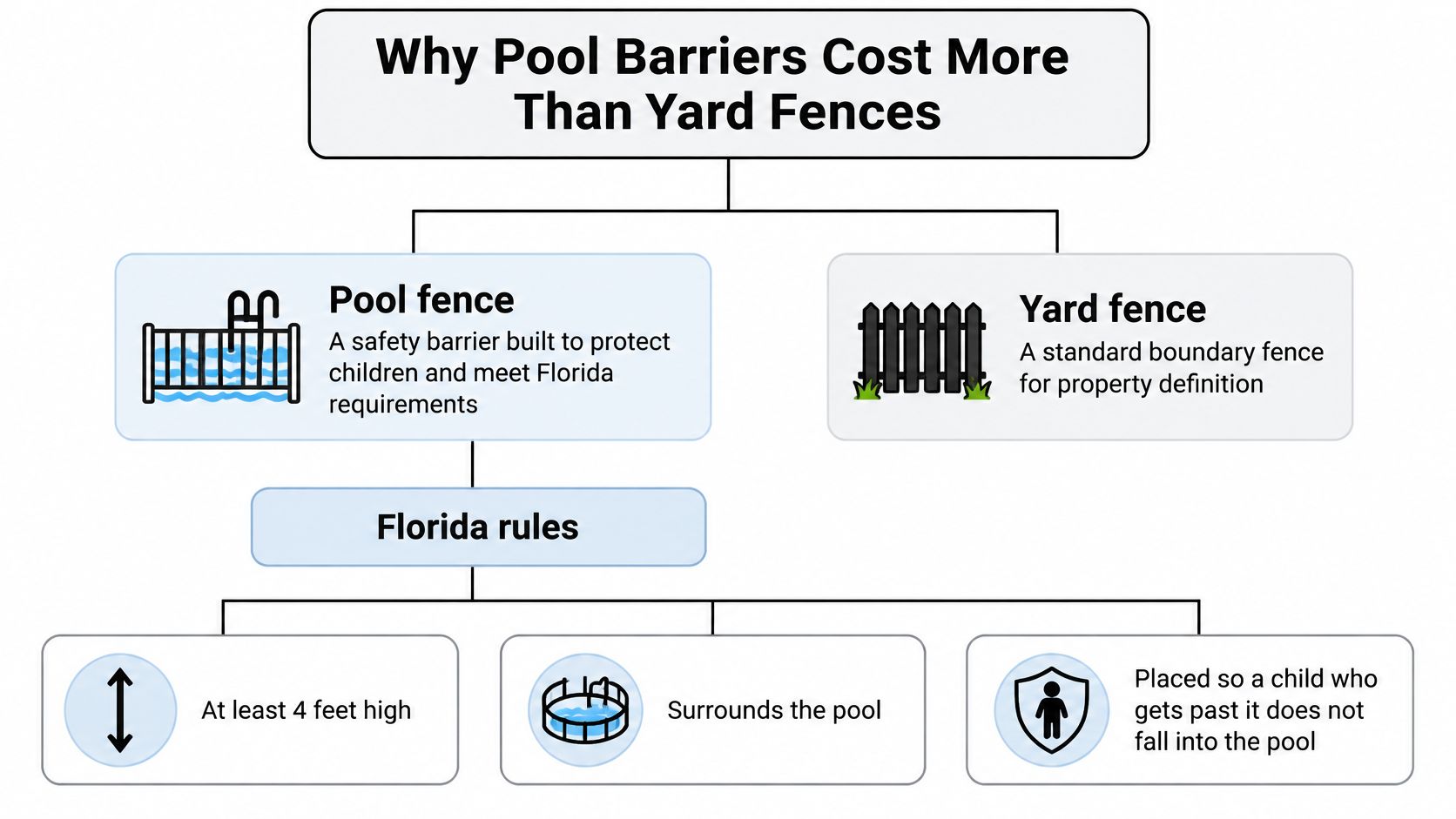
A pool fence is a safety barrier, not just an ornamental property boundary. The contractor must select components and place them so the completed enclosure performs as a system, including the space beneath panels and the operation of every access gate.
Florida's pool-barrier statute establishes a barrier height of at least 4 feet, a perimeter enclosure, and placement that prevents a child who penetrates the barrier from immediately falling into the pool. Local implementation details used in pool-barrier planning also include a maximum 2-inch bottom clearance, a 4-inch sphere opening limitation, and self-closing, self-latching gate hardware with the release at least 54 inches above the gate bottom; the applicable building department should confirm the requirements for the proposed installation.
The gate turns a panel purchase into a safety system
A useful comparison is a door slab versus a complete working doorway. Buying the slab doesn't provide the frame, hinges, latch, threshold clearance, or adjustment needed for the door to function correctly.
Pool fencing follows the same logic. Panels may need different picket geometry, a lower bottom rail, or a different configuration at a grade transition. Gate posts must support hardware that closes and latches reliably, rather than merely allowing the gate to swing.
The Florida residential pool-barrier requirements also require access gates to open outward away from the pool, self-close, and include a self-latching locking device with a release positioned beyond a young child's reach. The statute generally separates the pool barrier from the yard fence unless the yard fence itself satisfies the barrier requirements.
What a compliant scope should identify
A quote should describe the proposed system clearly enough that the homeowner isn't relying on the phrase pool fence alone.
- Panel geometry: Height, picket arrangement, and clear openings.
- Ground relationship: How the installer will handle low spots and transitions.
- Gate equipment: Identifiable hinge, closer, latch, and locking provisions.
- Approval responsibility: Who prepares the permit package and handles inspection-related corrections.
The practical overview of Florida pool fence requirements can help homeowners organize those questions before a site visit.
Substituting a decorative panel and adding a latch later doesn't necessarily solve the problem. The original panel geometry or proposed layout may still need to change. Spending less on unsuitable materials can leave the homeowner paying for replacement work before the enclosure is accepted.
The Line Items Inside an Installed Price
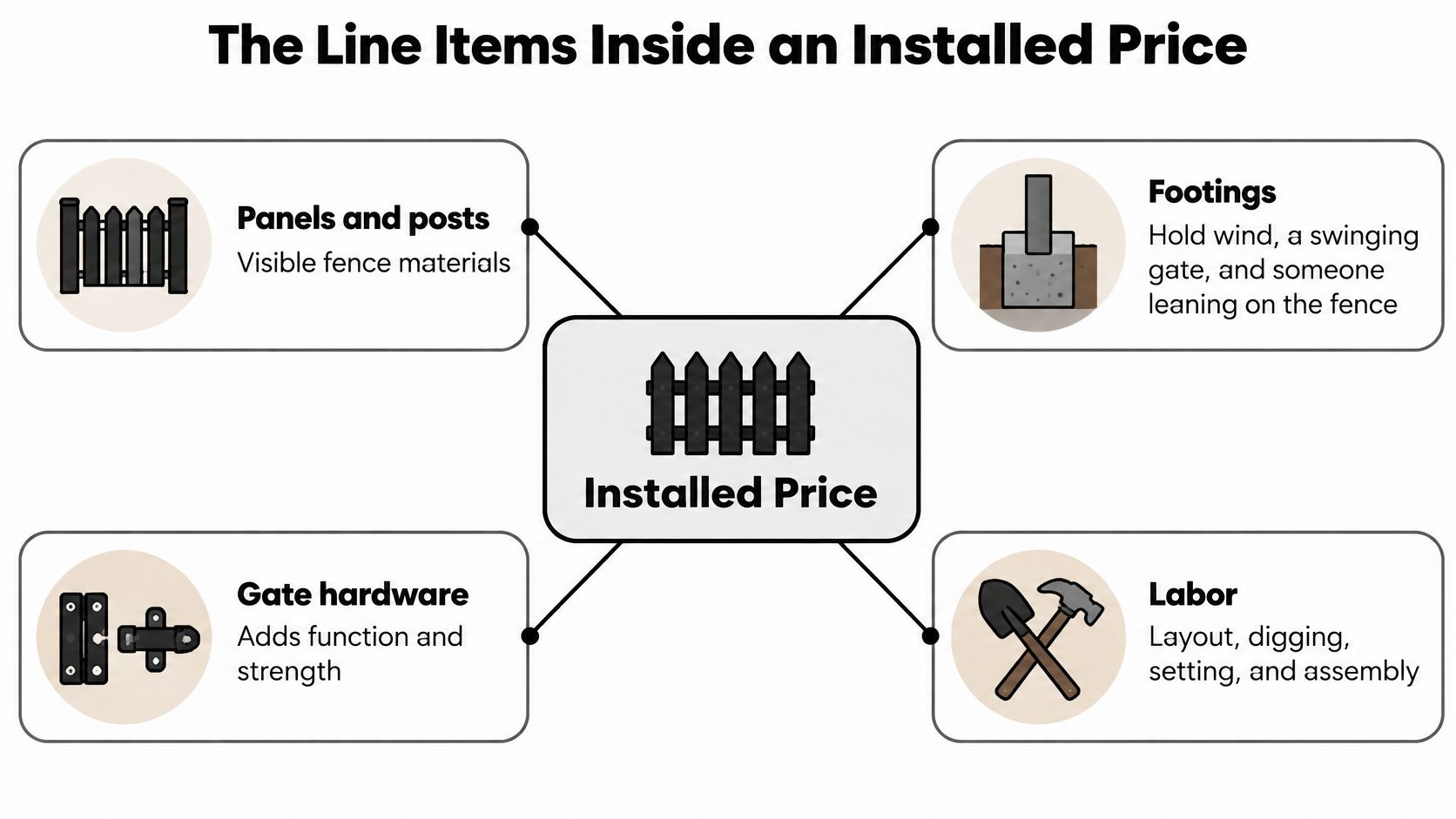
An installed fence price should describe what the crew supplies, what the crew builds, and what happens when the work is finished. Panels and posts are visible, but they aren't the entire scope.
A bundled price can be perfectly workable when its inclusions are written down. It becomes difficult to evaluate when the homeowner can't tell whether deck drilling, gate adjustment, or surface repair is included.
Read the bid as a construction package
| Bid bucket | What should be named | What deserves a question |
|---|---|---|
| Panels and pickets | Manufacturer or product series, configuration, finish | An unspecified aluminum panel |
| Posts and footings | Post type, mounting method, footing scope | Concrete included without installation detail |
| Gates and hardware | Gate dimensions and hardware models | Gate included without a hardware description |
| Labor and access | Layout, excavation, assembly, debris handling | Unpriced restricted-access work |
| Administration | Permit handling, required documents, inspection coordination | Owner responsibility left undefined |
| Restoration | Concrete, paver, irrigation, and landscape repair boundaries | Repair by others without identifying the affected area |
Posts and footings deserve close attention. A gate post carries a different working load from an ordinary line post, and a mounting detail suitable for one surface may be unsuitable for another. The bid should identify how the installer intends to support the system, not leave that decision until materials arrive.
Labor also includes tasks that aren't obvious from a finished photograph. Protecting a deck, carrying panels through a restricted access route, aligning mounting points, and cleaning drilling residue all require planned work.
Separate administration from exclusions
Permit fees and permit handling aren't interchangeable. A proposal can include preparing and submitting paperwork while excluding the jurisdiction's charges, or include both. The wording should make that distinction.
The same applies to a Notice of Commencement, utility locating, and inspection attendance. Any required documentation should have an assigned owner, and the contractor should explain which underground facilities need additional attention beyond the public utility locate.
- Finish specification: Identify the coating system rather than relying on a color name.
- Fastener compatibility: Specify fasteners and mounting components suited to the selected aluminum system and coastal exposure.
- Completion scope: Include final gate adjustment, debris removal, and the agreed inspection handoff.
A corrosion-resistant finish doesn't make every attached component corrosion-resistant. Hinges, latches, screws, and mounting hardware need compatible specifications too.
Proposal check: Included should describe a deliverable, not merely appear beside a vague category.
When the Same Footage Costs More
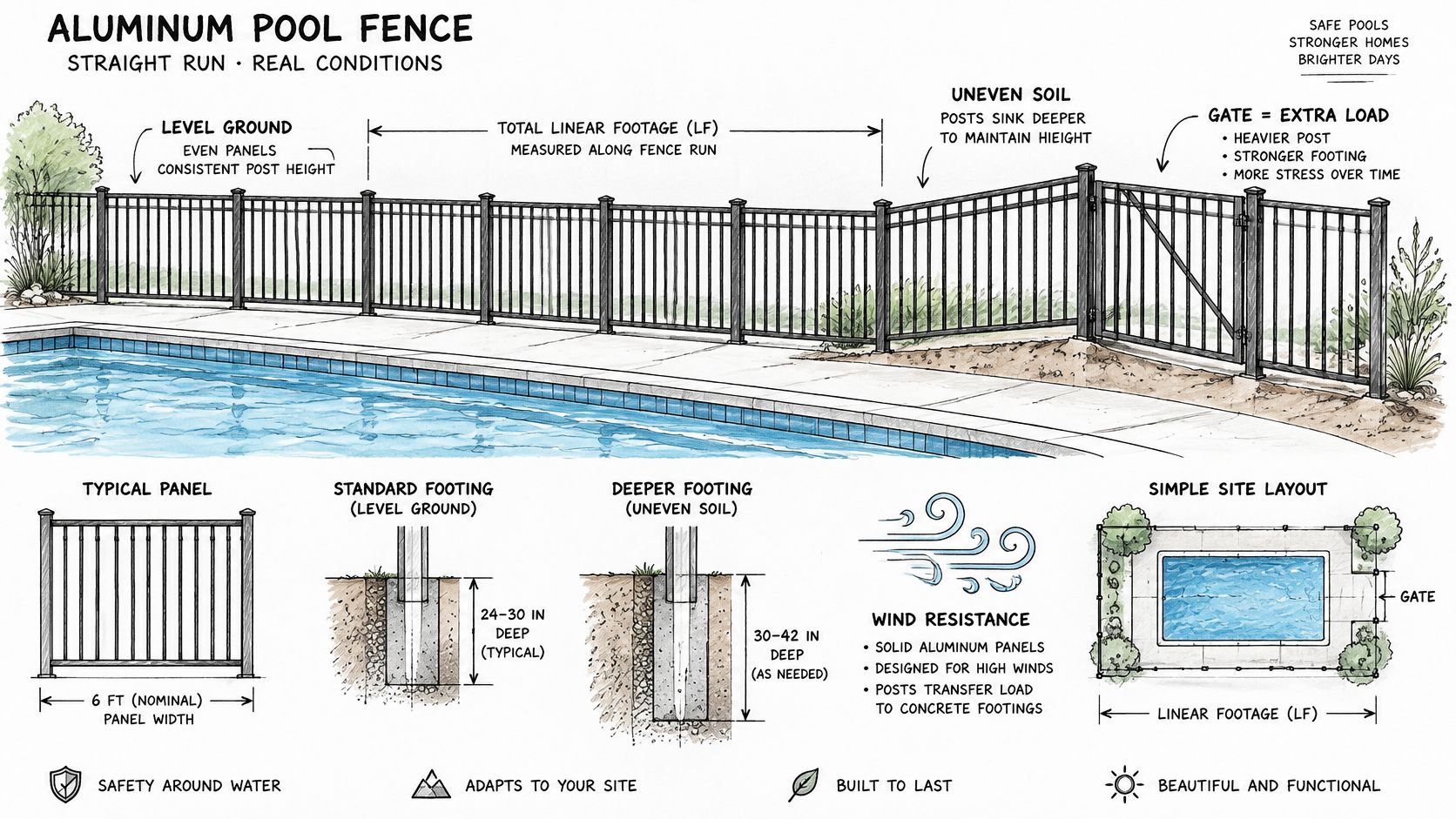
Consider two proposed enclosures with equal measured lengths. One follows straight runs through accessible soil beside an open patio. The other crosses a paver deck, turns beside a screened enclosure, and passes a narrow planting strip.
The first installer can establish a clear string line and reach post locations with excavation equipment. The second may need to protect finished surfaces, investigate what supports the pavers, relocate a post around an obstruction, and carry materials through a confined passage.
Florida's City of Newberry swimming-pool permit application recognizes aluminum as a pool-barrier material while requiring the complete barrier around the pool perimeter. Removing an inconvenient section from the proposed layout isn't a sound cost-saving measure unless an approved alternative maintains the enclosure.
Price the difficult post locations
The deck-and-screen layout needs more than a higher blanket labor allowance. The contractor should point to the affected locations on the plan and describe the proposed work.
Core drilling may be appropriate for some concrete installations, but pavers alone aren't a structural footing. The installer needs to establish what lies beneath the finished surface and select a suitable anchoring approach. A retaining wall or slab edge also deserves review before anyone assumes it can support a fence post.
The proposal should distinguish:
- Standard installation: Accessible post locations using the agreed base detail.
- Special mounting: Core drilling, engineered attachments, or other nonstandard anchoring.
- Custom fabrication: Panels or transitions that cannot be assembled from the selected standard system.
- Surface restoration: Replacement pavers, concrete patching, and cleanup of affected finishes.
Resolve the layout before ordering
A marked survey or site plan should show the pool edge, walls, screen structure, gates, grade changes, and known utility routes. Photographs help with access planning, but they don't replace measurements at the proposed post locations.
Curves deserve particular attention. A smooth-looking enclosure may require short changes in direction, additional posts, or fabricated sections rather than standard panels forced into an unsuitable alignment. Reviewing aluminum fence designs helps separate an aesthetic preference from its fabrication consequences.
The useful question is specific: Is this post location included as standard work, or priced as a special condition? That question gives the homeowner something concrete to compare.
A higher bid may be justified by a better-defined mounting and restoration scope. It shouldn't receive that assumption automatically, though. The contractor still needs to explain the difference in writing.
Sample Totals for Florida Pool Layouts
Published comparisons place a professionally installed permanent aluminum enclosure around a 100-foot pool at roughly $2,700–$3,500, while another pool-code aluminum comparison reaches $4,800–$8,200, as summarized in PoolFence.com's pricing breakdown. The same breakdown reports about $250–$500 for an added gate and $75–$150 for a pool-rated hardware upgrade, which are different purchases rather than interchangeable allowances.
The spread doesn't establish contractor overcharging. It establishes that a headline total isn't useful until the homeowner knows its scope. Neither published band guarantees that a particular Florida layout includes permitting, difficult excavation, or restoration.
Sample aluminum pool fence totals by scope
| Layout | Footage | Published or modeled total | What drives the number |
|---|---|---|---|
| Simple permanent aluminum around a pool | 100 ft | $2,700–$3,500 | Narrower-scope comparison; use soil installation and a basic gate as a planning scenario, not a guaranteed inclusion |
| Pool-code aluminum system | 100 ft | $4,800–$8,200 | Confirm height, spacing, hardware, permit, and inspection scope |
| Added pool gate | Per gate | $250–$500 | Published gate allowance; verify whether posts and closer are included |
| Pool-rated hardware upgrade only | Per gate | $75–$150 | Hardware upgrade, not a complete extra gate |
| Paver deck beside a screen cage | Same footage as a soil bid | Above the soil row when additional work is required | Core drilling, custom panels, and surface repair |
The table distinguishes published prices from the installation conditions that a contractor must verify. It doesn't assign a documented construction specification to a price guide that never supplied one.
Apply the comparison to a Treasure Coast property
For a rectangular pool in Stuart or Jupiter with open soil access, the estimate may use the contractor's standard panel and footing package. Moving that same barrier route onto pavers beside a screen enclosure changes the mounting, access, and restoration questions even if the measured length remains unchanged.
A homeowner can normalize competing bids with a simple worksheet:
- Start with the base: Multiply measured barrier footage by the contractor's stated installed rate.
- Identify existing inclusions: Mark which gates and hardware packages already appear in that base.
- Add only genuine extras: Separate additional access points from upgrades to included gates.
- Keep site work visible: List custom sections, drilling, removal, and surface repairs independently.
The budget formula is base enclosure plus unbundled gates, hardware upgrades, and site-specific work. Adding a gate allowance to a proposal that already includes that gate would double-count the cost.
What is the installed cost per gate and per difficult post location, not merely per foot?
A proposal that falls outside a published band should explain the scope responsible for the difference. The homeowner shouldn't reject it solely for missing a headline range, but shouldn't accept unexplained pricing either.
Keep Change Orders Off the Bill
Change-order prevention starts before the contractor orders panels. The homeowner and estimator need an agreed route, a known access plan, and a written description of the surfaces the crew will disturb.
Catalog drawings aren't enough to establish the final installation clearances. Palmetto Bay's standard open aluminum fence detail identifies a 4-inch opening limitation for pool barriers, making actual clear spaces important wherever decorative rails, uneven paving, or grade changes affect the enclosure.
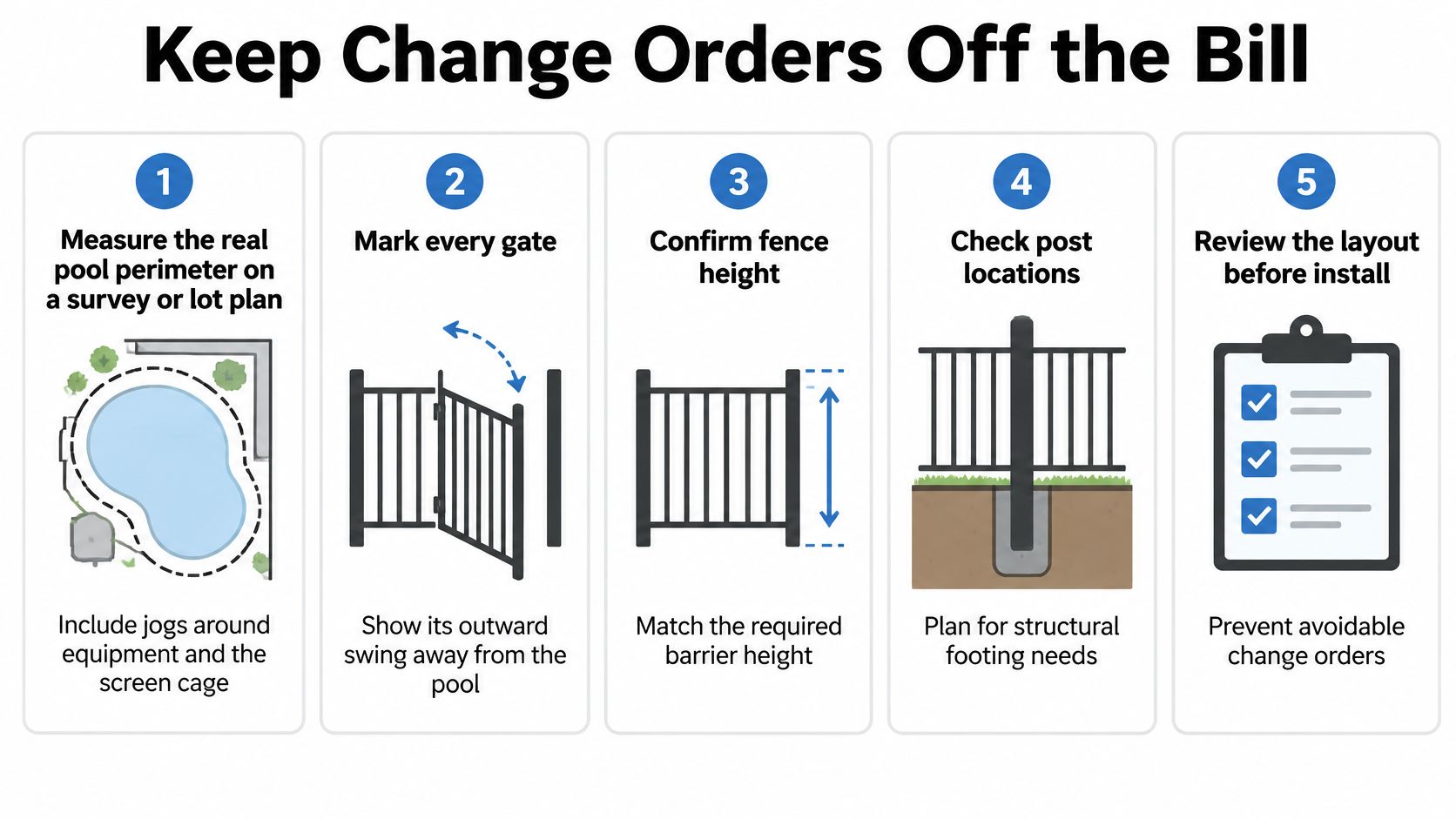
Put the prevention work in order
Measure the proposed barrier route. Use a survey or lot plan and confirm the alignment on site with a tape or measuring wheel. Include jogs around equipment and the screen cage rather than tracing the waterline.
Mark every access point. Show the gate location, swing direction, clear passage, and proposed latch position. A convenient gate on paper can become awkward when it opens against landscaping or conflicts with a walkway.
Record the surface at each run. Label soil, concrete, and pavers separately. Where a post lands near a material transition, the contractor should confirm the mounting detail before providing a fixed installation scope.
Flag changes in grade. Check low spots with a string line or laser level. A panel can look level across its top while leaving an unacceptable opening underneath, and resolving that condition may require a different panel arrangement or grading work.
Check actual clear openings. Measure between components and beneath the proposed barrier, including transitions and decorative features. A catalog description doesn't account for the way a panel meets irregular ground.
Assign the administrative tasks. Put utility locating, permit handling, any required Notice of Commencement, and inspection coordination in writing. Identify who attends the inspection and who handles corrections attributable to the installation.
Name the exclusions. Tree removal, stump grinding, private irrigation repair, lawn replacement, and concealed-condition work need clear boundaries. If an obstruction is discovered, the agreement should require approval of the changed scope before that extra work proceeds.
Bring the documents that affect the bid
The estimating appointment should start with the property information that can change the route or product selection. HOA appearance requirements, for example, should be checked before a homeowner approves a panel style.
- Survey or lot plan: Include easements and any available approved pool layout.
- HOA architectural rules: Provide height, color, style, and submission requirements.
- Site photographs: Show the deck, screen enclosure, side-yard access, and likely post locations.
- Gate preferences: Identify normal household access and equipment access needs.
An online fence cost estimator and calculator can provide a starting budget. Its output should still be reconciled with the measured route and the contractor's site-specific scope before scheduling.
Compare specifications before setting a start date
Place the proposals side by side and check height, openings, ground clearance, mounting method, gate hardware, permit responsibility, and exclusions. Then compare the finish and fastener specifications, especially for exposed coastal properties.
The lowest price is useful only if the contractor has priced the intended work. If the difference between bids can't be explained by identifiable components or installation tasks, request a revised breakdown rather than guessing.
A start date should follow a complete written scope, not substitute for one. That protects the homeowner's budget and gives the installation crew a clear plan to build.
#MartinCountyFencing #PalmBeachCountyFencing #StLucieCountyFencing #StuartFencing #PalmCityFencing #JupiterFencing #PortStLucieFencing #HobeSoundFencing #TequestaFencing #AluminumPoolFence #PoolSafetyFence #FloridaPoolBarrier #TreasureCoastFencing #PoolGateHardware #FencePermitFlorida #HOAFenceApproval #SelfClosingGate #PoolFenceCost
Homeowners can visit AlliedFenceAndGate.com™ for aluminum pool fencing, self-closing and self-latching gates, and project support covering permitting, utility locates, and inspection coordination across Florida's Treasure Coast and northern Palm Beach County. A survey, deck photographs, and preferred gate locations give the estimating team the information needed to separate the base enclosure from hardware, mounting, and restoration costs.
Related Fencing Services
Need a fence or gate on the Treasure Coast?
Licensed, insured, and bonded. Free estimates across Martin, St. Lucie, Indian River & Palm Beach counties.
Call (772) 530-3127