Fence Permit Requirements in Martin and Palm Beach Counties
You have the line picked out, the style narrowed to aluminum or vinyl, and a Saturday install in mind. Then someone asks whether the county needs a permit, and the answer is not sitting on the material brochure. Fence permit requirements turn on the parcel, not on how simple the fence looks from the sidewalk.
A short run can still need a building permit, a zoning approval, or a hard stop for an easement, a flood zone, a corner-lot sight triangle, or a pool. Permit exemption is not code exemption. A city can skip the permit and still enforce height, setbacks, and finished-side rules. The International Code Council model-code guidance treats a building permit as the usual requirement unless the fence stays under a height threshold the local government adopts. Check the parcel before you measure.
Table of Contents
- When Your Fence Project Needs a Permit
- Height, Setbacks and Approval Layers
- Documents to Assemble Before You Apply
- How the Permit Process Runs from Survey to Final Inspection
- Permit Fees and Review Timelines
- Pool Barrier Rules That Palm Beach Inspectors Check
- Confirm the Permit Path Before You Order Materials
When Your Fence Project Needs a Permit
The local building department decides the path. Material, height, yard location, and use can send one fence to a building permit, a zoning approval, both, or neither.
| Project type | Usual approval path | Core documents | Main review trigger |
|---|---|---|---|
| Standard residential privacy fence (wood, vinyl, aluminum) | Building or zoning permit, set by the jurisdiction and the height | Application, survey, site plan | Height, setbacks, and finished side facing out |
| Front-yard or decorative fence | Zoning approval, often with a lower height cap | Site plan with front setback dimensions | Corner visibility and HOA rules |
| Residential chain-link fence | Zoning improvement permit for ordinary residential chain link; building permit when it is a pool barrier | Site plan, product details | Mesh opening if used as a pool barrier |
| Pool barrier fence and gate | Building permit with barrier inspection before pool completion | Survey, barrier and gate details | Height, bottom clearance, spacing, self-latching gate |
| Commercial perimeter or gated fence | Building permit, often with fire-department review | Engineering or product approval, site plan | Emergency access and secured gate operation |
| Replacement in the same location | A new permit is commonly still required; confirm with the building department | Survey, site plan | The old footprint does not exempt the new fence |
| Fence crossing an easement or flood zone | Additional review that can delay or deny approval | Survey showing easements, flood status | Utility and drainage easements, floodplain rules |
Confirm that table with the building department for the address. Martin County and Palm Beach County do not share one fence form, and a city inside either county can add its own overlay.
Three checks before you measure
Run these before you pull a tape or order posts.
City or unincorporated county. A Stuart or Jupiter address is not reviewed the same way as unincorporated county land next door. The permit counter follows the boundary, not the mailing city.
HOA or no HOA. An architectural committee can reject a color, a height, or a style the county would allow. That review is separate from the permit.
Pool, gate, or commercial use. A barrier, a powered gate, or a commercial perimeter changes the permit even when the fence is short. Front setbacks and the area near a driveway or intersection usually carry a lower height cap than the side or rear yard.
Practical rule: Price the permit path before you price the panels. A layout that crosses an easement is a different job from the same fence set inside the buildable yard.
Height, Setbacks and Approval Layers
A fence that needs no building permit can still fail zoning, easement, floodplain, corner-lot, or pool-barrier review. Check the parcel before measuring: the front yard, driveway sight lines, and nearby water can change the allowed height, placement, or design. A short fence is not automatically exempt from local rules.
| Jurisdiction | Front-yard height cap | Permit trigger |
|---|---|---|
| Miami-Dade County, FL | 6 ft (2.5 ft near intersections and driveways) | Building permit for wood, concrete, commercial chain link, and pool-barrier chain link |
| Miami Shores, FL | 3 ft 6 in | Contractor license and insurance, or an owner-builder disclosure |
| Orlando, FL | City zoning sets the front-yard cap | Permit for corner lots, alley lots, historic districts, public easements, powered gates, pools, and floodplains |
| Fort Myers Beach, FL | 48 in in specified front-yard areas | Permit for every fence or wall; building-permit procedures above 25 in |
| Martin County, FL | Confirm the cap with Martin County zoning | Confirm the trigger with the Martin County building department |
| Palm Beach County, FL | Confirm the cap with Palm Beach County zoning | Confirm the trigger with the Palm Beach County building department |
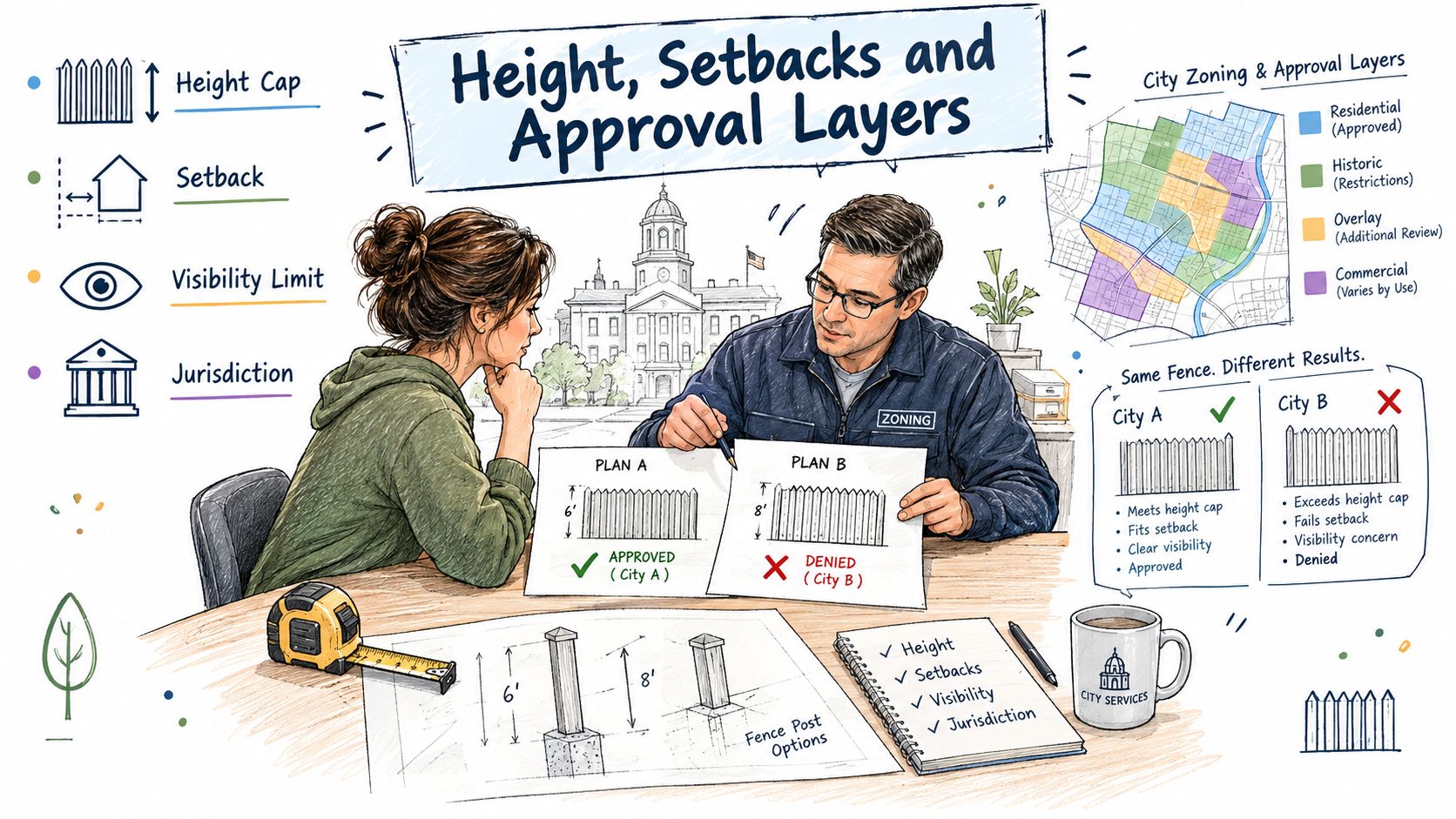
The Miami-Dade fence and gate page limits fences in front of the building line to 6 feet, dropping to 2.5 feet near intersections and driveways. Front-yard limits can be lower than side- and rear-yard limits, so do not carry a height allowance from one part of a property to another.
What each layer actually controls
State code sets structural-safety requirements and pool-barrier rules. The city or county adopts and administers the building code and permit process. Zoning determines height, setbacks, and sight lines. An HOA architectural committee may also control color, material, and style. These approvals address different requirements.
HOA fence approval in Florida is separate from municipal permitting. If the property has an association, obtain its approval as well as any required government permit. An HOA can reject a design that meets local code, and an HOA approval does not authorize construction that violates code.
The Miami Shores fence requirements set front-yard fences at 3 feet 6 inches and side- and rear-yard fences at 6 feet. They also require supports to face inward. In Orlando, some residential fences six feet or less are exempt from a permit, but corner lots, alley lots, historic districts, public easements, and floodplains still trigger permit review. Exempt fences must comply with city code, according to the Orlando fence guide.
Fort Myers Beach requires a permit for every fence or wall, with building-permit procedures applying above 25 inches. Within 25 feet of water, portions above 48 inches are limited to 25 percent opacity under the Fort Myers Beach fence rules. Confirm Martin County and Palm Beach County height limits and permit triggers with the relevant offices for the parcel. The Miami-Dade and Miami Shores examples show why a nearby city's allowance is not a reliable substitute.
Documents to Assemble Before You Apply
Reviewers are not only checking the product. They treat the fence as a site improvement.
| Document | What it shows | When it is required |
|---|---|---|
| Signed building-permit application | Project scope, owner, and contractor | Almost every building-permit job |
| Current property survey | Boundaries, easements, and setbacks | Usually required; confirm the maximum survey age |
| Site plan | Fence line, type, height, and gates | Almost every submittal |
| Zoning approval | Height and setback compliance | Where zoning review applies |
| Contractor license and insurance proof | A licensed, insured installer | Contractor-built projects |
| Owner-builder disclosure | The homeowner is doing the work | Owner-built projects |
| Notice of Commencement | A recorded notice of the project | Some jurisdictions, on projects over $2,500 |
| Product approval documents | Manufacturer approval for the system | Non-wood and non-chain-link systems |
| Fire-department approval | Fire access and gate operation | Commercial projects |
| Engineering or wind calculations | Structural and wind-load design | Tall or wind-exposed fences when local code requires them |
A Florida package, as described in the Miami Shores horizontal wood fence requirements, can include a signed application, zoning approval, a current survey showing easements, a site plan with location and type, and proof of licensing and insurance. Commercial jobs may also need fire-department approval. Some jurisdictions require a Notice of Commencement above $2,500, plus product approval for systems that are not wood and not chain link. Placement affects setbacks, easements, right-of-way visibility, drainage, and emergency access, so the reviewer is not scoring a catalog photo.
Working order for the package
Get the survey before you lock post locations. Mark utility and drainage easements on that survey, then confirm height and setback rules, then collect engineering or product approvals. A clean photo set still fails if the line crosses an easement or breaks a corner-visibility rule.
Survey age is a local setting. Ask the building department how recent the survey must be before you pay for a new one. The dollar threshold for a Notice of Commencement is local too, so confirm that figure before you record anything.
A fence that looks right from the street can still be the wrong line on the survey.
If you are reading the survey yourself, how to read property survey measurements is the sheet to keep next to the site plan. Match the fence line to the boundary and the easement, not to the hedge.
How the Permit Process Runs from Survey to Final Inspection
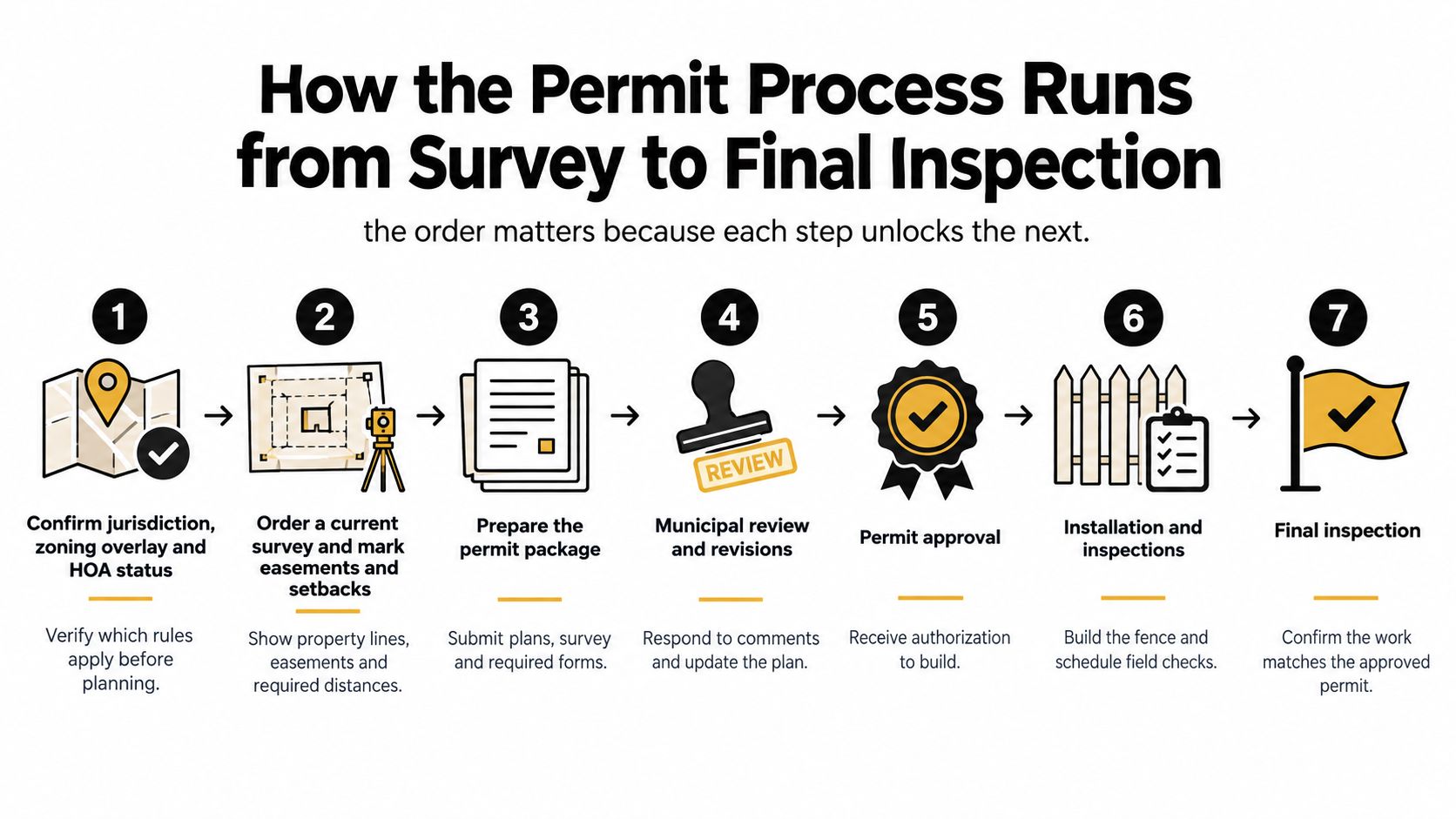
A short fence can still trigger permit or site review. Before measuring, check the parcel for easements, flood considerations, corner-lot visibility rules, and pool-barrier requirements. A permit exemption does not exempt the work from applicable code.
- Confirm jurisdiction, zoning overlay, and HOA status. The wrong permitting office can reject an otherwise complete package.
- Order a current survey and mark easements and setbacks. Do not base post locations on an existing fence line, which may not follow the boundary.
- Draw the site plan. Show the proposed fence line, height, gates, and materials so reviewers can assess the layout.
- Submit the application. Include the required license, insurance, product approvals, and any applicable Notice of Commencement.
- Answer plan-review comments. Corrections can send the application through another review cycle.
- Pay the fees and obtain the permit. Wait for issuance before digging or building.
- Request a utility locate before digging post holes. Manatee County's utilities locate page directs contractors and homeowners to Sunshine 811 for public utilities. A utility conflict can affect the schedule, liability, and fence layout.
- Build to the approved plan. Moving a gate after approval can leave the finished work out of line with the plan inspectors review.
- Schedule required inspections. A pool project may require a barrier inspection before completion. The barrier must meet applicable requirements for openings and climbability. A yard fence qualifies only if it meets those barrier rules.
- Close the permit after final approval. An open permit can remain associated with the property.
What sends the job backward
Utility marks, easements, and permit conditions need attention before post holes are dug. A post placed on a utility line can delay work, while building into an easement can force a layout change. If a Notice of Commencement applies, confirm that it is recorded as required. A fence that meets boundary rules may still fail a pool-barrier inspection, so resolve that distinction before construction.
Permit Fees and Review Timelines
Martin County and Palm Beach County fee schedules can change. Call the building department for its current fee sheet before budgeting from an online estimate.
What the permit line usually contains
A fence permit may involve several separate costs:
Application charge. This opens the permit file.
Plan or zoning review. A zoning review may be charged in addition to the building fee.
Survey. If the department will not accept the survey you have, a replacement survey is a project cost, not a permit fee. Include it in the budget.
Notice of Commencement recording. If the project meets the local dollar threshold, the clerk's recording fee is separate from the building fee.
Inspection and reinspection. A failed inspection can mean another visit and another charge.
Miami Shores lists a $50 submittal fee in its fence requirements package. The package also calls for a survey no older than 7 years and either a contractor license with insurance or an owner-builder disclosure. Those figures apply to Miami Shores, not to Martin or Palm Beach County. They show why even a small application can have a published fee and a document-age limit.
What stretches the calendar
An incomplete application does not enter review as a complete file. If the office rejects the survey, intake may have to start again. Each correction requested during plan review can add another review cycle.
Budget the permit, survey, and possible reinspection separately from materials and labor. The installed fence price does not include those costs.
Before signing an installation contract, ask the building department for its current fee schedule, the expected first-review turnaround, and how many correction cycles are allowed before the file goes stale.
Pool Barrier Rules That Palm Beach Inspectors Check
A fence that passes a boundary review may still fail a pool inspection. Pool barriers must meet child-safety requirements across the full enclosure, including gates and any existing fence or wall used as part of it.
| Element | Requirement | Why it matters |
|---|---|---|
| Barrier height | At least 48 inches | Helps prevent a child from climbing over |
| Bottom clearance on the side away from the pool | No more than 2 inches | Prevents crawling underneath |
| Vertical opening, standard configuration | 1-3/4 inches in specified configurations | Limits passage through the barrier |
| Vertical opening when horizontal members are 45 inches or more apart | Up to 4 inches | Limits passage when rails are widely spaced |
| Chain-link mesh opening | Maximum 2-1/4 inches, or 1-3/4 inches with slats | Limits passage and climbing |
| Gate closing and latching | Self-closing and self-latching | Helps keep the gate closed |
| Existing fence or wall in the enclosure | Inspected before the pool certificate of completion | Confirms the full enclosure functions as a barrier |
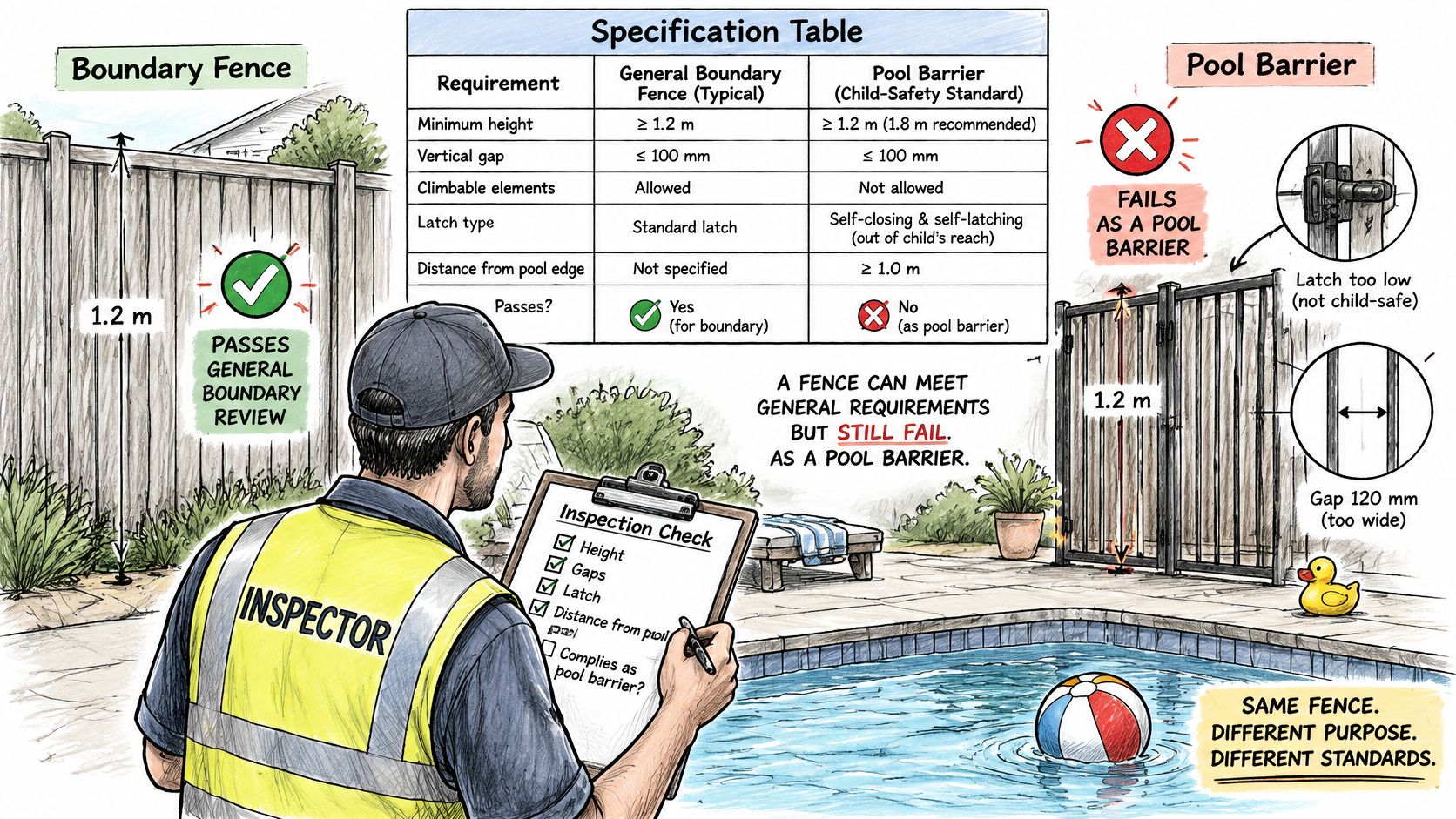
The Palm Beach County pool barrier requirements set measurable checks for height, clearance, and openings. The barrier must generally be at least 48 inches high, with no more than 2 inches of clearance on the side facing away from the pool. In specified layouts, vertical openings are limited to 1-3/4 inches. Where horizontal members are 45 inches or more apart, vertical openings may be up to 4 inches. Chain-link mesh openings are capped at 2-1/4 inches, or 1-3/4 inches when slats are used. These measurements address gaps a child could crawl under, climb, or pass through.
Gates and shared walls
Palm Beach County inspects an existing fence or wall before issuing a pool certificate of completion. If a neighbor's wall or fence forms part of the enclosure, a recorded agreement may be needed. The barrier must be continuous on the record as well as around the yard.
Do not use another city's latch measurement as the Palm Beach requirement. The Sarasota fence checklist specifies a latch release at least 54 inches above the bottom of the gate, a gate that swings away from the pool, and bottom clearance of no more than 2 inches. Confirm Palm Beach County's release-height requirement before ordering gate hardware. Sarasota's measurement does not automatically apply in Palm Beach.
What to have in hand at inspection
Measure and photograph the barrier height, bottom clearance, picket or mesh spacing, and self-closing, self-latching hardware. Walk the entire enclosure and check every gate and shared wall. A single opening can leave the barrier incomplete. For more detail on layouts and related requirements, see this guide to pool fence requirements in Florida.
Confirm the Permit Path Before You Order Materials
Most rejections are paperwork and parcel facts, not a bad panel choice. Clear these six items before a material order.
Wrong jurisdiction. Confirm municipal versus unincorporated status before anyone prices the job. The permit counter follows that line.
Missing or outdated survey. Ask the building department for the survey age it will accept. An old survey that looks tidy still gets bounced.
Flood-zone conflict. Check flood status before the fence line is set. Flood review can hold a short residential fence.
Corner-lot visibility. Measure the sight area at the intersection, then apply that lower height, not the side-yard cap.
HOA approval skipped. Get association approval on its own track. A county permit does not satisfy the architectural committee.
Replacement treated as exempt. A same-footprint rebuild is often still a permit. Confirm that locally before you pull the old fence down.
AlliedFenceAndGate.com handles permitting, Notice of Commencement filing where it is required, and inspection coordination for Treasure Coast fence work. Confirm in writing whether the Sunshine 811 locate is inside the quote before you compare prices.
Send the property address, the current survey, and the fence plan. Confirm the permit path with the installer. Order materials only after that path is in writing.
#FencePermitRequirements #MartinCountyFencing #PalmBeachCountyFencing #StuartFencing #JupiterFencing #PalmBeachGardensFencing #TreasureCoastFencing #FloridaFencing #FencePermits #PoolFencing #PalmBeachCounty #MartinCounty #FloridaBuildingCode #FenceInstallation #AluminumFencing #FloridaFenceContractor
AlliedFenceAndGate.com™ pulls fence permits, files a Notice of Commencement when the job requires one, schedules utility locates, and coordinates county inspections for residential and commercial fences on the Treasure Coast and in northern Palm Beach County. If you are comparing a privacy fence, a pool barrier, or a commercial perimeter, start with the address and the survey so the permit path is settled before materials are ordered. Visit AlliedFenceAndGate.com™ to send the property details and line up that review.
Related Fencing Services
Need a fence or gate on the Treasure Coast?
Licensed, insured, and bonded. Free estimates across Martin, St. Lucie, Indian River & Palm Beach counties.
Call (772) 530-3127