Fence Cost Estimator Calculator: A Florida Homeowner Guide
A Treasure Coast homeowner measures the backyard, enters the perimeter into a fence cost estimator calculator, and gets a number that feels workable. Then the first contractor quote comes in higher, the second lands somewhere between, and the third is lower than the online result. That experience is common because the calculator answered a limited question, while each contractor priced an actual Florida property.
A useful estimator still matters. It can organize linear footage, height, material, gates, labor, and site allowances before a crew visits. But the screen can't see a swale, buried obstruction, difficult access, HOA restriction, or a post hole that refuses to cooperate. In Florida, the ballpark becomes trustworthy only when the line items reflect the lot.
Table of Contents
- Why Fence Estimates Move After the Estimator
- Inputs a Fence Cost Estimator Calculator Should Ask For
- How to Read the Line-Item Breakdown
- How Each Material Reads Inside the Calculator
- Running the Allied Fence Estimator Step by Step
- Honest Accuracy Limits of a Fence Cost Estimator
- Homeowner Checklist Before You Trust the Number
Why Fence Estimates Move After the Estimator
A Treasure Coast fence calculator can produce a reasonable starting figure, then shift after a contractor walks the property. The tool usually assumes a measurable fence line, chosen material, standard post spacing, ordinary gates, and installation that needs no unusual preparation. One documented model includes total length, post spacing, material, gate count, labor rate, and height because each variable changes the work or the amount of material required. Calcexp's fence cost calculator reference
The lot supplies the missing variables. A backyard may drain toward a swale, move from loose sand into harder soil, or leave the crew carrying materials around landscaping and air-conditioning equipment. Coastal exposure, HOA rules, pool-safety requirements, and local permitting can also specify a fence style or add work the calculator never asks about.
The perimeter isn't the whole project
A straight run is simple to price. Corners, transitions, gates, demolition, and elevation changes create separate installation decisions. Corner posts may need different hardware, a gate opening may require added bracing, and a sloped section may need stepping rather than a level top line. Removing an existing fence adds labor, disposal, and handling before the new posts go in.
The same material can also behave differently on different properties. Sandy soil may allow faster digging but provide less resistance around posts. Hard ground, roots, concrete, or unmarked utilities can slow excavation. A contractor should confirm the fence line and request an 811 locate before digging, even though that safety step does not appear in a basic linear-foot calculation.
Published installed pricing varies widely by material, which is why a single universal rate hides too much. The calculator's material ranges are useful for comparing categories, but they do not account for a Treasure Coast lot's gates, grade, access, permitting, or soil. Keep the full material comparison in the estimator, then test its assumptions against the site.
Practical rule: Use the online result to set a budget range. Give the written proposal more weight after the contractor confirms the scope and site conditions.
A differing first quote is not automatically a problem. Ask the contractor to explain it. A clear proposal identifies materials, posts, gates, labor, removal, permits, locates, and site allowances instead of placing every unknown inside one blended price.
Inputs a Fence Cost Estimator Calculator Should Ask For
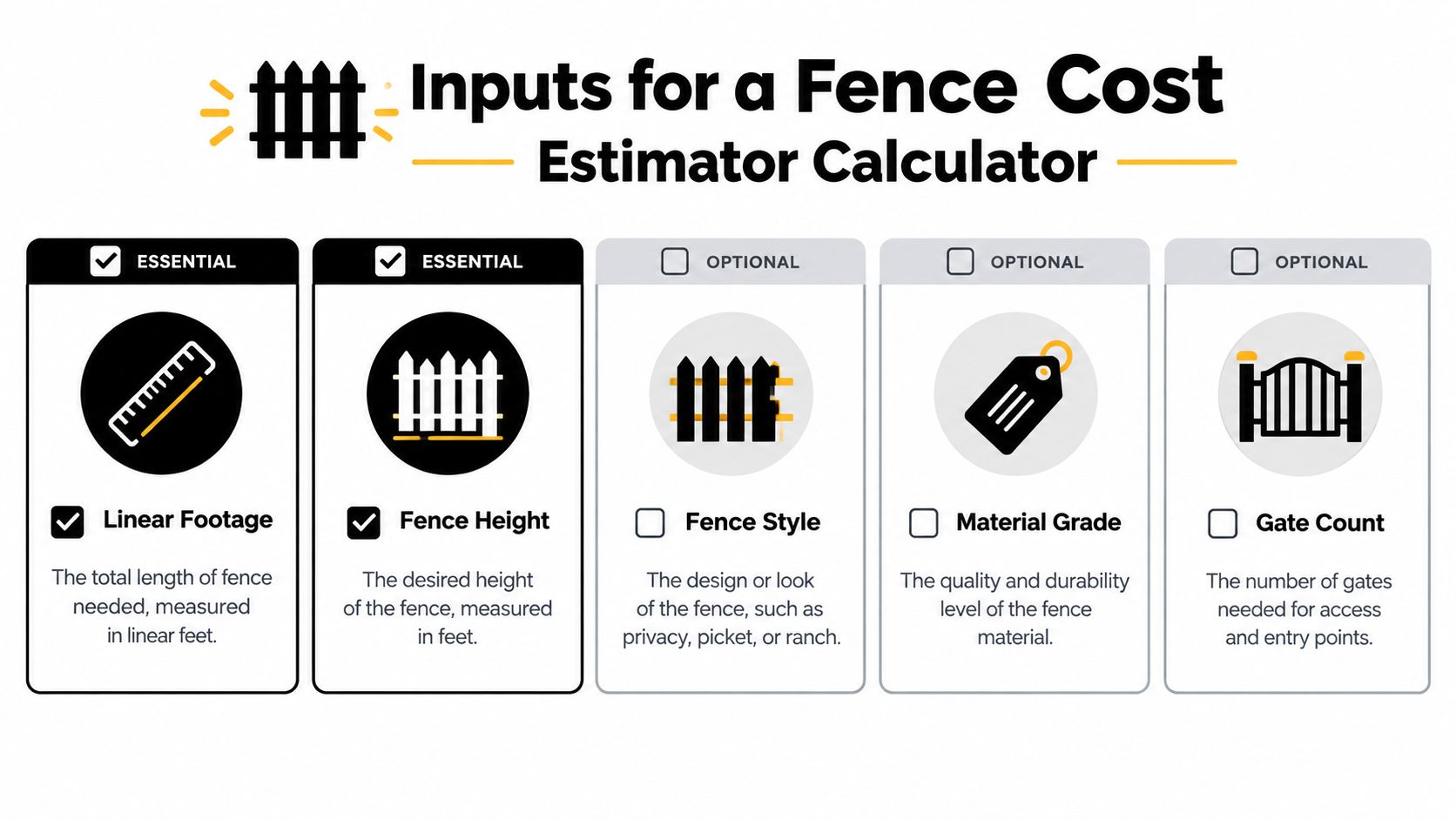
A calculator becomes useful when its inputs follow the decisions a Florida fence contractor makes on the lot. Start with the proposed run, then account for height, material, gates, grade, soil, access, and code requirements. Linear-foot math sets the baseline. Site conditions determine whether that baseline holds.
Start with the measurable scope
Linear footage: Enter the actual fence line, not the entire property perimeter. Setbacks, easements, buildings, driveways, and unfenced areas can reduce the installed run. Confirm the boundary before entering measurements with this guide on how to find property lines for a fence.
Fence height: Height changes material quantity, post demands, appearance, and sometimes permit or code review. For a calculator, treat the height adjustment as an estimate assumption. A 4-foot fence can price below a standard 6-foot design, while an 8-foot fence can price higher, depending on the material and construction requirements.
Material and style: Aluminum, vinyl or PVC, chain link, and wood use different panels, rails, posts, fasteners, and spacing. Privacy construction does not follow the same material logic as an open ornamental layout. The selected profile, grade, and finish should appear as separate choices when they affect the takeoff.
Add the details that move the quote
Gate count and opening width need their own fields. A pedestrian gate and a vehicle gate require different frames, hinges, latches, clearances, and labor. Pool fencing can also require self-closing and self-latching hardware.
The site section should ask about slope, soil, roots, trees, utilities, equipment access, and existing-fence removal. Include fields for county permits, 811 utility locates, wind-related requirements, and HOA review. In Florida, sandy soil may dig quickly but still require careful post setting, while roots, hard ground, concrete, or restricted access can add labor.
The output should identify skipped conditions instead of presenting a precise-looking total. If soil, terrain, access, or permitting remains unverified, label that uncertainty and show which allowance may change after a site visit. That makes the estimate useful as a budget range while leaving the written proposal to confirm the actual scope.
How to Read the Line-Item Breakdown
A single total hides the decisions that produced it. A line-item estimate is more useful because it lets the homeowner challenge one assumption without throwing out the entire calculation.
The material line normally represents the fence fabric, boards, panels, or pickets. It scales with the installed run, but the selected profile and grade matter. A privacy panel, decorative aluminum section, and basic chain-link fabric won't carry the same material logic.
Posts and rails deserve close attention. The takeoff may include line posts, terminal posts, corner posts, rails, concrete, brackets, and hardware. A documented workflow uses posts = ceiling(length ÷ spacing) + 1 and sections = ceiling(length ÷ spacing), then adds gate openings as separate items. CostFlowAI's fence estimator workflow describes that formula-driven approach and identifies common terrain multipliers of 1.00 for level ground, 1.10 for slight slope, 1.25 for moderate slope, 1.50 for steep stepped layouts, and 1.75 for rocky or difficult access.
Read the estimate as a scope map
| Line Item | What It Covers | Scope Decision It Drives |
|---|---|---|
| Material | Fence fabric, panels, boards, rails, and selected profile | Which style and grade the homeowner is buying |
| Posts and setting | Line, corner, terminal, and gate posts, plus concrete and hardware | Spacing, depth, bracing, and soil response |
| Gates | Walk gates, drive gates, frames, hinges, latches, and operators where applicable | Opening width, access needs, and hardware class |
| Labor | Layout, excavation, setting, assembly, adjustment, and cleanup | Crew effort and installation complexity |
| Terrain or access | Slope, roots, rocky soil, hand work, and difficult handling | Whether the site needs a separate allowance |
| Removal and disposal | Teardown, hauling, and disposal of an existing fence | Whether replacement includes the old structure |
Why labor shouldn't disappear inside the rate
Labor isn't a decorative percentage added at the end. It reflects how long the crew must lay out the line, dig or auger holes, set posts accurately, build gates, adjust transitions, and remove debris. One published model identifies labor as 50% to 60% of installed price, and Home Project Calculator's fence pricing reference also points to slope, rocky soil, removal, and gate additions as meaningful cost drivers.
A terrain surcharge isn't automatically padding. It can indicate that the estimator has recognized slower excavation, stepped layout, roots, or restricted equipment access. The homeowner should ask what condition triggered it and whether the allowance can change after site verification.
How Each Material Reads Inside the Calculator
Material selection changes more than the visible fence surface. It also changes post spacing, bracing, gate construction, hardware, finish requirements, and how Florida conditions affect installation. A calculator that prices only panels will miss much of the work that appears after the contractor walks the lot.
| Material | Typical installed range per linear foot | Dominant line items | Common code or site add-ons |
|---|---|---|---|
| Aluminum | $25 to $60 | Panels, posts, brackets, gates, and finish | Pool gate hardware, wind exposure, corners, and custom fabrication |
| Vinyl or PVC | $20 to $50 | Posts, rails, privacy panels, and gates | Wind-zone-rated components, slope transitions, and reinforced posts |
| Chain link | $8 to $25 | Fabric, line posts, terminal posts, tension components, and gates | Corner bracing, security additions, difficult soil, and removal |
| Wood privacy | $15 to $35 | Posts, rails, boards, concrete, fasteners, and gates | Height changes, board profile, treatment, slope, and demolition |
The installed ranges above are illustrative model ranges, not promises of local pricing. Allied's published starting ranges are a separate business reference, with aluminum at $28 to $150 per foot, vinyl at $25 to $48, chain link at $22 to $50, and wood at $25 to $45, as supplied in the company information. Ask which product grade, height, gate package, and site scope support the applicable range. Material labels alone are not enough for a fair comparison.
Aluminum and vinyl
Aluminum often appears as a clean panel-and-post calculation. The price can shift at corners, transitions, custom welded sections, and gate hardware. A pool enclosure may require self-closing and self-latching components, turning a basic gate line into a code-sensitive assembly. Wind exposure and uneven grades can also add posts, brackets, or fabrication time.
Vinyl or PVC looks simple because its panels create a consistent appearance. The estimate still needs allowances for reinforced posts, rails, wind exposure, and transitions over uneven ground. A straight run may install efficiently. Several direction changes require more cutting, fitting, and field adjustment.
Chain link and wood
Chain link is often the most linear-foot-driven option, yet terminal and corner posts can change the total. Security requirements, barbed wire, gates, difficult soil, and old-fence removal should appear as separate line items rather than disappearing inside a general rate.
Wood can look familiar in a calculator because the board price is easy to recognize. The complete scope depends on picket spacing, privacy style, rails, post treatment, fasteners, and gate construction. Slope, demolition, and Florida soil conditions can change the labor allowance even when the footage stays the same.
Use the fence installation cost guide beside the estimator output, then confirm exactly what the selected profile includes. That review helps explain why a calculator's ballpark can drift once actual access, soil, gates, and code requirements are verified.
Running the Allied Fence Estimator Step by Step
A homeowner can use a digital estimator as a structured pre-visit exercise instead of guessing from a tape measure. AlliedFenceAndGate.com™ offers a digital estimator that accepts property information, supports survey or lot-plan uploads, and produces a ballpark estimate with project selections and add-ons.
Begin with the property record
The first step is uploading a survey or satellite view of the lot. A clear survey can show dimensions, easements, setbacks, and obstacles more reliably than a rough perimeter traced from memory. A satellite image can help establish the intended line, but it still needs field confirmation before installation.

The measurement extraction step draws the proposed fence line and tallies the fenceable footage. The homeowner should inspect every corner and change point before moving forward. If the line crosses a pool area, runs near an air-conditioning unit, or follows a side yard with limited access, those details should be marked or described rather than left for the final review.
Select the build, then inspect the output
The next fields cover material, height, color, and style from the available installation options. Each selection feeds the material and post assumptions used in the estimate. Gate entries then add walk gates, drive gates, and pool-code self-closing variants where applicable.
The final step produces a line-item PDF quote for review. The homeowner should check the footage, gate count, material description, color, removal, permitting, and any visible site allowance before submitting or scheduling a visit.
Field confirmation still matters: The digital workflow can organize the scope, but a Treasure Coast crew must confirm property conditions, utility conflicts, soil response, access, code requirements, and the exact fence line before the estimate becomes a signed proposal.
The homeowner can edit the drawing and selections before submission. The fields most likely to need on-site confirmation are post depth, footing conditions, slope treatment, utility clearance, gate swing, and any obstacle that wasn't visible in the uploaded plan.
Honest Accuracy Limits of a Fence Cost Estimator
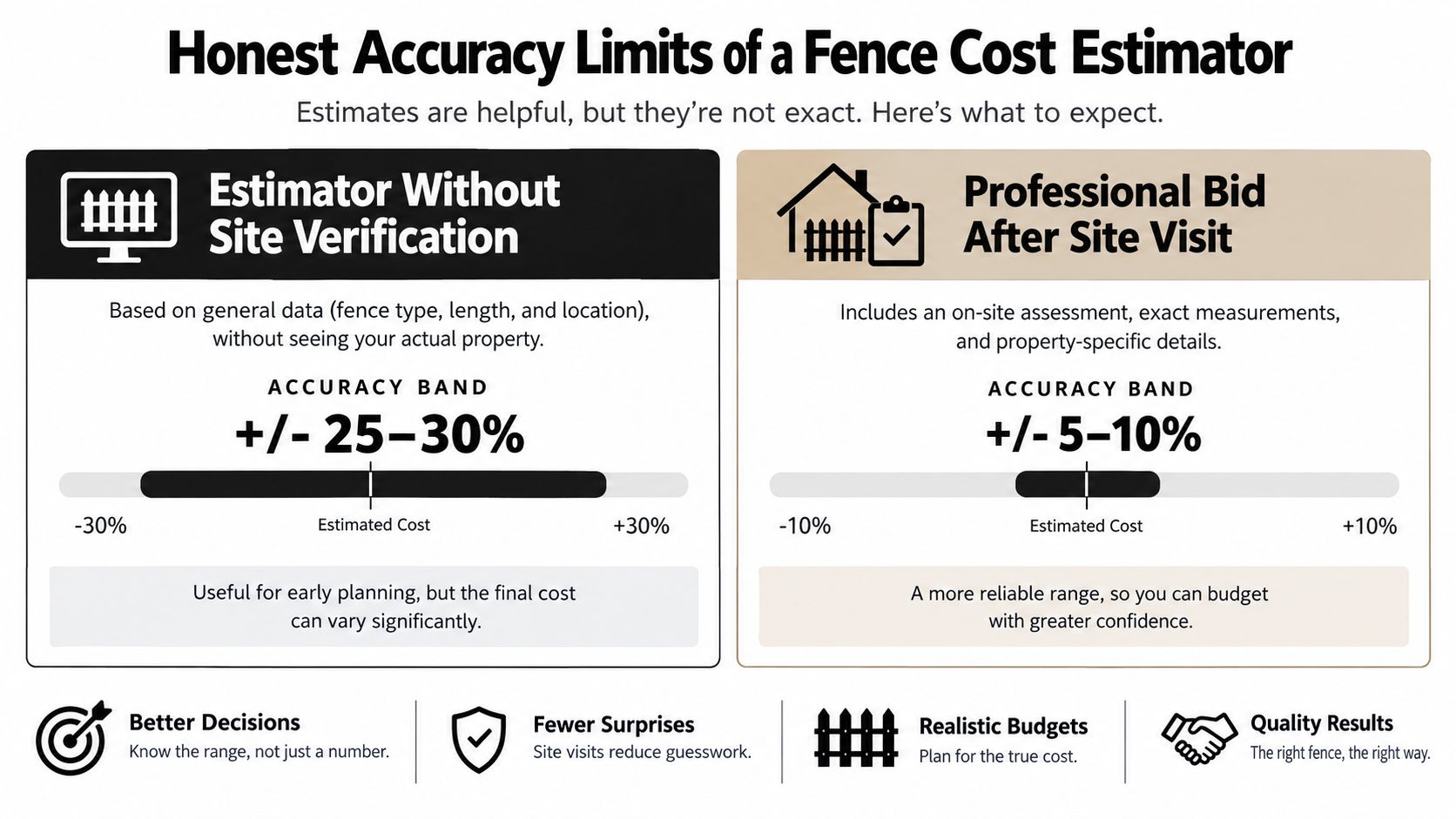
A blended per-foot number creates confidence without showing risk. Construction estimates have recognized accuracy bands at early stages. The Construction Management Association of America identifies early-class ranges of about -10% to +15% for Class 1 estimates and -15% to +20% for Class 2 estimates in its construction estimating and change-order resource. A digital fence estimate without site verification should therefore be treated as an early planning figure, not a guaranteed contract price.
Florida sites create specific uncertainty. A line that appears level from an image may need stepping or racking. Sandy, rocky, or root-filled soil can change excavation effort and footing decisions. Utility conflicts found during 811 locates, HOA height or color requirements, county permitting, and pool-gate hardware can also move the final scope.
What should be firm and what should remain provisional
The uploaded plan, selected material, intended height, visible gate count, and proposed fence line can be firm enough for a preliminary budget. Post depth, soil treatment, exact terrain allowance, utility clearance, permit requirements, and demolition conditions should remain provisional until the site is reviewed.
A 2026 planning model places many residential fences at $12 to $60 per linear foot installed, with a national average around $20 to $45, while showing chain link at $10 to $25 and wrought iron at $30 to $80. That model is summarized in Project Cost Pro's fence calculator guidance, and its wide spread reinforces the need to inspect assumptions rather than chase one national average.
A responsible estimator exposes the variables driving the uncertainty. A contractor should be able to point to the allowance for labor, gates, haul-off, permits, terrain, and post setting. If the quote can't explain its own total, the homeowner has little protection when a change order appears.
Homeowner Checklist Before You Trust the Number
A calculator earns confidence when its inputs match the written scope. Before signing, a Treasure Coast homeowner should compare the digital output with the property, the selected product, and the contractor's installation assumptions.
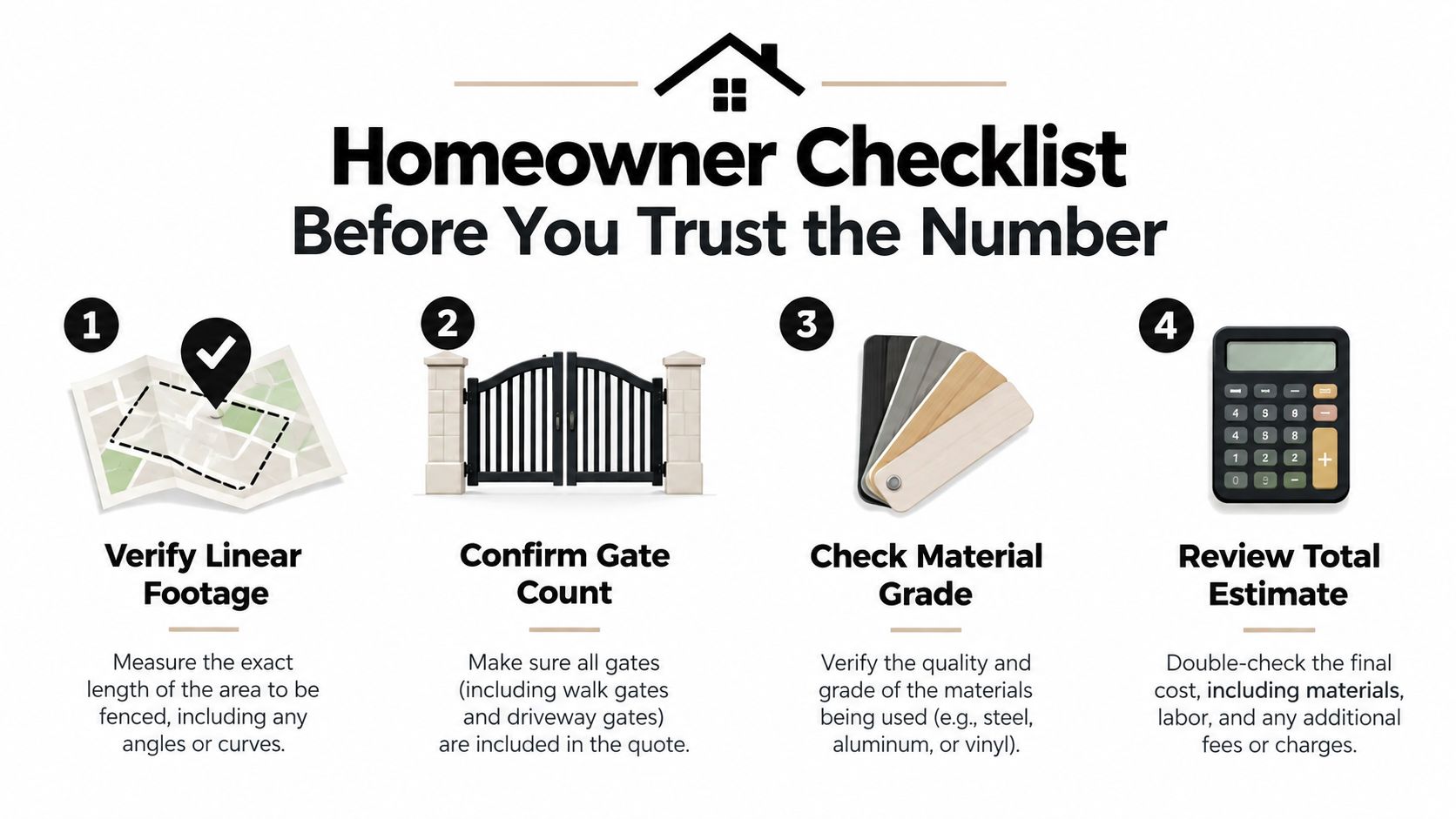
- Verify linear footage: Compare the drawn fence line with the survey, setbacks, easements, and actual corners.
- Confirm gate count: Check every walk gate and drive gate, including opening direction and pool-safety hardware where required.
- Check material grade: Make sure the quote identifies the profile, color, post type, rail arrangement, and hardware rather than naming only “aluminum,” “vinyl,” “chain link,” or “wood.”
- Review post installation: Ask how post depth, concrete, spacing, and difficult excavation are handled.
- Find buried allowances: Confirm whether removal, haul-off, permits, 811 locates, slope, roots, rocky soil, and restricted access are included or provisional.
- Clarify approvals: Ask who handles HOA submittals, county permitting, Notice of Commencement requirements, and inspection coordination. The fence permit application resource can help frame that conversation.
- Question the gate assembly: Determine whether gates are welded assemblies or kits, and identify the hinge, latch, closer, and lockset.
- Review payment milestones: Confirm the deposit, progress terms, completion trigger, and what documentation accompanies the final payment.
The estimator is a budgeting tool, not a contract. The final number should follow a site walk, utility-locate process, approval review, and written scope that states what happens when the crew encounters roots, rock, slope, an easement, or an unlisted obstruction.
#MartinCountyFencing #StLucieCountyFencing #PalmBeachCountyFencing #TreasureCoastFencing #StuartFencing #JensenBeachFencing #PortStLucieFencing #VeroBeachFencing #FortPierceFencing #PalmCityFencing #FloridaFencing #FenceEstimator #FenceCalculator #AluminumFencing #VinylFencing #ChainLinkFence #WoodFencing #PoolFence
AlliedFenceAndGate.com™ provides a digital fence estimator for ballpark planning, followed by fencing, gates, permitting coordination, utility locates, and site review across Florida's Treasure Coast and northern Palm Beach County. Visit AlliedFenceAndGate.com™ to upload project information and request an estimate that makes the assumptions visible before installation begins.
Related Fencing Services
Need a fence or gate on the Treasure Coast?
Licensed, insured, and bonded. Free estimates across Martin, St. Lucie, Indian River & Palm Beach counties.
Call (772) 530-3127