Vinyl Coated Chain Link Fencing for Florida Properties
The most popular advice about vinyl-coated chain link fencing is also the most misleading: adding a colored PVC layer doesn't make a Florida fence maintenance-free or permanently rust-proof. In salt air, intense sunlight, irrigation overspray, landscaping impacts, and storm exposure all matter. The coating can improve appearance and delay corrosion, but its value depends on the metallic core, coating class, installation quality, hardware, and the conditions surrounding the fence.
For property managers in Martin County, St. Lucie County, Indian River County, or northern Palm Beach County, the right question isn't just whether vinyl coated chain is “better” than galvanized steel. The useful question is whether the specified system matches the site, the intended service, and the owner's willingness to inspect and maintain it.
Table of Contents
- The Reality of Vinyl Coated Chain Link in Coastal Florida
- Decoding Chain Link Coatings and ASTM Standards
- Comparing Galvanized, PVC-Coated, and Vinyl Options
- Best Use Cases Across the Treasure Coast
- How to Read a Fence Quote and Avoid Specification Gaps
- Lifecycle Costs and Warranty Realities
- Situational Recommendations for Your Property
The Reality of Vinyl Coated Chain Link in Coastal Florida
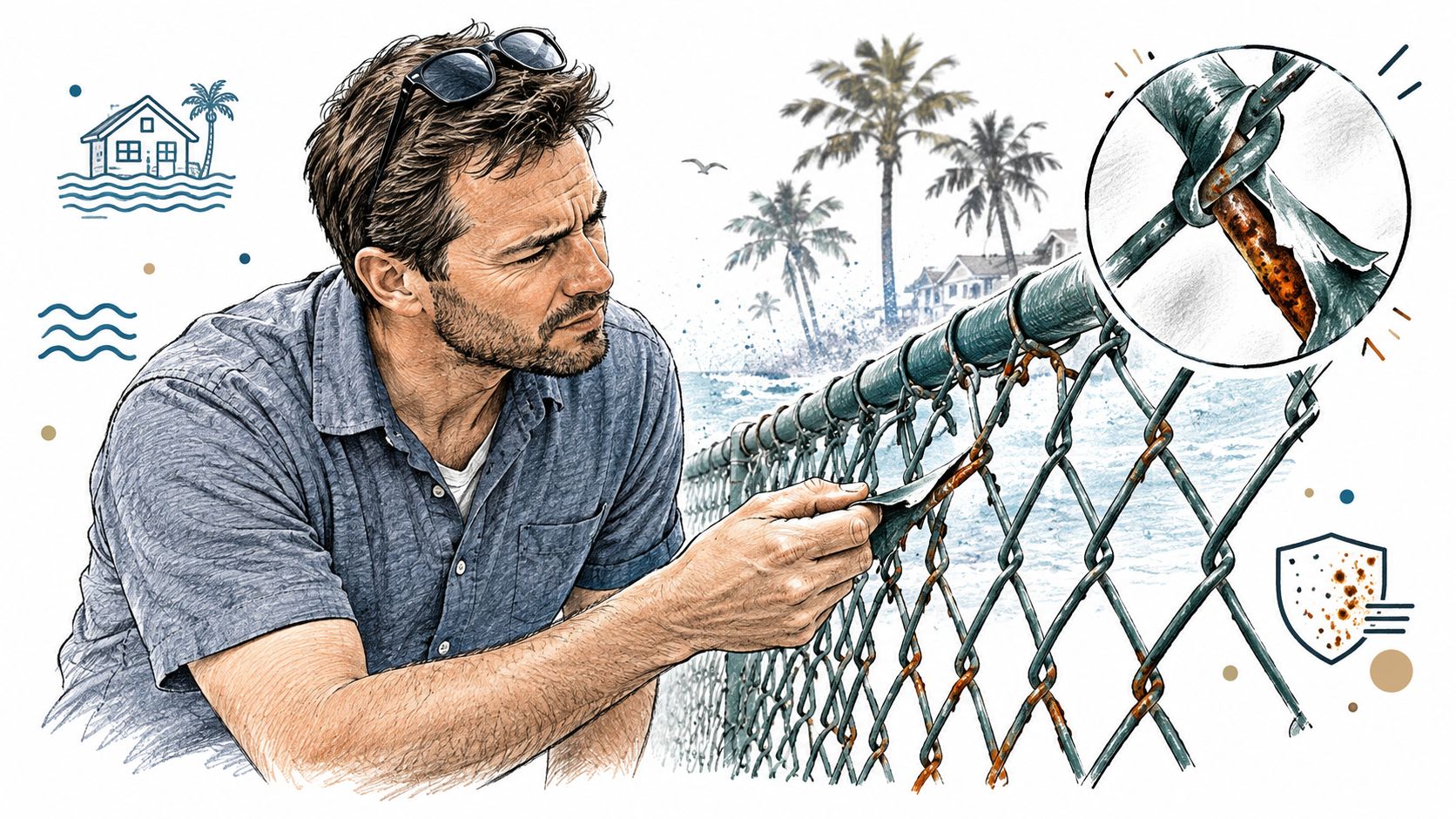
A vinyl coating is a barrier, not an invincible shield. Manufacturers commonly apply PVC over metallic-coated steel, which gives the fence a second layer of protection and a more finished appearance. But a cut from a string trimmer, a scrape from a gate, or impact from a storm-blown object can expose the steel beneath. Once exposed, that location becomes a potential starting point for corrosion.
Florida's coastal environment adds pressure from salt-laden air, humidity, ultraviolet exposure, and frequent wet-dry cycles. The coating may discolor, chalk, become brittle, or lose its visual uniformity over time. The metallic layer underneath still matters because damage to the outer coating doesn't eliminate the need for corrosion protection at the core.
What salt air and UV exposure actually change
Coastal degradation rarely appears as one dramatic failure. It often begins with small scratches, faded sections, damaged ties, or corrosion around fittings. Irrigation systems can intensify the problem when sprinklers repeatedly wet the same portion of the fabric. Landscaping crews can also damage the coating while trimming along the fence line.
A property owner who sees rust at a scratch shouldn't assume the entire fence has failed. The practical response is to identify the damage, clean the affected area, assess whether the core wire remains structurally sound, and repair or replace the affected fabric or fittings when necessary. Waiting until corrosion spreads through the wire turns a localized repair into a larger perimeter problem.
Coastal rule: Vinyl coating improves the starting position, but it doesn't remove the need for inspection, careful trimming, and prompt repair.
The distinction is important for anyone comparing chain link fence rust causes and prevention. Galvanized steel and vinyl coated chain can both perform well when properly selected, but neither should be sold as immune to Florida's exposure conditions.
The practical maintenance standard
A sensible maintenance program includes visual checks after major storms, attention to gate contact points, cleaning of accumulated salt and debris, and examination of cut ends, ties, posts, and hardware. The exact interval depends on exposure. A fence directly beside the ocean needs more attention than one in a protected inland neighborhood.
The strongest purchase decision combines a suitable ASTM class, a clearly identified core wire, corrosion-resistant framework and hardware, and an installation that avoids unnecessary coating damage. Color is the visible feature. The hidden construction determines much of the long-term result.
Decoding Chain Link Coatings and ASTM Standards
“Galvanized,” “PVC-coated,” and “vinyl-coated” are product categories, not complete specifications. A usable fence quote should identify the steel core, metallic coating, PVC system, finished diameter, coating thickness, mesh size, and governing standard. Without those details, two products carrying the same sales label may have different corrosion resistance and replacement costs.
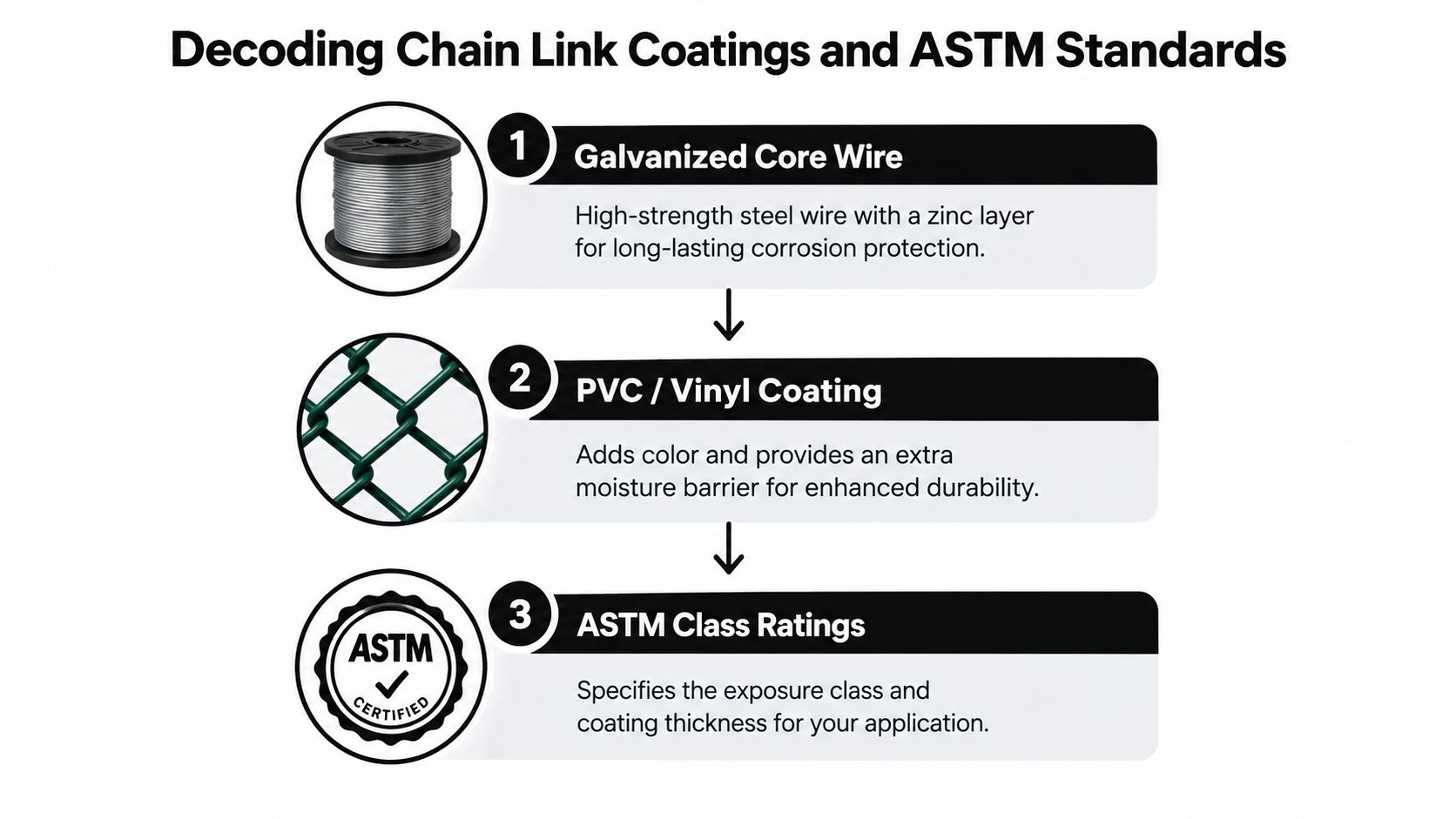
ASTM F668 is the principal U.S. material standard for PVC-coated steel chain-link fabric. It separates coating classes by thickness. Class 1 and Class 2a specify PVC coating between 15 and 25 mils, while Class 2b specifies a thinner 6 to 10 mil coating. The standard should appear in the submittal, not only in marketing copy.
Galvanized core, PVC layer, and coating class
Galvanized chain link depends on zinc protection applied to the steel wire. Vinyl-coated chain adds a PVC layer over a metallic-coated core. The outer layer provides color, a moisture barrier, and a smoother surface. Salt air can still reach the underlying system through cuts, abrasion, poor trimming, or failed bonding, so the core specification remains important.
Manufacturing method affects performance. CAN/CGSB-138.1-2019 states that vinyl-coated wire must be coated before weaving by thermal extrusion or fusion, and that its 2019 edition superseded the 1996 edition. ASTM F668 identifies PVC-coated steel chain-link fabric in the United States. Public-sector specifications may call for a 10-mil vinyl coating over metallic-coated wire, while ASTM-based product sheets describe Class 2b bonded coatings in the 6 to 10 mil range, as documented in this chain-link fence specification.
The quote or submittal should state whether the coating is bonded or extruded. A thinner bonded system may suit a protected location, but it should not be presented as equivalent to a thicker commercial-grade coating without identifying the class and exposure conditions.
Why core wire gauge can matter more than appearance
The finished outside diameter includes the coating. ASTM-based purchasing therefore identifies vinyl fabric by the metallic core wire size, not just the coated diameter. One industry specification lists Class 2b fused-and-bonded fabric with a 9-gauge finish over a 10-gauge core and an 8-gauge finish over a 9-gauge core, showing why the order must state the core. The procurement example appears in this chain-link product specification.
A coated measurement can make a lighter core look stronger than it is. For commercial, school, utility, or high-use properties, “vinyl coated” alone leaves room for substitution. Property managers should also compare fabric specifications with the chain-link fence panels and installation components included in the quote.
Product listings demonstrate the variation. One commercial color fabric specifies a 2-inch diamond mesh, 11-gauge galvanized steel core, 8-gauge finished diameter, and compliance with Federal Specification RR-F-191/1D Type IV plus ASTM F668 Class I. Another calls for 10 mil PVC coating over metallic-coated wire, as shown in this commercial vinyl-coated fabric listing. In coastal Florida, those details help predict maintenance and replacement exposure better than color alone.
Comparing Galvanized, PVC-Coated, and Vinyl Options
Material choice affects more than the fence's color. It determines how the system handles salt air, scratches, maintenance access, and future replacement. Galvanized steel provides a practical metallic finish. PVC-coated fabric adds color and another barrier over the steel. Vinyl-coated fabric, when ordered to a defined ASTM class, gives the buyer clearer control over coating thickness and product consistency.
The term “PVC-coated” covers a broad range of products. “Vinyl-coated Class 2a” identifies a specific coating class under ASTM F668, with a coating thickness of 15 to 25 mils. That distinction matters because a colored finish alone does not establish the coating thickness, core wire, or overall system quality.
Chain Link Material Comparison for Florida Properties
| Feature | Galvanized Steel | PVC-Coated | Vinyl-Coated (Class 2a) |
|---|---|---|---|
| Appearance | Silver metallic finish | Colored finish, depending on system | Defined colored finish with thicker ASTM class coating |
| Corrosion approach | Zinc protection on steel | Metallic coating plus PVC layer | Metallic coating plus 15 to 25 mil PVC layer |
| Coastal suitability | Can work with appropriate specification and maintenance | Depends heavily on core, coating, and installation | Stronger candidate where appearance and added coating thickness are priorities |
| Scratch response | Exposed steel can begin corroding | Damaged PVC can expose the underlying system | Damage still requires inspection and repair |
| HOA compatibility | May be restricted by appearance | Often easier to match approved color schemes | Suitable where the HOA accepts the specified color and finish |
| Structural performance | Driven by core gauge, mesh, framework, and installation | Not determined by color alone | Not determined by coating class alone |
| Visual maintenance | Metallic finish shows oxidation and weathering | Color can fade or weather | Color and coating condition remain inspection items |
| Best fit | Utility, industrial, budget, or concealed boundaries | Residential and commercial color applications | Higher-spec visible perimeters requiring a defined coating class |
Matching the material to the stress
Galvanized steel fits fences where function takes priority, maintenance access is straightforward, and a metallic appearance is acceptable. It can also suit utility, industrial, or less visible boundaries where the owner does not need a colored finish.
PVC-coated fabric has a practical advantage around homes, planted properties, and communities with approved color palettes. Black or green coating can reduce the visual contrast against vegetation and may make routine soil or weathering less noticeable. The trade-off is that the quote must identify the metallic coating, core wire, PVC system, and installation details. “PVC-coated” by itself leaves too much room for variation.
Class 2a vinyl-coated fabric makes sense when a thicker, specified coating is part of the owner's maintenance and appearance priorities. It remains a coated steel fence, not a maintenance-free product. Coastal salt, sun, irrigation, and physical contact can still damage the surface. A thicker coating doesn't compensate for an undersized structural system, poor gate alignment, or corroding fasteners.
HOA approval should come before material ordering. Confirm the color, height, mesh, visibility, and gate design in writing. A finish that looks appropriate on a sample can still fail community requirements, leaving the property owner with a costly change order or replacement.
Best Use Cases Across the Treasure Coast
Material selection changes across the Treasure Coast because exposure changes from property to property. A residence several miles inland, a commercial parcel beside the Intracoastal, and an ocean-facing service yard don't place the same demands on a fence.
Martin County and St. Lucie County properties may experience intense sun, humidity, tropical storms, and irrigation exposure even when they aren't directly on the beach. Indian River County and northern Palm Beach County sites can present the same combination, with additional concern where prevailing winds carry salt toward the perimeter.
Residential and HOA properties
Black or green vinyl coated chain often fits residential boundaries where the owner wants a less industrial appearance. It can blend with trees, planting beds, pool-deck surroundings, and approved community palettes. The color also hides routine soil and shadowing better than bright metallic fabric.
That choice works best when the owner specifies the core wire and coating class, confirms the color with the HOA, and keeps landscaping from rubbing against the mesh. Vinyl coating doesn't solve every residential concern. Gate hinges, latch components, posts, and concrete interfaces still need attention.
Pool barriers require a separate code review. In Florida, Miami-Dade pool-barrier guidance requires access gates to be self-closing and self-latching, to open outward away from the pool, and to use a latch release at least 54 inches above grade on the outside, or a release on the pool side positioned at least 3 inches below the gate top, according to this Florida pool barrier presentation. Fence fabric color is secondary to compliant gate mechanics.
Commercial, utility, and waterfront sites
Commercial properties need a more disciplined specification because perimeter failure affects access, security, operations, and liability. A stronger core, suitable mesh, properly sized framework, corrosion-resistant hardware, and a documented coating system should be evaluated together.
Oceanfront or Intracoastal properties deserve particular caution. A vinyl outer layer may improve the initial appearance, but a damaged coating, poor fastener choice, or neglected gate can create early weak points. In highly exposed locations, the owner should compare vinyl coated chain with galvanized, aluminized, or other corrosion-focused systems rather than assuming color equals durability.
Inland versus exposed micro-climates
The useful distinction isn't just “coastal” or “not coastal.” Fence lines beside seawalls, docks, open fields, pool equipment, saltwater systems, or irrigation spray face different conditions from protected interior courtyards.
A fence specification should follow the exposure map, not the brochure photograph.
For mixed properties, a hybrid approach can be sensible. A colored vinyl system may suit the public-facing boundary, while a heavier galvanized or differently protected system may be more practical along a service yard or concealed rear perimeter. That allocation can preserve appearance where visitors see the fence and prioritize service conditions where they don't.
How to Read a Fence Quote and Avoid Specification Gaps
A quote that says “vinyl coated chain link” describes a finish, not a complete assembly. Property managers should ask for enough information to compare equivalent bids. Otherwise, one contractor may price a heavier commercial fabric while another prices a lighter residential product, with both using the same broad phrase.
Four items that belong in the written scope
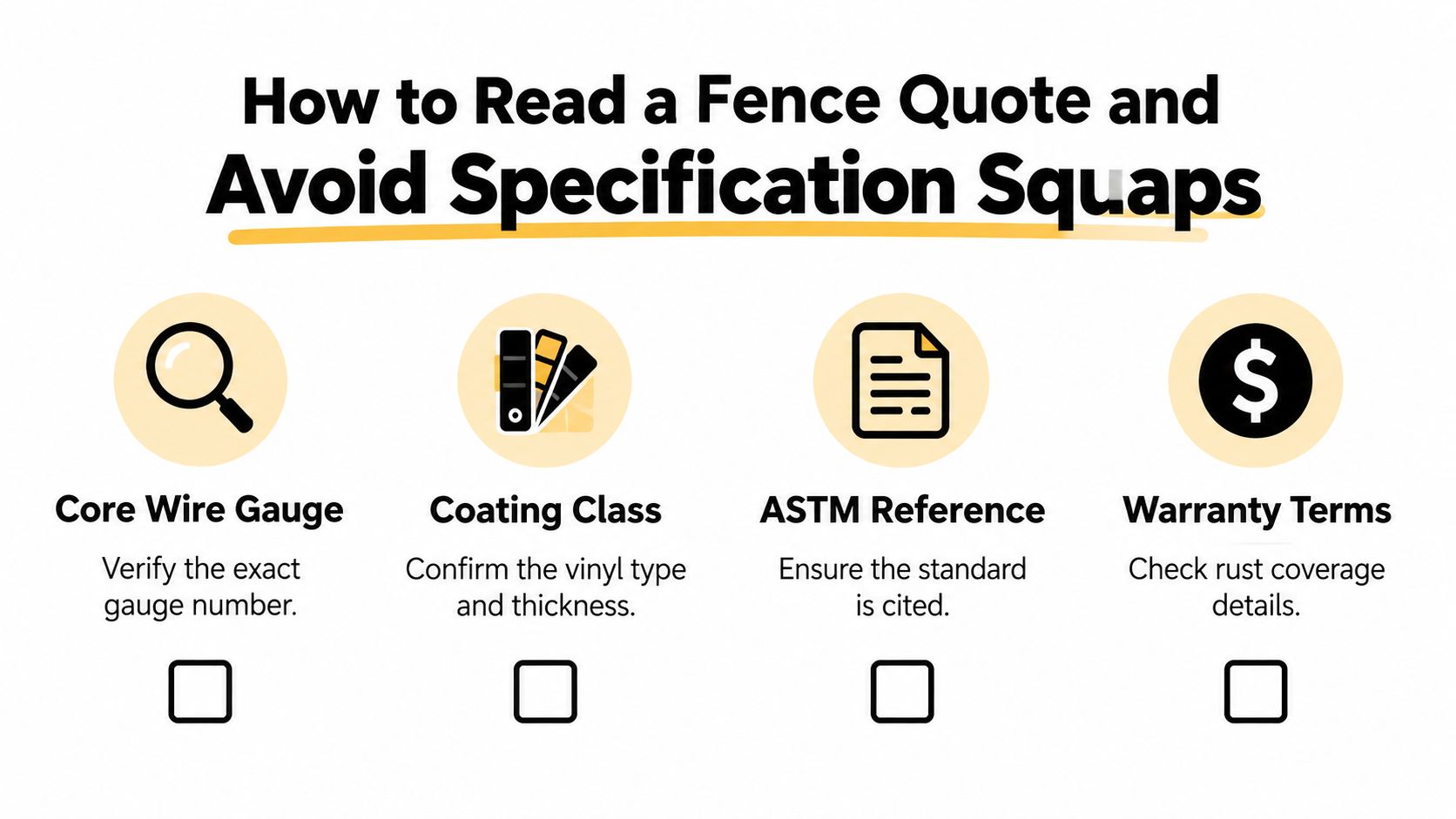
Core wire gauge should appear separately from the finished coated diameter. The industry example of a 9-gauge finish over a 10-gauge core demonstrates how a buyer can misunderstand the product when only the outside measurement is listed. Ask whether the gauge refers to the metallic core or the completed coated wire.
Coating class and method should identify whether the fabric is Class 1, Class 2a, or Class 2b under ASTM F668, along with the specified thickness and whether the coating is bonded, extruded, or fused and bonded. A quote that lists only “black vinyl” doesn't establish the coating performance.
ASTM and federal references help establish the material benchmark. The quote should identify ASTM F668 when PVC-coated fabric is proposed and should state any applicable federal or project specification. The reference should match the product submittal, not merely appear as unexplained boilerplate.
Warranty terms need careful reading. The owner should determine whether the warranty covers fading, chipping, peeling, coating adhesion, corrosion, framework, labor, or only replacement material. A coating warranty isn't automatically a structural warranty.
Questions that expose substitutions
Ask for the mesh size, core wire, finished diameter, metallic coating, coating thickness, fabric height, post and rail specifications, gate hardware, and repair responsibilities. The more exposed the location, the more important it becomes to identify fasteners and fittings rather than treating them as minor accessories.
The chain link panel specifications guide can help a buyer organize those questions before comparing bids. The goal isn't to force every property into one product class. It's to prevent a premium price for an unspecified system.
A professional quote should also identify removal, disposal, permits when applicable, utility locating, gate installation, site access, and cleanup. These items affect the final project even though they aren't part of the fabric's coating rating.
Lifecycle Costs and Warranty Realities
The lowest installation price can be the wrong benchmark for a coastal perimeter. Vinyl coated chain generally costs more than basic galvanized fabric because the product adds a coating system, color, and additional manufacturing requirements. The value comes from the combination of appearance and corrosion delay, not from a promise that the fence will never need attention.
Available industry cost material indicates that installed vinyl-coated chain link commonly costs more than galvanized alternatives and is marketed with long coating warranty periods, as discussed in this vinyl-coated chain link cost and warranty overview. Those warranties often focus on coating defects such as fading, chipping, and peeling, rather than guaranteeing full structural performance in every environment.
What the warranty may leave out
Owners should look for exclusions involving:
- Coating damage: Cuts, abrasion, impact, and installation damage may be excluded.
- Hardware corrosion: Hinges, latches, screws, ties, and fittings may carry separate terms.
- Site exposure: Salt air, industrial contaminants, chemicals, or irrigation may affect coverage.
- Workmanship: The material manufacturer may not cover installation errors.
- Consequential loss: A warranty may replace material without paying for removal, labor, access, or restoration.
A warranty is useful only when its scope matches the risk. A long coating term doesn't prove that the underlying core, posts, gates, or fasteners will remain serviceable under a particular coastal exposure.
Repairability is part of the cost
Vinyl coated chain has a practical advantage over many solid systems because damaged sections can often be assessed and repaired without replacing an entire privacy wall. But repair color matching can become difficult after weathering, and a replacement section may look newer than the surrounding fence.
The economic comparison should include inspection time, cleaning, replacement fabric, gate adjustments, hardware changes, landscaping interference, and access requirements. A site that is easy to inspect and protected from direct salt spray may justify the visual premium. A harsh industrial or waterfront site may favor a different corrosion strategy, even if the initial appearance is less decorative.
Warranty question: Ask what happens after the coating fails, not just how long the brochure says the coating is covered.
The financially responsible choice aligns the coating with the property's exposure and the owner's maintenance capacity. “Vinyl” isn't automatically the lowest lifetime-cost option, and “galvanized” isn't automatically the cheapest after repeated repairs or premature replacement.
Situational Recommendations for Your Property
The correct specification depends on who uses the property, what the fence must accomplish, and how much exposure the site receives. A coastal homeowner prioritizing appearance may choose a different system from a warehouse manager protecting a service yard. A budget-conscious owner may reasonably select galvanized steel, provided the material is appropriate and the expected maintenance is understood.
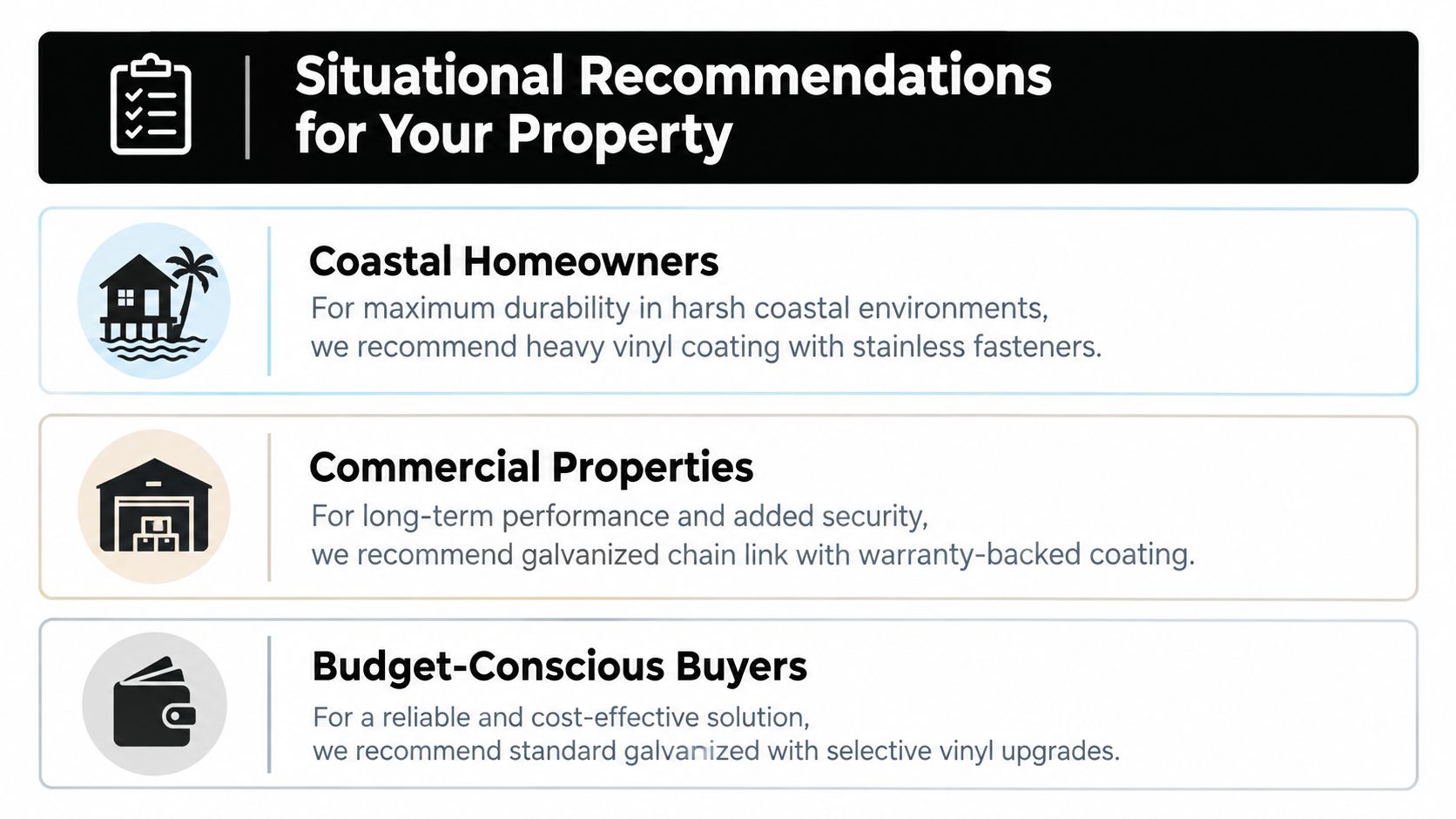
Coastal homeowners
For a home near the beach or Intracoastal, a heavier vinyl coating can support the desired appearance, but the specification should also address the core wire, gate hardware, fasteners, and maintenance access. Stainless fasteners may be appropriate where corrosion exposure warrants them, subject to compatibility with the rest of the assembly.
The owner should confirm HOA color rules, pool-barrier requirements, gate operation, site clearances, and the repair process before installation. Black and green finishes can integrate well with surrounding greenery, but they still need inspection after storms and equipment contact.
Commercial properties
Commercial and institutional owners should prioritize documented performance over color alone. A properly selected galvanized chain-link system with a warranty-backed coating may be more suitable than a thin decorative finish when the perimeter faces frequent contact, heavy use, or difficult maintenance access.
The coating class, core gauge, mesh, posts, rails, terminals, bottom restraint, gates, and hardware should appear in the submittal. The commercial fencing services offered through AlliedFenceAndGate.com™ include galvanized and vinyl-coated chain-link options for perimeter applications, allowing the material choice to follow the site rather than a one-size-fits-all sales pitch.
Budget-conscious buyers
Standard galvanized steel remains a rational choice for many inland residential boundaries, temporary needs, and low-visibility areas. Selective vinyl upgrades can reserve the colored finish for the front boundary, pool area, or sections visible from common spaces.
Vinyl coated chain became a recognized product line during the mid-20th century as PVC technology matured. Master Halco's manufacturer history notes that the company began producing vinyl-coated chain-link fabric in Olney, Illinois, after moving from fittings into chain-link fabrication in 1961, describing the product as a later extension of its chain-link line. That history is documented in the Master Halco company history.
A responsible recommendation doesn't promise a maintenance-free fence. It identifies the required standard, chooses the core for the actual use, specifies compatible hardware, and explains what the owner should inspect after installation.
AlliedFenceAndGate.com™ provides vinyl-coated and galvanized chain-link installation and repair for residential and commercial properties across Florida's Treasure Coast and northern Palm Beach County. Property owners can review site conditions, coating specifications, gates, permitting, and maintenance priorities with the project team by visiting AlliedFenceAndGate.com™.
Related Fencing Services
Need a fence or gate on the Treasure Coast?
Licensed, insured, and bonded. Free estimates across Martin, St. Lucie, Indian River & Palm Beach counties.
Call (772) 530-3127