Pool Safety Fence Near Me: A Florida Local Buyer's Guide
You've searched “pool safety fence near me,” opened a dozen contractor websites, and still don't know which company can install a barrier that will pass inspection. The cheapest quote may look attractive until an inspector finds a gate that doesn't close by itself, a latch within a child's reach, or a fence layout that leaves the pool connected to the yard.
In Martin County and Palm Beach County, a pool fence is more than a decorative boundary. It's a life-safety barrier, a permitting issue, and a project that needs to be designed around Florida requirements from the first site visit.
Table of Contents
- Why Finding the Right Pool Fence Contractor Matters
- How to Vet and Hire a Local Pool Fence Installer
- Florida Pool Fence Code Requirements and Permits
- Choosing the Right Fence Material for Florida Conditions
- Preparing for Your Fence Estimate and Installation
- Final Checklist for a Code-Compliant Pool Fence
Why Finding the Right Pool Fence Contractor Matters
A general fence installer may have an open schedule and attractive project photos, yet still lack pool-barrier experience. Setting posts and hanging gates are only part of this work. The contractor must read the relationship between the pool, house, deck, doors, windows, landscaping, and access routes before deciding where the barrier belongs.
That review matters in Martin and Palm Beach Counties, where a layout can create permitting and inspection problems even when the materials look excellent. A contractor who understands local requirements can identify access points early, explain the permit path, and document the proposed barrier before installation begins.
A finished fence can still fail inspection. A gate may swing toward the pool, a latch may sit low enough for a child to reach, or a side-yard opening may let a child walk around the barrier. Landscaping, existing screens, doors, and deck transitions can also create gaps that are easy to miss from a driveway view.

The layout matters as much as the material
Evidence reviewed in controlled pool-fencing studies found that drowning or near-drowning odds were 73% lower when a pool had a fence, with an odds ratio of 0.27 and a 95% confidence interval of 0.16 to 0.47. The review also identified a four-sided isolation fence as substantially more protective than a three-sided property-line arrangement, with an 83% lower child drowning risk.
Those findings support a practical design rule: separate the pool from the house and the rest of the yard. A child should not be able to move directly from an open door, patio, or play area to the water.
Practical rule: A pool fence quote should describe the barrier layout, gate operation, permit responsibility, documentation, and inspection plan, not just the material and total price.
Failed inspections create avoidable problems
A failed inspection can delay pool use, require a return visit, and force changes to completed decking or landscaping. It can also create a dispute over whether corrective work was included in the original quote. Get the scope and inspection responsibility in writing before work starts.
Florida's pool-safety framework, including the Virginia Graeme Baker Pool and Spa Safety Act, reinforces the need to prevent unsupervised child access, as explained in CPSC pool-safety guidance. For homeowners comparing “pool safety fence near me” results, availability and price matter, but code knowledge, documentation, and inspection follow-through matter more.
How to Vet and Hire a Local Pool Fence Installer
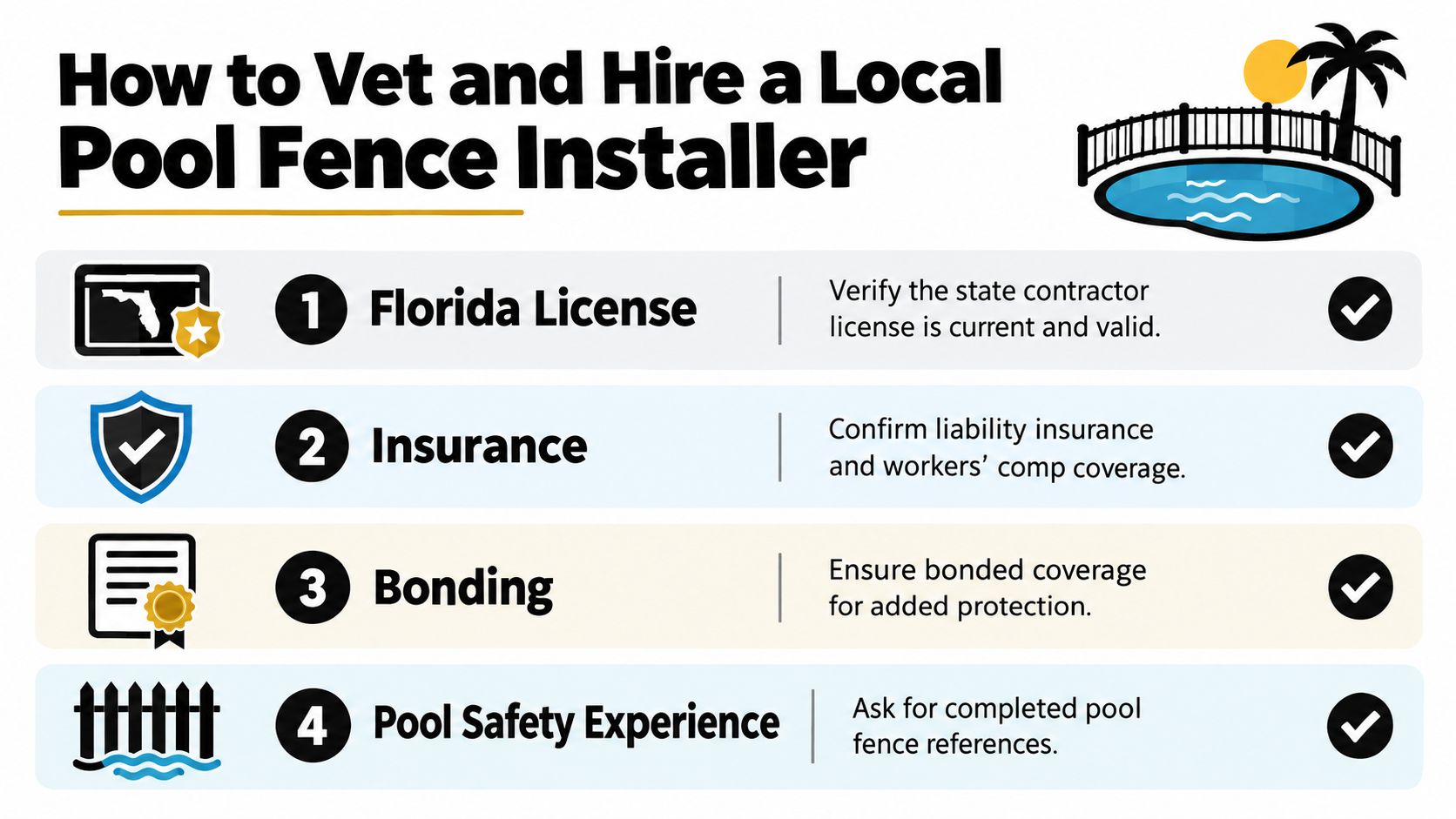
Start with the contractor's legal and safety credentials before discussing colors or decorative details. A legitimate candidate should be able to provide a Florida contractor license, proof of general liability insurance, workers' compensation coverage, and bonding information. Those documents protect the homeowner from relying on a verbal promise that the project is covered.
Use a direct screening process
Ask each installer the same questions so quotes can be compared fairly:
- Pool-fence experience: Does the company regularly install residential pool barriers and self-closing, self-latching gates?
- Permit handling: Will the contractor prepare and submit the required permit documents?
- Utility safety: Will the company arrange an 811 utility locate before digging or drilling?
- Inspection coordination: Who schedules the inspection, and who returns if the inspector identifies a correction?
- Written scope: Does the quote identify fence footage, gates, hardware, site preparation, permit work, and exclusions?
- References: Can the contractor provide recent pool-fence references in Martin or Palm Beach County?
A contractor who answers these questions clearly is easier to hold accountable than one who sends a one-line price by text. The quote should also explain whether tree removal, stump grinding, difficult access, deck conditions, or changes to existing gates could affect the final cost.
Separate useful tools from sales pressure
A digital estimator can help establish a reasonable starting point before an in-person consultation. AlliedFenceAndGate.com™ provides online estimating, lot-survey and property-photo uploads, AI-based measurement extraction, digital documentation, and payment workflows. Those tools don't replace a site assessment, but they can make the initial conversation more concrete.
Red flags include a contractor who avoids permit questions, refuses to discuss insurance, won't identify the gate hardware, or insists that a property-line fence automatically satisfies pool-barrier requirements. Green flags include a detailed PDF quote, written warranty terms, clear payment milestones, local references, and a process for handling inspection corrections.
Florida Pool Fence Code Requirements and Permits
Florida residential pool-barrier rules focus on continuous isolation, barrier height, and gate behavior. The barrier must surround the entire pool, spa, or hot tub perimeter, although Palm Beach County documentation recognizes a combination approach in some residential situations. That arrangement can use a partial perimeter barrier together with compliant child-safety measures at house openings, rather than leaving the pool area open to the property.
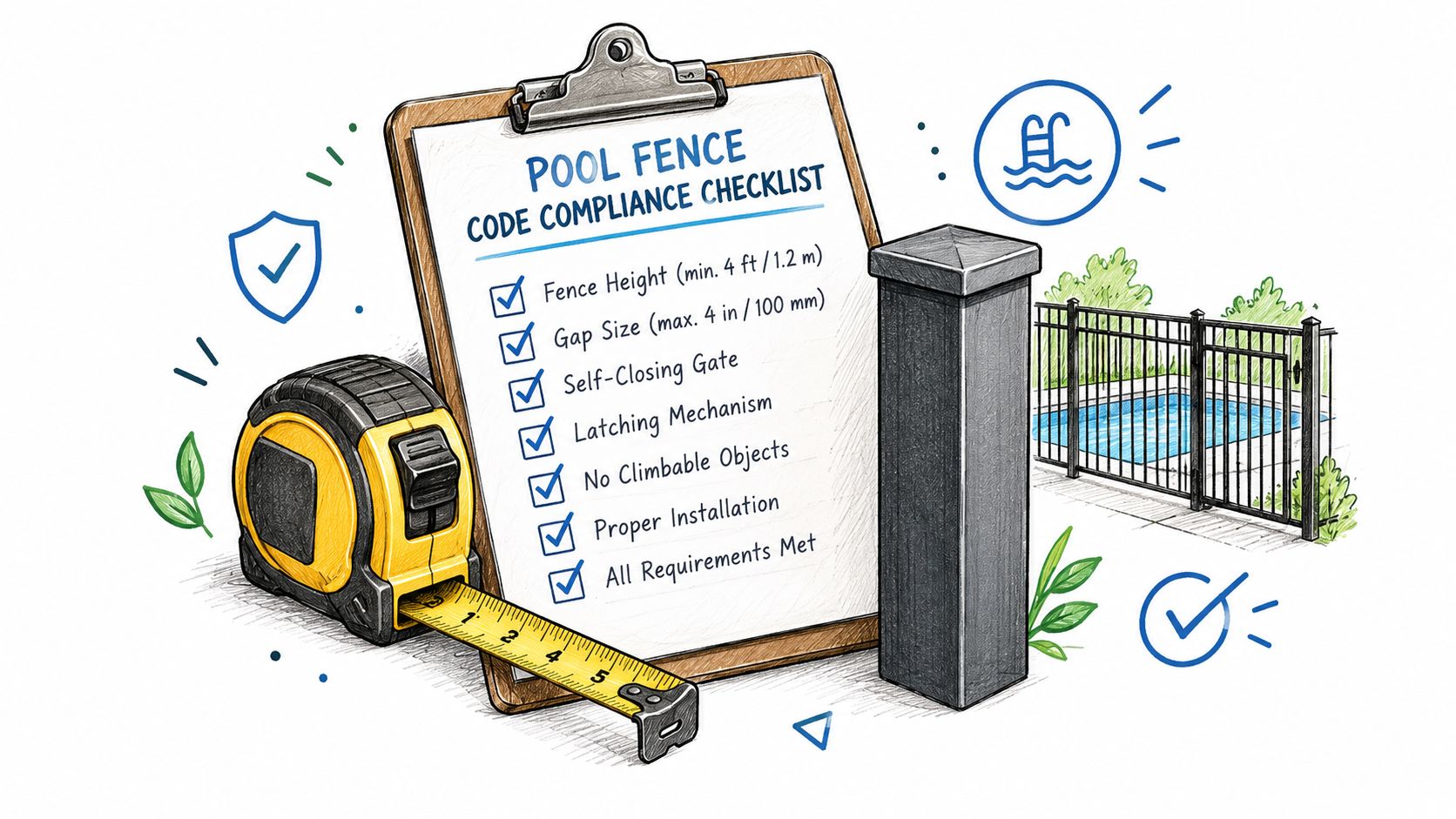
The common residential barrier height standard in Florida is 48 inches minimum above finished ground level on the outside of the barrier, and Martin County's public-pool affidavit uses the same 48-inch minimum. The affidavit also requires the gate latch to be at least 54 inches from the bottom of the gate or at least 3 inches below the top on the pool side.
Gates receive close attention
Florida access-gate rules require the gate to:
- Swing outward: The gate must open away from the pool.
- Close automatically: Hinges and hardware must return the gate to a closed position without relying on a homeowner's memory.
- Latch automatically: The latch must engage without manual intervention after the gate closes.
- Resist child access: The release mechanism must be positioned on the pool side so a young child can't reach it over the top or through an opening.
A Miami-Dade pool-barrier presentation explains these access-gate requirements and notes the child-safety placement rule when the release is lower than 54 inches above the threshold. Palm Beach County's affidavit materials also address the release location, so contractors should verify the exact condition that applies to the property rather than relying on a generic gate design.
Permitting needs a named owner
The contractor and homeowner should agree in writing who handles the permit application, Notice of Commencement, 811 locate, inspection request, and correction response. A homeowner searching for a pool safety fence near me shouldn't assume those tasks are included just because the company advertises “code-compliant” work.
For background on the paperwork sequence, homeowners can review how a Florida fence permit application works. The site assessment should identify doors, windows, gates, pool equipment, retaining features, trees, irrigation lines, and underground utilities before installation begins.
Inspection readiness is practical, not theoretical. Inspectors can evaluate the continuous barrier, height, openings, gate swing, self-closing action, self-latching action, and latch location. A contractor who documents those points before requesting inspection gives the homeowner a much better chance of avoiding rework.
Choosing the Right Fence Material for Florida Conditions
A fence that looks appropriate in a showroom may perform poorly beside a Florida pool. Heat, humidity, heavy rain, coastal salt, vegetation, and storm exposure all affect finishes, posts, panels, and hardware. Start with the barrier route and property conditions, then choose a material that can support a clean, inspectable pool enclosure. A privacy or security product is not automatically suitable for pool-barrier use.
Pool Fence Material Comparison for Florida
| Material | Price Range (per ft) | Pros | Cons | Best For |
|---|---|---|---|---|
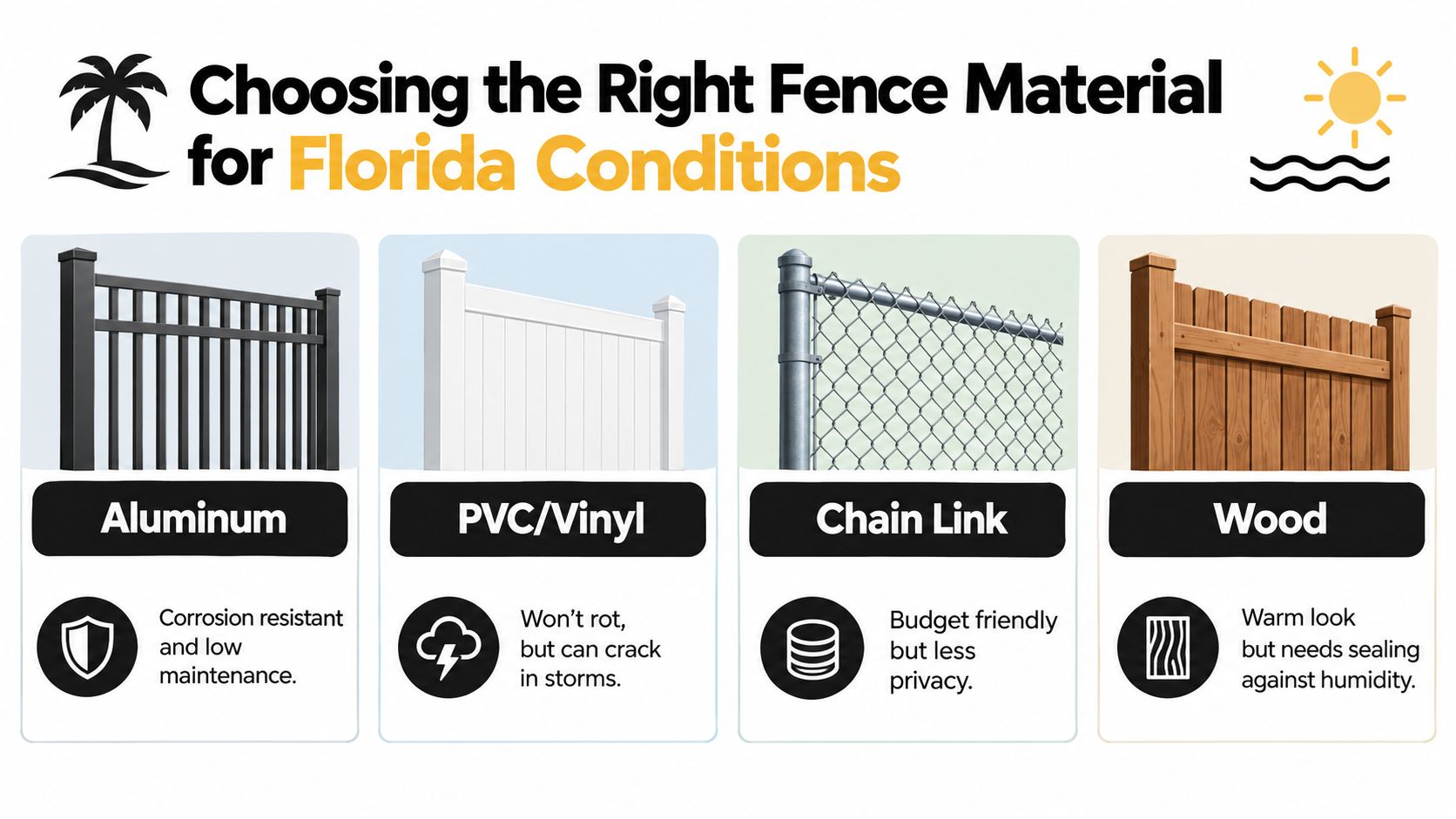
| Aluminum | $28–150 per ft | Corrosion-resistant, low maintenance, open sightlines | Higher prices for custom designs, limited privacy | Pool enclosures, decorative borders, coastal settings |
| PVC/Vinyl | $25–48 per ft | Won't rot, low maintenance, privacy options | Can crack in storms, larger visual footprint | Homeowners wanting privacy and easy upkeep |
| Chain link | $22–50 per ft | Budget-friendly, practical security, durable mesh options | Limited privacy, appearance may not suit every pool deck | Utility-focused layouts and security-minded properties |
| Wood | $25–45 per ft | Warm traditional appearance, adaptable privacy design | Needs sealing and regular maintenance in humidity | Traditional yards and cedar board-on-board designs |
These published ranges are summarized in Allied's published fence price ranges by material. The installed quote depends on the property, design, access, gates, preparation, and permit-related work. Price per foot can hide major differences. One proposal may include removal, difficult drilling, and a compliant gate, while another may exclude them.
Match the material to the property
Aluminum is frequently practical around pools because it provides visibility, resists corrosion, and avoids the recurring sealing required by wood. It defines the pool area without making the yard feel closed in, which can help preserve sightlines from the house. Coastal properties still need suitable hardware and a finish appropriate for salt exposure.
PVC or vinyl works for homeowners who want a stronger visual division or more privacy. It will not rot, but the installer should review storm exposure, panel movement, and soil conditions before describing the system as maintenance-free. Larger solid panels can also change the appearance and wind load of the enclosure.
Chain link provides a functional barrier where budget and security take priority. The open mesh offers limited privacy and may look out of place beside a finished pool deck unless screening is added. Screening can also change wind exposure, so the complete installation deserves review rather than treating the mesh as the only consideration.
Wood delivers the most traditional appearance, especially in a cedar board-on-board design. Florida humidity makes sealing and regular maintenance part of ownership, and neglected boards can affect the condition and appearance of the barrier.
Choose the material that supports reliable gate operation, durable posts, and a clear inspection path on the actual property. That decision matters more than a sample's appearance or a low initial price.
Preparing for Your Fence Estimate and Installation
Good preparation makes the estimate more accurate and reduces surprises after the crew arrives. Homeowners should gather a property survey, clear lot photos, pool-deck images, and HOA rules if the neighborhood has architectural review. Photos should show the pool from the house, side yard, rear yard, driveway, and any access gate.
A digital tool such as the pool fence cost calculator can provide a ballpark starting point before the contractor visits. It won't identify every buried line or site obstacle, but it helps homeowners understand how perimeter length, material, gates, and access conditions affect the conversation.
What the site assessment should uncover
The installer should walk the full proposed barrier route and identify:
- Trees and roots: Determine whether tree removal or root conflicts will affect post placement.
- Stumps and dense growth: Confirm whether stump grinding or clearing is needed before layout.
- Deck and paving conditions: Check concrete, pavers, slopes, cracks, and transitions that affect anchoring.
- Utilities: Arrange the required 811 locate before digging or drilling.
- Existing openings: Review doors, gates, screens, and other routes that could undermine pool isolation.
- Drainage and grades: Account for finished ground levels when checking barrier height.
Change orders often begin with conditions that weren't visible in an online measurement. A careful site review puts those conditions into the written scope before installation rather than after materials have been ordered.
Confirm the installation-day details
Before approving the contract, ask who will coordinate permits and inspections, what the warranty covers, and how corrections are handled. Confirm the financing terms in writing, including the stated 50% deposit and balance on completion where those terms apply.
The crew should leave the site with the gate closing and latching properly, posts stable, hardware adjusted, and the work area clean. The homeowner should receive copies of permit documents, inspection information, warranty paperwork, and the final payment record.
Final Checklist for a Code-Compliant Pool Fence
A compliant pool fence project comes down to a few decisions made in the right order:
- Hire a qualified contractor: Verify Florida licensing, insurance, bonding, and specific pool-barrier experience.
- Design the isolation layout: Keep the pool separated from the house and yard wherever the applicable local requirements call for that arrangement.
- Confirm the barrier dimensions: Check the 48-inch minimum height and the applicable opening and ground-level conditions.
- Specify the gate correctly: It must swing outward, close by itself, latch by itself, and keep the release beyond a child's reach.
- Assign the paperwork: Put permits, Notice of Commencement, 811 locates, and inspection coordination into the contract.
- Choose for the site: Compare aluminum, vinyl, chain link, and wood based on corrosion, humidity, privacy, upkeep, appearance, and budget.
- Document the final work: Keep the permit, inspection outcome, warranty, and gate-maintenance instructions.
A pool safety fence isn't a project to improvise after the pool is already in use. Homeowners should also review pool safety gate latch requirements so the gate hardware receives the same attention as the fence panels and posts.
Use an online estimator and lot-analysis tools to establish a realistic starting point, then have a qualified local installer verify the site and code path. That combination reduces avoidable mistakes without treating a digital measurement as a substitute for professional judgment.
#MartinCountyFencing #PalmBeachCountyFencing #MartinCountyPoolFence #PalmBeachPoolFence #StuartFencing #PalmBeachGardensFencing #TreasureCoastFencing #FloridaPoolFence #PoolSafetyFence #PoolFenceInstallation #PoolSafetyGate #AluminumFencing #VinylFencing #ChainLinkFencing #WoodFencing #FenceContractor
AlliedFenceAndGate.com™ handles pool safety fence installation, compliant self-closing and self-latching gates, permitting, 811 utility locates, and inspection coordination across Martin County, Palm Beach County, and the Treasure Coast. Visit AlliedFenceAndGate.com™ to use the digital estimator and arrange a site assessment for a code-focused pool barrier.
Related Fencing Services
Need a fence or gate on the Treasure Coast?
Licensed, insured, and bonded. Free estimates across Martin, St. Lucie, Indian River & Palm Beach counties.
Call (772) 530-3127