Just Fence It: A Treasure Coast Homeowner Decision Guide
A Palm City homeowner can spend a Saturday pacing a bare backyard with twine between stakes, then spend the next week wondering whether the fence is even allowed. The proposed line may cross a drainage easement, the gate may face the wrong way for a pool, or the material that looked good in a sample may struggle with salt air and storm exposure.
“Just fence it” sounds simple because the visible product is simple. The installed project isn't. A sound Treasure Coast decision passes through purpose, rules, site, and budget, in that order and then again as the details change. Skip one filter and the result can be a fence that gets removed within a few years, a stalled inspection, or a permit denial that holds up related construction.
The coastal setting makes those filters practical survival conditions. Salt-laden air reaches properties near the Indian River Lagoon and the Atlantic, summer storms punish weak layouts, and code enforcement differs between Martin County, northern Palm Beach County, and individual municipalities. A fence has to work for the property, the authorities, and the people using the yard.
Table of Contents
- Standing in the Backyard With a Roll of Twine
- Four Reasons Treasure Coast Homeowners Fence
- Matching Materials to Coastal Florida Conditions
- HOA Approval and Permits on the Treasure Coast
- What Really Moves the Final Installed Price
- Maintenance Over the Life of the Fence
- A Pre-Project Checklist Before You Call a Contractor
- Turning the Decision Into a Real Project
Standing in the Backyard With a Roll of Twine
The homeowner with the roll of twine usually starts with a visual question: Where should the fence go? A contractor has to start with four more useful questions. What problem is the fence solving? What rules control the line, height, gates, and material? What will the site do to the installation? What will the complete project cost after the less visible work is included?
A privacy fence on a tight lot in Port St. Lucie has a different job from an aluminum pool enclosure in Stuart. A boundary fence beside a retention pond needs a different site review from a short decorative run around a front garden. The same material can be a sensible choice in one location and a poor choice in another.
Purpose comes before product
A fence only earns its place when it solves a defined problem. Pool safety, privacy, child or pet containment, property delineation, and controlled access all create different requirements. Choosing a material before identifying the purpose often produces an attractive fence that fails at the actual job.
Rules are part of the design
HOA documents, recorded plats, easements, municipal setbacks, pool-barrier requirements, and visibility rules can alter the layout before a post is installed. A contractor who discovers those restrictions after ordering materials has already allowed the project to move in the wrong direction.
The site decides the labor
Sand fill, roots, old construction debris, grade changes, irrigation, and buried utilities all affect post placement. Coastal weather also makes wind exposure and corrosion resistance more important than a showroom sample suggests.
Practical rule: A fence quote is only decision-ready when it describes the line, gates, site conditions, approvals, and inspection responsibilities, not just the material.
The rest of the decision should follow that sequence rather than a generic price list. First, the homeowner needs to identify the reason for fencing. Then the rules, coastal conditions, and installed cost can be matched to that purpose.
Four Reasons Treasure Coast Homeowners Fence
Most residential fence decisions on the Treasure Coast fit one of four practical purposes. Naming the primary purpose keeps the design from drifting toward features that look useful but don't solve the homeowner's immediate problem.
Pool safety
A pool barrier is a code and life-safety project, not a decorative perimeter. Florida pool guidance requires gates providing pool access to open outward away from the pool, close automatically, and latch securely. The latch release generally belongs on the pool side unless it is at least 54 inches above the bottom of the gate, with the additional requirement that a young child can't reach it over the top or through an opening, as explained in the Florida pool barrier statute.
That cause-and-effect relationship matters during layout. Gate swing, latch height, opening gaps, and the surrounding deck or wall can't be designed independently. A fence that looks compliant from the street can still fail inspection if the gate hardware or reach path is wrong.
Privacy
Tight lots and nearby second-story windows create a different trigger. In parts of Port St. Lucie and Jupiter, homeowners may want relief from direct views into a patio, outdoor kitchen, or bedroom-facing yard. PVC or wood privacy panels can solve that problem, but an HOA may control the approved height, color, finished side, and location.
A privacy fence also changes wind exposure. Solid panels catch more wind than open pickets, so the installer has to account for the fence line, support system, and local requirements rather than treating privacy as a purely visual choice.
Child and pet containment
Retention ponds, canals, open side yards, and busy streets make containment a daily-use decision in many Martin County subdivisions. The practical question isn't only whether a dog can pass beneath the fence. It includes gate security, grade changes, pool access, and whether a child can reach a latch or climb an adjacent feature.
For a family yard, a walk gate that closes reliably may matter more than an ornamental upgrade. A fence can also separate play space from equipment, landscaping, or water hazards without turning the entire property into a fortress.
Boundary and weather management
Some owners need a clear property line after a landscaping dispute, a sale, or a new construction project. Others want a controlled edge around a side yard, trash area, or service access point. Historical land use helps explain this continuing role. The phrase “fence it in” has a documented history reaching back to the late 1500s, while modern definitions describe a fence as a structure or barrier enclosing land or marking a property perimeter.
On the Treasure Coast, a boundary fence may also provide limited screening from prevailing weather. It won't replace hurricane hardening, and a solid fence isn't automatically the right choice for a high-wind location, but the desired balance between openness, privacy, and exposure should be settled before material selection.
| Purpose | Treasure Coast Trigger | Project Implication |
|---|---|---|
| Pool safety | Pool access and inspection requirements | Engineer barrier height, openings, gate swing, self-closing hardware, and latch reach together |
| Privacy | Tight lots, neighboring windows, and HOA review | Confirm approved height, color, finished side, and wind-rated panel design |
| Child and pet containment | Canals, retention ponds, streets, and side-yard access | Prioritize reliable gates, safe openings, and careful line placement |
| Boundary and weather management | Property disputes, service areas, and exposed yards | Verify survey lines, easements, wind exposure, and the desired level of screening |
Matching Materials to Coastal Florida Conditions
Material selection on the Treasure Coast is a trade-off between corrosion resistance, wind performance, privacy, code fit, appearance, and upkeep. The right product isn't the one with the best showroom finish. It's the one that continues doing its assigned job after salt air, ultraviolet exposure, heavy rain, and HOA scrutiny.
A useful product overview is available in Florida fence products and material options, but the final selection still depends on the property and approval documents.
Aluminum
Powder-coated aluminum is a strong fit for pool enclosures, decorative boundaries, and locations where visibility matters. A marine-grade finish can resist coastal corrosion without the rust concerns associated with untreated steel, and open pickets reduce the visual and wind load of a solid panel.
The compromise is privacy. Aluminum won't screen a neighbor's yard or an outdoor living area unless the design adds another approved element. It also usually carries a higher upfront material cost than basic chain link or some wood layouts.
Treasure Coast verdict: Choose aluminum when pool safety, appearance, corrosion resistance, and low upkeep matter more than full privacy.
Vinyl and PVC
Vinyl or PVC privacy fencing offers a clean, low-maintenance surface and is often easier to present to an HOA than a heavily weathered wood design. It suits homeowners who want screening without routine staining or painting, provided the product has the wind performance required for its installation.
Discoloration, brittle components, and panel movement are the concerns to examine. Coastal exposure and hurricane conditions make the panel specification, post reinforcement, and installation method important. A low price doesn't tell the homeowner whether the system is suitable for the site.
Treasure Coast verdict: Choose vinyl or PVC when privacy and low routine maintenance lead the decision, but confirm color stability, wind-rated components, and HOA acceptance first.
Chain link
Chain link remains the budget workhorse for containment, service areas, and functional boundaries. It provides visibility and can satisfy a pool-barrier purpose when the complete design meets the applicable requirements, including gate hardware and opening limits.
Standard galvanized chain link rarely satisfies a privacy-focused HOA or homeowner. Black vinyl-coated chain link improves the appearance and can soften the utilitarian look, but it still won't deliver the same visual block as a privacy panel.
Treasure Coast verdict: Choose chain link when function, visibility, and cost control outrank architectural screening.
Pressure-treated wood
Wood brings warmth and a familiar privacy-fence appearance. It may offer a lower first cost than a premium coastal system, but humidity, irrigation, ultraviolet exposure, and wet soil increase the maintenance burden. On the Treasure Coast, wood fences commonly need sealing or staining on a recurring cycle, and the lower rail near irrigation can deteriorate before the posts.
HOA communities may also prefer vinyl, PVC, or aluminum for consistent appearance and fewer maintenance complaints. Cedar board-on-board construction can improve the look and performance, but it doesn't remove the need for ongoing care.
Treasure Coast verdict: Choose wood when its appearance is central and the owner accepts regular maintenance, inspection, and possible HOA limitations.
| Material | Salt Air | Hurricane & Wind | Pool Code Fit | HOA Acceptance | Maintenance |
|---|---|---|---|---|---|
| Aluminum | Strong with an appropriate powder-coated finish | Open layouts can reduce exposure, but design still matters | Well suited when height, openings, and gates comply | Often favorable for decorative and pool layouts | Low |
| Vinyl/PVC | Low routine corrosion concern, but finish quality matters | Requires suitable panel and post specifications | Can work when the complete barrier meets code | Often favorable for approved privacy styles | Low |
| Chain link | Galvanized or coated systems need hardware attention over time | Open construction can be practical for exposed sites | Can fit functional barrier designs | Variable, improved by black vinyl coating | Low to moderate |
| Wood | Vulnerable to moisture and coastal weathering | Solid panels require careful design and fastening | Possible, subject to barrier details | Often limited by community standards | High |
HOA Approval and Permits on the Treasure Coast
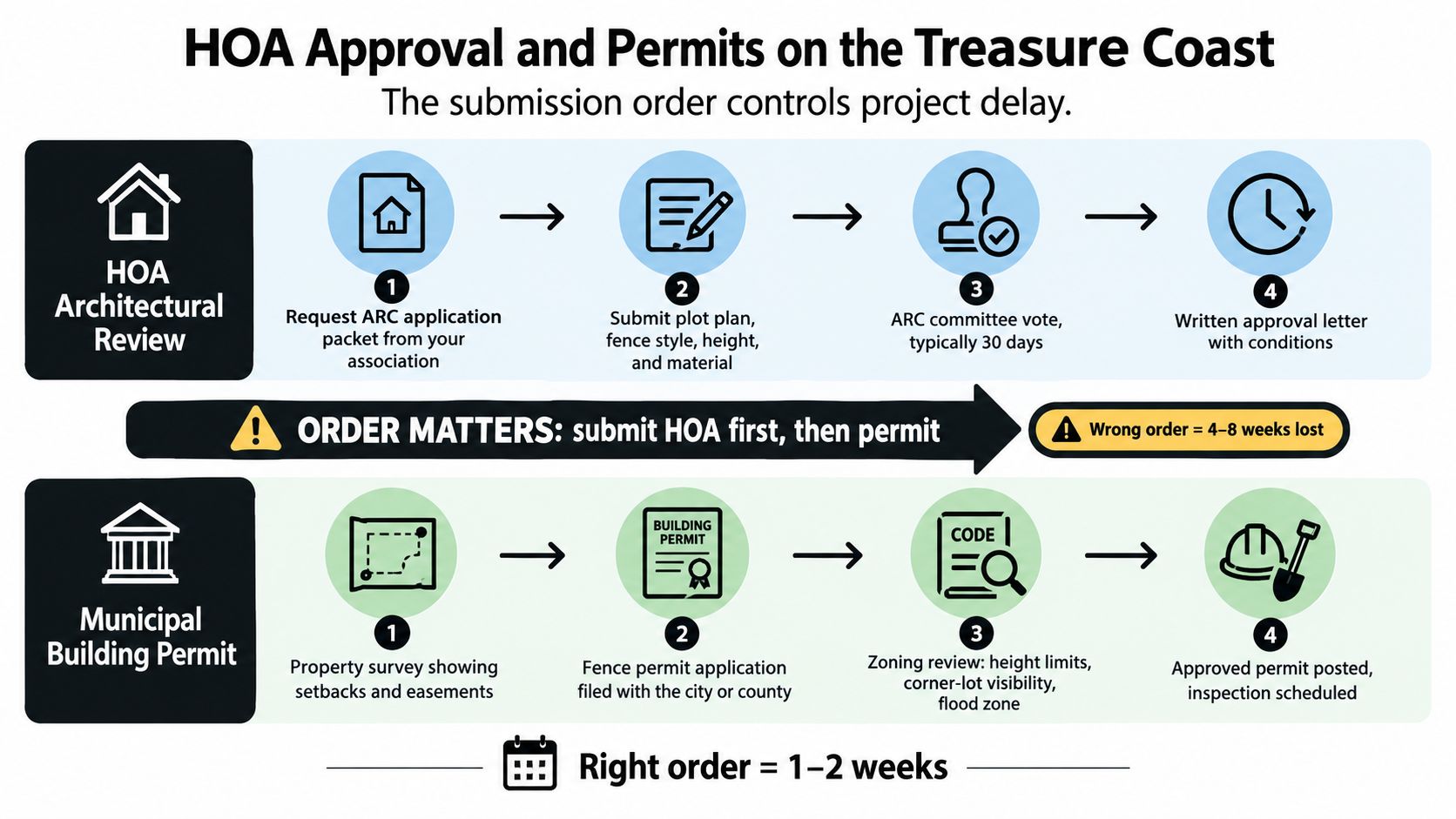
HOA approval and municipal permitting should be treated as one checkpoint. A board may approve a style that conflicts with a setback, easement, corner-lot visibility rule, or pool requirement, while a city or county may accept the location but reject the finish or color under the community documents.
Start with the recorded plat or current survey. The drawing should identify lot lines, drainage easements, utility corridors, existing structures, and any zero-lot-line conditions. A contractor needs that information before promising a post line.
Build the approval packet
A useful HOA submission usually includes:
- Site plan: Show the proposed fence line, gates, structures, pool, and setbacks.
- Elevation drawing: Identify height, picket or panel style, and finished sides.
- Material sample: Provide the actual color and finish rather than a verbal description.
- Hardware details: Include gate latch, hinge, and operator information where relevant.
- Property documents: Attach the survey or plat that supports the proposed location.
ARC review timing varies by association and meeting schedule. Some communities publish a stated review period, while others require a committee meeting before issuing written conditions. The board needs a complete specification, not a promise that details will be selected later.
Run the municipal track at the same time
While the HOA reviews the packet, check the applicable city or county permit process. Permit guidance can require a formal application, site plan or survey, fees, and sometimes a variance for height or a corner-lot condition. Pool barriers deserve particular attention because the gate and barrier mechanics are inspection-critical, not optional upgrades. The Florida fence law overview can help organize the questions, but the local building or planning department controls the approval.
Call 811 before digging so electric, water, communication, and irrigation lines can be marked. A contractor should coordinate the locate before post setting, not after equipment arrives. The correct sequence is survey, HOA package, municipal review, utility locate, installation, and inspection coordination, with written approvals retained in the project file.
What Really Moves the Final Installed Price
Material is the line item most homeowners notice first. It isn't the only line item that determines the installed price, and it often isn't the variable that creates the largest surprise.
Recent pricing guidance illustrates how wide installed bands can be before site-specific additions. It places chain link at roughly $10 to $40 per foot, vinyl or PVC at $20 to $60 per foot, and wood at $20 to $50 per foot, while typical residential projects around 150 to 300 linear feet may land around $4,000 to $12,000, as summarized in this fence industry pricing guide. Those figures are starting context, not a Treasure Coast quote.
The line items behind the headline
A missing or outdated survey can require a current survey or mortgage-style drawing before the contractor sets posts. A platted subdivision may have recorded easements that aren't visible from the yard, and a fence installed over one can create a correction later.
Gates also change the scope quickly. A single walk gate has different fabrication, hardware, and footing needs from a wide driveway gate, especially when the design includes an operator cutout, access control, or reinforced posts.
The ground itself can add labor. Sand fill, buried debris from an earlier pool project, roots, hardpan, grade changes, and drainage conditions all affect drilling and post-setting methods. Concrete requirements, driven systems, root pruning, or tree removal should appear as separate line items rather than being buried in a vague allowance.
A useful quote doesn't hide site uncertainty. It names the assumption and explains what happens if the assumption proves wrong.
Compliance and coordination costs
A complete price may also need to account for:
- Survey work: Confirming boundaries, setbacks, and easements.
- Gate hardware: Self-closing and self-latching pool hardware, reinforced posts, hinges, and operators.
- Utility coordination: Locating underground services before excavation.
- Tree work: Pruning or removal when roots or code conditions block the line.
- Wind details: Tie-downs, reinforcements, or product requirements for exposed locations.
- Permits and inspections: Application handling, posted permits, and inspection coordination.
The fence installation cost guide is useful for framing material ranges, but the homeowner should request a line-item quote that distinguishes fencing, gates, demolition, survey, permits, utility work, tree work, and inspection responsibilities. Two quotes with the same footage can describe very different projects.
| Variable | Typical Impact | Why It Matters |
|---|---|---|
| Survey or plat confirmation | Adds a separate professional service when documents are missing or inadequate | Prevents posts from crossing easements or property lines |
| Gate count and width | Increases fabrication, hardware, post, and labor scope | Wide or operated gates need more structure than a walk gate |
| Soil and roots | Can increase excavation and post-setting work | Sand, debris, hardpan, and roots change installation methods |
| Utilities | May alter the digging sequence or route | Unmarked lines create safety and scheduling risks |
| Trees and drainage | Can require pruning, removal, or a line adjustment | The fence must coexist with site conditions and local rules |
| Pool or wind requirements | Adds specified hardware or reinforcement | A base material price may exclude inspection-critical details |
Maintenance Over the Life of the Fence
The coastal environment treats a fence like exposed equipment. Salt air, strong ultraviolet light, afternoon thunderstorms, irrigation overspray, and storm gusts work on finishes and hardware even when the fence appears sound from a distance.
Wood carries the clearest maintenance obligation. On the Treasure Coast, owners should expect sealing or staining roughly every two to three years as a practical maintenance cycle, with exact timing driven by exposure and product. The lower rail near irrigation heads can rot before the posts, so a visual check of the base and fasteners matters more than a quick glance at the panels.
What each material asks of the owner
Aluminum with a proper powder-coated finish and quality vinyl or PVC generally create the lightest routine maintenance load. That doesn't mean they are maintenance-free. Gates still need adjustment, hinges need attention, and impact or storm damage should be repaired before it affects adjacent sections.
Chain link usually remains structurally useful, but coastal exposure can cause vinyl coating to chalk and hardware to develop rust bleed. The fence may still stand while the appearance and gate operation deteriorate.
Wood demands the most active ownership. Staining, sealing, checking fasteners, watching the bottom rail, and replacing damaged boards are part of the ownership decision, not unexpected exceptions.
Pool gates deserve their own inspection routine
Pool-code fencing adds a mechanical obligation. Self-closing hinges and self-latching hardware need to work reliably, and a failed latch can create a problem during a resale inspection. The gate should be tested after storms, landscaping changes, and any repair that affects the gate post or grade.
A low first-cost fence can become expensive when recurring coatings, hardware replacement, and partial repairs are included. The material with the higher purchase price may make more sense when the owner values fewer maintenance visits, a consistent HOA appearance, and lower risk of a premature replacement.
A Pre-Project Checklist Before You Call a Contractor
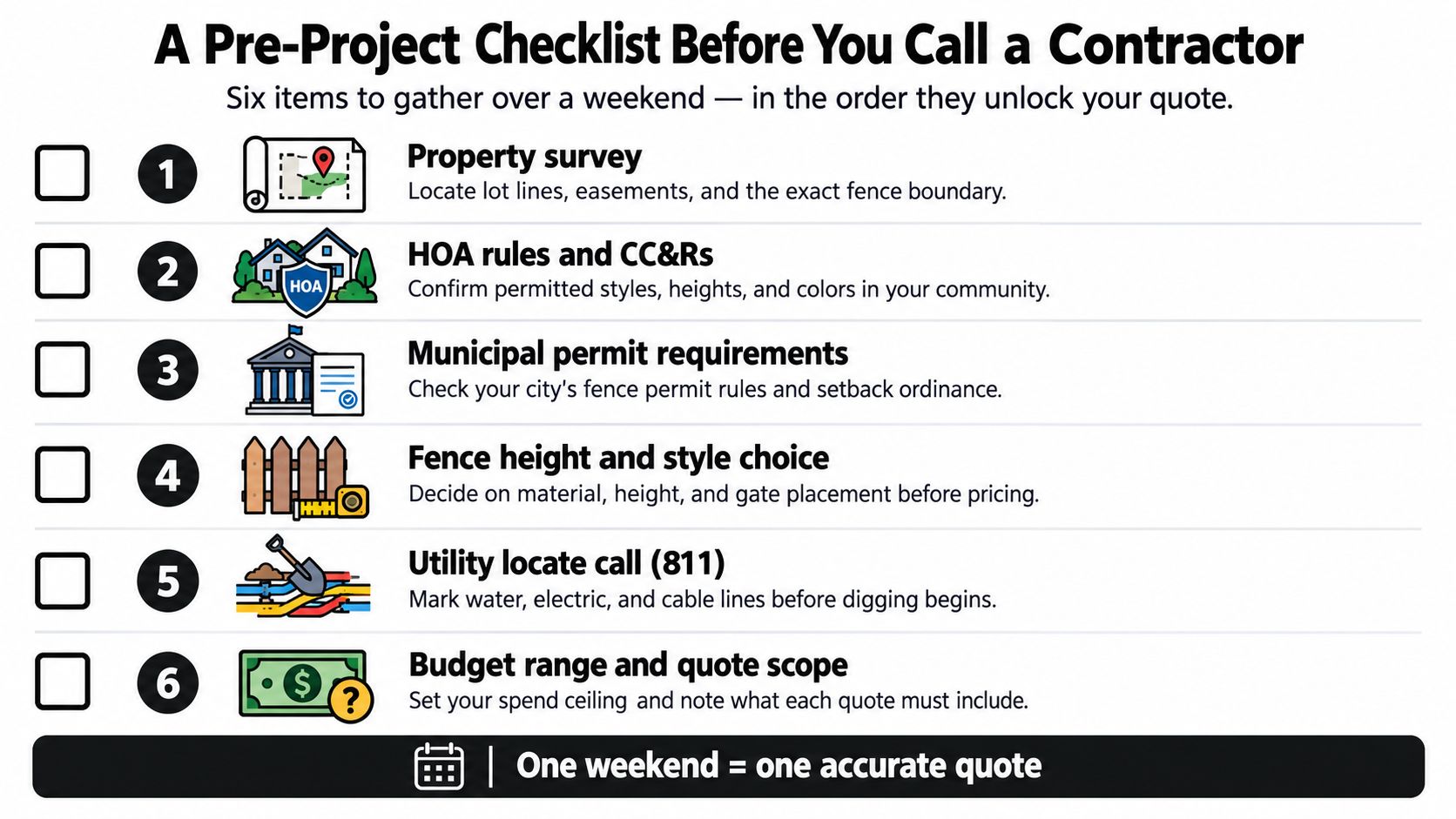
A homeowner can gather the information needed for a productive quote over a weekend. The goal isn't to design every bracket in advance. It's to remove the unknowns that force a contractor to guess.
Start with the documents
Property survey: Find the lot lines, easements, drainage areas, pool, structures, and recorded setbacks. If the survey is missing or too old for the project, ask the county, closing file, surveyor, or title company what replacement document is available.
HOA rules and CC&Rs: Request the architectural packet and confirm permitted materials, colors, heights, finished sides, gate styles, and submission requirements. Save the written conditions rather than relying on a phone conversation.
Municipal permit requirements: Identify the responsible city or county department and ask whether the planned height, location, corner-lot condition, or pool barrier needs approval. Keep the application instructions with the survey.
Then document the yard
Take clear photos of every proposed fence side. Include grade changes, pool equipment, air-conditioning units, trees, roots, irrigation heads, retaining edges, existing gates, neighboring fences, and areas where equipment may have difficulty reaching. A few wide shots and close-ups give the estimator more useful information than a single front-facing photograph.
Choose the likely height, style, material, and gate locations before requesting pricing. The decision doesn't have to be final, but a contractor needs a defined comparison. A four-foot open aluminum fence and a privacy PVC run aren't interchangeable scopes.
Finish the coordination items
Submit the 811 locate request before digging is scheduled, and ask the contractor who will verify the marks at the site. Gather the permit instructions, HOA forms, survey, photos, and a written budget ceiling. Review deposit terms, payment milestones, change-order language, warranty coverage, and whether permits, inspections, demolition, and cleanup are included.
A digital estimator such as the one offered by AlliedFenceAndGate.com™ can use uploaded surveys and property photos to help calculate a fenceable perimeter and flag possible easements before an on-site review. It remains a preliminary tool, not a substitute for field verification or municipal approval.
Turning the Decision Into a Real Project
“Just fence it” works better as a sequence than an impulse. The property use case determines the design, the rules determine whether that design can proceed, the site determines the labor, and the budget determines which trade-offs are acceptable.
The most useful action this week is simple: pull the HOA architectural guidelines and the applicable county or city fence ordinance, then mark the proposed boundary on the survey. If the documents are missing, book two on-site estimates with Treasure Coast installers who can explain permit handling, utility locates, gates, and inspection coordination in writing.
A fence should start when purpose, approvals, site conditions, and budget align. The neighbor installing one first isn't a project schedule.
AlliedFenceAndGate.com™ helps Treasure Coast property owners plan aluminum, PVC/vinyl, chain link, wood fencing, pool gates, and code-compliant railings with estimating, permitting, 811 utility locates, and inspection coordination. Visit AlliedFenceAndGate.com™ to upload project details, review fencing options, and request a practical starting point for the site.
Related Fencing Services
Need a fence or gate on the Treasure Coast?
Licensed, insured, and bonded. Free estimates across Martin, St. Lucie, Indian River & Palm Beach counties.
Call (772) 530-3127