Self Closing Gate Hinges Heavy Duty: Florida Buyer's Guide
The most common advice about self closing gate hinges heavy duty is to buy the strongest spring hinge available. That's the wrong starting point. A hinge can have plenty of closing force and still leave a pool gate unsafe if the gate sags, the latch sits out of position, salt corrodes the moving parts, or the gate rebounds before the latch catches.
Choose hardware for the whole gate assembly: its weight and width, hinge placement, post strength, latch geometry, and exposure to pool chemicals and coastal air. The best hinge is the one that closes the actual gate reliably without defeating the latch or creating a different safety problem.
Table of Contents
- Heavy-Duty Hinge Options Side by Side
- Florida Pool-Gate Rules the Hinge Must Meet
- Hinge Materials, Test Standards and Weight Ratings
- ADA Closing Rules for Accessible Gates
- Matching Hinge Choices to Your Gate Type
- Install, Adjust and Test Before You Trust the Gate
Heavy-Duty Hinge Options Side by Side
Start with the closing mechanism, not the spring strength. Each option below moves the gate a different way, and that difference decides whether the latch catches cleanly, the gate holds its line in wind, and the closing force stays consistent over time.
| Option | Closing mechanism | Rating and width limit | Best fit | Main watch-out |
|---|---|---|---|---|
| Adjustable wrap-spring hinge | Coil spring wraps around the hinge pin; a bolt sets tension | Manufacturer rating for the exact model; observe its gate-weight and width limits | Pool and residential gates needing adjustable closing force | Stay inside the model's published adjustment range |
| Butterfly spring hinge | Spring pair in folding leaves; tabs bear on the upright | Manufacturer rating for the exact model; observe its gate-weight and width limits | Light to mid-weight wood or aluminum gates | Set hinge spacing per the model's installation guide |
| Gravity or offset hinge | Gate geometry pulls the gate closed, with no spring | No spring-force adjustment; use only where the hinge design and gate geometry support the load | Light gates on level ground | Weak on slopes and in wind |
| Spring-loaded strap hinge | Spring sits inside a strap or barrel hinge | Manufacturer rating for the exact model; observe its gate-weight and width limits | Heavy wood or steel driveway gates | Weight grade must match the gate, not the label |
| Hydraulic gate closer, paired with hinges | Hydraulic cylinder controls closing speed | Closer and hinge capacities must suit the gate's weight and width | Wide or heavy gates needing a damped close | It isn't a hinge; latch alignment still matters |
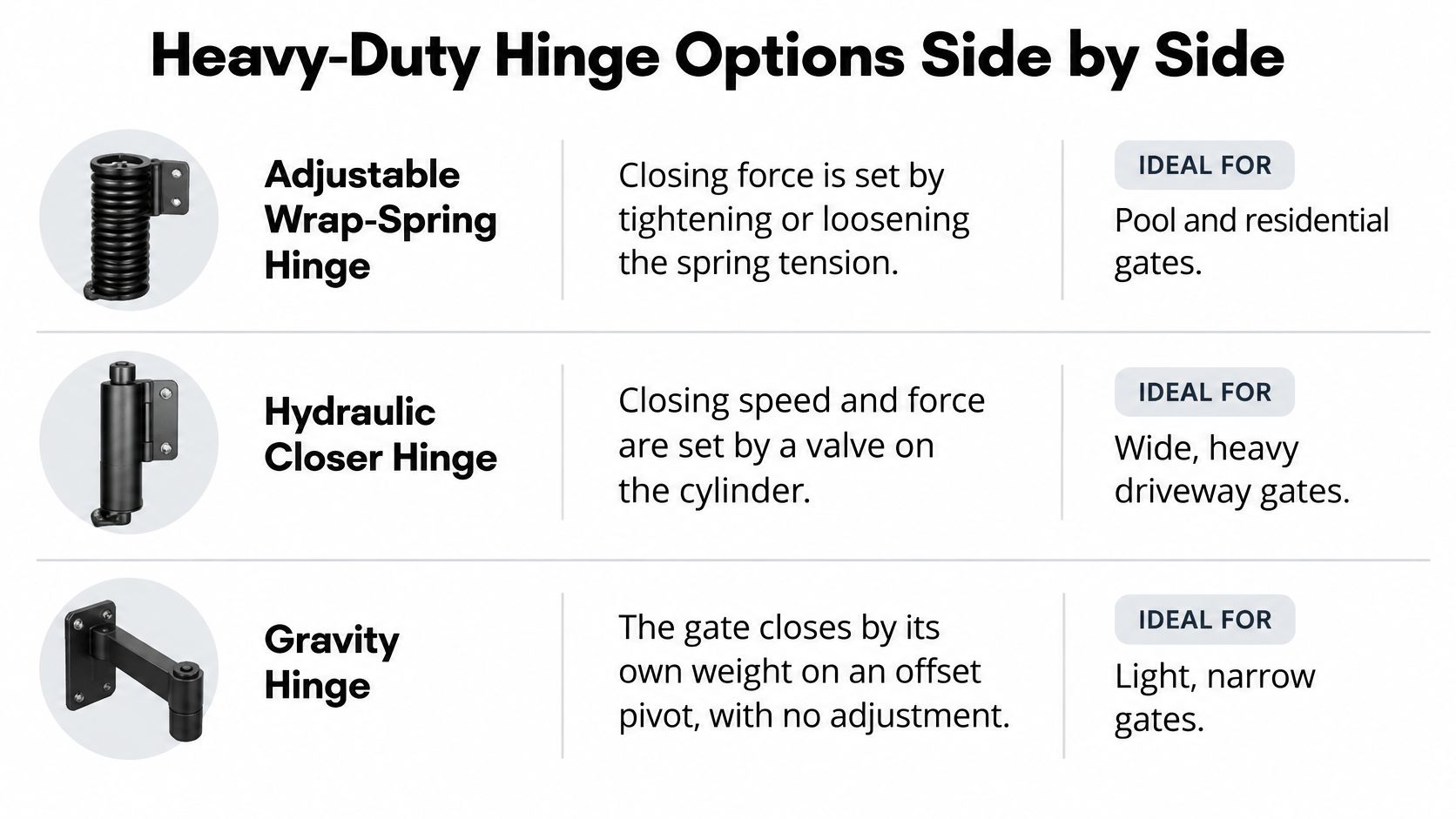
Which mechanism fits the gate
Adjustable wrap-spring hinges are the practical choice for pool and residential gates because spring tension can be tuned to the gate after it hangs. That tuning has limits. Each model publishes its own adjustment range, and pushing past it can defeat the self-closing action rather than strengthen it. Treat tension as fine-tuning for a gate that already swings true. It will not fix a sagging frame or pull a badly positioned latch into line.
Butterfly spring hinges suit lighter gates when the tabs sit firmly against the upright or rail. The installation guide for each model sets the required spacing between hinges, so follow it rather than guessing. If the gate is too heavy, the tabs don't bear properly, or the frame flexes, the hinge can bind or fail to pull the latch into place.
Gravity or offset hinges close the gate with geometry instead of spring force. Nothing about them is adjustable, so they only earn their place on light, narrow gates installed on level ground. Slope, wind, or extra gate weight interrupts the closing path, and there is no tension bolt to compensate.
Spring-loaded strap hinges belong on heavy wood or steel driveway gates, but only when the manufacturer's load grade matches the actual gate. A heavy-duty label on the box does not establish that match. Confirm the gate's weight before you pick the spring, because an undersized spring leaves the gate hanging open and an oversized one can slam it past the latch.
Hydraulic closers control the closing motion; the hinges still carry the gate's weight. Pair a closer with appropriately rated hinges when a wide or heavy gate needs a controlled, damped close, and confirm the latch meets the gate squarely at the end of its travel.
Shortlist rule: Check the exact model's maximum gate weight, maximum gate width, and required hinge count first. The rating line matters more than the spring label, and there's no universal weight rating that applies to every hinge.
Florida Pool-Gate Rules the Hinge Must Meet
A product listing that calls a hinge “pool-gate compliant” doesn't make the whole gate compliant. Florida's pool-access gate rules address how the gate swings, closes, latches, and protects access to the release. The hinge supplies closing action, but the gate geometry and latch hardware determine whether the complete barrier does its job.
| Requirement | Florida value | What the hinge must support |
|---|---|---|
| Gate height at dwelling-unit access | 48 in minimum | A full-height gate hung plumb on the hinge line |
| Latch height | 54 in above gate bottom, or 3 in below gate top on the pool side | Hinge geometry that keeps the latch in its zone |
| Operable parts for a key lock, opener, or combination lock | 34 to 48 in above finished floor or ground | Lock and latch placement, not hinge position |
| Release mechanism reach | 54 in minimum where reachable from either side | Reliable closure that still engages the latch |
| Openings near release | Maximum 1/2 in within an 18 in zone | Stable alignment that doesn't let sag widen gaps |
| Closing and latching | Self-closing, self-latching, and lockable; no exception | Repeatable closing force |
The Florida pool-access statute requires the gate to open outward, close automatically, and use a self-latching locking device. It also places the release on the pool side and requires it to be positioned so a young child can't reach it over the gate or through an opening. The Florida Building Code specifies a 54-inch release height when it can be reached from either side, and limits openings near the release to 1/2 inch within an 18-inch zone.
Treat every dimension as an assembly check
Florida guidance sets a 48-inch minimum gate or barrier height for access from homes, apartments, motels, and hotels. It also sets latch placement at 54 inches above the gate bottom or at least 3 inches below the gate top on the pool side. For gates with a key lock, electronic opener, or integral combination lock, the operable parts must be 34 to 48 inches above finished floor or ground, according to Florida Building Code staff guidance.
Those dimensions turn hinge selection into a geometry problem. The hinge line must hold the gate plumb so the latch lands in its permitted position and the clearance around the release stays within bounds. A sagging gate can widen an opening; a powerful spring won't correct that.
The statute doesn't approve any particular hinge by itself. It requires an outcome from the full gate assembly, and self-closing and self-latching aren't limited to pedestrian gates. For broader context on the barrier requirements, see this guide to Florida pool fence requirements. Homeowners comparing powered systems can also review this practical overview of automatic gate installation costs, while keeping powered access hardware separate from the pool gate's own closing and latching duties.
A spring that's wound too tightly can create false confidence: the gate may rebound, stop short, or move too fast for the latch to catch. The right question isn't which hinge is strongest. It's which hinge-and-latch setup keeps the gate aligned and latching under the conditions it really faces.
Hinge Materials, Test Standards and Weight Ratings
Ignore “commercial grade” unless the product documentation backs it up. A useful spec sheet tells the buyer how the hinge was tested, what gate weight and width it supports, how it resists corrosion, and how it must be mounted. Without those details, the label doesn't help determine whether the hinge suits a particular gate.
The ANSI/BHMA A156.1 hinge standard covers lightweight, standard-weight, heavy-weight, and detention hinges. Its test categories include cycle life, lateral wear, vertical wear, friction, strength, finish, material, and dimensional checks. For a gate, those tests connect to familiar problems: wear can contribute to sag and latch misalignment, friction can sap closing force, and strength testing speaks to whether the hardware withstands mechanical loads.
A related benchmark gives a sense of the testing expected for high-grade architectural hardware. ANSI/BHMA A156.26 Grade 1 continuous hinges must pass 2.5 million opening-and-closing cycles on a specified-weight door, along with abuse, overload, vertical-wear, and strength tests. That benchmark applies to continuous door hinges, not every gate-hinge design. Don't transfer its rating to a gate hinge; use it as a reason to ask for the exact product's own test evidence.
Match material to exposure
| Material or finish | Corrosion behavior near pools and coast | Best use |
|---|---|---|
| 304 stainless steel | Resists most coastal exposure; can pit when pool chemicals are present | Pool enclosure gates |
| 316 stainless steel | More chloride resistance than 304 | Oceanfront or direct salt spray |
| Zinc-plated carbon steel | Sacrificial coating; rust starts once plating wears | Sheltered interior gates only |
| Powder-coated steel | Chips can expose steel at pivot points | Dry inland gates with stainless fasteners |
| Bronze or brass | Good corrosion resistance, lower load capacity | Decorative, light gates |
For pool and coastal installations, stainless or properly isolated corrosion-resistant components are the safer starting point. 304 stainless steel can be suitable around many pools, but chemical exposure can still cause pitting. For oceanfront sites or direct salt spray, 316 stainless steel offers higher chloride resistance. Zinc plating has a clear weak point: once it wears through, rust can begin. Powder-coated steel also needs attention at pivots, where chips may expose the underlying steel.
Salt-spray testing to ASTM B117 provides an environmental test method, not a promise of service life. The ANSI/BHMA hinge guidance on testing and corrosion cautions that real-world results change with installation, maintenance, and environmental conditions. Ask whether the corrosion data applies to the complete assembly, including exposed moving parts, and don't assume a finish rating guarantees performance in a coastal location.
When comparing finishes, a guide to choosing galvanised hinges for gates can help clarify where galvanised hardware fits. For a pool enclosure or salt-exposed gate, the decisive questions remain the hinge's exact load limits and the protection of its working parts.
Buy from the specification, not the adjective
Before ordering, get the manufacturer's maximum gate weight and width, required hinge quantity and spacing, adjustment range, spring-tension procedure, cycle evidence, substrate and fastener requirements, and corrosion-finish data. Reject a spec sheet that omits the gate's weight or width limits. A strong cycle rating can't make an undersized hinge fit, cure misalignment, or free a salt-bound pivot.
ADA Closing Rules for Accessible Gates
A gate on an accessible route into a building may need to meet the door provisions in the 2010 ADA Standards, section 404. That check is separate from Florida pool-barrier compliance: one concerns accessible passage and closing behavior, while the other requires a pool-access gate to close and latch as part of a safety barrier. Where both apply, the design has to satisfy both sets of requirements.
For doors with closers, the ADA provisions require at least 5 seconds to move from 90 degrees open to 12 degrees. The standards also cap opening force for interior hinged doors at 5 pounds; exterior door opening force is assessed separately. A local building official can confirm which provisions apply to a particular gate and route.
A spring hinge may close a gate reliably yet fail to provide the controlled timing needed on an accessible route. When that's the concern, a hydraulic closer paired with a hinge rated for the gate's weight can control the closing motion more effectively. The closer doesn't replace the hinge rating, and it doesn't eliminate the need for a properly aligned latch.
Test the installed gate at its actual weight, width, and slope rather than relying on a bench setting. For related project considerations, see the guidance on ADA-compliant fencing, railings, and ramps.
Matching Hinge Choices to Your Gate Type
Residential pool enclosure gate: Choose an adjustable wrap-spring hinge in a corrosion-resistant material, and hang the gate to swing outward. The adjustable mechanism lets the installer tune closure to the gate, but the latch position and opening geometry still have to meet Florida's requirements.
Coastal wood privacy or driveway gate: Use stainless or properly isolated corrosion-resistant hardware. A butterfly hinge is a reasonable option only for a light gate with firmly supported tabs and at least 32 inches between hinges; a heavier wood leaf needs a hinge rated for its actual load.
HOA aluminum gate: Start with the hardware the HOA permits, then check the hinge rating against the full gate. Aluminum frames can deflect, and that movement can add friction or shift the latch over time. Specify hardware that can be inspected and adjusted without compromising the gate's safety function.
Commercial or accessible access gate: Choose a heavy-weight or detention-grade hinge only when the rating matches the gate. If the opening is on an accessible route, pair the hinges with a closer that can meet the applicable closing-time requirement, then test the completed installation.
Light chain-link or wood gate on level ground: A gravity or butterfly hinge can be a sensible choice for a small, sheltered gate. But a light pool gate still has to close and latch as a pool-access gate; light weight alone doesn't make a gravity hinge suitable for that safety job.
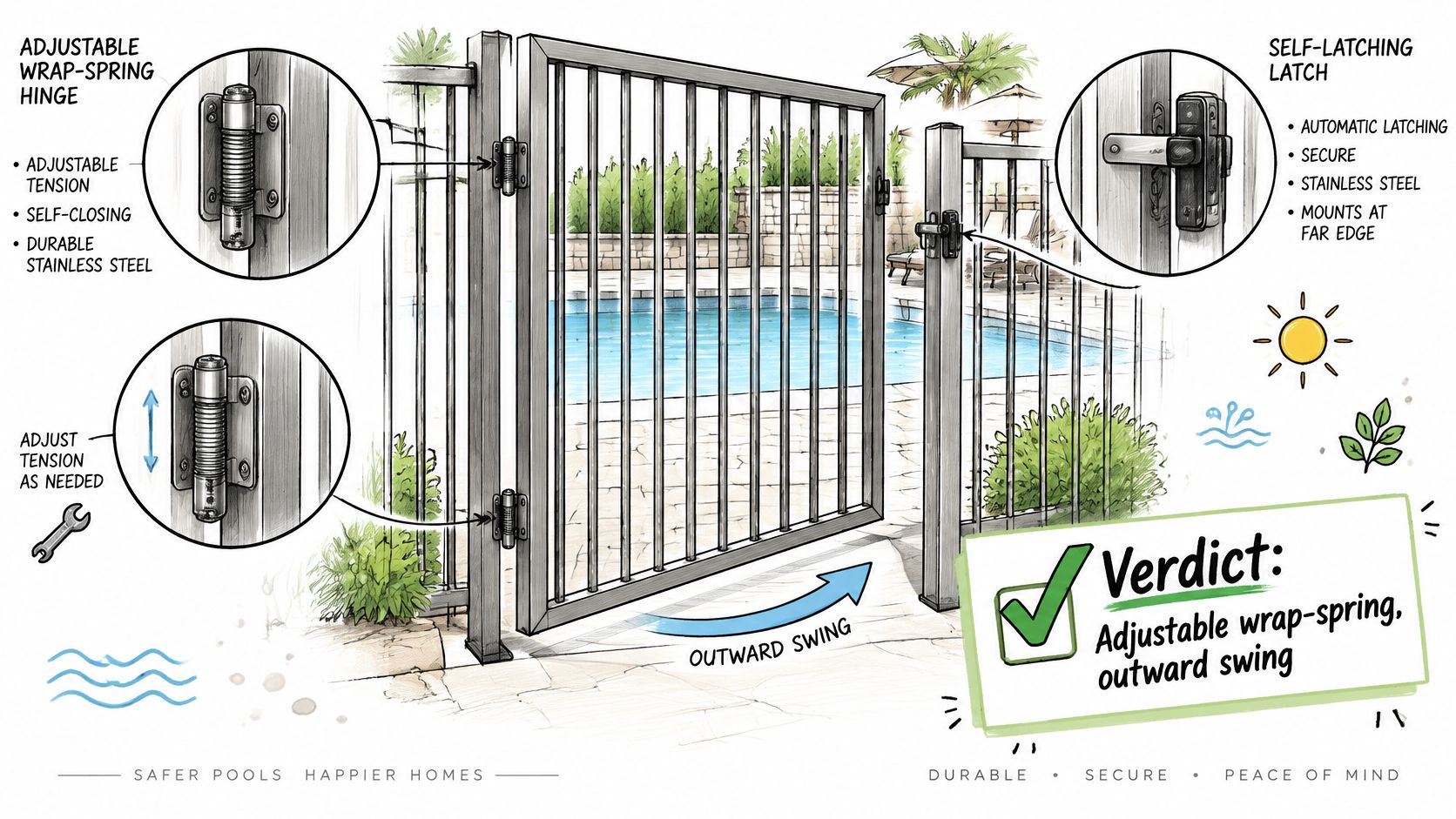
The gate's real weight, width, and exposure decide the hinge, not the label.
Install, Adjust and Test Before You Trust the Gate
A heavy-duty hinge only does its job when the gate, post, latch, and fasteners work as one system. Spring force, gate geometry, latch position, and coastal exposure all share the work of closing the leaf. Install to the model's instructions, leave factory settings alone unless the gate needs adjustment, and treat the release-and-latch test in everyday use as the pass-or-fail point.
Check the rating. Confirm the gate's actual weight, width, and slope against the manufacturer's limits before buying or mounting hardware. Florida pool-gate compliance depends on the complete assembly, and the Florida residential pool-barrier code provisions require the gate to self-close and self-latch. Pick a hinge that can deliver that under the gate's real conditions, not just on a bench.
Fix the hinge tabs. Secure the hinge with the fasteners, hole sizes, and spacing the manufacturer lists for that model. Firm bearing and full fastening keep the hinge from shifting or binding as the gate cycles.
Hang the gate. Mount the gate plumb and check that it sits square to the latch before setting spring tension. If the post leans or the frame twists, the hinge fights avoidable drag every time the gate moves.
Set closing force carefully. Leave factory tension in place if the gate already closes and latches. If adjustment is needed, follow the manufacturer's procedure exactly, using the tools and turn increments it names. Stop at the listed limit; going further can disable the self-closing function you are paying for.
Run the acceptance test. Open the gate from several angles and release it without helping. The gate must return fully and engage the latch each time. Rebound, a short stop, or a missed latch is a failure, not a minor quirk to ignore.
Retest after conditions change. Repeat the test after wind, temperature swings, or any alignment adjustment. Frame deflection, corrosion, settlement, and latch friction all add resistance, so an installation that passed at handover can need maintenance later, especially near salt air.
Record the settings. Note the hinge model, fastener arrangement, spring setting, and closure-test results. That record gives the next installer or maintenance technician a clear baseline instead of guesswork.
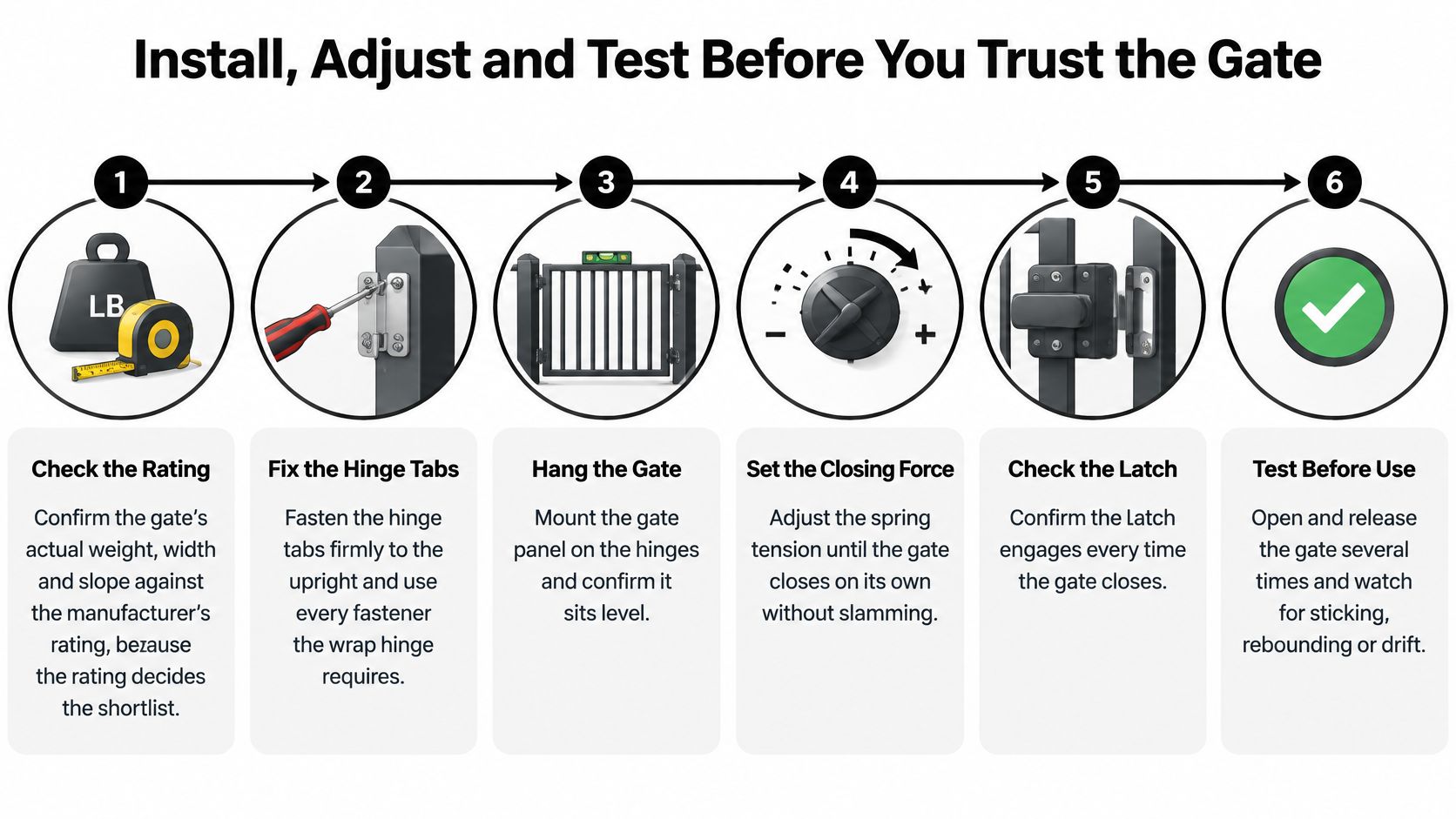
For a pool gate, release the gate from several starting angles and confirm it closes without manual help and latches positively every time. That test exercises the hinge and latch together under the actual gate weight, width, slope, wind exposure, and friction. Owners planning controlled entry can review this practical guide to installing access control for gated communities, while keeping pool-barrier closure and latching reliable as their own requirement. For the wider enclosure, pool safety fence installation guidance can help owners plan the fence and gate as a complete barrier.
#MartinCountyFL #PalmBeachCounty #TreasureCoast #StuartFL #JupiterFL #WestPalmBeach #FloridaFencing #PoolFencing #PoolSafetyGate #SelfClosingGate #HeavyDutyHinges #GateHardware #FloridaBuildingCode #StainlessSteel
AlliedFenceAndGate.com™ installs pool safety gates with self-closing, self-latching hardware and builds fence and gate projects across Florida's Treasure Coast and northern Palm Beach County. Visit AlliedFenceAndGate.com™ to discuss a gate that fits its weight, exposure, and code requirements.
Related Fencing Services
Need a fence or gate on the Treasure Coast?
Licensed, insured, and bonded. Free estimates across Martin, St. Lucie, Indian River & Palm Beach counties.
Call (772) 530-3127