PVC vs Vinyl Fence: Same Material, Different Quality
PVC fence and vinyl fence usually refer to the same rigid polyvinyl chloride product, and the name alone doesn't establish how well it will perform. A privacy system can last 20 to 30 years, but that expectation depends on the product specification and installation, not whether the quote says PVC or vinyl.
The surprising part of the PVC vs vinyl fence comparison is that buyers often compare two names while overlooking two different construction systems. A thin profile with poorly supported gates isn't equivalent to a documented exterior-grade system with appropriate reinforcement, even when both look identical in a sample photograph.
For Florida properties, the important questions concern sun exposure, wind-load design, pool-barrier compliance, and eventual disposal. Those details belong in the proposal before the homeowner signs, not in a conversation after installation.
Table of Contents
- Why PVC and Vinyl Fence Mean the Same Thing
- PVC Fence Compared With Wood, Aluminum and Chain Link
- Formulation and Reinforcement Decide Real Quality
- Pool Code and Fire Limits That Apply to PVC Fences
- Recycling and What Happens When the Fence Comes Out
- Which PVC Fence Fits Your Property
- Get Written Specs Before You Sign
Why PVC and Vinyl Fence Mean the Same Thing
Vinyl is the common residential fencing name for PVC. Neither word, by itself, identifies a premium grade. The useful distinction is between the actual profiles, compounds, connections, and reinforcement supplied under those names.
The ASTM F964 specification defines a PVC fencing or railing system through its primary structural members, including posts, rails, spindles, pickets, and gates made from exterior PVC profiles. Its requirements address dimensional tolerances, extrusion quality, physical properties, and weatherability, rather than treating a marketing label as evidence of performance.
| Term | What it means | What belongs on the quote |
|---|---|---|
| PVC fence | Rigid polyvinyl chloride exterior profiles, terminology common in specifications and standards | Manufacturer, product line, profile construction, and applicable standard |
| Vinyl fence | Usually the same material category under the common residential marketing name | The same product and installation details |
| Vinyl-coated chain link | Steel mesh covered with a PVC coating, not a rigid PVC panel system | Mesh, framework, coating, gates, and hardware |
How the terminology developed
The material predates the backyard privacy fence by decades. According to Infinity Fence's vinyl fencing history, commercial PVC development accelerated in the 1920s after Waldo Semon's work at B.F. Goodrich; rigid PVC became commercially important during the 1930s and 1950s, while vinyl fencing appeared in the late 1970s as limited ranch-rail and agricultural products.
Manufacturers subsequently expanded into privacy, semi-privacy, picket, railing, and gate systems. That evolution explains the broad vocabulary, but it doesn't establish that every current product shares the same formulation or structural design.
Practical rule: Compare formulation, reinforcement, profile design, and warranty. A different name on the proposal isn't necessarily a different material.
Vinyl-coated chain link deserves particular attention because the word vinyl describes its coating, not its load-carrying structure. Its steel framework and open mesh make it a different choice for privacy, appearance, and repair.
PVC Fence Compared With Wood, Aluminum and Chain Link
Fence materials by height, maintenance, lifespan and installed cost
| Material | Height | Maintenance | Lifespan | Installed Cost per Linear Foot |
|---|---|---|---|---|
| PVC privacy | 4 to 8 ft | Near-zero, with cleaning and hardware checks | 20 to 30 years | $40 to $65 for standard 6-ft height |
| PVC picket or semi-privacy | Set by selected profile and approved layout | Routine washing and hardware checks | Obtain the selected product's service-life documentation | From $30 |
| Cedar or pressure-treated wood | 4 to 8 ft | High, annual attention | 10 to 20 years | $25 to $45 |
| Aluminum picket | 3 to 6 ft | Near-zero, with hardware checks | 25 to 40+ years | Obtain design-specific pricing within the aluminum offering |
| Custom welded aluminum | 3 to 8 ft | Near-zero, with hardware checks | 30 to 50+ years | Aluminum offering spans $28 to $150; custom design requires a quote |
| Vinyl-coated chain link | 4 to 6 ft | Low | 20 to 30 years | $22 to $35 |
| Galvanized chain link | 4 to 6 ft | Low | 15 to 25 years | Obtain a coating- and framework-specific quote |
These are AlliedFenceAndGate.com™ product ranges and planning prices, not interchangeable national averages. Unpriced cells require a specified product rather than an invented estimate. The Florida fence products guide provides additional context for matching the material to the property.
Why broad vinyl prices can mislead
A general vinyl estimate isn't necessarily a Florida privacy-fence estimate. TacticalGearGuy's comparison, citing Angi project data and industry comparisons, gives professionally installed vinyl fencing a typical $15 to $40 per linear foot range, but doesn't establish that every configuration includes the same privacy profile, reinforcement, gates, or site work.
The local privacy range in the table addresses a more specific offering. Comparing the lower end of a broad national category with a reinforced local privacy installation can create an apparent price discrepancy without revealing an actual overcharge.
Wood remains a sensible choice when a natural appearance or repairable board construction matters more than minimizing upkeep. Its initial price advantage can narrow when the owner pays for repeated surface preparation, staining, sealing, or painting. That doesn't mean PVC always costs less over ownership; repairs, storm exposure, and the owner's maintenance habits still matter.
Choose the function before the finish
Aluminum suits an open boundary or pool enclosure where visibility matters. It doesn't provide the same screening as a solid privacy panel unless a privacy-specific design is selected.
Chain link is a practical choice for economical containment and security. A vinyl coating changes appearance and surface protection, but it doesn't turn open mesh into backyard screening.
Near-zero maintenance isn't zero attention. PVC can be washed with a garden hose, with mild soap for tougher marks; power-washing isn't required. Gates still need inspection and adjustment, and slopes, demolition, access restrictions, and specialty hardware should appear as separate quote items.
Formulation and Reinforcement Decide Real Quality
Two fences sold as vinyl can perform very differently because the outcome depends on the compound, profile, and reinforcement. An attractive sample doesn't reveal the full wall section, internal supports, or how the installer will anchor the finished assembly.
The following checklist separates surface appearance from the components that deserve documentation.
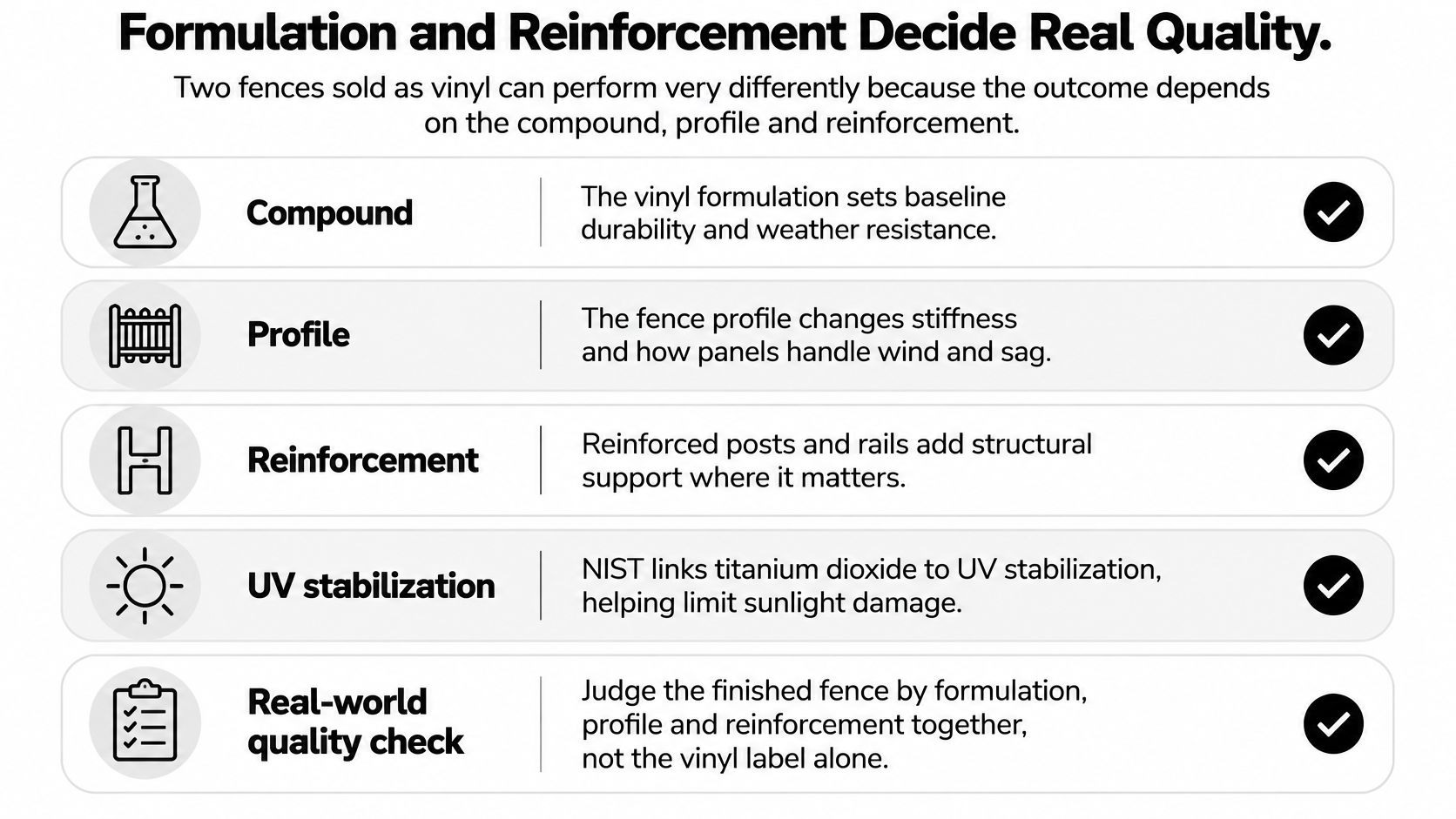
Compound and profile evidence
The National Institute of Standards and Technology technical note on polymer weathering identifies titanium dioxide and calcium-carbonate content as significant influences on PVC siding weatherability. It also describes light-related yellowing, chalking, loss of mechanical properties, and a shift toward more brittle behavior in exposed unplasticized PVC samples.
Those findings aren't a fence-specific lifespan guarantee. They explain why documented outdoor-weathering performance is more useful than an unsupported UV-resistant claim.
Quality markers to request before buying
| Quality Marker | What to Request | Why It Matters |
|---|---|---|
| UV stabilizers and titanium dioxide | Outdoor-weathering data and the UV-stabilizer specification | Helps evaluate resistance to sunlight-related surface and impact deterioration |
| ASTM F964 compliance | Confirmation covering the quoted posts, rails, pickets, and gates | Establishes relevant exterior-profile performance requirements |
| Virgin PVC compound | Confirmation of 100% virgin compound, with no regrind, for the specified offering | Identifies the supplied formulation; performance documentation still matters |
| Coextruded cap-stock | Description of the outer layer, coverage, and construction | Identifies the weather-facing surface and its protective role |
| Post reinforcement | Specified 5-by-5-inch solid PVC posts with internal aluminum at gates, corners, and long runs | Supports loaded locations and helps control movement |
| Florida wind-load design | Footing depth, post spacing, reinforcement, and hardware on the proposal | Connects the material choice to the site's structural demands |
| Warranty terms | Written coverage for cracking, splitting, peeling, and significant fading | Defines covered defects, remedies, and exclusions |
AlliedFenceAndGate.com™ specifies 100% virgin PVC with UV inhibitors and impact modifiers, doesn't install regrind or import-grade product, and uses the reinforced post arrangement described above. Its manufacturer warranty covers cracking, splitting, peeling, and significant fading for the life of the original installation.
Virgin resin alone isn't a substitute for test results. Likewise, coextrusion isn't automatically inferior to a homogeneous profile: the exterior-profile standard description recognizes both homogeneous extrusion and coextrusion with distinct PVC layers.
Florida wind loads require assembly details
A privacy panel presents a broad surface to wind. The load must pass through rails, connections, posts, and footings into the ground, so a strong-looking panel can't compensate for an unsuitable foundation or unsupported gate.
Profile compliance isn't a hurricane rating for the complete installed fence.
The proposal should identify the applicable wind design, fence height, post spacing, footing dimensions, and connection details. Wall thickness and internal ribs should be shown in a profile drawing, not described only as heavy-duty.
Warranty review also needs precision. Homeowners should distinguish material replacement from labor coverage and identify exclusions for storm damage, installation errors, impact, or unauthorized modifications before treating lifetime wording as complete protection.
Pool Code and Fire Limits That Apply to PVC Fences
A property-line fence doesn't automatically qualify as a pool barrier. The material label doesn't settle gate operation, openings, placement, or whether a child can defeat the enclosure.
The Leon County swimming-pool notice summarizes Florida barrier requirements, including a minimum 4-foot height, placement generally at least 20 inches from the water's edge, and a gate release at least 54 inches above the standing surface. The checklist captures that notice's requirements; the permitting authority must confirm the applicable configuration.
Florida pool barrier requirements
| Requirement | Florida Rule |
|---|---|
| Barrier height | At least 4 feet |
| Openings | No gaps a child can crawl under, squeeze through, or climb over |
| Distance from water's edge | At least 20 inches, unless an approved configuration applies |
| Gate swing | Opens outward, away from the pool |
| Gate closing | Self-closing and self-latching |
| Gate release height | At least 54 inches above the standing surface |
| Separation from yard fence | Separate unless the yard fence lies on the pool perimeter and meets the same rules |
Check the entire enclosure
The installed PVC pool-fence offering uses proper picket spacing, a 48-inch minimum height, and pool-code gate hardware to FL 515 standards. A compliant design still depends on the finished installation, including grade changes and the standing surface beside the latch.
An outward-swinging gate with the wrong closer isn't an acceptable substitute for a complete operating assembly. Homeowners and property managers should review the Florida pool fence requirements guide while checking the layout, rather than ordering ordinary yard gates and planning to upgrade them later.
Aluminum offers rust-free pool-fence construction, but its compliance also depends on the selected layout and hardware. No material makes an incorrectly arranged enclosure compliant.
Fire exposure is a separate decision
Moisture and corrosion resistance don't make PVC noncombustible. Independent fire-safety coverage from Zone Zero Report explains that vinyl can melt, ignite, or contribute to spread under extreme wildfire exposure and that no universal U.S. code test certifies an entire fence assembly's fire performance.
A self-extinguishing description shouldn't be treated as proof that the fence is safe beside every ignition source. Property owners should obtain available fire-behavior documentation and check adopted requirements concerning combustible fencing near buildings.
That review should include the house connection, vegetation, grills, fire pits, and generators. Where local defensible-space rules restrict combustible fencing, a noncombustible metal configuration may be the appropriate choice, especially near structures.
Recycling and What Happens When the Fence Comes Out
Technically recyclable doesn't mean locally accepted. A removed PVC panel can be suitable for material recovery and still have no practical collection route at the property's location.
PVC recovery operates at an established commercial scale. VinylPlus's progress reporting describes collection and recycling activity across PVC product streams, but those broad programs don't establish a fence-specific recovery rate or guarantee acceptance at a local transfer station.
The removal process determines the options
A fence doesn't leave the property as clean resin. Demolition produces panels, posts, screws, hinges, latches, reinforcement, and concrete, sometimes mixed with soil or vegetation.
A recycler may require separation before accepting the PVC. Metal inserts and attached hardware can complicate processing, while concrete-filled or heavily contaminated components may need a different route. Municipal curbside collection generally isn't designed for bulky rigid fence panels.
End-of-life check: A credible recycling plan names an accepting facility and its preparation requirements, not just a recyclable material.
The practical questions belong in the purchase discussion:
- Installer take-back: Does the removal scope include sorting and transporting old PVC panels, and where will they go?
- Facility acceptance: Will the transfer station or construction-and-demolition recycler accept rigid PVC fencing in the condition it will arrive?
- Disposal charges: Which transport, sorting, tipping, or rejected-load costs belong to the homeowner?
A promise to haul away the old fence answers only the transportation question. It doesn't establish recycling, reuse, or the portion ultimately recovered.
Sustainability depends on keeping the fence useful
PVC's strongest practical environmental case combines a long service interval with reduced routine repainting and a credible removal route. Premature replacement weakens that case, particularly when damaged panels can't be repaired individually or matching parts aren't available.
Repairability therefore deserves attention before purchase. An owner should know whether rails, pickets, caps, and gate components can be replaced without discarding an otherwise serviceable run.
The useful comparison isn't plastic versus natural material in isolation. It includes how long the installed system remains useful, what maintenance it requires, and what the local waste system will accept when removal becomes necessary.
Which PVC Fence Fits Your Property
The best fence follows the property's constraints, not the terminology on a sales sheet. Privacy, visibility, containment, exposure, and approval requirements should determine the shortlist before color or decorative caps.
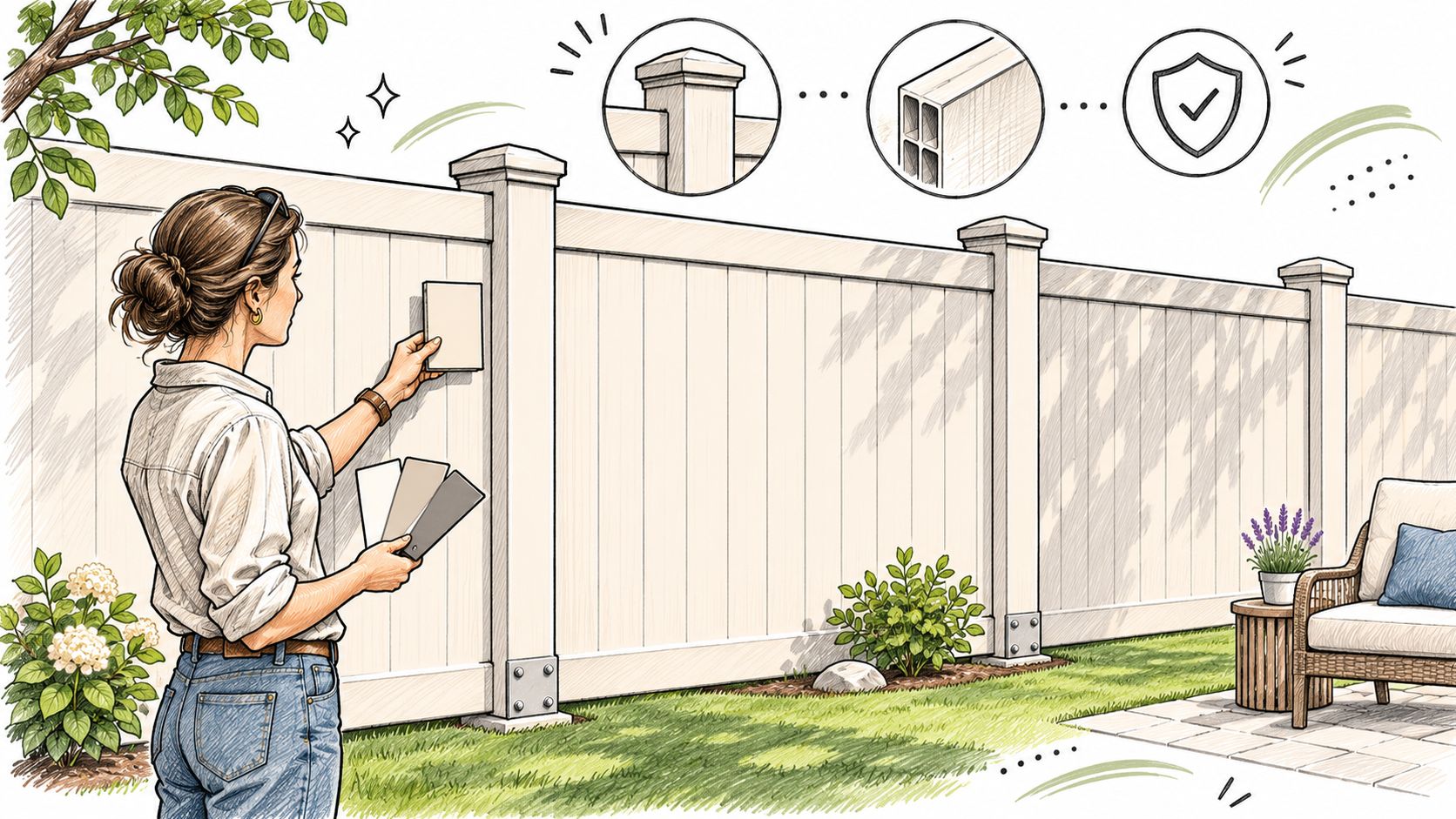
Physical samples help homeowners compare the finish against the house, paving, and landscaping in daylight.
Best-fit fence choice by property situation
| Property Situation | Best-Fit Choice | Verify Before Ordering |
|---|---|---|
| Backyard privacy, no pool | 6-foot PVC privacy with reinforced posts | Color, texture, and wind-load footing design |
| Pool enclosure | PVC pool fence or aluminum with pool-code gate hardware | Picket spacing, approved barrier height, and gate release placement |
| HOA community | Aluminum or PVC in an HOA-approved color and layout | Architectural committee rules on height, material, and product line |
| Coastal or high-wind lot | Reinforced PVC with aluminum-reinforced posts | Footing design and written exterior-profile compliance |
| Budget boundary or pet containment | Vinyl-coated chain link | Height, mesh, and gate options; it isn't solid privacy fencing |
| Close to a house or in a fire-prone setting | Confirm local code before selecting combustible fencing | Adopted requirements, structure proximity, and vegetation |
Privacy and appearance
For an ordinary backyard privacy boundary, a solid-panel configuration is usually the starting point. The recommendation changes when the homeowner values an open view, airflow, or a decorative street-facing boundary more than screening.
Available PVC colors include white, tan, clay, and gray, with smooth and woodgrain textures. A sample should be examined from normal viewing distance, not only held close to the eye. Gate proportions, exposed post faces, and transitions across sloping ground can affect the finished appearance as much as the panel color.
The vinyl fence lifespan guide helps frame ownership expectations while the buyer compares repair access, cleaning, and replacement-part availability.
Approvals and exposure can change the answer
An HOA-approved aluminum offering doesn't mean every design is automatically approved for every parcel. Architectural committees may require a particular color, height, orientation, or product line, so written approval should precede ordering.
On coastal and open lots, the buyer should prioritize documented structural details and suitable hardware over ornamental upgrades. A sheltered-yard proposal shouldn't be copied to an exposed site without review.
For pools, aluminum's rust-free construction and compliant configurations make it a strong alternative when visibility matters. For inexpensive boundary marking or pet containment, coated chain link often provides the required function without paying for privacy that the property doesn't need.
Get Written Specs Before You Sign
A useful proposal describes what will be installed, how it will be supported, and what the price includes. PVC vs vinyl fence is a terminology question; the purchasing decision is a specification question.
AlliedFenceAndGate.com™ installs privacy, semi-privacy, picket, and pool PVC fencing in Martin and Palm Beach Counties, with broader Treasure Coast coverage noted. Its instant estimator provides a ballpark price range, while the written proposal should resolve the requirements for the actual address.
Take this checklist into the quote meeting
- Identify the product: Record the manufacturer, product line, color, texture, profile construction, and compliance documentation.
- Attach the structural scope: Include reinforcement locations, post spacing, footing details, connections, and applicable wind-load design.
- Define gate work: List opening dimensions, hardware, operating clearances, and pool-barrier requirements where applicable.
- Read the warranty: Establish covered defects, exclusions, labor responsibility, and the process for making a claim.
- Assign removal costs: State who removes existing fencing, separates recoverable materials, and pays disposal charges.
- Confirm project administration: Identify responsibility for the lot survey, permits, 811 utility locates, and inspection coordination.
Quotes should separate fence installation from demolition, gates, unusual access, vegetation work, and other site-specific charges. Otherwise, a lower total may omit work included in the competing proposal.
The homeowner should retain the approved layout, material specification, warranty, and final inspection records together. Those documents make later repairs, insurance discussions, and replacement orders easier to resolve.
#MartinCountyFencing #PalmBeachCountyFencing #TreasureCoastFencing #StuartFencing #PalmCityFencing #JupiterFencing #HobeSoundFencing #PV CFencing
AlliedFenceAndGate.com™ offers licensed, insured, and bonded PVC/vinyl fence installation with permitting, utility locates, and inspection coordination. Homeowners can visit AlliedFenceAndGate.com™ for an instant ballpark estimate, then request a written, address-specific quote covering profiles, reinforcement, gates, and removal costs.
Related Fencing Services
Need a fence or gate on the Treasure Coast?
Licensed, insured, and bonded. Free estimates across Martin, St. Lucie, Indian River & Palm Beach counties.
Call (772) 530-3127