How Long Does Vinyl Fence Last? Florida Guide
A quality vinyl fence should be planned for about 20 years of best appearance and 30 years or more of functional service, not a single lifetime replacement date. Those are different milestones: a fence can look weathered while still enclosing the yard securely.
On Florida's Treasure Coast, the practical question isn't just how long the plastic survives. It's whether the posts stay upright, the rails remain intact, and the gate still closes and latches after years of sun, salt air, and storms. A faded panel and a loose gatepost call for very different spending decisions.
Table of Contents
- How Long a Vinyl Fence Lasts
- How Sunlight Ages the Plastic
- What Florida Weather and Footings Change
- Simple Care That Protects the Surface
- Real Yards and the Keep, Repair, or Replace Call
- Plan the Next Fence on the Treasure Coast
How Long a Vinyl Fence Lasts
The useful budgeting distinction is appearance life versus functional life. Midtown Home Improvements describes approximately 20 years of best appearance and 30 years or longer of functional service for properly installed vinyl fencing, within a commonly reported service-life range of about 20–30 years.
These are industry planning estimates, not an engineering guarantee or a replacement date stamped on a warranty. Formulation, installation, exposure, and component condition determine whether a particular fence reaches those expectations.
Vinyl fence lifespan to plan for
The planning horizons below apply to a quality residential system, not an isolated piece of PVC.
| Planning question | What to expect | What usually changes it |
|---|---|---|
| Best appearance | About 20 years | Intense UV, heat, fading, chalking, or surface discoloration |
| Functional service | 30 years or longer | Impacts, soil movement, loose posts, and worn gates or fasteners |
| Quality system installed correctly | 20-year look and 30-plus-year service | Formulation, reinforced posts, spacing, footings, and gate installation |
| After cosmetic change | Still structurally usable | Color shift alone isn't an automatic replacement date |
| Extreme events | Service can end early | Fallen trees, branches, high winds, and large temperature swings |
| Component wear | Often before the panels fail | Hinges, latches, screws, and post movement rather than the PVC skin |
A fence is a system of panels, rails, posts, concrete, gates, and fasteners. An intact panel doesn't compensate for a moving foundation, and a strong foundation doesn't make a cracked gate frame safe. The first repair bill often involves a moving or loaded component rather than wholesale panel replacement.
That distinction matters when comparing estimates. A proposal that identifies the panel manufacturer but says little about gate reinforcement, post construction, or concrete leaves the homeowner without the details that determine practical service life.
Budgeting rule: Separate the point when the fence may stop looking fresh from the point when it can no longer do its job.
Plan around condition, not birthdays
For a homeowner asking “how long does vinyl fence last,” the best answer includes a condition check. A fence that has faded evenly, stands straight, and operates properly shouldn't automatically go into the demolition pile.
Conversely, attractive panels don't justify keeping a loose boundary or an unreliable pool gate. Maintenance records and occasional photographs help distinguish gradual cosmetic aging from new movement or damage.
The sensible budget has room for component repairs before complete replacement. Matching a hinge or repairing a gate while the surrounding fence remains sound can preserve useful service without paying to replace an otherwise functional enclosure.
How Sunlight Ages the Plastic
A vinyl fence's UV protection works somewhat like sunscreen. The protective ingredients reduce exposure inside the material, but they don't make outdoor plastic immune to sunlight indefinitely.
Outdoor PVC formulations commonly use rutile titanium dioxide as a UV-screening pigment, together with stabilizers that help control degradation and thermal oxidation, as described in this review of polymer photodegradation. The practical difference is between PVC formulated for outdoor weathering and plastic that merely carries the PVC name.
What changes at the surface
A National Institute of Standards and Technology study of vinyl siding found that titanium dioxide and calcium carbonate content significantly affected weatherability, with UV exposure contributing to yellowing, chalking, reduced tensile strength, and a shift from ductile toward brittle behavior. The study also identified temperature and moisture as influences on degradation.
That's relevant material science, not a fence-replacement timetable. Siding and fence profiles have different shapes, loads, and formulations, so the findings explain the mechanism without assigning a precise expiration date to a backyard fence.
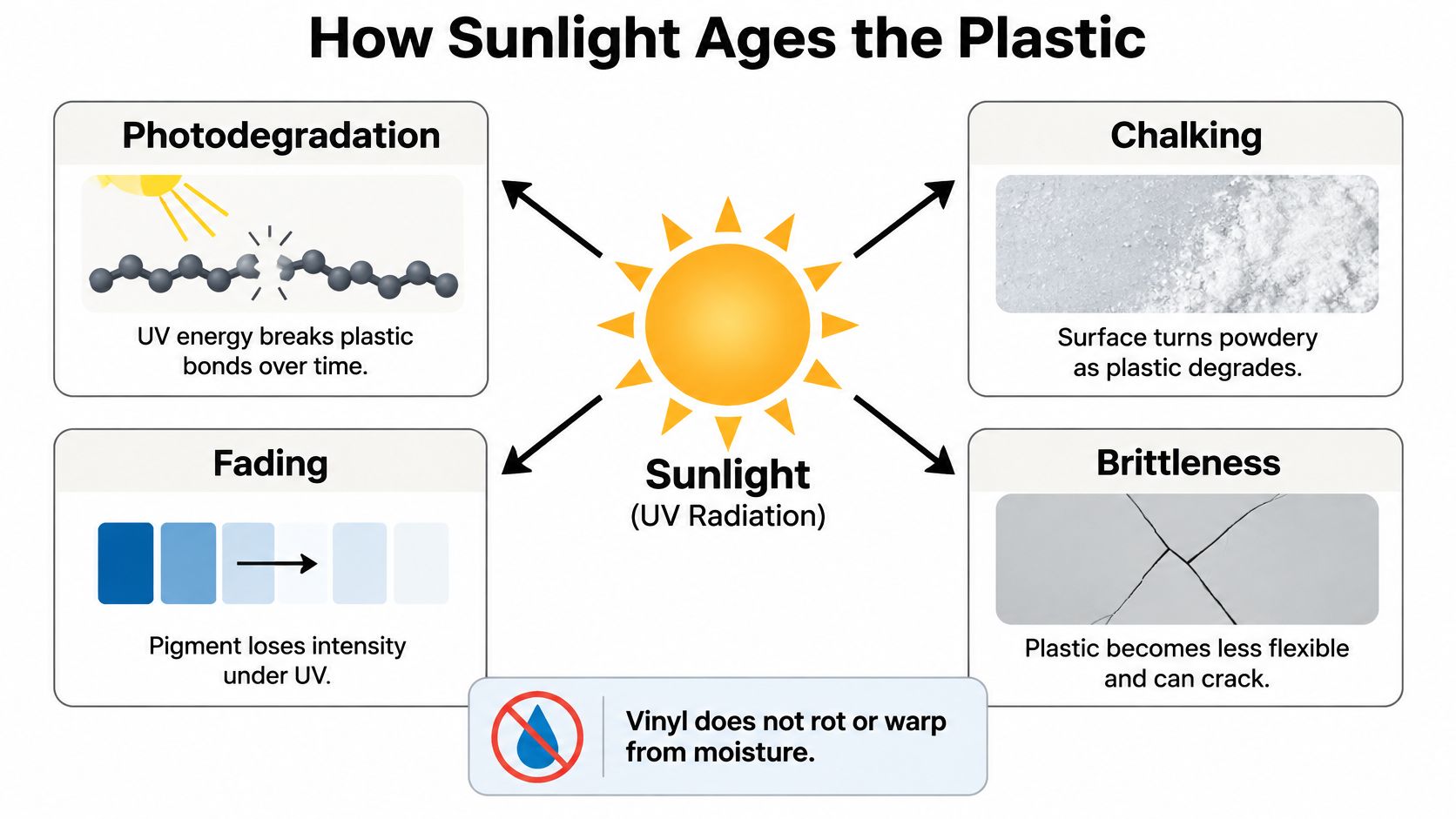
A Stuart privacy fence facing afternoon sun has a different exposure from a shaded inland run. Heat and repeated wetting also affect the environment around the profile, so identical-looking products don't necessarily age identically on different lots.
Chalking isn't the same thing as dirt. Loose grime washes away; a persistently powdery surface may reflect weathering of the material itself. Color change alone doesn't prove structural failure, but cracked edges or unusually easy breakage deserve closer inspection.
Modern profiles still need a suitable compound
Early simple PVC fence designs aren't a fair stand-in for every modern interlocking privacy system. However, National Research Council Canada's outdoor-weathering material documents deterioration modes including discoloration and embrittlement, reinforcing the need to evaluate formulation rather than the material name alone.
For homeowners comparing vinyl fence color options, the useful questions concern the specific product's weathering performance and color coverage. A sample establishes the starting appearance, not how evenly that appearance will hold.
Surface color matters, but resistance to cracking matters more when a branch or lawn tool strikes an aging profile.
Vinyl doesn't need the paint-and-stain routine associated with wood. That maintenance advantage shouldn't be mistaken for immunity to solar aging.
What Florida Weather and Footings Change
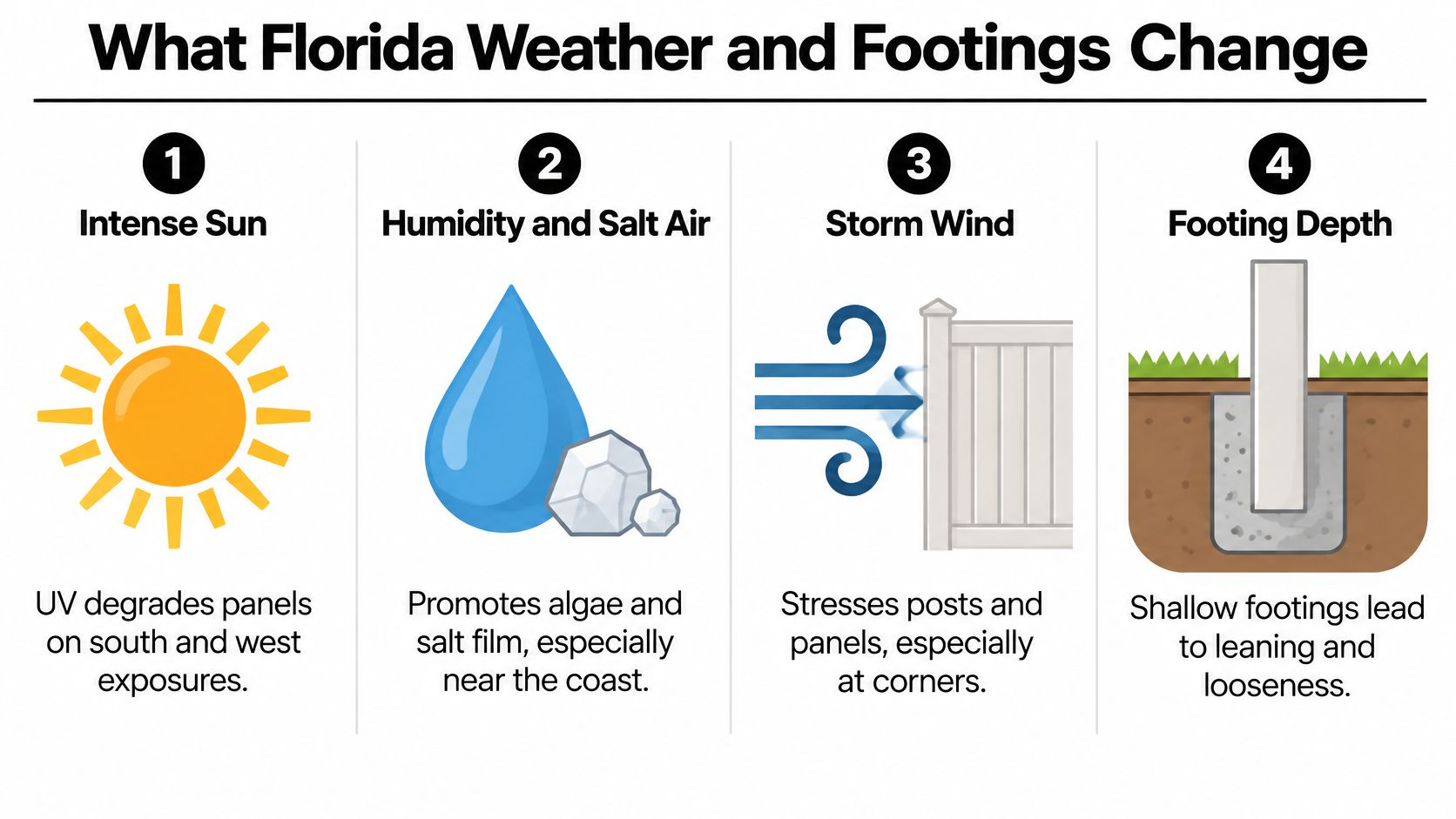
On the Treasure Coast and in northern Palm Beach County, coastal exposure affects different components differently. Sun acts on the profiles, salt deposits collect around hardware, and wind transfers force through the rails into the posts and soil.
A solid privacy run also presents a different wind-loading problem from an open picket fence. Comparing those systems only by panel price misses the construction beneath the ground and inside the posts.
What to verify before a vinyl fence goes in
| Check | Why it matters | Florida consequence if skipped |
|---|---|---|
| Virgin PVC and UV package | Titanium dioxide and stabilizers help slow yellowing and embrittlement | Poorly stabilized profiles can fade and chalk sooner in full sun |
| ASTM F964-type profile | Addresses weathering, impact, dimensions, and warp resistance | A year claim without demonstrated profile performance offers little technical assurance |
| Wall thickness and reinforcement | Properly designed sections resist impact and wind flex | Thin rails and unsupported spans can become vulnerable points |
| Post size and concrete footing | Posts and soil carry wind and gate loads | Shallow footings can allow leaning after storms or soil movement |
| Height and wind design | The applicable design basis sets the required construction | An underbuilt privacy run can fail while its plastic still looks new |
| Hardware and gates | Hinges and latches experience repeated movement | Ordinary screws can corrode, and gate sag can compromise operation |
The relevant profile benchmark is ASTM F964, which covers rigid PVC exterior fencing profiles and addresses extrusion quality, dimensional tolerances, weatherability, impact resistance, and resistance to warping. Compliance with a profile standard isn't a substitute for a suitable foundation or complete wind design.
A meaningful quote identifies the manufacturer, profile, reinforcement, post spacing, and footing arrangement. Virgin-PVC wording can be useful, but it shouldn't replace documented performance; the compound and finished profile still need to suit the application.
Concrete and gate construction deserve equal attention
Footing depth shouldn't be selected from a generic backyard diagram alone. Fence height, local soil, exposure, and the approved system determine the foundation arrangement, including footing dimensions and any required reinforcement.
A gate opening deserves particular scrutiny because the post carries an uneven, moving load. A heavy gate attached to an inadequately supported post can sag even when the neighboring panels remain straight.
Useful vinyl privacy fence installation details include alignment, drainage, reinforcement, and the relationship between posts and rails. The installer also needs to accommodate the manufacturer's assembly requirements rather than fastening every joint rigidly by instinct.
- Confirm the UV package. Product documentation should identify exterior-weathering protection, not describe the fence as premium.
- Match hardware to coastal exposure. Corrosion-resistant hinges, latches, and screws deserve the same attention as panel color.
- Resolve barrier requirements early. Pool use can change gate hardware, permitting, and inspection requirements.
Useful life ultimately comes down to the weakest part of compound, foundation, and hardware. Cleaning can improve a dirty surface, but it can't correct an undersized footing.
Simple Care That Protects the Surface
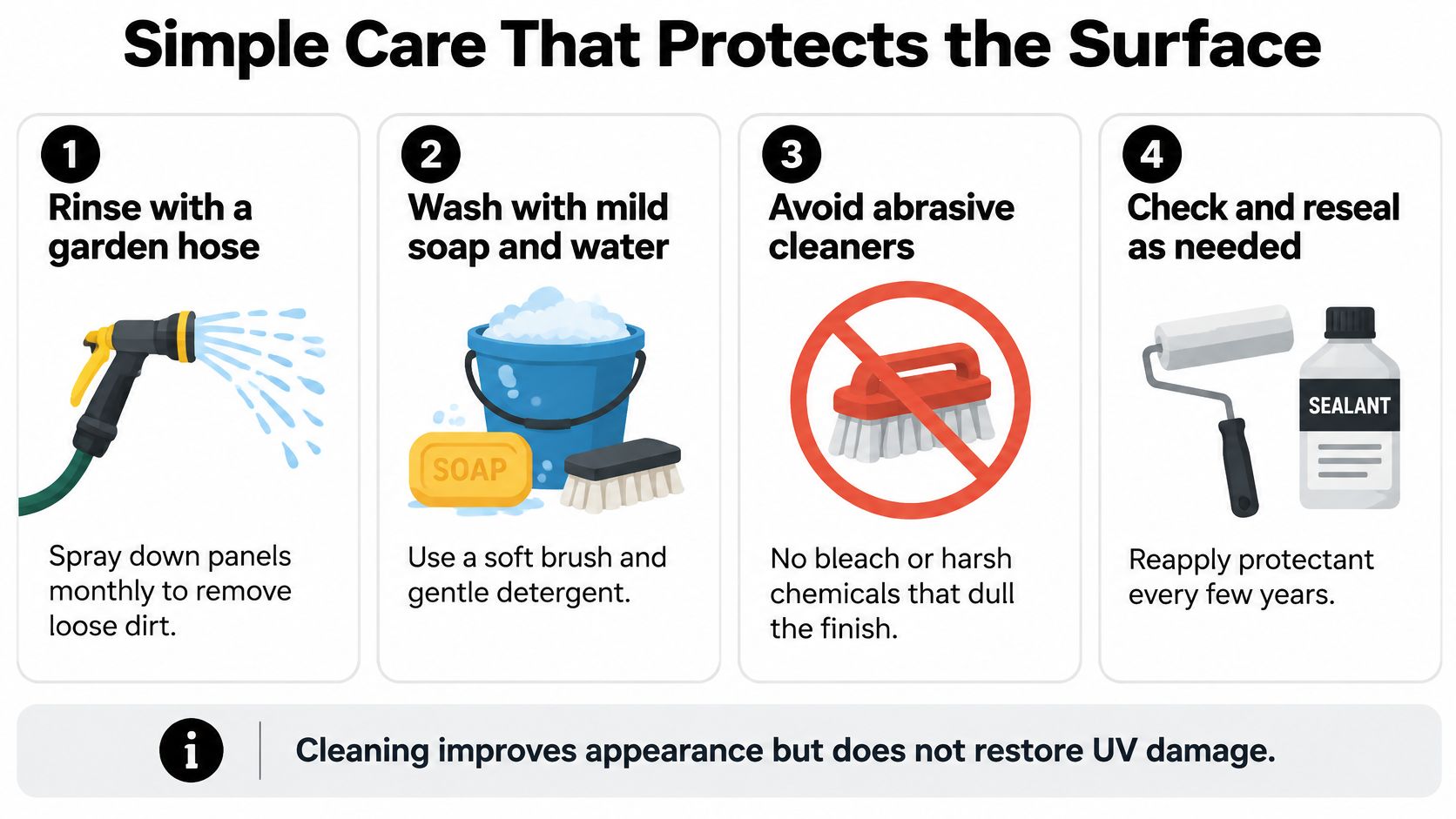
A garden hose, mild soap, and a soft sponge handle most ordinary vinyl-fence cleaning. The point is to remove deposits without sanding, etching, or blasting the finish.
A straightforward routine also creates opportunities to catch a loose latch or moving post before it turns into a larger repair. Low maintenance doesn't mean that a fence should go unexamined.
A practical care routine
Rinse panels, rails, and posts. A useful household schedule is once or twice a year, with an extra rinse after heavy pollen or storm debris. Start with a garden hose and include shaded lower rails, where dirt and mildew are easy to overlook.
Wash stubborn grime gently. Mild soap and a soft cloth or sponge are the starting tools. Work on a manageable area and rinse away the soap before it dries. Harsh solvents, abrasive pads, and routine pressure washing can damage the finish rather than improve it.
Reduce constant wetting. Redirect sprinklers that repeatedly soak the same bay. Trim vegetation back enough that leaves don't stay pressed against the plastic and the fence remains accessible for inspection.
Check posts and operating hardware. An annual household inspection should include gentle pressure on each post and a full swing of every gate. Loose screws need attention, but a screw that won't tighten may indicate a damaged attachment rather than a need for more force.
Inspect after a named storm. Walk the line for cracked profiles, displaced rails, fresh gaps, and new lean. Photograph damage before disassembly, and keep children and pets away from unstable sections.
Retain product identification. Keep installation paperwork, warranty documents, spare parts, and photographs of product markings. Matching a replacement rail is easier when the manufacturer and profile are known.
What washing cannot fix
A clean panel can still be brittle, and a spotless gate can still hang from a moving post. No cleaning product restores lost material toughness or corrects foundation settlement.
Routine sealing or protectant application isn't a default requirement for vinyl fencing. Any coating should have the fence manufacturer's explicit approval; an unsuitable product can create a new finish problem without solving the original one.
Maintenance boundary: Soap addresses deposits. Hardware work addresses operation. Neither resets the material's exposure history.
Persistent staining should be evaluated separately from cracking. Repeatedly scrubbing a weathered patch harder can damage the surface while leaving the underlying color change untouched.
Real Yards and the Keep, Repair, or Replace Call
The following hypothetical yards show why age alone makes a poor replacement test. Each represents a different combination of appearance, support, and operating condition, not a documented customer project.
Three coastal yard scenarios
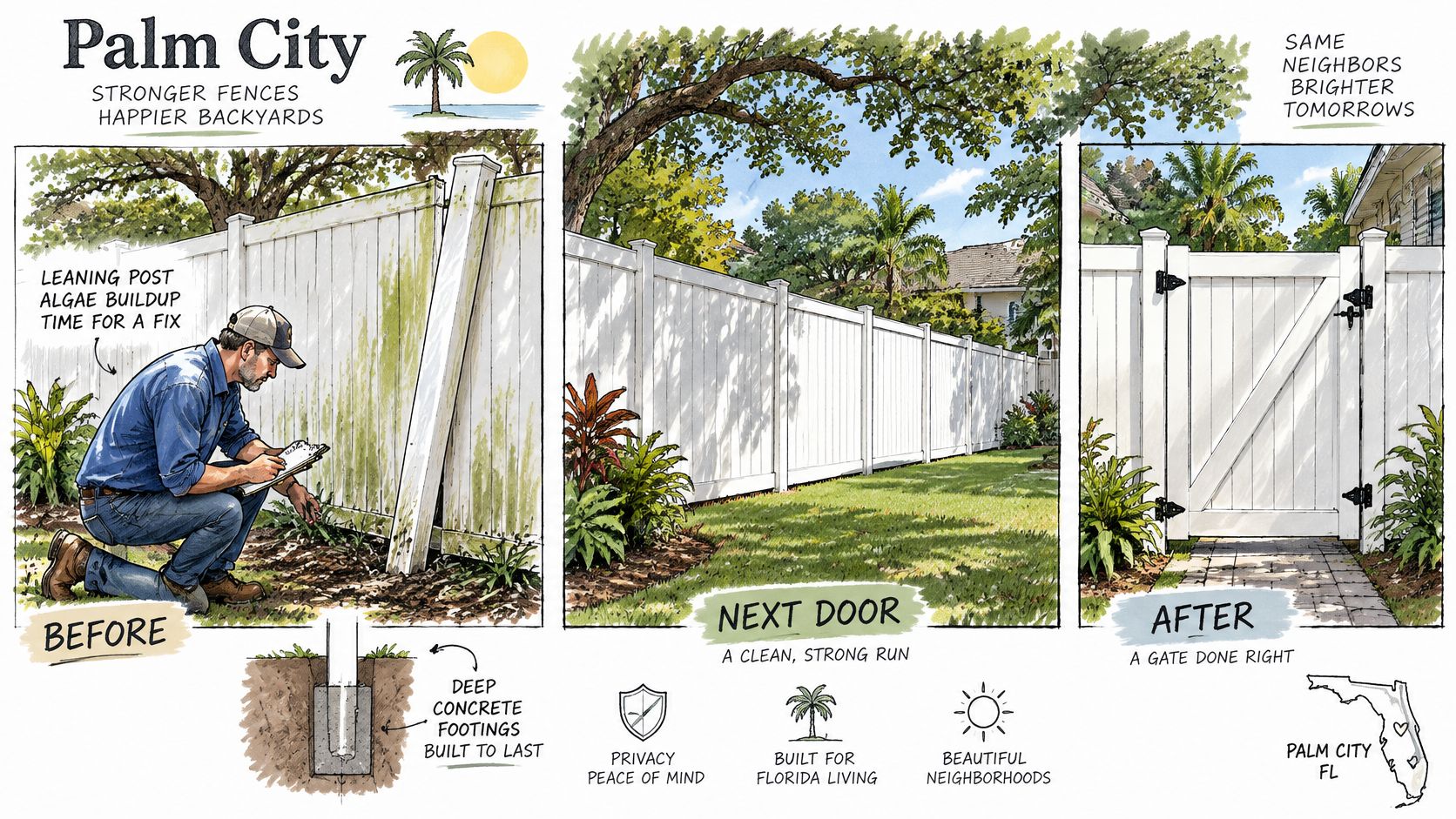
A partly shaded Palm City yard. Suppose a white privacy run is about 18 years old, with reinforced posts and well-built footings. The south-facing surface has light chalk, but the color remains reasonably even, the rails are seated, and the gates latch.
That fence is a candidate for cleaning and continued monitoring. Replacing it because it no longer looks newly installed would discard useful service.
A gray fence near an inlet. Consider a hypothetical fence about 12 years old, exposed to full sun and salt air. Uneven color and mildew on the lower rails make it look tired, yet the posts remain plumb and the profiles are intact.
Gentle washing may improve the appearance without eliminating the color difference. The homeowner can then judge the remaining cosmetic issue fairly, rather than confusing a dirty surface with a failed enclosure.
A storm-damaged privacy line. Suppose a limb strikes a 6-foot fence and shifts two posts held by shallow footings. A rail cracks, and the nearby pool gate no longer self-closes.
That is functional damage, even if neighboring panels still match perfectly. The repair needs to address the damaged profiles, post support, and gate operation rather than push everything upright.
Wind design and pool use change the decision
The 2023 Florida Building Code allows fences no higher than 6 feet to be designed for either a 75-mph fastest-mile wind speed or a 115-mph three-second gust, depending on the applicable design basis. Those are distinct design measures, not interchangeable promises that any installed fence will survive a particular storm.
Pool-barrier use also changes the compliance question. Miami-Dade's permit requirements for certain non-wind-resistant open pool barriers illustrate why an open appearance shouldn't be treated as a permit exemption; local requirements still need confirmation.
Make the repair decision by failure type
- Keep a sound enclosure. Color shift and light chalk aren't automatic reasons for removal when posts, rails, and gates remain secure.
- Repair isolated components. Failed hinges, latches, or screws can justify targeted work when their supporting posts and attachment points remain sound.
- Replace damaged sections when necessary. Cracked profiles, permanently warped rails, leaning posts, or racking call for structural assessment. A pool gate that won't close and latch requires prompt correction and safe interim access control.
A focused fence repair assessment should distinguish replaceable hardware from a moving foundation. An adjustment that hides post movement isn't a lasting repair.
Before removal, arrange disposal rather than assuming everything is recyclable. Separate hinges and metal inserts from PVC where safe, keep concrete apart, and confirm what the receiving facility accepts.
The INEOS Inovyn sustainability progress report discusses PVC recycling alongside challenges involving composite products and legacy additives. Broad recycling activity doesn't guarantee a local outlet for mixed residential fence waste, so a hauler or rigid-PVC recycler should approve the load before demolition begins.
Plan the Next Fence on the Treasure Coast
The next step should match the actual defect. A sound fence with surface buildup and a worn hinge needs a different scope from a cracked privacy run with leaning posts.
For a replacement, the written proposal should describe more than style and footage. The useful details are the weather-resistant compound, stated UV protection, reinforced posts, footing arrangement, engineered spacing, and corrosion-resistant hardware.
Put the complete system in the quote
AlliedFenceAndGate.com™ installs 4-to-8-foot vinyl/PVC privacy fencing with near-zero maintenance needs and a stated 20-to-30-year lifespan, along with gates and repair service. Its PVC systems use reinforced posts, proper footing depth, and engineered spacing for Florida wind loads, allowing the fence, gate, and supporting construction to be evaluated together.
The PVC manufacturer warranty covers cracking, splitting, peeling, and significant fading for the life of the original installation. The written terms should still be retained, with storm damage, impact damage, installation conditions, and claim procedures clarified before signing; a material warranty and a workmanship commitment aren't the same promise.
- Start with a ballpark. The Digital Fence Estimator and Calculator can help establish an initial budget.
- Confirm site constraints. Height, HOA color rules, property boundaries, and pool-gate requirements need resolution during the site assessment.
- Keep the scope specific. A repair proposal should name the failed components; a replacement proposal should explain the supporting construction.
For an existing fence that only needs cleaning and minor hardware work, preserving the sound sections is a reasonable choice. For an unsafe gate or unstable run, postponing the structural work merely leaves the underlying problem in place.
#MartinCountyFencing #PalmBeachCountyFencing #StLucieCountyFencing #IndianRiverCountyFencing #StuartFencing #JupiterFencing #PalmBeachGardensFencing #PortStLucieFencing #FortPierceFencing #VeroBeachFencing #PalmCityFencing #HobeSoundFencing #TreasureCoastFencing #VinylFence #PVCFence #PoolFence
AlliedFenceAndGate.com™ offers vinyl fence installation, gate systems, and repairs across Florida's Treasure Coast and northern Palm Beach County. Homeowners can visit AlliedFenceAndGate.com™ to use the digital estimator and arrange a site assessment that separates cosmetic wear from structural repair or replacement needs.
Related Fencing Services
Need a fence or gate on the Treasure Coast?
Licensed, insured, and bonded. Free estimates across Martin, St. Lucie, Indian River & Palm Beach counties.
Call (772) 530-3127