Wood Privacy Fence Cost Per Foot: 2026 Price Guide
A standard six-foot wood privacy fence typically costs about $25 to $50 per linear foot installed nationally. That starting figure excludes gates, old-fence removal and permits.
The useful question isn't which contractor offers the lowest rate. It's what construction and scope that rate buys. Different board layouts, footing assumptions and exclusions can produce substantially different totals for what looks like the same fence.
For homeowners in Martin County and Palm Beach County, a fair comparison starts with matching specifications. A quote that appears unusually expensive per foot may include work another contractor hasn't priced. Conversely, a higher price doesn't automatically mean stronger construction.
Table of Contents
- Wood Privacy Fence Cost Per Foot by Style and Height
- What a Per-Foot Quote Covers and What It Leaves Out
- How Wood Species and Fence Height Change the Price
- Gates, Removal and Permits That Raise the Total
- Florida Specifications That Set a Realistic Price
- Wood Compared With Vinyl and Aluminum Over Time
- Confirm Your Quote Before You Sign
Wood Privacy Fence Cost Per Foot by Style and Height
A standard six-foot wood privacy fence has a national planning range of approximately $22 to $45 per linear foot installed, before gates, removal and permits, according to ReplaceCost's fence cost guide. Style, height, access and regional labor conditions determine whether that benchmark fits a particular property.
Installed cost per foot by fence style and height
| Style | Height | Installed cost per linear foot | Pickets per 8 ft section |
|---|---|---|---|
| Stockade, solid boards and lowest cost | 6 ft | $15–22 | About 15 |
| Shadowbox, alternating boards with airflow gaps | 6 ft | $18–30 | About 16 |
| Cedar board-on-board, full screening | 6 ft | $20–35 | About 17 |
| Privacy fence, any wood | 8 ft | $50–75 | Set by board width, overlap and style |
The style prices and approximate picket counts above come from Linear Feet Calculator's wood privacy fence guide. They're style-specific benchmarks, not interchangeable bids for identical lumber grades and site conditions.
The picket count explains part of the price difference. More boards mean more lumber, handling and fastening. Board-on-board also requires consistent overlap, while shadowbox needs careful alignment on opposite sides of the rails. A comparison of wood privacy fence styles helps distinguish visual screening from airflow before pricing begins.
Turn the measurement into a base budget
A measuring wheel or long tape should follow the proposed fence line, not an approximate backyard boundary. Each straight run belongs on a sketch, with gate openings deducted from the fence footage. On sloped ground, the measurement should follow the intended fence alignment rather than relying solely on a flat map.
The reusable calculation is:
Base fence budget = installed fence footage × matching assembly rate. Gates, demolition, permits and unusual site work remain separate.
The ReplaceCost benchmark puts a 200-foot perimeter at roughly $4,400 to $9,000 before those additions. That example assumes the full measured length receives fencing; a perimeter containing gate openings requires the corresponding adjustment.
AlliedFenceAndGate.com™ publishes $25 to $45 per linear foot installed for cedar or pressure-treated wood. Local specifications still matter more than whether a bid falls inside a national range. Taller construction requires longer or stronger posts, footing details suited to the loads, and more material, so a standard-height rate shouldn't be stretched to cover a taller fence.
What a Per-Foot Quote Covers and What It Leaves Out
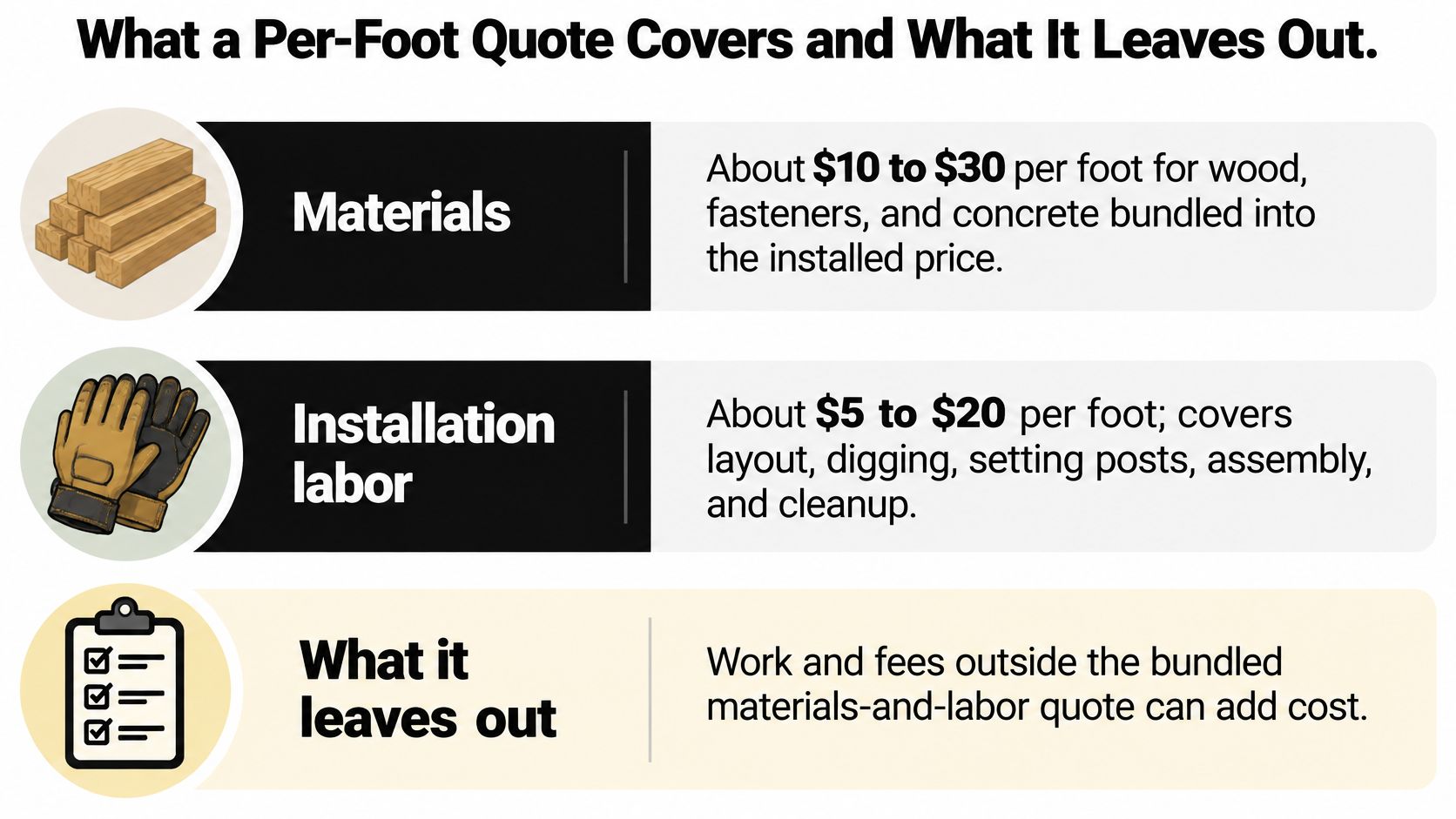
An installed price bundles materials with the work required to turn them into a fence. Nails & Numbers places a standard six-foot wood privacy fence at approximately $25 to $50 per linear foot nationally, with materials commonly accounting for $10 to $30 per foot and installation labor roughly $5 to $20 per foot; its taller-fence benchmark is $50 to $75 per foot for eight-foot privacy fencing.
Those component ranges aren't a menu to combine at whichever endpoints produce the preferred total. They describe different projects and assemblies. Labor includes layout, excavation, post alignment, concrete placement, rails, fastening and any gate work included in the written scope.
Short or irregular jobs can exceed ordinary benchmarks because crews still need equipment, delivery and mobilization. Corners require detailing, and cramped access can prevent efficient machine excavation. It's comparable to a delivery charge on a small grocery order: dividing the same fixed expense across fewer items produces a higher unit cost.
Normalize the scope before comparing totals
A useful quote-normalization worksheet checks the following:
- Pricing basis: Identify whether the price covers materials only or a completed installation.
- Matching assembly: Record height, species, board layout, lumber grade, rails and posts.
- Separate features: Identify gates, corners, reinforced ends and specialty hardware.
- Excluded work: Mark demolition, grading, vegetation clearing, utility conflicts and difficult access.
- Financial completeness: Identify permits, staining, sales tax and any allowances rather than treating missing items as free.
Linear Feet Calculator's wood fence cost guide explains why published per-foot figures aren't comparable when height, species, installation scope and exclusions differ. A materials-only estimate can look attractive beside a full-service bid without offering the same purchase.
The publisher's listed fence prices include professional installation, concrete-set posts and standard hardware. Gates, operators and specialty items are priced separately, which makes those distinctions important during comparison.
A difference of hundreds of dollars in a project total isn't the same as hundreds of dollars per foot. An extreme unit-price gap calls for checking footage, minimum charges and scope before drawing conclusions.
Each quote should ultimately fit the same five lines: installed straight-run fencing; gates and specialty items; removal and site work; permits and other fees; exclusions, allowances and final total. That format makes missing work visible instead of rewarding the shortest estimate.
How Wood Species and Fence Height Change the Price
Pressure-treated pine usually offers the lower initial material choice. Cedar's appeal is its natural decay resistance and appearance, but the price comparison only works when both options use the same height, board arrangement and structural details.
Published estimates illustrate the spread: Gauge Yard lists six-foot pressure-treated privacy fencing at approximately $20 to $30 per foot installed and cedar at $25 to $40. A different benchmark from Linear Feet Calculator places pressure-treated pine at $15 to $20 per foot and cedar at $18 to $35.
Wood species compared on installed cost, lifespan and upkeep
| Wood type | Installed cost per foot | Expected lifespan | Upkeep |
|---|---|---|---|
| Pressure-treated pine | $15–30 across the cited estimates | 10–20 years under the publisher's wood-fence planning assumptions | Regular staining or sealing; persistent dampness shortens service |
| Cedar, including board-on-board or shadowbox | $18–40 across the cited estimates | 10–20 years under the publisher's wood-fence planning assumptions | Staining or sealing every few years; better natural rot resistance |
These combined cost bands summarize the cited estimates, not a single national survey. The lifespan figures are planning assumptions for the publisher's wood fencing, not a promise that every board or post will last equally long.
Species doesn't replace structural design
Pressure treatment doesn't make poor drainage harmless. Posts need treatment appropriate to their exposure, and boards shouldn't remain buried in mulch or pressed against wet soil. Cedar also needs sensible detailing; natural resistance isn't immunity to trapped moisture.
The pressure-treated pine versus cedar comparison is most useful after the intended height and privacy layout are settled. Cedar board-on-board and shadow-box construction are both available through the publisher, so species selection doesn't require choosing a single visual style.
Height changes the assembly, not just the amount of visible lumber. A taller solid fence creates greater force on the posts and demands suitable lateral-load resistance. A premium cedar quote may also include overlapping boards or taller construction, so the species alone shouldn't receive all the blame for the price.
The practical lookup order is height, species, layout, then structural specification. A cheaper wood used in a taller, more demanding assembly can cost more than cedar in a straightforward standard-height fence.
Gates, Removal and Permits That Raise the Total
Gates, demolition and permit responsibility belong on separate quote lines. Otherwise, the headline wood privacy fence cost per foot can conceal substantial differences in the finished project.
Add-ons priced separately from the per-foot rate
| Add-on | Typical cost | When it applies |
|---|---|---|
| Old fence removal and haul-away | $3–8 per linear foot under the publisher's pricing | Replacing an existing fence |
| Gates | $400–1,800+ depending on gate type under the publisher's pricing | Pedestrian, drive or automated access; operators and specialty items need separate scope |
| Martin County wood fence permit | $60, including $30 zoning review | Applicable projects in Martin County |
| Palm Beach County residential fence permit | $125 | Applicable residential projects in Palm Beach County |
The Florida fence permit guide reports the listed Martin County and Palm Beach County fees and says both counties generally require fence permits. Actual jurisdiction, exemptions and current schedules need confirmation before materials are ordered.
How the additions stack up
Consider a hypothetical 200-foot perimeter with a four-foot pedestrian gate. The fence portion would be measured separately from the opening, while the gate receives its own price for framing, hinges, latch and supporting posts. If the entire old perimeter needs removal, the publisher's removal range produces a calculated $600 to $1,600 tear-out allowance.
The written estimate should then add the applicable Martin County permit rather than burying it in the fence rate. It should also state whether permit preparation and coordination are included, because an application fee and the labor to manage an application aren't the same thing.
A pedestrian gate isn't equivalent to a double driveway gate. Wider leaves require stronger framing and support, and automation introduces equipment and safety components beyond ordinary fence hardware.
- Slopes: Confirm stepped or following-grade construction and how bottom gaps will be handled.
- Rock and roots: Specify whether difficult excavation and root conflicts are included or treated as allowances.
- Buried services: Arrange an 811 utility locate before digging and identify private irrigation, lighting and other lines that may need separate attention.
A property in a county can still fall under a municipality's permitting process. The correct office should confirm the current fee and requirements, while the estimate should identify who handles submission, inspections and unexpected site conditions.
Florida Specifications That Set a Realistic Price
A Florida fence quote should identify the structure being purchased, not merely the wood facing it. The City of Fort Lauderdale's wood fence requirements provide a municipal example using decay- and termite-resistant wood, minimum #2 lumber, 4-by-4 pressure-treated posts, approximately two-foot embedment in concrete footings about ten inches in diameter, and at least three 2-by-4 horizontal rails.
Those details are a specification example, not a substitute for approval in Martin County or Palm Beach County. Fences up to six feet may also require wind-load design depending on the jurisdiction and applicable conditions.
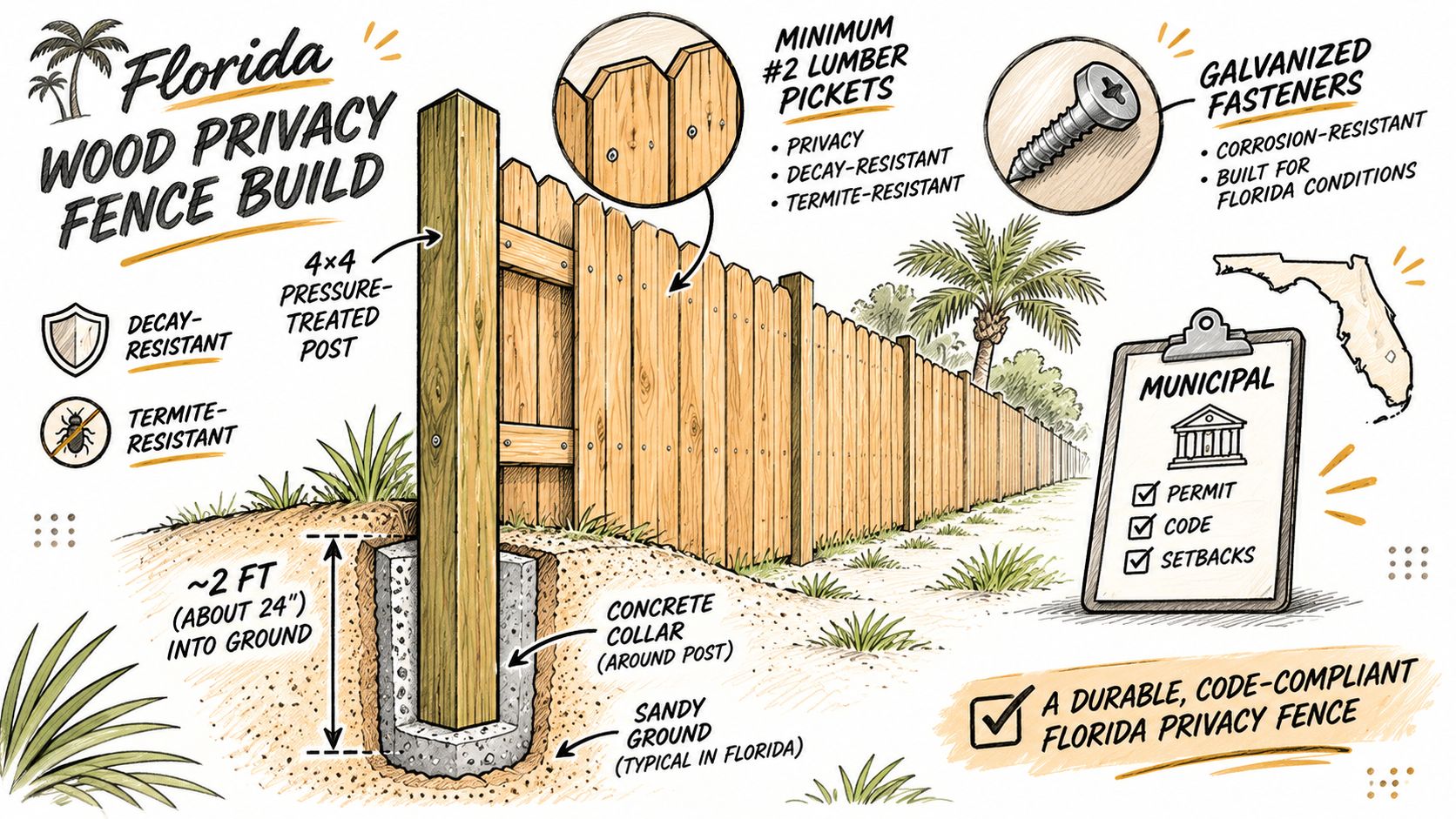
Concrete volume, post length and excavation affect real construction cost. Reinforced gate supports and corner conditions require attention beyond an ordinary intermediate post. Where engineering calls for closer spacing, the contractor must supply and install additional posts rather than attach more boards.
Moisture detailing deserves equal attention
A strong fence can still deteriorate prematurely if water stays trapped against its components. Boards need clearance from soil and accumulated debris, exposed cuts need appropriate treatment or protection, and footing tops shouldn't form pockets that collect water around posts.
Finishing also requires judgment. Applying stain to unsuitable or excessively wet lumber doesn't compensate for poor drainage, and coating every visible face won't protect an untreated cut buried in the ground.
Practical rule: Structural resistance and moisture management are separate requirements. Paying for one doesn't eliminate the other.
Full-coverage board-on-board provides stronger visual screening but presents a more solid surface to wind. Shadowbox permits airflow through the staggered boards, although it doesn't provide the same screening from every viewing angle. Neither style eliminates the need for locally appropriate structural design.
AlliedFenceAndGate.com™ recommends cedar board-on-board for longevity in Florida's climate. That recommendation still needs to sit alongside suitable posts, drainage and hardware rather than stand in for them.
A technically complete quote should identify species or treatment, post dimensions and spacing, footing depth and diameter, rail count, corrosion-resistant fasteners, gate framing, finish and maintenance expectations. Without those details, a homeowner can't tell whether a lower price reflects efficiency or omitted construction.
Wood Compared With Vinyl and Aluminum Over Time
The cheapest installation isn't automatically the cheapest fence to own. Material selection should account for maintenance responsibility, replacement access, and the privacy each design provides.
Installed cost and lifetime comparison by fence material
| Material | Installed cost per foot | Expected lifespan | Maintenance |
|---|---|---|---|
| Wood privacy fence | $25–45 | 10–20 years | High |
| PVC/vinyl privacy fence | $40–65 at six-foot standard height | 20–30 years | Near zero; no painting |
| Custom welded aluminum | $50–70+ | 30–50+ years | Near zero |
These are the publisher's material-specific price and service-life planning ranges. Custom welded aluminum is a distinct product, not a substitute price for every aluminum fence configuration.
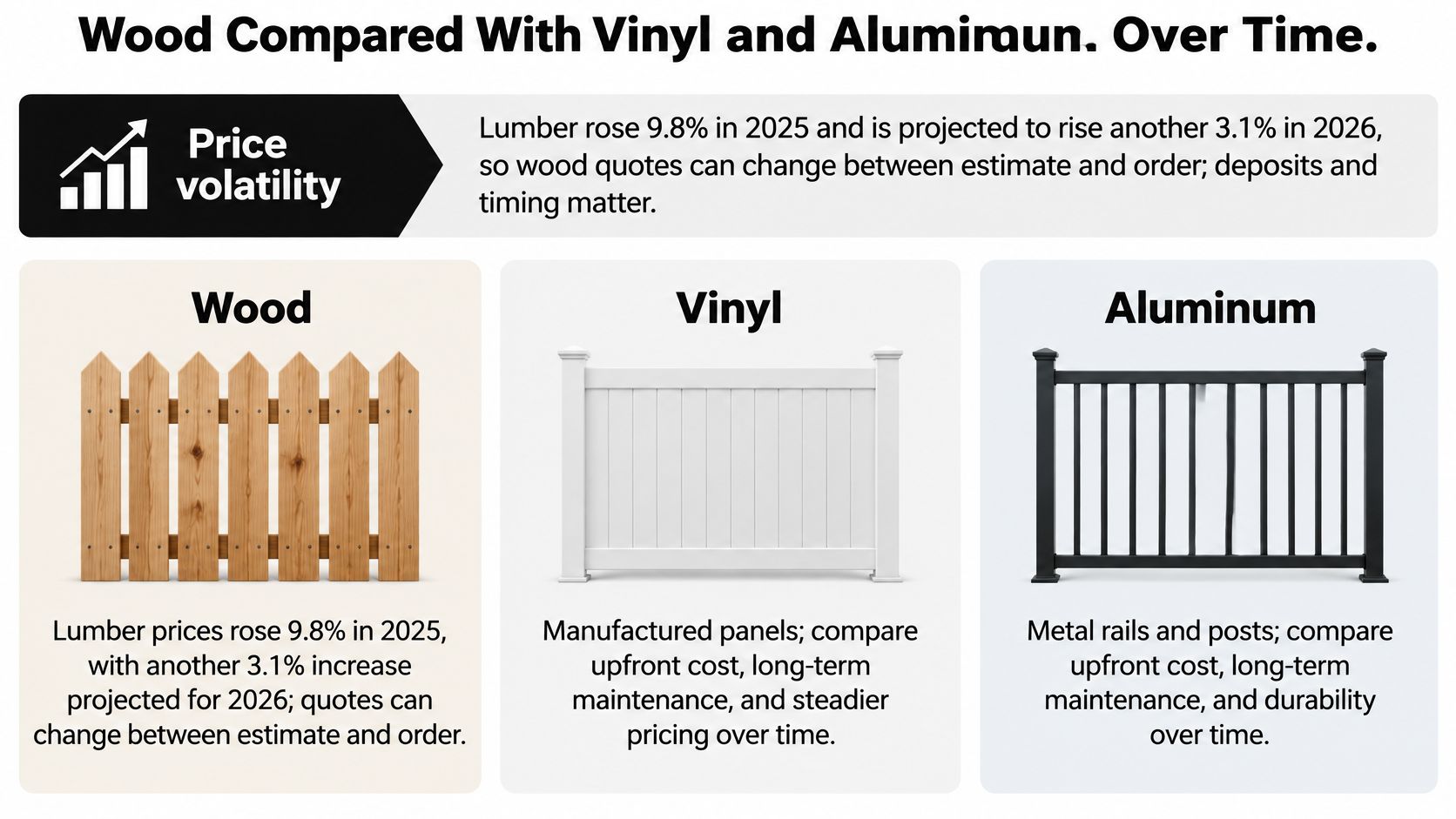
Wood also carries procurement uncertainty. Farm Credit East's forest products outlook reports that lumber prices increased 9.8% in 2025 and projects another 3.1% increase in 2026. That projection isn't a guaranteed increase in a homeowner's installed fence quote, but it supports checking quote expiration and material-order terms.
Compare annual ownership cost correctly
A useful calculation is installed cost plus expected maintenance, repairs and eventual removal over the ownership period, divided by that period. An annual maintenance allowance must first be multiplied by the years being evaluated; adding a single annual allowance to a lifetime installation cost understates the expense.
Wood needs an allowance for finishing, damaged boards, post repairs and eventual rebuilding. PVC/vinyl won't rot, warp or need painting, and the publisher offers solid privacy fencing in white, tan, clay and gray. Aluminum is rust-free and low maintenance, with picket, privacy and custom welded designs, but an open picket layout doesn't deliver solid-fence privacy.
The vinyl privacy fence versus wood comparison helps frame that choice around appearance and upkeep rather than installation price alone.
Storm exposure, difficult replacement access and HOA requirements can outweigh an initial saving. Low maintenance also doesn't mean storm-proof or inspection-free, so every material still needs an appropriate installation and occasional checks.
Confirm Your Quote Before You Sign
A complete comparison requires written scope, not a verbal assurance that everything is included.
- Collect three matching written quotes. Keep height, species, rail count, gates, removal and permit responsibility consistent.
- Use the same five-line comparison. Separate installed fencing, gates, removal and site work, permits and fees, then exclusions and final total.
- Confirm the jurisdiction. The local permitting office should verify the applicable process before purchasing materials.
- Check construction details. Post sizes, footing dimensions, treatment and corrosion-resistant hardware matter especially on exposed coastal sites.
- Record payment terms. Deposit requirements, balance timing, quote expiration and change-order approval should be in writing.
The online Fence Estimator provides an instant ballpark range based on customer specifications at no cost. It's useful for screening a budget, while a site-specific written quote establishes the actual scope.
The lowest per-foot number isn't necessarily the lowest project total. A complete, line-item estimate makes a fair comparison possible.
#MartinCountyFencing #PalmBeachCountyFencing #StuartFencing #JupiterFencing #TreasureCoastFencing #FloridaFencing #WoodPrivacyFence #WoodFenceInstallation #CedarFencing #PressureTreatedFence #BoardOnBoardFence #ShadowboxFence
AlliedFenceAndGate.com™ installs cedar and pressure-treated wood fencing and coordinates permitting, utility locates and inspections across its Florida service area. Visit AlliedFenceAndGate.com™ to use the free Fence Estimator and establish a ballpark budget before comparing the construction details and separate project allowances.
Related Fencing Services
Need a fence or gate on the Treasure Coast?
Licensed, insured, and bonded. Free estimates across Martin, St. Lucie, Indian River & Palm Beach counties.
Call (772) 530-3127