Aluminum Fence Types: Styles, Costs and Where Each Fits
The pool shell is in, the HOA packet is still open on the kitchen table, and the fence quote shows three aluminum options that look nearly identical in the photos. One is a three-rail picket, one is a shop-welded ornamental panel, and one is labeled pool code. Color is the least important line on that sheet. The same run of aluminum can pass or fail a Florida pool inspection based on geometry, grade, and gate hardware. Sorting aluminum fence types is a compliance and durability decision, not a catalog exercise.
Table of Contents
- Aluminum Fence Types at a Glance
- How Alloy and Build Method Set Fence Quality
- Pool Fence Designs That Pass Florida Inspection
- Decorative, Boundary and Privacy Layouts Compared
- Salt Air, Finishes and Metal Contact Risks
- Choosing the Right Fence Type and Checking Before You Order
Aluminum Fence Types at a Glance
| Fence type | Typical height | Expected lifespan | Maintenance load |
|---|---|---|---|
| Standard picket | 3 to 6 ft | 25 to 40+ years | Low; rinse and check fasteners yearly |
| Custom welded panels | 3 to 8 ft | 30 to 50+ years | Near zero; inspect welds and finish yearly |
| Pool enclosure panels | 4 ft minimum under Florida barrier rules | 25 to 40+ years when rinsed and free of chemical damage | Inspection-driven; check gaps, grade and gate each season |
Those three families cover most residential jobs. Read the columns as job specs, not style labels. Typical height is the range the layout is built to serve. Expected lifespan assumes regular fresh-water rinsing and no salt-spray or chemical damage eating the finish. Maintenance load is the work that keeps that lifespan, not a promise that the fence can be ignored.
Four factors that separate a type
Height needed. A front border can sit at 3 or 4 feet. A rear boundary often wants 5 or 6. A pool barrier cannot drop below the statutory minimum, and a tall privacy screen is a wind sail, not a taller picket.
Expected lifespan. Standard picket systems are commonly specified for 25 to 40+ years. Custom welded panels, with every picket fused to the rails, are commonly specified for 30 to 50+ years and near-zero routine work beyond a yearly look at welds and finish. Those numbers collapse if sprinkler overspray, pool chemicals, or beach salt sit on bare edges.
Maintenance. Fastened picket fences need a yearly rinse and a fastener check. Welded panels have fewer loose parts, so the yearly pass is about coating nicks and weld toes. Pool panels add a seasonal geometry check because grade and gates move.
Code or only a look. Ornament on a side yard is a look. Openings, bottom gap, and latch behavior at a pool are code. An HOA color rule is a covenant, not a building-code height.
Practical rule: Choose the type by the job the fence must do, containment, privacy, pool safety, or decoration, then check alloy, thickness, joints, and site grade.
Aluminum is an architectural metal. The family name matters less than the alloy and the build method behind the panel.
How Alloy and Build Method Set Fence Quality
Two fences can match in black powder coat and spear tops, yet one is a window-frame profile and the other is a thin ornamental tube. Alloy and fabrication decide which one stays straight in a summer squall.
6063-T5 is the common extruded choice for rails, posts, and pickets. Its magnesium-silicon mix extrudes cleanly, takes a smooth finish, and resists corrosion well enough for decorative residential, boundary, and pool layouts. 6061-T6 is the higher-strength alternative when wind, impact, long spans, or security loads govern. A commercial supplier of powder-coated 6063-T5 privacy and security panels reports rail wall thicknesses of about 1.8 to 3.0 mm and picket thicknesses of about 1.6 to 2.5 mm, against lighter residential sections near 1.0 to 1.6 mm, and notes that post spacing, section thickness, gate geometry, welded versus fastened joints, and site wind pressure set performance, so Florida jobs with tall privacy panels, solid screens, corners, or large gates need engineered wind-load data rather than a guess borrowed from an open picket panel (Shengxin Aluminium).
Extruded profiles versus welded joints
Extruded parts repeat the same cross-section from post to post, which is why rails and channels look consistent down a long run. Mechanically assembled fences join those parts with brackets and screws. That is fast and repairable, and it also creates fastener points that loosen if the wrong metal is used.
Welded panels fuse each picket to its rails in the shop, so the section arrives as one piece with no visible fasteners. Fewer loose parts is the gain. Weld quality is the risk. A cold weld or an uncoated cut edge fails long before the extrusion does. Thicker walls and closer post spacing cut deflection, and they also raise material cost and the size of the concrete footing. How an aluminum fence post is set matters as much as the picket profile once the panel gets tall.
Three checks before a deposit
- Ask for alloy and temper in writing. "Aluminum" on a quote is not a specification. 6063-T5 and 6061-T6 are different products.
- Compare section thickness. A 1.0 mm residential picket and a 2.0 mm commercial picket can share a finish chip and not share a wind rating.
- Ask how joints are made. Welded, bracketed, or a mix. Then ask what protects the weld and the cut ends.
Appearance never identifies a fence type. Post spacing and wall thickness drive how far a panel bows.
Pool Fence Designs That Pass Florida Inspection
The most decorative fence can create more inspection risk than a plain vertical-picket run. Scrolls, mid-rails, and cutouts are the usual reasons.
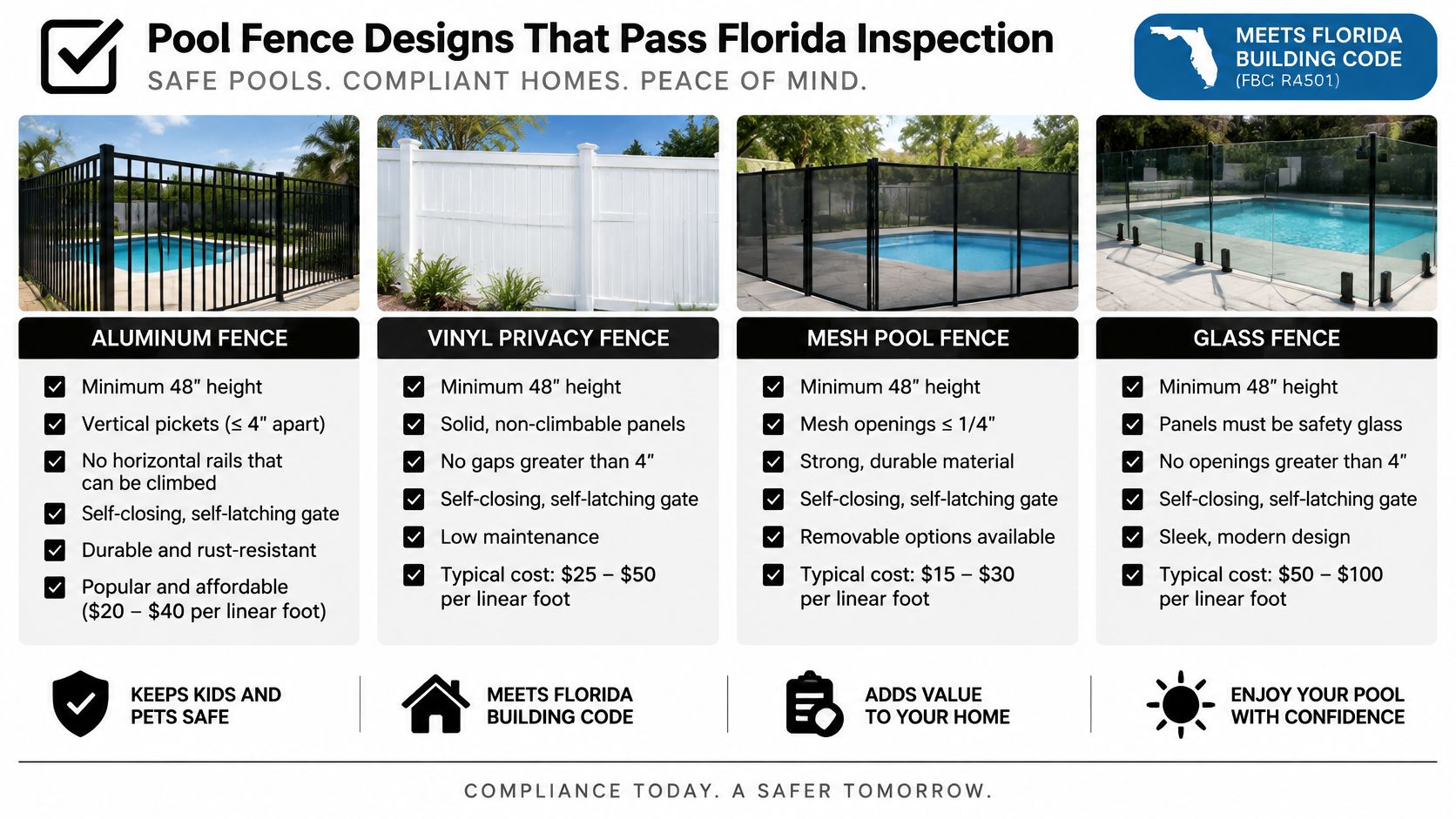
Florida's 2025 statutes require a residential pool barrier at least 4 feet high that does not let a young child crawl under, squeeze through, or climb over, and no opening in the barrier may pass a 4-inch sphere (2025 Florida Statutes, Chapter 515). A panel that meets those numbers in the shop can miss them in the yard. Soil settles, a retaining wall becomes a step, a decorative rail becomes a foothold, or the gate stops latching. Inspectors judge the whole barrier, not the metal.
That is why picking a pool fence type is a compliance decision before it is a style decision. The same panel passes on flat grade and fails at a swale.
Where each layout fails
| Requirement | Florida reference value | Common failure point |
|---|---|---|
| Minimum barrier height | 4 ft | Settling soil or a retaining wall lowers effective height |
| Bottom clearance | No gap a child can crawl under | Grade change opens a gap under the panel |
| Opening size | Must not pass a 4-inch sphere | Wide pickets or decorative cutouts |
| Climbable features | No footholds or ledges | Decorative rails and planters within reach |
| Gate | Self-closing and self-latching | Latch fails or hinge sags over time |
Vertical picket. This is the layout that fails least often when spacing is tight and rails sit where a child cannot use them as steps. The failure is usually at the ground, not in the picket: a swale or a new paver patio opens a crawl-under gap under one bay.
Framed panel. A framed section can rack to follow a slope, which helps on a deck-to-grade transition. It fails when the frame's horizontal members land in the climb zone, or when a solid insert is added later and nobody recalculates wind or openings.
Ornamental. Rings, spears with wide gaps, and a mid-rail at knee height are the patterns that get red-tagged. A visually open fence is often safer once openings, climbability, hardware, and elevation are drawn together. The Florida pool fence requirements checklist is worth walking before the order, not after the concrete cures.
Site check before the inspector walks it
- Measure height from finished grade on both sides of every panel.
- Measure bottom clearance at every low point, including where mulch, sod, or a deck board changes the surface.
- Test sphere passage across picket spacing and any decorative cutout.
- Look for ledges, rails, planters, or equipment pads within reach of the top.
- Open the gate from every position it can rest in and confirm it self-closes and self-latches.
A compliant panel becomes noncompliant the week the grade changes. Recheck after landscaping, not only on install day.
Decorative, Boundary and Privacy Layouts Compared
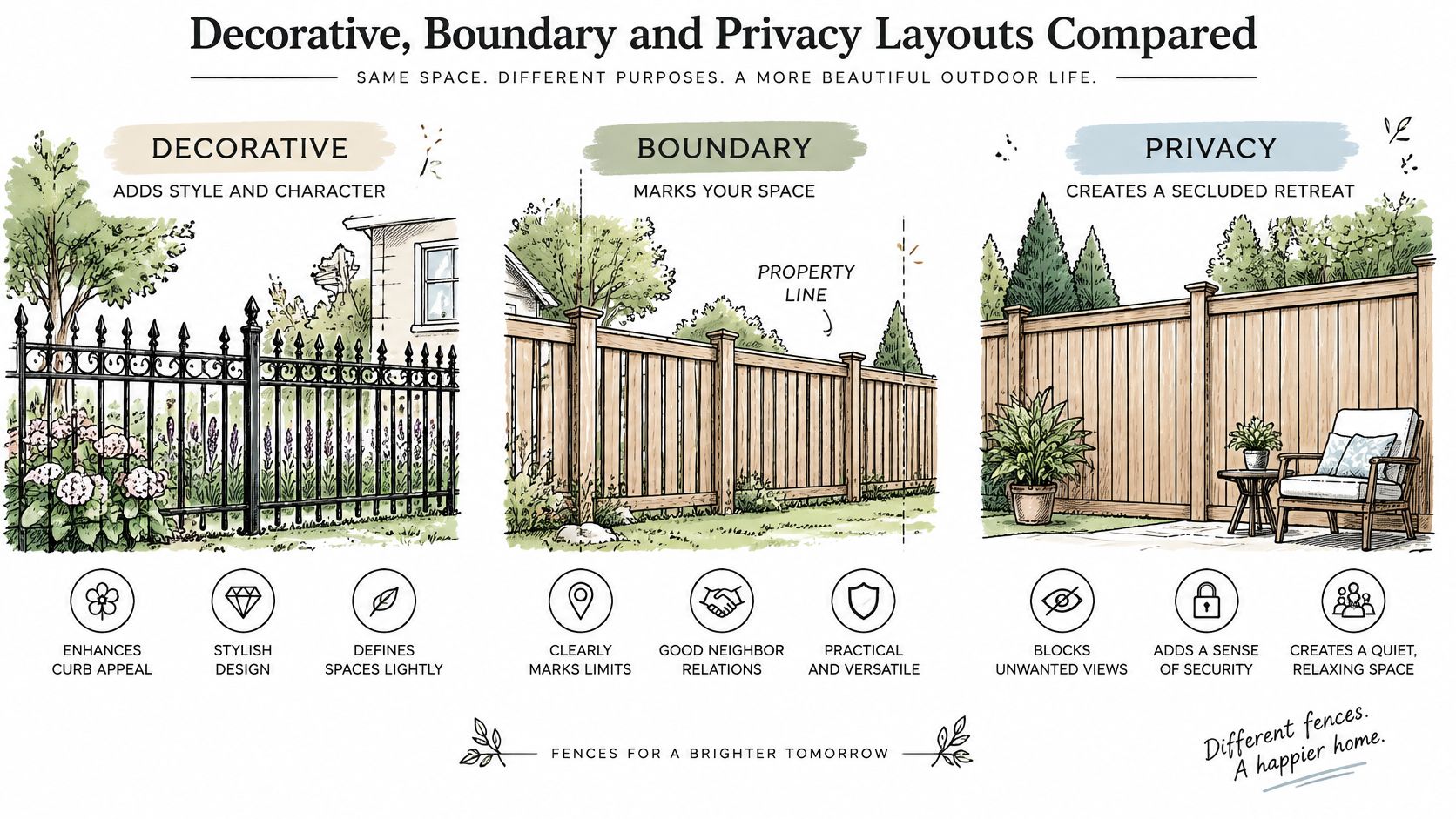
Say a homeowner in a Stuart or Jupiter HOA wants a fence on the rear property line and a lighter border across the front. The rear has to mark the lot and satisfy the architectural committee. The front has to look finished without turning the yard into a cage. One aluminum system rarely does both jobs at the same spacing, height, and opacity.
Boundary along the rear line
Standard pickets in the 3 to 6 foot band are the usual rear-line choice. Set the face back from the property line the way the covenants require, and match the material and color the committee already approved. Black three-rail is the default in many Treasure Coast communities. Bronze or a four-rail layout needs a written yes before fabrication, because a rejected color means a second coat or a second order.
Decorative border at the front
Lower, open pickets or ornamental rails fit where the look matters more than containment. A 3-foot flat-top or a short welded panel can edge a garden without blocking the facade. Puppy pickets, a tighter row along the bottom, help with small dogs on a side return. They do not turn a short border into a pool barrier.
Privacy where the view has to stop
Solid or framed panels are the privacy tool. A tall solid screen catches wind that an open picket never sees, so post spacing, wall thickness, and foundation depth need engineered numbers for that panel, not a copy of the neighbor's 4-foot ornamental run. Curves, radius gates, and an HOA-specific pattern are where custom welded work earns its place: each picket is fusion-welded to the rails, producing a one-piece panel with no visible fasteners and a top treatment the committee can approve from a drawing.
HOA review usually turns on materials, color, height, and placement. Request the architectural guidelines before a style is locked. The same scrolls that dress up a front border become footholds if that pattern is repeated beside the pool.
Salt Air, Finishes and Metal Contact Risks
Aluminum is corrosion-resistant. It is not corrosion-proof, and the claim that a coastal fence is maintenance-free is too broad. Salt air, humidity, and storm spray do not act the same on a beachfront lot as they do a few miles inland. Direct spray wets fasteners and cut edges for days. Inland humidity plus one salty storm is a milder, still real, exposure. Pool water and irrigation add chlorides even when the ocean is out of sight.
What may touch the aluminum
When aluminum meets another metal and moisture reaches the joint, the other metal should be painted or coated with zinc, cadmium, or aluminum. The Aluminum Association's structural guidance permits contact with 300-series stainless steel, zinc, or cadmium under the stated conditions, warns that uncoated aluminum should not take moisture or runoff that has already touched other uncoated metals, finds zinc-coated steel especially effective against atmospheric galvanic corrosion with aluminum, and says coating the steel is generally more effective than coating the aluminum. Aluminum that bears on concrete or masonry should be painted unless those materials stay dry after curing and contain no corrosive chlorides (Aluminum Association structural guidance).
| Contact case | Guidance | Note |
|---|---|---|
| Aluminum to 300-series stainless steel | Permitted contact | Use stainless or compatible hardware |
| Aluminum to zinc or cadmium | Permitted contact | Under the stated conditions |
| Aluminum to bare carbon steel | Coat the steel | Zinc-coated steel works well; coating steel beats coating aluminum |
| Aluminum to concrete or masonry | Paint the aluminum contact surface | Unless the material stays dry and chloride-free after curing |
Stainless or hot-dip galvanized hardware with aluminum posts is the practical pairing. A plain carbon-steel bracket in a wet sleeve is how a "rust-free" fence grows rust stains.
Finishes are not the same product
Anodizing grows an electrochemical layer from the aluminum itself. Paint and lacquer add a film whose life depends on surface prep, coating chemistry, and how hard the sun and salt hit that face. Mill finish has neither. A powder-coated black panel and a lacquered bronze panel can share a photo and not share a service life, because final life follows the application, not the color name. Cut ends, weld toes, and fastener holes are the spots that lose coating first. Touch those up before the panel goes in the ground, not after the first rust bloom.
A seasonal pass that actually helps
After a storm, rinse salt off pickets and posts with fresh water. Then check fasteners, coating chips, gate hinges, welds, and every place aluminum meets another metal or the concrete collar. Fix a weeping hinge before it stains the picket. Keep sprinklers off the lower rail. Drainage that dumps roof or deck runoff onto a post base undoes a good coating faster than age does.
Material selection alone does not set service life. Exposure, detailing, and whether someone rinses the fence decide it.
Choosing the Right Fence Type and Checking Before You Order
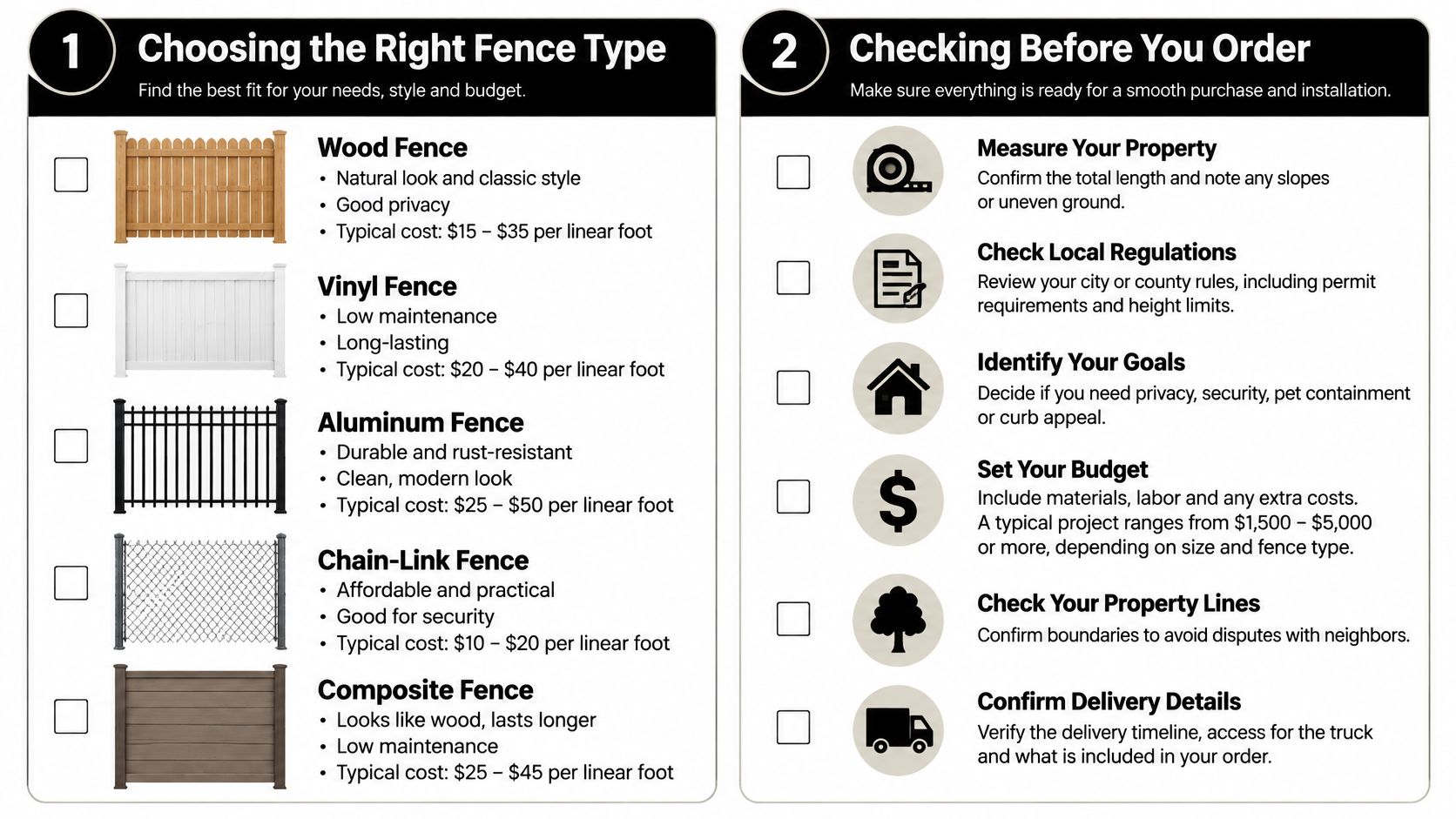
Start with the job the fence must do. Then check the constraints that decide whether it stays legal and whether it lasts. Aluminum fencing that is rust-free, pool code compliant, and HOA approved still has to be the right layout for that lot. AlliedFenceAndGate.com™ offers free estimates for all fence types, and listed fence prices include professional installation, concrete-set posts, and standard hardware, while gates, operators, and specialty items are priced separately.
| Situation | Best-fit type | Check before ordering |
|---|---|---|
| Backyard pool | Pool-compliant picket or framed panel | Gaps, grade, climbable features and gate latch |
| HOA boundary | Standard picket or welded panel | Approved materials, colors, height and setbacks |
| Privacy screen | Solid or framed panel | Engineered wind-load data for posts and foundation |
| Coastal lot | Coated or stainless-hardware aluminum | Galvanic contact points and drainage |
| Decorative border | Low picket or welded ornamental panel | No footholds if near a pool |
Why the match matters
A backyard pool wants a compliant picket or framed panel, tested for gaps, grade, climbable features, and the latch, not a decorative copy of the front yard. An HOA boundary wants a standard picket or a welded panel already checked against approved materials, colors, height, and setbacks. A privacy screen wants a solid or framed panel with wind numbers for the posts and the footing. A coastal lot wants coated aluminum and stainless or galvanized hardware, with contact points and drainage drawn, not assumed. A decorative border can be a low picket or a welded ornamental panel, provided no rail becomes a step if the pool is nearby.
Pre-order checklist
- Confirm the purpose. Containment, privacy, pool safety, or decoration. Write it on the estimate so the panel spec follows the job.
- Confirm height and setback limits. Building rules and the HOA can disagree. The stricter one controls.
- Confirm alloy, finish, and hardware in writing. Temper, coating type, and whether fasteners are stainless or hot-dip galvanized.
- Confirm the gate. Self-close and self-latch from any open position on a pool. Operators and specialty hardware are their own line items.
- Confirm HOA or permit requirements. Approval letters and inspection timing belong in the schedule, not in a surprise email after posts are set.
Height, section thickness, pool-code detailing, and concrete-set posts shape the installed price. A short open picket and a tall solid screen are not the same product at a different color. Asking for an aluminum fence price per foot only helps after those drivers are named, because a per-foot figure that hides the gate will not match the invoice.
Measure the barrier path, photograph grade changes and the gate opening, and collect the HOA guidelines. Then request an estimate that lists every gate on its own line. AlliedFenceAndGate.com™ serves Florida's Treasure Coast and northern Palm Beach County, including permitting and inspection coordination on residential pool, privacy, and boundary work.
#MartinCountyFencing #PalmBeachCountyFencing #TreasureCoastFencing #StLucieCountyFencing #IndianRiverCountyFencing #AluminumFencing #AluminumFenceTypes #PoolFencing #PoolSafetyFence #HOAFencing #FloridaFencing #FencingContractor #StuartFencing #JupiterFencing #PortStLucieFencing #VeroBeachFencing
AlliedFenceAndGate.com™ installs aluminum fence types for pool barriers, HOA boundaries, privacy screens, and custom welded layouts across the Treasure Coast and northern Palm Beach County, with concrete-set posts and hardware specified for Florida exposure. Free estimates cover every fence type and keep gates and specialty items on their own lines so the quote matches the job. Visit AlliedFenceAndGate.com™ to upload lot photos and request an estimate.
Related Fencing Services
Need a fence or gate on the Treasure Coast?
Licensed, insured, and bonded. Free estimates across Martin, St. Lucie, Indian River & Palm Beach counties.
Call (772) 530-3127