How Much Are Pool Safety Fences
A professionally installed pool safety fence in Florida typically runs $15 to $35 per linear foot for mesh, $28 to $55 for ornamental aluminum, and $120 to $500+ for frameless glass, with most Treasure Coast projects landing between roughly $1,500 and $10,000 depending on pool size and gate hardware. That spread is the whole story: the fence line matters, but the gate package, latch setup, permits, and inspection details are usually what separate a basic quote from the number a homeowner pays.
Most pricing pages stop at a single average and leave out the part that changes real Martin County and Palm Beach County jobs. A pool barrier isn't priced like a straight backyard fence. It has to meet Florida code, the gate has to close and latch correctly, the openings have to pass inspection, and local permitting adds another layer that national calculators usually ignore.
A wider public health lens shows why this category carries so much attention. A 2026 Texas cost-benefit study estimated that universal pool fencing would require about 98,905 new fences at an average cost of $3,343 each, for a total of about $330.6 million, and it noted that households with pools made up about 7% of all households in that analysis (Texas pool fencing cost-benefit study). That doesn't price a Treasure Coast installation by itself, but it does show how a "simple fence" becomes a serious investment once code, hardware, and compliance enter the picture.
Table of Contents
- What a 2026 Pool Safety Fence Actually Costs in Florida
- Comparing Mesh, Aluminum, and Glass Pool Safety Fence Pricing
- Florida Pool Barrier Code and What It Means for Your Budget
- How Martin and Palm Beach Counties Add Local Requirements
- Hidden Cost Drivers Beyond the Per-Foot Price
- AlliedFenceAndGate's Published Price Ranges by Material
- Using the AlliedFenceAndGate Estimator for a Real Ballpark
- Putting It All Together for Your Pool Fence Project
What a 2026 Pool Safety Fence Actually Costs in Florida
Florida pool safety fence pricing usually starts around $17 to $35 per linear foot for mesh, $28 to $55 for ornamental aluminum, and $120 to $500+ for frameless glass, with many installed projects falling somewhere between about $1,500 and $10,000 total based on size, material, and gate package. Those broad ranges are useful for a first pass, but they are not a finished budget.
On Treasure Coast jobs, I see homeowners get tripped up when they compare only perimeter footage. Two pools can both measure 120 feet and still come back hundreds, or even a few thousand dollars apart, once you account for gate count, deck conditions, latch setup, and permit requirements in Florida.
The Per-Foot Price Is Only the First Filter
A pool barrier quote covers more than panels and posts. It also has to cover the parts that make the fence legal, functional, and passable at inspection.
A simple rectangular pool with one gate on clean concrete usually prices closer to the lower half of a material range. A freeform pool with radius sections, short panel runs, pavers, limited access, and two self-closing gates usually does not.
What pushes one Florida quote above another:
- Gate count: Each gate adds self-closing hinges, self-latching hardware, alignment time, and adjustment labor.
- Pool shape: Curves, short sections, and tight transitions create more layout work and more cuts.
- Deck surface: Pavers, uneven slabs, and core-drill conditions slow installation and can add material or labor.
- Access to the work area: Crews move faster when they can stage material near the pool.
- Material choice: The jump from mesh to aluminum is real. The jump from aluminum to frameless glass is much larger.
| 2026 Pool Safety Fence Cost Ranges in Florida | Per Linear Foot | Typical 100-150 ft Project |
|---|---|---|
| Mesh | $17 to $35 | Roughly $1,700 to $5,250 |
| Ornamental aluminum | $28 to $55 | Roughly $2,800 to $8,250 |
| Frameless glass | $120 to $500+ | Roughly $12,000 to $75,000+ |
Those project totals are ballpark figures, not permit-ready quotes. They help with early budgeting, but they do not replace a site visit.
A homeowner who wants a rough starting number can use a pool fence cost calculator for Florida projects, but the check is whether the estimate breaks out gates, code-required hardware, permit costs, and inspection-related details. If those items are missing, the price is not complete.
Practical rule: If a pool fence quote looks unusually low, check whether the gate package, latch hardware, permit, and inspection items are excluded.
Comparing Mesh, Aluminum, and Glass Pool Safety Fence Pricing
On Treasure Coast quotes, material choice is usually the fastest way to move a pool fence budget by hundreds or by tens of thousands. National pricing guides show a wide installed range of about $10 to $45 per linear foot for pool fencing in general, with higher totals tied to premium materials and gate hardware requirements (HomeGuide pool fence pricing).
That is why a single "average pool fence cost" number does not help much. A 120-foot pool barrier in mesh, aluminum, and frameless glass can produce three very different proposals, even before permit and inspection items get added.
Mesh Is Usually the Lowest Starting Price
Mesh systems commonly run about $17 to $35 per linear foot installed, with price shifts driven by deck conditions, gate count, and hardware quality (Pool Guard USA mesh pool fence cost). For homeowners who want a removable barrier and a lighter visual footprint around the pool, mesh usually lands at the entry level.
I see the biggest surprises on mesh jobs when the footage looks modest but the layout is not. Short runs, corners, and a single code-compliant gate can push the total higher than expected because the labor and hardware do not shrink just because the perimeter does.
Aluminum Is the Common Permanent Choice
Ornamental aluminum sits in the middle tier at $28 to $55 per linear foot in recent pricing data (Estimate Fence Charlotte pool fence cost guide). On many Martin and Palm Beach County projects, this is the material homeowners settle on after comparing appearance, lifespan, and maintenance.
Two aluminum fences with the same footage can still price apart. Panel style, gate width, hinge and latch package, and the amount of site adjustment all matter. Homeowners comparing long-term looks and use cases can get a clearer sense of options in this aluminum fence for pool guide.
Glass Is Its Own Budget Category
Frameless glass starts around $120 per linear foot and can run $500+ per linear foot in higher-end systems, based on published industry pricing referenced earlier. On Florida coastal jobs, the hardware package matters just as much as the panels. Stainless components, anchoring method, and corrosion resistance all affect the final number.
Glass also carries tighter tolerance expectations in the field. A deck that is slightly out of level or a layout with multiple direction changes can add labor faster on glass than on mesh or aluminum.
Mesh, aluminum, and glass solve the same safety problem at very different price points. The material sets the starting range, but the gate package, hardware grade, and install conditions decide where your quote actually lands.
Florida Pool Barrier Code and What It Means for Your Budget
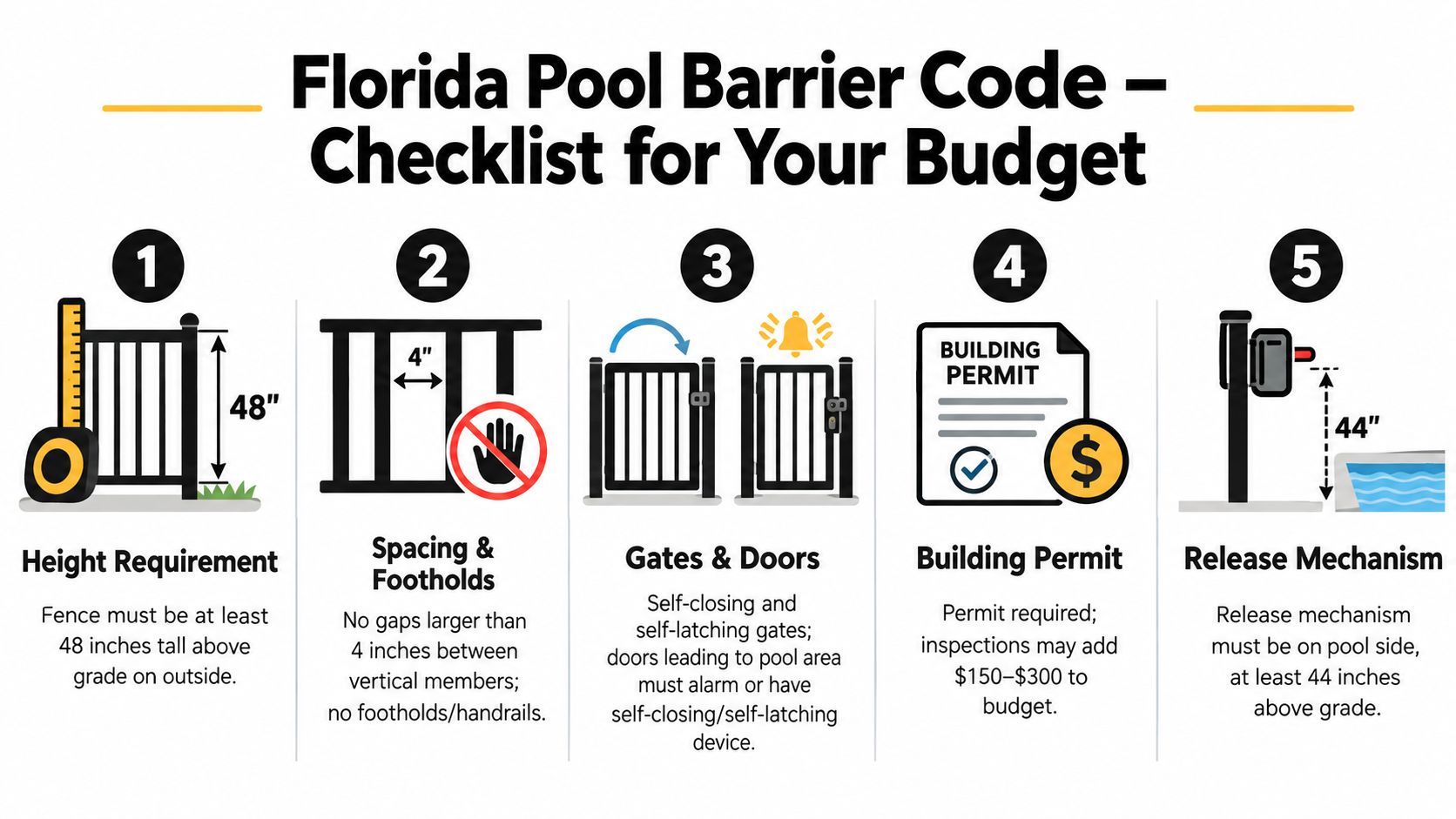
Before any material comparison makes sense, the barrier has to meet Florida rules. The statewide statute requires a minimum barrier height of 4 feet, or 48 inches, on the outside, and gates must open outward, be self-closing, and use a self-latching locking device positioned so a young child can't reach it over the top or through openings (Florida residential swimming pool barrier statute).
That language affects cost immediately because it rules out bargain gate hardware and casual installation methods. A pool gate has to perform consistently, not just look square on install day.
The Openings and Clearance Rules Drive Labor
Florida-focused guidance also states that openings in the barrier shouldn't allow a 4-inch sphere to pass through, and the bottom clearance to grade is limited to 2 inches in the common statewide standard summarized there (Florida pool fence code summary).
Those two details are where real field labor shows up. A deck that slopes slightly, a paver edge that wanders, or an older patio with inconsistent elevations can force extra fitting time. The installer can't run panels straight and leave a visible gap under the fence if that gap won't pass inspection.
Why Gates Cost More Than Homeowners Expect
The gate is usually the most sensitive part of the whole job. It has to swing outward, self-close, and self-latch every time. That means the hinge set, latch choice, post stability, and alignment all have to work together.
Budget pressure usually comes from:
- Self-closing hardware: Pool-rated hinges cost more than basic gate hinges.
- Latch placement: Hardware has to be mounted in a compliant location, which can affect gate design.
- Post strength: Gate posts often need a more substantial install than line posts.
- Deck work: Some surfaces require more exact anchoring and layout.
A homeowner comparing quotes should look for written hardware details, not just a fence total. A useful local reference point is this Florida pool fence requirements guide, which helps translate code language into field checks.
How Martin and Palm Beach Counties Add Local Requirements
State code is the floor. Local process is where many Treasure Coast budgets start to drift apart.
Palm Beach County publishes a pool barrier requirements process document stating that a natural barrier can be used if it meets Florida Building Code requirements, and county permitting guidance identifies pool barrier fence and rail work as a Type 1 Building Permit (Palm Beach County pool barrier requirements and process). That matters because once permit handling becomes part of the job, the contractor has to account for paperwork, scheduling, and inspection coordination.
Latch Height Is a Small Detail With Big Consequences
A Florida compliance summary covering Martin, St. Lucie, and Palm Beach counties states that many local jurisdictions recommend a 54-inch latch height as an added safety margin even though the statewide minimum barrier height is 48 inches (Florida county pool fence compliance summary). That doesn't sound dramatic, but it affects hardware placement, gate fabrication, and inspection readiness.
A pool barrier often passes or fails on small details. Latch placement is one of them.
Why Neighboring Quotes Can Still Be Different
Even when two pools look similar on paper, local review standards can shift the estimate. One jurisdiction may scrutinize latch placement more heavily. Another may require a cleaner permit package or a separate inspection sequence for barrier work.
| Local Cost Layers on Top of State Code | Martin County | Palm Beach County |
|---|---|---|
| Permit pathway | Local administration layered over state barrier rules | Pool barrier fence and rail work identified as a Type 1 Building Permit |
| Latch expectation | Local jurisdictions may recommend 54-inch latch height | Local jurisdictions may recommend 54-inch latch height |
| Barrier alternatives | Must still satisfy Florida code | Natural barrier may be used if it meets code requirements |
| Quote impact | More coordination around inspection details | More coordination around permit type and process documentation |
This is why national average pages rarely help much once a permit office gets involved. The county process doesn't always add dramatic visible material, but it does add real project handling.
Hidden Cost Drivers Beyond the Per-Foot Price
The biggest pricing gap in this category is the difference between fence cost and finished project cost. One Florida pricing guide breaks out materials, labor, permits, hardware, delivery, and disposal separately and shows that a standard 100 to 150 foot project can land anywhere from about $4,100 to $23,900 depending on layout and material choice. That same guide notes that permits, hardware, and labor can each add several hundred dollars (Well Built Florida pool safety fence cost guide).
That's the number most homeowners need before they sign. Not the panel rate. The landed rate.
The Line Items That Usually Surprise Homeowners
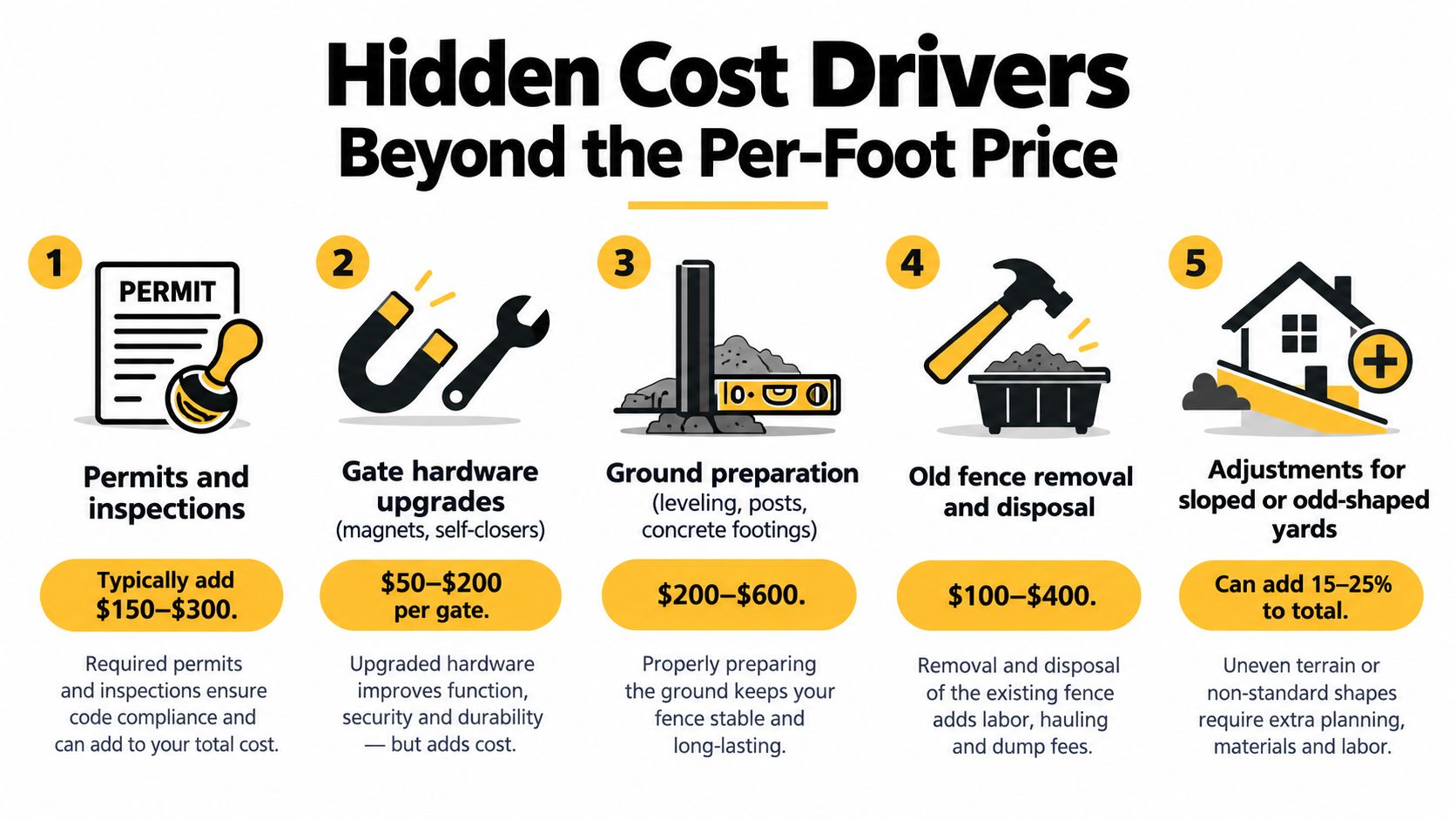
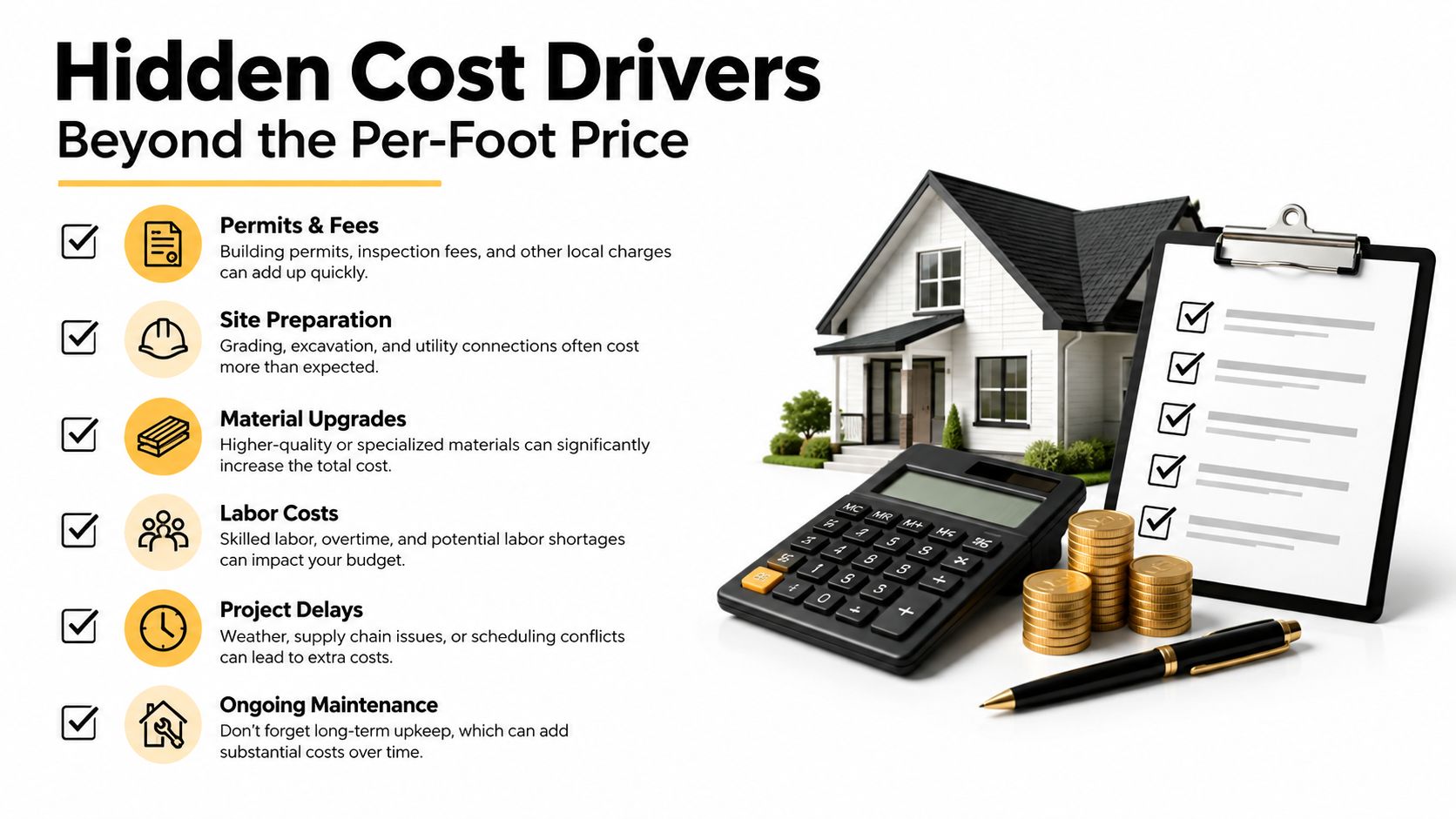
A clean quote should break out more than footage and material. Pool barrier work often picks up cost in places that don't show on a brochure photo.
- Permits and inspections: These are administrative costs, but they're part of a legal installation.
- Gate hardware: Self-closing and self-latching components are specialized compared with standard yard gates.
- Delivery and disposal: Material movement and old fence removal can change the final invoice.
- Labor complexity: Tight access, difficult deck conditions, or awkward geometry can add install time quickly.
What Doesn't Work
The most common mistake is shopping strictly by the lowest per-foot number. That works for a simple boundary fence more often than it does for a pool barrier because the inspection standard is tighter.
Another mistake is accepting a quote that bundles everything into one line without gate or hardware specifics. If the project later needs upgraded hinges, a different latch position, or extra deck work to close a gap, the homeowner hasn't bought certainty. They've bought an allowance.
Field check: A complete pool fence quote should identify the material, gate count, gate hardware, permit handling, and any likely deck or grade complications.
AlliedFenceAndGate's Published Price Ranges by Material
For local budgeting, published contractor ranges can help homeowners compare pool-fence pricing against broader fence categories. AlliedFenceAndGate.com™ lists starting price bands by material at $28 to $150 per linear foot for aluminum, $25 to $48 for vinyl, $22 to $50 for chain link, and $25 to $45 for wood based on its published material pricing.
Those aren't all pool-specific ranges, and that's the point. They show how a pool barrier sits inside a larger fence market where code, visibility, and gate configuration often push a project toward the upper end of a category.
Where These Ranges Overlap Pool Safety Work
Aluminum overlaps most directly with pool use because the published aluminum range starts at the same $28 per linear foot level seen in pool-specific pricing and stretches far upward into more decorative or heavier-grade systems. Vinyl can be predictable for some enclosed applications, but pool use still depends on whether the full design and gate arrangement satisfy code.
Chain link and wood are where homeowners need to slow down. Either can serve parts of a broader yard enclosure, but a pool barrier is judged by opening size, climbability concerns, and gate compliance. Material price alone doesn't decide whether the setup works.
| AlliedFenceAndGate Published Price Ranges by Material | AlliedFenceAndGate Range (per linear foot) | Common Pool Safety Use | Notes |
|---|---|---|---|
| Aluminum | $28 to $150 | Very common | Strong overlap with pool-specific aluminum pricing |
| Vinyl | $25 to $48 | Situational | Must still be configured to meet barrier rules |
| Chain link | $22 to $50 | Limited | Basic affordability doesn't guarantee pool-code suitability |
| Wood | $25 to $45 | Situational | Often used for privacy, but gate and barrier details control compliance |
Why This Comparison Helps
It answers a question homeowners usually have but don't phrase directly. They aren't only asking how much are pool safety fences. They're also asking why the pool quote doesn't match the backyard fence quote from another project.
The answer is that pool work is a code product first and a fence product second.
Using the AlliedFenceAndGate Estimator for a Real Ballpark
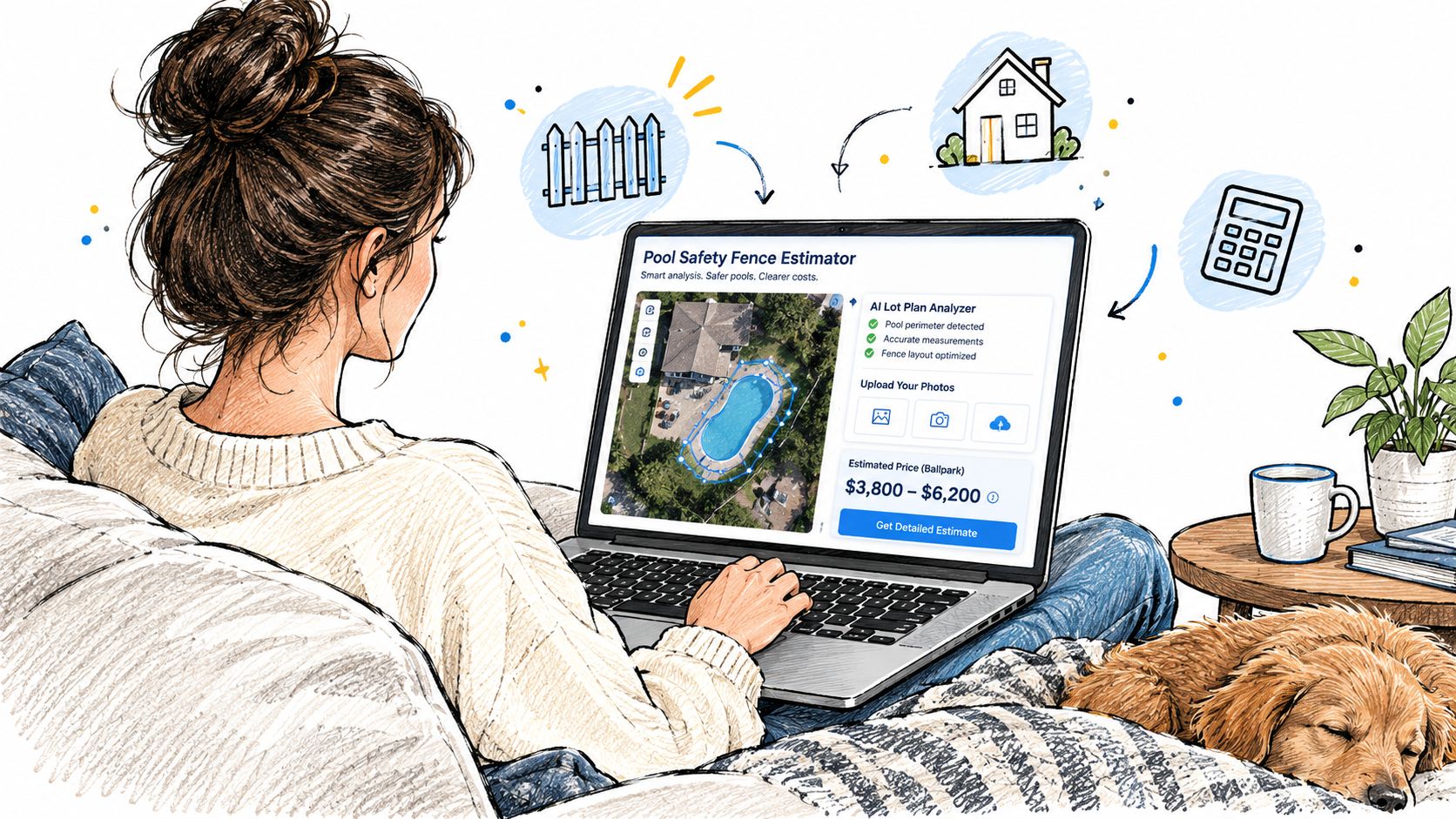
A practical estimate tool is useful when the homeowner has the address, a rough idea of footage, and a short list of material options. The goal isn't to replace a site visit. It's to narrow the budget before anyone spends time scheduling.
Inputs That Make the Number More Useful
The estimate improves when the homeowner enters the actual property address, approximate linear footage, intended material, and gate count. Photo uploads help because they show access, grade, existing structures, and deck conditions that often change labor.
The publisher's estimator also uses lot-plan analysis and image-based project inputs, which is useful for owners who don't yet have a formal field measurement. That gives a truer ballpark than a generic national calculator that only asks for one footage number and one material choice.
What the Estimator Can and Can't Do
It can establish a budget range that reflects local material families and common installation variables. It can't confirm every code-sensitive detail from a screen alone, especially if latch placement, deck coring, or unusual elevations are part of the job.
A smart homeowner uses the estimator to compare scenarios. Mesh with one gate. Aluminum with two gates. Glass for a shorter visual section. That makes the site visit more productive because the budget discussion starts with realistic options instead of guesswork.
Putting It All Together for Your Pool Fence Project
A good pool fence budget starts with the right material category and ends with a code-correct gate package. Mesh usually stays at the lower end of the spend, aluminum sits in the middle, and glass belongs in a premium bracket. The exact total moves when the project picks up gate hardware, permit handling, and deck or grade complications.
The safest way to review a quote is to verify four things in writing:
- Barrier compliance: Confirm the design is intended to satisfy Florida pool barrier requirements.
- County process: Verify how Martin County or Palm Beach County permit handling is being addressed.
- Gate hardware: Ask for the self-closing and self-latching hardware specs, not just "pool gate included."
- Takeoff method: Request a documented measurement basis before the site visit if the number is coming from an estimator.
A code-correct pool fence protects the household and supports the inspection path tied to lawful occupancy and resale confidence. That's why the cheapest-looking quote often isn't the lowest final cost.
AlliedFenceAndGate.com™ provides pool safety fencing, self-closing pool gates, permitting support, inspection coordination, and a digital estimator built for Treasure Coast and northern Palm Beach County projects. Homeowners who want a realistic ballpark before scheduling a visit can review options and start a quote at AlliedFenceAndGate.com™.
#MartinCountyFencing #PalmBeachCountyFencing #StuartFencing #JupiterFencing #PalmCityFencing #HobeSoundFencing #PortStLucieFencing #JensenBeachFencing #TequestaFencing #TreasureCoastFencing #PoolFence #PoolSafetyFence #AluminumFence #GlassPoolFence #MeshPoolFence #FenceContractor #FloridaFence #PoolGate #PalmBeachFence #MartinCountyPoolFence
Related Fencing Services
Need a fence or gate on the Treasure Coast?
Licensed, insured, and bonded. Free estimates across Martin, St. Lucie, Indian River & Palm Beach counties.
Call (772) 530-3127