Does Homeowners Insurance Cover Fence Damage in 2026?
Homeowners insurance usually covers fence damage when a covered sudden peril such as wind, hail, fire, vandalism or a falling tree causes it, but not when the fence wears out from age. The payout is reduced by the deductible and depreciation, so a covered loss can still leave most of the repair bill unpaid.
A Treasure Coast homeowner who finds two privacy panels leaning after an overnight storm, a gate that won't latch and a dog that can't go into the yard doesn't need a yes or no answer first. The useful question is how much money, if any, a claim will produce. That's where many fence claims surprise people. The fence can be an insured structure, the storm can be a covered event, and the check can still be small after the limit, deductible and depreciation are applied.
The logic is straightforward once it's broken into steps. First, the cause has to be covered. Next, the amount has to clear the deductible and fit inside the other structures limit. Then depreciation decides whether the payment resembles the price of a new fence or the value of the old one. Each step below uses the same kind of concrete numbers a homeowner can run against a real repair estimate.
Table of Contents
- When Fence Damage Is Covered and When It Is Not
- Other Structures Limits and Deductibles That Shrink Payouts
- How ACV and Replacement Cost Change a Fence Payout
- Flood, Neighbor Trees and Shared Fences Need Different Claims
- How to File a Fence Damage Claim Step by Step
- Decide Whether to File a Claim Before You Repair
When Fence Damage Is Covered and When It Is Not
A fence is usually treated as other structures coverage, often called Coverage B, alongside sheds, detached garages and in-ground pools. According to Allstate's guide to fence damage coverage, homeowners insurance generally covers fence damage when the loss results from a covered, sudden peril rather than gradual deterioration. That distinction is the whole test. The fence itself is often an insured structure, but the event that damaged it must also be insured.
Say a storm brings down a healthy tree and it crushes a 12-foot section of wood fence. That loss can be covered after the deductible even if the tree stood in a neighbor's yard, because wind and falling objects are typical covered perils. Compare that with the same fence leaning because the posts rotted at ground level over several years. The damage looks similar in a photo, but the cause is gradual, and gradual damage is typically excluded.
Practical rule: Don't ask only whether the fence is covered. Ask whether the specific event that broke it is a covered peril in the policy in hand.
Coverage by Cause of Fence Damage
| Cause of damage | Typically covered? | Why it matters |
|---|---|---|
| Windstorm or hurricane wind | Yes, after deductible | Wind is a named peril; hurricane deductibles may apply |
| Hail | Yes, after deductible | Hail is a named peril on standard policies |
| Healthy tree felled by wind | Yes, after deductible | Covered even if the tree belonged to a neighbor |
| Fire, vandalism or falling object | Yes, after deductible | Sudden covered perils for other structures |
| Rot, termites or wear and tear | No | Gradual deterioration is excluded |
| Poor maintenance or defective installation | No | Not a sudden insured event |
| Rising floodwater | No | Requires a separate flood policy |
The table reflects typical standard policies, not every insurer's form. A homeowner confirms the answer for a specific property by reading the declarations page together with the covered perils and exclusions wording. If the cause isn't listed as covered, or it appears in the exclusions, the claim stops there regardless of how expensive the repair is.
Other Structures Limits and Deductibles That Shrink Payouts
A windstorm can snap a wood privacy run and still leave a check near zero. Passing the cause test only opens the door. Two numbers on the declarations page then decide how much can come through it: the other structures limit, and the deductible.
Other structures coverage is commonly about 10% of the dwelling limit, though the percentage varies by policy and insurer. On a home insured for $300,000, that benchmark is about $30,000. On $400,000 it is about $40,000, and on $500,000 it is about $50,000. The amount works like one shared allowance, not a fence-only fund. The fence, shed, detached garage, and pool enclosure all draw from the same pool.
Say the storm also wrecks a shed. The fence estimate is $12,000 and the shed is $22,000. Against a $30,000 other structures limit, $4,000 of that combined damage sits above the ceiling before the deductible comes off. The policy does not open a second bucket for the fence.
Other Structures Limits and Deductibles by Home Value
| Dwelling limit | Other structures limit (about 10%) | Standard deductible range |
|---|---|---|
| $300,000 | About $30,000 | $500 to $2,000 |
| $400,000 | About $40,000 | $500 to $2,000 |
| $500,000 | About $50,000 | $500 to $2,000 |
The limit is a ceiling, not an automatic payout. The insurer pays only covered damage, and only the part that exceeds the deductible. Two blown-out vinyl panels priced at $900 never clear a $1,000 deductible, so the payment is $0. The cause was covered. The math still returns zero.
Hurricane damage adds a second, larger deductible on many Florida policies. The Insurance Information Institute's hurricane season insurance guide reports that hurricane deductibles commonly range from 1% to 5% of the home's insured value. On a $400,000 dwelling policy, 2% equals $8,000 and 5% equals $20,000. A $3,600 fence section destroyed by hurricane wind does not reach either threshold on its own. It counts only if the roof, screen enclosure, and other damage from the same storm push the total loss past that percentage deductible.
A fence claim filed alone after a named storm often fails on the hurricane deductible alone, even when wind is a covered peril.
Before filing, confirm three figures on the declarations page. The Coverage B limit is the ceiling for every detached structure together. The standard deductible is the amount subtracted from an ordinary wind, hail, or falling-object loss. A hurricane or windstorm deductible, when the form includes one, replaces that smaller floor after a named storm and can exceed the fence repair by itself.
How ACV and Replacement Cost Change a Fence Payout
A covered fence loss can still produce a small check. The settlement method, not the fact that wind was covered, is what sets the size.
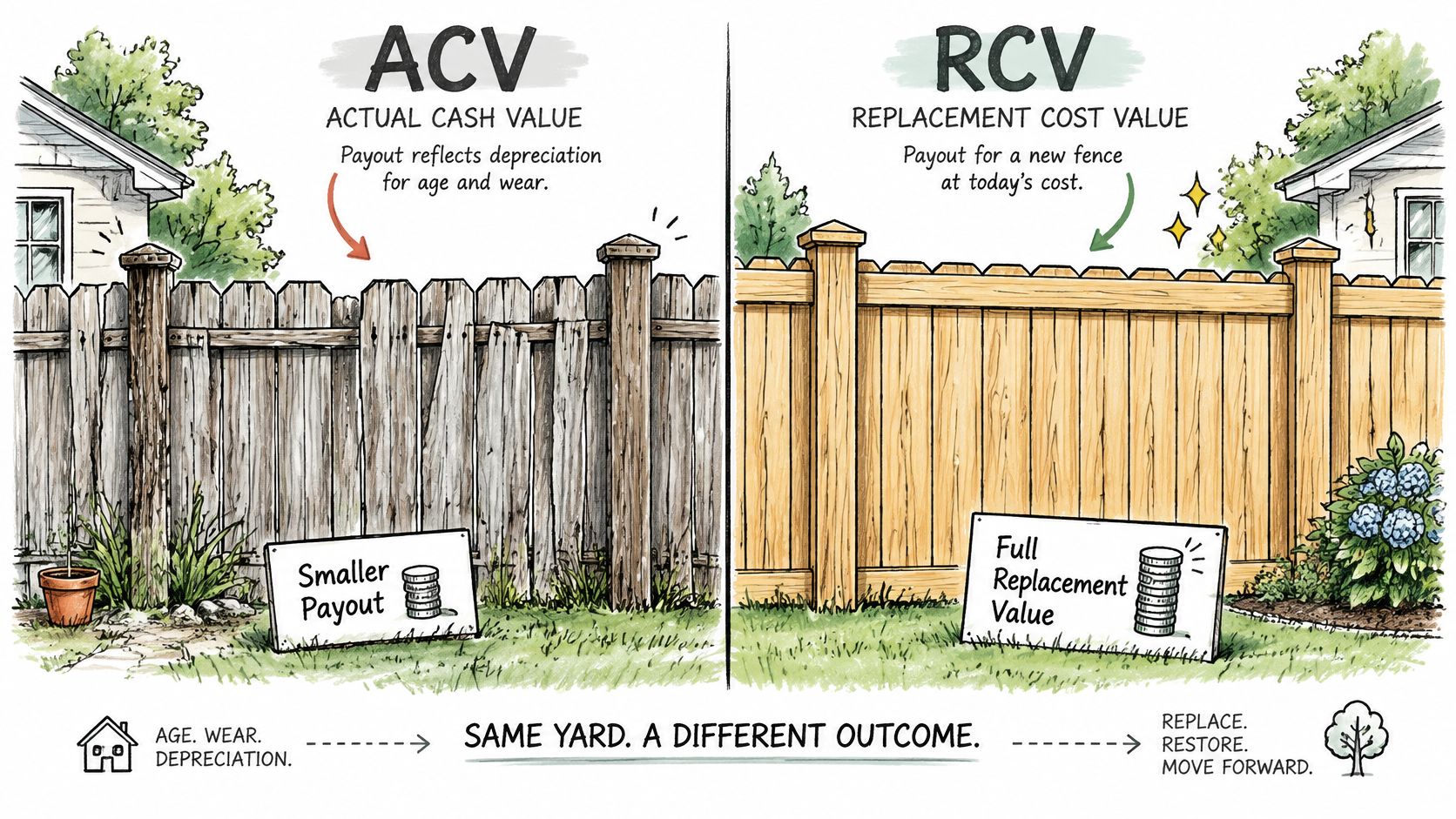
Two methods do that work. Actual cash value, or ACV, starts from the cost to replace the fence and then subtracts depreciation for age and wear. Replacement cost value, or RCV, pays to replace the fence with similar materials and does not subtract that depreciation, though the insurer often holds the depreciation until the work is finished and documented.
Depreciation works like a used-car trade-in. A fence that has already lived half its expected life is not priced as brand new, even if a storm destroyed it yesterday. Washington's insurance regulator says other-structures coverage is typically limited to 10% of dwelling coverage and can include a detached fence, in the Washington homeowner insurance guide. That percentage caps the whole other-structures pot. Depreciation and the deductible then cut the fence payment again, inside that cap.
A Worked Example on One Fence Section
A contractor estimates $3,600 to replace one storm-damaged wood privacy section. The fence is about 10 years into an expected 20-year life, so the insurer applies 50 percent depreciation. Half of $3,600 is $1,800, and that $1,800 is the ACV before the deductible. Subtract a $1,000 deductible. The first, and possibly only, ACV payment is $800.
Under an RCV settlement, the insurer typically pays that same $800 first. After the section is replaced and the paperwork is in, it releases the $1,800 it withheld for depreciation. The total then reaches $2,600, which is the $3,600 estimate minus the $1,000 deductible. The depreciation can come back. The deductible does not. Readers comparing that outcome with a full rebuild budget can check the cost to replace a privacy fence before treating the settlement as the project budget.
ACV and Replacement Cost Payout on a $3,600 Fence Section
| Settlement stage | Calculation |
|---|---|
| Replacement cost estimate | $3,600 given estimate |
| ACV before deductible | $3,600 minus 50% depreciation ($1,800) equals $1,800 |
| ACV first payment | $1,800 minus $1,000 deductible equals $800 |
| RCV after repair | $3,600 minus $1,000 deductible equals $2,600 |
RCV pays like kind and quality: similar height and similar material. A taller fence, a different material, or code upgrades the old fence never had generally stay outside that payment. If the Florida Building Code or a local permit requires changes, such as different post spacing or pool gate hardware, ask in writing whether the estimate includes those upgrades or whether they remain an out-of-pocket cost.
Run a real estimate through the same four lines. Heavy depreciation on an older fence can turn a covered loss into a check that pays only a fraction of the rebuild. That number is worth knowing before you sign a contract.
Flood, Neighbor Trees and Shared Fences Need Different Claims
Fence damage after a storm isn't one claim type. The source of the damage changes which policy responds, which deductible applies and whose insurer gets the first call. Sorting the cause before filing prevents a claim from being sent down the wrong path.
Wind Versus Flood and Storm Surge
Wind that pushes panels over belongs under the homeowners policy when wind is a covered peril. Floodwater or storm surge that lifts, shifts or rots the same panels generally requires a separate flood policy. In coastal Martin and Palm Beach County neighborhoods, one hurricane can produce both, and an adjuster will look for evidence that separates them. Waterlines, debris patterns and dated photos taken before cleanup help establish which force did what.
Sudden Damage Versus Rot and Neglected Maintenance
A post snapped cleanly in a gust tells a different story from a post that crumbles because it rotted at the base. Gradual rot, corrosion and neglected maintenance are routinely denied because they aren't sudden insured events. The complication is the mixed case, where a storm finishes off a fence that was already deteriorating. An insurer may cover the storm damage but reduce or deny payment for sections that had already failed, which is why pre-loss photos and maintenance records carry weight.
Neighbor Trees, Vehicles and Shared Boundary Fences
For fallen trees, Maryland's insurance administration homeowners tips note that a policy may cover a fence when a tree, even a neighbor's tree, falls on an insured structure, while emphasizing that the actual policy controls. The practical path is usually a claim on the fence owner's own policy first. If the neighbor knew the tree was dead or hazardous, liability questions can follow, but that doesn't remove the need to document and protect the property right away.
A vehicle impact points somewhere else again. The driver's auto liability coverage may be the primary source of recovery, with the homeowner's other structures coverage as a backup. A police report, the driver's insurance details and photos of the vehicle position matter more in that first hour than a repair estimate.
Shared boundary fences add ownership to the puzzle. Deeds, surveys, easements and HOA rules can decide who owns the fence, who may authorize replacement and who shares the deductible. Consumer guidance from Aviva also warns that many home policies may not cover fences, hedges or gates even when storm damage to the home is covered, so the first question is whether the fence is covered at all under the specific form.
Four facts pin down the claim path. The cause selects the policy. The ownership selects the claimant. The date selects the deductible. The exclusions decide whether any of it gets paid.
How to File a Fence Damage Claim Step by Step
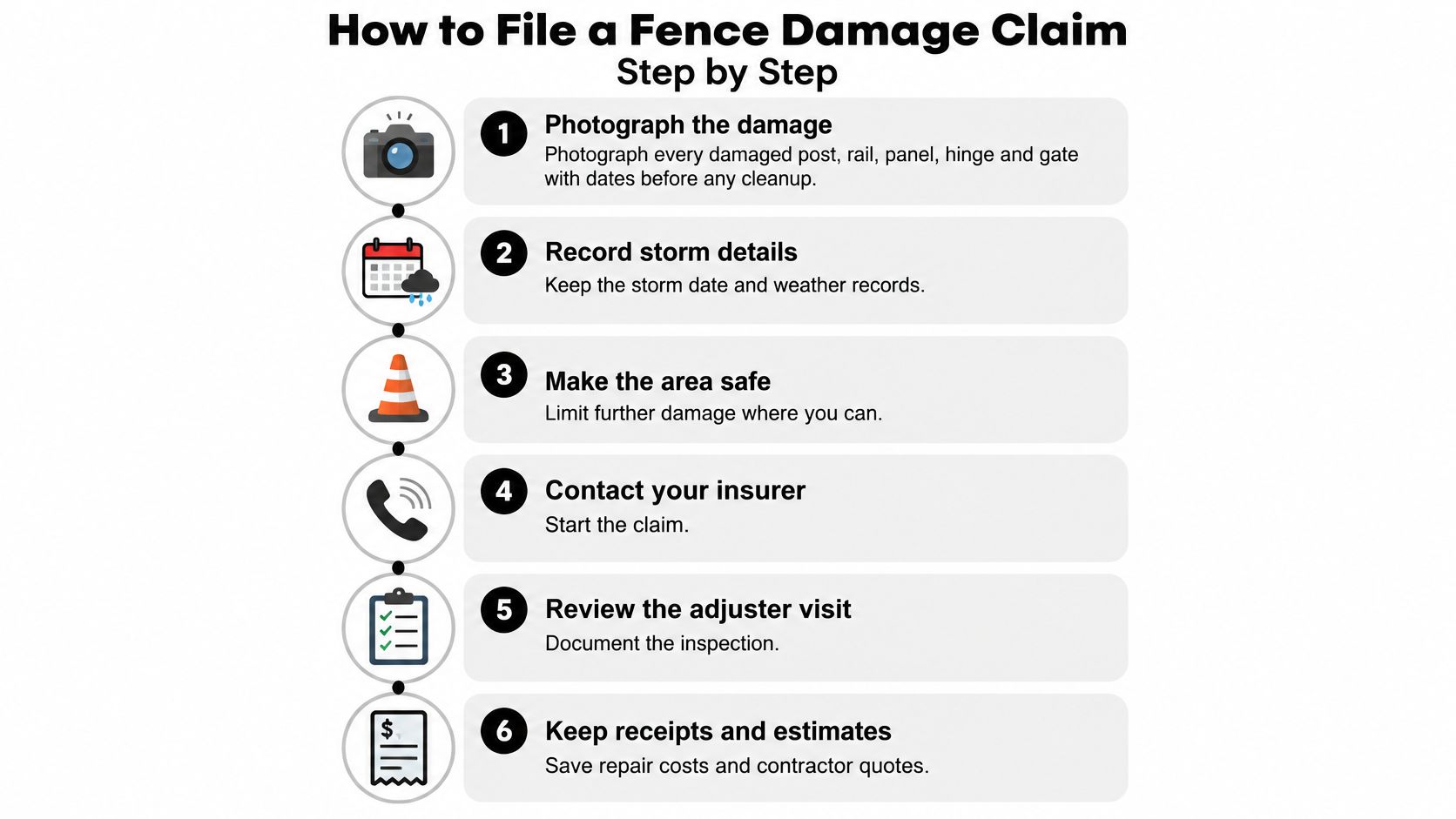
A Saturday windstorm drops forty feet of wood privacy fence across the lawn. Wind damage to a fence is often a covered peril, but coverage is only the first gate. The other structures limit, the deductible, and depreciation can each shrink what is left. Filing in the right order is how you keep the numbers honest before anyone rebuilds the line. The file works like a receipt trail: each step shows the adjuster the same fence you saw on day one.
- Photograph everything before cleanup: Every damaged post, rail, panel, hinge, and gate gets dated photos, plus wide shots of the fence line and any fallen debris. Those images lock the storm date and the pre-repair condition. Without them, a later argument about what the wind broke is just two memories.
- Make the area safe: A leaning panel near a pool or sidewalk gets braced or removed, and receipts for that emergency work stay in the file. Policies generally expect reasonable steps to prevent further damage or injury. Those receipts are part of the loss, not a favor you did the insurer.
- Identify the cause in plain terms: Wind, falling tree, vehicle, vandalism, or flood each follow a different path. Naming the cause correctly decides whether this is a covered peril or an exclusion. On the forty-foot example, "wind" is the word that belongs on the notice, not a vague "storm."
- Read the declarations page: The other structures limit, the standard deductible, and any hurricane deductible are printed there. Say replacement of those forty feet is estimated at $4,800 and the other structures limit is $8,000. The limit is not the bottleneck. A $2,500 hurricane deductible still comes off before you see a check. Skipping the declarations page is how homeowners open claims that were never going to pay.
- Check the Florida hurricane deductible timing: Hurricane deductibles in Florida are generally applied once per season rather than separately to every storm, and the Insurance Information Institute's guide to understanding insurance deductibles identifies Florida and Louisiana as exceptions to the usual per claim rule. A second storm may not trigger a new deductible, but it can raise questions about new damage versus unrepaired prior damage.
- Notify the insurer and get the position in writing: Prompt notice produces a claim number and a record of the date reported. A written coverage position prevents later arguments about what was approved. Readers dealing with broader storm losses can review the related guidance on storm damage insurance claims alongside these fence-specific steps.
- Gather two or three itemized estimates: Each estimate should state linear feet, materials, tear-out and disposal, and whether the price is a repair or a full replacement. Itemization lets you set the adjuster's lines next to the contractor's lines. AlliedFenceAndGate.com™ provides the documentation a homeowner's insurance adjuster needs after fence storm damage, and for storm or accident fence work it works directly with the homeowner's insurer on paperwork, permitting, and inspections.
- Meet the adjuster with the file ready: Photos, maintenance records, the survey if ownership is in question, and the estimates go on the table at the inspection. Discrepancies are easier to settle on site than by email afterward.
Before authorizing work: Ask how any depreciation holdback will be released, what documentation triggers it, and whether permit or code costs are included.
Run the same forty feet through depreciation before you celebrate the estimate. At 40 percent depreciation, actual cash value is $2,880. Subtract the $2,500 deductible and the first payment is $380. If the policy pays replacement cost, the $1,920 holdback comes later, and only after the fence is repaired and the paperwork matches. Receipts, final invoices, permit records, and completion photos are what convert that first actual cash value payment into any recoverable depreciation the policy allows. Keep them until the claim closes.
Decide Whether to File a Claim Before You Repair
A claim is a financial decision, not an automatic step after damage. A short breakeven test, run before calling the insurer, tells a homeowner whether filing produces money or just paperwork.
The Breakeven Test in Four Lines
- Start with the repair estimate: Use a real contractor figure, not a guess. For this test, say the estimate is $3,600.
- Subtract the deductible: With a $1,000 deductible, $2,600 remains before depreciation. If the estimate were $900, the test would already be over.
- Subtract likely depreciation on an ACV basis: At 50 percent depreciation for an older fence, the ACV before deductible is $1,800 and the first payment is $800. That is the practical near-term check.
- Weigh the result against the cost of claiming: An $800 payment may or may not justify the time, the claim on the policy record and any effect on future premiums. A repair estimate close to the deductible usually means paying out of pocket is the cleaner option.
The same test explains why owners of newer vinyl or aluminum fences often fare better. Less age means less depreciation, so more of the estimate survives to the payment line. Owners of older wood fences near the end of their service life face the opposite math, and for them a claim makes sense mainly when the fence damage is part of a larger storm loss that already clears the deductible.
What to Have Ready Before the First Call
- Declarations page: The Coverage B limit and both deductibles, highlighted.
- Dated photos: Every damaged post, rail, panel, hinge and gate, plus wide shots of the full fence line.
- Maintenance records: Receipts for staining, repairs or prior post replacements that show the fence wasn't neglected.
- At least two estimates: Itemized by linear foot and material, so ACV and replacement cost figures can be compared line by line.
That package can be assembled by the homeowner, and many do. For homeowners who'd rather have help organizing it, AlliedFenceAndGate.com™ provides the documentation needed for a homeowner's insurance adjuster after fence storm damage, and its InsureFENCE process uses AI to identify the ACV and RCV from uploaded insurance claim paperwork, showing what a policy pays toward a new fence. For storm damage or accident fence work, the business also works directly with the customer's homeowner insurance company and handles all paperwork, permitting and inspections. Those services sit alongside its regular storm damage fence repair work across the Treasure Coast.
The decision rule stays the same either way. File when the expected payment, after deductible and depreciation, is meaningfully larger than zero and the damage clearly traces to a covered peril. Pay directly when the estimate hovers near the deductible or the fence was already near replacement age.
The practical next step is simple. Send the claim paperwork and contractor estimates for review before signing a repair contract, so the budget reflects what the policy will contribute. That single check prevents the most common fence claim mistake, which is approving a full replacement priced on hope and discovering the settlement afterward.
#StuartFencing #MartinCountyFencing #PalmBeachCountyFencing #TreasureCoastFencing #JupiterFencing #PalmBeachGardensFencing #PortStLucieFencing #HobeSoundFencing #FenceRepairFlorida #StormDamageFenceRepair #PrivacyFenceFlorida #VinylFenceFlorida #AluminumFenceFlorida #PoolFenceFlorida #WoodFenceFlorida
AlliedFenceAndGate.com™ helps Martin County and Palm Beach County homeowners turn storm-damaged fence paperwork into a clear ACV and RCV picture through InsureFENCE, then handles the adjuster documentation, permitting and inspections for the repair itself. Homeowners who want that claim math checked before signing a repair contract can start at AlliedFenceAndGate.com™ and request a review of their claim documents and fence estimate.
Related Fencing Services
Need a fence or gate on the Treasure Coast?
Licensed, insured, and bonded. Free estimates across Martin, St. Lucie, Indian River & Palm Beach counties.
Call (772) 530-3127