Horizontal Aluminum Fence Panels: A Complete Guide
A Treasure Coast homeowner often starts with a simple picture: standing barefoot on the back lanai, looking toward the pool or side yard, and imagining one clean horizontal line tracing the property instead of another run of upright pickets. The choice looks modern, but key questions arrive afterward. Will the fence satisfy Florida pool-barrier rules? Can it handle hurricane exposure? What happens to the finish in salt air?
Horizontal aluminum fence panels deserve a closer look because Florida homeowners are balancing design, wind, permitting, and corrosion at the same time. The attractive layout works well in coastal neighborhoods, but only when the panel geometry, posts, fasteners, coating, gates, and footings are specified as one system.
Table of Contents
- Why Homeowners Are Choosing Horizontal Aluminum Fence Panels
- How Horizontal Aluminum Panels Differ From Vertical Pickets
- Design Benefits and Honest Trade-Offs
- Structural Considerations for Florida Conditions
- Material, Alloy, and Finish Options That Actually Matter
- Installation Notes From the Field
- Cost Implications and What Drives the Price
- Maintenance, Longevity, and the Bottom Line
- Maintenance, Longevity, and the Bottom Line
Why Homeowners Are Choosing Horizontal Aluminum Fence Panels
A homeowner in Stuart, Palm City, or Jupiter may want a fence that defines the property without visually cutting the yard into narrow vertical stripes. Horizontal aluminum fence panels answer that preference with long lines, controlled gaps, and a lower visual rhythm. From a lanai, the eye follows the fence across the yard instead of jumping from picket to picket.
That appearance fits contemporary homes particularly well. New construction in Palm Beach and Martin County often uses broad windows, long rooflines, large-format tile, and simple architectural geometry. A horizontal fence supports those sightlines. It can also frame a pool deck without making the enclosure feel as visually heavy as a solid wall.
The design appeal isn't the only reason the product is gaining attention. Aluminum is already a significant building material because manufacturers can extrude it into consistent profiles for frames, rails, panels, and other architectural components. In the United States, the building-and-construction sector shipped approximately 2.5 billion pounds of aluminum in 2022, and extruded profiles represented the largest product category. More than 60% of those shipments came from nonresidential construction, according to the Aluminum Association annual report.
That manufacturing history matters at the fence line. Extrusion gives fabricators repeatable sections and clean edges, which are essential when several horizontal rails need to align across a long elevation. The same report projects approximately 9% growth from 2022 through 2027, equal to more than 200 million additional pounds of annual aluminum shipments, showing how broadly the material is used in construction.
The Florida decision behind the look
Homeowners aren't choosing a modern profile in isolation. They're also dealing with pool barriers, salt-laden air, HOA review, and wind exposure. Aluminum avoids the red rust associated with steel, although its fasteners, cut edges, coatings, and connections still require careful protection in coastal conditions.
Traditional vertical aluminum still performs its basic boundary function, and it can be the sensible choice for an open pool enclosure or a simple side-yard line. In many newer neighborhoods, though, it reads as familiar rather than current. The changing calls from Treasure Coast homeowners reflect a broader demand for a fence that provides safety and separation while looking like part of the architecture. A detailed overview of residential applications appears in this guide to aluminum fencing for homes.
How Horizontal Aluminum Panels Differ From Vertical Pickets
The simplest comparison is to turn the visual logic ninety degrees.
A vertical picket fence uses narrow members that run from a lower rail toward an upper rail. Each picket is supported within the frame, and the repeated vertical pattern creates a light, open appearance. Horizontal aluminum fence panels use long rails or slats that run between posts, with the infill members arranged in continuous horizontal courses.
That change affects more than appearance. In a vertical layout, the short pickets are visually dominant and the rails divide them into sections. In a horizontal layout, the long rail becomes the feature that the eye notices first, and it also becomes the component that must resist sag and bending across the post span.
| Feature | Vertical aluminum pickets | Horizontal aluminum panels |
|---|---|---|
| Visual rhythm | Repeated upright members | Continuous lines and shadow bands |
| Primary structural concern | Picket and rail connections | Rail span, deflection, and post spacing |
| Privacy potential | Usually open unless specially configured | Can range from open slats to tight privacy layouts |
| Grade sensitivity | Small errors can be less obvious | Uneven grade makes sloping lines immediately visible |
| Pool application | Open pattern is familiar | Rail spacing and climbability require more design attention |
| Wind behavior | Open picket arrangement generally captures less surface area | Broad or solid faces can capture substantially more pressure |
Horizontal rails don't automatically require a particular post spacing. The correct spacing depends on the rail profile, unsupported span, solid-area ratio, wind exposure, post section, and connection details. As the exposed span grows, deflection becomes increasingly important because beam deflection rises with the fourth power of span length under comparable loading. That means a modest increase in rail span can create a disproportionate increase in movement.
What changes at a pool
Pool installations need a complete barrier review, not a style decision made from a catalog photograph. Florida provisions cited in municipal permit materials require the barrier to be at least 48 inches above grade, measured on the side facing away from the pool, and limit the vertical gap beneath the barrier to 2 inches, as described in this Florida pool-barrier design reference.
Horizontal rails can create footholds if the assembly is arranged carelessly. The design must control rail spacing, infill gaps, gate hardware, latch height, and the finished relationship between the fence and nearby structures. The horizontal slat privacy fence guide shows why the same general panel idea can be configured for privacy, a pool-patio boundary, or a more open architectural border.
Design Benefits and Honest Trade-Offs
The best horizontal aluminum fence panels give a yard a stronger sense of direction. Long lines can make a narrow side yard feel broader, frame plants without interrupting them, and preserve a view from the lanai toward a pool. At night, outdoor lighting often catches the shadow bands between slats, creating a layered effect that a basic vertical picket pattern doesn't produce.
That visual continuity comes with a demand for precision. A horizontal line exposes changes in grade, inconsistent post heights, and small alignment errors. On a sloped Treasure Coast lot, the installer may need to rack the panels so they follow the grade, step the sections, or adjust the layout around retaining walls and pool decks. The right solution depends on the site, not just the fence brochure.
Where the design earns its premium
An open horizontal layout can preserve airflow while providing a more contemporary boundary. A tight layout offers more privacy, but a solid face blocks breezes and carries higher wind demand. In Florida, that trade-off matters because outdoor comfort often depends on cross-ventilation around patios and lanais.
The design can also support HOA expectations when the association prefers coordinated colors and clean architectural lines. That doesn't guarantee approval. HOA documents may regulate height, finish, street visibility, pool screening, or the treatment of corner lots, so the homeowner should obtain written approval before fabrication.
Where it disappoints
The honest drawbacks are straightforward:
- Higher material and fabrication cost: Horizontal systems commonly price above basic vertical residential-grade aluminum because the profiles, brackets, and alignment tolerances are more demanding.
- More visible imperfections: A fence that looks perfectly straight in a product image can reveal every grade change once installed across an actual yard.
- Greater wind exposure: Broad or solid horizontal faces can act like sails, increasing demand on rails, posts, anchors, and footings.
- Conditional privacy: Privacy improves only when the slats are tightly arranged on the public-facing side. Pool-side gaps, code requirements, and airflow goals may limit how closed the design can be.
Practical rule: Choose the openness and privacy level before comparing colors. A finish can't correct a panel layout that blocks the breeze, violates a barrier requirement, or captures more wind than the posts can carry.
A practical design review should therefore begin with the property edge, pool location, prevailing exposure, and desired sightlines. The modern appearance is valuable, but it works best when the homeowner accepts the structural and airflow consequences of the chosen infill.
Structural Considerations for Florida Conditions
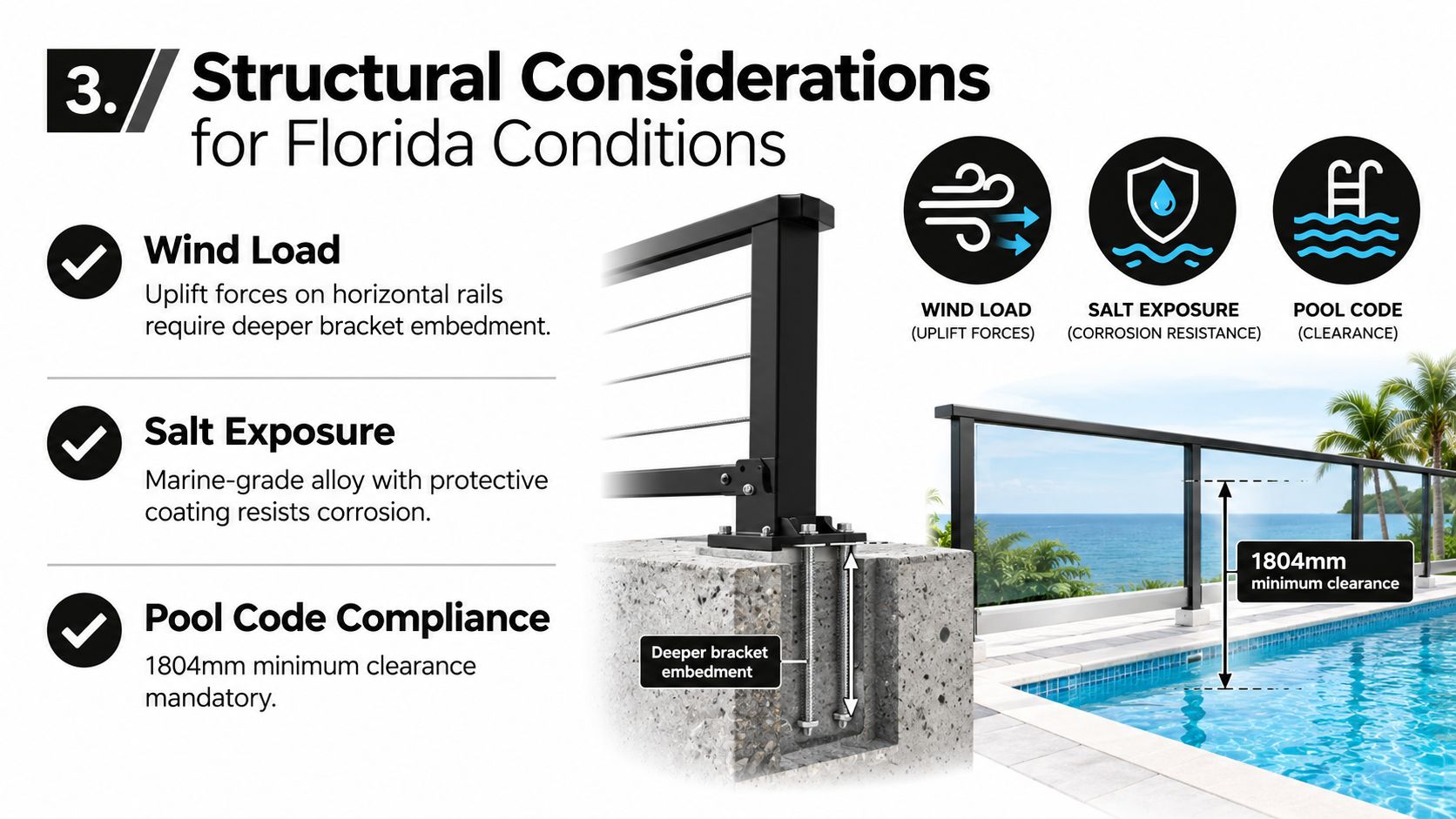
Florida fence design starts with the load path. Wind reaches the panel, transfers into rails and brackets, travels through the posts and anchors, and finally reaches the concrete and soil. If one connection is weak, a stronger slat won't rescue the installation.
Horizontal panels deserve special attention because a continuous surface can capture more pressure than a spaced picket arrangement. Florida provisions for aluminum construction require relevant structural members to be considered for wind in orthogonal directions, and a high-velocity-hurricane-zone provision identifies fences up to 6 feet high with a 75 mph fastest-mile wind design criterion, or a 90 mph wind-speed determination under the referenced method. The applicable requirements should be checked through the Florida aluminum code provisions.
Three questions belong in every quote
Wind load comes first. The quote should identify fence height, panel openness, post spacing, corner conditions, end posts, gate locations, and local exposure. A 72-inch on-center layout may be a useful starting point for many residential horizontal systems, but it isn't a universal engineering answer. Wide spans, solid infill, corners, and gates may require closer spacing or heavier members.
Salt exposure changes the connection details. In coastal Treasure Coast conditions, 6063 aluminum has useful atmospheric corrosion resistance, but dissimilar metals and trapped saltwater can create galvanic corrosion at fasteners. Compatible stainless or coated hardware, isolation at incompatible metal interfaces, sealed water traps, and protected cut edges matter more than a sales label such as “rust-proof.”
Pool code applies to the assembly. Florida pool barriers must be reviewed for height, openings, gaps below the fence, gate operation, latches, self-closing hardware, and climbability. Municipal permit materials also show that an open fence can still require a building permit. Miami-Dade County's identification of open picket fences as permit-related pool barriers is a useful reminder that openness doesn't remove the permitting obligation.
Corners and gates deserve heavier attention because they interrupt the regular panel rhythm and concentrate movement. Gate posts often need heavier-wall tubing, stronger hinges, and more substantial footings than ordinary line posts. A contractor evaluating an aluminum fence post specification should also account for soil, embedment, drainage, and the actual loads created by the selected panel.
Field conclusion: In Florida, the panel style is the easy decision. Structural performance is the purchase decision.
Material, Alloy, and Finish Options That Actually Matter
“Aluminum fence” isn't a complete specification. A homeowner comparing proposals should ask for the alloy, temper, profile construction, coating class, pretreatment, fastener material, and connection method. If the quote doesn't identify those items, the price comparison isn't yet apples to apples.
Architectural extrusions commonly use 6063 aluminum because it offers useful corrosion resistance, weldability, and finish response. Reported 6063-T5 values include approximately 145 MPa ultimate tensile strength, 110 MPa yield strength, a 68.9 GPa elastic modulus, and a density near 2.70 g/cm³, according to this 6063 aluminum alloy property reference. The low density reduces dead load compared with steel, while the lower modulus makes rail deflection a central design concern on long horizontal spans.
A commercial or heavier profile may use another alloy or temper. That isn't automatically better for a residence, but an unspecified alloy makes it difficult to evaluate the quote. Extruded architectural components also differ from thin stamped pieces or assemblies held together with undersized mechanical fasteners. The profile, wall thickness, weld quality, bracket fit, and drainage details all influence how the finished fence behaves.
Finish standards compared
Coating class matters especially near the Atlantic coast and around pools. A powder-coating technical reference describes AAMA 2604 as an intermediate exterior-performance specification and AAMA 2605 as a higher-performance specification for more demanding weathering. The cited AAMA 2604 discussion includes ASTM B117 salt-fog testing with a 5% salt solution for 3,000 hours, while the same reference associates AAMA 2604 with approximately five years of weathering performance and AAMA 2605 with approximately ten years. Those figures describe the referenced performance framework, not a guarantee for every fence installation. Review the powder-coating process and AAMA performance reference with the actual manufacturer specification.
| Standard | Coastal Suitability | Expected Fade/Chalk Resistance | Typical Use |
|---|---|---|---|
| AAMA 2604 | Suitable for many inland and moderately exposed locations | Intermediate exterior performance | Inland Treasure Coast boundaries and general residential applications |
| AAMA 2605 | Better suited to direct coastal and demanding weather exposure | Higher exterior performance | Atlantic-facing properties, poolside work, and premium architectural installations |
Standard black, white, and bronze aren't the only choices. Textured bronze, metallic silver, wood-grain transfer finishes, and custom color matches can coordinate with windows, doors, roof accents, or HOA palettes. The finish costs more up front when the pretreatment and coating specification are stronger, but a properly prepared surface reduces the need for repainting cycles and helps prevent the chalky, faded appearance associated with poorly protected older fencing.
Installation Notes From the Field
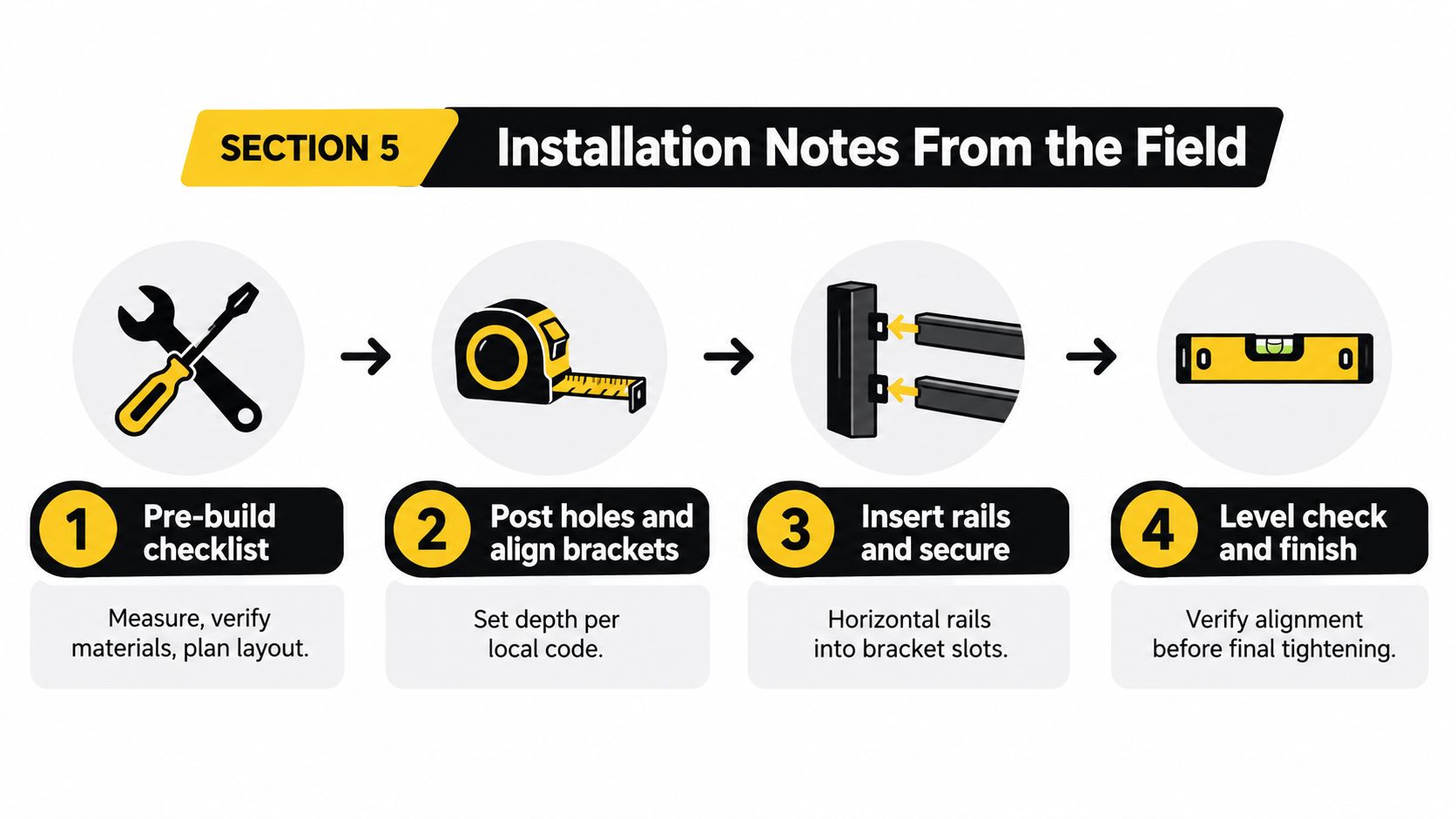
A good installation begins before the crew loads a post-hole auger. The property survey should be reviewed, the fence line should be marked, and Sunshine 811 should be contacted for utility locates. Setbacks, easements, drainage paths, pool equipment, irrigation, and HOA architectural review all deserve attention before the first hole is dug.
Jurisdiction changes the paperwork. A project in unincorporated Martin or St. Lucie County may follow a different submission path from work inside the City of Stuart or Port St. Lucie. Depending on the site and design, the permit file may need wind-load documentation, product information, a survey, pool-barrier details, or other sub-permits. A fence that appears simple from the street can still create a compliance problem if the line crosses an easement or the gate doesn't meet barrier requirements.
The build sequence that prevents expensive corrections
The physical work should follow a controlled sequence:
- Set the line and verify the layout. The installer confirms corners, ends, gates, grade changes, and the relationship to the pool or property line.
- Dry-fit the system. Rigid aluminum panels leave less room to hide a spacing mistake than flexible materials. A sample section helps verify the exact post location before concrete is placed.
- Set and align the posts. A 72-inch on-center layout is often used as a starting point for horizontal panels, while actual spacing depends on engineering, rail profile, wind exposure, and infill. Post depths of 24 to 36 inches may be considered depending on fence height, soil, and local requirements, but the approved detail controls.
- Install rails, slats, brackets, and gates. Rails need consistent elevation, and gate frames need stronger tubing and carefully aligned hinges. A sagging gate usually reflects a framing, footing, hinge, or alignment problem, not a problem that can be solved by tightening one screw.
Core-drilled concrete and no-mix foam are not interchangeable solutions for every Florida site. Soil conditions, post size, wind demand, drainage, and the manufacturer's installation requirements should determine the setting method. Foam can be inappropriate where the approved design calls for a specific concrete footing, while core drilling can create complications around existing slabs and reinforcing steel.
Where DIY stops making sense
A straightforward bolt-together section may be manageable for a capable homeowner, but horizontal systems become less forgiving around slopes, corners, pool gates, and welded frames. Bracket alignment, rackability, exact post layout, gate fabrication, and inspection documentation are the points where a small mistake can remain visible or compromise performance.
The project file should retain the survey, utility-locate confirmation, product information, permit, approved drawings, coating details, fastener specification, inspection record, and gate hardware information. Those documents help the owner understand what was installed and make future repairs far easier.
Cost Implications and What Drives the Price
Published residential aluminum fencing prices span approximately $28 to $150 per linear foot, according to the published aluminum fence pricing range. Treat that figure as a reference, not a bid. Horizontal aluminum panels often fall toward the higher end when they use wider profiles, tighter fabrication tolerances, engineered connections, upgraded finishes, or custom gates.
In Treasure Coast and Palm Beach County, the lowest per-foot proposal may not be the lowest project cost. Wind exposure, salt air, pool-barrier requirements, access, and the footing design can change the scope before installation begins.
| Cost Driver | Impact on Price | Why It Matters |
|---|---|---|
| Panel height | Raises material and structural requirements | Taller panels catch more wind and may require different posts or footings |
| Post spacing | Can increase post and labor quantities | Shorter spans help limit rail deflection |
| Gate count and width | Adds fabrication and hardware cost | Gates require stronger frames, hinges, latches, and dependable footings |
| AAMA 2604 or 2605 finish | Adds coating and preparation cost | The selected finish affects resistance to coastal weathering |
| Corrosion-compatible hardware | Raises component cost | Fasteners and connections face galvanic action and saltwater traps |
| Pool compliance | Adds design, hardware, and permit work | Height, openings, gate operation, and climbability must work together |
| Survey and wind documentation | Adds administration or engineering cost | Exposed lots and permit submissions may require supporting documents |
| Access and grade | Increases labor | Slopes, concrete removal, landscaping, and narrow access slow installation |
Horizontal systems commonly cost more than basic vertical pickets. Their infill profiles may use more aluminum, and the rails must stay visually straight across the run. Solid or closely spaced sections also present more wind surface, which can lead to closer posts, intermediate rails, or engineered stiffeners.
A per-foot figure assumes a relatively flat, open, accessible run. Pool equipment, seawalls, roots, concrete, easements, corner-lot exposure, and multiple gates can change the total substantially. Ask for a written proposal that identifies the alloy, finish rating, post dimensions, footing assumptions, fasteners, permits, gates, demolition, and inspection coordination.
The useful number is the total for a compliant, properly supported installation, not the headline rate alone.
Maintenance, Longevity, and the Bottom Line
Aluminum needs less routine attention than materials that rust, rot, or require repeated painting, but coastal exposure still deserves a maintenance plan. A practical schedule includes a quarterly fresh-water rinse, especially for homes close to the Atlantic, followed by a visual check for salt deposits, coating chips, damaged sealant, and trapped debris.
The coating should receive a closer inspection at least annually. Harsh alkaline cleaners can damage or strip an AAMA-rated finish, so mild cleaning methods and fresh water are safer choices unless the coating manufacturer specifies another product. Cut edges, screw points, brackets, and the underside of horizontal slats deserve special attention because saltwater can remain trapped there longer than it remains on an exposed face.
The moving parts usually need more attention than the stationary panels:
- Gate hinges: Check alignment, movement, and fastener tightness.
- Latches: Confirm reliable engagement and inspect for corrosion or looseness.
- Pool hardware: Verify self-closing and self-latching operation as part of the barrier inspection.
- Connections: Look for dissimilar-metal corrosion, coating failure, and water traps around brackets and fasteners.
- Ground line: Keep soil, mulch, and irrigation spray from remaining against posts and lower components.
Before signing a contract, the homeowner should confirm four items: 6063 alloy or a clearly identified alternative, AAMA 2604 or AAMA 2605 finish, code-appropriate post embedment, and written wind-load documentation for the permit file. The coating, fasteners, and footing details deserve as much attention as the color and slat spacing.
Aluminum also has a mature recovery system. The United States recovered approximately 3.3 million tons of aluminum from purchased scrap in 2023, with about 55% from new manufacturing scrap and 45% from old scrap recovered from discarded products, according to the USGS-referenced aluminum recycling information. Old scrap represented approximately 38% of apparent U.S. consumption that year, and industry data indicate that about 75% of all aluminum ever produced remains in use today. Major-market recycling rates for building and automotive aluminum can exceed 90%, although the actual environmental result depends on coatings, fasteners, separation, and local collection practices.
Horizontal aluminum fence panels can be a strong fit for Treasure Coast and northern Palm Beach County properties, but the attractive lines should come after the wind, pool, corrosion, and permit decisions. The right system is the one that looks clean from the lanai and still has a documented load path from panel to soil.
#TreasureCoastFencing #MartinCountyFencing #StuartFencing #PalmBeachCountyFencing #PortStLucieFencing #FloridaFencing #HorizontalAluminumFence #AluminumFencePanels #PoolFencingFlorida #CoastalFencing #HOAFencing #FenceInstallation
Maintenance, Longevity, and the Bottom Line
Aluminum needs less routine attention than materials that rust, rot, or require repeated painting, but coastal exposure still deserves a maintenance plan. A practical schedule includes a quarterly fresh-water rinse, especially for homes close to the Atlantic, followed by a visual check for salt deposits, coating chips, damaged sealant, and trapped debris.
The coating should receive a closer inspection at least annually. Harsh alkaline cleaners can damage or strip an AAMA-rated finish, so mild cleaning methods and fresh water are safer choices unless the coating manufacturer specifies another product. Cut edges, screw points, brackets, and the underside of horizontal slats deserve special attention because saltwater can remain trapped there longer than it remains on an exposed face.
The moving parts usually need more attention than the stationary panels:
- Gate hinges: Check alignment, movement, and fastener tightness.
- Latches: Confirm reliable engagement and inspect for corrosion or looseness.
- Pool hardware: Verify self-closing and self-latching operation as part of the barrier inspection.
- Connections: Look for dissimilar-metal corrosion, coating failure, and water traps around brackets and fasteners.
- Ground line: Keep soil, mulch, and irrigation spray from remaining against posts and lower components.
Before signing a contract, the homeowner should confirm four items: 6063 alloy or a clearly identified alternative, AAMA 2604 or AAMA 2605 finish, code-appropriate post embedment, and written wind-load documentation for the permit file. The coating, fasteners, and footing details deserve as much attention as the color and slat spacing.
Aluminum also has a mature recovery system. The United States recovered approximately 3.3 million tons of aluminum from purchased scrap in 2023, with about 55% from new manufacturing scrap and 45% from old scrap recovered from discarded products, according to the USGS-referenced aluminum recycling information. Old scrap represented approximately 38% of apparent U.S. consumption that year, and industry data indicate that about 75% of all aluminum ever produced remains in use today. Major-market recycling rates for building and automotive aluminum can exceed 90%, although the actual environmental result depends on coatings, fasteners, separation, and local collection practices.
Horizontal aluminum fence panels can be a strong fit for Treasure Coast and northern Palm Beach County properties, but the attractive lines should come after the wind, pool, corrosion, and permit decisions. The right system is the one that looks clean from the lanai and still has a documented load path from panel to soil.
AlliedFenceAndGate.com™ provides aluminum fence installation, pool safety gates, permitting assistance, utility locates, and inspection coordination for homeowners and property managers across Florida's Treasure Coast and northern Palm Beach County. For a site-specific review of horizontal aluminum fence panels, visit AlliedFenceAndGate.com™ and submit the property details for a written project assessment.
Related Fencing Services
Need a fence or gate on the Treasure Coast?
Licensed, insured, and bonded. Free estimates across Martin, St. Lucie, Indian River & Palm Beach counties.
Call (772) 530-3127