Pool Safety Fence Height Rules in Florida Explained
Florida Building Code requires pool barriers to be at least 48 inches above grade, measured on the side facing away from the pool, with a maximum 2-inch gap at the bottom. Height alone isn't compliance.
The U.S. Consumer Product Safety Commission identifies nearly 300 annual drowning deaths among children younger than 5 in swimming pools, which puts the pool fence question in its proper context. The CDC's drowning-prevention guidance also reports that a four-sided isolation fence separating the pool from the home and the rest of the yard reduces a young child's drowning risk by 83% compared with three-sided property-line fencing.
A fence can meet the catalog specification and still fail at the soil line, the gate, a decorative rail, or the transition to a wall. In Treasure Coast yards, pool safety fence height is only one measurement in a complete child-deterrence system.
Table of Contents
- Why Florida Takes Pool Fence Height So Seriously
- Florida's 48-Inch Minimum Barrier Requirement
- How to Measure Pool Fence Height the Right Way
- Why a Four-Foot Fence Alone Is Not Enough
- Gate Requirements That Can Make or Break Compliance
- When a Screen Enclosure or Existing Fence Counts as the Barrier
- Passing Your Pool Fence Inspection the First Time
- Your Pool Barrier Action Plan
Why Florida Takes Pool Fence Height So Seriously
The CDC reports an 83% risk reduction for young children when a four-sided isolation fence separates the pool from the house and the rest of the yard. The CDC explains the difference between four-sided and three-sided barriers. That finding reflects how the barrier controls access, not just how tall the panels look.
A common Treasure Coast inspection problem begins with a homeowner who orders a four-foot fence, measures one convenient section, and assumes the job is complete. The outside grade may rise along a slope, reducing the effective height. A planter, retaining wall, mulch bed, or later landscaping can also create a foothold or change the clearance beneath the fence.
The number is only the starting point
Florida requires a barrier at least 48 inches above grade, measured on the side facing away from the pool. Inspectors look along the full perimeter, including uneven ground and transitions beside walls, decks, and other structures. The bottom opening matters too. A maximum 2-inch clearance at the exterior side helps prevent a child from getting underneath.
The barrier also needs surfaces and spacing that do not provide an easy climbing route. Decorative rails, horizontal members, nearby furniture, equipment, and tree limbs can undermine an otherwise compliant panel. A fence may pass a quick tape-measure check at one post and still fail where the grade changes or an object creates a step.
A four-sided enclosure isolates the water from the home and the rest of the yard. A property-line fence can leave a direct route from a back door to the pool, even when its height appears adequate. The enclosure layout therefore deserves the same attention as the panel measurement.
On site, walk the perimeter from the exterior side. Check the height and ground clearance at low points, inspect every transition, and test the gate from several positions. The gate should close and latch on its own, with hardware that still works after weather, settling, and ordinary use. Ask whether a child can get under, through, or over any part of the barrier.
Florida's 48-Inch Minimum Barrier Requirement
Florida's commonly specified four-foot pool barrier comes from statute and building-code requirements, not a fence company's preferred product size. The Preston de Ibern/McKenzie Merriam Residential Swimming Pool Safety Act, enacted through Florida Senate Bill 86, created Chapter 515 of the Florida Statutes and became effective October 1, 2000. Related residential swimming-pool requirements took effect January 1, 2002. Florida Statutes Section 515.29 establishes the statutory framework for residential pool barriers.
Measure the outside face
Under the cited Florida Building Code provisions, the top of the barrier must be at least 48 inches, or 1,219 millimeters, above grade. The measurement is taken on the side facing away from the pool, not from the interior deck because that surface appears level.
The bottom clearance is equally important. On that exterior side, the vertical opening beneath the barrier must not exceed 2 inches, or 51 millimeters. A fence can reach the required top height and still fail because the bottom opening is too large at a low point.
Inspect the barrier as a complete enclosure
Florida's anti-climb language addresses more than panel height. The barrier cannot contain gaps, openings, indentations, protrusions, or structural features that allow a young child to crawl beneath it, squeeze through it, or climb over it. Gates must be self-closing and self-latching, and the barrier should completely surround the pool.
That makes the following measurements essential:
- Top of barrier: At least 48 inches above exterior grade, as specified in the Florida pool-barrier guidance.
- Bottom clearance: No more than 2 inches on the exterior side, or 51 millimeters, under the same guidance.
- Openings: No design feature should create a route beneath, through, or over the barrier.
- Gate function: The gate must close and latch automatically rather than depend on a person to secure it.
The numbers are straightforward. The site conditions are not. Every height and clearance measurement should be taken after the finished exterior grade, pavers, drainage work, and landscaping levels are established.
How to Measure Pool Fence Height the Right Way
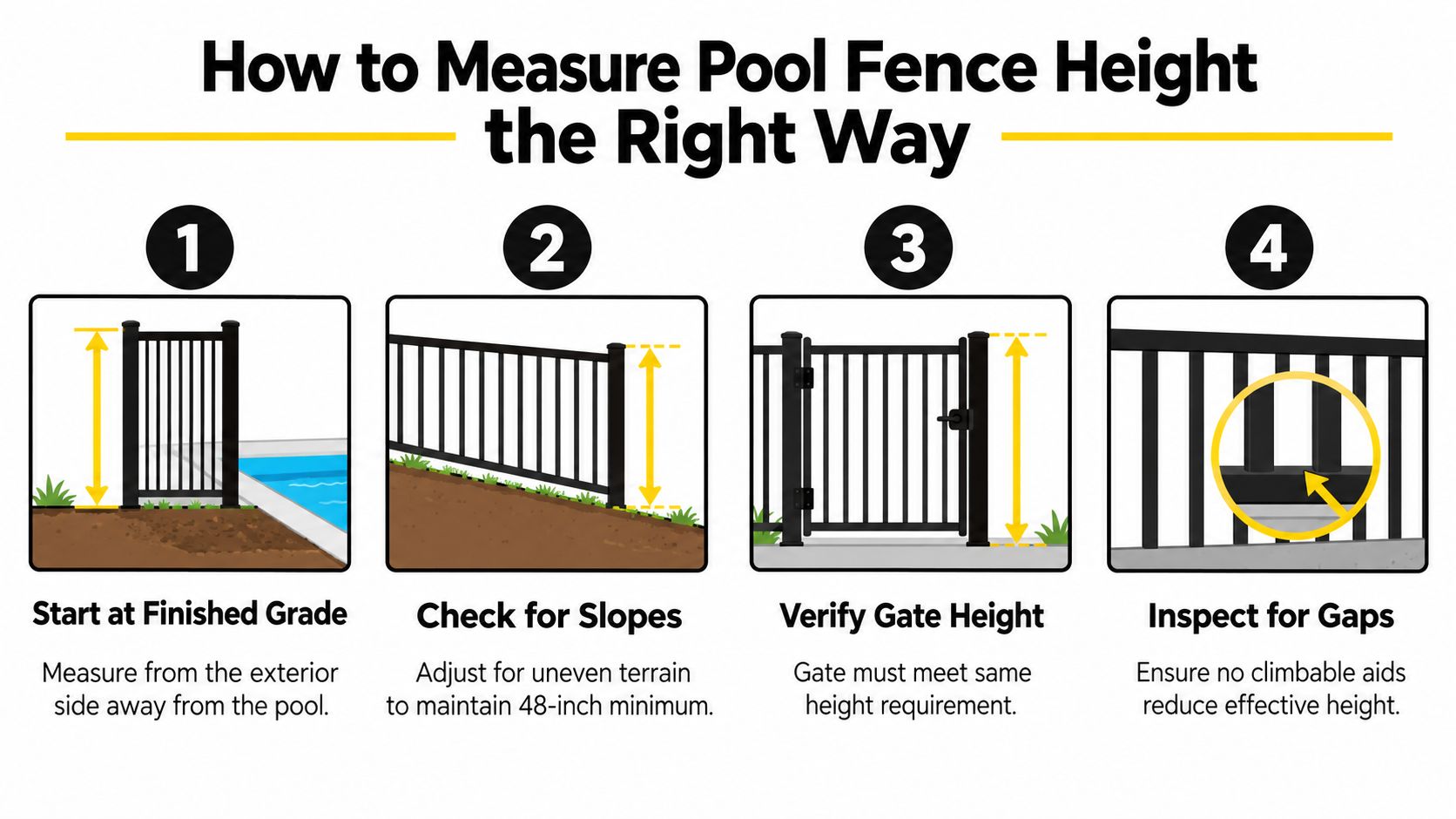
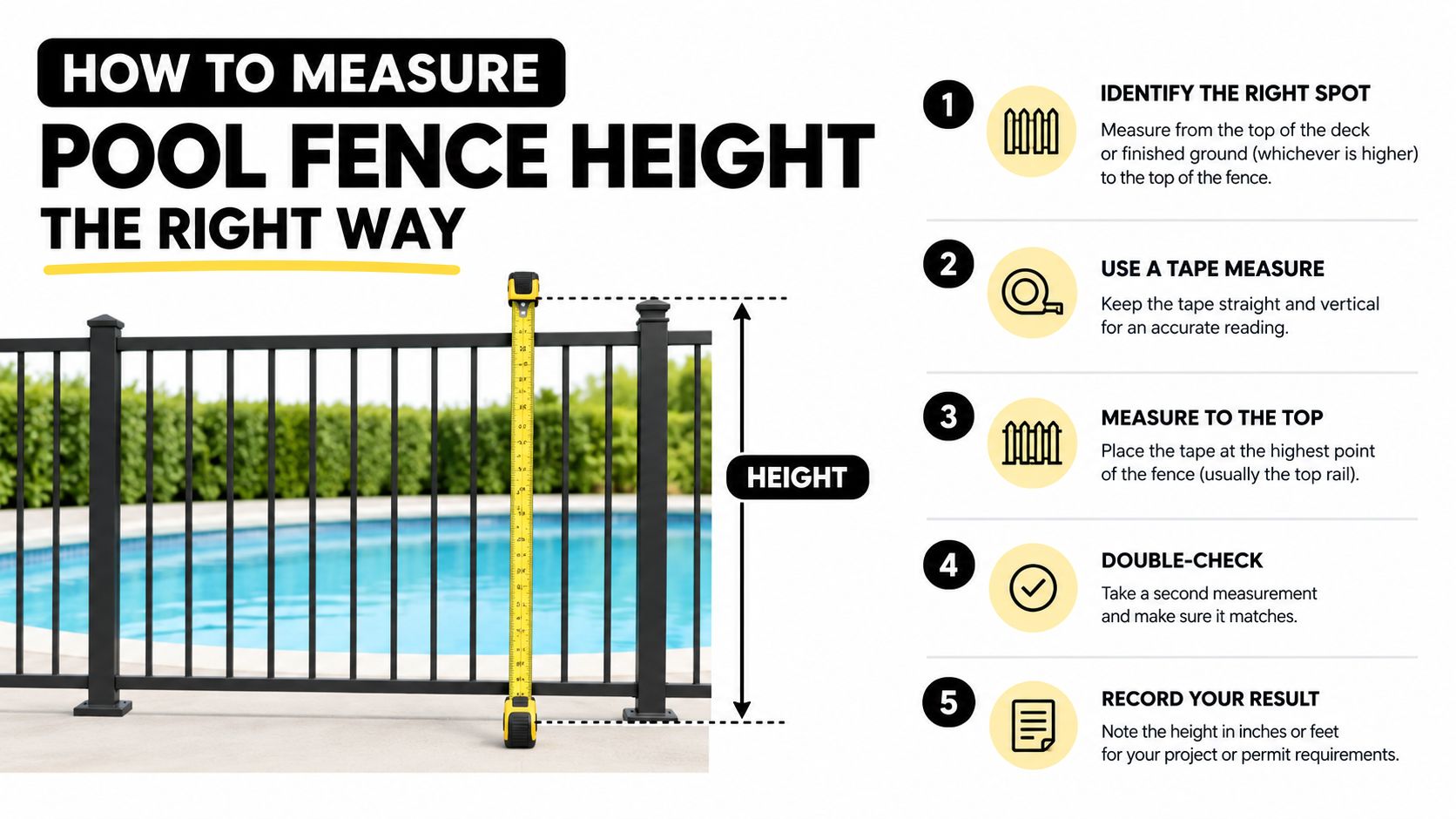
A 48-inch fence can still fail inspection if it is measured from the wrong side or over an uneven grade. Florida measures barrier height from the finished exterior grade, the ground on the side facing away from the pool. A higher exterior grade reduces the fence's effective height, even when the pool deck makes the panel appear full height.
Measurement rule: Measure from the finished exterior grade at the most vulnerable point, not from the pool deck you assume is level.
Use this field sequence:
Walk the entire outside perimeter. Mark slopes, steps, retaining walls, raised decks, drainage channels, and areas where soil may settle. Measure at low spots and higher exterior grades, not just beside a convenient post. On a three-sided barrier tied into a house or wall, include every connection. On a four-sided enclosure, inspect each fence line separately.
Check transitions. Where the barrier meets a wall, screen enclosure, deck, or another structure, look for a reduced effective height or an opening. The top line and bottom clearance must stay controlled around the full enclosure. A transition that looks acceptable from the pool side may fail when checked from outside.
Measure the ground-to-fence gap. Florida's exterior-side limit is 2 inches. The Florida Building Code pool-barrier timeline and guidance identifies that clearance as a specific compliance point. Check several locations along each panel, especially near slopes, gates, posts, and drainage areas.
Check openings and surface conditions
The CPSC uses a 4-inch-diameter sphere to test openings in residential pool barriers. No opening in the fence or gate should allow that sphere through. Check panel gaps, decorative cutouts, space beneath rails, gate edges, and joints where the barrier meets another structure.
Per The CPSC safety-barrier guidelines, a 4-inch exterior bottom clearance is the general limit, grass or gravel calls for 2 inches, and removable mesh uses a 1-inch limit. Florida's tighter 2-inch exterior requirement controls for the projects discussed here. The same guidance advises removing handholds and footholds, so measure climbability as part of the barrier, not height alone.
Height must remain continuous. A 48-inch panel beside a retaining wall can have less effective climb height if the wall raises adjacent ground. Mulch, pavers, settlement, and erosion can create the same problem after installation.
Why a Four-Foot Fence Alone Is Not Enough
A nominal four-foot aluminum or mesh fence can fail its safety purpose without being visibly damaged. The most common problem is a change in the relationship between the fence and everything around it.
Mulch installed outside the panels can raise the exterior grade. Pavers can create a step. A pool chair or planter can give a child a convenient launch point. Horizontal rails can become footholds, particularly when they face the pool side. Erosion can open a crawl-under space even when the original installation had the correct clearance.
The pool safety fence guidance from Allied Fence and Gate reflects the practical design issue: material choice matters, but layout, spacing, grade, and gate performance determine whether the installed barrier works as intended.
Audit the whole perimeter
A proper audit checks more than the fence panels:
- Exterior grade: Confirm that soil, mulch, gravel, and pavers haven't reduced effective height.
- Nearby objects: Move furniture, toys, planters, ladders, and equipment away from the barrier.
- Panel design: Look for horizontal members, decorative details, or rails that create handholds or footholds.
- Bottom edge: Recheck for settlement, erosion, washout, and irregular ground.
- Connections: Inspect where the fence meets the house, a wall, a screen enclosure, or a raised structure.
The CPSC recommends barriers with no climbable features and says nearby objects shouldn't provide an easy route over the enclosure. The CPSC barrier publication also uses the 48-inch minimum and the 4-inch sphere opening test as part of a broader system of protection.
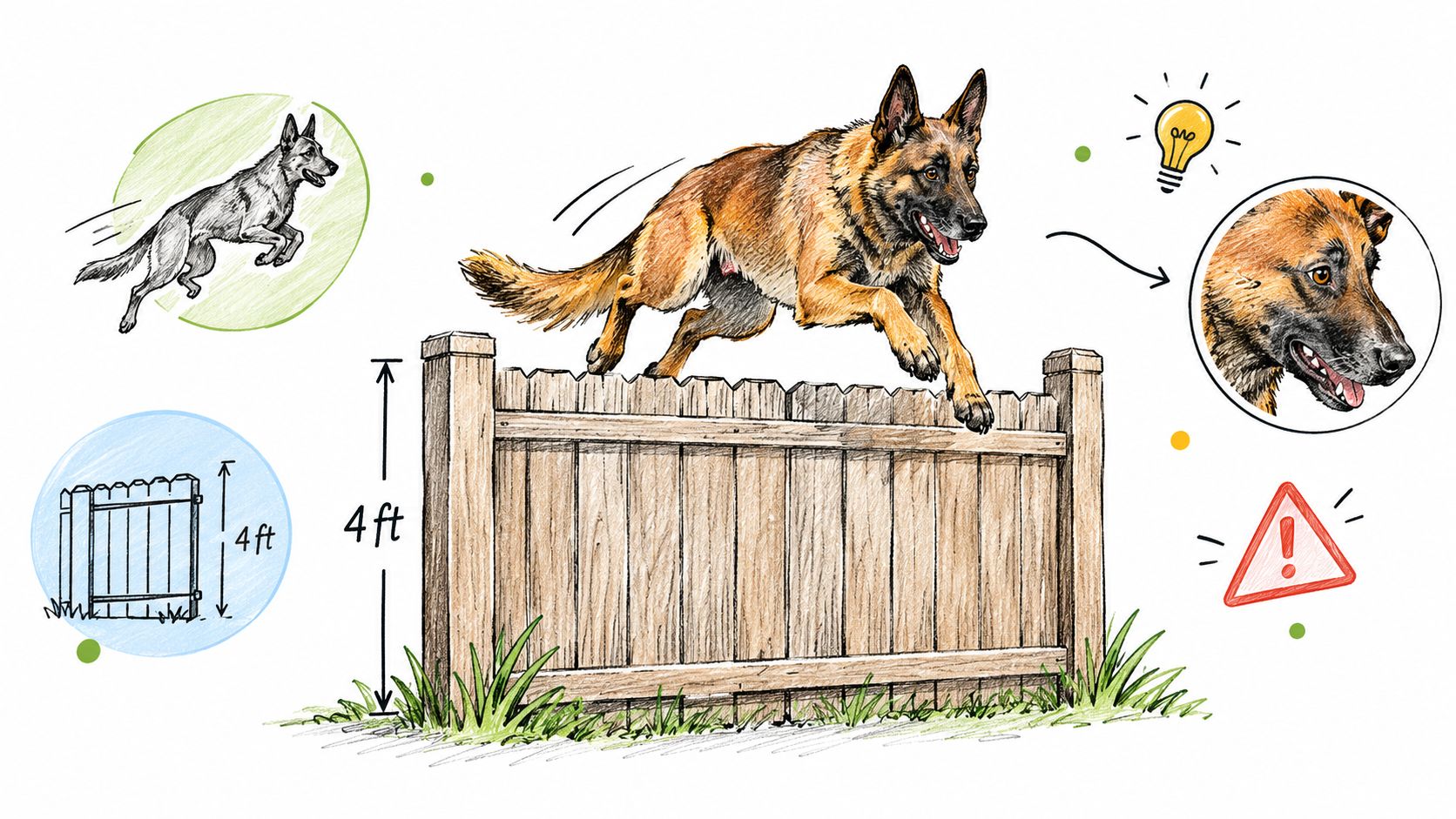
The lesson isn't that four feet is ineffective. The lesson is that four feet must remain four feet in practical use, with no foothold, handhold, gap, or object that turns the measured height into an easier climb.
Gate Requirements That Can Make or Break Compliance
The gate is the moving part of the barrier, so it deserves a separate inspection routine. A fence may have correct posts, spacing, and height, yet fail because the gate drags on the ground, stops short of the latch, or needs a hand to finish closing.
Florida pool-barrier rules require a self-closing, self-latching gate. The latch must engage automatically, and the gate's openings are subject to the same child-access concerns as the stationary panels. A latch positioned where a small child can easily operate it defeats the barrier even when the surrounding fence is correctly built.
Test function, not appearance
A gate should be released from a partially open position and allowed to close on its own. It should reach the latch without a push, pull, or lift. The same test should be repeated from different swing angles because hinge tension, slope, wind, and frame alignment can affect performance.
Gate checks should include:
- Self-closing action: Release the gate from several open positions and confirm that it closes completely.
- Self-latching action: Confirm that the latch engages every time, not only when the gate is guided by hand.
- Gap inspection: Apply the 4-inch sphere test to the space between the gate, posts, and surrounding structure.
- Hardware condition: Look for corrosion, loose fasteners, hinge wear, and latch misalignment.
- Post-storm review: Recheck the gate after strong weather, flooding, or outdoor construction.
Coastal Florida conditions make corrosion resistance a functional issue, not merely a finish preference. Corroded springs, hinges, or latches can stop a gate from closing reliably. The pool safety gate latch guide covers the hardware side of the barrier, but the installed gate still needs regular hands-on testing.
A gate that works during installation can change as the posts settle or the frame shifts. Homeowners should include the gate in routine pool-area checks rather than treating inspection approval as the end of maintenance.
When a Screen Enclosure or Existing Fence Counts as the Barrier
A screen enclosure, privacy fence, retaining wall, or decorative aluminum fence can serve as part of a pool barrier. Height alone does not decide compliance. Every section must connect into a continuous, child-resistant enclosure, with acceptable openings, ground clearance, transitions, and access control.
Measure the barrier from the exterior side, including uneven grades and areas where a wall, deck, or retaining structure changes the elevation. A six-foot property fence may still leave a direct walking route from the home to the pool. A screen enclosure may have a door that fails to close and latch. A retaining wall can create a climbable step, while decorative rails may provide footholds or openings.
The layout must isolate the pool from the house and the rest of the yard. CDC drowning-risk guidance supports evaluating the barrier as a four-sided enclosure rather than assuming a tall property-line fence is enough. If the back door still provides a direct sightline and walking path to the water, the layout may fail the four-sided test regardless of fence height.
Compare the existing options
The table applies the Florida dimensions and system requirements to common Treasure Coast barrier choices. A material meets the height standard only when its openings, bottom clearance, transitions, and gate arrangement also comply.
| Barrier Option | Minimum Height Standard | Ground Clearance | Key Compliance Concern |
|---|---|---|---|
| Dedicated aluminum pool fence | 48 inches above exterior grade | Maximum 2 inches on the exterior side | Vertical pickets, transitions, and gate hardware must resist access |
| Screen enclosure | 48 inches for the barrier portion | Maximum 2 inches where applicable | Screen doors and frame openings must secure the complete perimeter |
| Wood privacy fence | 48 inches above exterior grade | Maximum 2 inches on the exterior side | Boards, rails, corner gaps, and climbable features need inspection |
| Property-line fence | 48 inches only if the full layout qualifies | Maximum 2 inches on the exterior side | It may not isolate the pool from the home |
| Retaining wall or raised structure | Must form a compliant barrier segment | Clearance must not create a crawl-under route | Grade changes and climbable transitions can defeat the layout |
| Removable mesh barrier | 48 inches where used as the pool barrier | Removable mesh guidance uses a 1-inch limit | Posts, tension, openings, and removable sections require close review |
Audit every side, including doors, corners, wall returns, and connections to existing structures. Check the walking route from the home, not only the fence line. If one segment fails, the complete barrier fails as a system.
Passing Your Pool Fence Inspection the First Time
A passing inspection depends on the weakest point in the barrier, not the average fence height. In the Treasure Coast and northern Palm Beach County, confirm the locally adopted code edition and municipal requirements before ordering materials. Some jurisdictions require a taller barrier than the standard design, so verify the requirement for the property.
Inspectors look at the complete access route around the pool. They measure from the exterior side, check grade changes and bottom clearance, and examine whether a deck, retaining wall, screen frame, planter, or other feature creates a climbing or launch point. The gate, corners, wall returns, and connections to existing structures must work as one barrier.
Use a documented pre-inspection routine
Record measurements and photographs before requesting inspection. A contractor should document exterior-grade elevations, the tightest bottom gap, gate locations, and each transition. Clear records make corrections faster when soil settles or another structure changes the layout.
Check these points:
- Height: Measure the exterior-side height at low sections, slopes, corners, and transitions. Confirm the barrier remains at least 48 inches high where required.
- Clearance: Measure the bottom gap at posts, mid-span areas, gates, and uneven ground. Florida's exterior-side limit is 2 inches.
- Openings: Check panels, corners, gates, and connections against the 4-inch sphere limit.
- Climbability: Remove furniture, planters, toys, pool equipment, tools, and landscaping that provide footholds or handholds.
- Gate operation: Test self-closing and self-latching action from several partially open positions.
- Layout: Confirm the barrier separates the pool from the house and yard, rather than relying on a property-line fence that leaves a direct route to the water.
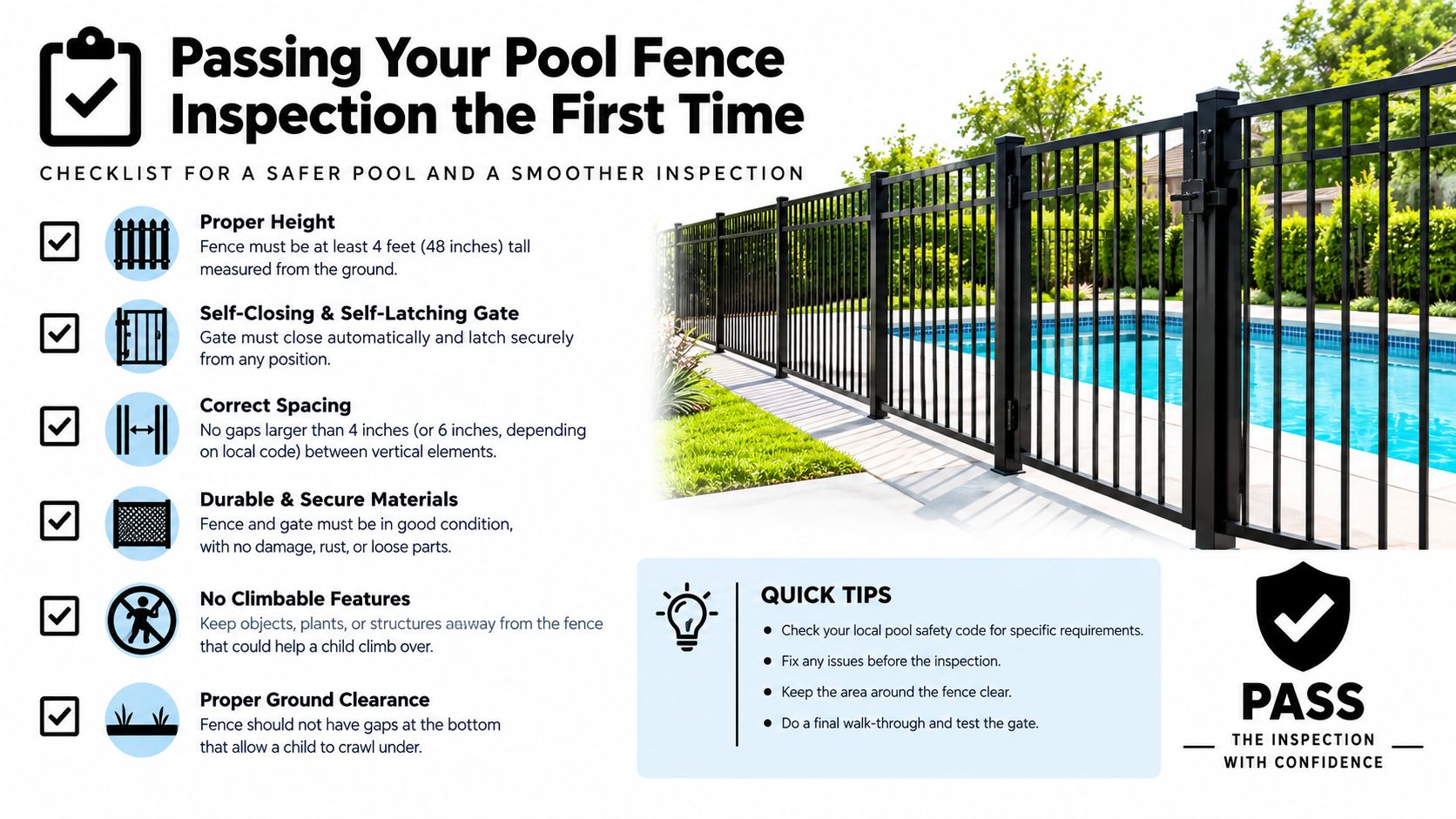
A licensed contractor can coordinate permitting, the Notice of Commencement, 811 utility locates, and inspection scheduling. Pool safety fence installation services from Allied Fence and Gate can include those administrative steps in the installation process.
Your Pool Barrier Action Plan
A useful pool barrier plan begins at the outside edge of the property conditions, not at the fence brochure. The project should account for the finished grade, the lowest effective height, the tightest bottom clearance, the least secure gate position, and every object that could help a child climb.
The following actions give a homeowner a practical starting point:
Measure the vulnerable point first. Find the highest exterior grade, the lowest fence section, and every transition to a wall, deck, screen enclosure, or retaining structure. Confirm the barrier remains at least 48 inches high on the side facing away from the pool.
Check the bottom edge. Look for erosion, settlement, mulch, pavers, gravel, and irregular soil. Florida's exterior-side clearance cannot exceed 2 inches.
Test the gate with both hands off it. Release it from several partially open positions. It should close fully and latch without assistance.
Remove access aids. Relocate furniture, planters, toys, tools, pool equipment, and decorative features that provide handholds or footholds.
Confirm the four-sided layout. Make sure the enclosure separates the pool from the house and the rest of the yard. A property-line fence may not provide that isolation.
Verify the local code edition. Before buying or building anything, have a licensed contractor confirm the municipality's adopted requirements, including whether a taller barrier applies.
Getting these details right before fabrication costs less than correcting a failed inspection or rebuilding a section after grade and gate problems appear. A properly engineered barrier protects a child through its layout, clearance, climb resistance, and gate function, not through the number printed on a fence brochure.
#MartinCountyFencing #PalmBeachCountyFencing #TreasureCoastFencing #StuartFencing #JensenBeachFencing #PortSaintLucieFencing #PalmCityFencing #PoolSafetyFence #PoolFenceInstallation #PoolSafetyGate #AluminumPoolFence #FloridaFenceContractor
AlliedFenceAndGate.com™ installs pool safety fencing and self-closing, self-latching gates with attention to exterior-side height, ground clearance, grade changes, and inspection preparation. Homeowners in Martin County, Palm Beach County, and the broader Treasure Coast can visit AlliedFenceAndGate.com™ to request a site assessment and discuss a code-conscious pool barrier layout.
Related Fencing Services
Need a fence or gate on the Treasure Coast?
Licensed, insured, and bonded. Free estimates across Martin, St. Lucie, Indian River & Palm Beach counties.
Call (772) 530-3127