Vinyl Privacy Fence Slats: A Florida Buyer's Guide

A homeowner on the Treasure Coast often starts with a simple problem: the chain-link fence is still sound, but the pool, patio, or side yard is completely visible. Replacing every post and footing feels unnecessary, yet ordinary screening doesn't provide the privacy or finished appearance the property needs. Vinyl privacy fence slats can solve that problem, but only when the slat, frame, footing, and local requirements are treated as one system.
Florida conditions make that distinction important. Intense sun, heat movement, wet soil, coastal exposure, and storm wind can expose weaknesses that aren't obvious in a product photograph. The right buying decision isn't just “vinyl or wood.” It's choosing a material and fence assembly that match the property, the exposure, and the permitting requirements in Martin County, Palm Beach County, or another Florida jurisdiction.
Table of Contents
- What Vinyl Privacy Fence Slats Actually Do on a Florida Property
- The Material Behind the Slat and Why It Matters
- Retrofit Slats, Slatwall Panels, and Picket-Replacement Formats
- Slat Openness, Color, and the Airflow Versus Privacy Trade-off
- Installing Vinyl Slats in the Florida Climate
- What Maintenance Actually Looks Like Over the Life of the Fence
- End of Life, Recycling, and What Recyclable Means for Vinyl Slats
What Vinyl Privacy Fence Slats Actually Do on a Florida Property
A typical Treasure Coast retrofit starts with an existing galvanized chain-link fence. The owner wants to screen a pool from the street or stop neighbors from looking into the backyard, but the posts and mesh are still serviceable. Retrofit vinyl privacy fence slats thread through the chain-link openings, changing the appearance and reducing sightlines without automatically requiring demolition of the entire fence.
That approach works best when the existing frame is straight, firmly embedded, and compatible with the selected slat system. The slats don't repair leaning posts, undersized footings, rusted rails, or loose fittings. Once the openings are filled, the fence presents more surface to the wind, so a frame that was adequate for open chain link may need closer review before it becomes a privacy barrier.
Three Florida applications show up repeatedly:
- Pool-side screening: Slats or solid panels can reduce views into a pool area, but a fence serving as a pool barrier must still satisfy the applicable safety requirements. Martin County separately states that pool-barrier fences require inspection, so a privacy product can't automatically be treated as an ordinary boundary fence. Martin County's fence compliance affidavit identifies that distinction.
- Side-yard privacy: A narrow side yard often benefits from partial or full screening where a decorative open fence leaves direct sightlines between neighboring properties.
- Boundary replacement or retrofit: A homeowner may choose a complete vinyl system when the existing fence has reached the end of its useful life, or retrofit slats when the supporting structure remains sound.
The practical result is more than blocked views. Slats alter the fence's visual character, reduce the openness of the boundary, and may provide a degree of wind buffering in sheltered conditions. They also increase wind demand on the assembly, which is why a slat should never be evaluated as an isolated strip of material.
Practical rule: A vinyl slat can change a fence from open to private, but it can't make a weak post, rail, or footing structurally adequate.
The Material Behind the Slat and Why It Matters
On a Florida job site, “vinyl” is only the starting point. Quality privacy slats usually use rigid, unplasticized polyvinyl chloride, or uPVC, a construction-grade PVC formulation made to hold its shape outdoors. It resists water absorption and rot, and it does not need the staining routine associated with wood. Its actual service life still depends on the formulation, UV protection, profile geometry, connections, installation, and exposure. PVC's extensive use in construction materials places fence slats within the broader family of rigid outdoor building products.
The profile also determines the slat's job. A board may be flat, ribbed, interlocking, or shaped for a particular rail and post system. Tongue-and-groove edges engage neighboring slats and limit visible gaps. A chain-link retrofit slat threads vertically through the mesh and depends on the existing posts, rails, fittings, and footings. Both products are vinyl, but their structural roles are different.
Formulation controls outdoor appearance
Florida sunlight is hard on exposed plastic. Titanium dioxide and other UV-protection additives help limit ultraviolet degradation, color change, chalking, brittleness, and cracking. Ask the manufacturer for formulation details, color-specific warranty limits, or recognized weathering-test information. A broad “weather resistant” label provides less useful guidance.
Color affects heat as well. Darker slats absorb more solar energy than white or light colors, increasing thermal movement and temperature cycling. Expansion clearances, rail connections, and installation details therefore matter more on a dark privacy fence. Vinyl Building Solutions' guide to vinyl fencing specifications discusses ASTM D3679 and ASTM D1435-based weathering guidance, including checks for cracking, flaking, crazing, peeling, and related surface defects.
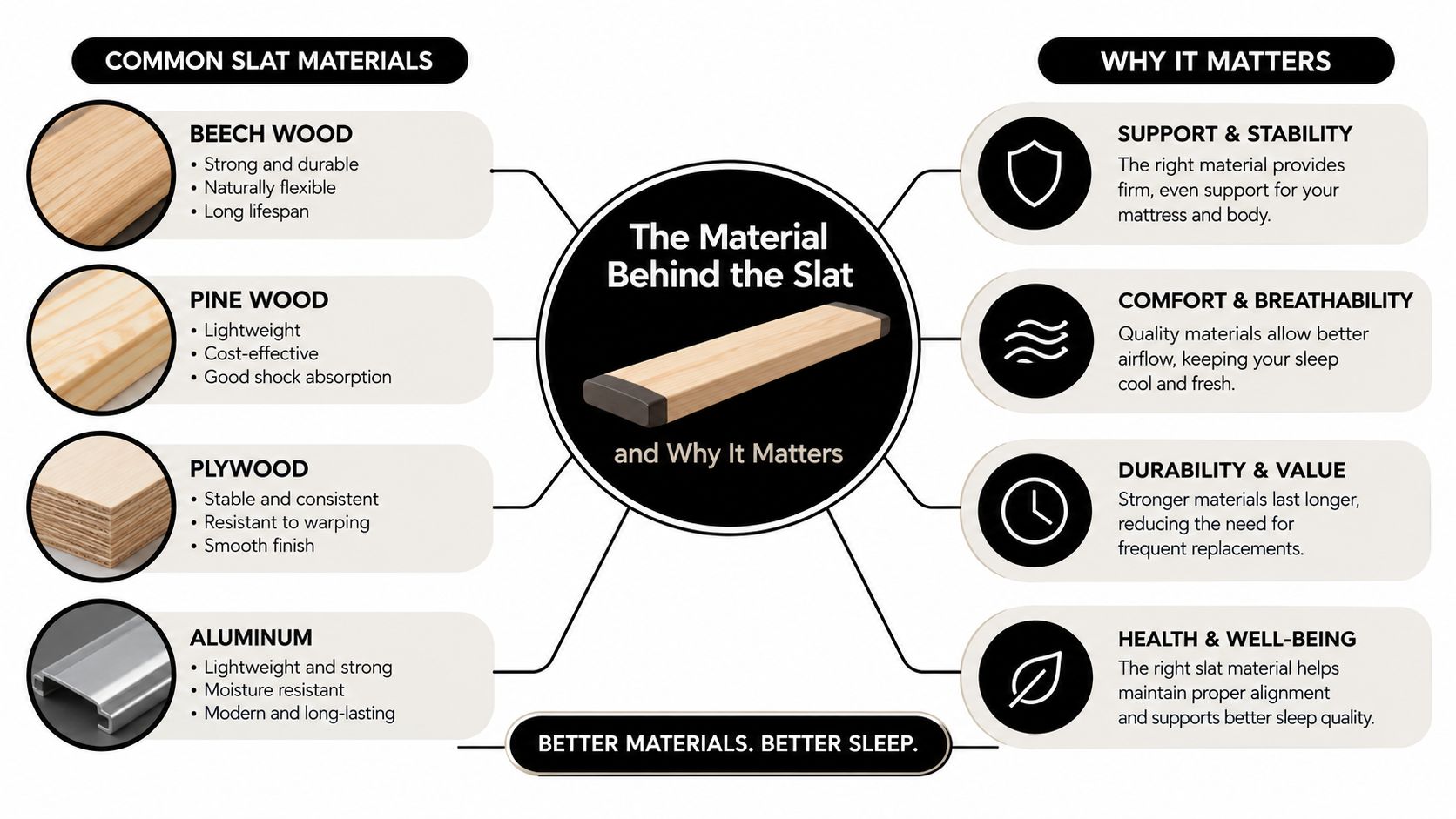
For a product comparison, review common vinyl fence types and configurations, then request the exact profile, approved colors, installation clearances, and warranty exclusions. “Vinyl” identifies a material family, not a guaranteed level of performance. ASTM material guidance does not by itself establish how a complete assembly will perform under Florida wind loads. Posts, rails, fasteners, footings, and the slat system must be evaluated together.
Retrofit Slats, Slatwall Panels, and Picket-Replacement Formats
The phrase “vinyl privacy fence slats” covers several products that aren't interchangeable. The correct choice depends on the frame already on the property, the desired appearance, and whether the project is a repair, a retrofit, or a complete fence installation.
Retrofit chain-link slats are the least disruptive option. They slide through existing chain-link mesh and are useful when the posts, top rail, fittings, and footings remain in good condition. They usually preserve the basic chain-link structure, so the finished appearance may still differ from a purpose-built solid vinyl fence. The common failure occurs when a homeowner fills an old, lightly supported chain-link frame without checking whether the newly solid surface increases wind demand.
Tongue-and-groove slatwall panels form a complete privacy fence system. Individual boards or panels connect to rails and posts designed for that product. This format gives a cleaner, more continuous appearance and is usually the better fit when privacy is the primary objective and the fence is being rebuilt from the ground up. Its weakness is compatibility. A panel system cannot be attached to arbitrary posts or rails and expected to perform as engineered.
Picket-replacement slats fit aluminum or vinyl rail systems where the homeowner is replacing the fence structure anyway. They can provide a more open decorative layout than a solid wall, depending on the spacing and profile. The mismatch problem appears when a homeowner orders boards sized for one rail depth, post spacing, or attachment method and tries to adapt them to another manufacturer's system.
| Slat Format Quick Reference | Frame Required | Typical Height | Best Use |
|---|---|---|---|
| Retrofit chain-link slats | Existing compatible chain-link mesh, posts, and rails | 4 to 6 feet | Privacy upgrade without removing a sound chain-link frame |
| Tongue-and-groove slatwall panels | Matching vinyl posts, rails, connectors, and footings | 4 to 6 feet | New solid privacy fence with a continuous finished appearance |
| Picket-replacement slats | Compatible aluminum or vinyl rails and posts | 4 to 6 feet | Rebuilding a fence with controlled openness and decorative spacing |
Height availability varies by manufacturer and system, so the table is a planning reference rather than a substitute for a product specification. The installer should verify the actual slat length, rail position, post size, gate arrangement, and footing design before ordering.
A retrofit saves demolition only when the existing structure is suitable for the new wind exposure. Filling the openings isn't a free structural upgrade.
A field inspection should look for leaning posts, corroded fittings, loose mesh, cracked concrete, settlement, and gate sag. If those conditions are present, a complete replacement may be more reliable than forcing a new slat into an old frame.
Slat Openness, Color, and the Airflow Versus Privacy Trade-off
Privacy and airflow pull the design in opposite directions. A full-privacy surface blocks the most direct views, but it also presents more area to wind. Semi-private and louvered arrangements allow more air movement and can reduce the visual and physical effect of a solid wall, but they won't provide the same screening around a pool or patio.
The decision should be made before the quote is prepared because openness affects more than appearance. Slat height, spacing, rail layout, post spacing, and gate geometry all interact with the amount of exposed surface. A six-foot solid panel and a partially open decorative layout cannot be assumed to place the same demand on the same frame.
A simple design comparison
| Configuration | Privacy | Airflow | Planning concern |
|---|---|---|---|
| Full privacy | Highest | Lowest | Requires careful review of posts, rails, connections, and footings |
| Semi-private | Moderate | Moderate | Useful where sightline control matters more than complete screening |
| Louvered or spaced | Lower | Highest | Preserves openness but may not screen a pool or patio effectively |
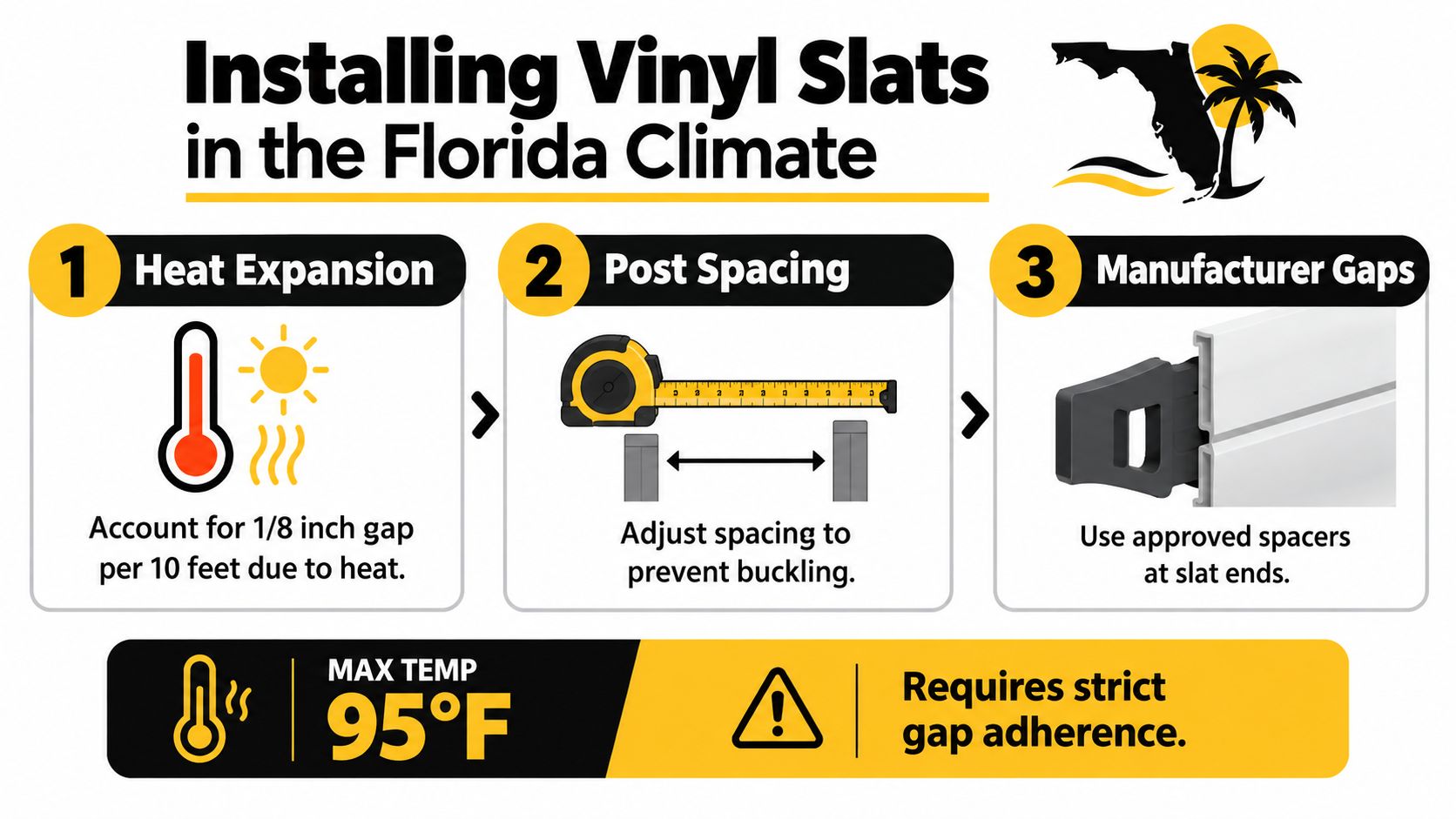
Color adds a second Florida-specific consideration. White and lighter tones generally reflect more solar energy, while darker slats can experience greater heat absorption and thermal movement. That doesn't make dark colors unsuitable. It means the installation needs manufacturer-approved clearances, properly detailed rail connections, and enough allowance for movement during daily heating and cooling.
The vinyl fence color options guide can help narrow the visual choice, but a color decision should still be checked against the product's warranty and weathering information. A brochure may show white, tan, clay, or gray as equivalent options, while the warranty may place different limits on darker finishes.
A practical pre-order checklist includes:
- Privacy target: Decide whether the fence must block direct views or only soften them.
- Wind exposure: Identify open lots, waterfront exposure, corner conditions, and long uninterrupted runs.
- Color and movement: Confirm clearances for the selected color and profile.
- Gate placement: Treat gates separately because their width, hardware, and reinforcement can govern performance.
- Existing frame: Verify that the current posts and rails can support the selected configuration.
Installing Vinyl Slats in the Florida Climate
A vinyl privacy fence can look straight on installation day and still fail early if the frame, soil, and clearances are wrong. Florida crews must account for heat-driven movement, the wind load created by a solid surface, and the permit process in the property's jurisdiction.
Start with the frame and the ground
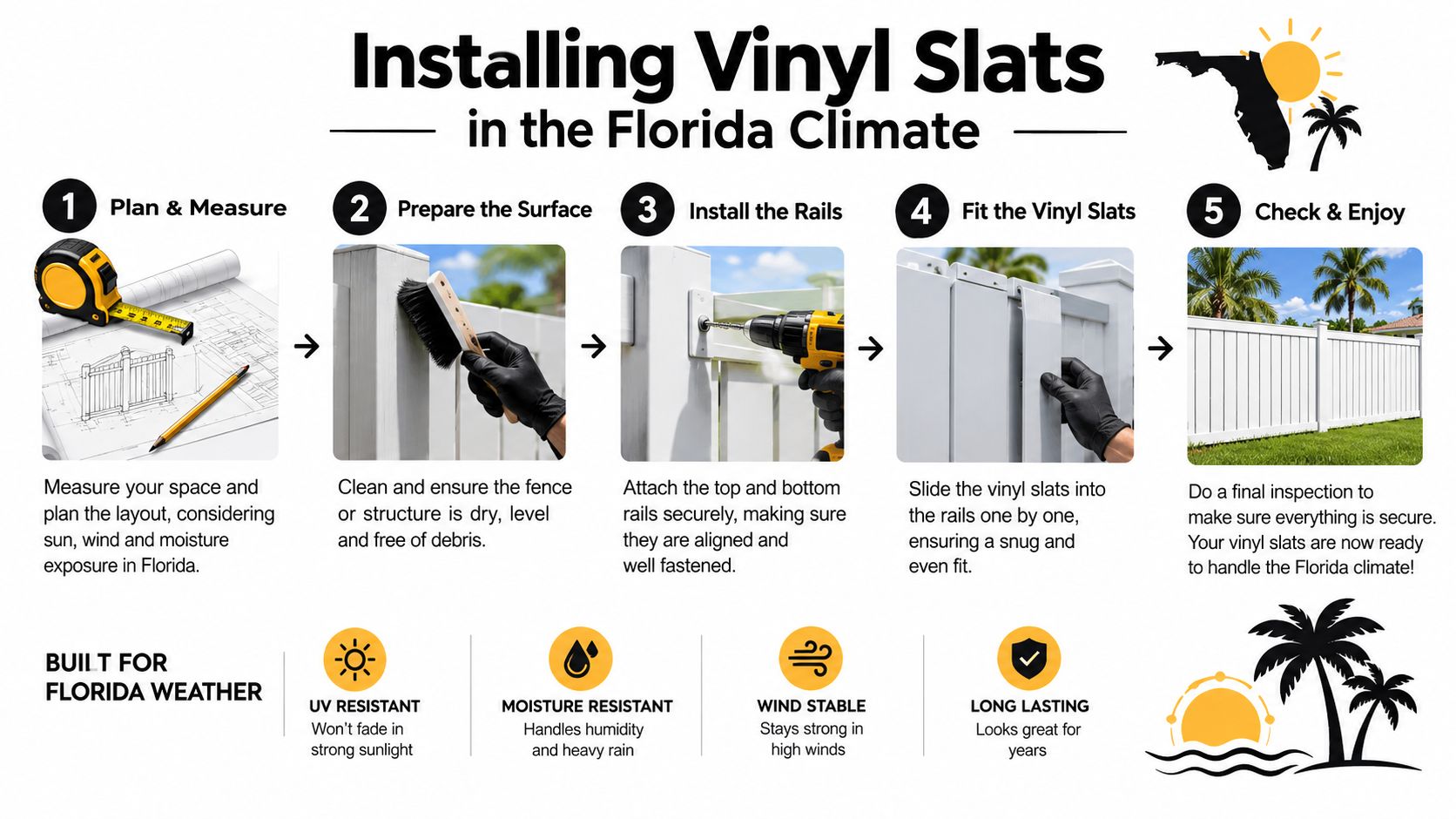
For a retrofit, inspect every post, rail, fitting, and footing before ordering slats. A chain-link fence built for open mesh may not support a filled privacy surface. Post spacing may need adjustment, rails may require reinforcement, and shallow or damaged footings may need replacement rather than modification.
Coastal and sandy soil require their own review. Footing dimensions and embedment depend on the selected system, soil, exposure, post size, and approved engineering details. A depth copied from another property does not establish a safe configuration for a Martin County or Palm Beach County site.
For rail spacing and footing details specific to solid privacy assemblies, use this step-by-step guide to how to install vinyl privacy fence.
Allow the slats to move
Rigid vinyl expands and contracts as temperatures change. Slat ends should not be forced tightly against posts, rails, or adjacent components unless the manufacturer specifies that installation. Approved end gaps and spacers provide room for movement and reduce the risk of buckling, distortion, or stress at the connections.
Measure the opening at the installation temperature, then follow the selected product's clearance table. Do not force a slat into a space that already feels tight during a cooler morning. Dark colors and long runs need closer attention because repeated heating and cooling makes small clearance errors more apparent.
Treat code numbers as design conditions
The 2023 Florida Building Code includes a simplified wind-design provision for fences no more than six feet high. Its 75 mph fastest-mile wind speed or 115 mph as a three-second gust values describe design conditions, not proof that every vinyl assembly meets them. The code provision distinguishes those wind measurements, so they cannot be treated as interchangeable.
ASTM F964 addresses rigid PVC fence profiles, including dimensional tolerances, extrusion quality, weatherability, impact resistance, warping, dimensional stability, and weathered impact testing. It doesn't establish the load-bearing capacity of a completed fence assembly. ASTM F964-13 can support material selection, but the posts, rails, fasteners, footings, gates, and slats still need to work as one engineered system.
Miami-Dade County treats new and replacement PVC or vinyl fences and gates as subject to documentation and permitting requirements. Check Miami-Dade's fence and gate requirements before scheduling work, because replacing an existing fence does not automatically remove the permit obligation.
In Martin County, confirm property-line placement and the 6-foot maximum height on a property line, along with setbacks, sight triangles, easements, waterways, wetlands, and preserve areas. Palm Beach County identifies fences in unincorporated areas as examples of projects needing a building permit. Easements may also require written permission from property owners' associations or easement beneficiaries. Review Palm Beach County's permitting and zoning information before materials are ordered.
What Maintenance Actually Looks Like Over the Life of the Fence
A vinyl fence in Martin or Palm Beach County usually needs less labor than wood, but it still needs a maintenance routine. Dirt, algae, salt residue, insects, irrigation, landscaping equipment, loose hardware, and storm debris can all shorten the useful life of the installation.
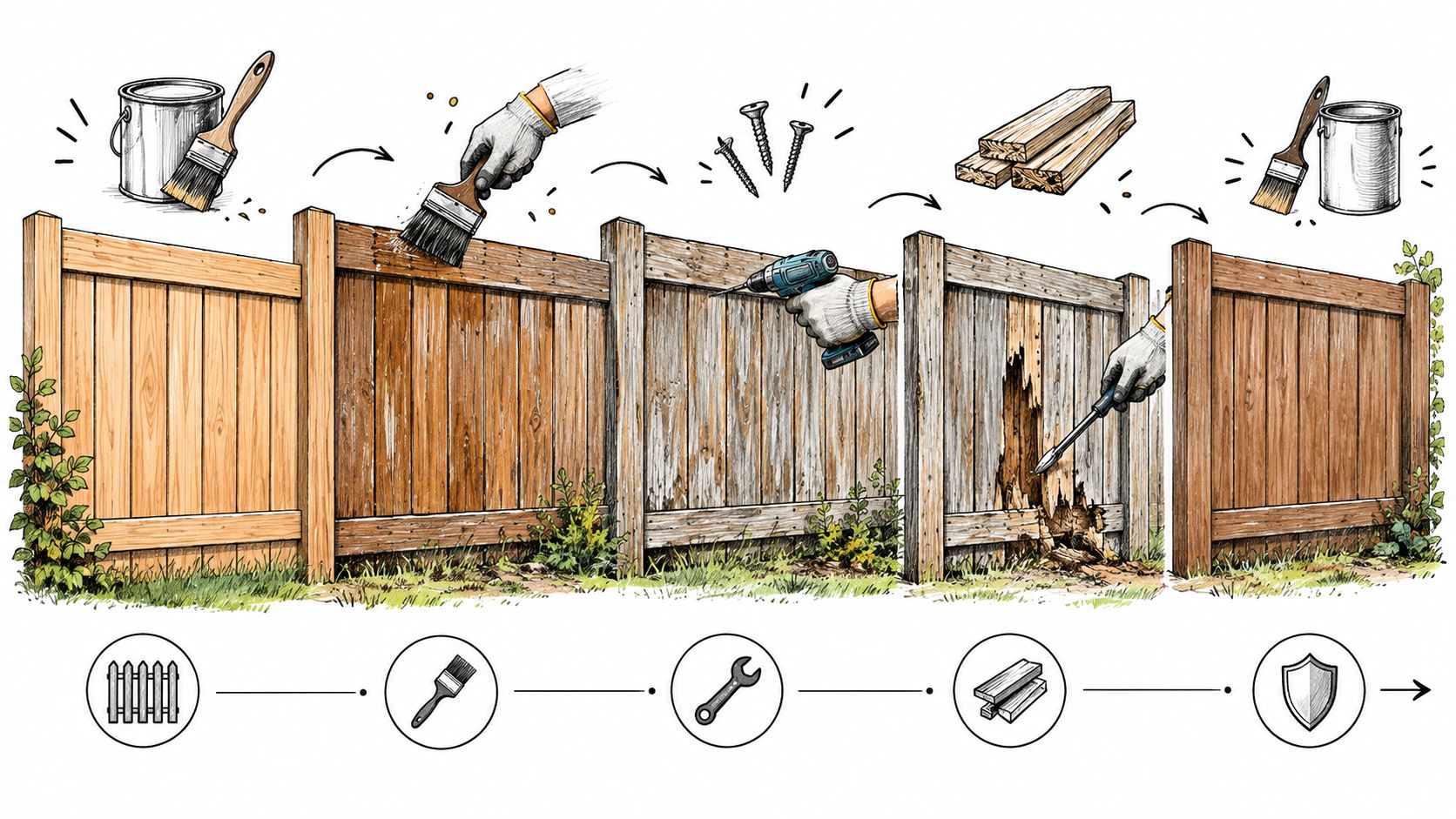
During the first year, inspect the fence after heavy rain, strong wind, and nearby yard work. Look for leaning posts, rail movement, bowed sections, cracked slats, and gates that no longer close cleanly. Wash the surface with water and a non-abrasive method. Avoid aggressive tools that scratch vinyl or wear a weathered finish.
Coastal properties benefit from a quarterly wash, especially where salt spray reaches the fence. Rinse irrigation overspray from the slats, keep vines from loading the rails, and prevent stored equipment from pressing against the panels. Shaded areas deserve extra attention because algae and biofilm stay damp longer.
The middle years need observation
After a storm, check the posts, rails, gate hardware, and visible fasteners. A contractor should check hardware torque where the assembly has taken wind or impact, then inspect the footing and post for movement. A solid privacy section can transfer substantial wind pressure into those supporting components, so a loose connection should not be dismissed as a cosmetic issue.
Darker colors may show chalking or surface change sooner than lighter colors because solar exposure is more visible. Cleaning helps keep the surface presentable, but it cannot reverse heat distortion, impact damage, or uneven weathering.
Individual slat replacement makes sense when the posts and rails remain sound. It becomes less practical if the original profile has been discontinued, the color has weathered unevenly, or damage reaches the supporting frame. Identify the failure location before choosing between a slat repair and full panel replacement.
Long service life still depends on the application
Weathering research provides useful context for PVC durability, but it does not promise a fixed lifespan for every slat. The PVC construction-material discussion supports a practical conclusion: properly formulated material can remain serviceable for a long time when the fence is correctly installed and maintained.
The weak point may be a gate, fastener, footing, storm-damaged post, or discontinued replacement part rather than the slat itself.
End of Life, Recycling, and What Recyclable Means for Vinyl Slats
A vinyl privacy fence tear-out in Martin or Palm Beach County usually produces more than clean slats. Rails, posts, fasteners, concrete footings, soil, and vegetation may be mixed together. A recycling facility might accept clean rigid PVC while rejecting a load that requires costly sorting. “Recyclable” describes a possible material pathway, not a guaranteed curbside service.
In the United States and Canada, approximately 1.1 billion pounds of vinyl were reported as recycled in 2020, including about 150 million pounds of post-consumer material. The post-consumer figure represented a 40% increase from 2014. The Baker Institute's review of PVC waste classification and recycling explains why recovery from building products remains uneven. Fence slats generally do not follow the same collection route as cardboard or aluminum packaging.
VinylPlus reported 724,638 tonnes of PVC waste recycled within its framework in 2024 and noted that roughly 70% of PVC is used in durable building products. That figure applies to the VinylPlus framework, not to residential fence tear-outs in Martin or Palm Beach County. The VinylPlus Progress Report supports a measured conclusion: PVC recovery exists, but local acceptance must be confirmed.
Before scheduling removal, homeowners should:
- Ask the installer or manufacturer whether removed slats or panels have a take-back route.
- Request that the removal crew separate rigid PVC from metal, concrete, dirt, and other waste.
- Call the Martin County or Palm Beach County solid waste authority to confirm acceptance of that specific PVC product.
- Record the product name, color, profile, and installation details for future repairs.
- Never burn vinyl as a disposal method.
Call the appropriate county authority before tear-out, and ask the installer to keep PVC separate on site. AlliedFenceAndGate.com™ installs PVC and vinyl privacy fencing, retrofit options, gates, and code-conscious fence systems across Martin and northern Palm Beach counties. Permitting, utility locates, and inspection coordination are available for applicable projects. Homeowners can review options through AlliedFenceAndGate.com™.
#MartinCountyFencing #PalmBeachCountyFencing #StuartFencing #JensenBeachFencing #PortStLucieFencing #PalmCityFencing #JupiterFencing #PalmBeachGardensFencing #TreasureCoastFencing #FloridaFencing #VinylFence #VinylPrivacyFence #PrivacyFenceSlats #PoolFenceFlorida #FenceContractorFlorida
Related Fencing Services
Need a fence or gate on the Treasure Coast?
Licensed, insured, and bonded. Free estimates across Martin, St. Lucie, Indian River & Palm Beach counties.
Call (772) 530-3127