Chain Link Fences in Florida: A Homeowner's Guide
The most popular chain link advice in Florida is also the least useful: choose the cheapest galvanized fence that fits the property. Two fences can look identical on installation day and age very differently on the Treasure Coast. Salt air, irrigation spray, pool chemicals, buried hardware, and the quality of the protective coating decide whether a fence remains serviceable or becomes a repair project.
Chain link fences still make sense for yards, dog areas, pool barriers, commercial perimeters, schools, and utility properties. The material is practical, visible, adaptable, and mass-produced. Its modern development began in 1844 in Norwich, England, when Charles Barnard adapted cloth-weaving machinery to produce uniform metal-wire mesh, and the technology reached the United States by 1891. A smoother selvage process patented by Frank J. Mafera in 1930 reduced sharp edges and helped chain link move beyond industrial sites into residential applications, as documented in the history of chain-link fencing.
The right buying question isn't merely, “What's the price per foot?” It's, “What coating, framework, hardware, height, and maintenance plan will deliver the lowest total cost for this exposure?” That question matters most near the coast, where standard galvanized chain-link fencing has been found to severely corrode in as little as 5 years in warm, humid, chloride-rich environments, according to federal materials research documented in this coastal corrosion report.
Table of Contents
- Why Chain Link in Florida Is a Coating Decision, Not a Material Decision
- Anatomy of a Chain Link System and What Every Quote Should Spell Out
- Choosing the Right Height and Security Configuration for Your Property
- Coastal Corrosion and How to Compare Coating Classes Honestly
- Florida Permits, Setbacks, Pool Code, and Utility Locates
- What a Real Chain Link Installation Costs on the Treasure Coast
- Maintenance, Lifespan, and Questions to Ask Any Fence Contractor
Why Chain Link in Florida Is a Coating Decision, Not a Material Decision
Chain link is not a single Florida product. The same silver fence can perform very differently depending on where it is installed and how it is coated. On the Treasure Coast, salt carried inland from the surf, sprinkler spray, pool chemicals, wet soil, and trapped moisture all increase the corrosion load on steel.
That makes the coating a buying decision, not a cosmetic detail. The fabric, wire diameter, posts, rails, gates, and fittings still affect strength and service life, but the protective coating is the first line of defense. Zinc protects steel sacrificially, so the coating corrodes before the underlying steel. ASTM A392 sets requirements for zinc-coated steel chain link fabric made before or after weaving, including coating classes and performance requirements described in ASTM's fabric specification.
Three coating paths
Galvanized fabric is the standard silver option. It can serve inland properties and locations with limited exposure, but the word “galvanized” does not identify the full product. A proper quote should name the applicable ASTM specification and coating class. Without those details, two silver fences may have different levels of zinc protection.
Aluminized fabric uses an aluminum-based protective layer instead of a zinc-only coating. It has a different corrosion-resistance profile, appearance, and weathering behavior. That combination may work for one property and be a poor fit for another. Match the material to the exposure rather than choosing by color or initial price.
PVC-coated fabric places a polymer barrier over the metal. The coating limits direct contact with salt and moisture and provides a finished color, but it does not eliminate the need to specify the underlying steel. The quote should identify the PVC classification, core wire gauge, coating thickness, and bonding method.
Public procurement documents show the level of detail a specification can include. The Denver chain-link fencing specification includes examples using a 9-gauge core, 2-inch mesh, and a 7-mil PVC coating bonded by fusion in a Class 2B system. Those details give buyers a useful comparison point when reviewing residential or commercial proposals.
Practical rule: A quote that says only “galvanized chain link” has not identified the coating decision that affects coastal performance.
The framework deserves the same scrutiny as the fabric. ASTM F1043 addresses steel fence framework, protective coatings, and testing for tension, adhesion, and cross-hatch performance, as described in the framework standard reference. Strong fabric paired with lightly protected posts, rails, gate frames, or fittings can still leave the fence vulnerable.
The global market remains substantial. A 2025 estimate from Global Growth Insights valued the chain link fencing market at USD 2,391.98 million. Residential and commercial uses represented more than 55% of demand, galvanized products nearly 63% of sales, North America about 34% of global share, and Europe about 26%. Those figures show continuing demand. They do not show that basic galvanized coating is right for a coastal yard.
For a clearer comparison, homeowners can review the differences between vinyl-coated chain link. A sound quote should let the buyer identify the fabric coating, framework protection, and specifications being purchased, then compare that package against expected service life and maintenance.
Anatomy of a Chain Link System and What Every Quote Should Spell Out
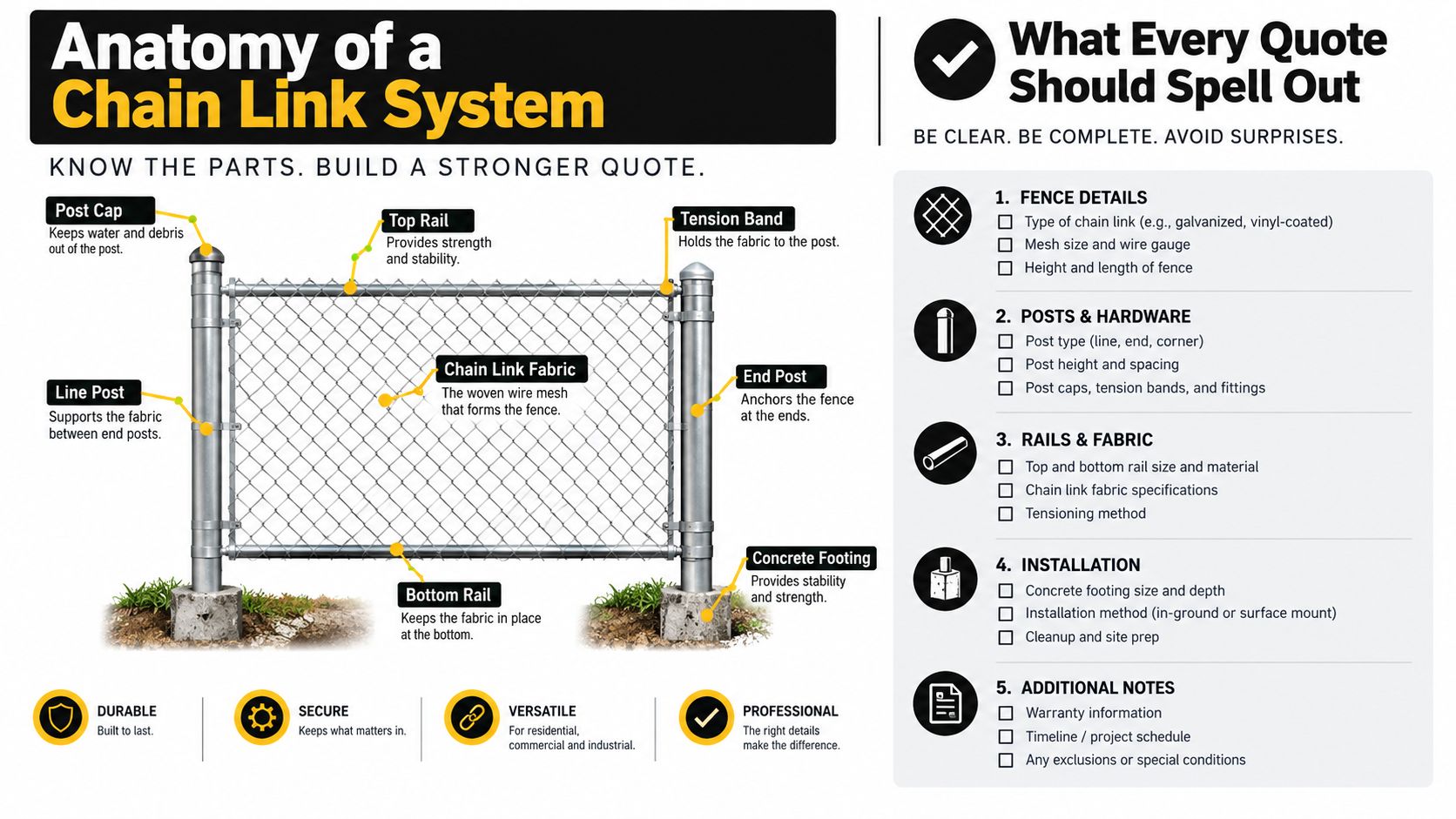
A chain link fence succeeds or fails as a complete system. The fabric is visible, but posts, rails, tension components, concrete, gates, and fittings determine whether the installation stays straight, withstands Florida weather, and operates properly. A low fabric price does not compensate for undersized framework or poorly protected hardware in a coastal yard.
The parts that carry the load
Terminal posts sit at ends, corners, and gate openings. They receive tension from the fabric and need more strength than intermediate supports where the layout and loads demand it. Gate openings place particular stress on these posts because they carry the gate hardware and repeated movement.
Line posts support the runs between terminals. Their spacing and diameter affect stiffness, appearance, and resistance to movement. A quote should identify both, rather than hiding them inside a single material allowance.
The top rail connects the upper framework and gives the fabric a defined edge. Tension wire can support the lower portion, especially where the installation needs tighter control at ground level. The quote should state whether each is included and how the bottom of the fabric will be secured.
Fabric should be specified by mesh opening, wire gauge, selvage, coating, and minimum breaking strength. Smaller mesh can make it harder for a pet to push through or catch a paw. Pool installations require close attention to opening size. Florida guidance limits chain-link openings to a maximum 2.25-inch square, or 1.75 inches when slats reduce the openings, as stated in the Florida residential pool code reference.
A 9-gauge fabric is a heavier residential option than lighter wire. Commercial specifications may use another gauge based on security, span, and use. Terminal-post upgrades, such as changing from 1-5/8 inches to 2 inches or 3 inches, add steel, concrete, and installation work because corners and gates carry greater loads.
The nine-line quote check
A Florida chain link quote should spell out:
- Linear footage and fence height, measured along the proposed fence line.
- Mesh opening and fabric gauge, including selvage style.
- Fabric coating and ASTM classification, not only the color or “galvanized.”
- Terminal-post size and quantity, including corner and gate posts.
- Line-post size, spacing, and quantity, plus the setting method.
- Top rail and tension-wire details, including whether each is included.
- Concrete and excavation, with allowances for roots, rock, difficult soil, or removal.
- Gate dimensions, frame, hinges, latch, stops, and operator provisions, where applicable.
- Labor, demolition, permits, utility locates, cleanup, warranty terms, and exclusions.
Gate hardware deserves its own review. Brace bands, tension bands, carriage bolts, post caps, hinges, latches, and gate stops are small components with direct effects on alignment, security, and service life. A chain link fence panel guide helps property managers distinguish a complete perimeter system from a quote covering only fabric and posts.
Choosing the Right Height and Security Configuration for Your Property
Fence height should match the problem you need to solve. A four-foot chain link fence can define a garden, contain a cooperative small dog, or form part of a pool barrier when the complete fence and gate assembly meets applicable requirements. It will not reliably contain every athletic dog, deter a determined trespasser, or provide meaningful privacy.
A six-foot fence is the practical residential default when a yard needs stronger separation and better containment. It preserves airflow and visibility while giving climbing dogs and opportunistic trespassers more fence to overcome. Three strands of barbed wire on angled arms move the installation into a higher-security category. Near homes, that configuration may raise zoning, neighborhood, liability, and appearance concerns.
Match the configuration to the property
A 25-pound terrier can fit through openings that contain a larger dog, particularly when the animal is persistent or the ground has gaps. A tomato garden usually needs a deterrent against casual entry, not a high-security perimeter. A pool needs a code-compliant barrier, child-resistant access control, and a gate that closes and latches correctly every time.
For Florida pool barriers, chain-link mesh openings must not exceed 2.25 inches square, unless slats reduce the openings to no more than 1.75 inches. Pool access gates must be self-closing, self-latching, and designed to open outward away from the pool, according to the Florida pool barrier requirements. A short fence or improperly configured gate can fail inspection and delay completion.
| Configuration | Best For | Limitations | Typical Cost per Linear Foot (FL) |
|---|---|---|---|
| Four-foot chain link | Boundary definition, gardens, some pool layouts, small contained areas | Limited privacy and weaker control for athletic dogs or trespassers | Quote-specific, varies by coating, gauge, site, and gates |
| Six-foot chain link | Residential yards, stronger pet containment, property separation | Limited privacy without slats or screening | Quote-specific, varies by coating, gauge, site, and gates |
| Six-foot chain link with three-strand barbed wire | Commercial yards, restricted-access areas, higher-security perimeters | May conflict with residential zoning, HOA rules, or liability requirements | Quote-specific, requires site and code review |
A pool fence is not compliant because the fabric looks tall enough. Mesh size, gate direction, closing action, latch position, surrounding grade, and access arrangement all matter.
Inspect the area around the pool, not only the perimeter line. Equipment, walls, retaining features, landscaping, and gates can interrupt a continuous barrier. Commercial properties require the same scrutiny. Drive gates, pedestrian gates, and access-control hardware often create greater security risk than the straight fence runs.
Coastal Corrosion and How to Compare Coating Classes Honestly
In coastal Florida, “galvanized” is not a complete fence specification. Salt air, humidity, irrigation, standing water, and blowing sand expose every metal component, so the purchase decision should focus on coating class and total ownership cost, not the lowest price per foot.
Before comparing bids, require the fabric standard, coating class, core material, framework coating, and hardware treatment in writing. ASTM A392 covers zinc-coated steel fabric and recognizes Class 1 and Class 2 options. Zinc acts as a sacrificial barrier, and the coating mass affects how long that protection can delay rust and section loss in exposed conditions. The ASTM A392 specification provides the governing reference.
What the quote should identify
Zinc-coated galvanized fabric remains practical for many properties, but the word “galvanized” does not identify the coating class. The fabric is only one part of the system. Posts, rails, gate frames, tension bands, bolts, hinges, and latches also face salt exposure and need suitable protection. A quote that specifies the mesh but says nothing about the framework or hardware leaves a major corrosion risk unaddressed.
Aluminum-coated fabric should be identified under the applicable ASTM classification, including ASTM A491 where that standard applies. It uses a different protective system from zinc-only fabric and can suit demanding exposure. Discuss surface weathering and appearance before installation, particularly where the fence will be highly visible.
PVC-coated fabric should list the polymer specification, coating class, core gauge, thickness, color, and bonding method. ASTM F668 covers PVC and other polymer-coated chain-link fabric. “Vinyl coated” alone is too vague to compare products accurately. Black or dark green may fit the property better than silver, but color does not replace a performance specification.
| Coating | ASTM Spec | Coating Weight | Coastal Rating (0-5) | Approx. Lifespan at 500 ft from coast |
|---|---|---|---|---|
| Galvanized | ASTM A392 | Quote must state the coating class and zinc mass | No universal rating without site exposure and class | No reliable figure can be assigned without verified site and coating data |
| Aluminized | ASTM A491 where applicable | Quote must state the applicable aluminum coating details | No universal rating without product and exposure data | No reliable figure can be assigned without verified product and site data |
| PVC-coated | ASTM F668 | Quote must state polymer class, core gauge, thickness, and bonding method | No universal rating without polymer system and exposure data | No reliable figure can be assigned without verified product and site data |
Federal coastal corrosion research found that standard galvanized chain-link fencing can severely corrode in as little as 5 years in warm, humid, chloride-rich coastal environments, as documented in the federal corrosion research. That result does not place every fence on the same schedule. It does show why a basic silver finish should not be presented as universally low-maintenance.
PVC can reduce direct salt contact with the steel, but the coating can still be damaged by sunlight, sand abrasion, landscaping, cuts around fittings, and chemical splash. Inspect gates, cut ends, fasteners, and low areas where moisture remains trapped. Repairs also become more involved when the coating is difficult to match or when corrosion has reached the framework.
The practical comparison is initial price versus coating performance, inspection burden, repair access, and replacement risk. For a closer explanation of rust mechanisms and repair concerns, review this chain link fence rust guidance. The right specification accounts for the property's exposure and identifies every coated component instead of hiding those details behind a low bid.
Florida Permits, Setbacks, Pool Code, and Utility Locates
A premium coating cannot correct a fence installed on the wrong line or through an unmarked utility. On Florida jobs, confirm ownership, jurisdiction, digging conditions, access, and inspection requirements before ordering materials. Fixing a bad layout after posts are set costs more than checking it first.
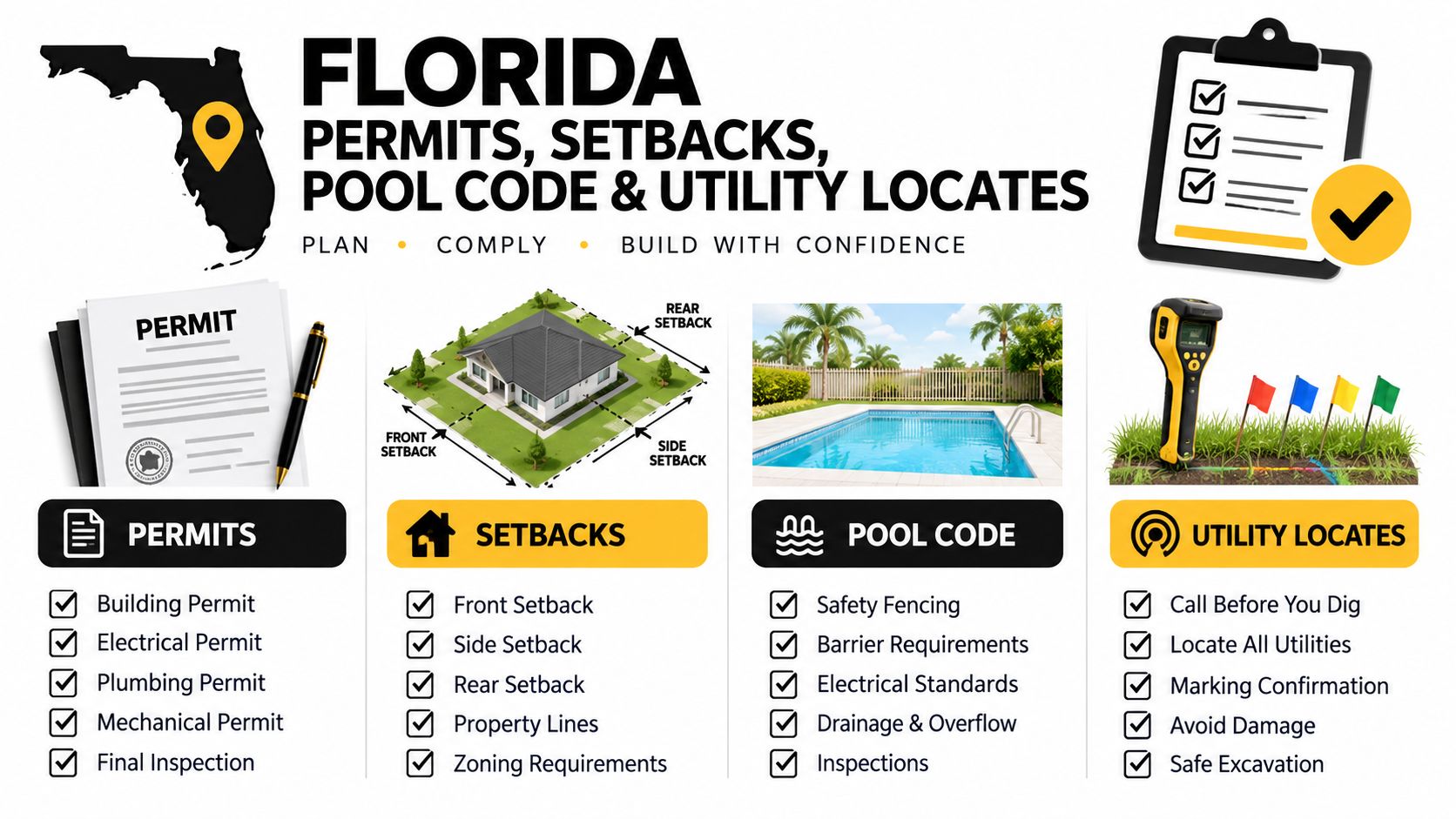
Permit rules vary by city and county. In Martin and St. Lucie counties, the applicable building or planning department should confirm requirements for the specific address. Thresholds, zoning districts, corner-lot visibility, easements, and HOA rules can change the answer. The contractor should state whether the project needs a fence permit, pool-barrier review, commercial approval, or supporting documents. A blanket promise that no permit is required is poor practice.
The pre-installation sequence
Check the property line first. Compare the proposed fence line with a survey, recorded boundary information, easements, and existing improvements. A line that appears correct from the yard can still cross a neighbor's property or restrict access to an easement.
Confirm setbacks next. Requirements can change with the jurisdiction, lot condition, zoning, and fence location. The owner should obtain the rule for the project address rather than treat a nearby fence as a legal precedent.
Locate utilities before digging. The contractor should submit a Sunshine State One-Call request through 811 and wait for the required responses before excavating post holes. Positive Response should show that participating utilities have responded or marked their facilities. Irrigation, pool electrical, low-voltage lighting, and other private lines may fall outside utility-company responsibility, so arrange a separate private locate when needed.
Pool barriers need their own inspection mindset
Florida pool requirements limit chain-link openings to 2.25-inch square, or 1.75 inches when slats reduce the opening. Gates must be self-closing, self-latching, and open outward away from the pool under the Florida residential pool code. Check the entire barrier path, including grade changes, gaps beneath the fabric, gate hardware, and nearby objects that could help a child climb.
A compliant installation starts with a documented site, marked utilities, and an approved layout. It does not start with a post-hole auger.
On installation day, keep the permit placard available when the jurisdiction requires one. Lot lines must be understood, utility marks must remain visible, and the crew should have the approved layout or permit documents. Document any field change around gates, pools, drainage, or easements before concrete is placed.
What a Real Chain Link Installation Costs on the Treasure Coast
A useful quote begins with a defined project, not a headline price. Consider a Treasure Coast example involving 200 linear feet of 4-foot residential chain link, one 4-foot walk gate, and one 10-foot double drive gate on a flat, cleared Martin County lot. The proposed system uses post-in-poured-concrete installation, aluminized fabric, and a 9-gauge core.
The cost cannot be stated as a fabricated total because the verified project data doesn't provide current material prices, labor rates, or gate pricing. A responsible benchmark compares the same line items across contractors and treats the final quote as site-specific.
What the crew is actually building
The straight runs require line posts, terminal posts at corners and ends, top rail, fabric, tension components, fittings, and concrete. The gates require stronger gate posts, hinges, latches, frames, stops, and alignment work. The drive gate may also need provisions for an operator, keypad, vehicle loop, or other access-control equipment if the owner adds automation.
A minimum of 40 pounds of concrete per hole and a production rate of roughly 30 to 40 feet per crew hour were specified in the project brief, but those figures aren't supported by the verified data supplied for this article. They should therefore be treated as contractor-specific estimating assumptions, not universal facts. Root drilling, rock drilling, old-fence removal, spoil handling, and restricted access can alter labor substantially.
| Component | Quantity | Material Cost | Labor Cost | Line Total |
|---|---|---|---|---|
| Four-foot aluminized fabric with 9-gauge core | 200 LF | Contractor quote required | Contractor quote required | Contractor quote required |
| Terminal and gate posts | Layout-dependent | Contractor quote required | Contractor quote required | Contractor quote required |
| Line posts and post caps | Layout-dependent | Contractor quote required | Contractor quote required | Contractor quote required |
| Top rail and tension components | 200 LF, subject to design | Contractor quote required | Contractor quote required | Contractor quote required |
| Walk gate, four feet wide | 1 | Contractor quote required | Contractor quote required | Contractor quote required |
| Double drive gate, ten feet wide | 1 | Contractor quote required | Contractor quote required | Contractor quote required |
| Concrete and excavation | Hole count and soil-dependent | Contractor quote required | Contractor quote required | Contractor quote required |
| Removal, roots, rocks, or special drilling | If required | Site-specific | Site-specific | Site-specific |
| Permitting, locating, cleanup, and documentation | Project-dependent | Project-specific | Project-specific | Project-specific |
Published starting price ranges from a contractor may help establish a preliminary budget, but a homeowner shouldn't multiply a generic per-foot figure by footage and assume gates, posts, concrete, demolition, permits, and difficult digging are included. Gate openings reduce fabric footage while increasing structural and hardware costs.
The most revealing quote isn't the one with the lowest linear-foot number. It's the one that explains what happens at every corner, gate, hole, and coating transition.
For a fair comparison, every bidder should receive the same fence line, gate schedule, height, mesh, gauge, coating, access requirements, and site conditions. The owner can then compare material substitutions, exclusions, warranty language, and change-order triggers instead of comparing unrelated packages.
Maintenance, Lifespan, and Questions to Ask Any Fence Contractor
Coastal maintenance should be planned before the fence is installed. Salt residue can collect on fabric, rails, gate frames, hinges, and fasteners, while irrigation and pool splash create concentrated exposure in places that may look sheltered.
A practical routine includes a monthly saltwater rinse within a mile of the surf, a quarterly tension check on the top and bottom portions of the system, and a 24-month hardware audit focused on gate latches, hinges, post caps, and exposed fasteners. These intervals come from the project requirements and should be adjusted to actual exposure, but they aren't universal service-life guarantees.
Inspect the failure points first
Gate hardware often reveals corrosion before the straight runs do. A gate that drags, fails to latch, or develops movement at the hinges needs attention before the problem transfers load to the posts.
Buried hardware deserves scrutiny because soil stays damp and hides coating damage. Sand abrasion can wear protective surfaces at ground level, while pool-chloride splash zones can attack fittings and nearby fabric faster than ordinary rain exposure.
Fabric tension should be checked after storms, impact, landscaping work, and gate-post movement. Loose fabric can sag and create gaps, while excessive tension can stress terminals and fittings. The contractor should explain how the system is designed to be tensioned and repaired.
Contractor questions that produce useful answers
- Coating: Which ASTM fabric specification and coating class are included?
- Framework: What protective coating applies to posts, rails, gate frames, and fittings?
- Fabric: What are the mesh opening, wire gauge, selvage, and minimum breaking strength?
- Installation: How will posts be set, braced, aligned, and protected at ground level?
- Compliance: Who handles permits, pool-barrier review, utility locates, and inspection coordination?
- Insurance: Can the contractor provide current license, insurance, and workers' compensation documentation?
- Warranty: Which failures are covered, and are salt exposure, chemical splash, or coastal corrosion excluded?
- References: Can the contractor provide three local references within five miles of the property?
Service-life claims should be treated cautiously. The verified data establishes that aggressive coastal exposure can severely corrode standard galvanized chain link in as little as 5 years, but it doesn't establish a universal lifespan for galvanized, PVC-coated, or aluminized systems at a specific distance from the ocean. A contractor who promises a fixed life without identifying coating, site exposure, hardware, and maintenance is selling certainty the material specification can't support.
The right chain link system for the Treasure Coast is the one that makes its vulnerabilities visible. A detailed quote, compliant layout, suitable coating, protected hardware, and scheduled inspection will usually matter more than a small difference in the initial price.
#MartinCountyFencing #StLucieCountyFencing #PalmBeachCountyFencing #TreasureCoastFencing #StuartFencing #HobeSoundFencing #JensenBeachFencing #PortStLucieFencing #VeroBeachFencing #FloridaFencing #ChainLinkFencing #GalvanizedFencing #VinylCoatedFencing #PoolFencing #CommercialFencing #FenceInstallation
AlliedFenceAndGate.com™ provides chain link fence installation, 4-foot and 6-foot systems, coated fabric options, gates, permitting, 811 utility locates, and inspection coordination for Treasure Coast properties. Homeowners and property managers can compare project details through the AlliedFenceAndGate.com™ estimator and request a quote built around coating, code, gates, and site conditions.
Related Fencing Services
Need a fence or gate on the Treasure Coast?
Licensed, insured, and bonded. Free estimates across Martin, St. Lucie, Indian River & Palm Beach counties.
Call (772) 530-3127