Fence Permit Cost in Florida: What to Expect
In Martin and Palm Beach Counties, homeowners should expect fence permit costs to range broadly, often starting between $50 and $200, but the true expense comes from the variable valuation formulas and required plan reviews that differ by municipality. The permit fee is only one part of the budget, because revisions, inspections, engineering documents, and approval delays can add a larger time tax.
The homeowner usually starts with a simple goal: replace a leaning wood fence, add privacy along a side yard, or enclose a pool before the next project deadline. Then the word permitting enters the conversation, and the installation suddenly feels less predictable. A fence that looks straightforward from the street may sit near a setback, easement, flood-prone area, corner visibility zone, or pool barrier.
A practical budget needs to separate three things: the permit charge, the documentation and review burden, and the cost of waiting while crews, materials, or other site work remain uncommitted. That distinction matters throughout Martin County and Palm Beach County, where the governing municipality can change the application path even when the fence design stays the same.
Table of Contents
- Why Fence Permitting Feels Like a Mystery
- The True Drivers Behind Fence Permit Cost
- Physical Factors That Increase Your Fees
- Martin vs Palm Beach County Permitting
- How AlliedFenceAndGate Handles Permitting
- Final Thoughts on Budgeting for Your Fence
Why Fence Permitting Feels Like a Mystery
A homeowner may call about a six-foot privacy fence expecting one number. The first estimate might cover panels, posts, labor, and a basic permit. Then the permitting office asks for a site plan, property information, product details, or additional review because the fence is close to a road or includes a gate. The original price wasn't necessarily wrong. It just didn't account for the jurisdiction's review path.
The confusion starts because fence permit cost isn't governed by a national flat rate. Official schedules show sharply different approaches. San Antonio lists a residential fence permit fee of $26.50 online or $36.50 in person in its fence guidance, while Fort Collins lists a $65 building permit fee plus a $35 plan check fee, creating a $100 application cost before valuation-based charges. Those examples are documented in the San Antonio fence permit guidance, and they show why a homeowner's first question should be about the local fee schedule, not a national average.
What happens before approval
A typical application begins with property identification, a description of the fence, its height and material, and a drawing showing where it will sit. The reviewer may then check zoning, setbacks, right-of-way concerns, drainage or flood conditions, and whether the proposed gate or enclosure creates an additional safety issue.
A missing measurement can create a revision cycle. A fence drawn on the wrong side of a property line can force a redesign. Starting construction before approval can create a stop-work problem or require changes after posts are already set.
Practical rule: The least expensive application is the one submitted complete the first time.
Why the first estimate changes
The initial permit figure often covers only the visible filing charge. Some municipalities add zoning, building, plan review, technology, state, or city surcharges. Philadelphia illustrates the layered approach with a $25 filing fee, a $50 zoning fee, a $69 or $139 building fee depending on project type, and additional city and state surcharges listed on its official fence permit page.
Homeowners searching for Florida fence rules can also review the Florida fence laws guide before choosing a layout. The useful lesson is simple: a permit isn't just a receipt. It's the administrative record showing that the proposed fence fits the property's conditions and the local code.
The True Drivers Behind Fence Permit Cost
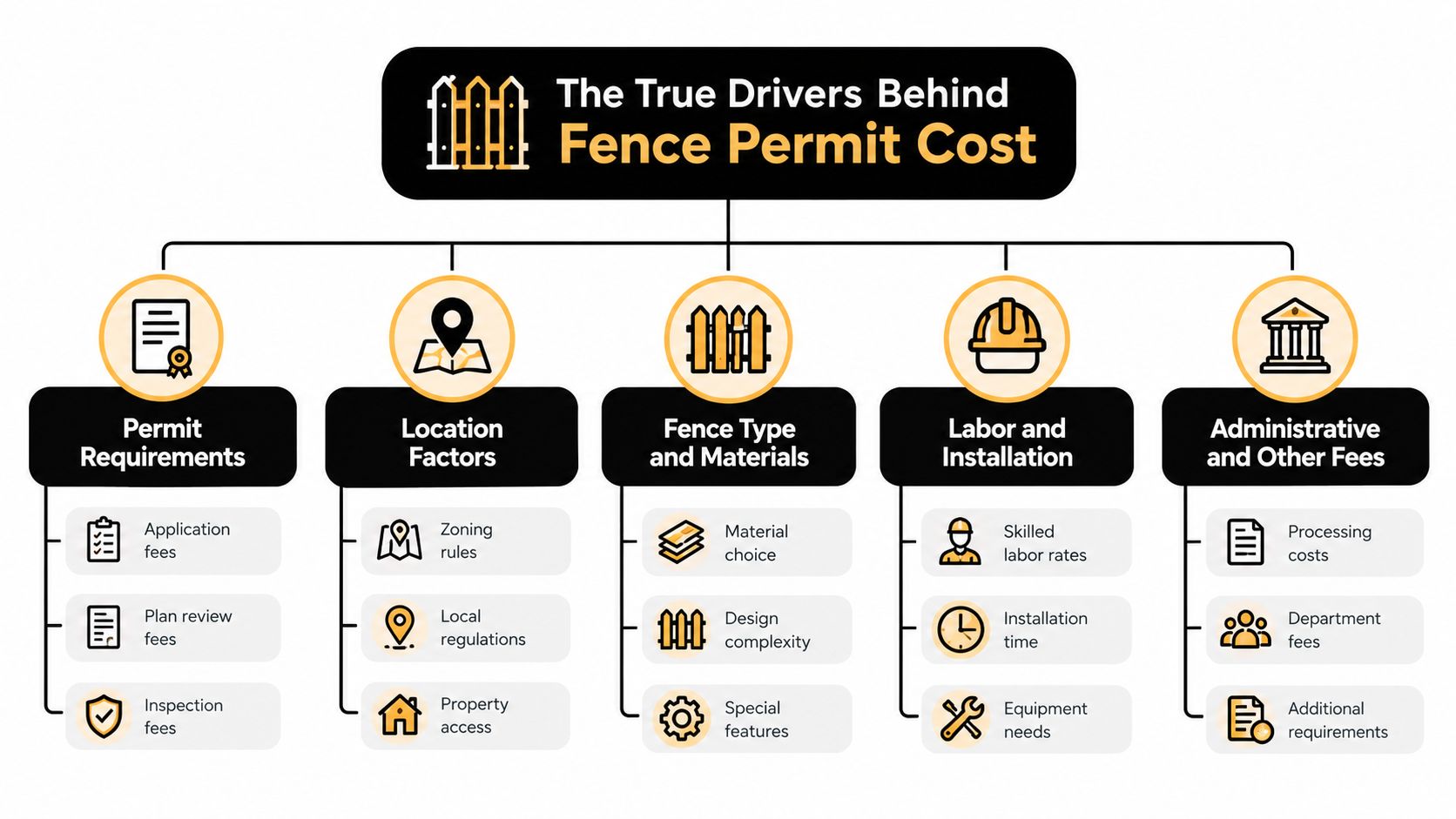
Permit pricing reflects the amount of work a department expects to perform. A flat fee works for a standard project with a predictable review path. A valuation-based schedule or a layered review system becomes more likely when the project involves unusual materials, significant height, a large perimeter, a complex gate, or a site condition that requires another department's input.
The fee components that matter
A homeowner should ask the permitting office or contractor to identify each applicable component:
- Filing charge: The basic administrative fee for opening the permit record.
- Zoning review: A separate check for setbacks, height, street frontage, lot conditions, or location restrictions.
- Building review: A technical review that may become more involved for masonry, concrete, tall fences, or structural components.
- Plan check: A charge for reviewing drawings, calculations, or supporting documentation.
- Surcharges: City, state, technology, or other charges that may be added to the main fee.
Philadelphia's published schedule demonstrates how quickly those layers can accumulate. The page lists a $25 filing fee for one- or two-family dwellings, a $50 zoning permit fee, and a $139 building permit fee per fence, while larger or more complex lots can face zoning fees of $253 to $632 plus additional per-permit surcharges. The same official guidance is especially useful for understanding why a headline fee can understate the total administrative cost.
Flat pricing versus valuation
Saint Paul uses a linear model, charging $45 for the first 200 lineal feet and $15 for each additional 100 lineal feet, according to its fence plan review and permit information. That structure makes fence length a direct pricing factor.
Other jurisdictions tie the charge to project valuation or review complexity. Centennial uses project valuation with a minimum review fee of $20, while Sandy Springs lists $80 for a standard fence permit and a total of $185 when a vehicular gate requires additional plan review and technology fees. Those examples show why two fences with similar installation labor can produce different permit invoices.
The installation estimate should therefore be reviewed separately from the permit estimate. Homeowners comparing material choices can use a detailed fence installation cost guide, but the local permit office remains the authority for the final charge.
Physical Factors That Increase Your Fees
The fence's physical design often determines whether the application stays routine or enters a more demanding review category. Height, material, gate type, location, and special site conditions all matter because each can change the safety or zoning questions a reviewer must answer.
Height changes the review
A taller fence carries greater wind exposure and may require stronger posts, deeper foundations, or engineering documentation. Fort Collins requires a design letter and licensed structural engineer details for fences more than 6 feet tall because of wind-resistance requirements. That requirement is described in the verified local guidance and is a good example of how a small design change can create a technical submittal burden.
Portland requires a permit for a wood fence taller than 7 feet, a masonry or concrete fence taller than 4 feet, a woven-wire or chain-link fence taller than 8 feet, and any fence enclosing a swimming pool, according to its residential fence permit rules. The same page states that fences must remain on private property, outside the public right of way, and comply with local height and setback rules.
Material and gate selection
Masonry and concrete can trigger more structural scrutiny than a light residential fence. An automated or vehicular gate can add plan review because the reviewer may need information about the opening, supports, access controls, or related safety features.
A slope also complicates the drawing and installation sequence. Posts may need stepped placement, adjusted heights, or a layout that handles grade changes without creating an unintended gap. A contractor evaluating a sloped chain-link layout can use chain-link fence guidance for sloped sites to identify design concerns before the application is filed.
Location remains decisive
Seattle's guidance says a construction permit isn't needed for a fence 8 feet high or less unless it includes masonry or concrete elements over 6 feet, but a permit is required for taller fences or fences in flood-prone areas. The city also limits fences to 6 feet in neighborhood residential and multifamily zones, 4 feet in front or street-side setbacks, and allows 8 feet on sloping sites when the average height between posts is 6 feet, as described in its official fence guidance.
Florida projects can face comparable location-driven questions involving pools, roads, easements, drainage, and coastal conditions. A simpler design that clearly fits the property's constraints often saves more than choosing the cheapest material and then paying for revisions.
Martin vs Palm Beach County Permitting
Martin County and Palm Beach County don't operate as one unified permitting system. A homeowner moving between the Treasure Coast and northern Palm Beach County can encounter different portals, fee schedules, documentation requests, and review layers even when the proposed fence has the same height and material.
That makes county selection a budgeting issue, but municipality and property conditions still matter within each county. A property inside a city may follow that city's process rather than an unincorporated county path. The application should identify the exact jurisdiction before anyone treats a quoted permit amount as final.
Two counties, different budgeting questions
For Martin County, the practical question is often whether the application can remain a straightforward residential fence review or whether the site creates additional zoning, flood, pool, or structural questions. In Palm Beach County, the same screening matters, but a property may also move through a different combination of municipal and county review layers depending on its location.
The difference isn't that one county always charges less. The difference is that fee calculation and review scope are local, and valuation, height, material, and project conditions can influence the result. A contractor who applies the wrong fee model can understate the cost before the application even reaches the reviewer.
| County | Fee Model Focus | Regulatory Complexity |
|---|---|---|
| Martin County | Local schedule, project valuation, site conditions, and applicable review layers | Varies by municipality, zoning context, pool or flood conditions, and fence design |
| Palm Beach County | Local schedule, valuation, fence type, and municipal or county review scope | Varies by city, unincorporated location, setbacks, special districts, and technical requirements |
What other jurisdictions reveal
The broader pattern is clear. Mountain View, California lists a $200 to $900 building permit fee for a single-family residential nonwood fence or wall 6 feet or less, based on a $2,000 to $14,000 construction valuation. A fence up to 7 feet can rise to a combined total of $1,780 to $2,480 when planning and building fees are included. These figures come from the verified jurisdictional comparison and demonstrate how review layers can outweigh the basic filing charge.
Charlotte County, Florida uses a valuation-based formula for residential fence work, charging 0.004 times ICC valuation at issuance when the project is at least $50,000, plus a 2.5% surcharge on the building fee and a $30 zoning review fee, as shown in its residential fence permit information. Washington, D.C. lists barricade and fence permits at $33 each with a 10% additional charge, producing $36.30. The comparison isn't a Florida price quote. It proves why local verification matters.
How AlliedFenceAndGate Handles Permitting
A permit problem rarely appears at a convenient time. It may surface after materials are ordered, after an installer has scheduled a crew, or after a property owner has coordinated pool work, landscaping, or a closing date. The practical value of professional permitting is not just form completion. It is controlling the handoffs between the site, the application, the reviewer, the utility process, and the inspection.
The contractor's workflow should begin with a site assessment. That review identifies the proposed fence line, gates, grade changes, pool conditions, access constraints, visible structures, and potential conflicts. Property photos and lot information can help create a clearer application package, but the final requirements still come from the applicable jurisdiction.
A process built around fewer surprises
A disciplined permitting workflow generally includes:
- Application preparation: The fence description, site information, drawings, contractor details, and supporting documents are assembled before submission.
- Fee confirmation: The applicable schedule is checked against the project type instead of relying on a generic allowance.
- Utility coordination: An 811 utility locate is arranged before digging so underground lines don't create a safety hazard or change order.
- Reviewer communication: Revision requests are answered with the specific information the department needs.
- Inspection scheduling: Required inspections are coordinated after construction reaches the appropriate stage.
- Record completion: Permit, notice, inspection, and closeout documents are retained for the property file.
This approach can reduce the carrying cost of delay. A crew that arrives before approval may sit idle. Materials can remain staged longer than planned. A missed inspection can push back gates, landscaping, pool access, or tenant operations.
A low permit fee doesn't protect the budget if an incomplete application keeps the project from moving.
Professional handling also matters for specialized installations. Pool safety fencing and self-closing, self-latching gates need to be designed around applicable safety requirements, while commercial access gates and ADA-compliant railings can involve a broader code discussion than a standard boundary fence. The right contractor doesn't promise that every application will be approved instantly. The contractor prepares the work so the reviewer has fewer unanswered questions.
Final Thoughts on Budgeting for Your Fence
Fence permit cost is a moving target because the local jurisdiction, project valuation, fence design, and review burden all influence the final amount. Martin County and Palm Beach County homeowners should start with the broad $50 to $200 expectation, then confirm whether the property falls under a city or county process and whether the application includes zoning, building, plan review, or surcharge layers.
A useful budget separates the work into four lines:
- Permit and review fees: Confirm the current schedule and all possible components.
- Documentation: Account for site plans, product information, engineering, or other required submittals.
- Site preparation: Identify slope, trees, stumps, pool conditions, easements, and access limitations.
- Time tax: Allow for revisions, inspection coordination, crew scheduling, and material holding time.
The cheapest path is usually not the one with the lowest filing charge. It is the path that matches the local rules, uses an accurate site plan, chooses a compliant design, and avoids rework after construction starts. Homeowners who confirm jurisdiction early and request a line-item permit estimate can protect the installation budget from administrative surprises.
#MartinCountyFencing #PalmBeachCountyFencing #TreasureCoastFencing #FloridaFenceContractor #FloridaFencing #FencePermits #FenceInstallation #PrivacyFence #PoolFencing #AluminumFencing #VinylFencing #ChainLinkFence
AlliedFenceAndGate.com™ manages fence permit applications, utility locates, notices of commencement, and inspection coordination for residential and commercial projects in Martin and Palm Beach Counties. Visit AlliedFenceAndGate.com™ to request a site assessment and plan a fence installation with the permitting requirements included from the start.
Related Fencing Services
Need a fence or gate on the Treasure Coast?
Licensed, insured, and bonded. Free estimates across Martin, St. Lucie, Indian River & Palm Beach counties.
Call (772) 530-3127