Vinyl Fence with Lattice Top: A Florida Homeowner Guide

A Treasure Coast homeowner often reaches the same decision after hurricane season: the gray wood fence has softened at the bottom, the fasteners show corrosion, and the HOA has sent another letter about keeping the street-facing boundary uniform. The neighbor's second-story window still looks directly into the yard, but one spouse doesn't want a tall, blank wall beside the patio.
A vinyl fence with lattice top addresses that compromise. The solid lower section screens the yard, while the open decorative section adds visual height and lets the fence feel less imposing. The right result depends on more than appearance, though. Post reinforcement, permit requirements, color selection, rail connections, and coastal exposure all belong in the quote.
Table of Contents
- Why Florida Homeowners Choose Lattice Top Vinyl
- How Vinyl Fence with Lattice Top Is Built
- Color and Finish Options for Florida Yards
- Benefits and Drawbacks Worth Knowing
- Installation, Permits, and Yearly Care
- Realistic Florida Cost Estimates
- Is Lattice Top Vinyl the Right Choice for You
- Your Lattice Top Vinyl Fence Checklist
Why Florida Homeowners Choose Lattice Top Vinyl
Consider a typical replacement along the Treasure Coast. A homeowner removes termite-softened wood after a difficult storm season and compares another wood installation with a vinyl privacy panel topped by diagonal lattice. South Florida sun has bleached the old boards, salt air has attacked exposed fasteners, and humidity has encouraged swelling and movement. An HOA may also require a consistent color and finished profile across neighboring lots.
The lattice option satisfies two competing requests. The lower privacy boards block ground-level views from the adjacent pool deck, while the open upper pattern breaks up the visual mass of the fence. Standard suppliers commonly offer lattice toppers in 12-inch, 18-inch, and 24-inch heights, with 18 inches often presented as the popular middle choice because it adds noticeable privacy and decoration without greatly increasing the overall height. These configurations are documented in standard lattice-top vinyl fence product information.
Practical rule: A lattice top improves the look of a privacy fence, but it doesn't replace a wind-engineered post and rail system.
A typical six-foot privacy panel may show roughly 12 inches of lattice above the solid section after installation, depending on the selected system and finished grade. That upper band lets some air and light pass through, which can make a patio boundary feel more open during ordinary coastal breezes. It shouldn't be sold as a guaranteed storm solution, because wind forces still travel through the panel, rails, posts, and concrete footers.
Where the style fits
Lattice-top vinyl works especially well behind pools, patios, and outdoor seating areas where privacy matters but a fortress-like wall would look out of place. It also fits HOA neighborhoods that favor decorative residential fencing, provided the association approves the height, color, lattice pattern, and cap.
Homeowners comparing profiles can review vinyl fence styles and applications before requesting a quote. The useful question isn't whether lattice looks attractive. It's whether the upper opening, total height, and structural specification suit the lot's exposure, drainage, neighbor sightlines, and local approval requirements.
How Vinyl Fence with Lattice Top Is Built
A contractor usually describes the assembly from the ground up. The 5-inch-by-5-inch routed posts receive the rails. The 2-inch-by-6-inch top and bottom rails hold the privacy boards, while tongue-and-groove boards lock together between them. Above the solid section, a framed lattice panel fits into the upper rail and is finished with a cap or top channel.
The lattice section is designed as part of the panel system, not as decorative trim screwed onto an ordinary privacy fence. Installation guidance from a major home-improvement supplier shows the lattice entering the middle rail first, followed by the top rail, with the completed assembly inserted into routed post holes. The lattice-top installation manual illustrates that preconfigured sequence.
Panel types and finished height
A solid privacy panel uses closely interlocking boards from bottom to top. A semi-privacy panel introduces openings through part of the field, while a full-lattice design uses an open trellis pattern across the panel rather than only at the crown. A lattice-top privacy panel combines the first approach with an open decorative band above it.
Common topper choices include:
- 12-inch lattice: A restrained decorative extension that may work where height restrictions are tight.
- 18-inch lattice: A more visible crown that balances privacy, airflow, and architectural detail.
- 24-inch lattice: A taller decorative section that can create a substantial finished profile and may trigger additional review.
The finished height is the solid panel height plus the lattice section. A six-foot solid panel with a one-foot lattice becomes a seven-foot fence, and that total may exceed local limits even when the solid portion alone appears acceptable. Product listings show standardized lattice-top configurations in 3-, 4-, 5-, and 6-foot panel heights, commonly with 6-foot panel lengths, reinforcing that this is a modular product category rather than a custom-only feature. Those standard sizes are summarized in lattice-top vinyl fence product listings.
Caps and material questions
A flat cap creates a clean, modern edge. A New England cap adds a more traditional residential profile. A solar cap can add illumination at posts, although its appearance and maintenance should be considered before approval.
Ask whether the product uses co-extruded vinyl and request the manufacturer's wall-thickness and performance documentation, including any reference to ASTM F964. A good quote identifies the actual system, not just “vinyl lattice,” because rail dimensions, post routing, insert options, and fastening details affect performance.
Color and Finish Options for Florida Yards
Color selection changes the way a fence ages visually. Bright white remains common in Treasure Coast and Palm Beach County neighborhoods because it reflects the Florida terrain, works with many HOA palettes, and makes mildew spotting easier to notice and clean. Almond or tan feels softer against palms, stucco, and sandy surroundings, while architectural gray gives a newer, more contemporary appearance.
Wood-grain tan and walnut textures can look convincing from the street, but darker or textured finishes make chalking, mildew spotting, and uneven fading more noticeable on a south-facing run. No vinyl finish should be treated as immune to UV exposure or salt air. A sample viewed in a showroom can look different after prolonged direct sun beside a pool or seawall.
| Color / Finish | UV Fade Resistance | Salt-Air Performance | HOA Acceptance | Resale Signal |
|---|---|---|---|---|
| Bright white | Strong visual consistency because fading is less obvious | Good when hardware and posts are specified correctly | Usually broad, subject to local rules | Clean and broadly marketable |
| Almond or tan | Good, with gradual color change easier to blend | Good for coastal residential settings | Often accepted where earth tones are required | Warm and compatible with many yards |
| Architectural gray | Moderate visual forgiveness, depending on shade | Good with corrosion-resistant components | Approval varies by community palette | Contemporary, but more style-specific |
| Wood-grain tan or walnut | More visible variation if the surface chalks or spots | Good when the system is properly specified | Often limited by HOA color standards | Decorative, but less universally neutral |
The vinyl fence color guide can help homeowners compare samples before a color is placed on a long boundary. Samples should be held in direct sun, viewed beside the house stucco and roof, and checked against the HOA's written palette rather than a neighbor's assumption.
For most resale-conscious homeowners, white is the lowest-risk finish. An earth tone may be the better choice when the HOA requires it or when white would create too much contrast with the home. The key is to approve the actual manufacturer sample, including the lattice, rails, posts, and caps. Mixed whites from different product lines can be obvious once installed.
Benefits and Drawbacks Worth Knowing
A lattice-top panel delivers a clear combination: solid privacy below and a more open appearance above. That works well around a pool or lanai where neighbors need to be screened at eye level, but the homeowner still wants daylight and breezes through the upper band. Vinyl also avoids the repainting, splintering, termite damage, and rot associated with untreated wood.
The trade-off is structural. One manufacturer reported 100 mph sustained winds and 116 mph gusts for a six-foot privacy panel, while its comparable privacy panel with lattice was rated at 70 mph sustained winds and 84 mph gusts. The same guidance required reinforcement extending at least 22 inches above grade, using an aluminum insert or concrete fill, to achieve the higher-load ratings. The manufacturer wind-rating document makes the central point clear: the lattice opening changes the panel's appearance and airflow, but it doesn't automatically make the assembly stronger.
| Factor | Benefit | Drawback |
|---|---|---|
| Privacy | Solid lower boards block ordinary sightlines into the yard | The open crown leaves limited visibility at the top |
| Air movement | Lattice passes some breeze and reduces the blank-wall effect | The full assembly still requires wind-load engineering |
| Upkeep | Vinyl doesn't need routine painting or staining | Surface chalking, mildew, and fading can still occur |
| Appearance | Decorative lattice gives a finished residential profile | Replacement sections may not match older colors |
| Repairs | Modular components can be serviced by an experienced installer | A damaged rail or panel may require removing a larger assembly |
| Coastal use | Vinyl avoids wood rot and termite damage | Posts, fasteners, gates, and reinforcement still need proper specifications |
Vinyl also has a practical repair weakness. A cracked rail or popped picket often isn't a quick single-board replacement, especially when the panel has tongue-and-groove boards captured by rails and channels. A replacement from a later production run may show a different shade beside the original.
The right quote should identify aluminum inserts, post embedment, rail fastening, and the tested system. Installers should not treat a lattice-top panel as interchangeable with a standard solid panel, because the load path and connection geometry are different.
Installation, Permits, and Yearly Care
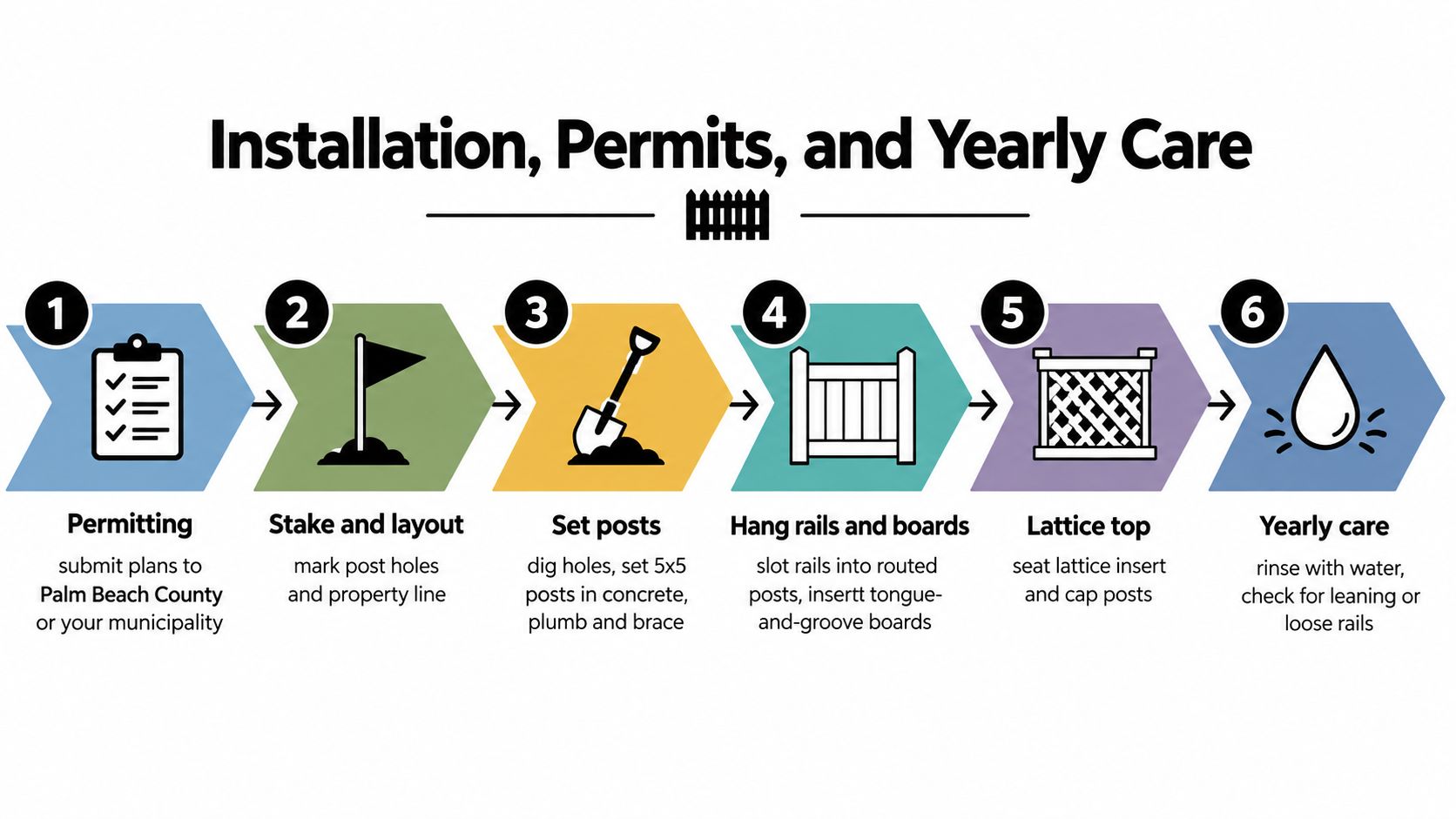
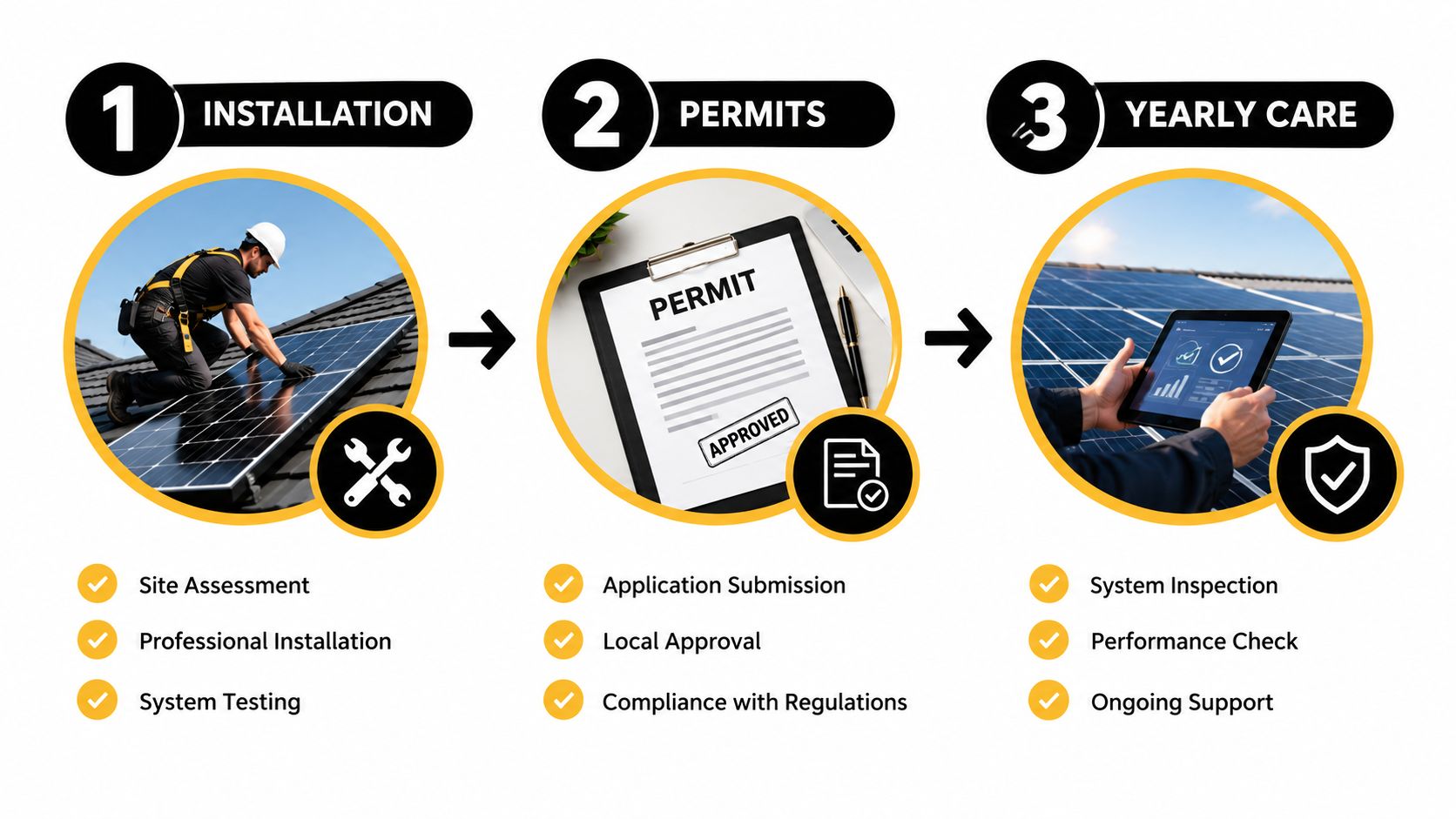
A sound Florida installation begins before the first post hole. The contractor confirms the property line, checks HOA requirements, submits the permit package to the applicable municipality or county, and arranges the 811 utility locate. Irrigation, outdoor lighting, cable, and other buried services are common in established yards, so a clean-looking property can still contain installation hazards.
The layout then determines where gates, corners, transitions, and posts will sit. Standard systems often use eight-foot spacing, while exposed locations may need closer spacing, deeper footers, or internal aluminum stiffeners. The actual spacing and reinforcement should come from the product's tested instructions and the local wind requirements, not from a generic estimate.
What the crew should do
- Stake the line: Mark the property boundary, gate openings, corners, and changes in grade.
- Set routed posts: Place posts plumb in concrete at the specified embedment and brace them while the concrete cures.
- Engage the rails: Insert rails fully into the routed posts and use the manufacturer's clips, screws, or set screws.
- Build the crown: Seat the lattice in the middle channel, install the top rail, and secure the cap and post tops.
- Coordinate inspection: Keep the installation accessible for any required post-depth or wind-load inspection.
The installation instructions specify that rails should penetrate the posts 1.5 inches on each side and be secured with a set screw or rail clip, while the lattice is captured in channels and the top channel is fastened over it. These connection details are explained in the vinyl privacy fence installation instructions.
A manageable care routine
Rinse the fence with a garden hose twice a year and use mild soap for visible grime. Pressure washing above 1,500 psi can damage surfaces or force water into vulnerable connections, so gentle cleaning is the safer approach. Each spring, check post caps, gate hinges, latches, rails, and areas where soil has shifted after a named storm.
A UV protectant can help slow chalking on tan or gray panels when applied according to the product label. After severe weather, look for lifted concrete footers, leaning posts, loose rails, and gate sag. Soil around a shifted post may need careful re-tamping, but a post that has lost alignment may require professional resetting.
Homeowners comparing installation providers can review residential fence installation services and ask for the permit, locate, fastening, and inspection responsibilities in writing.
Realistic Florida Cost Estimates
Lattice-top vinyl pricing varies with color, height, gate design, access, soil, and wind-zone requirements. Material-only pricing for white privacy fencing with a one-foot lattice section commonly falls around $35 to $55 per linear foot, while tan and wood-grain finishes may add 15% to 25%. These ranges are regional planning figures, not a substitute for a site-specific quote.
Installed pricing for a standard six-foot panel with a 12-inch lattice section and top rail cap commonly lands between $55 and $85 per linear foot in Palm Beach, Martin, and St. Lucie counties when the dig is clean, roots don't interfere, and posts use ordinary spacing. Gates create a separate cost category because hinges, latches, framing, alignment, and wind exposure add labor and hardware.
| Cost Component | Typical Range | Notes |
|---|---|---|
| White privacy with one-foot lattice, materials only | $35 to $55 per linear foot | Product, rails, posts, lattice, and standard components |
| Tan or wood-grain material upgrade | 15% to 25% additional | Finish and product-line premium |
| Standard installed fence | $55 to $85 per linear foot | Assumes accessible digging and standard layout |
| Single four-foot walk gate | $400 to $700 | Hardware and matching infill affect the quote |
| Twelve-foot arched driveway gate | $1,800 to $3,200 | Matching lattice and gate engineering add cost |
| Permitting and 811 fees | $75 to $250 | Jurisdiction and project conditions determine the amount |
| Full-yard example in Port St. Lucie | $13,500 to $16,500 installed | 180 linear feet, tan fence, one walk gate, and one double drive gate |
| Coastal wind-zone upgrades | 10% to 20% additional | Closer posts, aluminum inserts, or deeper footers |
Those figures should be compared line by line. A low per-foot price may exclude gates, permit handling, demolition, difficult roots, haul-away, reinforcement, or inspection coordination. A proper proposal identifies the lattice height, color, cap, post spacing, insert specification, gate hardware, and allowances for site obstacles.
Is Lattice Top Vinyl the Right Choice for You
Lattice-top vinyl makes sense when the homeowner wants privacy without the visual weight of a completely solid wall. The solid base protects the primary sightlines around a pool, patio, or backyard, while the decorative crown helps the fence relate to landscaping and the home's architecture. It's also a sensible fit when an HOA accepts decorative privacy profiles but limits an unbroken solid appearance.
A solid vinyl panel deserves serious consideration on a highly exposed lot. If maximum wind performance matters more than airflow and ornament, a shorter or fully engineered solid system may be the better purchase. Aluminum is often the stronger alternative when the priority is open sightlines, corrosion-resistant structure, pool visibility, or a code-driven enclosure rather than backyard privacy.
| Fence Type | Privacy | Wind Performance | Salt-Air Resistance | Maintenance | Florida Fit |
|---|---|---|---|---|---|
| Vinyl with lattice top | High below the crown | Requires system-specific reinforcement | Good with suitable hardware | Low, with periodic washing | Strong for decorative privacy yards |
| Solid vinyl | Very high | Often stronger than lattice versions when properly reinforced | Good with suitable hardware | Low | Better where privacy and wall-like screening dominate |
| Wood privacy | High when boards remain sound | Depends heavily on construction and condition | Fasteners and boards need attention | High | Familiar appearance, but demanding near the coast |
| Aluminum | Low to moderate, depending on design | Strong when engineered for the application | Very good with corrosion-resistant finishes | Low | Strong for pools, views, and open boundaries |
Distance from the coast, prevailing breezes, lot elevation, drainage, and the sightline from a second-story neighbor all matter. A property near open exposure or salt spray may need a structural review before the decorative profile is selected. A sheltered interior lot may have more flexibility.
The decision rule is simple: choose lattice-top vinyl when privacy, airflow, and a finished architectural look outweigh the need for the highest possible wind rating. Choose solid vinyl when screening and structural simplicity lead. Choose aluminum when visibility, pool safety, salt-air exposure, or an open boundary matters more than privacy.
Your Lattice Top Vinyl Fence Checklist
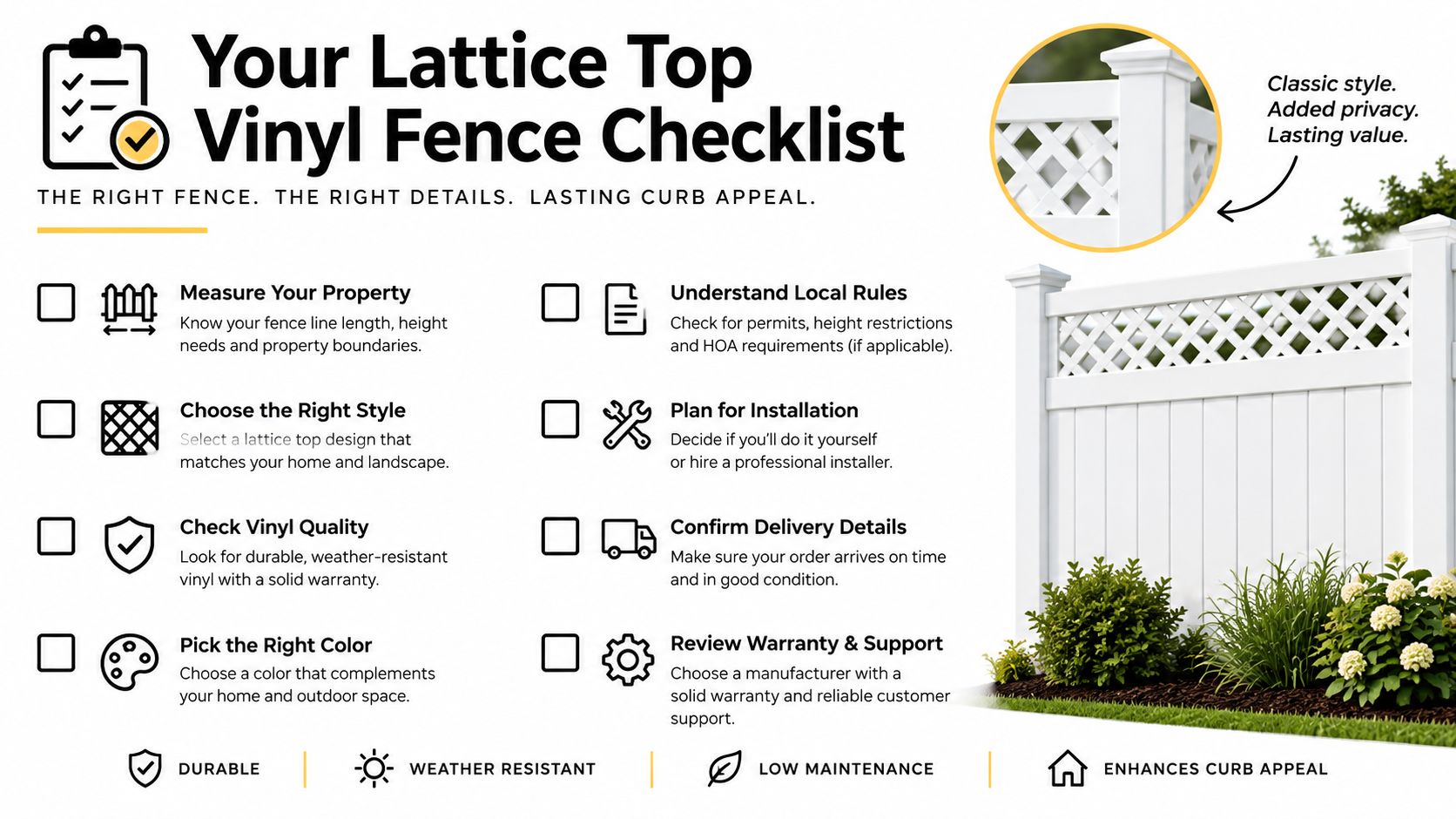
Before signing, the homeowner should be able to answer each question without relying on a verbal promise. The finished fence is a system, and the contract should identify the parts that control appearance, compliance, and storm performance.
Approval and property checks
- HOA submission: Confirm the approved color, lattice pattern, cap, total height, and property-line treatment.
- County or municipal permit: Verify the permit path for the specific address in St. Lucie, Martin, Indian River, or Palm Beach County.
- 811 locate: Require the utility locate before digging, including irrigation and low-voltage lines.
- Survey confirmation: Compare the proposed line with the survey, easements, drainage features, and existing walls.
- Wind-zone review: Ask which tested assembly, reinforcement, embedment, and spacing apply to the property.
- Gate plan: Show walk gates, drive gates, latch height, swing clearance, and any pool-safety requirements.
Product and appearance decisions
Select the lattice height before the estimate is finalized. A one-foot crown may be enough for decoration, while a two-foot crown creates a stronger architectural statement and can change total-height approval.
Choose the cap profile, then review a full-size color sample in direct Florida sun. White, almond, gray, and wood-grain finishes can look different beside stucco, pavers, roof tile, and landscaping. The written quote should also name the manufacturer, panel height, lattice style, post size, rails, reinforcement, fasteners, and warranty terms.
Contractor questions
- Who pulls the permit: The agreement should name the responsible party and inspection coordinator.
- What is inside the posts: Ask whether aluminum inserts or another reinforcement method is required.
- How are rails secured: Look for the manufacturer's specified clips, screws, or set screws rather than friction-fit language.
- What happens after a storm: Confirm whether alignment checks, gate adjustments, and damaged-panel repairs are available.
- What is excluded: Clarify demolition, roots, concrete removal, tree work, haul-away, survey work, and difficult access.
- How are changes documented: Require revised pricing before extra work begins.
A lattice-top vinyl fence is a strong match when the yard needs privacy but the owners don't want a blank barrier. It's a weaker choice when the site demands the maximum available wind rating and the decorative crown adds unnecessary exposure. The quote should settle that trade-off with documented product details, not optimistic sales language.
AlliedFenceAndGate.com™ handles vinyl fence projects across Florida's Treasure Coast and northern Palm Beach County, including site assessment, permitting, 811 utility locates, inspection coordination, and digital estimates. Homeowners can compare lattice height, color, gate layout, and wind-zone requirements by visiting AlliedFenceAndGate.com™ before scheduling a project.
Related Fencing Services
Need a fence or gate on the Treasure Coast?
Licensed, insured, and bonded. Free estimates across Martin, St. Lucie, Indian River & Palm Beach counties.
Call (772) 530-3127