Chain Link Fence Vinyl Coated: Florida Buyer's Guide
A black chain link fence can look finished on installation day and still be the wrong specification for a coastal yard in Stuart, Jupiter, or Palm Beach Gardens. Color hides a lot. It doesn't tell an owner how thick the steel core is, whether the vinyl is bonded or extruded over the wire, or whether the posts, ties, and gate hinges received the same corrosion protection as the mesh.
Table of Contents
- Why Your Vinyl-Coated Chain Link May Already Be Failing
- What Vinyl-Coated Chain Link Is Actually Made Of
- ASTM F668 Coating Classes Explained
- Galvanized vs Aluminized vs Vinyl-Coated
- Coastal Florida Durability and Lifespan
- Color Options Beyond Black and Green
- What Vinyl-Coated Chain Link Actually Costs
- Which System Fits Your Property
Why Your Vinyl-Coated Chain Link May Already Be Failing
A common Treasure Coast pattern starts with good intentions. A homeowner chooses black vinyl-coated chain link because it disappears against landscaping and looks less industrial than silver mesh. A few seasons later, white corrosion shows along the bottom rail, orange spots appear at cut ends, and the gate hinges look older than the fence itself.
That pattern doesn't mean vinyl failed everywhere. It usually means the mesh received an upgrade that the rest of the system didn't. Bottom rails sit near wet soil and irrigation overspray. Cut ends expose steel where fabric was trimmed in the field. Hinges, latches, tension bands, and tie wires take movement and abrasion that intact fabric in the middle of a run never sees.
The Four Decisions That Outrank Color
Long-term performance turns on four linked choices. The coating class controls how well vinyl stays attached. The core wire determines strength under the coating. The framework carries wind and gate loads. The accessory hardware often becomes the first visible corrosion point because it's handled, tightened, struck, and drilled.
- Coating class: Bonded or fused systems resist peeling better than loose extruded coatings when fabric is bent or cut.
- Core wire: Gauge should describe the metallic-coated steel core, not just the fatter outside diameter after vinyl is added.
- Framework and hardware: Posts, rails, ties, hinges, and latches need compatible protection, especially near saltwater.
Owners who already see early corrosion should separate cosmetic discoloration from coating breaches and structural rust before assuming the whole fence needs replacement. A practical starting point is reviewing how chain link fence rust develops and where it spreads first, then checking gates and ground contact points closely.
A premium mesh coating can't compensate for unprotected ties, hinges, or cut ends.
The showroom sample answers the easiest question, which color looks best. The spec sheet answers the expensive ones. For a chain link fence vinyl coated system in humid Florida, buyers should compare class, core, framework, and hardware before they compare black against green.
What Vinyl-Coated Chain Link Is Actually Made Of
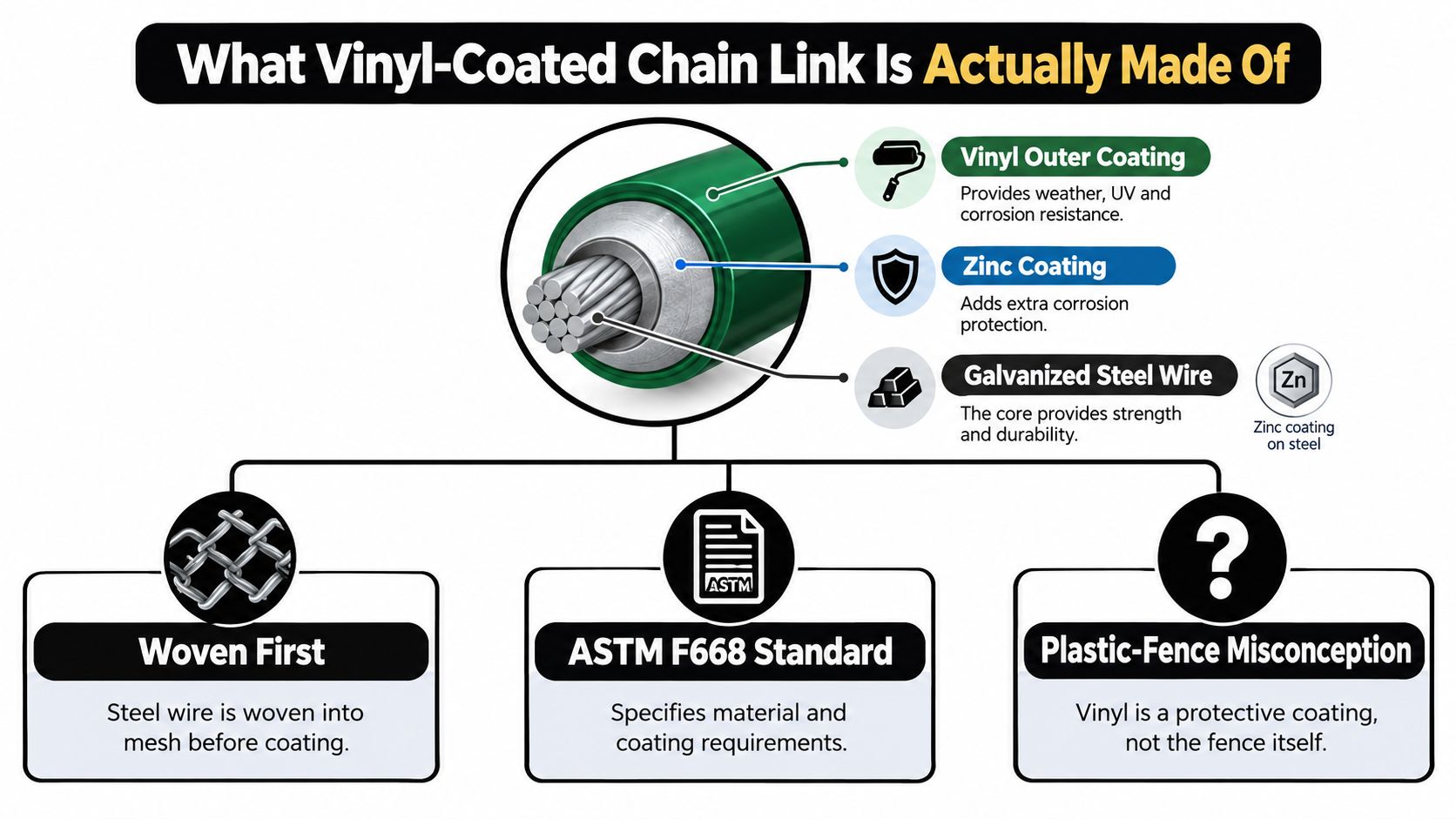
Vinyl-coated chain link isn't a plastic fence. It's a layered steel product with a metallic coating under a polymer jacket. ASTM F668 covers PVC and other organic-polymer-coated steel chain-link fabric, with polymer applied to steel wire before the wire is woven into mesh.
The steel core provides tensile strength and impact resistance. A zinc or other metallic coating gives sacrificial corrosion protection, meaning it corrodes preferentially and slows attack on the steel beneath it. The vinyl layer then adds a physical barrier against moisture, salts, handling, and everyday abrasion.
How To Read Coating Numbers Without Guessing
Canadian standard CAN/CGSB-138.1-2019 requires galvanized steel wire for vinyl-coated fabric and specifies thermal extrusion or fusion. Its benchmarks limit vinyl density to 1.30 g/cm³, set Shore Type A hardness at 93 ± 3, require tensile strength of 18 MPa ± 5%, and require minimum elongation of 275%, as summarized in the ASTM reference above.
Those figures translate into plain buying language. The coating should flex rather than behave like a brittle shell. It should stretch during weaving, tensioning, and minor impact without splitting away from the wire. Hardness matters too, because a coating that's too soft scuffs easily, while one that's too rigid can crack at bends.
Finished diameter can mislead buyers who only hear a gauge label. The same Canadian standard lists a heavy 6-gauge product at 4.88 mm (0.192 in.) finished diameter over a 3.61-mm (0.142-in.) galvanized core, and a medium 9-gauge product at 3.50 mm (0.138 in.) over a 2.41-mm (0.095-in.) core, per the ASTM reference above.
Questions That Belong On Every Quote
- What's the ASTM F668 class: Class 1, Class 2a, or Class 2b?
- What's the core: Zinc-coated, aluminum-coated, or zinc-aluminum coated steel, and what's the core diameter?
- What's included: Are posts, rails, ties, and gate hardware coated to match, or only the fabric?
A quote that only says "black vinyl-coated, 9-gauge finished" hasn't answered the important parts.
ASTM F668 Coating Classes Explained
The three ASTM constructions sound similar until adhesion enters the conversation. ASTM F668 distinguishes Class 1, Class 2a, and Class 2b coating constructions, and it requires coated wire to weave without cracking or peeling of the polymer coating.
Class 1 polymer is extruded over zinc, aluminum, or zinc-5% aluminum-mischmetal-coated steel. Class 2a polymer is extruded and adhered to the metallic-coated wire. Class 2b polymer is fused and adhered. The difference shows up when installers bend selvage, pull fabric tight, cut a gate opening, or repair storm damage.
ASTM F668 Coating Classes at a Glance
| Class | Coating Process | Adhesion | Best Fit | Relative Cost |
|---|---|---|---|---|
| Class 1 | Extruded over metallic-coated wire | Not adhered as a bonded system | Mild exposure, budget residential runs | Lower |
| Class 2a | Extruded and adhered | Bonded to the wire | Florida homes, gates, pool perimeters | Mid to higher |
| Class 2b | Fused and adhered | Thermally fused bond | Commercial, institutional, high-contact lines | Higher |
Thickness alone doesn't settle the comparison. A North American specification describes PVC thickness from 0.015 to 0.025 in. (0.38 to 0.64 mm) and reports bonded fabric produced at 5 ksi (34 MPa) bonding pressure, according to the Master Halco color chain-link specification sheet. A thick but poorly adhered jacket can still lift at a nick.
For most Florida homes, Class 2a is the defensible starting point because adhesion helps at tension points and field cuts. Class 1 can make sense inland where exposure is milder and budget drives the job. Class 2b fits commercial and institutional perimeters where impacts, repairs, and public contact are expected.
Quote language that prevents substitution: Specify ASTM F668 class, mesh opening, core-wire diameter or minimum breaking strength, fabric height, selvage, color, and coating certification.
That wording stops a supplier from hiding a lighter steel core under a larger finished diameter. It also forces an apples-to-apples bid. Without it, two contractors can both say "vinyl-coated" while pricing materially different fences.
Galvanized vs Aluminized vs Vinyl-Coated
Galvanized, aluminized, and vinyl-coated chain link all start with steel wire, but they manage corrosion differently. Galvanized fabric relies on zinc. Aluminized fabric uses an aluminum coating on steel. Vinyl-coated fabric combines a metallic-coated core with a PVC barrier and color.
Galvanized remains the straightforward workhorse for inland utility runs, storage yards, and budget-driven commercial perimeters. It has no polymer jacket to peel, and damage is easy to see. The trade-off is appearance and faster zinc consumption where salt, fertilizer, and constant humidity keep the surface active.
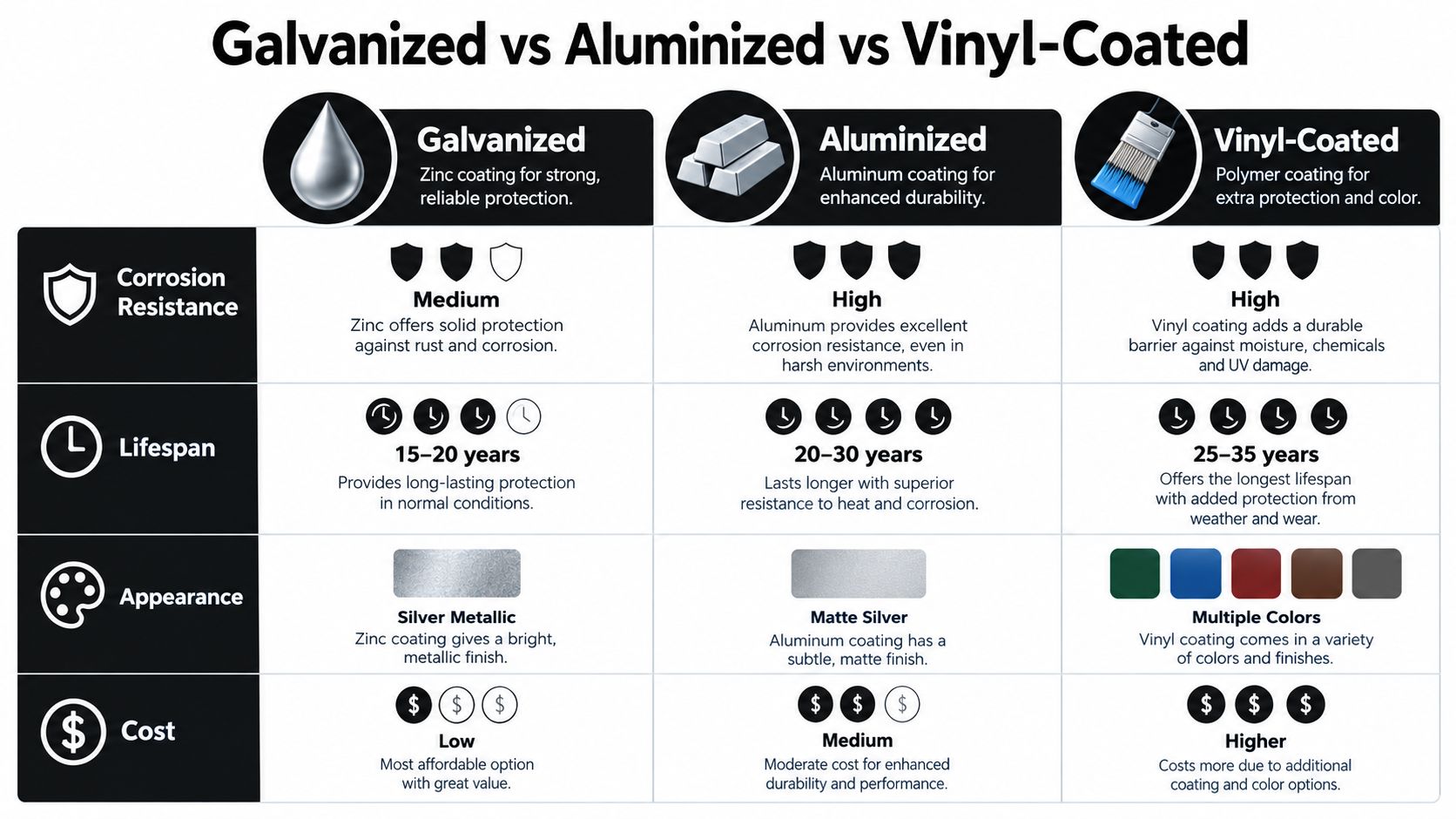
Aluminized steel deserves more attention on the coast than it usually gets. It keeps a metallic silver appearance and avoids the plastic look some owners dislike. For buyers comparing regional material options, Florida fence products suited to heat, humidity, and coastal exposure provides useful context beyond chain link alone.
Where Each System Earns Its Cost
- Galvanized: Best when visibility, low upfront cost, and easy repair matter more than appearance.
- Aluminized: Strong candidate for coastal owners who want metallic fabric without a colored polymer jacket.
- Vinyl-coated: Best when curb appeal, HOA acceptance, pool surroundings, or a softer residential look justify the premium.
A black vinyl-coated run around a Stuart backyard pool solves a different problem than a galvanized security line at an industrial yard off Federal Highway. The pool owner needs appearance, comfortable touch, and code compliance. The industrial owner needs height, heavy core wire, repairability, and hardware that tolerates trucks and gates.
Price follows specification, not just finish. Vinyl-coated fabric costs more than plain galvanized, but posts, rails, gates, and hardware can narrow or widen that gap quickly. The right comparison is complete system against complete system, with the same height, core gauge, framework, and gate count.
Coastal Florida Durability and Lifespan
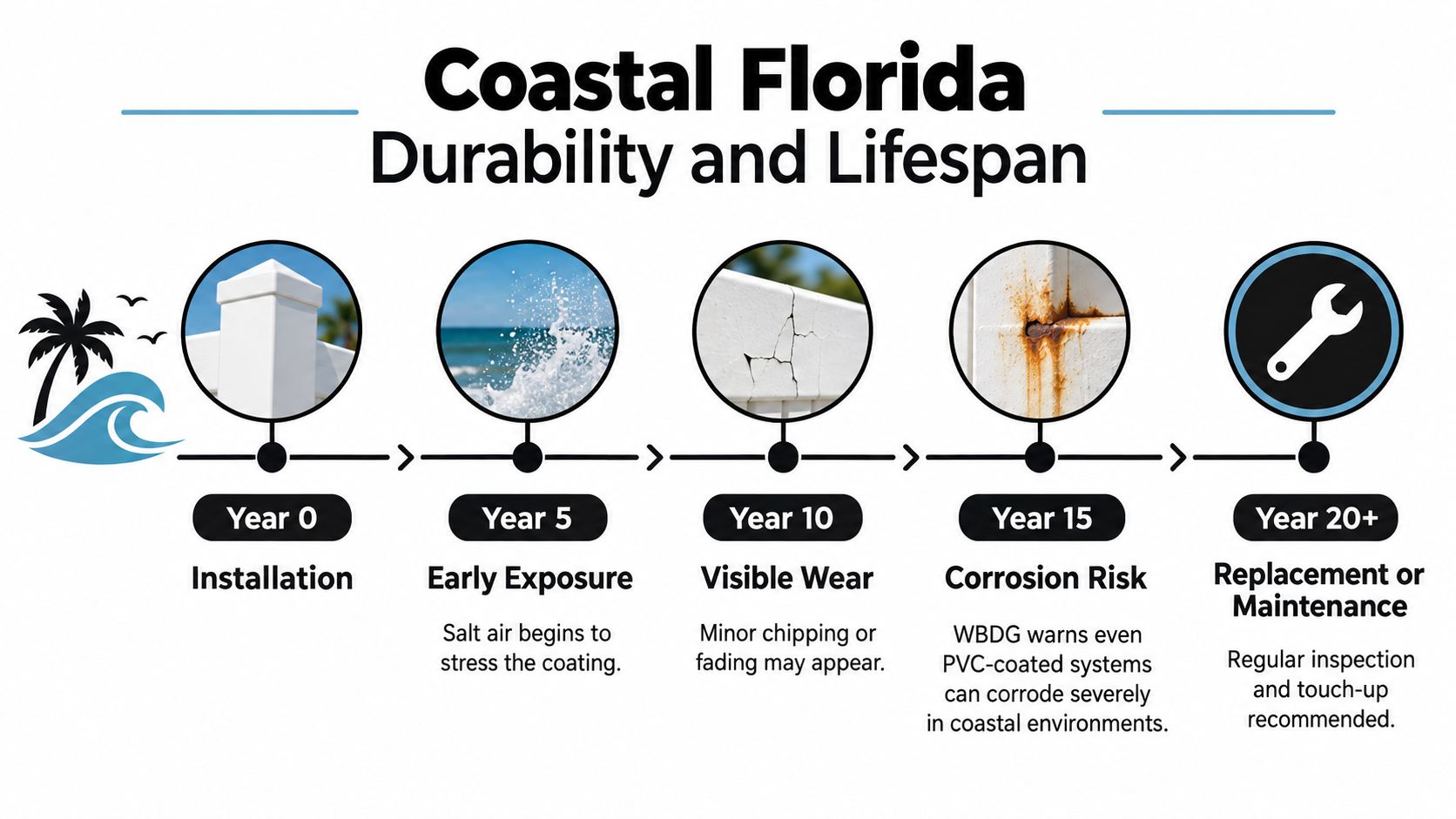
Federal corrosion guidance should temper any maintenance-free promise. The WBDG fencing knowledge area on corrosion prevention warns that even galvanized chain-link systems, including PVC-coated products, can experience severe corrosion in warm, humid, chloride-rich coastal environments in as little as five years.
That warning doesn't condemn every coastal vinyl-coated fence. It explains why exposure severity and small breaches matter so much. Intact vinyl separates the metallic coating from salt and moisture. A string-trimmer nick, mower strike, storm-debris cut, loose tie, or untreated cut end breaks that separation at exactly the point where water collects.
A Practical Inspection Routine
Owners near the Intracoastal, inlets, or open Atlantic exposure should inspect after named storms and during routine yard work. Salt deposits, lifted coating, cracked bends, rust at the soil line, and stiff gate hardware are early warnings. Freshwater rinsing helps where visible salt accumulates, especially on low rails and gate frames.
- After storms: Walk both sides, check for debris cuts, bent fabric, loose ties, and shifted posts.
- At ground level: Clear mulch and soil away from bottom wire where practical, then look for coating damage.
- At gates: Cycle each gate, inspect hinges and latches, and seal or replace damaged components promptly.
Vinyl performance depends on intact coating, full-system corrosion design, exposure severity, and maintenance. It isn't a permanent exemption from Florida weather.
Full-system upgrades change the math because they remove weak links. Coated framework, compatible ties, protected cut ends, and corrosion-resistant gate hardware keep one cheap component from staining or undermining better fabric. In severe waterfront or chemically aggressive settings, owners should also compare aluminum-coated steel, higher-grade bonded PVC, aluminum fencing, or nonmetallic alternatives before assuming vinyl-coated steel is automatically the longest-lived choice.
Color Options Beyond Black and Green
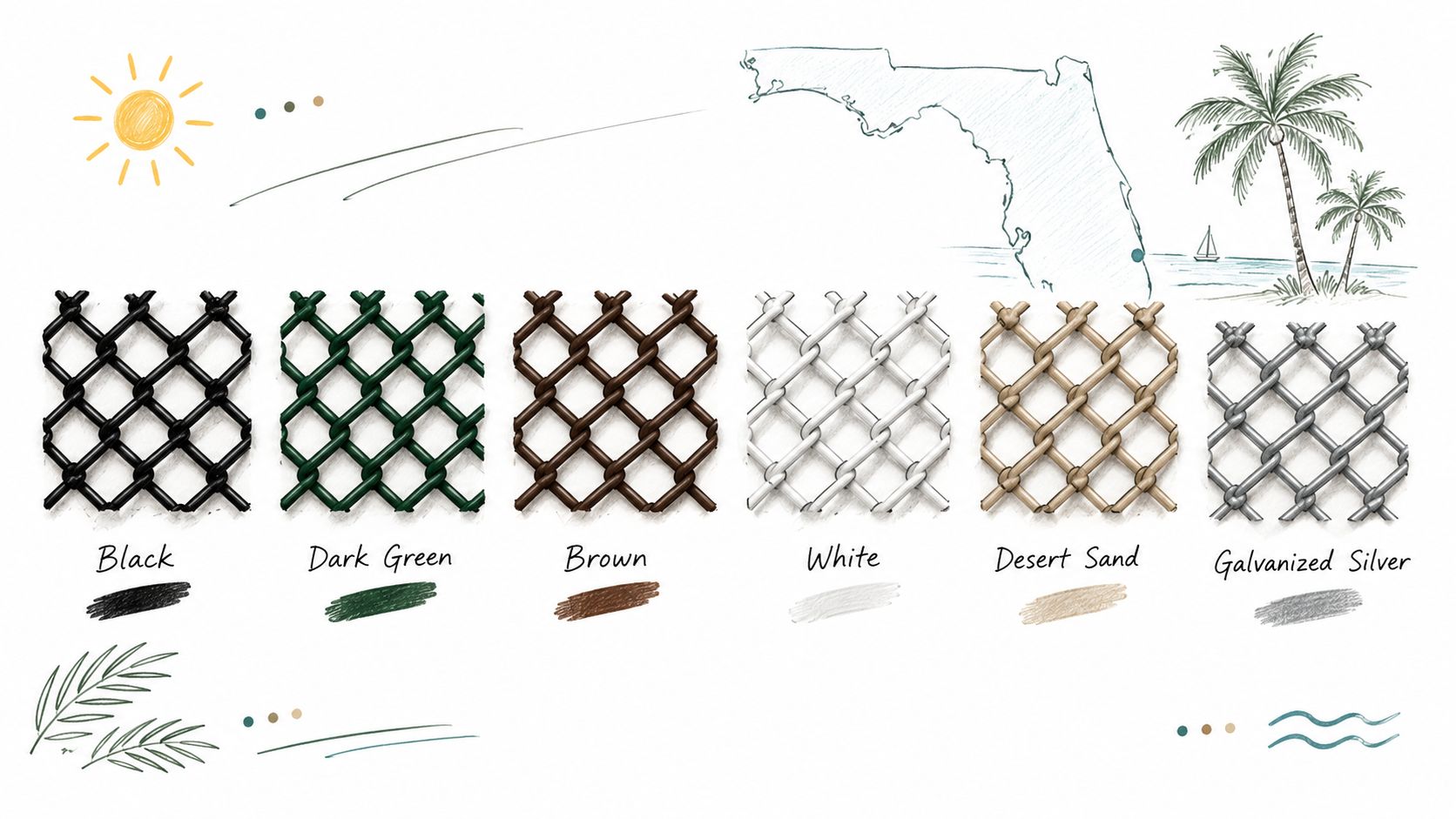
Modern vinyl-coated chain link is commonly offered in black, dark green, brown, white, and desert sand, alongside galvanized-only fabric for owners who prefer exposed metal. Color is pigment within the coating system. It doesn't upgrade a Class 1 product into a bonded Class 2a or fused Class 2b fabric.
Black remains popular because it recedes against hedges, shade, and water views. Dark green blends with dense planting. Brown suits wooded lots and earth-tone architecture. White and desert sand can match lighter stucco and coastal palettes, but they demand closer attention to mildew, irrigation staining, and visible grime.
Sun, Salt, and HOA Rules
Dark colors hide many scuffs but can show salt residue and surface chalking in hard sun. Lighter colors hide salt better, yet mold and algae stand out faster under oaks and near sprinklers. Framework and fittings should match the fabric color plan, because silver posts behind black mesh defeat the visual reason for paying for colored fabric.
HOA approval can narrow the palette before durability enters the discussion. Treasure Coast and Palm Beach communities often favor black or dark green where chain link is allowed at all. Owners should confirm approved colors, height, visibility from streets or waterways, and whether privacy slats are permitted.
Pool barriers add a separate rule set. Florida pool-barrier guidance requires a barrier at least 48 inches high, bottom clearance no greater than 2 inches, and openings that don't pass a 4-inch-diameter sphere, according to the Florida Building Commission pool barrier outline. For chain link, maximum mesh is a 2¼-inch square unless slats attached at the top or bottom reduce openings to no more than 1¾ inches, per that same outline.
Color selection therefore often becomes a paired decision with slats, mesh size, and gate hardware. The coating doesn't replace opening-size or climbability requirements.
What Vinyl-Coated Chain Link Actually Costs
Published pricing gives owners a sane starting range before site conditions enter the quote. AlliedFenceAndGate.com publishes starting price ranges of $22–$50 per linear foot for chain link fencing, including vinyl-coated upgrades, with line-item transparency through its digital estimator. Owners comparing bids can use chain link fence installation cost per foot factors to separate material choices from labor and site costs.
That range isn't a promise for every property. Height is an immediate driver, because taller fabric needs stronger posts, larger footings, and more labor. Mesh size, core gauge, coating class, framework coating, and gate count move the number further. A short residential run with multiple corners and gates can cost more per foot than a long straight commercial line.
Line Items That Swing a Quote
- Fabric specification: Core gauge, mesh opening, ASTM F668 class, and color.
- Framework: Post diameter and wall thickness, top rail or tension wire, bottom rail, and coating.
- Gates and hardware: Walk gates, double-drive gates, self-closing pool hardware, hinges, and latches.
- Add-ons and compliance: Privacy slats, barbed wire where allowed, permitting, utility locates, removal, and difficult access.
The mesh is rarely where surprise costs land. Posts, ties, hinges, corners, and gates create most of the spread between two "same fence" quotes.
A low bid deserves questions if it doesn't name the core gauge and coating class. A higher bid also deserves questions if it upgrades fabric but leaves ordinary hardware at the gate. Fair pricing is visible pricing. Each bidder should itemize fabric, posts, rails, fittings, gates, slats, removal, permitting, and warranty exclusions so owners can see what the premium buys.
Contractors serving Martin and Palm Beach Counties also have to coordinate permits and 811 utility locates. Those steps aren't decorative paperwork. They affect scheduling, inspection readiness, and whether a post hole becomes an expensive underground surprise.
Which System Fits Your Property
The right recommendation changes with exposure, appearance rules, and how hard the fence will be used. A chain link fence vinyl coated in a bonded class suits many Florida homes, but it isn't the automatic winner for every shoreline or security perimeter.
Situational Recommendations
Coastal residential near saltwater calls for a bonded Class 2a or fused Class 2b fabric, coated framework, compatible ties, and corrosion-resistant gate hardware. Owners should budget for rinsing and inspections rather than treating the purchase as maintenance-free. On severe beachfront exposure, aluminum fencing or aluminum-coated steel may be the more honest long-term comparison.
Inland HOA neighborhoods often favor black or dark green Class 2a fabric because appearance matters and salt exposure is less aggressive. The priority is confirming HOA color and height approval before ordering material. Class 1 may be acceptable for low-contact side yards, but gates still justify better hardware.
Commercial security perimeters need height, heavier core wire, strong terminal posts, and repairable components. Oakland Park permitting materials state that chain-link fences over 12 feet high must be designed under Florida Building Code section FBC 1616.1, while fences less than 12 feet may follow Table 2224, according to the Oakland Park fence and gate permit packet. That threshold makes tall security work an engineering conversation, not just a taller version of a backyard fence.
Pool barriers need compliant mesh or slats, self-closing and self-latching gates, and hardware children can't easily defeat. Appearance matters, but code dimensions decide whether the installation passes inspection.
Pre-Install Checklist for Any Contractor
- ASTM F668 class: Class 1, 2a, or 2b, stated in writing.
- Core specification: Metallic coating type, core-wire gauge or diameter, and mesh size.
- Framework specification: Post and rail sizes, coatings, footing approach, and spacing.
- Hardware specification: Ties, bands, hinges, latches, and gate frame material.
- Warranty details: Exclusions, coating coverage, hardware coverage, and repair procedure for nicks.
Vinyl-coated chain link is the wrong buy when the quote won't identify its class, when accessories remain unprotected in salt air, or when an owner expects zero inspection on a waterfront lot. It's a strong buy when the full system is specified as one corrosion strategy.
#StuartFencing #JupiterFencing #MartinCountyFencing #PalmBeachCountyFencing #TreasureCoastFencing #PalmBeachGardensFencing #PortStLucieFencing #HobeSoundFencing #TequestaFencing #ChainLinkFence #VinylCoatedChainLink #FloridaFenceContractor
For a vinyl-coated chain link quote that names the ASTM F668 class, core gauge, framework, and gate hardware instead of hiding behind a color name, visit AlliedFenceAndGate.com™ to use the digital estimator and request a site-specific proposal. Allied handles permitting, 811 locates, and inspection coordination for residential and commercial fencing across Florida's Treasure Coast and northern Palm Beach County.
Related Fencing Services
Need a fence or gate on the Treasure Coast?
Licensed, insured, and bonded. Free estimates across Martin, St. Lucie, Indian River & Palm Beach counties.
Call (772) 530-3127