Aluminum Fence Double Gate Guide for Florida Homeowners
A driveway gate that clears a trailer on moving day can become a daily nuisance if its leaves sag, scrape, or miss the latch. The same problem matters even more at a Florida pool enclosure, where a gate that looks closed may not be securely latched. A well-planned aluminum fence double gate is not just a wider opening. It's two moving leaves, their hardware, the posts, and the applicable safety requirements working together.
The key decisions are practical: what needs to pass through, which leaf opens most often, how the center meeting point is secured, and whether the finished gate can meet pool-safety or accessibility requirements. Getting those details right before fabrication makes the difference between a gate that works on paper and one that operates reliably on site.
Table of Contents
- Why a Double Gate Is a Different Decision Than a Single Gate
- How a Double Gate Is Actually Built
- Florida Code Numbers That Shape the Gate
- Sizing the Opening and the Active Leaf
- Hardware That Holds Up to Coastal Florida
- Thermal Movement, Posts, and Long-Term Alignment
- Pricing Drivers and What to Budget in Florida
- From Quote to Working Gate on Site
Why a Double Gate Is a Different Decision Than a Single Gate
A homeowner with a wide driveway may want enough room for a boat trailer without maneuvering close to a fence post. A pool owner might need occasional access for equipment while keeping the everyday pedestrian route convenient. At a commercial property, a service entrance may need to admit a truck now and then, even though residents use only one side of the opening. In each case, two leaves can make sense, but the decision isn't based only on making a gate wider.
A double gate has two independently moving leaves that must meet at the center. Each needs support from its own hinges and post, and the pair has to close into alignment so the center hardware and latch can do their jobs. A wide opening can also put more demand on the posts and hardware than a pedestrian gate, especially when wind pushes against solid or closely spaced infill.
A double gate works as a system. Treating it like a single gate split in half overlooks the center stop, the inactive leaf's ground anchor, and the need for reliable closure.
Start with the actual use. If equipment or vehicles need the full opening, a double gate may be useful. If people use the entrance every day but wide access is rare, a separate pedestrian gate can reduce wear on the larger assembly. A single engineered leaf might also suit the opening, provided its size, weight, support, and swing space are properly designed.
The right configuration depends on more than the span between posts. Use, traffic, swing clearance, grade, code, and hardware all shape the decision. That's why the planning question is not just “How wide should it be?” It's “How will both leaves stay aligned, secure, and easy to operate?”
How a Double Gate Is Actually Built
The moving parts make more sense when the leaves are named. The active leaf is the side people normally open. It carries the handle and primary latch. The inactive leaf generally stays secured when the full opening isn't needed, using a drop rod or cane bolt that slides into a ground receiver or threshold.
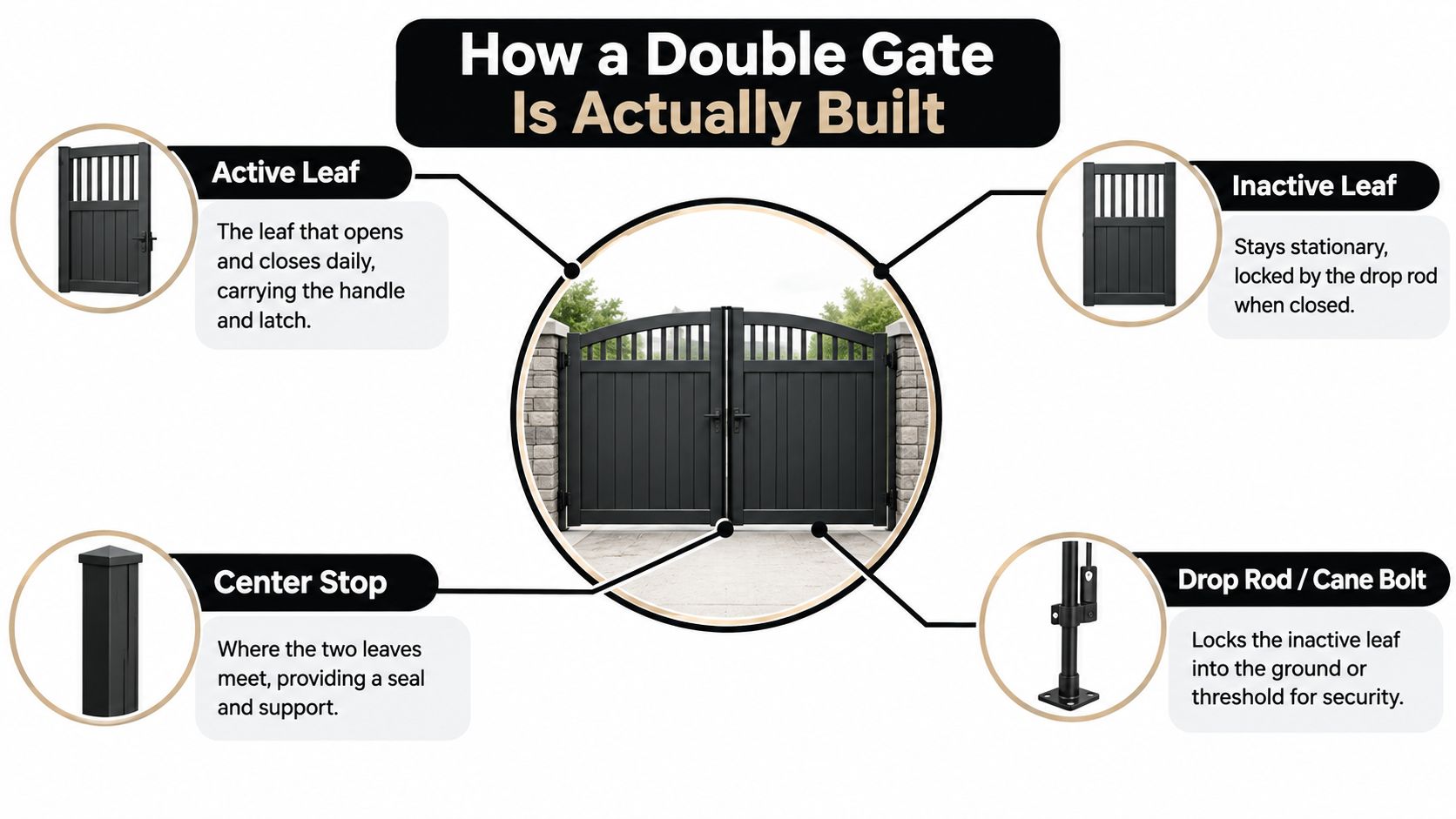
Each leaf hangs from hinges attached to its own post. Those hinges need to suit the leaf's weight and allow adjustment, because a small change in alignment can affect the gap at the center and the latch engagement. The posts, in turn, must be selected and installed for the loads they'll carry, rather than treated like ordinary fence-line supports.
At the center, the leaves meet at a center stop, which gives them a consistent closing position and helps keep the meeting point from drifting. The inactive leaf's drop rod holds that side in place; the active leaf then closes against it and latches. If the two leaves meet unevenly, a latch may appear to engage while the assembly remains unstable, or one side may drag as it swings.
Think through the operating sequence
Decide which leaf should open first, where the inactive leaf locks, and how the active leaf closes and latches. Check that the drop rod can move freely at the finished grade and that paving, slope, landscaping, or debris won't obstruct it. The center stop and latch must work together without forcing the frames into position.
Allied Fence & Gate's aluminum and ADA railing fabrication work reflects a practical principle: hardware and frames need to be specified as a coordinated assembly, not selected as unrelated parts. The same principle applies here. A gate that closes smoothly depends on the relationship between its leaves, hinges, stop, latch, posts, and ground conditions.
Florida Code Numbers That Shape the Gate
For a pool enclosure, safety requirements shape the design before style does. Florida pool-barrier guidance requires an access gate to be self-closing and self-latching, and it must swing outward, away from the pool. The latch release generally needs to be at least 54 inches (1,372 millimeters) above the bottom of the gate. If it's lower, it must be arranged so a young child can't reach it over the gate or through an opening. The Florida pool-barrier guidance also limits openings near the release mechanism to no more than 1/2 inch (12.7 millimeters) within 18 inches (457 millimeters) of that mechanism.
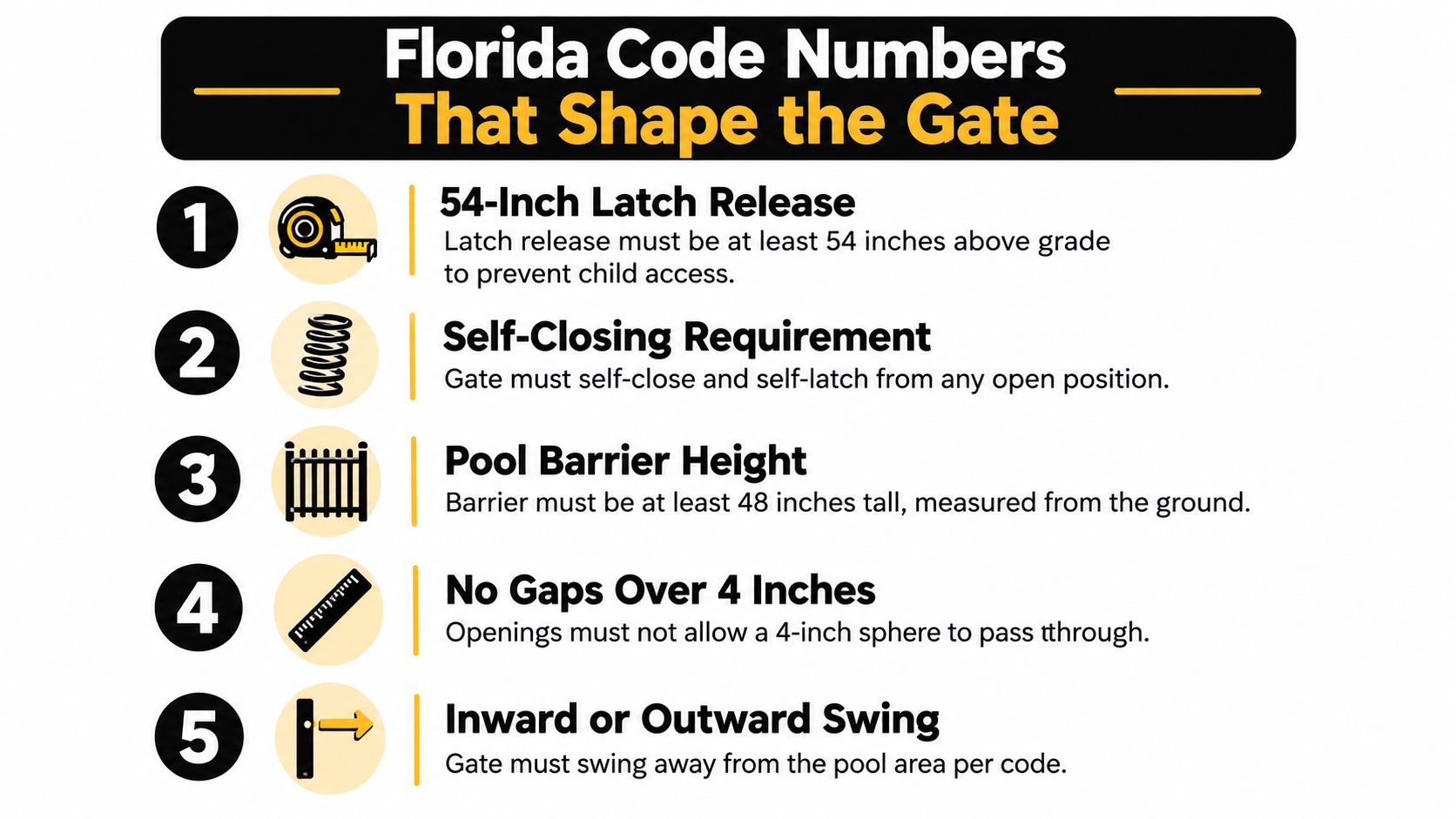
A pool barrier also needs to meet the applicable height requirement. Florida pool-barrier materials and local inspection guidance specify a minimum 4-foot barrier height; the Gainesville inspection form also describes that minimum and identifies self-closing, self-latching hardware and latch placement among the checks for direct-access doors (Gainesville pool-barrier requirements). Confirm the local inspector's measurement method and requirements for the specific enclosure.
Check the complete assembly, not just the latch
On a double gate, the two leaves must align at their meeting point while each closes reliably. A closer that works on one leaf but leaves the other ajar defeats the purpose of self-latching hardware. Check the swing direction, latch release position, center seam, and clearances at the finished grade, not only on the fabrication drawing. For practical latch details, see this guide to pool safety gate latches.
Accessibility adds another design constraint on routes serving commercial, institutional, multifamily, or public-facing spaces. The Access Board specifies that one active leaf of a double-leaf gate must meet the applicable clear-width and maneuvering-clearance requirements. Those measurements are addressed next, because nominal gate dimensions don't tell the whole story.
Sizing the Opening and the Active Leaf
A fabricated leaf's width isn't the same as the clear space people can use. Hinges, stops, posts, and hardware all take up room, so a gate that looks generous on a drawing can leave a narrower passage once installed. On an accessible route, design at least one active leaf to provide a minimum 32-inch (815 mm) clear opening when opened to 90 degrees. The measurement runs from the gate stop to the face of the gate, as set out in the Access Board's guide to entrances, doors, and gates.
That means the nominal active leaf needs to be wider than the required clear passage. The actual amount depends on the hinges, stop, posts, and hardware selected. Verify the finished opening in the field rather than assuming a leaf dimension guarantees usable clearance.
Work backward from the passage
Before ordering, identify what uses the opening and whether people need accessible passage through the active leaf. Then account for the space taken by the hardware stack at both sides: hinge and post at the swing side, latch and receiving hardware at the opposite side, plus the center stop and inactive-leaf drop rod. Confirm the opening at the planned swing angle and check that the approach and maneuvering area isn't blocked by a wall, ramp, sidewalk, vehicle, or landscaping.
If two hinged gates are arranged in series on an accessible route, the required separation is at least 48 inches plus the width of any gate swinging into that space, according to the Access Board's guidance linked above. Coordinate that space before post placement, especially at narrow returns or near ramps and parking areas.
A wider opening can be useful for vehicles and equipment, but it also brings heavier leaves and greater hardware demands. When full-width access is occasional, compare a double gate with a narrower main opening plus a separate pedestrian gate. Choose the configuration that serves the usual traffic well, not just the largest object that might pass through.
Hardware That Holds Up to Coastal Florida
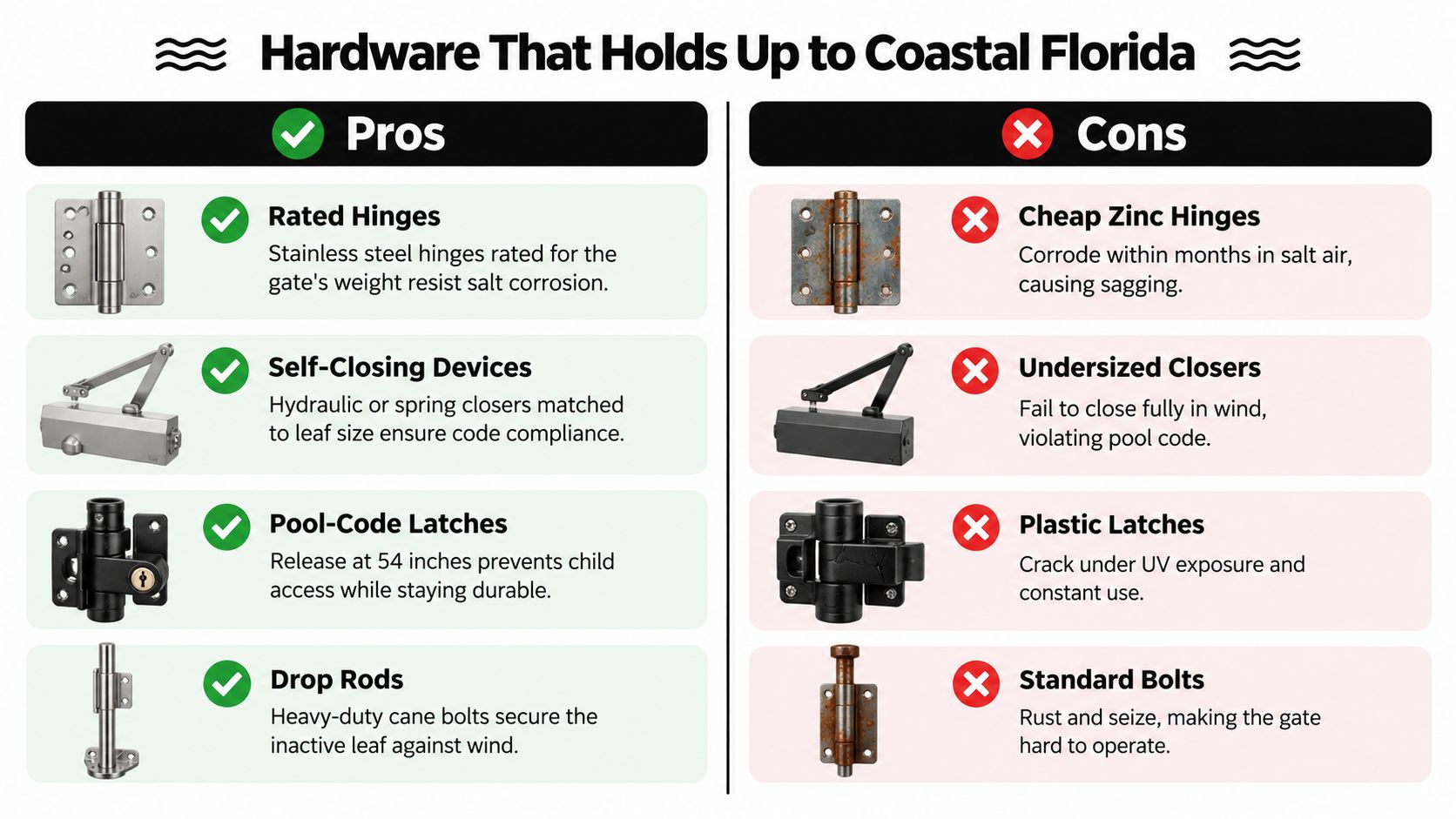
“Aluminum doesn't rust” is an incomplete answer for a gate near salt air. Aluminum forms a protective oxide film, but chloride exposure can undermine that protection and contribute to localized pitting or corrosion beneath coatings in marine environments. Exposure research on marine conditions describes corrosion and changes in material behavior over time (research on marine-exposed aluminum). For homeowners, the practical concern is that hinges, fasteners, latches, and coating edges can become trouble spots even while the gate frame still appears sound.
Match the components and the exposure
Start by matching hinges and closers to the size, weight, and use of each leaf. A pool gate's closer must bring the gate fully shut, while its latch must engage reliably at the required release position. The inactive leaf needs a drop rod that holds it firmly without binding against the paving or receiver. These parts aren't interchangeable details: each affects how the full assembly behaves.
Coastal detailing matters, too. Avoid direct contact between aluminum and dissimilar metals where galvanic corrosion could become a concern, and use appropriate nonconductive isolation where needed. Don't set aluminum directly against wet concrete; concrete alkalinity can attack the metal. Keep post bases drained, and avoid details that trap standing water, soil, or salt around fasteners and coating edges. Coating quality and installation details can matter as much as the alloy label.
For Treasure Coast properties, establish a regular wash-and-inspect routine suited to the exposure. Rinse away salt and grime, then look over the hinge points, latch, fasteners, coating interfaces, and post bases. Ask the installer which components are compatible with the gate system and how to isolate adjacent materials. A guide to gate hinges and hardware can help frame those questions, but the final selection should match the actual gate and site.
Thermal Movement, Posts, and Long-Term Alignment
Aluminum expands as it warms, and the amount depends on the alloy. NIST testing reports that measured expansion curves increase with temperature and that additions such as beryllium, copper, or silicon reduce aluminum's expansion coefficient (NIST research on aluminum expansion). On a double gate, even modest movement can matter at the center meeting point, where the two leaves need to align and the latch needs enough engagement.
A gate adjusted tightly during mild weather may bind at the meeting stile in hotter conditions. Too much clearance can also create problems, including poor security or unreliable latching. Dark finishes, direct sun, long frame runs, and dissimilar materials can make careful allowance more important.
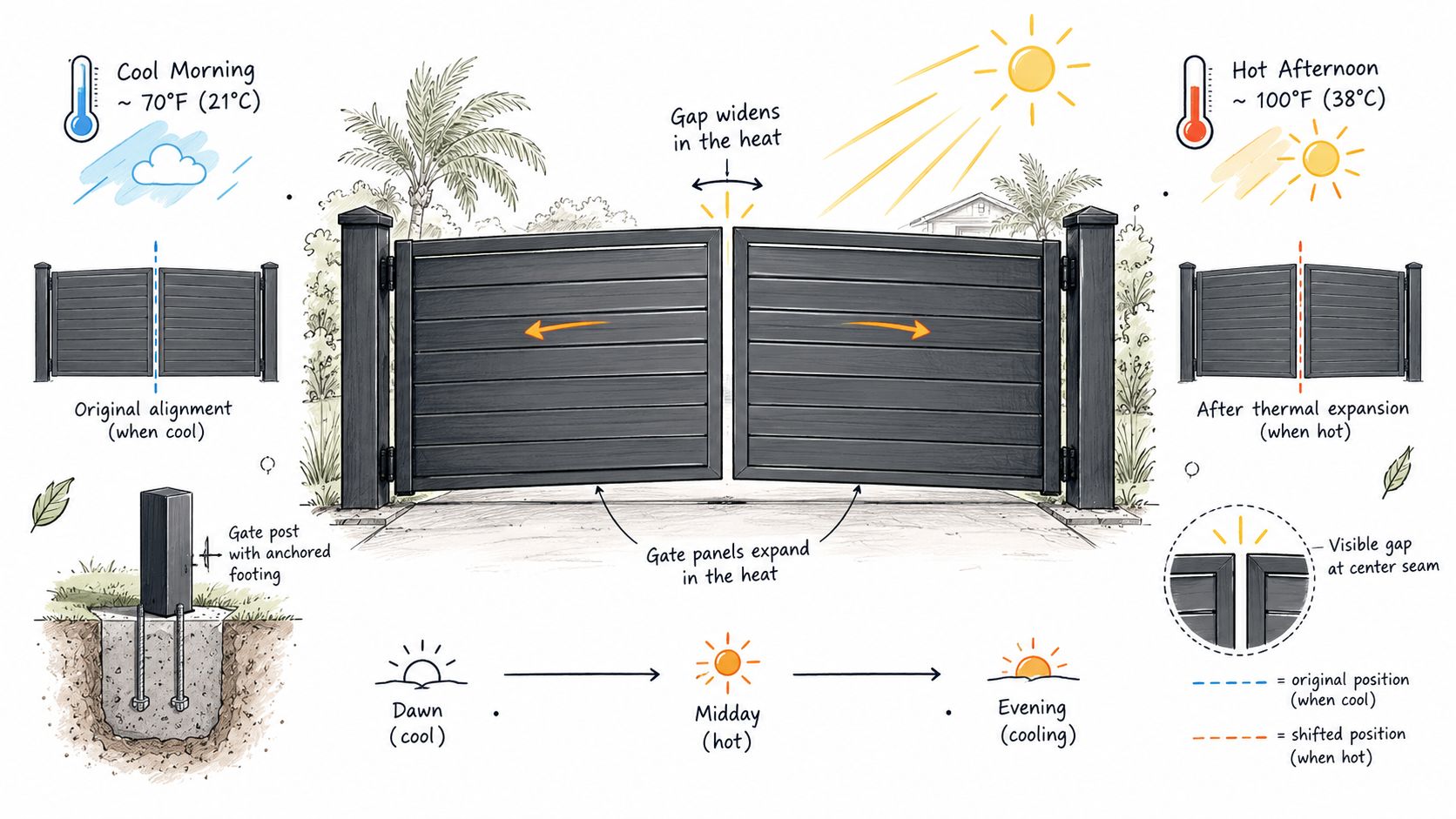
Posts are part of the alignment calculation. Each one supports a leaf, and deflection under the leaf's weight or wind pressure can change the gap and latch position. At the same time, poor drainage around a post base can expose hardware and metal interfaces to standing water and trapped salt.
Specify adjustable hinges, compatible components, and a latch with suitable engagement. Check that the inactive leaf's drop rod has room to operate across the ground conditions, and that neither leaf is forced into alignment by the center stop. Before handover, test both leaves through their full swing range and verify that they close and latch without scraping or binding.
Pricing Drivers and What to Budget in Florida
Allied Fence & Gate publishes an aluminum fencing range of $28 to $150 per foot. That's a starting reference for fencing, not a quote for a complete double-gate installation; gate configuration, hardware, posts, site work, and permitting can change the project total. The aluminum fence price-per-foot guide explains the broad range, while a project estimate needs the opening and site details.
| Driver | Effect on Cost | Florida-Specific Note |
|---|---|---|
| Leaf size and frame | Larger leaves can require more robust posts and hardware. | Allow for wind exposure and the planned swing. |
| Picket style and spacing | The chosen design changes fabrication requirements. | Pool enclosures must still meet applicable safety rules. |
| Finish and coating | Finish selection affects the material specification. | Coastal exposure makes coating and detailing important. |
| Posts and center hardware | Wider openings may call for upgraded supports, stops, and drop-rod receivers. | Account for grade, drainage, and meeting-point alignment. |
| Code-rated hardware | Self-closing and self-latching components add project requirements. | Pool-gate details need to match the site and applicable inspection checks. |
| Site preparation | Slope, obstacles, or tree work can add labor. | Utility locates and inspection coordination belong in the project scope. |
A residential driveway may prioritize vehicle or trailer clearance and stronger posts. A pool-enclosure gate has to accommodate the required safety hardware and swing. A small commercial entry may also need an accessible clear opening and maneuvering space. Each scenario shifts the leaf dimensions, hardware, and site requirements, so a single per-foot figure won't capture them all.
Ask whether the quote includes permitting, Notice of Commencement where applicable, 811 utility locates, and inspection coordination. Separate those project costs from the fence material price. A useful estimate should state what's included, which site conditions could change the scope, and how the chosen configuration affects the hardware.
From Quote to Working Gate on Site
A reliable installation starts with the site, not the cut list. A lot survey or clear property photos help establish the opening, fence lines, grade changes, nearby paving, and swing clearance. Allied Fence & Gate offers lot-survey and property-photo uploads with AI-based measurement extraction; those digital measurements can support planning, but the final layout still needs to be checked against the actual site.
Before digging, the project needs utility locates. Allied handles 811 locates on every project, which helps the installation team identify underground services before setting posts. The posts should then be sized and placed for the two-leaf opening, the loads each side carries, and the planned hinge locations. A double gate's center line, stop, and drop-rod receiver should be considered before the posts are fixed in place.
Installation checks that affect operation
Once the supports are ready, the installer mounts the leaves and adjusts the hinges so each moves freely and meets the center consistently. The closer and latch are installed to their manufacturer requirements, with the active and inactive leaves operating in the intended order. The drop rod must secure the inactive leaf without binding on the finished paving or grade.
For pool access, verify the outward swing, self-closing action, self-latching engagement, and latch-release position against the applicable requirements. For an accessible route, measure the usable opening at the completed gate and confirm the approach and maneuvering space. These checks belong at the installed gate, not just on the fabrication drawing.
Take these decisions to the contractor meeting
- Use case: Describe what needs to pass through and how often full-width access is needed.
- Opening and leaf plan: Confirm the clear opening, active and inactive leaf, swing direction, center stop, and drop-rod location.
- Compliance: Identify pool-barrier or accessibility requirements that apply, then agree how they'll be verified at the finished grade.
- Hardware and site conditions: Ask about hinge capacity, closer and latch compatibility, coastal isolation, drainage, thermal movement, and post support.
- Project scope and budget: Confirm permits, utility locates, inspection coordination, site work, and what the quote includes.
The practical counterpoint is simple: a double gate isn't always the better gate. If the opening rarely needs to accommodate a large vehicle or equipment, a single engineered leaf or a separate pedestrian gate may be simpler to use and maintain. Compare those options before committing to two leaves.
For a starting estimate without a phone call, the Allied Fence Estimator and AI Lot Plan Analyzer can help organize project details and produce a ballpark figure. Use that estimate as a planning tool, then confirm dimensions, hardware, code needs, and site conditions with the installer.
AlliedFenceAndGate.com™ offers aluminum double-gate installation, site assessment, permitting, utility locates, and inspection coordination for Florida properties. Use its Instant Fence Estimator and project services to outline the opening, compare gate configurations, and request a project estimate.
Related Fencing Services
Need a fence or gate on the Treasure Coast?
Licensed, insured, and bonded. Free estimates across Martin, St. Lucie, Indian River & Palm Beach counties.
Call (772) 530-3127