Chain Link Fence vs Privacy Fence Cost in Florida
Galvanized four-foot chain link is the lowest installed cost at roughly $10–$40 per linear foot, while a six-foot wood or vinyl privacy fence typically runs $25–$60 per linear foot installed, meaning a 200-foot boundary lands near $2,000–$8,000 for chain link versus $5,000–$12,000 for privacy. A homeowner on the Treasure Coast comparing estimates should treat those figures as the opening conversation, not the final contract price.
The confusion usually starts when a quote shows one attractive per-foot number but leaves out gates, old-fence removal, difficult digging, permits, or pool-barrier hardware. A basic galvanized enclosure and a solid privacy fence solve different problems, and Florida conditions can make the scope more important than the material label.
Table of Contents
- What Chain Link and Privacy Fences Cost to Install
- The Cost Drivers Behind Every Fence Quote
- Chain Link, Wood Privacy, and Vinyl Privacy Compared
- Why the Cheaper Fence Can Cost More Over 30 Years
- Three Sample Budgets for Treasure Coast Properties
- Florida Permits, Pool Barriers, and Inspection Overhead
- Choosing the Right Fence for Your Property and Priorities
What Chain Link and Privacy Fences Cost to Install
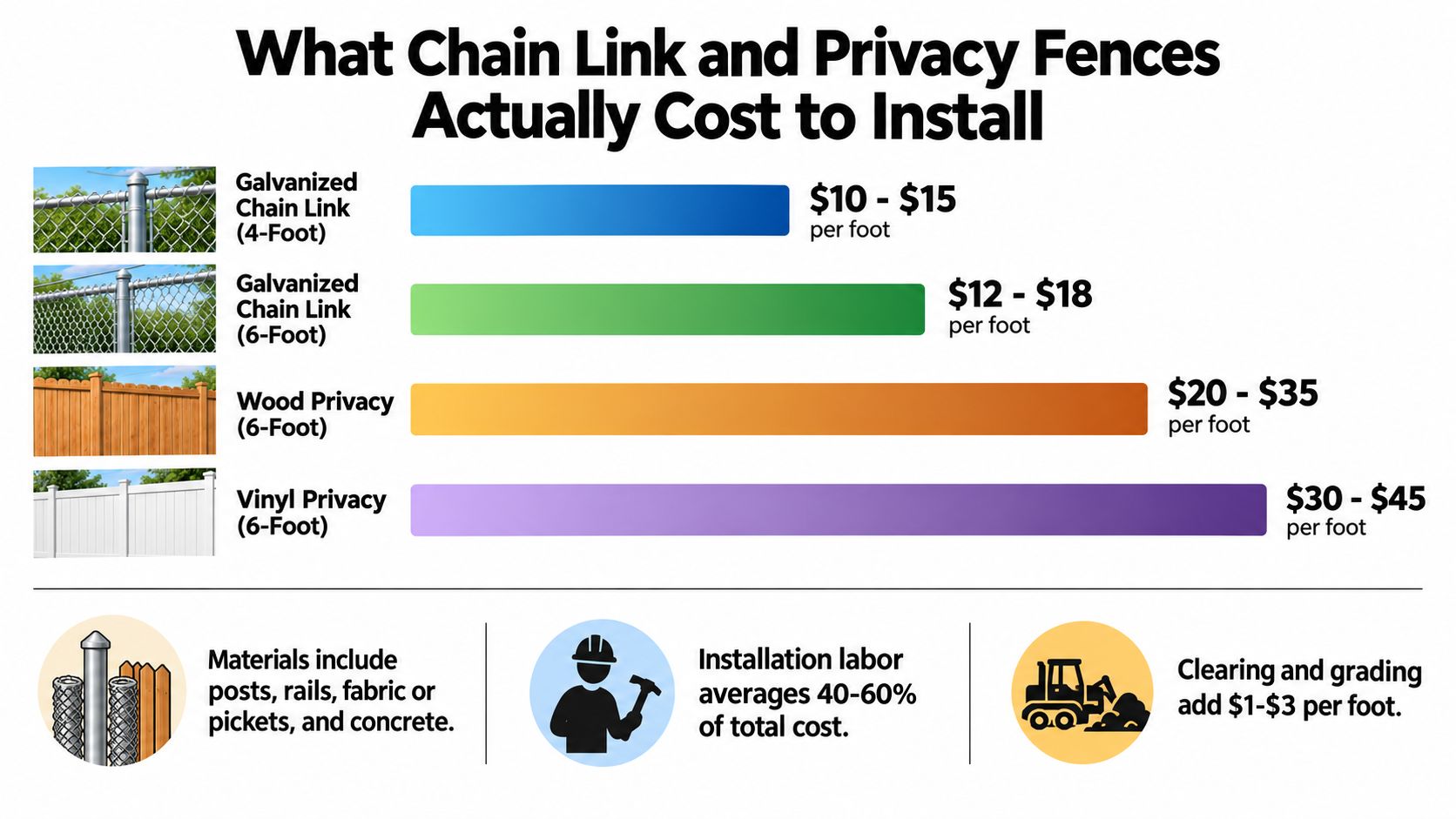
A homeowner on the Treasure Coast may receive two very different estimates for the same boundary length. The useful starting point is the installed linear-foot range, not the material price on a supplier's invoice. Galvanized chain link generally costs less on installation day because woven wire uses less material and leaves the yard open to view. A six-foot privacy fence costs more because solid boards or panels require additional material, framing, posts, and concrete.
For budgeting, broad national benchmarks are:
| Fence configuration | Installed planning range | 200-linear-foot planning range |
|---|---|---|
| Standard chain link | $10–$40 per linear foot | $2,000–$8,000 |
| Six-foot privacy fence | $25–$60 per linear foot | $5,000–$12,000 |
| Eight-foot privacy fence | $50–$85 per linear foot | Not calculated here |
These ranges combine materials and labor, but they do not cover every property condition. The comparison is documented in current privacy fence installation cost benchmarks, which places the midpoint of a six-foot privacy project about 75% higher than the midpoint of the chain-link range before unusual site conditions, gates, permits, demolition, or landscaping are added.
Use the range as a quote sanity check
The low end usually reflects a straightforward galvanized four-foot or six-foot chain-link run with good access, ordinary soil, limited corners, and simple gates. Vinyl-coated chain link, taller systems, privacy slats, heavier framework, and security additions can move chain link well above the basic comparison.
A six-foot wood or vinyl privacy fence also has a wide price spread. Board quality, panel construction, wind exposure, post depth, gate design, and finish all affect the estimate. A line reading “privacy fence, $X per foot” does not show whether the price includes treated posts, concrete, caps, demolition, disposal, or gate hardware.
The chain-link installation cost per foot guide helps frame the first question, but a Treasure Coast quote still requires a site review. Narrow side-yard access, dense roots, sandy or wet ground, irrigation lines, and coastal exposure can change the labor plan.
Start by multiplying the proposed installed rate by the measured fence length, then add each separate line item on the estimate. A quote outside the broad range is not automatically unreasonable. It should explain which site condition, material choice, or added scope accounts for the difference.
The Cost Drivers Behind Every Fence Quote
The per-foot rate is only a compressed summary of several construction decisions. A Treasure Coast estimate normally reflects the materials, post layout, concrete, digging, gates, access, cleanup, and compliance work required for that specific property.
| Line Item | Chain Link Impact | Privacy Fence Impact |
|---|---|---|
| Fabric, boards, or panels | Woven galvanized or coated fabric keeps material use relatively efficient | Solid boards or panels require more material and visual coverage |
| Posts and concrete | Line posts, terminal posts, rails, tension wire, and concrete | Taller or heavier posts, additional concrete, rails, framing, and wind-resistance details |
| Fence height | Four-foot and six-foot systems are common basic choices | Six-foot construction is common, with taller privacy systems costing more |
| Gates | Frame, mesh, hinges, latch, and optional access control | Heavier frame, hinges, latch, reinforcement, and possible automation |
| Demolition | Cutting out fabric and removing posts or concrete | Removing panels, rails, posts, concrete, and disposal loads |
| Site access and terrain | Narrow access, roots, slopes, and hard digging increase labor | The same conditions increase labor, with solid panels adding handling and wind considerations |
| Vegetation and irrigation | Clearing, trimming, and line protection may be required | Privacy runs often need the same clearing, plus room to handle wider panels |
| 811 utility locates | Required as a safety step before digging | Required as a safety step before digging |
| Permits and filing | Depends on jurisdiction, purpose, height, and project value | Height, location, privacy coverage, pool use, and project value can create added review |
| Notice of Commencement | A recorded filing may apply when the work reaches the applicable value threshold | The same threshold applies, and the larger scope can make it more likely |
Solid fencing carries a structural issue that open mesh largely avoids. A continuous privacy surface catches more wind, so exposed sites may need stronger posts, deeper embedment, closer spacing, or other wind-resistance details. A taller fence also consumes more boards or panel material and can require more concrete at each post.
Gates are separate construction, not leftover footage
Gate count and width deserve their own line. A single walk gate doesn't carry the same hardware or structural demand as a wide vehicle gate, and an access-controlled opening adds equipment and coordination. Pool gates bring another layer because the opening may need self-closing and self-latching hardware.
Demolition can be underestimated when an existing fence has posts set in concrete. Vegetation removal, stump grinding, irrigation repairs, survey questions, and easement conflicts can also appear after the fence line is marked. The fence cost estimator calculator is useful for a ballpark, but it can't replace field verification of those conditions.
Scope warning: Two quotes can show the same per-foot price while covering different heights, gates, post spacing, demolition, concrete removal, permit work, and cleanup. A lower number isn't lower until the scopes match.
Chain Link, Wood Privacy, and Vinyl Privacy Compared
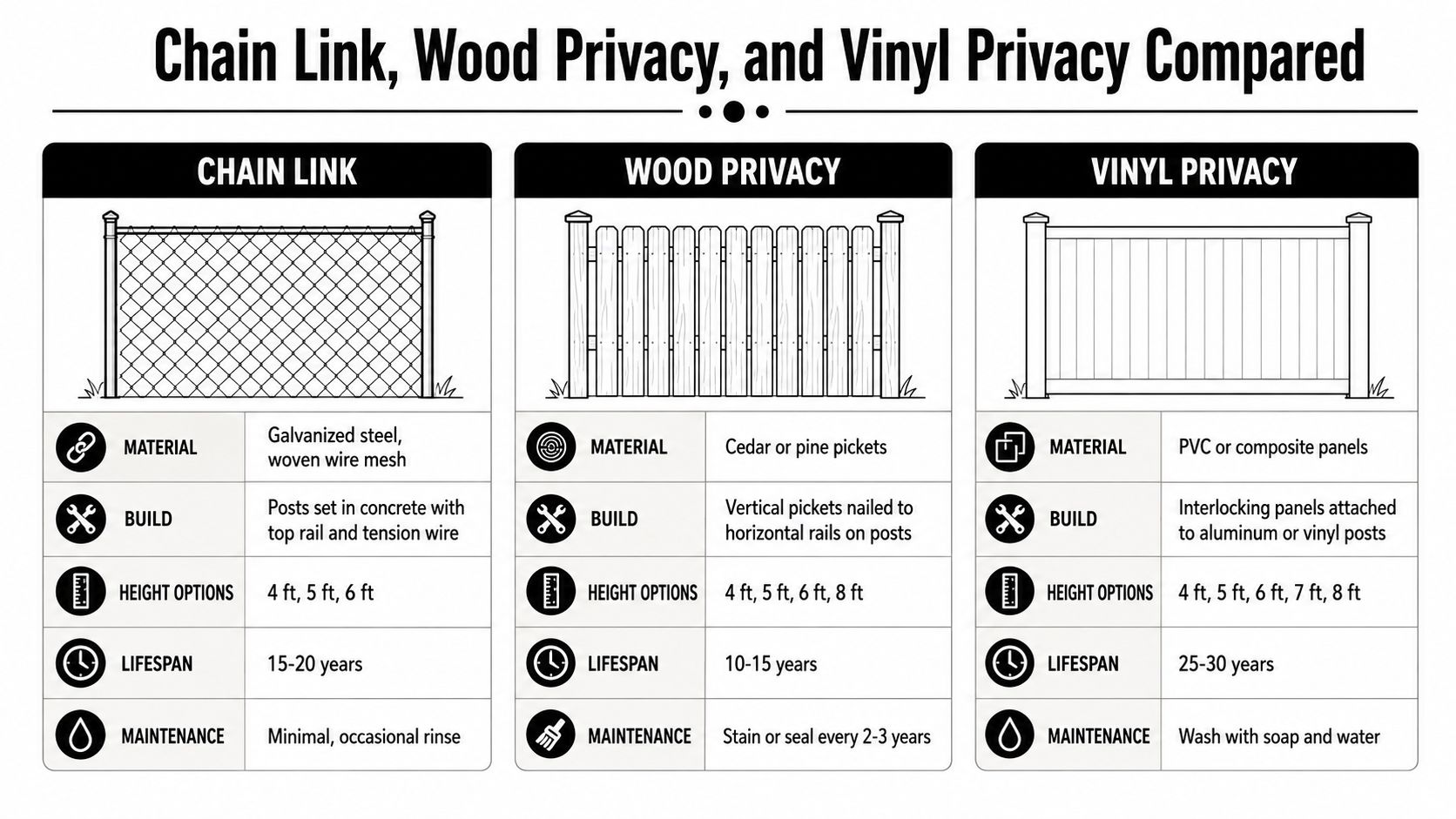
The three common choices serve different purposes. Chain link contains people, pets, and equipment at the lowest day-one cost. Wood creates a traditional solid barrier. Vinyl provides solid coverage with less routine upkeep. The right comparison depends on what the fence must accomplish after installation.
Chain link
Galvanized chain link uses woven steel mesh attached to posts set in concrete, with a top rail and tension components. Four-foot and six-foot heights are common on Treasure Coast residential work, and optional barbed wire can support commercial security applications.
It loses on privacy because the open mesh preserves sightlines. Adding slats or screening can improve visual coverage, but those additions raise the cost and can change wind exposure. Its advantage is practical enclosure with limited routine maintenance.
Wood privacy
A six-foot wood privacy fence uses vertical pickets fastened to horizontal rails and structural posts. Cedar board-on-board construction is a strong Florida choice when the homeowner wants a natural appearance, overlapping coverage, and an HOA-compatible residential look.
Wood allows localized repairs and finish changes, but it demands more attention than chain link or vinyl. Moisture, sun, insects, leaning posts, split boards, and finish deterioration can turn an apparently inexpensive installation into a recurring maintenance project.
Vinyl privacy
PVC or vinyl privacy fencing uses interlocking panels attached to vinyl or reinforced posts. It can be supplied in multiple colors and provides a uniform solid appearance without routine staining or sealing.
Vinyl often loses to wood on repair flexibility and to basic chain link on initial price. It gains ground when the owner values privacy and low maintenance over the lowest installation bill. Product selection still matters, especially for gates, post reinforcement, and exposed locations.
The Florida fence product guide provides a broader view of material choices, including applications beyond this three-way comparison.
Why the Cheaper Fence Can Cost More Over 30 Years
Installation price answers only one question: how much must the owner pay before the fence is in place? A 30-year ownership view adds maintenance, corrosion, repairs, and replacement cycles, and that changes the chain link fence vs privacy fence cost discussion.
Current lifecycle references place 30-year ownership for galvanized chain link at approximately $9,500–$12,000, compared with approximately $8,500–$10,000 for vinyl privacy fencing. Those figures come from a 30-year fencing ownership cost comparison. The result is counterintuitive because vinyl privacy commonly costs more at installation.
Conditions that change the result
Galvanized steel isn't the same as vinyl-coated chain link, and wood privacy isn't the same as vinyl privacy. Treating each material family as one product hides the differences that matter in Florida.
- Salt exposure: Coastal air can accelerate corrosion on vulnerable metal components.
- Irrigation overspray: Repeated wetting can affect metal and wood, especially where sprinklers reach the fence.
- Soil chemistry: Ground conditions influence post deterioration and corrosion.
- Fence height: Taller systems use more material and can place greater demands on posts.
- Gate count: More openings mean more hardware, adjustment, and possible repair points.
- Owner maintenance: Cleaning, sealing, replacing boards, and correcting minor problems can alter the ownership result.
Galvanized chain link may be the lowest upfront choice, but an owner who faces corrosion or an earlier replacement can lose that advantage. Vinyl privacy may require more money at the start yet reduce recurring maintenance and preserve a more consistent appearance.
Practical rule: Price three versions before choosing. Show the lowest upfront option, the expected maintenance option, and the replacement-adjusted option.
A local comparison should separate galvanized chain link, vinyl-coated chain link, wood privacy, and vinyl privacy. It should also show whether the estimate assumes owner-performed maintenance or contractor service. That detail makes a larger difference than a generic national average.
Three Sample Budgets for Treasure Coast Properties
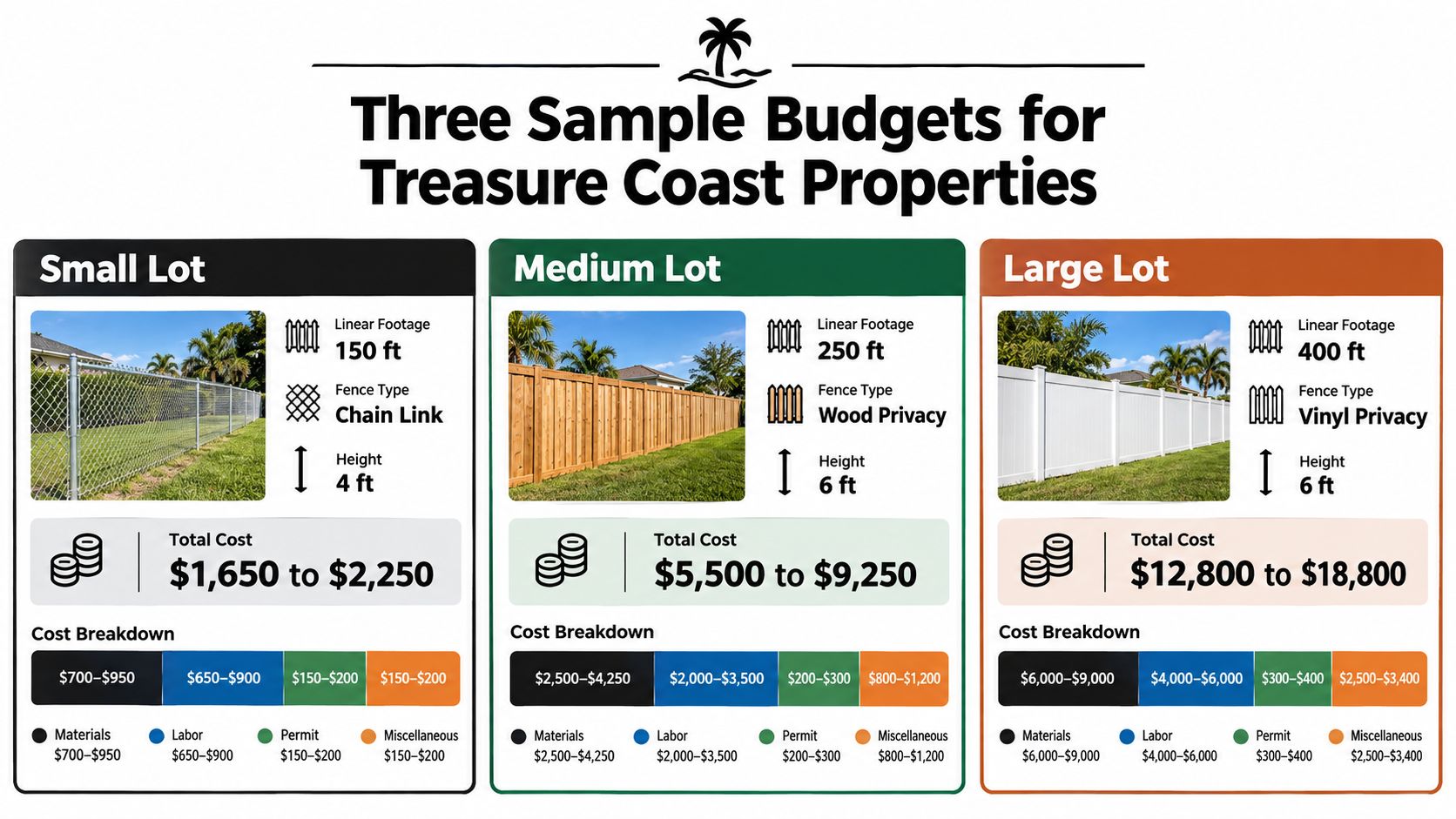
A small backyard, an HOA lot, and a pool enclosure can produce very different fence budgets, even when the material price looks similar. The examples below show how property size, access, gates, and compliance change the conversation. They are planning examples, not fixed bids.
Small backyard boundary in Martin County
A 100-foot backyard boundary with basic four-foot galvanized chain link offers a straightforward starting case. Applying the broad $10–$40 per linear foot installed range established earlier produces a preliminary fence-cost range of $1,000–$4,000, before gates, demolition, permits, and unusual access conditions.
List a walk gate, vegetation trimming, utility locating, and any jurisdictional filing as separate line items. A narrow side-yard entrance, dense roots, irrigation conflicts, or an existing concrete-set fence can raise the total beyond simple footage multiplied by a per-foot rate.
Typical 200-foot HOA lot in Palm Beach County
A 200-foot, six-foot privacy boundary falls into the $5,000–$12,000 planning range for the installed fence itself. Wood may fit an HOA that expects a natural board appearance, while vinyl provides a more uniform finish and reduces routine maintenance.
The estimate should show gate count and width, finish or treatment, post spacing, demolition, disposal, and HOA review. Solid panels also require a wind-resistance discussion on exposed properties. List permit and Notice of Commencement handling separately rather than hiding those costs inside an unexplained per-foot figure.
Larger pool-barrier project
A 300-foot enclosure that forms part of a pool barrier needs a different budget structure. Include compliant gate hardware, continuous enclosure details, the pool-barrier application, inspection coordination, and layout around the pool deck, equipment, and existing structures.
Open chain link may reduce material cost. Solid vinyl or wood may better meet a privacy goal. Neither material automatically satisfies pool requirements. The appropriate budget covers the complete compliant scope, not the least expensive fence fabric.
Online estimators provide only a ballpark. Root systems, irrigation, easements, existing fence removal, gates, and actual property lines can change the total before contract signing. A site visit is where those hidden line items become visible.
Florida Permits, Pool Barriers, and Inspection Overhead
Florida rules can change the effective price even when the material estimate looks simple. Key West, for example, permits solid or open fences up to four feet high on front, rear, and side property lines under its stated local guidance, while also requiring a recorded Notice of Commencement for work valued at $2,500 or more. Naples uses a different threshold, stating that a fence under 50 feet may not require a permit unless it forms part of a swimming-pool or spa safety barrier. These examples are documented in the Key West fence permit guidance, so Treasure Coast homeowners should verify the rules with the specific city or county.
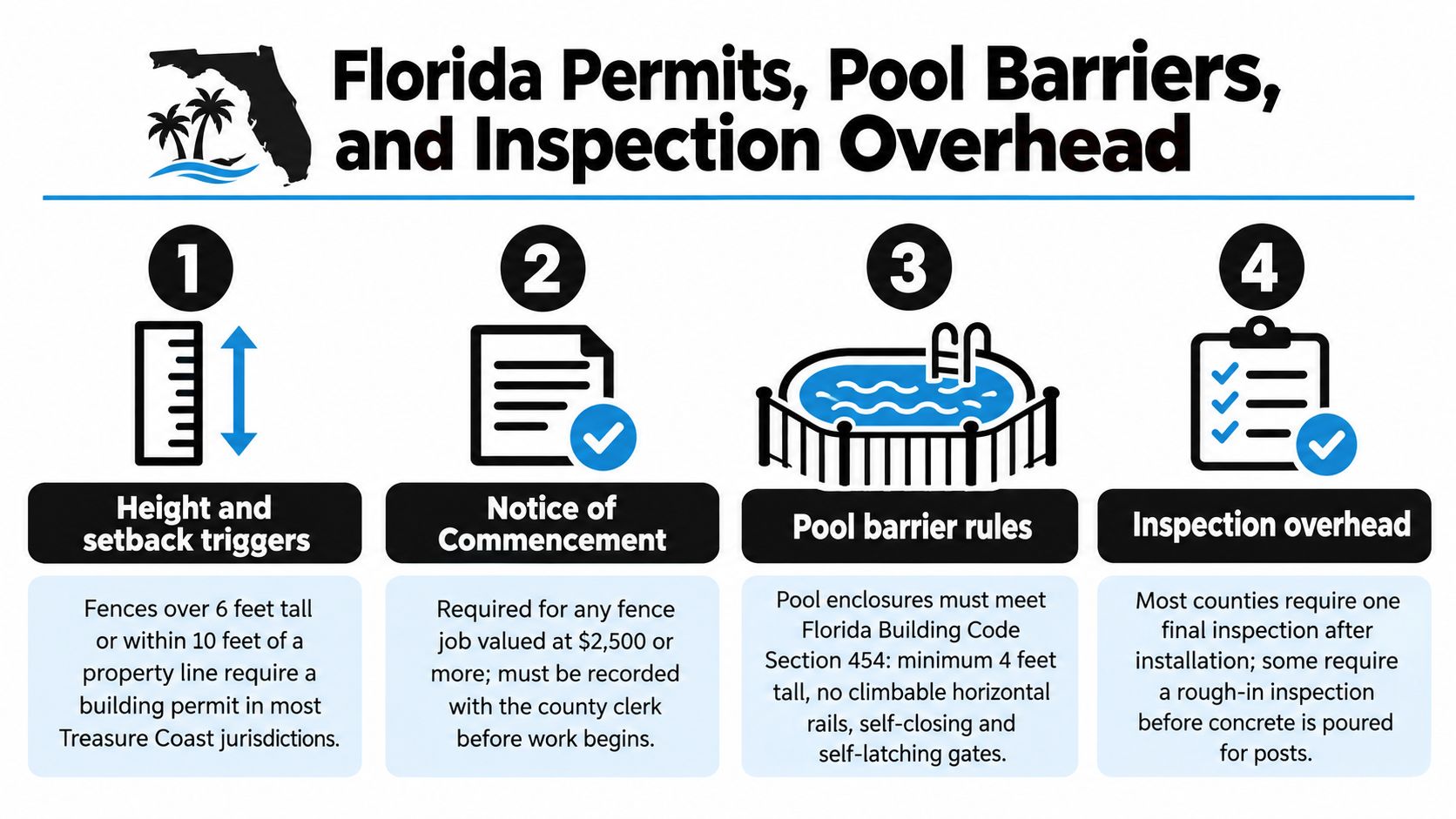
Pool work follows a different logic. Palm Beach Gardens identifies Florida Building Code section R4501.17 and Florida Statutes chapter 515 as requirements for a barrier around the entire perimeter of a residential pool, spa, or hot tub, as stated in its pool barrier affidavit. A privacy fence can't be assumed to qualify because it blocks views.
Before signing, the homeowner should confirm:
- Purpose: Is the fence a boundary, privacy screen, security perimeter, or pool barrier?
- Location: Does the fence sit near a property line, corner, easement, deck, equipment pad, or visibility area?
- Height: What height and construction does the local jurisdiction allow at that location?
- Filing: Does the project require a permit, Notice of Commencement, inspection, or separate pool application?
- Gate hardware: Are self-closing and self-latching components required?
- Scope: Are 811 locates, demolition, disposal, vegetation work, and inspection coordination included?
Choosing the Right Fence for Your Property and Priorities
A basic perimeter or pet enclosure usually favors galvanized chain link. It keeps the initial installed cost lower, preserves visibility for supervision, and can be configured with security additions such as barbed wire where the application allows it.
Privacy changes the recommendation. Wood privacy fits homeowners who want a natural appearance, customization, and a traditional HOA look, provided they accept regular upkeep. Vinyl privacy suits owners who want solid coverage, multiple color options, and less routine maintenance, particularly when the longer ownership view matters more than the first invoice.
Pool projects require a code-compliant barrier rather than a material preference. The fence must support the required enclosure and gate functions, and the contractor must coordinate the applicable permit and inspection process. Commercial security work may favor chain link with controlled gates, while a residential backyard may justify the additional cost of wood or vinyl because the actual priority is visual separation.
The cheapest fence is the wrong fence when it doesn't solve the real problem, whether that problem is visibility, privacy, safety, security, or code compliance.
A site-specific quote should identify the fence type, height, linear footage, posts, concrete, gates, demolition, permits, utility locating, and cleanup. AlliedFenceAndGate.com™ offers an online estimator for fence styles, gates, and add-ons, followed by project-specific quoting and support with permitting, 811 utility locates, and inspection coordination.
AlliedFenceAndGate.com™ provides ballpark estimating and site-specific fence quotes for chain link, wood privacy, vinyl privacy, pool barriers, and access-controlled gates across Florida's Treasure Coast and northern Palm Beach County. Compare the right scope, including gates, permits, utility locates, demolition, and pool-barrier requirements, by visiting AlliedFenceAndGate.com™ and requesting a quote for the property.
#MartinCountyFencing #PalmBeachCountyFencing #TreasureCoastFencing #StuartFencing #PortStLucieFencing #JupiterFencing #PalmBeachGardensFencing #FloridaFencing #ChainLinkFence #PrivacyFence #VinylFence #WoodFence #PoolSafetyFence #FenceInstallation #FenceContractor
Related Fencing Services
Need a fence or gate on the Treasure Coast?
Licensed, insured, and bonded. Free estimates across Martin, St. Lucie, Indian River & Palm Beach counties.
Call (772) 530-3127