10 Privacy Fence Designs for Florida Homes: 2026 Guide
A Stuart homeowner may be looking at a backyard pool that lines up directly with a neighbor's second-floor windows. The HOA may allow privacy fencing, but only at an approved height and in a limited color range. A solid fence could solve the sightline problem, yet the same design may create a wind concern, conflict with pool-barrier rules, or require more maintenance than the owner wants.
The best privacy fence designs for Florida are judged by more than appearance. Wind exposure, salt air, humidity, HOA approval, pool-code compliance, property lines, and maintenance tolerance all affect the right choice. A fence that looks excellent in a sheltered inland yard may need reinforced posts, different materials, or more open construction near the coast.
The ten designs below move from cedar and other wood layouts to vinyl, aluminum, chain link, living screens, and engineered systems. Each one fits a different combination of privacy needs, lot conditions, approval requirements, and upkeep expectations.
Table of Contents
- 1. Cedar Board-on-Board Privacy Fence
- 2. Shadowbox Good Neighbor Wood Fence
- 3. Horizontal Slat Modern Privacy Fence
- 4. PVC or Vinyl Solid Privacy Fence
- 5. Vinyl Privacy Fence with Lattice Top
- 6. Aluminum Solid-Infill Privacy Fence
- 7. Aluminum Louvered Privacy Fence
- 8. Chain Link Fence with Privacy Slats or Windscreen
- 9. Living Privacy Fence with Hedge and Fence
- 10. Wind-Engineered Privacy Fence with Steel-Reinforced Posts
- 10 Privacy Fence Designs Comparison
- Choosing the Right Privacy Fence Design for Your Lot
1. Cedar Board-on-Board Privacy Fence
Cedar board-on-board fencing gives a Treasure Coast backyard a warm, finished appearance while blocking direct views from neighboring yards and upper windows. Boards overlap across the rails, and alternating placement creates a similar appearance from both sides. That makes it a practical choice for a property line shared with a neighbor who doesn't want to see the unfinished back of a fence.
Western red cedar is often preferred for Florida wood fencing because its natural oils and tannins help it resist decay and insects better than many softer woods. It also remains relatively lightweight, which reduces some stress on the posts compared with heavier solid assemblies. The material still needs protection from Florida sun, rain, humidity, and ground moisture.
A cedar board-on-board fence suits backyard perimeters in Stuart and Palm City, side-yard runs between properties in Jupiter and North Palm Beach, and pool-area enclosures where a natural appearance matters.
Details that protect the installation
- Use durable posts: Ground-contact pressure-treated posts or properly concreted posts provide the structural base.
- Protect coastal hardware: Galvanized or stainless fasteners are sensible within a few miles of saltwater.
- Control ground contact: A small gap beneath the boards helps limit moisture wicking and rot.
- Seal cut ends: Stain or sealer should cover every cut end before installation.
- Plan maintenance: Cleaning each year and resealing every 2 to 3 years is the stated care schedule in the project plan.
Local rules still control height, placement, and permitting. The New Jersey Department of Transportation privacy-fence research report explains that conventional privacy fences are commonly designed as visual screens rather than engineered noise barriers, and it distinguishes a typical 6 to 8-foot privacy fence from a purpose-built highway sound wall. Florida homeowners should make the same distinction around busy roads.
For installation details, the board-on-board fence guide can help owners compare board orientation, privacy, and construction choices before requesting a site assessment.
2. Shadowbox Good Neighbor Wood Fence
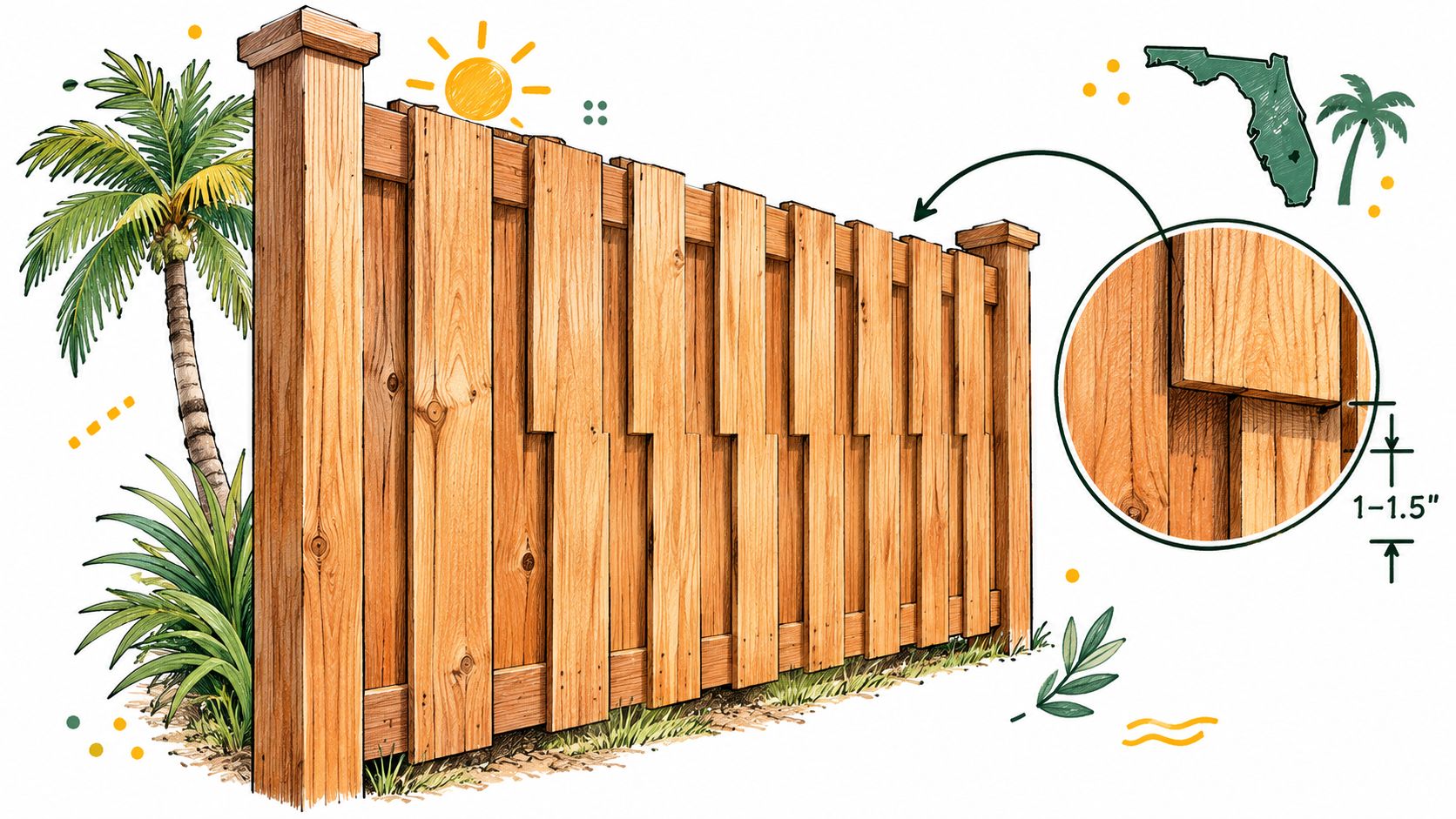
A shadowbox fence suits property lines where both yards deserve a finished view. Boards alternate across the rails, creating staggered openings. Each side sees board faces rather than a continuous row of exposed rails and backs.
The spacing also changes how the fence handles Florida conditions. Compared with a fully overlapping board-on-board panel, the design allows more air through and presents less of a continuous surface to strong wind. Privacy is the trade-off. It blocks direct views, while angled sightlines, raised windows, and nighttime lighting may still reveal activity inside the yard.
This style works well along shared boundaries between townhome or patio-home neighbors in Martin County. It also fits Palm Beach Gardens lots where both owners want a consistent appearance. Salt air and humidity still demand careful material selection, especially near the coast, while exposed corners and long runs deserve closer attention during the site review.
What to settle before posts go in
Use multiple rails on wind-exposed runs, and choose kiln-dried lumber to reduce early warping and shrinkage. Confirm the property line with a current survey before placing posts. Old fences, mature landscaping, and informal boundaries can make the apparent line misleading.
Keep the boards at least 2 inches above ground to reduce direct moisture contact under the project specifications. The gap will not remove maintenance, but it helps rainwater drain away from the lower edges.
Practical rule: A shadowbox fence supports good neighbor relations when both sides receive the same finished treatment and the property line is confirmed before construction.
Local ordinances and HOA documents control height, color, placement, and transparency. They can also affect pool areas, gates, and required setbacks. Florida has no single statewide rule that settles every residential fence detail, so check the municipality and HOA before ordering materials. The Palm Beach Gardens fence regulations provide a local starting point, but the applicable code and community documents govern the project.
For pool enclosures, confirm the required barrier arrangement with the local building department before choosing a shadowbox layout. A design that looks private may still need a compliant gate, latch, or separation from the pool area.
3. Horizontal Slat Modern Privacy Fence
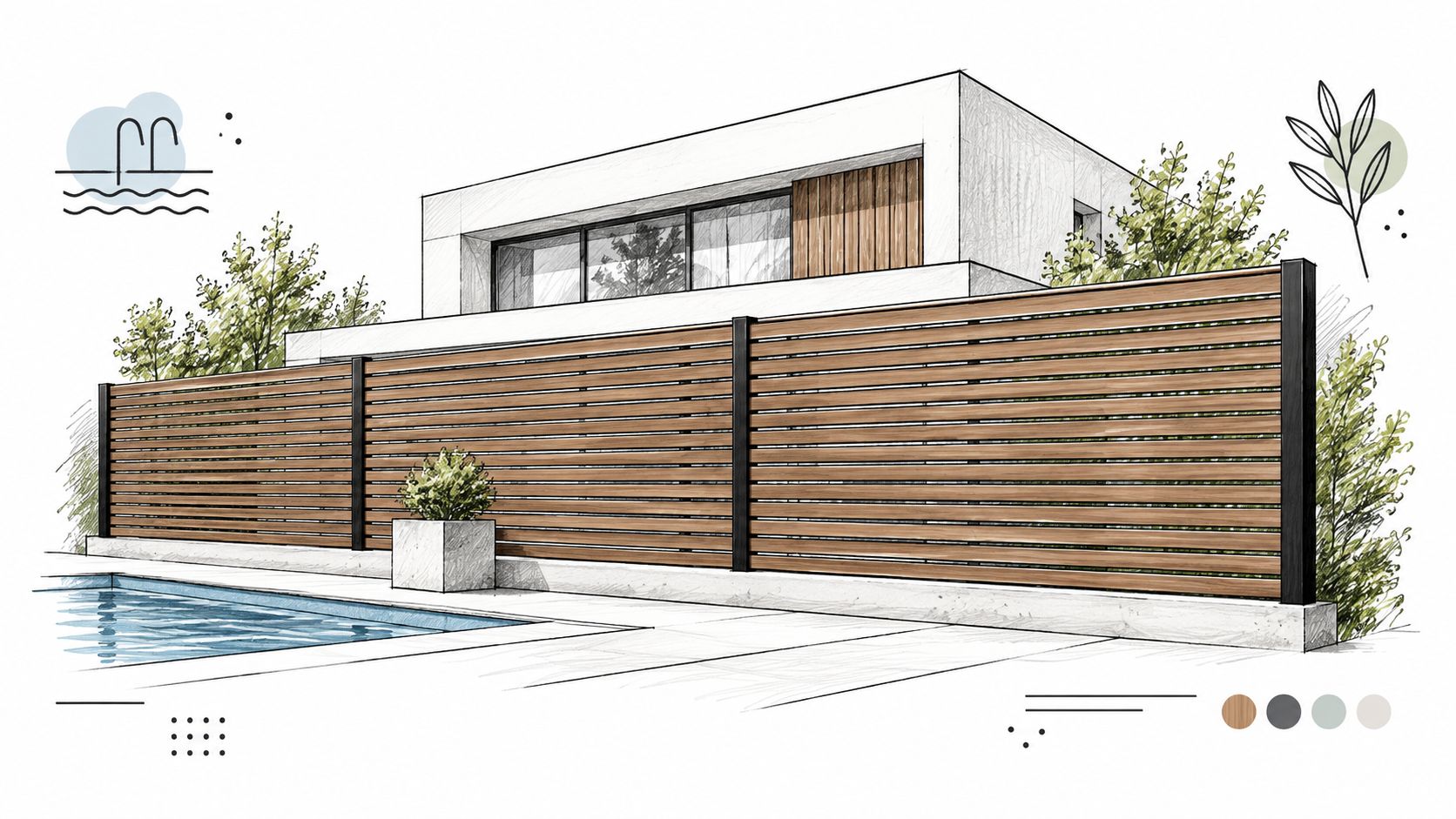
Horizontal slat fencing gives a modern Jupiter or Hobe Sound property strong architectural lines. Wood or composite boards run between vertical posts, and narrow, consistent gaps balance privacy with ventilation. The style pairs naturally with stucco, aluminum, flat rooflines, and coastal-contemporary landscaping.
The main weakness is installation precision. Irregular gaps stand out immediately, especially across a long run viewed from a pool deck or living-room window. Horizontal boards also need continuous backing rails and careful drainage because Florida rain can sit against the lower structure when the base is too close to soil or paving.
A horizontal slat screen works well around modern residential pools, private courtyards, and commercial entry areas. It can also frame an outdoor kitchen without making the entire yard feel closed in.
Build the lines, then protect the base
- Keep spacing uniform: Measure each opening before cutting rather than relying on visual estimates.
- Use continuous support: Backing rails help maintain alignment and distribute movement.
- Coordinate the color: A stain that relates to the home's trim or roof usually looks more intentional than a contrasting brown chosen after installation.
- Create drainage: Keep wood away from standing water and provide a base detail that lets rain escape during Florida's wet season.
- Review sightlines: Place tighter slat spacing where neighbors' windows overlook the yard, and use wider spacing where airflow matters more.
The horizontal slat privacy fence guide provides a useful reference for comparing board direction, spacing, and modern layout details.
The style isn't automatically suitable as a pool barrier. A privacy screen and a compliant pool enclosure serve different purposes. The barrier must be evaluated for openings, climbable features, gates, placement, and the governing jurisdiction's requirements.
4. PVC or Vinyl Solid Privacy Fence
Solid PVC or vinyl fencing appeals to homeowners who want visual privacy without painting, staining, or replacing rotted boards. Rigid panels can be arranged in flat-panel or board-on-board patterns, and common colors include white, tan, gray, and clay. The clean appearance often fits HOA communities where uniform perimeter fencing is part of the neighborhood design.
Vinyl doesn't rot or attract insects like wood, but the material still depends on sound engineering. Solid panels act like broad sails in exposed locations. Posts, reinforcement, footing design, rail connections, and panel fit determine whether the fence remains stable during strong wind.
This option works around Palm Beach County pools and outdoor kitchens, in Stuart communities with approved white fencing, and on Port St. Lucie commercial properties where steel-reinforced posts support a low-maintenance privacy barrier.
Compare the panel with the structure
A manufacturer warranty should address color and UV fading, not only manufacturing defects. Coastal properties also need regular rinsing to remove salt spray before it accumulates on panels, posts, and gate hardware.
The plan calls for steel-reinforced posts and footings extending approximately 24 to 36 inches in Florida soils. Those dimensions are project specifications, not a universal code requirement, so the final footing design should follow the product system, soil conditions, exposure, and local approval requirements.
Vinyl expansion also matters. Installers need to follow the manufacturer's instructions for movement gaps, especially where panels meet gates, walls, or corner posts. A fence that looks rigid still moves with temperature changes.
Florida property owners should also separate visual privacy from pool safety. Florida Statute §515.29 requires a pool barrier to be at least 4 feet high when measured on the outside and restricts openings and structural features that could allow a young child to pass underneath, through, or over the barrier. The Florida pool-barrier statute also addresses perimeter placement and gate operation.
5. Vinyl Privacy Fence with Lattice Top
A lattice-top vinyl fence places a decorative open section above a solid lower panel. The planned configuration uses a 4-foot solid lower section and a 2-foot lattice top for a total height of 6 feet. Because the upper section is open, it allows more light and air through than a full solid panel while preserving substantial backyard screening.
That balance suits Port St. Lucie and Jensen Beach homes where owners want privacy without creating a completely closed wall. It also works along pool enclosures where neighbors need to be screened but the property doesn't require total visual separation.
The upper section still needs structure
Reinforced lattice edges help reduce impact damage, especially near gates, play areas, and service paths. Posts should be sized for the actual system and site exposure. A lattice top reduces the solid surface area, but it doesn't remove wind load.
Pattern choice affects the overall appearance. A traditional diamond lattice may suit a coastal or cottage-style house, while a tighter geometric pattern can work better with a contemporary exterior. Climbing plants can add screening over time, but they also add weight and require trimming, irrigation, and access for maintenance.
The vinyl fence with lattice top guide offers a practical way to compare lattice proportions and privacy expectations before selecting a panel style.
A lattice-top fence still needs HOA approval for height, color, and pattern. It also needs a separate pool-code review when it forms part of a swimming-pool barrier. Florida guidance focuses on whether a child can climb, squeeze through, or reach a gate release, not just whether the fence looks private.
6. Aluminum Solid-Infill Privacy Fence
Aluminum solid-infill fencing brings a more custom appearance to privacy screening. Solid panels attach between powder-coated aluminum posts and rails, creating a privacy wall with the clean edges and custom detailing associated with ornamental metalwork.
For Florida coastal properties, aluminum avoids the rust behavior associated with ordinary steel and the rot concerns associated with wood. The coating and hardware still matter. Salt air can attack poor finishes and incompatible fasteners, while solid infill transfers meaningful wind forces into the frame and foundations.
This design suits Palm Beach Gardens pool enclosures, Treasure Coast commercial entry features, HOA perimeter treatments, and custom welded residential privacy walls with decorative top rails.
Coordinate finish, hardware, and code
Marine-grade or coastal-rated powder coating deserves consideration for oceanfront and near-saltwater sites. Stainless or aluminum fasteners can help avoid galvanic corrosion when different metals meet.
Pool-area aluminum fencing must be reviewed as a safety assembly. Gates need the correct swing direction, self-closing action, self-latching operation, and release arrangement. A solid panel can satisfy a homeowner's privacy objective and still fail a pool inspection if the gate hardware is wrong.
Florida Building Code guidance reviewed by the Florida Building Commission states that a pool-access gate must be self-closing and self-latching, with the locking-device release located on the pool side unless the required release-height condition is met. Within 18 inches of the release, openings cannot exceed one-half inch under the cited guidance. The Florida Building Commission staff analysis should be checked alongside the currently adopted code and local interpretation.
Solid infill should be engineered as a wind-loaded wall, not priced as decorative pickets with panels added later.
7. Aluminum Louvered Privacy Fence
Louvered aluminum fencing blocks direct sightlines while allowing air and some daylight through angled horizontal slats. Privacy is strongest from the viewing direction the louvers were designed to address, so the angle should respond to actual conditions. A neighbor's second-floor window may require a different configuration than a sidewalk-level view.
This design works well for Stuart hospitality patios, Palm Beach County medical or education campuses, equipment screens, and modern Treasure Coast courtyards. It provides a cleaner architectural screen than chain link while avoiding the fully solid face of a conventional privacy wall.
Design for the view and the gate
The louver angle should be set after checking the most important sightlines. A screen intended to hide pool activity from the street may need a different orientation from one intended to shield a patio from an adjacent house.
Gate access should be drawn early. A narrow service opening, pedestrian gate, or wider equipment gate changes post locations and can affect the louver layout. Commercial projects also need clear walking routes and ADA considerations around gates and approaches.
The material itself resists rot, but the frame still needs appropriate wind design. Solid-looking louvered sections can collect substantial lateral force, particularly at corners and ends. A qualified installer should account for exposure, post size, connections, and the frame's actual open area.
Louvered fencing isn't the best choice when the owner needs complete visual blocking from every angle. It is better suited to a controlled sightline, a ventilated patio screen, or equipment concealment where airflow is part of the requirement.
8. Chain Link Fence with Privacy Slats or Windscreen
A chain link fence can screen a Port St. Lucie backyard, contractor yard, or Palm Beach County utility enclosure without the cost and weight of a solid wall. Privacy slats weave through the mesh, while windscreen attaches across it to create a more continuous visual barrier. The result remains more utilitarian than cedar, vinyl, or custom aluminum, but it provides practical separation on budget-conscious residential lots, school grounds, and athletic-field perimeters.
Reinforce the mesh before adding screening
Screening changes the fence's wind load. Terminal posts, line posts, rails, ties, and concrete footings may need more capacity than an open chain link run. Check an existing fence before adding a broad fabric panel, especially on an exposed corner, near the coast, or along a long straight boundary.
Installation details affect both privacy and wind performance. Slats commonly weave from the top downward or from the bottom upward, depending on the product and locking design. Top-weave slats can make later windscreen attachment or removal easier at the lower edge, while bottom-lock systems may hold the slats more securely during storms. Follow the product instructions and avoid fastening fabric in a way that interferes with the slat locks.
Choose heavily galvanized or vinyl-coated mesh, protect cut ends from corrosion, and use UV-stabilized slats or fabric for Florida sun. Windscreen can trap rainwater, leaves, and sand, so keep the bottom edge accessible and preserve drainage around the fence.
Slats and windscreen interrupt views and change airflow. They can also alter how sound travels, but this assembly should not be presented as tested noise control without project-specific evidence.
Barbed wire requires its own zoning and HOA review. It is restricted in many residential zoning districts on the Treasure Coast, so confirm the local ordinance before adding it to any run. Pool-code requirements, gate hardware, and fence height also deserve review before installation, particularly on lots with a pool or waterfront exposure.
9. Living Privacy Fence with Hedge and Fence
A living privacy fence combines an immediate structural screen with shrubs or hedges planted beside it. The fence provides privacy from the day of installation, while the plants soften the view, add greenery, and can reduce the harsh appearance of a long boundary.
This combination works around Jupiter pool enclosures, Palm Beach Gardens vinyl fences, and commercial access-road perimeters. Aluminum with Florida-friendly planting can create a more open appearance than solid vinyl, while a hedge beside a wood fence can soften the material's weathered character.
Give the plants room to mature
Plant selection should follow the UF/IFAS Florida-Friendly Landscaping guidance, with attention to irrigation, fertilizer, salt exposure, mature size, and maintenance access. Native or Florida-friendly choices can reduce the need for intensive watering and feeding, but no hedge is maintenance-free.
Planting should occur on the side of the fence that allows pruning and irrigation access. Root barriers or adequate spacing may be needed near utility lines and concrete footings. Driveway corners and intersections also require sight-triangle review, so a hedge can't grow to any height beside a vehicle exit.
A hedge is a long-term screen, not an immediate substitute for a properly located fence.
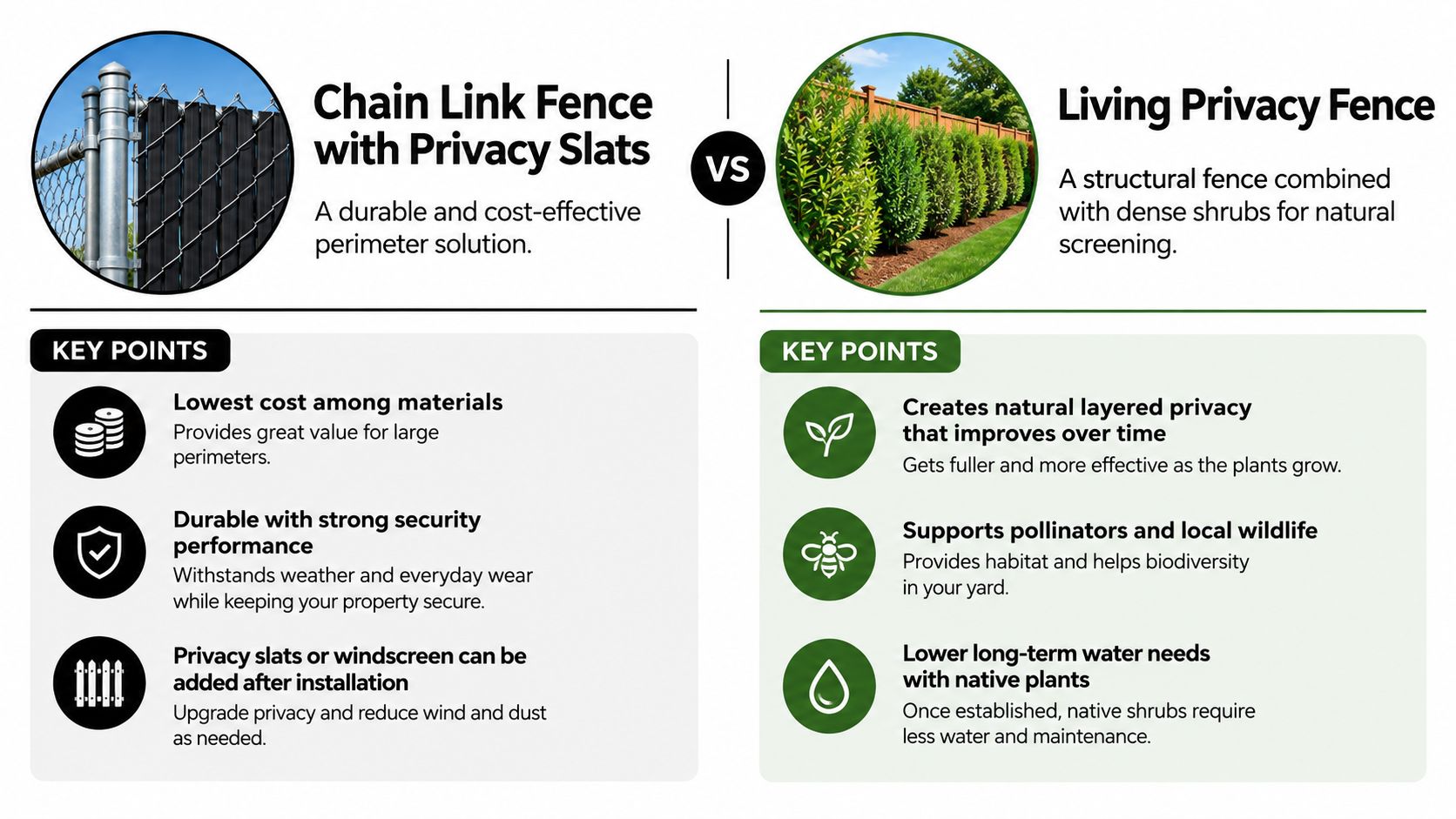
The fence and surroundings should be planned as one system. A solid fence may protect young plants from direct views, while an open aluminum fence may provide better ventilation and easier visual monitoring around a pool. The comparison infographic below illustrates the different roles of chain-link screening and living coverage.
10. Wind-Engineered Privacy Fence with Steel-Reinforced Posts
An engineered privacy fence starts with wind exposure, not a catalog photograph. The design may use galvanized or steel-reinforced posts, deeper footings or concrete piers, closer post spacing, stronger anchors, and heavier connections. Wood, vinyl, and aluminum can all be used when the assembly is designed for the site.
This approach matters on Martin County barrier islands, oceanfront residential lots, and exposed Palm Beach County commercial properties. It also makes sense when replacing a fence that failed during a storm, particularly if the owner wants the replacement evaluated rather than rebuilt to the same weak configuration.
Document the project before excavation
Request wind-load calculations or approved product details for exposed properties. A Miami-Dade fence-testing document identifies a maximum ultimate design wind loading of 115 mph for its referenced test condition, which demonstrates why a generic “hurricane-ready” label isn't enough for every Florida site. The Miami-Dade fence-testing report applies to its tested condition, not automatically to another product or lot.
Utility planning is part of the engineering process. Florida Power & Light states that Florida law requires calling 811 before digging, whether the owner or a contractor performs the work. The request should be made at least two business days before excavation, as described in FPL's utility-locate safety guidance. Marked utilities may force changes to post spacing, gate locations, or the fence line.
Permit and inspection requirements should be confirmed with the local building department. Storm-damaged fences should also be photographed before repairs so the existing condition is documented for possible insurance evaluation.
10 Privacy Fence Designs Comparison
| Fence Type | 🔄 Implementation Complexity | ⚡ Resource Requirements & Maintenance | ⭐ Expected Outcomes | 📊 Ideal Use Cases | 💡 Key Advantages / Tips |
|---|---|---|---|---|---|
| Cedar Board-on-Board Privacy Fence | Moderate, carpentry, alternating boards & solid post setting | Western red cedar, galvanized/stainless fasteners, pressure-treated posts; Cost: $25–45/ft; reseal/stain every 2–3 yrs | Strong privacy, warm natural appearance; good rot/insect resistance when cedar used | Backyard perimeters, neighbor-shared boundaries, pool enclosures preferring natural look | Use ground-contact posts or concrete; specify coastal fasteners; leave small bottom gap; plan regular resealing |
| Shadowbox (Good Neighbor) Wood Fence | Moderate, staggered boards, careful fastening for stability | Cedar or pressure-treated pine; Cost: $25–45/ft; periodic sealing | Balanced privacy with greater airflow; lighter visual weight than solid panels | Shared property lines, sloped yards, townhome boundaries | Use kiln-dried lumber; two+ rails for wind; keep boards ~2" off ground |
| Horizontal Slat Modern Privacy Fence | High, precise spacing, concealed fasteners, more framing/posts | Cedar, composite or treated wood; more posts (6–8' spacing); wood ~$25–45/ft, composite higher; maintenance varies | High aesthetic/curb appeal; adjustable privacy via gap size; moderate durability | Modern homes, pool decks, commercial courtyard screens | Use continuous backing rails; consistent gaps; plan drainage and stain to match home |
| PVC/Vinyl Solid Privacy Fence | Low–Moderate, panel assembly straightforward but posts/footings critical | Rigid PVC panels, hollow or steel-reinforced posts; Cost: $25–48/ft; low routine maintenance | Low maintenance, consistent appearance, resists rot/insects; long service life if UV-stable | Pool enclosures, HOA perimeters, low-maintenance yards | Specify UV-stabilized product & warranty; use reinforced posts; leave expansion gaps; rinse salt spray |
| Vinyl Privacy Fence with Lattice Top | Low–Moderate, similar to vinyl with added lattice assembly | Vinyl panels with lattice top; Cost: $25–48/ft; occasional lattice cleaning | Ground-level privacy with reduced wind load and decorative top | Backyards needing breeze, pool areas, traditional-styled homes | Choose reinforced lattice; size posts for wind; consider climbing plants for added screening |
| Aluminum Solid-Infill Privacy Fence | High, custom fabrication, heavier framing, possible engineering | Powder-coated aluminum, solid infill panels; Cost: $28–150/ft; low maintenance | Upscale, durable, excellent coastal corrosion resistance; strong long-term performance | Pool privacy enclosures, commercial perimeters, upscale residences | Specify marine/coastal powder coat; request wind-load engineering; use stainless/aluminum fasteners |
| Aluminum Louvered Privacy Fence | High, precise louver angles, custom fabrication & framing | Powder-coated aluminum louvers & frame; Cost: $28–150/ft; low maintenance but periodic debris cleaning | Blocks sightlines while allowing airflow; lower wind load than solid panels | Commercial patios, rooftop or courtyard screens, equipment screening | Set louvers to block common sightlines; include access early; design for site wind loads |
| Chain Link with Privacy Slats or Windscreen | Low, fast install; add-ons increase wind-load needs | Galvanized or vinyl-coated mesh + slats or windscreen; Cost: $22–50/ft; slats/windscreen may need replacement | Cost-effective security with variable privacy depending on infill; durable | Contractor yards, athletic fields, utility enclosures, budget residential | Use UV-rated slats/fabric; increase terminal post size and spacing when adding windscreen |
| Living Privacy Fence (Hedge + Structural Fence) | Moderate, combines planting plans with fence install; ongoing maintenance | Structural fence (any material) + native shrubs; plant costs & irrigation; timeline 1–3 yrs to fill in | Natural layered screening that improves over time; supports wildlife; softer aesthetic | Residential backyards, pool edges, landscapes seeking habitat & curb appeal | Follow UF/IFAS plant guides; plant on serviceable side; install root barriers and keep clear of utilities |
| Wind-Engineered Privacy Fence (Steel-Reinforced Posts) | High, wind engineering, deeper footings, permitting, longer timeline | Galvanized/steel-reinforced posts, larger concrete footings; engineering fees; higher labor cost | Superior storm resistance and code compliance; reduced blow-over risk | Oceanfront, barrier-island homes, exposed commercial sites, post-storm rebuilds | Request wind-load calculations, schedule utility locates (811), confirm permits and document for insurance |
Choosing the Right Privacy Fence Design for Your Lot
The selection sequence should start with approval, not material. HOA rules may control color, height, pattern, and location before wind, price, or landscaping enters the discussion. The local building department may impose separate requirements for front yards, side yards, rear yards, corners, gates, and pool barriers.
Next, classify the lot's exposure. A sheltered inland yard may support a lighter shadowbox or lattice-top design, while an oceanfront or barrier-island property may need reinforced posts, stronger footings, tighter spacing, and documented wind details. A solid fence presents more exposed surface than an open ornamental fence, so the panel choice and structural system need to be reviewed together.
Salt air and humidity then narrow the material options. Cedar provides a natural appearance but requires cleaning and resealing. Vinyl reduces painting and rot concerns but still needs sound post reinforcement and rinsing near the coast. Aluminum avoids wood rot and ordinary steel rust, but the coating, fasteners, and solid-infill engineering determine how well it handles the site.
Pool projects require a separate safety decision. A privacy perimeter isn't automatically a compliant pool barrier. Florida law requires a pool barrier to be at least 4 feet high when measured on the outside, with restrictions on openings and climbable features. Gates must swing outward, away from the pool, and must be self-closing and self-latching under the cited statute. The Florida Statutes pool-barrier requirements should be reviewed with the currently adopted code and local permitting office.
Maintenance tolerance is the final filter. Owners who want a natural material should budget for cedar care. Owners who want less routine upkeep should compare vinyl and aluminum, while commercial properties may favor chain link with screening where function and access matter more than a residential finish.
Before any post holes are dug, schedule the 811 locate and allow the required lead time. Confirm permit and inspection requirements with the local building department, verify the property line, and obtain HOA approval in writing. Then compare two or three shortlisted designs with the Digital Fence Estimator at AlliedFenceAndGate.com for a ballpark price range before requesting a detailed quote.
AlliedFenceAndGate.com™ installs cedar wood, PVC or vinyl, aluminum, chain link, pool-safety fencing, and access gates across Florida's Treasure Coast and northern Palm Beach County. Homeowners can use its digital estimator, upload lot information and property photos, and request help with permitting, 811 utility locates, and inspection coordination. Visit AlliedFenceAndGate.com™ to compare privacy fence designs and start planning the right system for the lot.
Related Fencing Services
Need a fence or gate on the Treasure Coast?
Licensed, insured, and bonded. Free estimates across Martin, St. Lucie, Indian River & Palm Beach counties.
Call (772) 530-3127