Chain Link Fence Quote Guide for Florida Homeowners
A realistic installed chain link fence price in Florida is $22 to $50 per linear foot. The final chain link fence quote depends on what that rate includes, from mesh and posts to gates, permits, utility coordination, concrete, and wind compliance.
A homeowner on the Treasure Coast may receive two bids that appear identical at first glance. Both might show the same price per foot, yet one excludes the gate, permit coordination, and difficult access while the other includes them. The lower number can become the higher invoice once those missing items surface.
The useful question isn't just, “What does chain link cost per foot?” It's, “What scope of work does this quote price?”
Table of Contents
- What a Chain Link Fence Quote Really Covers
- Information You Need Before Requesting a Quote
- How Chain Link Pricing Is Calculated
- Permits, Utility Locates, and Florida Wind Rules
- Common Add-Ons That Change the Final Price
- How the Allied Fence & Gate Estimator Works
- Quote Checklist and Common Pitfalls to Avoid
What a Chain Link Fence Quote Really Covers
A chain link fence quote should describe an installed system, not just a roll of wire. Chain-link fencing evolved from nineteenth-century industrial wire-netting technology, including Charles Barnard's 1844 machine in Norwich, England, which adapted cloth-weaving methods to repeatable wire-mesh production. Commercial development accelerated in the United States during the 1890s, and later patents refined terminal assemblies, privacy inserts, gates, and installation components. That history helps explain why mesh, posts, fittings, gates, and coatings are separate specifications rather than interchangeable parts. The documented history of chain-link fencing shows how a simple material became a mature product system.
A Treasure Coast estimator normally needs to separate at least three cost layers:
- Base installation: Fabric, line posts, terminal and corner posts, rails or tension wire, concrete, ties, bands, and standard labor.
- Site work: Existing fence removal, vegetation clearing, grading, difficult access, soil conditions, utility conflicts, and property-line verification.
- Compliance and options: Permits, engineering or wind review, pool-barrier hardware, privacy slats, barbed wire, upgraded coatings, and specialty gates.
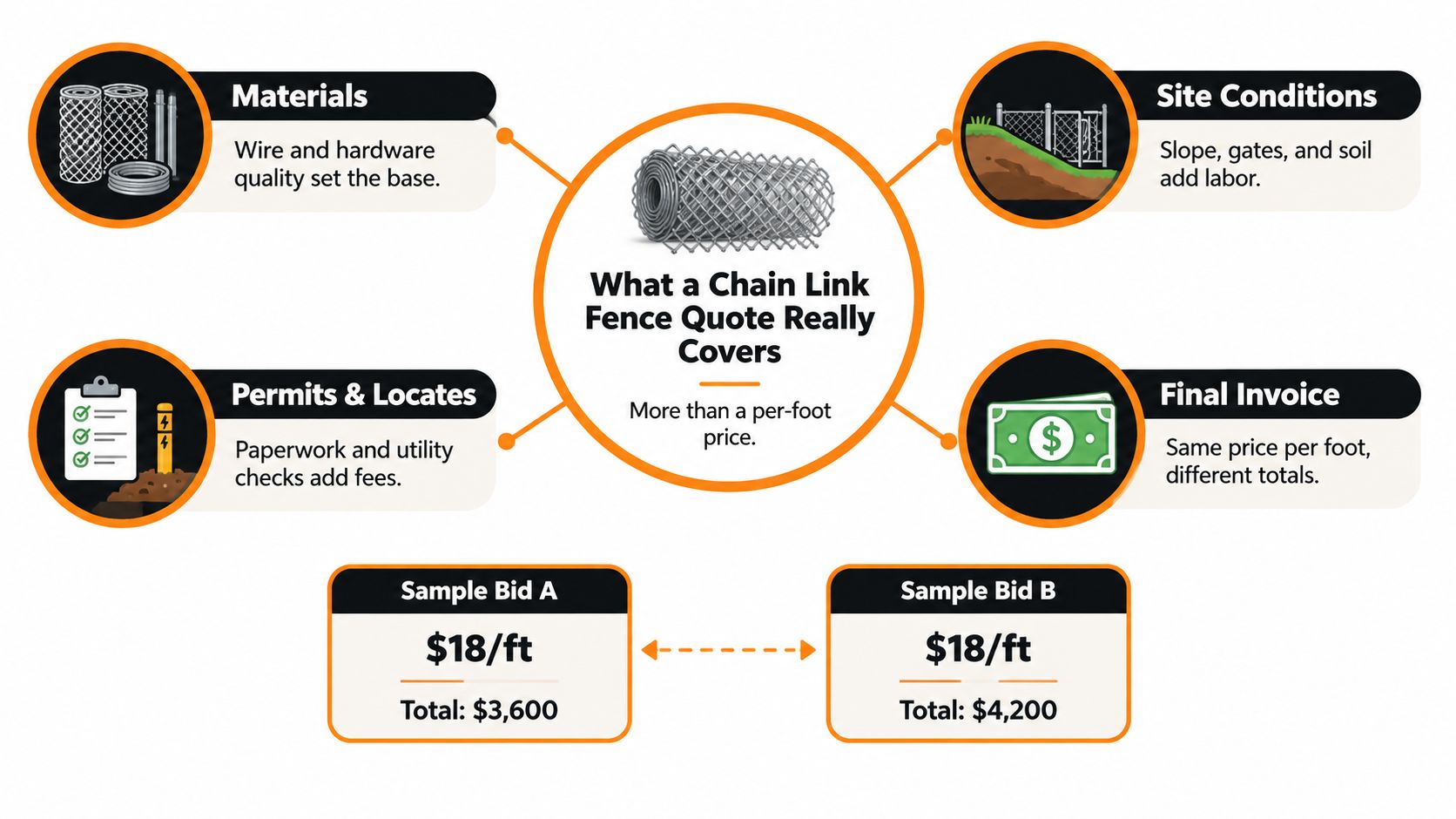
Why equal rates produce unequal totals
Suppose two contractors quote the same nominal rate. One may measure only the straight runs and leave gates, concrete allowances, permitting, and utility coordination outside the contract. The other may identify each terminal condition, include gate hardware, and document exclusions. Those bids aren't comparable, even if their headline rates match.
A practical estimator should show total run length, height, mesh, wire gauge or diameter, coating, post spacing, gate count, hardware, and assumptions about grade and airflow. The quote should also state whether removal, disposal, permits, surveys, inspections, and utility-company coordination are included.
Practical rule: The cheapest nominal quote is often the least useful quote when it hides the work that can create change orders.
Homeowners who want a preliminary planning number can compare the published Florida range with an online fence cost estimator calculator, but a ballpark figure shouldn't replace a measured scope. A fixed-price proposal becomes credible only after the contractor identifies the physical and regulatory conditions that could change the installation.
Information You Need Before Requesting a Quote
A contractor can't produce a dependable number from an address alone. The homeowner should gather the property survey PDF, a lot plan, recent yard photographs, and any documents showing easements, wetlands, preserves, waterways, or pool locations before requesting a site review.
Start with the total fence run length, not just the lot perimeter. A boundary fence may stop at a driveway, turn around a pool, or include a gap for an existing structure. Mark every corner, end condition, gate opening, and location where the grade changes. A sloped run can require additional layout decisions even when the measured distance looks straightforward.
The requested height also matters. A four-foot boundary, a six-foot privacy-oriented run, a commercial security perimeter, and a pool barrier don't share the same hardware or compliance assumptions. The homeowner should identify whether the mesh remains open or will receive privacy slats, screening, barbed wire, or another attached feature.
| Information to Prepare Before a Chain Link Quote | Why It Matters | Where to Find It |
|---|---|---|
| Property boundary | Prevents posts from crossing the owner's line or an easement | Property survey or recorded lot plan |
| Run length and corners | Determines fabric, posts, fittings, and labor | Survey, lot plan, or measured sketch |
| Fence height | Changes fabric, posts, ties, bands, and wind assumptions | Intended use and local requirements |
| Gate locations and widths | Adds posts, hinges, latches, and operating clearance | Driveway, walk-through, and site photos |
| Grade changes | Affects layout, gaps, stepped sections, and labor | Yard photographs and site walk |
| Existing fence | Identifies removal, disposal, and access needs | Photos and homeowner description |
| Pool, waterway, or preserve | Can trigger specialized review or restrictions | Site plan and county records |
| Easements and utilities | May require utility-company coordination or relocation | Survey, title documents, and 811 locate |
Conditions that deserve early attention
Corner lots need sight-triangle review. Easement crossings can require written letters from affected utility companies. Pool enclosures need barrier-specific gates and clearances. These aren't minor notes to add after the contract is signed.
Clear photographs should show the fence line from both directions, gates, landscaping, sheds, retaining walls, driveways, drainage features, and the existing grade. Photos won't replace a field measurement, but they help the estimator identify access problems before crews and materials are scheduled.
How Chain Link Pricing Is Calculated
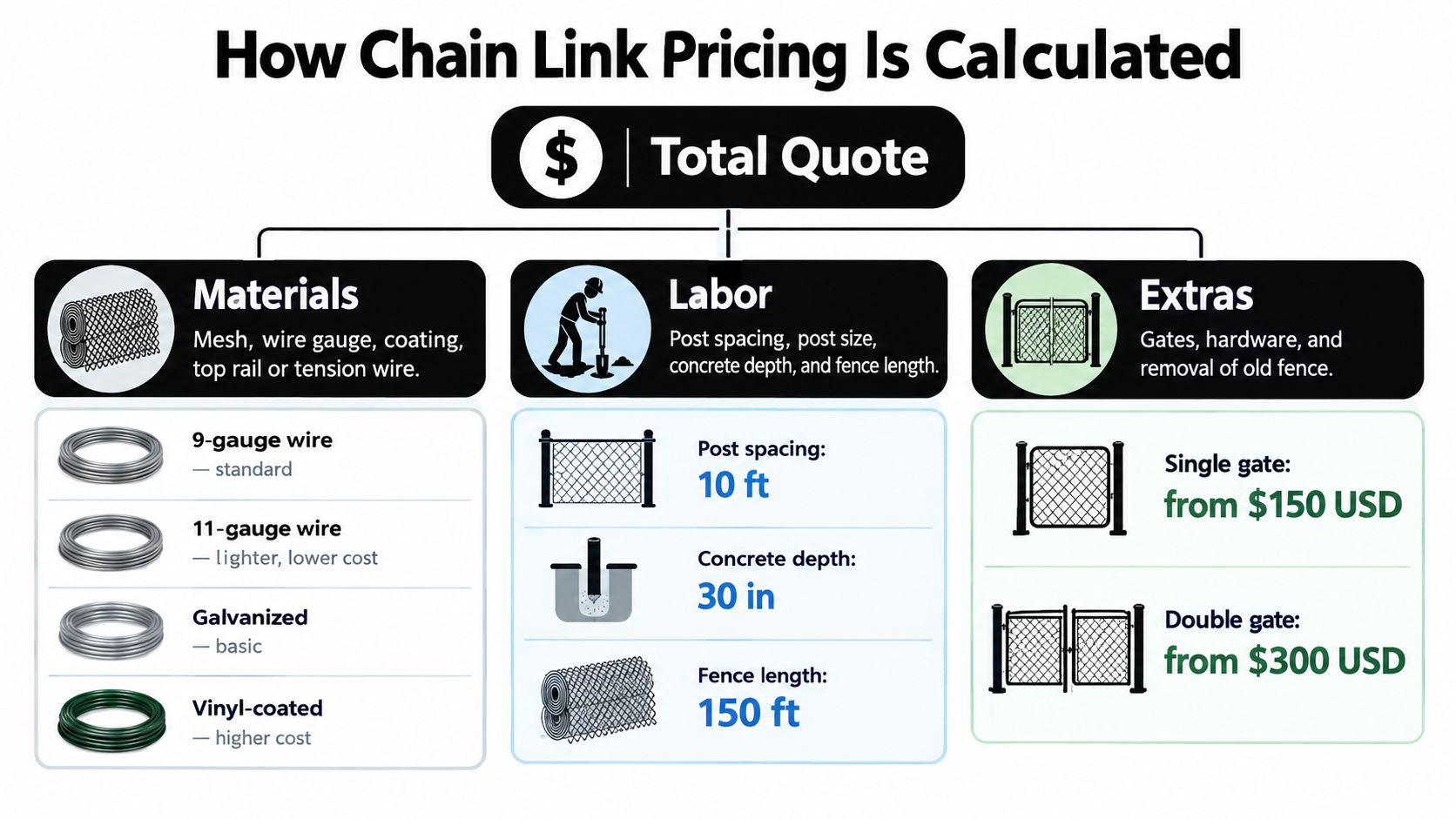
A complete takeoff turns the drawing into quantities. Fabric area is only one line. The estimator should count line posts, terminal and corner posts, top rail or tension wire, braces, tension bands, ties, fittings, concrete, gates, hardware, removal, disposal, mobilization, and any permitting or engineering allowance.
Fabric and framework
The quote should identify mesh opening, wire gauge or diameter, and coating. A smaller diamond opening or heavier wire can serve security requirements but costs more than a lighter, more open specification. The terms “chain link” or “galvanized fence” alone don't identify enough material to compare bids.
Post spacing affects both material quantity and structural behavior. Florida prescriptive provisions use 10 feet on center as a post-spacing benchmark and require fabric ties at the top rail and line posts. Those same provisions specify one fewer tension band than the fence height in feet, so the hardware count changes between a four-foot and a six-foot installation. Florida prescriptive chain-link provisions provide a useful comparison point, although the governing jurisdiction and project conditions still control.
Foundation assumptions also belong in writing. FHWA details use 2-inch mesh, 3.05 mm wire for fabric up to 1.2 meters high, 3.76 mm wire above that height, and at least 600 mm of concrete depth for line posts. FHWA chain-link specifications illustrate why a quote should show wire and foundation specifications instead of using a generic material label.
Gates, labor, and omitted items
A gate isn't a piece of fabric cut out of the fence. It needs posts sized for the opening, hinges, a latch, stops, frame components, and sometimes wheels, automation, access control, or self-closing hardware. Terminal posts at gates, corners, and ends also require bracing and tensioning that line posts don't provide.
The chain link fence installation cost per foot guide can help with early planning, but homeowners should ask for the actual takeoff behind the estimate. Common omissions include concrete, terminal assemblies, gate hardware, old-fence disposal, mobilization, difficult access, and inspection coordination.
Privacy slats deserve separate treatment. They change airflow, so a standard open-fabric assumption may no longer apply, especially on an exposed coastal lot. The quote should identify the slat product and state whether the posts, foundations, braces, and connections were reviewed for the altered wind condition.
Permits, Utility Locates, and Florida Wind Rules
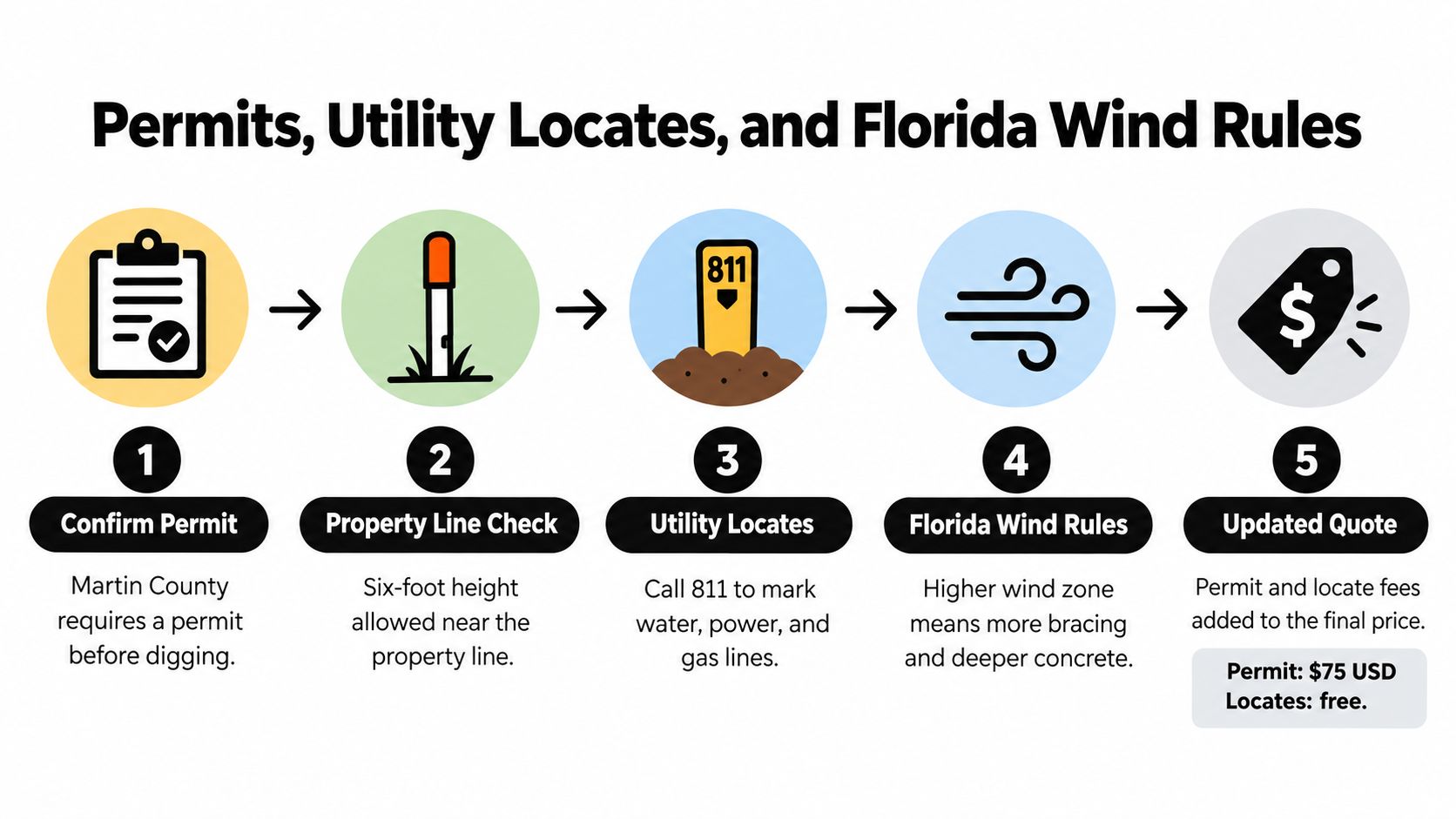
Permitting is a quote variable in Martin County, not an optional administrative detail. The county requires a permit for fence construction, limits a fence placed on the property line to a maximum six-foot height, and requires the fence to remain within the owner's boundaries. Restrictions can also apply near building setbacks, corner-lot sight triangles, wetlands, preserves, and navigable waterways. Martin County fence requirements should be checked before the contractor finalizes the layout.
A fence within 25 feet of a navigable waterway is generally restricted, subject to specified side-property-line or seawall situations. If the proposed fence crosses an easement, written letters from all affected utility companies are required. That means the quote should say whether surveys, easement coordination, redesign, utility letters, permit fees, and inspection scheduling are included.
Utility safety belongs in the base workflow
The contractor should arrange an 811 utility locate before digging posts. A straight residential run can still cross irrigation, electrical, water, communications, or gas lines. Martin County documentation also requires utility-company letters when a fence crosses an easement, and it requires property boundaries to be respected. Martin County compliance documentation makes clear that a routine-looking layout isn't automatically clear to build.
The quote should state who requests the locate, what happens if markings conflict with the proposed fence line, and whether relocation or redesign is excluded. A utility conflict discovered after delivery can affect both timing and price.
Wind assumptions need to be visible
Florida provisions state that chain-link fences over 12 feet, or 3.7 meters, require design for Chapter 16 wind loads. Shorter fences may use engineered loads or applicable prescriptive provisions, but those prescriptive provisions are limited to fences with unrestricted airflow.
Privacy slats, solid inserts, large gates, attached security wire, unusual soil, corner lots, and exposed coastal sites can all change the design assumptions. A quote that ignores those conditions may save money on paper while creating larger changes during permitting or installation.
A defensible quote doesn't hide wind assumptions inside a generic installation rate. It identifies the exposure, openness, gate condition, foundation approach, and any engineering allowance.
Common Add-Ons That Change the Final Price
A base chain-link package can be practical for an open boundary, but Florida homeowners often need more than open fabric. Each option should appear as a separate line so the customer can choose it deliberately rather than discover it in a revised invoice.
Coating and wire choices
Galvanized fabric is a basic utilitarian specification. Vinyl-coated fabric adds a finished appearance and can suit homeowners who want a less industrial look, but the quote should identify the coating and the framework finish separately. A contractor shouldn't describe one as merely “better” without considering exposure, appearance, maintenance, and budget.
That wire gauge is another trade-off. Heavier wire can provide a more solid security barrier, while a lighter specification may suit a low-risk residential boundary. The quote should identify gauge or diameter, mesh opening, post size, and framework dimensions so the homeowner understands what changed.
Privacy and security additions
Privacy slats reduce visibility but change the wind exposure. Barbed wire extensions serve commercial or higher-security perimeters and may involve additional posts, arms, warning considerations, and permitting review. Neither option belongs in a standard open-fabric price unless it has been specifically selected.
Gates create their own decision point. A standard walk gate, driveway gate, access-controlled gate, and wind-rated gate package don't have the same posts or hardware. Pool gates require particular care: Florida materials require an outdoor pool barrier to be at least 48 inches high, with no more than 2 inches between grade and the bottom of the barrier. The barrier also can't contain openings or protrusions that enable a young child to crawl under, squeeze through, or climb over it. Florida pool-barrier requirements should be reflected in the gate and fence specification.
Self-closing and self-latching hardware belongs on the pool quote as its own line. A pool-related installation also requires inspection coordination, rather than being treated as an ordinary yard boundary.
How the Allied Fence & Gate Estimator Works
A digital estimating workflow starts with documents rather than a vague phone description. The homeowner uploads a lot survey or property plan and photographs of the proposed fence line. An AI-based measurement extraction tool reads available boundary dimensions and setbacks, giving the estimator a clearer starting point before field conditions are confirmed.
The instant estimator then returns a ballpark range based on the selected project specifications and installed pricing data. The result isn't a substitute for a site assessment, but it gives the homeowner a practical way to test how height, run length, gates, and material choices affect the initial budget.
From preliminary number to written scope
The next step is a detailed PDF quote. The document identifies the selected fence system, measured work, options, exclusions, and project assumptions. It can be downloaded without an email signup, which lets a homeowner compare the scope with another contractor's proposal rather than comparing only headline rates.
A field review remains important where the property includes slopes, easements, existing fencing, waterways, difficult access, or utility conflicts. The contractor can revise the digital estimate after confirming those conditions and then coordinate permitting, 811 utility locates, and inspection scheduling as part of the project workflow.
Signing and payment terms
The digital contract is handled in-house, rather than through a third-party electronic-signature platform. Financing terms are disclosed in the proposal, including a 50% deposit and the balance due on completion. Those terms should be reviewed alongside the scope, permit responsibilities, material specifications, and change-order language.
Homeowners can review the Allied Fence & Gate estimator before requesting a detailed proposal. The useful distinction is that the estimator creates a planning range, while the measured PDF quote documents the work that the crew is expected to install.
Quote Checklist and Common Pitfalls to Avoid
Before signing, the homeowner should be able to answer each of these questions from the proposal itself:
- Fabric: Does the quote identify mesh opening, wire gauge or diameter, and coating?
- Framework: Are line posts, terminal posts, corner posts, top rail or tension wire, braces, ties, bands, fittings, and concrete listed?
- Layout: Does it show run length, height, corners, ends, grade changes, and post spacing?
- Gates: Are gate count, dimensions, posts, hinges, latches, stops, automation, and self-closing or self-latching requirements stated?
- Site work: Are removal, disposal, clearing, access limitations, soil conditions, and mobilization included or excluded?
- Compliance: Does the proposal identify permits, 811 locates, inspections, wind review, easements, and property-line assumptions?
- Pool work: Does it address the 48-inch barrier height, 2-inch bottom clearance, openings, gate operation, and inspection requirements?
- Price validity: Does it state how long the price remains valid and whether material escalation can apply?
The most common estimating mistake is treating every linear foot as identical. Gate openings, corners, terminal conditions, slopes, poor soil, privacy inserts, and easement conflicts all require different decisions. Another common mistake is pricing fabric and line posts while omitting terminal assemblies, concrete, fittings, removal, or disposal.
A standard residential gate package may also fail to satisfy local wind or pool-barrier requirements. The proposal should make those assumptions visible before the deposit is paid.
The real question isn't what chain link costs per foot. It's what must be included for the quote to be inspection-ready and fixed-price.
AlliedFenceAndGate.com™ provides chain link fencing, digital ballpark estimating, measured PDF proposals, permitting, 811 utility locates, and inspection coordination across Florida's Treasure Coast and northern Palm Beach County. Visit AlliedFenceAndGate.com™ to submit property information and request a quote that separates the base installation from the site and compliance items.
Related Fencing Services
Need a fence or gate on the Treasure Coast?
Licensed, insured, and bonded. Free estimates across Martin, St. Lucie, Indian River & Palm Beach counties.
Call (772) 530-3127