8 Wood Privacy Fence Styles for Florida Homes
The popular advice says an opaque wood fence is automatically the best privacy fence. Florida proves otherwise. A tight board layout can block views, but humidity, UV exposure, coastal corrosion, storm wind, drainage, site grade, HOA review, permits, and maintenance expectations determine whether that fence remains useful after installation.
The eight wood privacy fence styles below compare visual privacy, appearance, the estimated $25 to $45 per linear foot wood-fence range from Allied Fence and Gate's published pricing information, climate suitability, installation complexity, and upkeep. The range is a starting context, not a final quote. Height, gates, soil, access, preparation, permits, and finish requirements can change the project substantially.
Before work begins, property owners should confirm local requirements, property lines, utility locations, HOA rules, and permits. A practical decision path is simple: set the budget, decide whether privacy must be complete or partial, match the design to the home, then choose the material and maintenance plan that the site can support.
Table of Contents
- 1. Board-on-Board Privacy Fence
- 2. Shadowbox Privacy Fence
- 3. Picket Privacy Fence With Lattice Top
- 4. Solid Board Privacy Fence
- 5. Horizontal Slat Privacy Fence
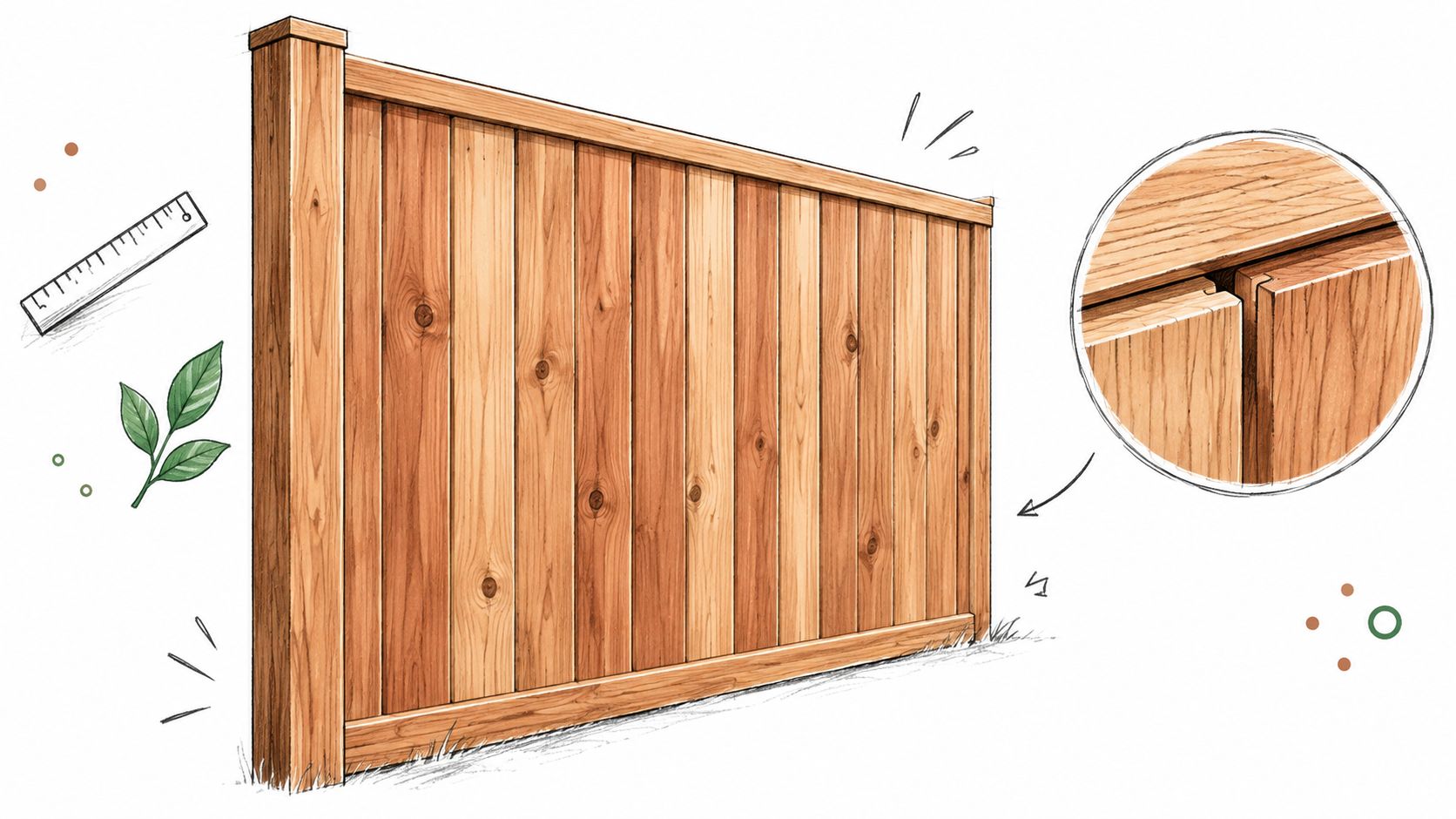
- 6. Cedar Tongue-and-Groove Privacy Fence
- 7. Louvered Privacy Fence With Angled Boards
- 8. Staggered-Height Stepped Privacy Fence
- 8 Wood Privacy Fence Styles Compared
- Choose the Style That Fits Your Property
1. Board-on-Board Privacy Fence
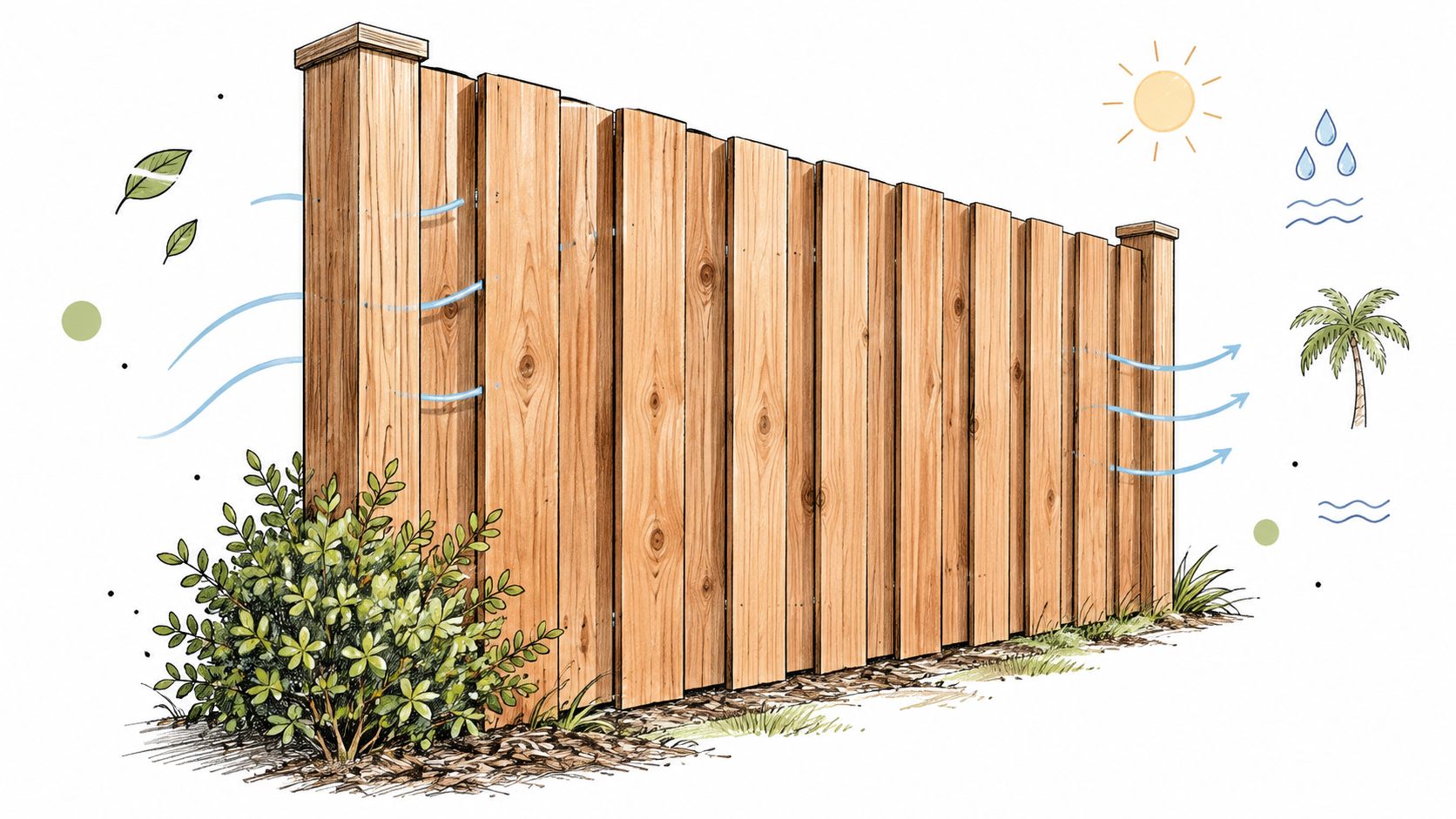
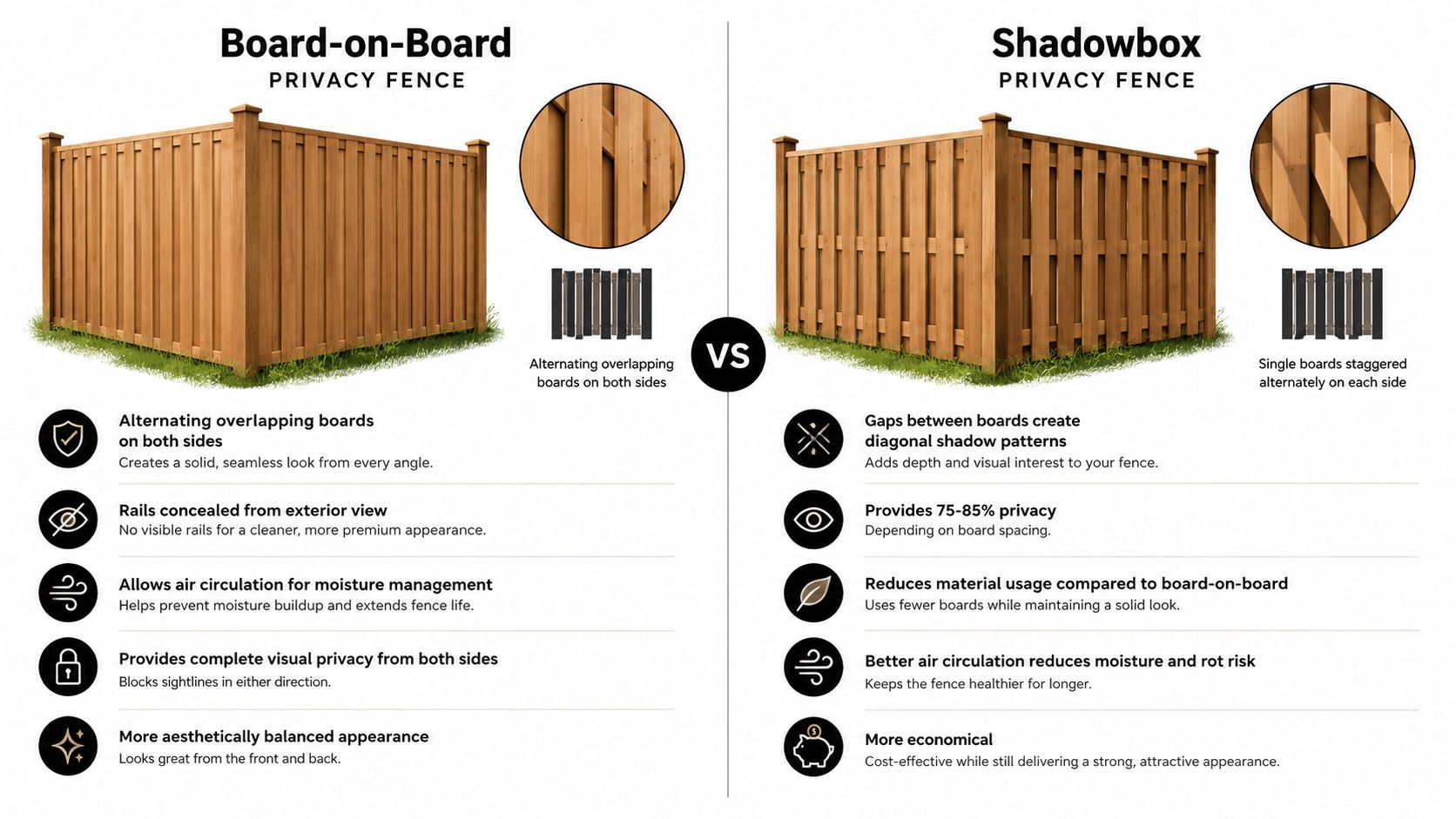
Board-on-board fencing earns its privacy reputation through overlapping vertical boards installed on alternating sides of the rails. The layout blocks direct sightlines from either side and continues to cover narrow gaps as boards move slightly with Florida's humidity. Fence Advisors describes board-on-board as a maximum-privacy design with a 10/10 privacy rating and strong wind performance.
Both neighbors see a finished fence face, and the layered pattern permits limited air movement. That airflow can matter on storm-exposed properties, although no wood fence should be treated as a substitute for properly set posts, sound rails, and code-compliant construction. More boards and labor increase the price compared with a basic flush-mounted fence, so confirm the material allowance before approving the design.
Cedar is a practical Florida specification because it resists rot and insects naturally. In humid Treasure Coast neighborhoods, apply a protective stain or sealer within 6 months, then inspect the finish regularly and reseal or stain every 2 to 3 years. Keep soil and mulch below the boards, maintain drainage at the posts, and check for cupping, soft spots, loose fasteners, and mildew after wet seasons.
Where it works best
Board-on-board fits mature neighborhoods in Stuart, uniform high-end communities in Palm Beach County, and waterfront properties in Martin County where both sides of the boundary should look intentional. Use stainless steel or other corrosion-resistant fasteners near salt air, and verify HOA approval, property lines, permits, and height requirements before ordering materials.
Review the board-on-board installation details for post depth, drainage, rail alignment, and inspection points. Schedule an 811 utility locate before digging. A final inspection should check loose hardware, grade transitions, gate operation, and visible code concerns before closeout.
2. Shadowbox Privacy Fence
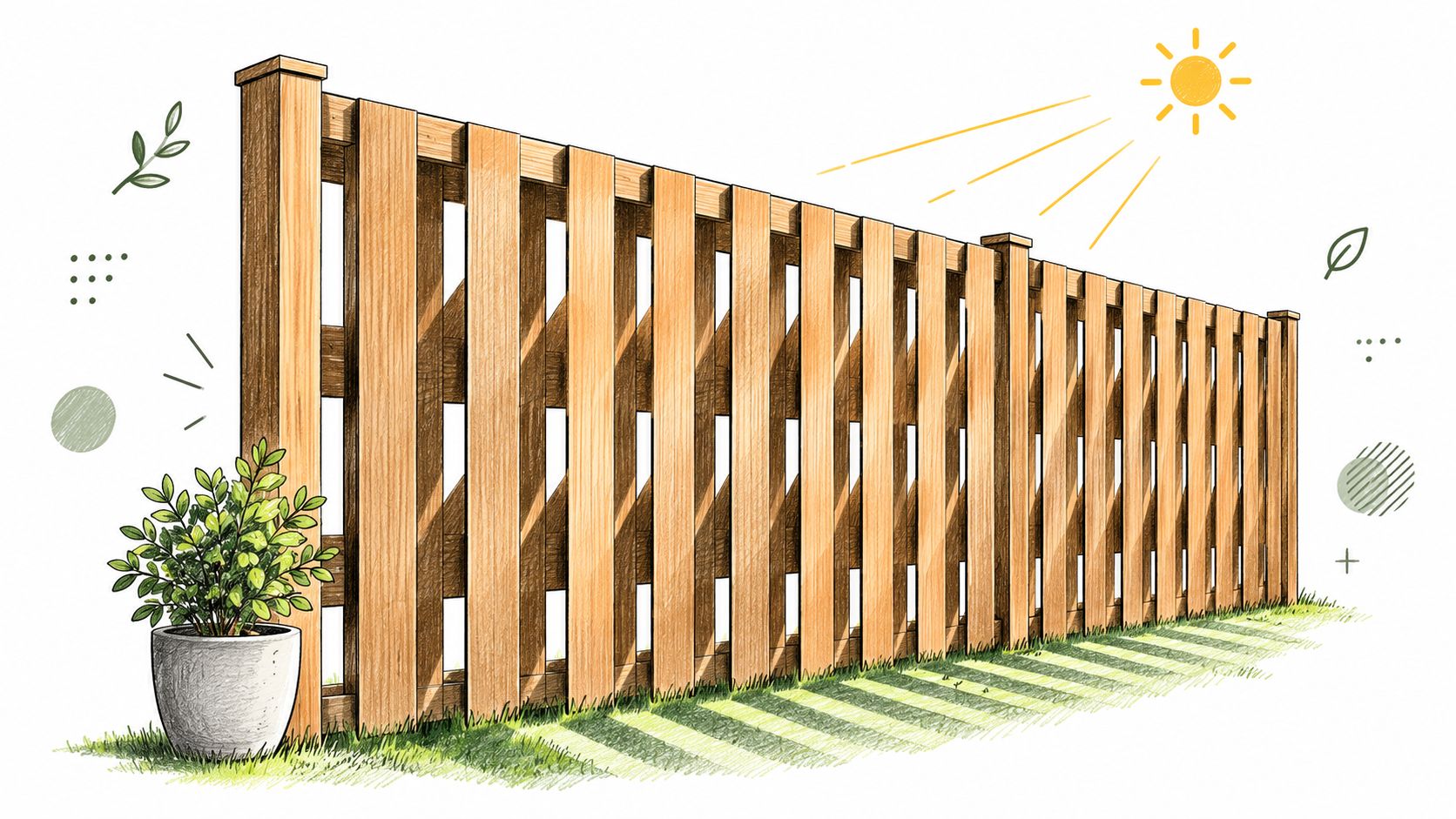
Shadowbox fencing alternates boards on opposite sides of the rails, producing a layered pattern that looks finished from either direction. The spaces let air and light move through the fence, making the design more forgiving on exposed Florida lots than a fully opaque wall. Its biggest compromise is visual privacy. Neutral fence guidance identifies shadowbox as a partial-privacy style that trades some blockage for airflow and a finished appearance on both sides.
That trade-off works well for a shared boundary. A property owner in Palm Beach County may want a polished fence face for the neighbor, while a Martin County homeowner may prefer a decorative pattern rather than complete obscurity. The same layout can frame a patio or pool area without creating the heavy, enclosed appearance of a solid stockade fence.
Shadowbox is often a value-oriented alternative to board-on-board because it uses a staggered layout rather than overlapping every board into a continuous screen. It still needs accurate spacing, straight rails, and careful fastener selection. Cedar or properly treated lumber should be paired with galvanized or stainless steel hardware to reduce rust staining in Treasure Coast humidity.
Installation details that matter
Consistent spacing keeps the shadow pattern even. The crew should also consider the fence's orientation, afternoon sun, drainage path, and access for future staining. A UV-protective finish within 6 months helps control graying, while recurring inspections should focus on the lower boards, post bases, and rail ends where moisture remains longest.
Shadowbox isn't the right choice for a homeowner who needs complete visual screening, stronger sound-blocking perception, or a barrier with no visible light movement. It is a better fit where airflow, neighbor-facing appearance, and moderate privacy matter as much as opacity.
3. Picket Privacy Fence With Lattice Top
A lattice-top privacy fence gives homeowners a more traditional profile without surrendering ground-level screening. The lower section uses solid boards or closely spaced pickets, while an open lattice panel rises above it. That upper opening brings in light and supports a softer architectural transition between the house, landscaping, and fence line.
This design is especially useful in Palm Beach County communities where an HOA may prefer a picket character over a tall, uninterrupted wall. It can also suit front-yard applications where the fence must complement the home rather than appear purely defensive. In Stuart, a lattice top can coordinate with porch details, trellises, or established garden beds.
The lattice creates a maintenance boundary
Open lattice isn't automatically low maintenance. Vines can add shade and visual screening, but they also hold moisture against the wood and make inspection harder. Removable lattice panels or hinged access points make it easier to trim growth, clean the boards, and replace damaged sections.
Homeowners should select a lattice pattern and total height only after checking HOA documents and local rules. Residential guidance commonly centers on 6 feet for rear and side yards, while front yards are often limited to 3 or 4 feet. Some jurisdictions may allow 8 feet with a permit or variance, so the applicable local rule must be confirmed through the relevant authority and fence-height guidance.
Cedar or another exterior-rated wood helps the fence handle Florida moisture and sun. Stainless steel fasteners prevent corrosion near the coast. Climbing plants such as clematis or jasmine can be considered for Treasure Coast conditions, but they shouldn't be treated as instant privacy. The structure needs time for coverage, and the homeowner still needs access to stain, inspect, and repair the wood behind the vines.
4. Solid Board Privacy Fence
Solid board fencing is the practical full-privacy choice, but its simple appearance can conceal drainage and wind-load problems. Vertical boards are installed tightly beside one another on one side of the rails, creating an opaque face with fewer material and layout variables than board-on-board or tongue-and-groove construction. That usually makes installation faster and budgeting easier.
The style suits backyard screening in Martin County, commercial perimeters in Palm Beach County, and business or industrial properties across the Treasure Coast. It can also define a pool area when the complete fence design satisfies applicable safety and building requirements.
Moisture and wind determine the specification
A solid wall gives wind less room to pass through, so post size, embedment, concrete placement, and rail attachment deserve more attention than decorative caps. On Florida sites, the lower board edge should remain clear of soil, mulch, irrigation spray, and standing water. Posts should be rated for ground contact, and the fence line should drain rather than form a trough after rain.
Cedar and properly rated pressure-treated lumber offer practical options, but neither removes maintenance. Inspect the bottom edges, post bases, fasteners, and rail connections after wet weather and tropical storms. Replace split boards promptly, keep vegetation from touching the fence, and renew the protective finish as its surface begins to dry, fade, or absorb water. Untreated spruce or fir has a much shorter service life in this exposure.
The published wood-fence range of $25 to $45 per linear foot provides early budget context, but it is not a project quote. Gates, grade changes, demolition, difficult access, permits, staining, post requirements, and coastal corrosion protection can change the final price.
A defensible Florida specification pairs exterior-rated boards with corrosion-resistant fasteners, a UV-protective finish within 3 months, and carefully set ground-contact posts. Check HOA approval, local permitting, and inspection requirements before ordering materials. Locate the fence line through 811 before digging, then verify property lines and drainage so a private boundary does not create a neighbor dispute or redirect runoff.
5. Horizontal Slat Privacy Fence
Horizontal slats deliver the modern look many contemporary Florida homes want. Boards run parallel to the ground between vertical posts, with tight spacing for stronger screening or wider spacing for a more open boundary. Mixed wood tones, metal accents, and clean post caps can make the fence read as part of the architecture rather than a separate yard enclosure.
That appearance comes with a moisture warning. Horizontal boards create more ledges and attachment points where water can remain, especially if the fence follows a grade or sits near irrigated landscaping. The installation needs a deliberate slope, drainage path, ventilation gaps, and access for cleaning the inside face.
Use the style where inspection remains possible
A horizontal fence shouldn't be packed tightly against a wall, planting bed, or property feature that prevents inspection. Weep paths and open drainage at the bottom help keep water from becoming trapped. Cedar or an exterior-grade hardwood is preferable to a softwood that is more likely to warp under Florida humidity and UV exposure.
Board-on-board horizontal construction can hide posts and improve the finished appearance, but it increases material and labor demands. Stainless steel fasteners are worth specifying because horizontal attachment points can accelerate rust migration when water sits on them. A professional installer should verify rail strength, post alignment, slope, and code requirements before the boards close in the structure.
Horizontal slat privacy fence planning is most appropriate for modern estates in Palm Beach County, contemporary Martin County homes, and high-end Treasure Coast properties where curb appeal is part of the project brief. It isn't the economical default. It works when the owner accepts precision installation and recurring board-by-board maintenance.
Practical rule: A horizontal fence should be selected only after the drainage, ventilation, and inspection access have been designed, not just after the board color has been chosen.
6. Cedar Tongue-and-Groove Privacy Fence
Cedar tongue-and-groove fencing delivers a continuous, panel-like surface with few visible gaps. The interlocking boards suit luxury homes, estate properties, and architecturally significant buildings in Palm Beach County and Martin County, but the refined appearance comes with tighter installation tolerances and higher material costs than a basic picket assembly.
The enclosed face resembles exterior millwork and can improve visual privacy along patios or side yards. It also limits visibility into the panel, so inspection access matters. Florida moisture can remain hidden near the lower edge or behind trim, particularly where drainage is poor. Leave appropriate clearance above grade, provide ventilation where the design allows, and plan how damaged boards will be removed.
Precision controls the result
Use kiln-dried, exterior-milled cedar, with Select or #1 grade lumber preferred for a premium installation. Let the boards acclimate to local humidity before installation, then specify stainless steel fasteners to reduce rust staining on the cedar. In coastal areas, confirm that every metal component, including hinges and gate hardware, suits salt exposure.
A tongue-and-groove layout gives installers less room to correct errors. Misaligned grooves, overdriven fasteners, and boards installed too tightly can cause cracking or buckling as moisture levels change. Before the run is closed, the crew should confirm post caps, bottom clearance, gate transitions, drainage, wind exposure, and access for future panel replacement. HOA review may also be needed when the fence changes the street-facing elevation, and local permitting requirements should be checked before construction.
Cedar needs a maintenance plan. Apply a clear or cedar-tone finish soon after installation, inspect the joints and lower edges regularly, and reseal when the coating begins to fail. Cedar fence staining guidance can help owners choose a finish and schedule upkeep before the wood grays or moisture damage becomes visible. Cedar and redwood lifespan estimates vary with maintenance, exposure, and construction quality, so the premium appearance only makes financial sense when the owner accepts the care it requires.
7. Louvered Privacy Fence With Angled Boards
Louvered fencing uses angled horizontal or diagonal boards to direct sightlines while allowing air and light through the assembly. It suits patios, pool decks, and outdoor living spaces where complete enclosure would feel too heavy. The angled face can screen standing eye-level views without turning the boundary into a flat wall.
Privacy depends on the angle, spacing, and viewpoint. A design that blocks a neighbor standing several feet away may reveal more when viewed from a higher balcony or a lower grade. For that reason, the owner should establish the actual sightlines before selecting the board angle.
Match the louvers to the sun and storm path
Florida sun moves across the fence throughout the day, and the wrong orientation can create glare, unwanted openings, or a visual effect that changes dramatically by season. The layout should also account for prevailing wind, attachment-point drainage, and diagonal bracing. Stainless steel fasteners are particularly important where angled boards create small surfaces that can hold water.
Cedar or properly rated pressure-treated lumber can support the design, provided the wood is exterior-grade and the posts are specified for ground contact. Consistent cuts make the slats look intentional, while uneven spacing makes the fence appear unfinished and can change the privacy level along the run.
Louvered fencing is a partial-screening choice, not a substitute for a solid boundary. It works for a contemporary home in Stuart or a Palm Beach County pool terrace that needs privacy with airflow. It works less well for a property seeking complete visual separation, noise perception reduction, or a simple low-maintenance installation.
The owner should preserve access to the inner faces for washing, staining, and checking fasteners. Without that access, the design's most attractive feature becomes the part least likely to receive maintenance.
8. Staggered-Height Stepped Privacy Fence
A stepped fence follows a sloped property by changing height in defined sections rather than forcing the top line to remain level. It prevents the lower edge from disappearing into the ground on graded sites and avoids awkward gaps beneath a single-height panel. On a flat property, the same approach can create a deliberate design feature, but the design needs a functional reason or it can look arbitrary.
Waterfront and hillside properties in Martin County, Palm Beach County estates with changing grades, and Treasure Coast lots with elevation transitions are natural applications. The fence can use vertical boards, horizontal slats, or privacy panels, but the chosen board language should remain consistent from one step to the next.
Survey the grade before choosing the pattern
A professional site survey should establish elevations, property boundaries, drainage direction, and transition points. Step changes work best at corners, planting breaks, or other natural divisions. Every section still needs to comply with applicable height rules, and an allowed height in one part of the lot may not apply to another.
Utilities must be located along the entire fence line before excavation. Grade changes can alter the relationship between the post holes and underground services, so 811 coordination is a safety requirement rather than a scheduling detail. Tree roots, stumps, and unstable soil may also require site preparation before posts can be installed correctly.
Stepped fencing solves a grade problem first. Its decorative value comes after the fence has been made stable, drainable, and code-compliant.
Drainage deserves special attention at each step. Soil and mulch shouldn't build up against the lower boards, and runoff shouldn't collect at the inside corners. Property owners considering digital planning can upload lot photos or survey information for assessment, then confirm the final design with a qualified installer who can coordinate preparation, permitting, and inspection.
8 Wood Privacy Fence Styles Compared
| Style | Implementation Complexity 🔄 | Resource / Cost ⚡ | Expected Outcome ⭐ / 📊 | Ideal Use Cases 📊 | Key Advantages & Tips ⭐ / 💡 |
|---|---|---|---|---|---|
| Board-on-Board Privacy Fence | High, precise overlapping both sides, concealed rails | High materials & labor (cedar preferred) | ⭐⭐⭐⭐⭐, Full double-sided privacy; improved ventilation; longer wood life | High-end residential, HOA neighborhoods, waterfront properties | Full, balanced finish; moisture management; use cedar & stainless fasteners; stain within 6 months |
| Shadowbox Privacy Fence | Moderate, staggered boards; careful spacing for pattern | Moderate, material savings vs board-on-board; faster install | ⭐⭐⭐⭐, ~75–85% privacy; good airflow; attractive shadow effect | Mid-range residential, pool screens, cost-conscious homeowners | Economical with visual interest; maintain consistent spacing; use cedar/PT and UV stain |
| Picket Privacy Fence with Lattice Top | Moderate–High, two-tier build and lattice attachment | Moderate–High, higher labor, lattice maintenance | ⭐⭐⭐⭐, Ground-level privacy + architectural curb appeal; light at top | Front yards, HOA-required traditional aesthetics, homes needing curb appeal | HOA-friendly; allows vines; verify HOA rules, choose cedar, plan vine access |
| Solid Board Privacy Fence (Flush Mount) | Low, simple flush-mounted boards on single side | Low, most economical full-privacy option; fast install | ⭐⭐⭐⭐, Complete opacity; fastest install; higher moisture risk if unvented | Budget residential/commercial perimeters, backyard privacy, pool enclosures | Most cost-effective; allow ventilation gaps; use cedar/PT, stainless fasteners, stain early |
| Horizontal Slat Privacy Fence | High, precise horizontal alignment and drainage planning | High, premium materials & skilled labor | ⭐⭐⭐, Strong contemporary impact; variable privacy; drainage risks if poorly vented | Modern estates, design-forward properties, architectural sites | Distinctive modern look; ensure slope/drainage and ventilation; use exterior-grade woods, pro install |
| Cedar Tongue-and-Groove Privacy Fence | Very High, precision milling and skilled installation | Very High, premium cedar and labor costs | ⭐⭐⭐⭐⭐, Seamless, weather-tight, premium finish; long lifespan | Luxury residences, estates, architect-specified projects | Premium weather protection and appearance; use kiln-dried Select cedar, skilled carpenters, stainless hardware |
| Louver/Slat Fence with Angled Boards | High, angle cuts and consistent spacing required | Moderate–High, labor-intensive; moderate material use | ⭐⭐⭐, Partial privacy (60–75%); excellent airflow; preserves views | Patios, pool decks, modern outdoor living areas | Balances privacy and connectivity; pick angle for desired coverage; use stainless fasteners and plan maintenance |
| Staggered Height Stepped Privacy Fence | High, site-specific surveys and variable post heights | Moderate–High, custom cuts and increased labor | ⭐⭐⭐⭐, Maintains privacy on slopes; visually cohesive on grade changes | Hillside/waterside properties, sloped lots, terrain-aware designs | Solves grade challenges and adds interest; require professional survey, verify code heights and drainage planning |
Choose the Style That Fits Your Property
The best wood privacy fence style is the one that fits the property's exposure, grade, rules, and maintenance capacity. Flush-mount solid board is the practical choice for economical full privacy. Shadowbox offers airflow and a finished appearance on both sides, making it useful for shared boundaries and wind-exposed yards. Board-on-board provides the strongest visual screening with a balanced presentation from either side, although it requires more material and care.
Tongue-and-groove cedar belongs on premium projects where a refined finish justifies precision carpentry and recurring sealing. Horizontal slats and louvered designs suit contemporary homes and outdoor living areas, but both require careful drainage, ventilation, and access for inspection. Lattice-top fencing offers HOA-friendly curb appeal where traditional styling matters. Stepped fencing solves changing grades and can turn a difficult site into a coherent boundary.
The published $25 to $45 per linear foot wood-fence starting range from Allied Fence and Gate's pricing information should be compared with site conditions, height, gates, removal, preparation, permits, hardware, and finish requirements. It isn't a final quote, and a style that appears inexpensive can become costly if poor drainage, inaccessible boards, or unsuitable posts create early repairs.
A Florida selection checklist
- Confirm the privacy goal: Decide whether the yard needs complete screening, shared-side privacy, airflow, or only patio separation.
- Review local requirements: Check HOA rules, front-yard limits, permits, pool requirements, property lines, and easements.
- Inspect drainage and grade: Identify standing water, irrigation spray, slope changes, roots, and low points before selecting the panel layout.
- Assess the property: Upload property information or photos for an initial assessment if a digital measurement review would help.
- Schedule 811 locates: Locate underground utilities before any post holes are marked or excavated.
- Choose the hardware: Specify stainless steel or galvanized fasteners where humidity and coastal exposure could accelerate corrosion.
- Plan recurring care: Establish annual inspections and a sealing or staining routine suited to the wood species and exposure.
AlliedFenceAndGate.com™ serves Martin and Palm Beach Counties and the broader Treasure Coast with wood fencing, permitting, utility locates, inspection coordination, site assessment, and digital estimating tools. The company's service range also includes pool safety fencing, gates, aluminum, PVC/vinyl, chain link, and ADA-compliant railings, which can help when a property needs more than one type of exterior work.
Florida fence longevity depends as much on water management and maintenance as it does on the style selected.
Local homeowners, HOA boards, property managers, and commercial owners can use the estimator to establish a ballpark budget, then request a site assessment before approving a design. The right next step is to compare the fence style against the actual lot, not against a photograph taken in a different climate.
#MartinCountyFencing #PalmBeachCountyFencing #TreasureCoastFencing #StuartFencing #MartinCountyFence #PalmBeachCountyFence #TreasureCoastFence #FloridaWoodFence #WoodPrivacyFence #CedarFence #BoardOnBoardFence #ShadowboxFence #PrivacyFenceInstallation #FenceContractorFlorida #PoolFenceFlorida
AlliedFenceAndGate.com™ offers wood privacy fence installation, digital estimating, site assessment, permitting, 811 utility locates, and inspection coordination across Martin County, Palm Beach County, and the broader Treasure Coast. For a Florida-specific recommendation on board layout, posts, drainage, hardware, and maintenance, visit AlliedFenceAndGate.com™ and request an assessment.
Related Fencing Services
Need a fence or gate on the Treasure Coast?
Licensed, insured, and bonded. Free estimates across Martin, St. Lucie, Indian River & Palm Beach counties.
Call (772) 530-3127