Pool Gate Lock Regulations: Florida Compliance Guide
Florida requires residential pool gates to be self-closing and self-latching, with the release mechanism positioned at or above 54 inches. Local inspectors enforce that baseline through the Florida Building Code, plus any stricter Martin or Palm Beach County ordinances.
A common Treasure Coast scenario starts with a homeowner standing beside a newly installed gate, confident that the project is finished. The gate looks substantial, the latch clicks when someone pulls it shut, and the fence matches the approved layout. Then the inspector measures the release, finds one reach or alignment problem, and issues a correction notice. The failure usually isn't the fence material. It's the interaction between the gate swing, latch position, closing action, and actual barrier geometry.
Table of Contents
- What Florida Pool Gate Lock Regulations Actually Require
- Self-Closing and Self-Latching Hardware Specifications
- Choosing Compliant Pool Gate Lock Hardware
- Inspection Failures and Real Compliance Scenarios
- Permitting and Inspection Steps in Martin and Palm Beach Counties
- Building a Pool Gate Lock System That Passes Inspection
What Florida Pool Gate Lock Regulations Actually Require
Florida pool gate lock regulations exist to prevent unsupervised access, not merely to make a gate harder to open. A residential barrier gate must close on its own and latch without someone lifting, pushing, or manually engaging the hardware. The release mechanism must also be positioned so a young child can't easily reach it from inside the pool area.
The Consumer Product Safety Commission recommends self-closing and self-latching residential pool gates. Its guidance addresses a release mechanism placed at least 54 inches above the bottom of the gate, and it explains the alternative placement when the release sits below that threshold. The CPSC also states that its barrier guidance isn't a mandatory federal standard. Local jurisdictions make the requirements enforceable when they adopt model language into building and safety codes. The CPSC residential pool barrier guidelines provide the national reference point, while Florida and local building departments determine how that guidance applies during permitting and inspection.
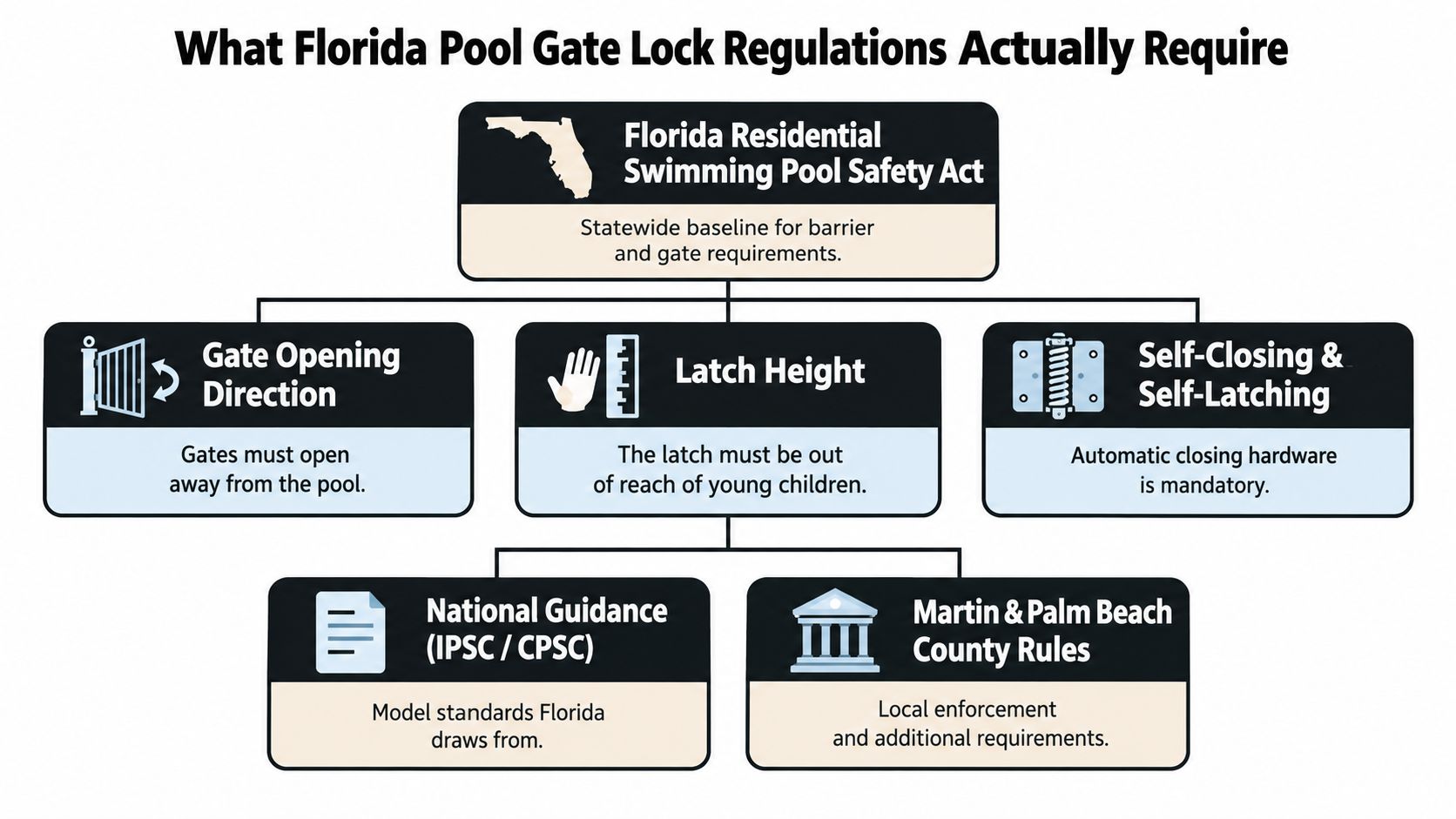
The statewide baseline and local overlay
Florida's statewide requirements establish the starting point for residential pool barriers. The gate must swing away from the pool, close automatically, and latch securely. The latch release must be out of reach of young children under the applicable configuration.
Martin County and Palm Beach County properties still have to satisfy the statewide standard, but the local building department and adopted amendments control the inspection outcome. A design that passed in another Florida city, or in another state, may not satisfy the local interpretation. Plan reviewers and inspectors may focus on the exact site conditions, the approved drawings, and whether the installed gate performs as a complete barrier rather than as an attractive standalone product.
Practical rule: A manufacturer's label saying “pool safe” doesn't replace the approved design, local code review, or a field test of the installed gate.
Homeowners should also distinguish advisory guidance from mandatory code language. The CPSC publication is model guidance, not a federal construction mandate. Once similar requirements appear in an adopted Florida code or local amendment, however, the inspector can evaluate the installation against that enforceable standard. The pool fence requirements guide can help property owners organize the broader barrier questions before focusing on the lock.
The practical question is therefore not just, “Does this latch lock?” It is, “Does the complete gate satisfy the Florida baseline and the stricter local condition, if one applies?” That distinction protects homeowners from relying on a generic online specification that doesn't account for swing direction, reachability, adjacent structures, or the way the gate closes on the finished grade.
Self-Closing and Self-Latching Hardware Specifications
A compliant gate has to perform automatically. A person shouldn't need to pull the gate tight, lift the latch, turn a key, or press a second control after releasing the gate. Inspectors commonly test the gate from different open positions because a mechanism that works when the gate is barely open may fail when the gate is opened wider or when wind and hinge friction affect its movement.
The measurable latch rules are the part most homeowners can check before requesting inspection. The CPSC guidance addresses the pool-side release, its relationship to the top of the gate, and the openings around the release area. The pool safety barrier publication specifies that, when the release mechanism is below 54 inches, the pool-side latch release should be at least 3 inches below the top of the gate, with no opening greater than 1/2 inch within 18 inches of the release area.
Field measurements that matter
| Requirement | Measurement | Why It Matters |
|---|---|---|
| Pool-side latch release | At least 54 inches above the bottom of the gate in the applicable configuration | Keeps the release outside a young child's easy reach |
| Lower-release alternative | At least 3 inches below the top of the gate | Prevents a child from reaching over the gate to operate the release |
| Opening near release area | No opening greater than 1/2 inch within 18 inches of the release area | Limits reach-through access to the latch |
| Gate closing action | Must close and latch automatically from its open position | A gate that closes without latching still leaves the barrier open |
The release height should be measured from the correct finished surface, not from an unfinished slab, a raised paver, or a convenient point on the fence post. A small change in grade can alter the field measurement. The hardware also has to remain protected from reach-through access on the pool side.
Self-closing is more than a spring
A spring hinge can provide the closing force, but the hinge isn't the entire system. The gate frame must be square, the hinges must be aligned, the post must remain stable, and the strike must meet the latch at the correct position. If the gate rubs on the ground or drifts sideways under its own weight, increasing spring tension may not solve the underlying problem.
A proper pre-inspection test includes releasing the gate without touching it again, watching it travel fully to the closed position, and confirming that the latch engages audibly and mechanically. A gate that stops short, bounces off the strike, or requires a second push has failed the functional purpose even if the latch looks correctly positioned.
Why latch engagement fails
Corrosion, loose fasteners, a shifted post, and a bent strike plate can all prevent reliable engagement. Pool chemicals and coastal moisture make exposed hardware condition especially important on the Treasure Coast. The hardware should be checked after installation and during routine property maintenance, because an initially compliant gate can become unreliable as alignment changes.
The pool safety gate latch guide gives property owners a focused reference for evaluating latch placement and operation. The inspection standard is functional: the gate must close, the latch must engage, and the release must remain appropriately controlled.
Choosing Compliant Pool Gate Lock Hardware
Hardware selection should begin with the gate's required behavior, not with the appearance of the lock body. A pool barrier gate needs a mechanism that supports automatic latching and a closing system that brings the gate into the strike consistently. Key access, keypad access, and convenience features come afterward.
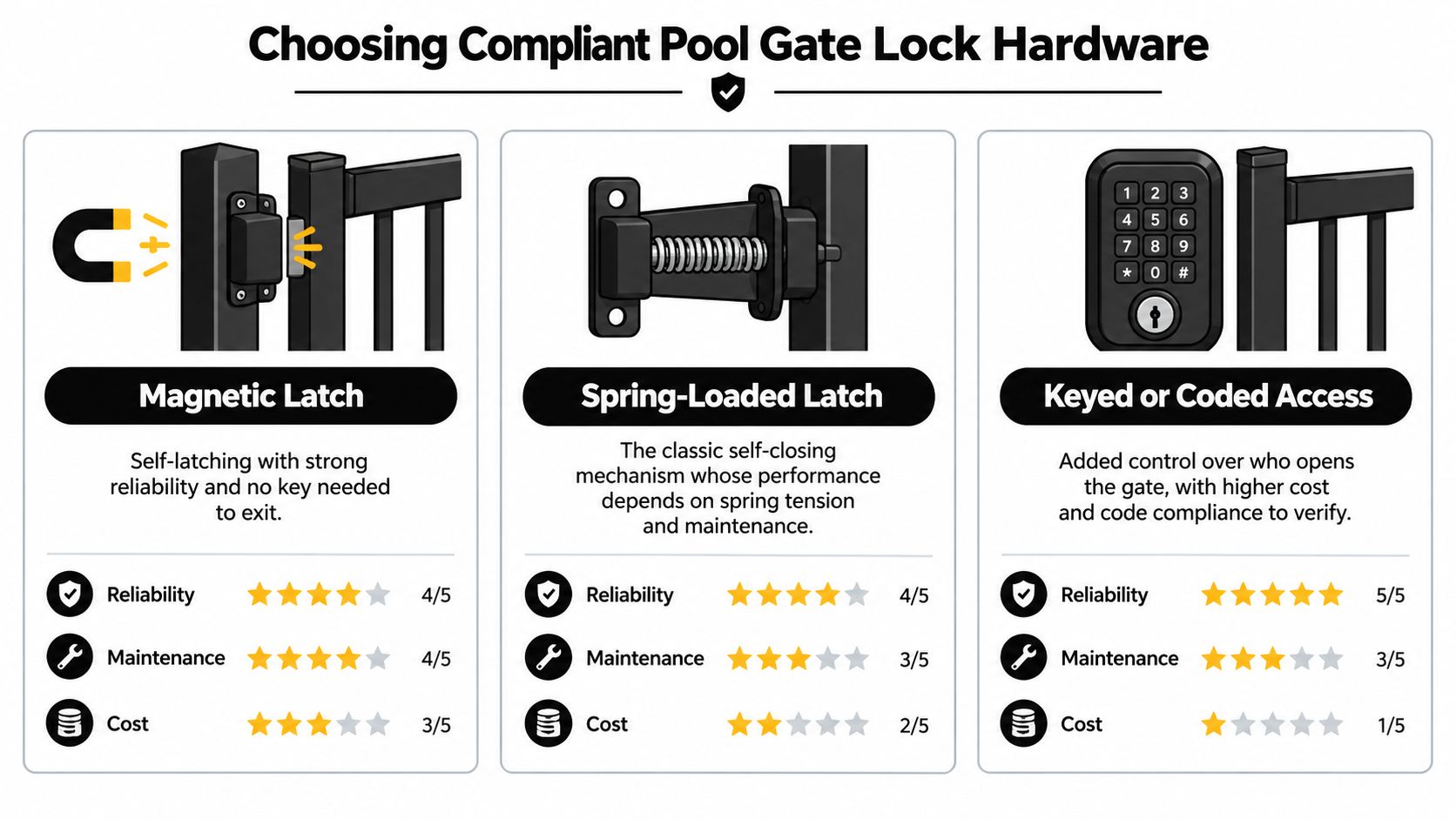
Magnetic latches
A magnetic latch can work well when it is designed for pool-barrier use and installed with compatible self-closing hinges. Its main advantage is automatic engagement without requiring someone to rotate a handle or throw a bolt. A magnetic mechanism also supports straightforward exit behavior when the pool-side release is configured correctly.
The risk is assuming that every magnetic product is automatically compliant. The gate still has to reach the closed position, the latch still has to engage from the required open positions, and the release still has to meet the applicable reach and clearance rules. A magnet cannot compensate for a sagging gate or a strike that sits outside the latch path.
Spring-loaded latches
A spring-loaded latch is the traditional choice for a self-latching barrier gate. It engages as the gate closes, but its reliability depends on spring condition, alignment, and maintenance. A weak spring, contaminated mechanism, or poorly positioned strike can leave the gate apparently closed while the latch remains unsecured.
Spring-loaded hardware suits properties where the gate receives regular use and the closing action can be tuned accurately. The installation should account for the gate's weight, hinge resistance, post stiffness, and exposure to weather. A product specification that uses the phrase “self-latching” is useful, but it doesn't prove that the finished assembly will latch on a particular site.
Keyed or coded access
A keyed or coded system can add controlled entry for a multifamily property, hospitality facility, or shared amenity area. It also introduces more questions. The release must support safe exit, the access-control arrangement must match the adopted code, and the lock must not prevent the gate from self-closing and self-latching.
Washington guidance illustrates one possible alternative to relying only on latch height. An access gate may use a continuously locked latch, coded lock, or equivalent system that always requires a key or code to enter the pool area, as described in the Washington pool barrier guidance. That alternative shouldn't be transferred automatically to Florida. Local approval and the exact access configuration still control.
| Hardware choice | What works | What commonly fails |
|---|---|---|
| Magnetic latch | Purpose-built self-latching hardware paired with reliable closing hinges | Product selected by appearance, weak alignment, or an unreliable magnet |
| Spring-loaded latch | Correct spring tension, solid posts, and an accurately positioned strike | Corroded springs, gate sag, and a latch that misses the strike |
| Keyed or coded access | Approved access control that preserves compliant exit and automatic latching | A lock that requires special knowledge, holds the latch open, or substitutes for code without approval |
A bolt that requires deliberate throwing is a poor choice for a barrier that must latch automatically. Hold-open and passage features also deserve caution. If a setting keeps the latch retracted, the gate may no longer perform its safety function.
Inspection Failures and Real Compliance Scenarios
A representative inspection pass often looks uneventful. The gate swings outward from the pool, the closer brings it fully shut, the latch catches without assistance, and the release sits in the approved position. The inspector then checks the surrounding barrier, because a compliant lock cannot correct a gate that opens the wrong way or a nearby condition that defeats the enclosure.
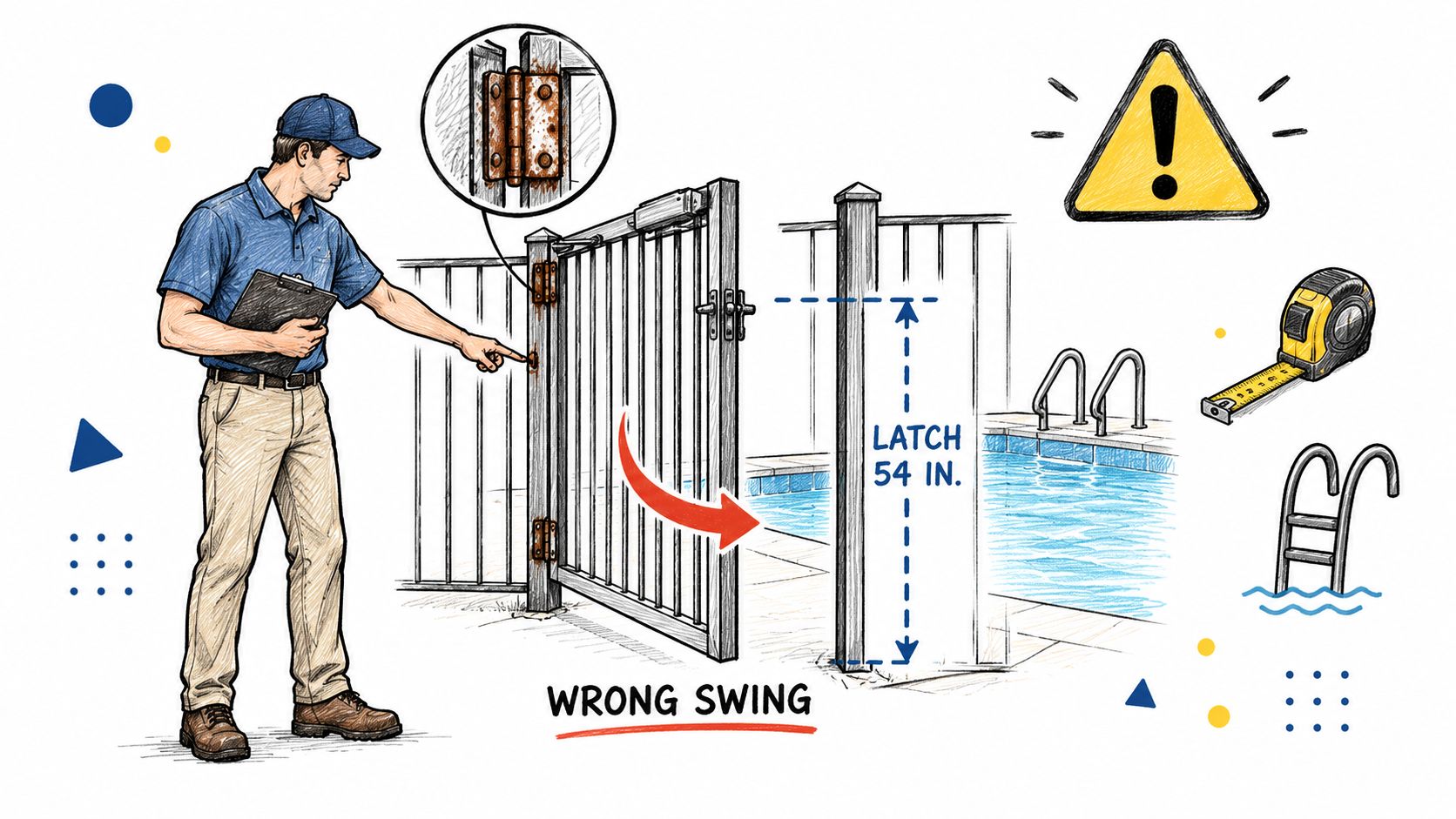
The attractive gate that fails
A homeowner may replace a rusty latch with a new decorative model and assume the problem is solved. During inspection, the gate still swings toward the pool, or the new latch release remains reachable from the pool side. The hardware looks improved, but the barrier function hasn't changed enough to pass.
Another common scenario involves a gate that closes from a nearly shut position but stops short when opened farther. Hinge tension, a sloped surface, a misaligned post, or a tight gap at the bottom can change the travel path. Inspectors don't approve the gate based on its best performance. They evaluate whether it reliably closes and latches as installed.
Shared pool access creates a harder balance
A private residential gate and a shared apartment or hospitality gate may face different operational pressures. Residents, guests, staff, and emergency responders need usable access, while the barrier still has to control child access and return to a latched condition after every passage.
That tension becomes more important when egress hardware is expected to release with one motion and without special knowledge. The National Drowning Prevention Alliance barrier guidance discusses the interaction between child safety, latch location, access control, and emergency egress. It also highlights that a lower latch configuration may be allowed only in limited access-controlled arrangements, and that a gate must still close and latch securely rather than remain held open by the lock.
A gate can be easy for an authorized adult to exit and still be noncompliant if the hardware leaves the barrier unlatched after use.
Property managers should test the gate under normal traffic, not just during a quiet contractor walkthrough. The test should include entry, exit, release of the gate from different positions, and inspection of the hardware after repeated operation. For public-facing properties, the access plan should be reviewed before hardware is ordered, because changing the lock after installation can affect the post, gate frame, release location, and permit documents.
Permitting and Inspection Steps in Martin and Palm Beach Counties
Pool gate work should be treated as a permitted safety project when the installation or alteration falls under the local building department's requirements. The process starts with the approved barrier layout, not with a hardware order. Plans should show the gate location, swing direction, latch arrangement, and relationship to the existing pool enclosure.
The county reviews the submission against the Florida Building Code and applicable local requirements. Martin County and Palm Beach County can apply their own administrative procedures and amendments, so a contractor should verify the requirements for the property's actual jurisdiction rather than rely on a permit package from another municipality.
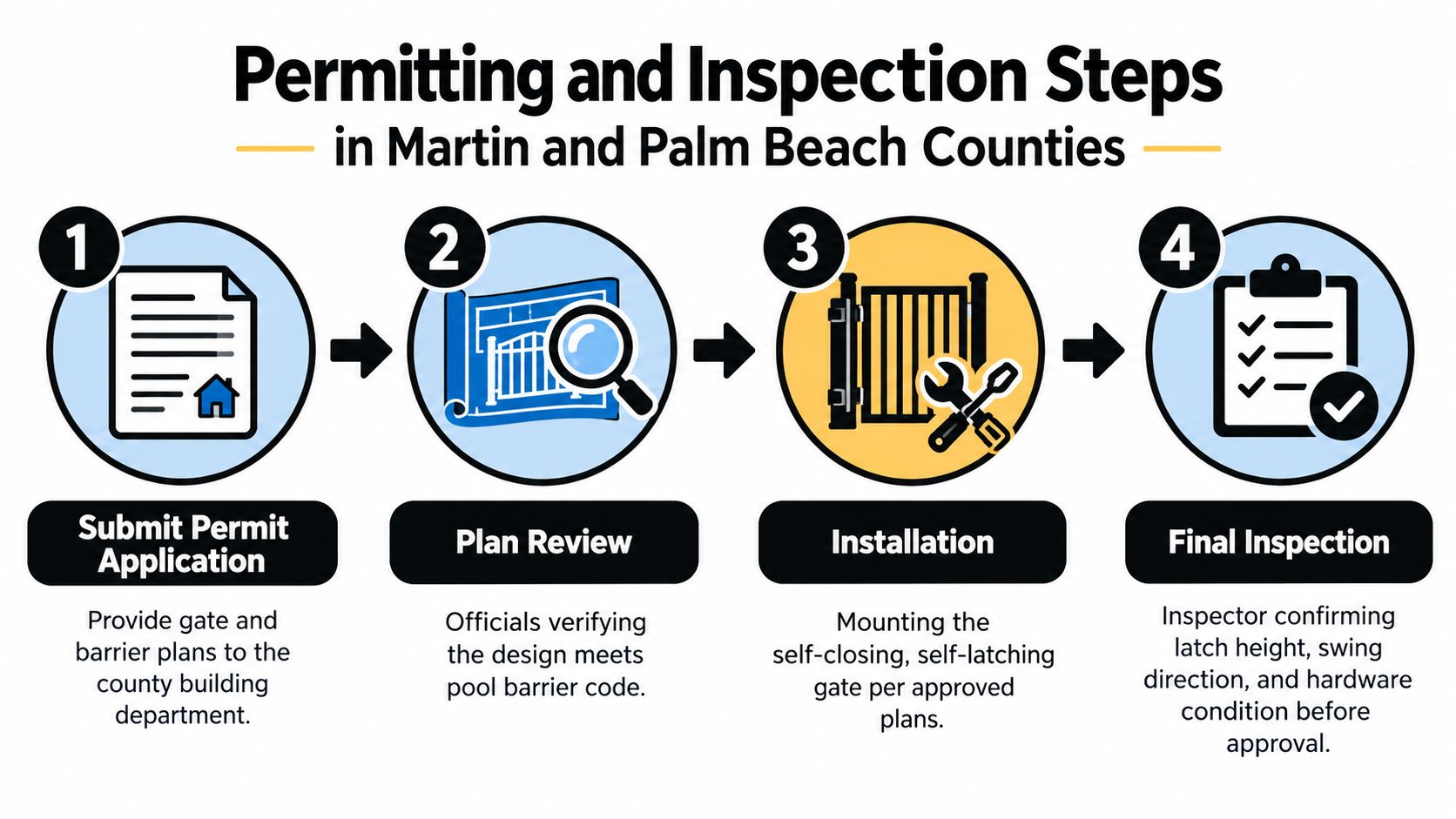
A practical project sequence
Confirm the jurisdiction. The property owner or contractor identifies the county and municipality, checks local amendments, and confirms whether the work requires a new permit or an alteration to an existing pool barrier permit.
Prepare the permit documents. The package should identify the barrier layout and gate details clearly. The fence permit application resource can help organize the information needed for a fence-related submission, but the building department remains the authority for the permit decision.
Coordinate site safety. Underground utility locating should occur before excavation or post installation. A Notice of Commencement may also be part of the project documentation, depending on the work and local process. The responsible contractor should confirm the required filings rather than assume every property follows the same workflow.
Install to the approved design. The gate frame, hinges, latch, strike, and adjacent barrier should match the approved plan. Substituting hardware or changing the swing after plan approval can create a field condition that no longer matches the reviewed design.
Run a pre-inspection check. The contractor should verify latch release height, closing action, latch engagement, swing direction, post stability, gate clearances, and corrosion condition. The test should be performed on the finished surface and with the gate released, not manually guided into place.
Schedule final inspection. The inspector confirms that the installed barrier performs as required. Correction work should be completed before requesting reinspection, with photographs and product information retained in the project file when appropriate.
Delays usually begin before inspection
A missing plan detail, unresolved property condition, unlocated utility, or late hardware substitution can slow the project before the inspector arrives. Coastal exposure creates another practical issue. Hardware that is already showing rust or sticking during inspection signals that the selected product or maintenance plan may be unsuitable for the site.
Licensed, insured, and bonded contractors can coordinate permitting, utility locates, documentation, and inspection scheduling as part of the installation workflow. That coordination matters for homeowners, but it is especially important for property managers and general contractors responsible for multiple trades and a shared pool area.
Building a Pool Gate Lock System That Passes Inspection
A passing pool gate is a system, not a single lock. The barrier layout, gate frame, hinges, closing force, latch, strike, release position, swing direction, and surrounding grade all affect the result. A high-quality latch installed on a weak post can fail just as readily as inexpensive hardware installed on a well-built gate.
Material selection should account for Florida weather and pool exposure. Corrosion-resistant components, protected fasteners, stable gate posts, and hardware designed for outdoor use reduce the chance that alignment and closing performance will deteriorate. The finish matters, but reliable geometry matters more. A gate must stay square enough for the latch to meet the strike every time.
A sound installation process follows a simple order:
- Review the site: Confirm the pool barrier line, finished grade, access needs, and any local design conditions.
- Match the hardware: Select a self-latching mechanism and closing hardware that suit the gate's weight, frame, traffic, and access requirements.
- Build for alignment: Set posts securely, keep hinges aligned, and position the strike so the latch engages without force.
- Verify operation: Release the gate repeatedly from different positions and confirm full closing and positive latching.
- Document the work: Retain permit information, product details, inspection results, and maintenance recommendations.
AlliedFenceAndGate.com™ provides pool safety gate installation, self-closing and self-latching hardware, permitting coordination, utility locates, and inspection coordination for properties across Florida's Treasure Coast and northern Palm Beach County. Its scope includes aluminum, PVC, chain link, and wood fencing, along with access-controlled gate systems and code-focused pool barrier work.
Homeowners and property managers should request a site assessment before selecting a replacement lock. The assessment should address the existing gate's swing, latch location, post condition, grade, access needs, and the requirements of the local building department. That approach prevents a cosmetic hardware replacement from becoming another failed inspection.
#MartinCountyFencing #PalmBeachCountyFencing #TreasureCoastFencing #StuartFencing #PortStLucieFencing #JupiterFencing #PoolGate #PoolGateLock #PoolSafetyGate #PoolFenceInstallation #FloridaPoolSafety #SelfClosingGate #SelfLatchingGate #FenceContractor #GateInstallation
Homeowners and property managers can visit AlliedFenceAndGate.com™ to request a pool gate assessment, permitting support, and inspection-ready installation across Martin County, Palm Beach County, and the Treasure Coast. The team can review the existing latch, gate alignment, swing direction, and access requirements before recommending a compliant repair or replacement.
Related Fencing Services
Need a fence or gate on the Treasure Coast?
Licensed, insured, and bonded. Free estimates across Martin, St. Lucie, Indian River & Palm Beach counties.
Call (772) 530-3127