Pool Fence for Inground Pool: Florida Code and Design Guide
In 2025 the Illinois State Fire Marshal reported that 80% of fatal child drownings with a known location happened in residential settings, and that 91% of those residential drownings involved children younger than 5 (Illinois State Fire Marshal). Not lakes, not beaches, not water parks. Backyards.
That reframes the fence around an inground pool. It isn't privacy cladding or a boundary marker that happens to sit near water. It's the physical control on who reaches the water, and Florida writes that control into law with dimensions attached: a height measured on one specific side, a limit under the bottom rail, a gate that has to shut itself.
Most failed installations don't fail at the height. They fail at the finished grade, the gate alignment and the handful of climbable details that never show up in a photograph of a finished yard.
Table of Contents
- Florida Pool Fence Requirements at a Glance
- Why a Four-Sided Pool Enclosure Beats a Backyard Fence
- Choosing a Pool Fence Material for Florida Conditions
- Measuring Height, Gaps and Grade Before You Set Posts
- Gate Placement, Latches and Testing Routine
- Planning, Permits and Contract Sign-Off
Florida Pool Fence Requirements at a Glance
| Requirement | Florida standard | What to check on site |
|---|---|---|
| Barrier height | At least 4 ft (48 in), measured on the outside | Measure from the outside finished grade |
| Climbable features | No gaps, indentations or protrusions a young child can climb | Check horizontal rails, planters and furniture |
| Openings | Cannot pass a 4 in sphere (commonly applied test) | Test panel spacing with a 4 in sphere |
| Bottom clearance | No more than 2 in at the base | Measure the gap under panels after grading |
| Gate swing | Opens outward, away from the pool | Confirm the swing clears the deck and furniture |
| Gate closing | Self-closing and self-latching | Test hands-off from several opening angles |
| Release mechanism | Pool side, beyond young child reach | Check latch height over and through the gate |
| Dwelling wall as barrier | Only if no door or window gives pool access | Inspect every door and window into the pool area |
| Barrier separation | Separate from yard fence unless that fence lies on the pool perimeter and meets every rule | Decide early whether one fence can serve both roles |
Nine rows, and every one of them is an inspection item rather than a suggestion. Florida Statutes section 515.29 requires a residential swimming-pool barrier to be at least 4 feet high when measured on the outside of the barrier, and the current text of the statute applies that rule to a fence or other barrier intended to prevent young children from reaching an inground pool. Four feet is the statutory minimum, not a design preference, and it's measured on the side facing away from the water, which is usually the side a homeowner never looks at.
The same section requires the barrier to be built so that gaps, openings, indentations, protrusions or structural components cannot let a young child crawl underneath, squeeze through or climb over. That single sentence reaches into details a material catalog skips: the relationship between the bottom rail and grade, the spacing of vertical members, the profile of the top rail, and what landscaping does to all three over a season.
Where a 4-foot fence still fails
A tape measure answers one row and one row only. Horizontal rails spaced like ladder rungs, a decorative cap, a planter box pushed against the panels, an equipment pad, a low tree limb over the run, or a bottom gap widened by blown mulch all change the answer the code is asking for. The height row passes, the climb row fails, and the property is non-compliant with a fence that looks finished.
Practical rule: Measure the outside height from finished grade with a tape and a level, then walk the same run asking what a five-year-old could stand on, squeeze through or crawl under. Both answers have to come back clean before material gets ordered.
The separation row deserves the same discipline. Florida treats the pool barrier and the yard fence as different objects unless that yard fence sits on the pool perimeter and meets every barrier rule on its own. A dwelling wall counts as part of the barrier only when it has no door or opening window that gives access to the pool area.
Work the table top to bottom twice, once at design and once before the final inspection. Florida permitting and inspection look at the whole barrier system, so a fence that clears 48 inches but carries a foothold or a child-passable opening doesn't pass. Every row needs a yes.
Why a Four-Sided Pool Enclosure Beats a Backyard Fence
The evidence for isolation is unusually clean. The U.S. Centers for Disease Control and Prevention reports that a fence separating the pool from the house and the rest of the yard reduces a young child's drowning risk by 83% compared with three-sided property-line fencing, where the house forms the fourth side (CDC drowning risk factors). Same water, same child, different geometry.
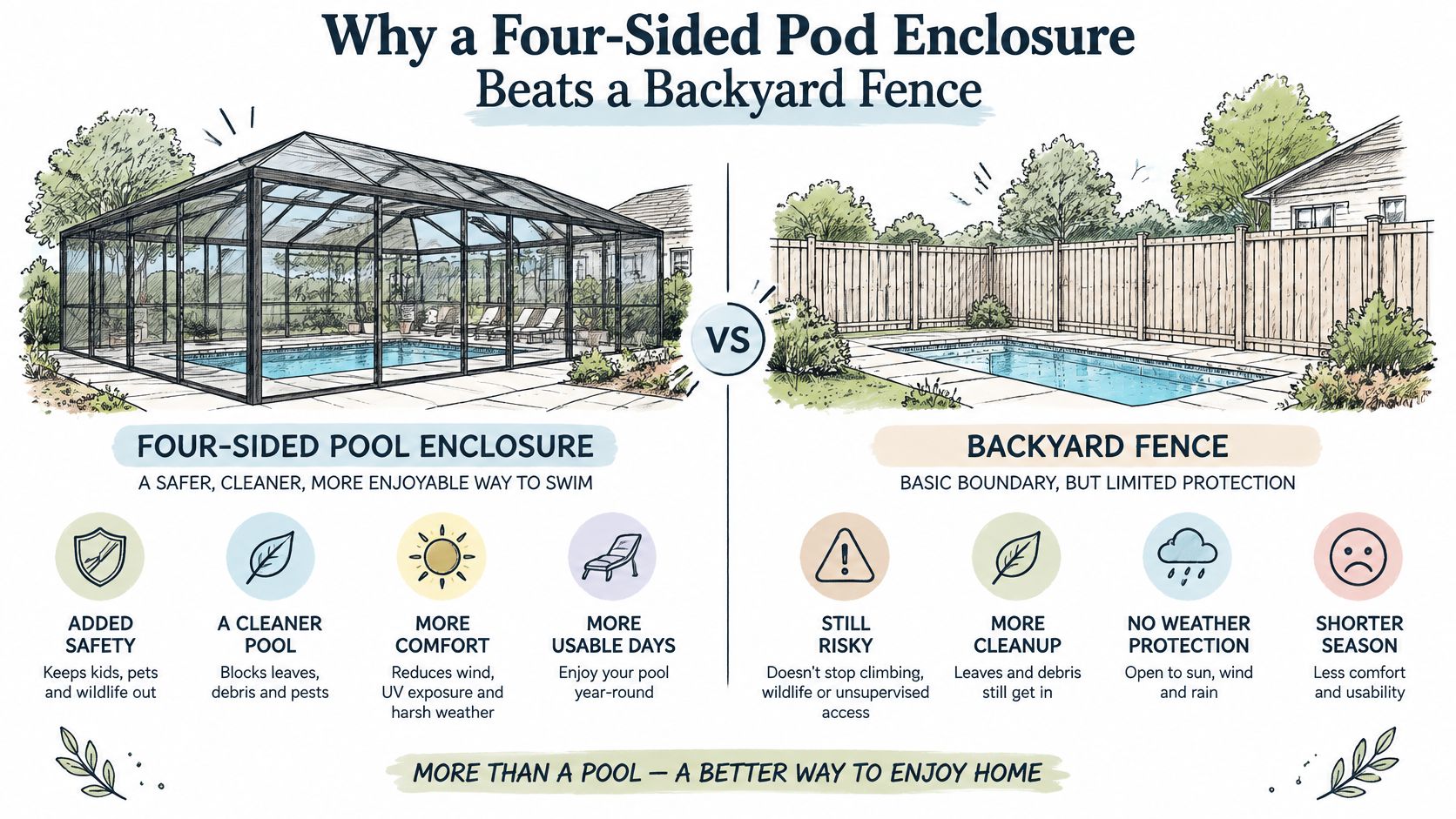
Analyses of U.S. drowning data point the same direction: pools isolated from the house by a compliant barrier account for a small share of child drowning deaths compared with pools protected only at the property line. The federal Consumer Product Safety Commission recommends a barrier that completely surrounds the pool, stands at least 4 feet high and uses a self-closing, self-latching gate, and it calls barriers 5 feet or higher preferable.
A property-line fence controls who enters the yard. A pool enclosure controls who reaches the water. Children reach water through doors, side yards, dog runs and gates propped open for a wheelbarrow. A perimeter fence leaves every one of those routes live, which is why the 83% figure turns on separation rather than fence quality.
The inground pool gets its own compliant enclosure. A backyard perimeter fence or the exterior wall of the house is not a substitute for it.
That rule drives placement, budget and sequence at once. The enclosure goes on the pool perimeter, the gate lands on the shortest route a child would take from the house, and the budget follows that geometry rather than the lot line. Swapping a tired yard fence for a taller, prettier one improves curb appeal. It does nothing for the drowning-risk number, because it never touched the path between the back door and the water.
Choosing a Pool Fence Material for Florida Conditions
| Material | Typical pool height | Climb risk when built to code | Coastal maintenance |
|---|---|---|---|
| Aluminum pickets | 4 to 5 ft, up to 6 ft | Low with vertical pickets spaced to code | Low; powder coat or marine-grade finish resists salt air |
| Vinyl or PVC | 4 to 6 ft | Low with solid or narrow-picket design | Low; wash to remove mildew |
| Removable mesh | 4 ft or more | Low when anchored and taut; higher if loose | Moderate; check anchors and mesh wear |
| Chain link | 4 to 6 ft | Moderate; diamond mesh offers footholds | Moderate; check coating and cut ends for rust |
Aluminum with vertical pickets is the default pool choice for good reasons. It keeps sightlines open so an adult at the kitchen window can see the water, it holds up to salt air when the finish is powder coat or marine grade, and the picket geometry makes the opening test easy to satisfy. Flat-top styles remove the decorative caps that turn a top rail into a handhold.
Vinyl and PVC deliver a solid or narrow-picket look with almost no upkeep, and the privacy is genuine. The catch is structural. A solid panel takes wind load, so posts need reinforcement and footings set deep enough for Florida exposure, with picket spacing engineered rather than eyeballed. A panel that leans after a storm has moved its gate out of alignment, and the gate is the part that matters most.
Three questions that settle the material choice
- Is the pool ever unattended? If yes, a permanent fixed barrier carries the load. Removable mesh suits a construction phase, a party season or a rental turnover, and it only works while it's up, anchored and taut.
- Does privacy drive the design? A pool close to a neighbor or a road usually argues for vinyl or a semi-privacy picket profile, provided the spacing still satisfies the opening rule. Privacy and pool compliance aren't opposites, but the wrong profile can make them fight.
- Does the HOA have a say? Deed restrictions on material, color and height can run stricter than the state rule, and architectural review takes time. Get the approval before the material order, not after.
An hour spent comparing panel heights, picket profiles and gate options pays for itself, and this breakdown of pool safety fence styles covers the trade-offs that show up around inground pools.
Material changes the look, the maintenance bill and the wind performance. It doesn't change a single row of the code table. Every option in that comparison still has to hit the outside height, the gap limits and the gate rules.
Measuring Height, Gaps and Grade Before You Set Posts
The survey happens before a post hole gets dug, because every dimension the code cares about is measured against finished grade, and finished grade is the last thing on the job to be finished. The 2023 Florida Residential Swimming Pool Code sets the barrier top at no less than 48 inches (1,219 mm) above grade, measured on the side facing away from the pool, caps bottom clearance at generally 2 inches (51 mm), limits clearance to 4 inches (102 mm) where the barrier mounts on the pool structure, and uses the 4-inch (102 mm) sphere as the opening test.
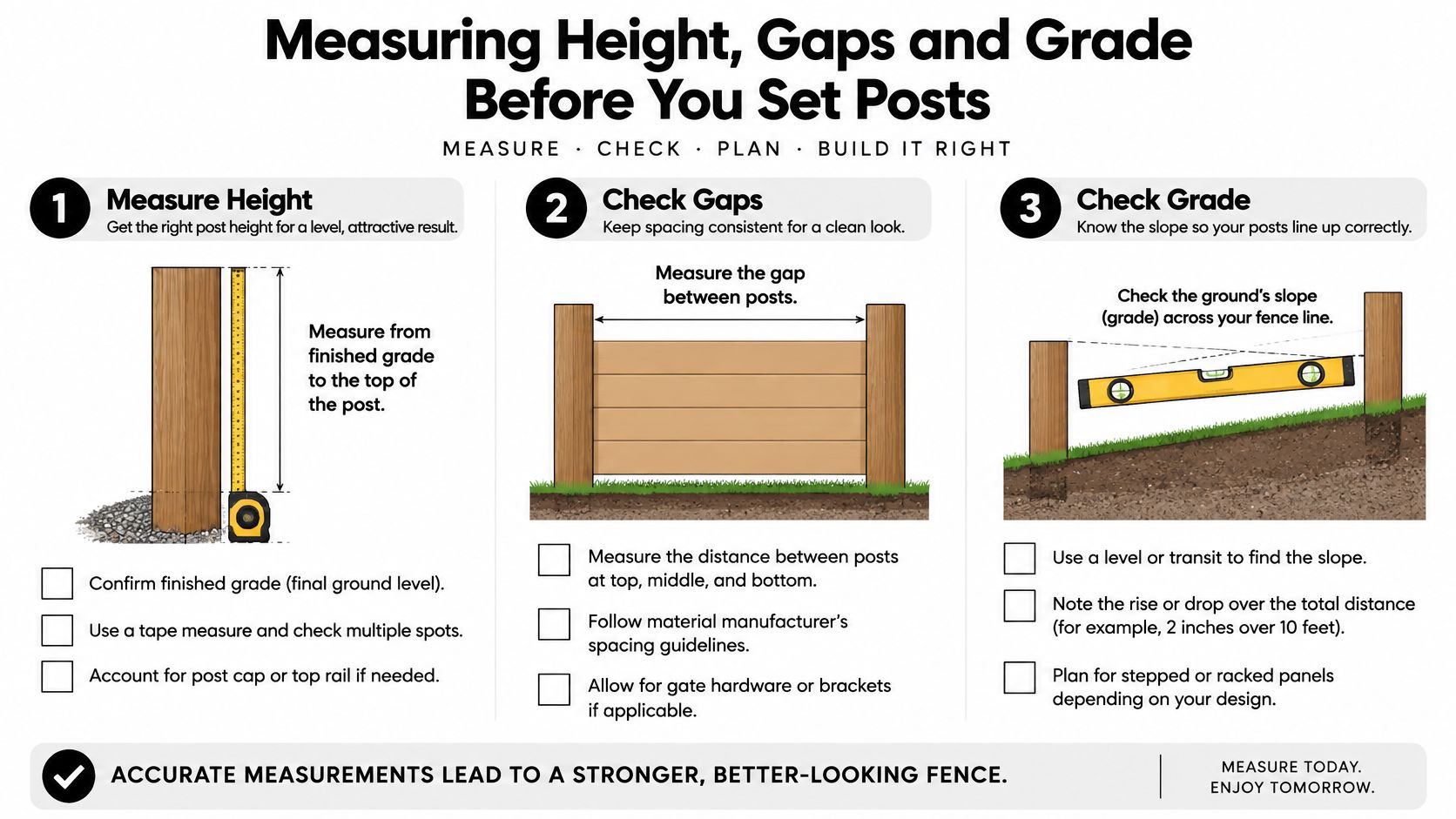
- Survey the outside grade line. Slope, retaining walls and regraded soil change effective height along a run, so mark the low point and the high point before anything else.
- Snap a 48-inch reference above grade on the outside face. Every panel top, including the section over the slope, has to meet that line, not the line drawn on a flat-plan assumption.
- Measure the bottom gap panel by panel. Keep it at or under 2 inches and account for irrigation erosion and mulch, which raise and lower the soil line in different weather.
- Check structure-mounted sections separately. Where a panel ties into the pool deck or a wall, the clearance from the pool structure stays at 4 inches or less.
- Sweep the openings with the sphere gauge. An opening that swallows the gauge is too wide, however clean the panel looks from standing height.
- Hunt footholds. Horizontal rails, decorative rings, planters, furniture, hose reels, equipment pads and low limbs all convert a four-foot barrier into a staircase.
- Record every wall, door and window that could be drafted into the barrier, and confirm each one has no access to the pool area.
The height on the drawing and the height on the site are two different numbers until the deck, the sod and the mulch settle in.
That sign-off comes before the material order, not after. Measurement errors compound, and the run-by-run method for measuring a fence line keeps a quote honest and a panel count accurate.
Gate Placement, Latches and Testing Routine
A gate that hangs perfectly on inspection day and drags by August is the most common way a compliant barrier stops being compliant. Florida law requires pool gates to open outward, away from the pool, to be self-closing and self-latching, and to carry a release mechanism on the pool side, positioned so a young child cannot reach it over the top or through an opening (Florida Statutes section 515.29). Hardware grade, hinge alignment and post settlement decide whether that gate still latches on day 500.
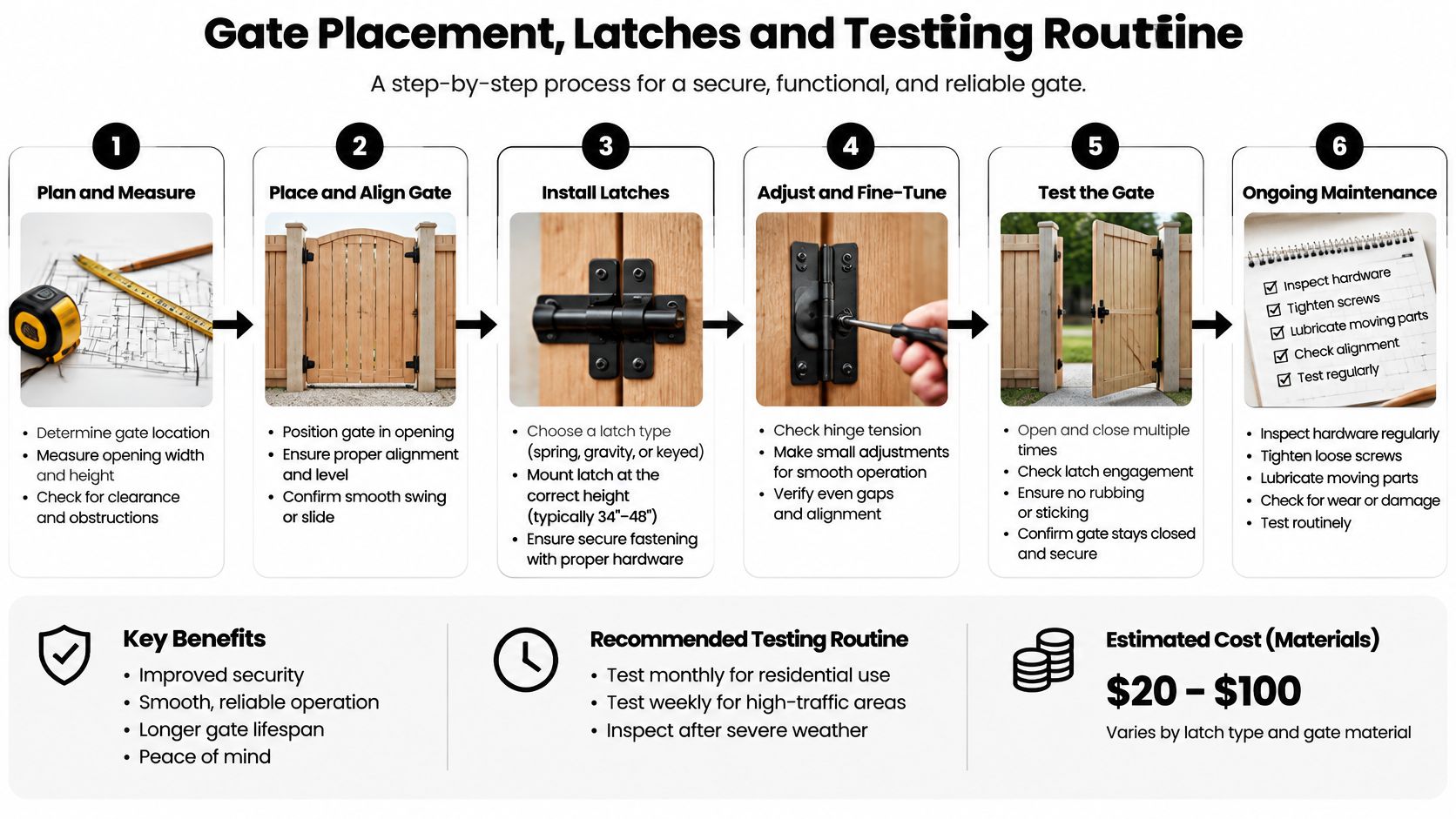
- Hang the gate on the route people walk, between the house door and the pool deck. A gate placed for convenience gets propped open; one on the natural path gets used the way it was designed.
- Walk the whole arc of the outward swing. It has to clear the coping, the deck and any movable furniture through the full travel, not only at rest.
- Specify coastal-grade hardware. Stainless steel or marine-grade aluminum self-closing hinges and a matching latch survive salt air; plated hardware pits and then sticks.
- Set the release on the pool side, high enough and far enough inboard that a child cannot reach it over the top rail or through the pickets.
- Test hands-off from full open, half open and a quarter open. Three angles, three closures, no assistance. A gate that needs a nudge at fifteen degrees fails.
- Re-check alignment after settlement, storms and grading work. Hinge friction, wind load on a solid panel and a shifted post all announce themselves as a gate that almost latches.
- Log the test date, then repeat it after any planting or regrading near the posts.
The failures repeat in patterns. A sagging gate catches on the deck. A latch set too low is reachable through the pickets. A chair holding the gate open for the dog defeats every safeguard on the property at once. And a removable mesh barrier that never gets re-anchored after swim season stops counting as a barrier at all.
The stakes aren't theoretical. The Consumer Product Safety Commission reports an average of 379 pool- or spa-related fatal drownings involving children under 15 each year (CPSC pool season safety guidance), which is why gate hardware and daily usability earn as much attention as panel material.
Latch height, release placement and the test sequence are where inspections get won, and this guide to pool safety gate latches walks through the hardware choices behind them.
A compliant gate is one that latches on an ordinary Tuesday, long after the inspector has left.
Code compliance is the floor. Passing a review proves the barrier met the standard once. Daily usability, a gate on the walking route, hardware that shrugs off salt air and a test routine that survives the calendar, is what holds the line against a determined four-year-old.
Planning, Permits and Contract Sign-Off
Sequence decides the schedule. Run these steps in order and the final inspection becomes a formality. Run them out of order and a finished fence comes back down, usually at the owner's expense.
- Start with the HOA. If the lot sits in an association, architectural review comes first and can add weeks. Height, material and color rules in the deed restrictions may be stricter than the state standard, so the design has to satisfy both before anyone digs.
- Confirm the permit and inspection path. Establish which permits cover the new barrier and which cover any change to a pool enclosure, because a remodel that moves a fence or replaces a cage can trigger a code review instead of counting as cosmetic. Knowing which Florida projects need permits before the layout is fixed keeps the paperwork and the design in step.
- Call 811 and mark the private lines too. The free utility locate covers the public plant only. Irrigation, pool plumbing, bonding wire, lighting conduit and septic are on the owner to flag, and a hit on any of them costs more than the fence.
- Decide whether the existing yard fence stays. If it does, verify it meets the separation rule or plan a separate barrier around the water. Keep pool equipment, storage boxes and planters outside the climbing zone while the layout is still editable.
- Run the sequence end to end. Survey, approvals, locate, set posts, install barrier, install gate, finish deck and grade, test, inspect. Deck and grade changes come before the final height check, so the measurement reflects the finished yard rather than bare soil.
What the contract should confirm in writing
- Outside height clearing the state minimum, measured above finished grade on the side facing away from the pool, with the 48-inch line confirmed after sod, mulch and decking go in.
- No climbable gaps or footholds in the delivered design, including the top profile, the bottom rail's distance off grade, and any adjacent structure a child could use as a step.
- A gate that swings outward, self-closes and self-latches, with the release mounted on the pool side.
- Who finishes the grade and who returns to re-verify height once the landscaping is complete.
- Whether a code-qualifying safety cover is an accepted alternative for the property, settled before the budget commits to a fence.
The grade clause is where compliant fences fail. A barrier that measures 48 inches over bare dirt can drop below the line once a raised deck or a fresh layer of mulch builds up the outside approach. The contract should name the person responsible for that second measurement.
On install standards, AlliedFenceAndGate.com™ builds pool fencing that is Florida pool code compliant, installs PVC pool fencing with proper picket spacing, a 48-inch minimum height and pool-code gate hardware to FL 515 standards, and fits gates with self-closing pool-code hinges and latches in stainless steel or marine-grade aluminum.
The next move is small and it happens on site. Measure the outside grade at its lowest point, mark where the gate should hang, and send that plan out for a quote before deck work starts. Two numbers and a gate location settle most of the design questions.
#FloridaPoolFence #PoolFencing #InGroundPool #PoolFenceForIngroundPool #PoolSafetyFence #SelfLatchingGate #PoolCodeCompliance #MartinCountyFencing #PalmBeachCountyFencing #StuartFencing #PalmCityFencing #JensenBeachFencing #HobeSoundFencing #JupiterFencing #TequestaFencing #TreasureCoastFencing #AluminumPoolFence #BackyardPoolSafety
AlliedFenceAndGate.com™ installs pool fencing across Martin County and northern Palm Beach County, from aluminum picket enclosures and PVC panels to self-latching pool gates built to Florida pool code. If a barrier around an inground pool needs its outside height verified, a gate that closes on its own, or a full permit, 811 locate and inspection run handled in one sequence, the team walks the property and prices the run before deck work begins. Visit AlliedFenceAndGate.com™ to book a site assessment and get the layout confirmed against the code table.
Related Fencing Services
Need a fence or gate on the Treasure Coast?
Licensed, insured, and bonded. Free estimates across Martin, St. Lucie, Indian River & Palm Beach counties.
Call (772) 530-3127