Fences Property Lines: Where Your Fence Can Legally Sit
The fence was already there when you bought the house. It lines up with the neighbor's hedge, it appears on the county parcel viewer, and the mowed strip runs right alongside it. So you measure off it, order panels, and book the install. Then someone asks for your survey, and the plan stops cold.
A fence sitting on or near a property line isn't automatically legal, permitted, pool-compliant or coastal-ready. Those are four separate tests, and most guides cover only the first one and stop. Ownership is settled by a recorded survey. Placement is settled by zoning. Construction is settled by permits. Safety and environmental rules sit on top of all three.
What follows is how each test works in Florida, where the answers get specific fast, and what to check before a single post hole gets dug.
Table of Contents
- Find the Line Before You Dig
- Where a Fence Can Sit Relative to Your Line
- Who Owns a Fence That Sits on the Line
- Local Zoning, Height and Setback Rules
- Permit Triggers and the 6-Foot Threshold
- Pool Barriers and Coastal Dune Exceptions
- Coordinate With Neighbors and HOA Boards
- Confirm Your Line Before Ordering the Fence
Find the Line Before You Dig
The most expensive fence mistake isn't a bad material choice. It's building on the wrong line and finding out afterward. Four things get mistaken for a boundary: the fence already standing, the mowed edge, the hedge, and the aerial photo on a listing site. None of them defines one.
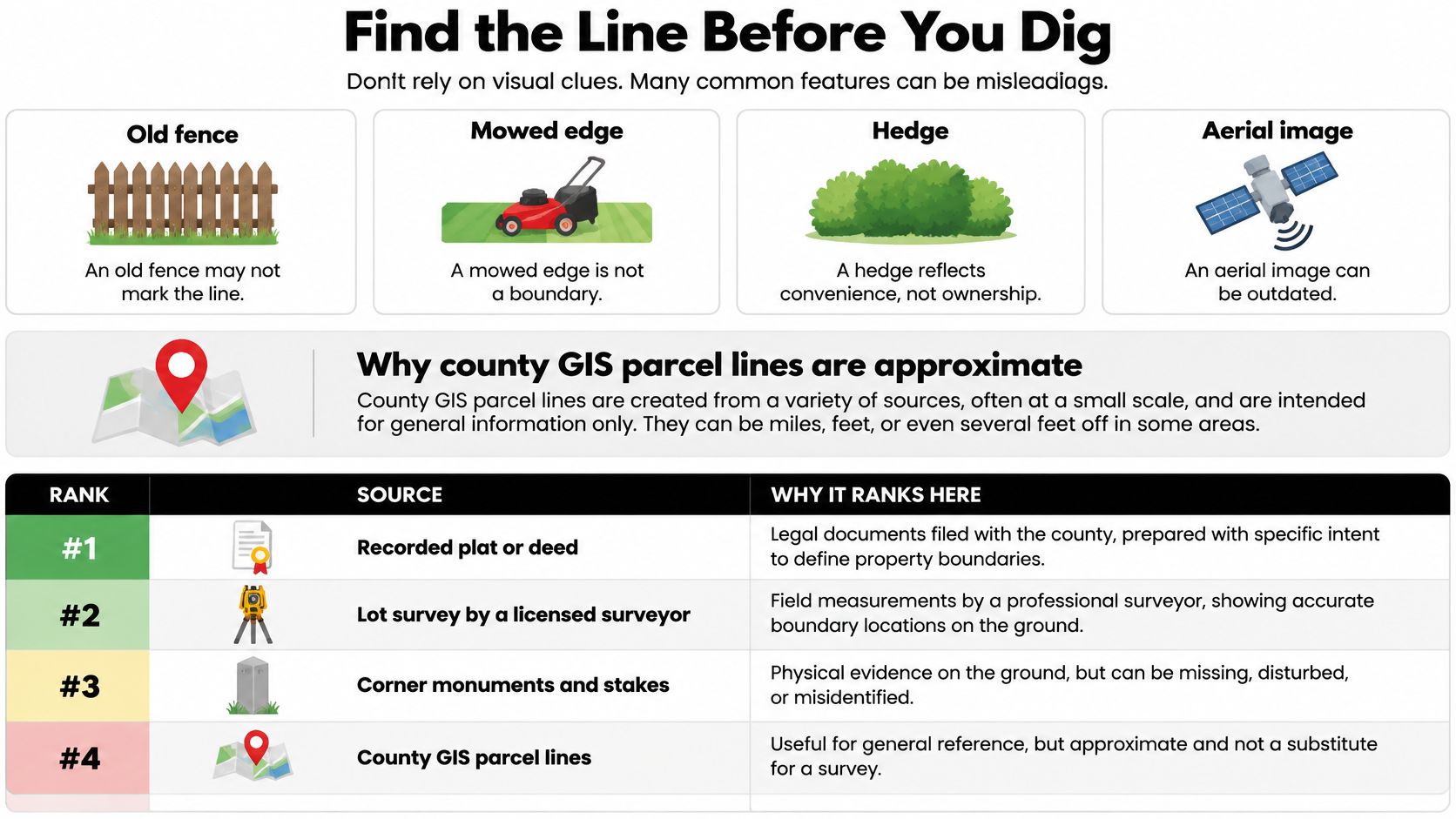
A fence records where somebody decided to build. A mowed edge records who owns a mower. An aerial image can be years out of date, and it shows features rather than legal lines. The shortcut most homeowners reach for first fails the test: a licensed professional land survey is the most reliable method because GIS and online mapping boundaries are approximate and are not substitutes for a legal survey, according to the recordable survey guidelines published by the University System of Georgia.
Keep one thing clear while you work through this. Pinning down the line settles the ownership question only. A fence can sit dead center on the correct boundary and still fail on height, setbacks, pool code or coastal rules, so the survey is step one rather than the whole job.
| Evidence | What it shows | Reliability for fence placement |
|---|---|---|
| Recorded survey with monuments | Bearings, distances and corner evidence | High, use for placement |
| Plat and deed description | Legal description of the parcel | High when tied to field monuments |
| County GIS parcel map | Approximate parcel outline | Low, never stake from it |
| Aerial image | Visible features such as edges and paths | Low, shows features rather than legal lines |
| Existing fence or hedge | Where someone built, not where the law puts the line | None as evidence of ownership |
What valid field evidence looks like
Survey-grade evidence has a shape to it. Florida's boundary-survey rule requires the field work to locate monuments and evidence of occupation, then reconcile those observations with the recorded boundaries. When a corner monument must be set, the Florida Department of Agriculture boundary survey rule calls for durable material at least 18 inches long with an identifying cap tied to the responsible surveyor or authorized business. Florida's platting statute adds a second layer: permanent reference monuments at the corners and direction changes of platted boundaries, so a recorded subdivision leaves physical evidence a later surveyor can recover.
Six steps before the first stake
- Pull the record. Request the recorded plat and deed for your parcel from the county records office. That gives the legal description the surveyor will work from.
- Hunt for corners. Look for existing monuments, pins or capped rods at the lot corners. Preserve whatever you find, even if it's leaning or half buried.
- Commission a boundary survey when monuments are missing, when the deed description is vague, or when the fence will sit within a few feet of the line.
- Have the surveyor stake the line and flag the proposed fence path. A flagged path turns an abstract bearing into a walkable route.
- Photograph every stake and monument before excavation starts. Those photos are what settles a question six months later.
- Compare the alignment against easements and rights-of-way shown on the survey. A utility easement along a rear line can undo a plan that looked clean on paper.
A survey costs far less than moving a finished fence, and the margin for error is smaller than it looks. Being a few inches over the line is enough to put concrete footings and post bases on adjoining land, which turns a weekend project into a removal order. The guide to finding property lines for a fence walks through the same records search from a contractor's side of the table.
When a fence is already wrong and a neighbor won't discuss it, the practical next step is legal rather than carpentry. A firm such as Tanner Law offers Orange County boundary dispute help and can explain the remedies available before anyone starts pulling posts out of the ground.
Where a Fence Can Sit Relative to Your Line
The short answer: in most jurisdictions the fence belongs inside your line, with posts, concrete footings and gate swing all kept on your side. A fence sitting directly on the line is workable, but only when both owners agree to it in writing. Without that agreement, a fence on the line becomes a shared structure with a shared set of arguments.
The situation you're in determines everything that follows.
| Situation | Who it affects | Main risk | Action before building |
|---|---|---|---|
| Fence fully inside the line | You only | Setback or height rule breach | Confirm setback in local code |
| Posts or footings over the line | You and neighbor | Encroachment and forced removal | Survey, then move the fence inward |
| Shared fence on the line | Both owners | Cost and upkeep disputes | Written agreement before work starts |
| Fence built over the line | Neighbor | Removal order and damages | Stop work, survey, reposition |
| Corner lot with sight triangle | Drivers and you | Height limit violation | Check corner height limit with the city |
| Waterfront lot | You and the water boundary | Setback from seawall or water | Verify setback before staking |
What actually crosses the line
The panels aren't the problem. Concrete is. A post hole dug eighteen inches from the line can bell out at the base and push a footing a foot onto the neighbor's side, and a fence that looks perfectly inside the line from the kitchen window can still be encroaching where it meets the ground.
Gates add a second layer. A gate that swings outward over the line is an obstruction, and on a narrow side yard it may swing into a neighbor's driveway or across a shared walkway. Landscaping planted as a buffer counts too, since the bed and the irrigation line usually extend past the fence face.
Sight triangles and waterfront lots
Corner lots bring a rule that surprises people. On a corner lot, the height limit inside the sight triangle is 4 feet, because a tall fence at the corner blocks the view line drivers need. That applies to what's legal at the corner, not at the middle of the side yard.
Waterfront parcels carry their own geometry. The line may run to the seawall or to the water, and the buildable edge is often set back from both. Setbacks from seawalls and waterways need verifying before stakes go in, not after.
Rule of thumb: until a survey confirms the line, plan the fence at least the post width plus a few inches inside your best estimate of the boundary, and never assume the visual face of the fence is the line.
Who Owns a Fence That Sits on the Line
The scenario plays out constantly. A homeowner buys a house with a tired privacy fence, assumes it marks the property edge, and a survey later shows it sitting a couple of feet onto the neighboring parcel. The fence wasn't dishonest. It was convenient.
Boundary description has a messy history. Early American communities used metes and bounds, describing land through physical features, bearings and distances rather than a uniform grid. Research on New Haven records counted roughly 80 private land disputes brought before the Particular Court between 1649 and 1662, and later work found that metes-and-bounds counties experienced more property disputes than all other counties in the same states combined, as detailed in NYU Law's study of metes and bounds.
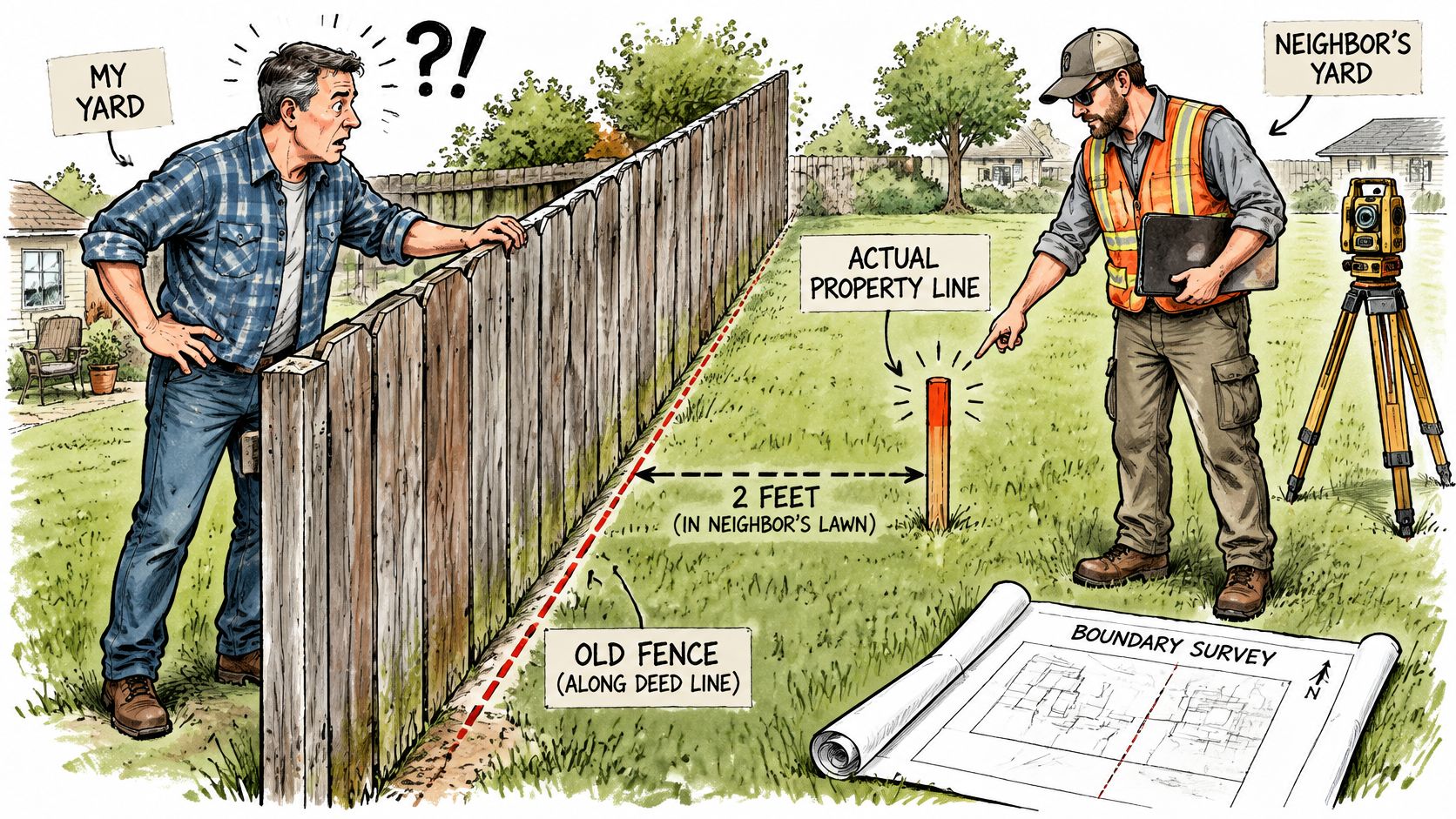
Five questions come up whenever a fence line is claimed:
- Who paid for it? Receipts suggest intent, not ownership.
- Who built it, and when? Age tells you whether the fence predates a survey.
- Is there a written agreement? A signed document beats twenty years of assumption.
- Which side is the finished face? Finished-face conventions vary, and they're local custom, not law.
- Who maintains it? Maintenance usually follows the agreement, not the fence.
Those answers are evidence. They aren't proof. The recorded survey and the boundary monuments decide where the line is, and no existing fence moves that line by an inch.
Local Zoning, Height and Setback Rules
A fence planted dead on the boundary can still be illegal, because zoning sets the placement limit. Orlando permits fences on or inside the property line, but only with a site plan drawn from a survey showing dimensions and setbacks, per Orlando's fence permit guide. Resolving who owns the strip is the first check. Placement, height and sight lines are separate ones.
| Jurisdiction | Placement rule | Extra control |
|---|---|---|
| Orlando | Fences allowed on or inside the property line | Site plan based on a survey showing dimensions and setbacks |
| Volusia County | Verify whether the fence must sit inside the line | Height limits that can differ between front yards and rear or side yards |
| Fort Lauderdale | Verify setbacks measured to the property lines | Street-facing residential fences can carry their own setback |
| Oakland Park | Verify that footings count toward staying within the lot | Height caps that can apply in sight-triangle areas |
Read the rows together and the pattern holds: the most permissive code still keeps the fence on your side, while stricter versions pull it back from the line and drop the height near the street.
Yard position is where owners get surprised. A fence that is legal along the rear line can be a violation a few dozen feet forward, because codes commonly set lower limits where a yard faces the street. Corner and waterfront parcels tend to pick up extra conditions on top of that, and corner lots carry a 4-foot maximum fence height inside the sight triangle.
The concrete counts too. Where a code requires the fence to stay within the lot, footings and posts are part of the structure, so a footing poured over the line breaks the rule even when every panel sits legally.
Before staking, work the local picture in this order: which municipality and zoning district govern the lot, whether the parcel is a corner or waterfront lot, where the right-of-way and recorded easements sit, where sight triangles fall, what the HOA layers on top, and what drawings the permit office expects. Most rejected applications fail at that last step, when the site plan shows the fence but no dimensions tying it to the property line.
Permit Triggers and the 6-Foot Threshold
Here's where statewide code and local code split apart. A Florida Building Code binding interpretation states that fences 6 feet or less in height are generally not regulated as buildings under the code, while a municipality may still require a zoning-only permit or impose its own installation rules. The same record distinguishes fences taller than 6 feet, which may fall under building-code regulation in specific circumstances, as set out in the Florida Building Commission binding interpretation.
Two more layers complicate the answer. Florida's current statewide edition is the 8th Edition (2023), effective December 31, 2023, and the state's Florida Building Commission code materials track local amendments that can add requirements on top of it. Locally, some counties go further than the statewide baseline. Martin County requires a building permit for all new fence installations.
An approved permit can also carry conditions that restrict placement. One Florida Building Code permit record authorized about 425 feet of temporary chain-link fencing at a maximum height of 6 feet, but required the fence to stay within the property lines, capped it at 4 feet in the front setback area, and prohibited land clearing and fill under that approval. Height changed by location on the same lot.
When calling the building department, ask in this order:
- Does this height need a permit under your local rules?
- Is a zoning-only review required even if the building permit is waived?
- Which survey or site plan must be submitted with the application?
- Are front-setback heights different from rear and side yard heights?
- Are footings, grading or fill covered by the same permit?
- Which inspections apply, and when should they be called?
The fence permit application walkthrough covers how those answers translate into a submittal package.
Pool Barriers and Coastal Dune Exceptions
A boundary fence and a pool barrier are two different objects, and the distinction catches homeowners at inspection. A fence placed correctly on the lot line can still fail as a pool enclosure.
Florida law requires a residential pool barrier to be at least 4 feet high, to block child-sized gaps and climbing routes, and to sit around the pool perimeter. A general yard fence can serve as that barrier only when it's located on the pool perimeter and meets every barrier requirement, per Florida Statutes section 515.29. The statute also separates the barrier from the yard enclosure in ordinary layouts, so a fence at the property edge rarely does both jobs at once.
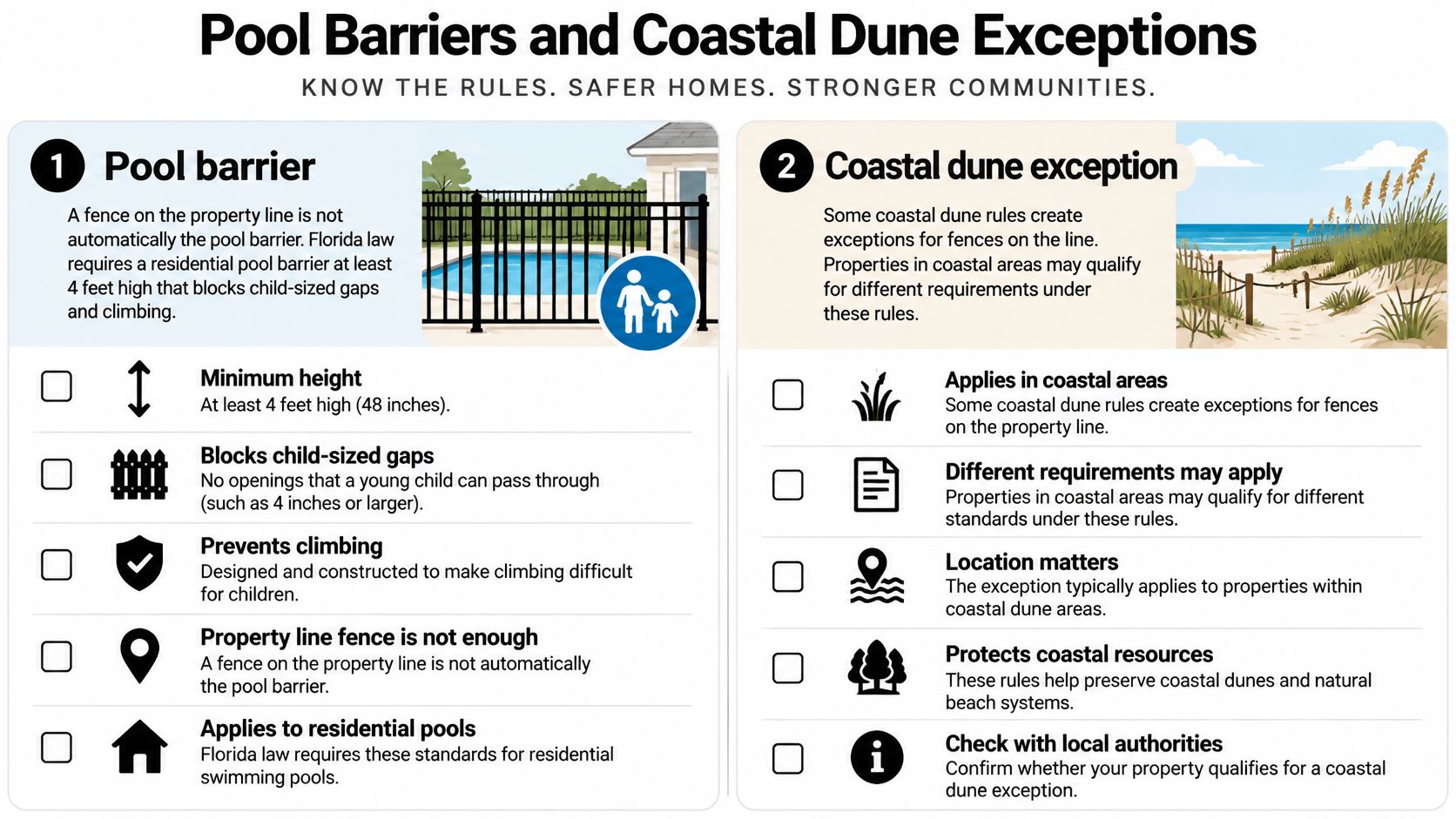
The plan-review checklist that matters:
- Height of at least 4 feet measured from the finished grade.
- No climbable features near the fence, including equipment pads, planters and stacked furniture.
- Openings small enough that a child can't pass through a gap.
- Self-closing and self-latching gate hardware that engages without help.
- Distance from the water that matches the layout the plan shows.
Public pools follow a stricter standard. Florida Building Code materials require a continuous fence at least 48 inches high around the pool perimeter wherever adjacent buildings or structures don't already block or enclose the area, and the fence must connect to itself or abut adjacent structural members, according to the Florida Building Code pool enclosure provisions.
Coastal lots add a separate permission problem. Florida law allows general permits for certain fences and minor projects only when they won't measurably interfere with the natural functioning of the beach-dune system or marine-turtle nesting sites, and applicants may need to notify the state at least 30 days before work, per Florida Statutes section 161.053. A surveyed line on a dune-adjacent lot is not construction authorization.
A boundary that's legally yours can still be ground you aren't allowed to build on this season.
The Florida pool fence requirements breakdown covers how barrier layouts get engineered so the pool enclosure and the property line each do their own job.
Coordinate With Neighbors and HOA Boards
Most fence disputes start with a conversation nobody wrote down. The neighbor agreed verbally, the fence went up, and two years later the recollection of that agreement has changed. Paper fixes this before it costs anything.
Work the sequence in order:
- Share the survey and the proposed alignment with the neighbor before work begins. A marked path on the ground ends most objections immediately.
- Agree in writing on location, height, materials, gate placement, cost split and who maintains each side. One page signed by both owners is enough.
- Give notice of work dates and any access needed across the neighbor's lot for equipment or material staging.
- Check the HOA architectural guidelines for approved materials, colors, heights and placement, then submit a complete package. Incomplete submissions get returned and delay the install by weeks.
- Match the approved plans exactly. Boards approve a specific design, and a taller panel or a moved gate can void the approval after the fence is already up.
On cost, the written agreement governs. Some neighbors split a shared fence evenly, others trade maintenance duties for a bigger share of materials, and plenty of owners pay the full price to keep full control of the design. There is no default arrangement, so whatever is decided needs signatures, not a handshake.
Boards enforce deed restrictions because the covenants run with the land and bind every lot in the community, which is the premise behind protecting property values through CC&R enforcement. That is also why a variance request without a survey rarely gets a friendly hearing.
What works: a one-page agreement, a copy of the survey, and a photograph of the stakes, all sent to the neighbor before the first post goes in. What doesn't work is a text message saying it's fine.
If the strip itself is disputed, stop. Document the position with photographs and the survey, consider a mediator before an attorney, and don't build on contested ground while the question is open. Neighbor consent, HOA approval and the city or county permit are three separate checks, and a fence that clears one still has to clear the others.
Confirm Your Line Before Ordering the Fence
Start by gathering three things: the lot survey as a clean PDF or scan, the HOA architectural guidelines, and photographs of any corner monuments, pins or stakes on the property. Send them to the contractor before the site visit so the fence line can be mapped in advance instead of guessed at on the day.
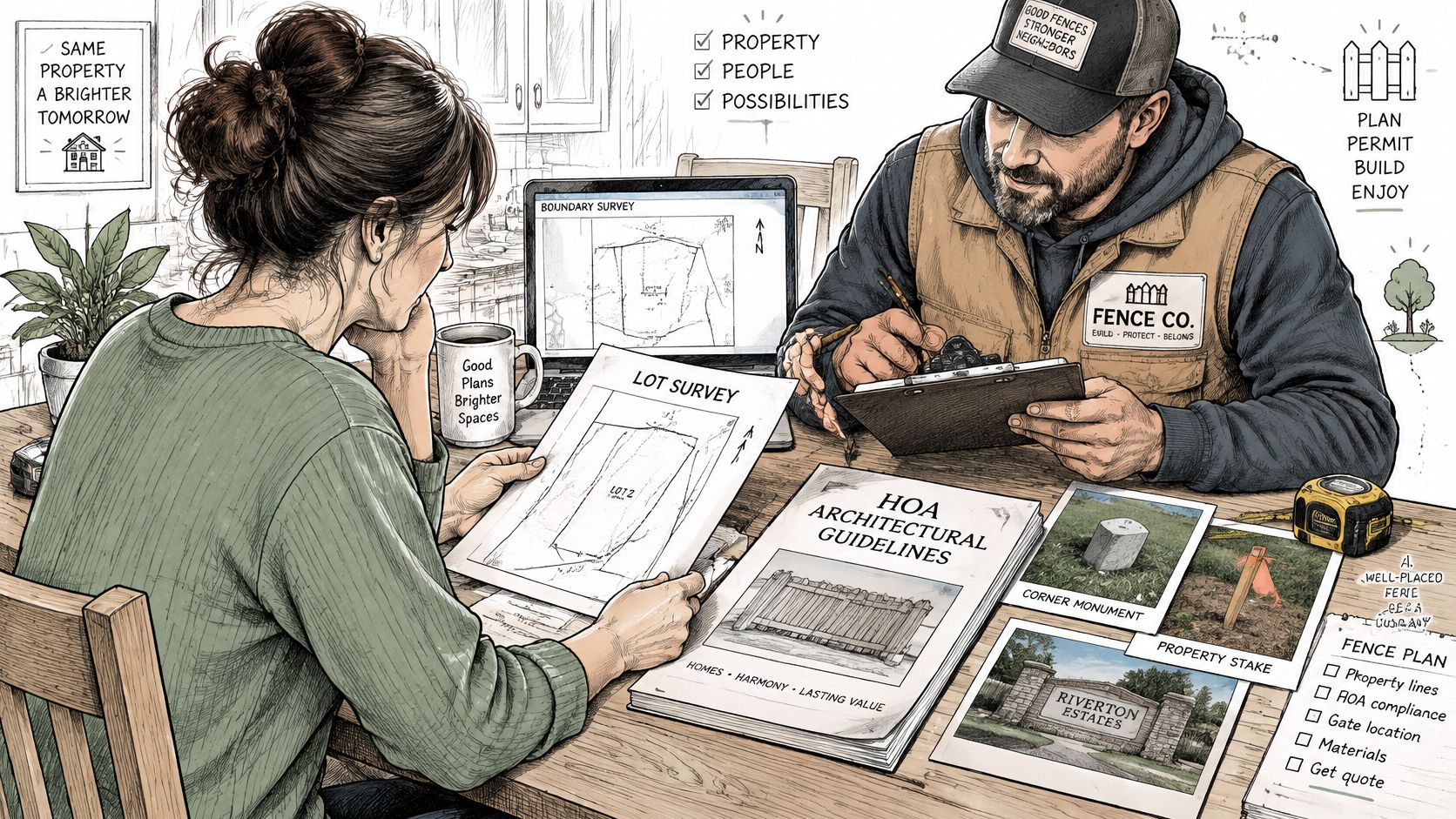
AlliedFenceAndGate.com™ takes that a step further: customers can upload a property lot survey and the AI reads the exact dimensions to make the fence estimate more accurate before anyone sets foot on the lot.
Then run the decision rule:
- Confirm the surveyed line and the monuments that mark it.
- Check the setback and height rule for your zoning district.
- Determine whether a building permit, a zoning-only review or both apply.
- Get neighbor and HOA approval in writing.
- Adjust the design and gate location if the survey shows less room than expected, before any material is ordered.
Moving a built fence costs many times what redrawing a plan costs. Keep the signed survey and every approval with the permit file, because the next buyer's title company will ask for them.
#MartinCountyFencing #PalmBeachCountyFencing #StuartFLFence #JensenBeachFence #HobeSoundFence #PalmCityFence #TequestaFence #JupiterFLFence #PortSalernoFence #TreasureCoastFencing #PropertyLineSurvey #FencePermits #PoolFenceSafety #PrivacyFenceInstallation #AluminumFencing #VinylFencing #ChainLinkFence #HOAApprovedFencing
AlliedFenceAndGate.com™ installs residential and commercial fencing across Martin County and Palm Beach County, and handles permitting, utility locates and inspection coordination on every job, so the line on the survey and the line on the ground match. Pool fencing is built to Florida Building Code with self-closing, self-latching gates, and every pool fence the company installs passes Martin County inspection. Upload a lot survey to the online estimator for an instant ballpark range, then visit AlliedFenceAndGate.com™ to book the site visit.
Related Fencing Services
Need a fence or gate on the Treasure Coast?
Licensed, insured, and bonded. Free estimates across Martin, St. Lucie, Indian River & Palm Beach counties.
Call (772) 530-3127