Pool Fence Florida: Code Rules and Inspection Steps
The pool is finished, the patio is poured, and the next person who decides whether anyone swims is the inspector. A line of pickets can look complete and still fail. Florida treats a pool fence Florida homeowners install as a child-access system, not a lot-line marker. A gap at the dirt, a latch a small child can reach, and a side gate left cracked open are the items that land on correction notices.
That pattern shows up constantly on the Treasure Coast. The yard fence was already standing. The HOA liked the look. Then the pool permit asked for a barrier that surrounds the water, with a gate that closes and latches on its own. Height is one row on that checklist. It is not the whole test.
Table of Contents
- Florida Pool Fence Requirements at a Glance
- Why Florida Treats the Pool Barrier as Child Access Control
- Yard Fence Versus Pool Barrier Layout Rules
- Pool Fence Materials That Meet Florida Barrier Rules
- Gates and Latches Inspectors Test First
- How to Permit, Install and Pass Final Inspection
- Common Pitfalls and What Each Fix Costs
- Confirm Your Barrier Before You Request a Quote
Florida Pool Fence Requirements at a Glance
Read the numbers before you pick a style or call for a quote. Under the Residential Swimming Pool Safety Act, a residential pool needs at least one approved safety option before final inspection and a certificate of completion. An enclosure that meets the barrier rules is one of those options. The same statute sets the barrier at at least 4 feet high, measured on the outside, and bars gaps, openings, indentations, protrusions, or structural pieces a young child can crawl under, squeeze through, or climb.
| Requirement | Florida standard | How to check |
|---|---|---|
| Barrier height | At least 4 ft (48 in), measured on the outside | Measure from finished grade on the side facing away from the pool |
| Gap under the barrier | No more than 2 in between grade and the bottom of the barrier | Re-measure after grading, pavers and landscaping are finished |
| Gap above an above-ground pool structure | No more than 4 in between the pool structure and the barrier bottom | Measure at several points along the pool wall |
| Distance from the water's edge | At least 20 in | Measure from the waterline to the barrier |
| Openings and climbable features | No gaps, openings, protrusions or structures a young child can crawl under, squeeze through or climb over | Check horizontal rails, planters and furniture that could serve as footholds |
| Pool gate | Opens outward, closes automatically, self-latches, release on the pool side | Test the swing, close and latch after installation and again after the gate settles |
What each row is really testing
Height is an outside measurement from finished grade, not from the pool deck and not from the top of a footer. A panel that reads 48 inches on the label can come up short where the yard rises.
The bottom gap is a crawl space. Two inches is the maximum between ground level and the barrier bottom, so sod, pavers, and a fresh grade can erase a pass you had on install day. Re-measure after the gardener leaves.
Above-ground pools get a separate limit. When the barrier sits on the pool structure, the opening between that structure and the barrier bottom stays at 4 inches or less. Check several points, because oval walls and uneven pads do not sit flat.
Setback from the water keeps a child who defeats the barrier from dropping straight in. Twenty inches from the water's edge is the minimum. Measure to the waterline, not to the coping you wish you had.
Openings and footholds cover more than picket gaps. Horizontal rails, a planter, and a chair against the outside face all count if a child can use them.
The gate is its own system. Per the pool safety feature statute, access gates open outward, away from the water, close on their own, and self-latch, with the release on the pool side where a young child cannot reach it over the gate or through an opening. Test it after the hinges settle, not only on the day the crew leaves.
Practical rule: These figures are a statewide floor. The local building department can add permit conditions, and an HOA can add appearance rules on top.
A fence passes when every row passes. A tall fence with a low latch, a wide bottom gap, or a climbable rail still fails.
Why Florida Treats the Pool Barrier as Child Access Control
A solid four-foot boundary fence can still let a toddler reach the water. The side gate stays propped with a brick during a party, the latch never catches, and the path from the lanai to the pool is open. The pickets did their job. The access points did not.
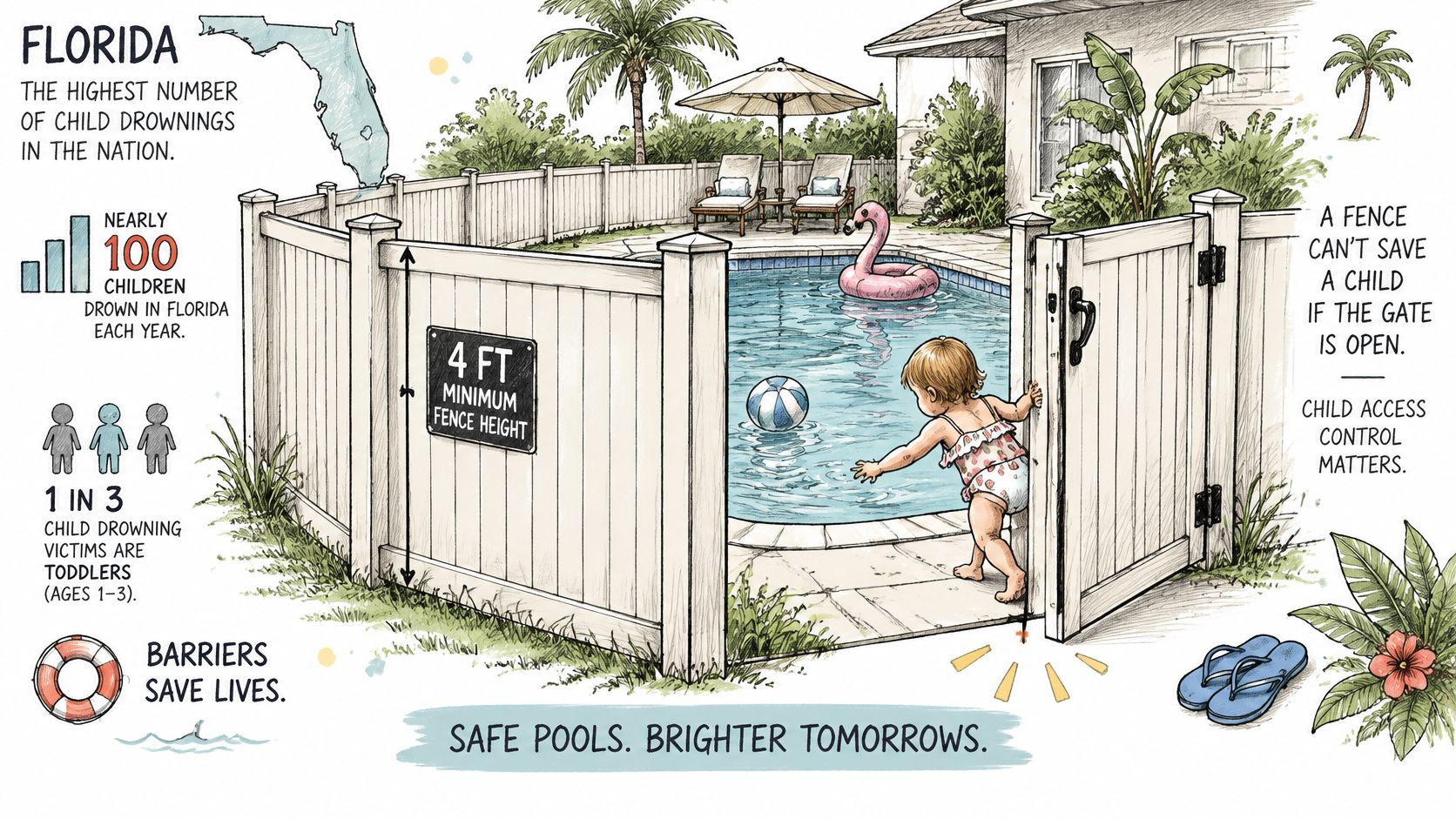
The drowning numbers are why the statute is written that way. A Florida legislative analysis reported approximately 350 to 500 drowning deaths annually from 2005 onward, averaging about 2 deaths per 100,000 residents. Children age 4 and under were reported to drown at approximately 6 per 100,000, nearly three times that statewide average. The same analysis records drowning as the leading cause of accidental death for Florida children age 5 and under, with children that age representing 87.7% of one year's child accidental-drowning deaths and 83.9% of the 2025 total.
Isolation beats a property-line fence
Layout changes the risk, not just the look. The CDC reported in 2025 that a four-sided isolation fence separating a pool from the house and yard reduces a young child's drowning risk by 83% compared with three-sided property-line fencing.
That finding tells a homeowner to cut the pool off from both the house and the rest of the yard. A fence that only marks the lot line leaves the back door, the side yard, and every window on the pool wall inside the same space as the water. Three sides of fencing plus the house is a different system from four sides that stand between the child and the pool.
Layered access, not one product
Think of the barrier, the gate, and any door or window that faces the water as one system.
- Barrier: stops a crawl, a squeeze, and a climb around the perimeter.
- Gate: has to shut and latch without anyone remembering to do it.
- House openings: a door or operable window on the pool wall is another entrance, and it does not disappear because the side yards are fenced.
A propped gate defeats a perfect panel height. A back door that opens straight onto the deck defeats a beautiful side fence. Later checks on layout, materials, and hardware all come back to that same idea: control every way a child reaches the water.
Yard Fence Versus Pool Barrier Layout Rules
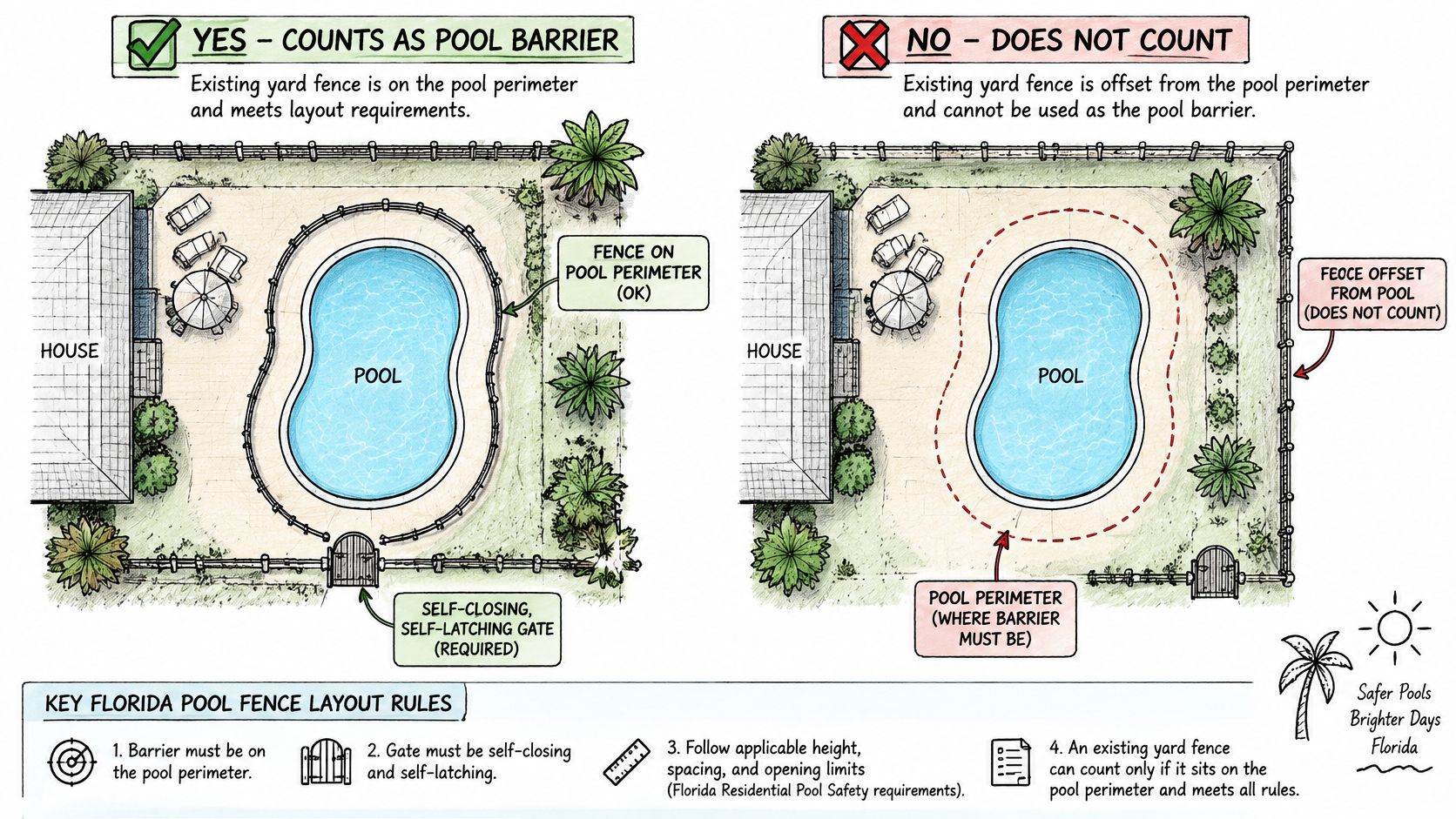
A general yard fence is not a pool barrier just because it is already paid for. Florida law requires the barrier to be at least 4 feet high on the outside, to surround the pool perimeter, and to have no gaps, openings, indentations, protrusions, or structural components a young child can crawl under, squeeze through, or climb. A yard fence counts only when it sits on the pool perimeter and meets those barrier standards, or you add a separate compliant barrier. The statute also requires the barrier far enough from the water's edge that someone who gets through does not fall straight in. Aluminum, vinyl, and other permanent enclosures are all judged on that layout, not on the brand of the panel.
Four layouts, in the order you meet them
Property-line fence. This is the three-sided problem in physical form. The fence runs the back and sides of the lot, the house closes the fourth side, and the pool sits in the open yard. Children who are already in the yard are already at the water. That fence can stay as a boundary. It does not, by itself, isolate the pool. Adding a foot of height on the same posts does not move the fence onto the pool perimeter.
Pool-only enclosure. The fence follows the water, with its own gate, and the rest of the yard stays outside. This is the layout that matches isolation. Irregular freeform pools still need a continuous run. A jog around a spa, a raised spa wall, or a narrow side yard is part of the perimeter, not a place to stop the panels.
Dwelling wall. A solid wall can be one face of the barrier only when it has no door and no operable window that gives pool access. A sliding glass door, a crank-out window, or a pet door on that wall means the wall is an entrance, not a barrier. Alarms and covers are separate statutory options. They are not a free pass to ignore an openable door and call the stucco a fence.
Screened enclosure. A cage can be the barrier when the screen walls, doors, and base track meet the same child-access rules. A screen door that drifts open, a torn panel at the kickplate, or a track a child can squeeze under fails the same way a picket fence fails. The cage does not get a discount because it also keeps bugs out.
An afternoon audit
Measure finished grade, not the height printed on the panel. Find retaining walls, raised decks, pavers, and planters a child could stand on. Then run three checks:
- Outside height. At the low point of the grade, on the side facing away from the pool, confirm the barrier still meets the outside-height rule along the whole run.
- Gaps. Look under the bottom and between pickets or mesh, including post returns and gate jambs.
- Footholds. Note rails, furniture, AC pads, and built-in planters a child can climb.
A fence that fails any one of those three needs a separate barrier. Taller panels on the same posts rarely close a gap or remove a foothold.
Pool Fence Materials That Meet Florida Barrier Rules
The state does not approve a material. It judges geometry: height, openings, climbable parts, and how the gate behaves. Aluminum, vinyl, mesh, block, chain link, and wood can all pass or fail on those terms.
| Material | Strengths | Watch-outs under the barrier rules | Best use |
|---|---|---|---|
| Aluminum picket | Corrosion-resistant, see-through, long lasting | Picket spacing and gate hardware must match the barrier standard | Pool enclosures and HOA-approved layouts |
| Vinyl or PVC | Low maintenance, smooth finish, good wind performance with reinforced posts | Post depth and panel spacing must handle wind loads | Privacy and semi-privacy pool fences |
| Mesh panel on frame | Clear view, lightweight, quick to install | Mesh must have no openings a child can use and the frame must not be climbable | Screened barriers around a pool |
| Masonry wall | Permanent and solid | Any door or operable window facing the pool blocks the wall from counting as a barrier | Existing walls that form part of the enclosure |
| Chain link | Economical and durable | Climbable unless fitted with slats or mesh and gaps are checked | Budget barriers, after confirming with the local inspector |
| Wood | Warm appearance | Horizontal rails act as footholds and boards can shrink and open gaps | Less common for pool barriers |
What the table cannot show
Aluminum and PVC still need picket or panel spacing a child cannot pass, plus posts set in footings deep enough for coastal wind. A smooth top rail and vertical infill are what keep the fence from becoming a ladder. Horizontal rails on the outside face are a foothold no matter how expensive the material is. Rail placement matters as much as the product name.
Mesh on a frame stays compliant only while the mesh stays tight and the frame stays free of climbable crossbars. A loose panel that bellies out creates an opening the original spec never had.
Chain link is the clearest trade-off. It costs less up front and lasts, and it is also easy to climb. Slats or a mesh insert, plus a checked bottom gap, are what turn it into a barrier rather than a pet fence. Low-maintenance aluminum avoids that extra layer. Chain link can still be the right budget choice once the local inspector has accepted the climb treatment you plan to use.
Choose the material that keeps openings narrow and the top rail smooth. Confirm spacing with the inspector before you order panels. A crate of the wrong infill is cheaper to cancel than to tear out after a failed inspection.
Gates and Latches Inspectors Test First
Inspectors fail gates more often than they fail straight runs of fence. The rule is specific. The gate opens outward, away from the water, closes automatically, latches automatically, and puts the release on the pool side where a young child cannot reach it over the gate or through an opening.
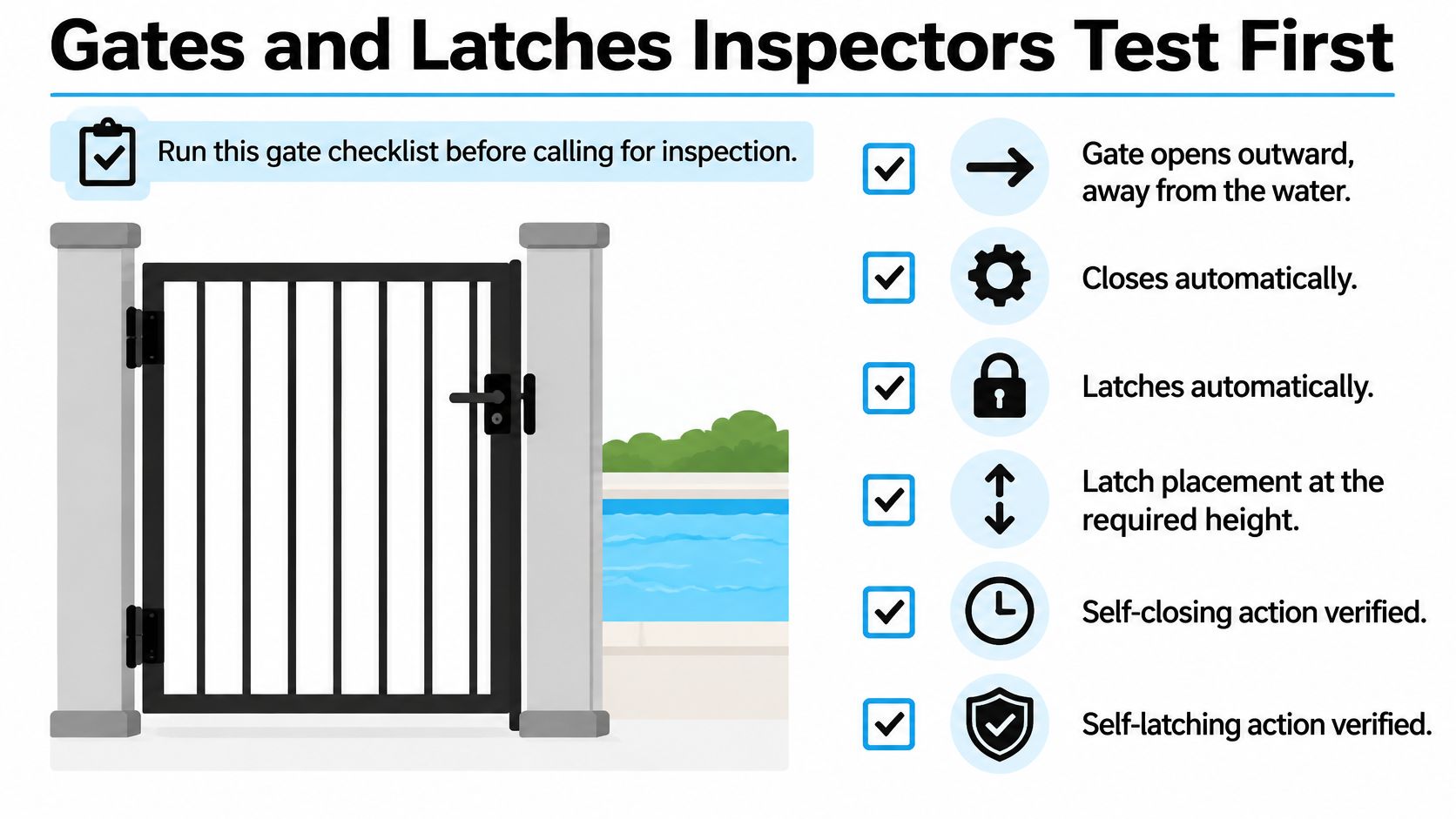
Run this before you call for inspection. A pool safety gate latch that looks right on the drawing still has to work after the posts move.
Six checks, in order
- Open the gate fully and let go. It has to swing shut from that wide position, not only from a few inches ajar. A closer that works at 20 degrees and dies at 90 degrees is a fail.
- Lift the latch side and watch for sag. A gate that drops even a little can miss the strike. Florida humidity and a heavy decorative panel make this show up within weeks.
- Stand outside and try to reach the release. It belongs on the pool side, high enough that a climbing child cannot work it over the top or through a gap. A latch mounted for adult convenience on the yard side is the wrong hardware, even if it is sturdy.
- Push the closed gate from the pool side. It should stay latched. A latch that needs a shove to seat will be left unlatched.
- Sight the bottom edge with the gate closed. Any gap a child can pass under is the same defect as a gap under a panel.
- Recheck hinges and the self-closer after storms, heavy rain, and the seasonal humidity swing. Salt air loosens fasteners that felt tight in January.
The failure that shows up most often is a gate that closes but does not latch. Sag drops the latch tongue below the strike, or the latch was mounted too low on the gate to begin with. Both look like a working gate until you watch the tongue miss.
Use corrosion-resistant hinges and latches. Cheap plated hardware pits in salt air, the gate sags, and the next inspection fails a fence that passed the first time. Stainless or marine-grade hardware costs more on day one and avoids a return trip.
How to Permit, Install and Pass Final Inspection
Clearances that pass on paper fail in the yard when grade, pavers, or a pool wall change the opening. The Florida Building Commission guidance is why you verify in the field: uneven grades, pavers, retaining walls, raised decks, and above-ground ladders change effective clearances. Nominal panel height is not the measurement.
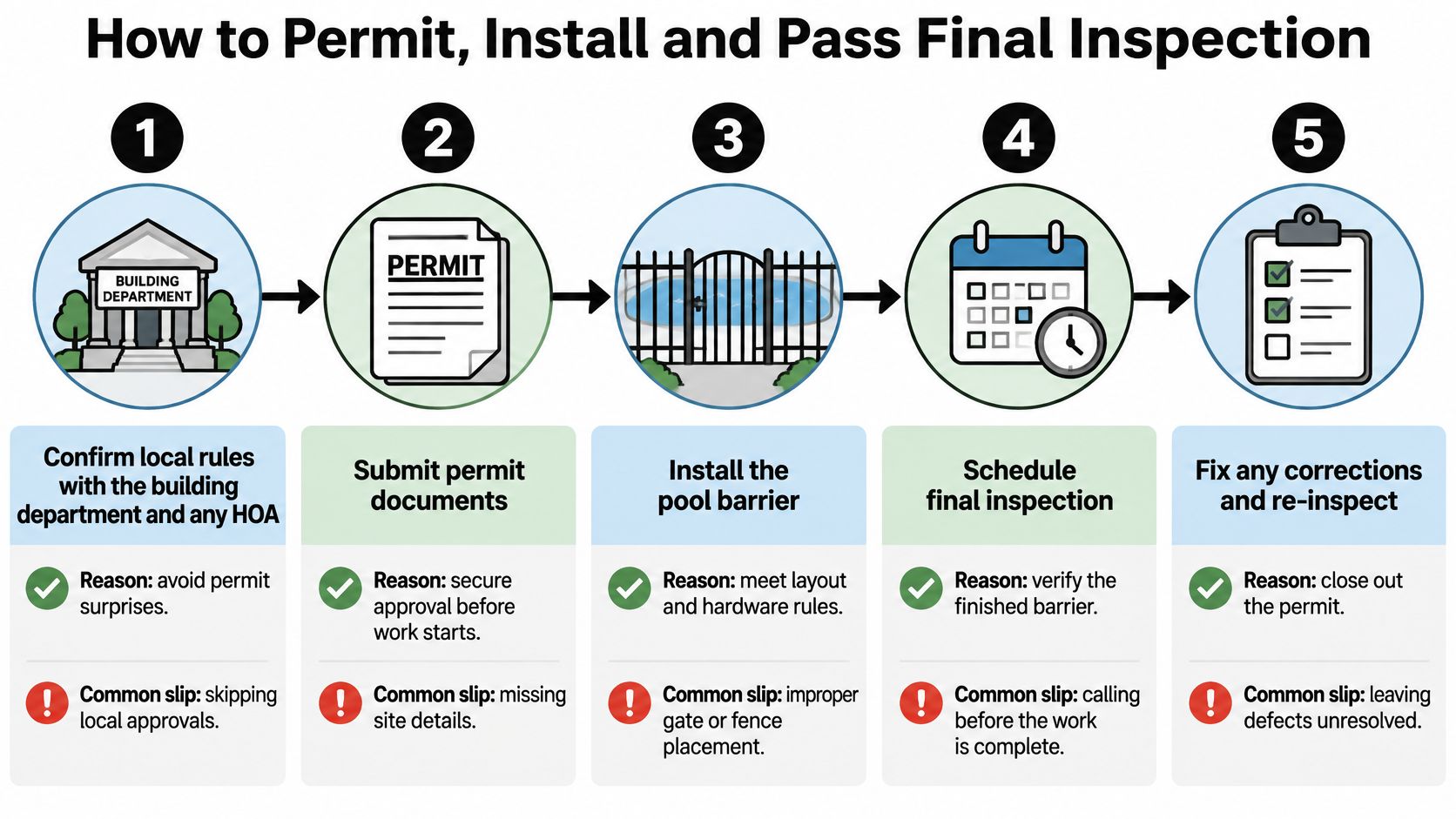
Martin County requires a building permit for all new fence installations. Other cities on the Treasure Coast have their own forms. Treat the state floor as the start of the file, not the end of it. A fence permit application that skips the house wall is the packet that comes back.
The path, and the slip at each step
- Confirm local rules with the building department and any HOA before you order. The reason is simple: permit rules and fence standards change by jurisdiction. The slip is treating the statewide floor as the whole rule.
- Measure the site on finished grade outside the fence line, the distance from the water's edge, and every house door or window that opens toward the pool. Measuring before regrading or landscaping is the slip that makes yesterday's numbers useless.
- Design to the barrier standard, including outside height, no child-passable gaps, and a pool-side gate release. Copying the existing yard-fence layout is the slip. That fence was built for the lot, not for the water.
- Submit a site survey and dimensioned drawings that show the house wall and the pool-side gate. Omitting the house wall hides the door the inspector will stand in front of.
- Install on proper footings with consistent picket or panel spacing. Uneven spacing at the posts is where a child-sized opening appears even when the field panels are correct.
- Verify every clearance after the panels are up. Bottom gap and above-ground clearance are the figures crews miss when they only check catalog height.
- Test every gate with it operating, then call for inspection after the gate has settled. Booking the inspection the afternoon the concrete is poured is how a closer that has not taken a set fails in front of the inspector.
- Final approval for a residential pool requires a compliant barrier or another approved safety feature in place. Plan the schedule around the certificate of completion. That is the milestone, not the day the truck leaves.
Schedule around the certificate
A typical residential fence installation in Stuart takes 1-3 days once the permit is approved and materials are on site. Permitting and inspection sit outside those days. Build the calendar backward from the certificate, and leave time for a correction cycle if a latch or a bottom gap needs a return visit. Calling inspection on an unsettled gate burns that buffer.
Common Pitfalls and What Each Fix Costs
The expensive surprises are layout problems, not hinge adjustments. Price the fix before the crew is on site. A pool fence cost calculator is useful only after you know which row you are buying.
| Pitfall | Fix | Cost level |
|---|---|---|
| Gate sags and misses the latch | Rehang or adjust hinges and self-closer | Low |
| Latch mounted too low or on the outside | Move release to pool side at an unreachable height | Low |
| Gap under panels after regrading | Add bottom rail or adjust posts | Moderate |
| Yard fence used as barrier without changes | Build separate compliant barrier or rebuild run | Highest |
| Aboveground pool ladder left accessible | Lock, remove or enclose the ladder | Low to moderate |
| Climbable planters or furniture beside fence | Relocate the objects | None |
What moves the price
- Perimeter length: every extra foot is posts, panels, and footings, so a freeform pool costs more than the same water in a simple rectangle.
- Number of gates: each gate adds a closer, a latch, and a second post that has to stay plumb. One gate is a hardware line. Three gates are a different job.
- Keep or rebuild: a yard fence that cannot serve as the barrier means a new run, not a repair. That is usually the highest line on the quote.
- Grade and footings: slopes, soft sand, and retaining walls add digging and sometimes a stepped layout so outside height holds at the low points.
- Above-ground ladders: a ladder left in place is an open stair into the water. Locking, removing, or enclosing it is a small scope unless the enclosure has to tie into an odd wall.
The costly change is turning a yard fence into a separate barrier. That is why the layout audit comes before the material conversation. A pitfall caught before installation costs far less than the same pitfall on a correction notice, when the crew remobilizes and the certificate waits.
Confirm Your Barrier Before You Request a Quote
A quote is a price on a layout. If the layout is wrong, the price is a guess.
- Measure the pool-side layout and finished grade against every row in the requirements table. Outside height, bottom gap, water setback, and anything a child can stand on.
- Test the gate for swing, close, and latch, including release height on the pool side. Do it with the gate fully open, then again after you push from inside.
- Call the local building department and confirm the permit requirements for that property, including any HOA submittal the city does not handle.
AlliedFenceAndGate.com™ installs pool fencing and gates for homeowners who have already done that audit. What the company has confirmed is specific: PVC pool fencing goes in with proper picket spacing, a 48-inch minimum height, and pool-code gate hardware, reflecting Florida Statutes sections 515.27 to 515.29. Pool fencing from the company is built to Florida pool code. Licensing, insurance, bonding, and the exact service area should be confirmed with the company before you hire, rather than treated as settled here.
Measurements drive the price. A quote after the audit tells you the cost of a barrier that can pass. A quote before the audit often prices the fence you already have.
#FloridaPoolFence #MartinCountyFL #StuartFencing #PalmBeachCounty #TreasureCoastFencing #FloridaPoolSafety #PoolBarrier #FloridaBuildingCode #PoolGateLatch #PVCPoolFence #HOAFencing #FloridaFencing #StuartFL #JupiterFencing #PalmCityFencing #HobeSoundFencing #PoolFenceFlorida #MartinCountyFencing
AlliedFenceAndGate.com™ installs pool fencing and self-closing, self-latching gates built around Florida barrier rules, from the permit file through inspection. If you are comparing a yard fence with a true pool enclosure, the layout audit above is the right starting point. Visit AlliedFenceAndGate.com™ to review pool fence options and request a quote once your measurements are in hand.
Related Fencing Services
Need a fence or gate on the Treasure Coast?
Licensed, insured, and bonded. Free estimates across Martin, St. Lucie, Indian River & Palm Beach counties.
Call (772) 530-3127