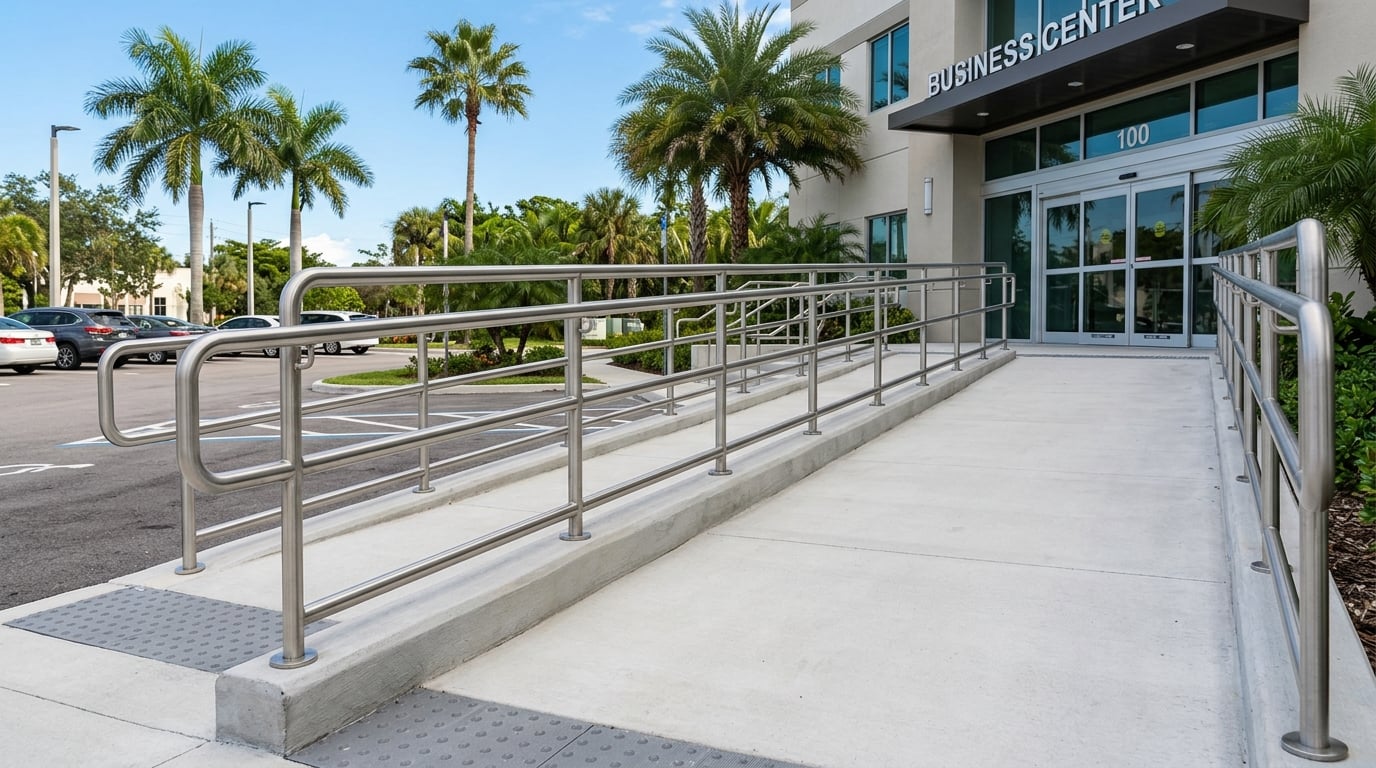
Why This Matters
ADA violations in Florida carry fines of $75,000 for first offense and $150,000 for subsequent offenses under federal law. Private lawsuits (which have exploded in Florida) can add $10,000-$50,000+ in settlements. Getting railings and ramps right isn't optional — it's a legal requirement for any commercial or public-facing property.
If you manage a commercial property, HOA clubhouse, church, medical office, restaurant, or any place the public enters, your handrails and ramps must meet specific ADA requirements enforced by both the Americans with Disabilities Act (federal) and the Florida Building Code (state). Florida has adopted ADA Standards for Accessible Design, meaning state inspectors enforce federal requirements. Here's every specification you need to know.
Handrail Height Requirements
Stairway Handrails
- Height: 34–38 inches from stair nosing
- Required on both sides of stairs
- Top extension: 12” minimum horizontal
- Bottom extension: 1 tread depth + 12”
Ramp Handrails
- Height: 34–38 inches from ramp surface
- Required on both sides of ramp
- Extensions: 12” minimum at top and bottom
- Required when rise exceeds 6 inches
Grip Size & Shape Specifications
The gripping surface is one of the most commonly failed inspection items. The handrail must be graspable along its entire length.
- Circular cross-section: Outside diameter between 1.25” and 2”
- Non-circular cross-section: Perimeter between 4” and 6.25”, max cross-section dimension of 2.25”
- Clearance from wall: Minimum 1.5 inches between rail and any adjacent surface
- Continuous grip: No obstructions that require releasing and re-gripping. Brackets must not obstruct the gripping surface.
- Returns: Handrails must return to the wall, guard, or walking surface at terminations — no open ends that catch clothing or injure.
Ramp Slope & Landing Requirements
Practical example: A 24-inch rise (two standard steps) requires a minimum 24-foot ramp run at 1:12 slope, plus a 5-foot landing at the top and bottom. That's roughly 34 feet of total ramp structure. This is why ADA ramp projects are significant construction — not a weekend project.
Who Must Comply in Florida
Must Comply
- • Restaurants & bars
- • Medical & dental offices
- • Retail stores
- • HOA clubhouses & common areas
- • Churches & houses of worship
- • Government buildings
- • Hotels & resorts
- • Multi-family common areas
- • Schools & daycare facilities
- • Banks & financial offices
- • Any place open to the public
Typically Exempt
- • Private single-family homes
- • Private duplexes
- • Detached private garages
- • Private pools (non-community)
Note: Even exempt properties may choose to install ADA-compliant railings for safety, accessibility, or resale value.
Common Inspection Failures We See
As a contractor who installs ADA railings weekly in Martin and Palm Beach Counties, here are the failures we see most often on existing properties:
- Wrong height — Rails at 30” or 42” instead of 34–38”. This is often from installing "guard rails" instead of "hand rails" — they serve different purposes.
- No extensions — Rail ends at the top/bottom step instead of extending 12”+ horizontally.
- Open ends — Rail terminates without returning to wall or post. Creates a catch hazard.
- Wrong grip diameter — Decorative rails with 3”+ square tubes. Beautiful, but not graspable and not ADA compliant.
- One-sided only — Ramp has a rail on one side. ADA requires both sides.
- Ramp too steep — Slope greater than 1:12. Often seen when space is limited and the installer "winged it."
- No landing — Ramp runs directly to a door without a level landing. ADA requires 60” × 60” level area at top.
What ADA-Compliant Installation Costs
| Project Type | Price Range (Installed) |
|---|---|
| Stairway handrails (per linear foot) | $80 – $150/LF |
| Ramp handrails (per linear foot) | $90 – $200/LF |
| Full ramp with railings (per LF) | $150 – $400/LF |
| Typical commercial railing project | $3,000 – $15,000+ |
| Full ADA ramp + railings + landing | $5,000 – $25,000+ |
Pricing includes materials, labor, concrete footings, permitting, and inspection. South Florida rates, 2025-2026.
Frequently Asked Questions
What height must ADA handrails be in Florida?
ADA handrails must be between 34 and 38 inches measured from the walking surface to the top of the gripping surface. Florida Building Code follows this federal ADA standard. For stairways, this is measured vertically from the stair nosing. For ramps, it is measured from the ramp surface.
What is the required grip diameter for ADA handrails?
ADA requires a circular cross-section with an outside diameter between 1.25 inches and 2 inches. Non-circular cross-sections must have a perimeter between 4 inches and 6.25 inches with a maximum cross-section dimension of 2.25 inches. The gripping surface must be continuous and unobstructed.
How long must handrail extensions be at the top and bottom?
At the top of stairs: the handrail must extend horizontally at least 12 inches beyond the top riser. At the bottom of stairs: the handrail must extend at the slope of the stair flight for a horizontal distance equal to one tread depth beyond the bottom riser, then continue horizontally for at least 12 inches. For ramps: 12-inch horizontal extensions at both top and bottom.
What is the maximum ramp slope for ADA compliance?
The maximum running slope for an ADA-compliant ramp is 1:12 (8.33% grade), meaning for every 1 inch of rise, you need 12 inches of horizontal run. The maximum cross slope is 1:48. The maximum rise for any single ramp run is 30 inches before a landing is required.
Does a business need ADA railings in Florida?
Yes. Any place of public accommodation, commercial facility, or state/local government facility must comply with ADA accessibility requirements. This includes restaurants, medical offices, retail stores, churches, HOA clubhouses, municipal buildings, and multi-family residential common areas. Failure to comply can result in lawsuits, fines of $75,000+ for first violations, and denial of certificate of occupancy.
How much do ADA-compliant railings cost in Florida?
ADA-compliant aluminum handrails typically run $80-$200+ per linear foot installed in South Florida, depending on complexity. This includes the railing, posts, ADA-compliant grips, returns, extensions, and concrete footings. Ramps with railings cost $150-$400+ per linear foot. A typical commercial railing project runs $3,000-$15,000+.
Need ADA-Compliant Railings or Ramps?
We install ADA-compliant handrails, ramps, and accessible pool fencing for commercial properties across Martin County and Palm Beach County. Free on-site assessment and quote.