Storm Damage Insurance Claims: How to File and Get Paid
The most common advice after a storm is simple: document the damage, file quickly, and insurance will handle the rest. That advice is incomplete for a fence, gate, or railing. A house claim and a fence claim can follow different limits, different exclusions, and different deductibles, even when the same wind caused both losses. Owners who treat storm damage insurance claims as one claim for everything often discover the difference only after the first check arrives.
Table of Contents
- Why Storm Claims Pay Less Than the Repair Bill
- Which Storm Damage Your Policy Covers
- Deadlines and the Hurricane Deductible Clock
- How ACV and RCV Change the Insurance Check
- How to File a Storm Damage Claim Step by Step
- Reading Contractor and Insurer Estimates Side by Side
- What to Do If the Claim Is Denied or Underpaid
- Confirm the Scope Before You Schedule Repairs
Why Storm Claims Pay Less Than the Repair Bill
A contractor's estimate answers one question: what does it cost to rebuild the fence? An insurer's payment answers a narrower question: what part of that cost does the policy owe after limits, exclusions, valuation, and the deductible? Those are not the same number, and the gap between them is where owners lose money.
A valid claim is not the same as a full payment.
The arithmetic is plain. The insurer starts with covered physical damage, subtracts the deductible, and subtracts depreciation if the policy pays actual cash value. A fence panel runs through that same arithmetic as a roof does. If depreciation and the deductible consume most of the covered amount, a covered loss can still produce a small check.
Why These Claims Are Now Routine
Storm losses are no longer rare events that arrive once in a generation. NOAA recorded 403 U.S. weather and climate disasters costing over $1 billion each between 1980 and 2024, and the pace for 2020 to 2024 reached 23.0 events per year, more than 2.5 times the long term average of 9.0, according to the Congressional Research Service summary of NOAA billion dollar disaster data. Severe storms were the largest category at 203 events in that same record.
Named hurricanes aren't the only source of volume. In the first half of 2024, severe convective storms accounted for 70% of global insured natural catastrophe losses, according to Swiss Re figures cited in the Insurance Information Institute analysis of hail and severe convective storm losses. More regional claims mean slower adjuster inspections, busier contractors, and tighter material supply. A fence claim competes for attention with roofs, interiors, and commercial losses from the same event.
Three causes explain most of the shrinkage. First, the fence may fall under a separate other structures limit rather than the dwelling limit. Second, the peril may be excluded, especially flood or deterioration. Third, the policy may pay actual cash value instead of full replacement cost. The order that protects an owner is coverage check first, then deadlines, valuation, filing steps, estimate comparison, scope decisions, and finally the dispute path if payment falls short.
Which Storm Damage Your Policy Covers
A fence can fail during a storm and still fall outside the policy's coverage. The cause of damage matters: wind, flood, hail, impact, and deterioration may leave similar damage, but insurers assess them under different policy terms. Identify the likely cause before comparing repair estimates.
A fence is often insured as an other structure, with a limit separate from the home's dwelling coverage. The limit may be lower than the repair cost, and some policies exclude fences or gates. Aviva guidance warning homeowners about storm exclusions for fences and gates cautions homeowners to check for these exclusions. Flood damage is a separate concern: standard homeowners policies generally exclude flooding, so coverage may depend on a separate flood policy or an applicable endorsement.
| Damage cause | Typical coverage path | Policy term to check | Evidence to keep |
|---|---|---|---|
| Non-hurricane wind | Windstorm or all-perils section; fences often under other-structures limit | Other-structures limit and any wind sublimit | Photos of each failed panel, post and gate |
| Hurricane wind | Hurricane deductible, possibly a separate windstorm policy | Hurricane deductible percentage and named-storm terms | Warning dates and a dated damage timeline |
| Hail | Windstorm-type coverage in most policies | Hail exclusions or fence sublimit | Impact marks, dent counts, close-up photos |
| Flood or storm surge | Usually excluded from standard homeowners; separate flood policy | Flood endorsement or flood policy limits | Water lines, soil scour, debris marks |
| Falling tree or vehicle impact | Often covered as a sudden peril | Debris removal limits and tree-ownership terms | Tree or vehicle in place, impact points |
| Rot, corrosion or wear | Usually excluded as maintenance | Wear-and-tear and deterioration exclusions | Pre-storm photos, post age, footing condition |
| Code-required upgrades | Ordinance or law coverage, often limited | Ordinance or law endorsement | Permit requirements and inspector notes |
One Fence, Two Different Answers
A six-foot wood fence knocked flat by a gust can lead to different coverage decisions depending on its condition before the storm. If sound posts snapped or pulled from intact footings, the damage may fit the policy's windstorm coverage. If posts had rotted at ground level and the fence leaned over, the insurer may classify the failure as deterioration. Photos showing clean breaks, pulled footings, and nearby sections still standing plumb can help establish what happened.
The same cause-based assessment applies to the roof, but roof and fence coverage should be reviewed separately. Aastro Roofing Company's roof insurance guide discusses roof coverage questions; it does not determine how a fence is covered. Keep the fence repair and any roof work as distinct items in the claim, each matched to its own policy terms and estimate.
Before filing, confirm in writing whether the fence falls under the home policy, a separate windstorm arrangement, or a flood policy. If the insurer denies coverage, ask it to identify the specific exclusion or endorsement supporting that decision. An intake representative's verbal assurance does not settle coverage.
Deadlines and the Hurricane Deductible Clock
Two questions control the Florida hurricane deductible. Was a hurricane watch or warning in effect, and when did the last watch or warning end? Owners who can't prove those dates may argue about wind speed while the carrier applies the policy clock.
Florida's hurricane deductible trigger is tied to official National Hurricane Center warnings, not just to high winds or a storm being informally called a hurricane. Under Florida law, the applicable period begins when a hurricane watch or warning is issued for any part of Florida and ends 72 hours after the last such watch or warning is terminated, as explained in Florida Department of Financial Services guidance on the hurricane deductible trigger. That timing can determine whether damage is processed under the hurricane deductible rather than the ordinary all perils deductible.
The Once Per Year Rule
Florida policyholders generally pay only one hurricane deductible per calendar year when they remain insured with the same insurer or insurance group for a second or subsequent hurricane during that year, according to the Florida consumer guide to the hurricane deductible. The rule doesn't erase the deductible, and it doesn't merge separate storms into one loss. Each occurrence still needs separate reporting and separate evidence of distinct damage.
The dollar difference can decide whether filing makes sense. As an illustration, a 2 percent hurricane deductible on a $300,000 dwelling equals $6,000. A non hurricane storm that falls under a lower all perils deductible could leave a much smaller amount for the owner to absorb. That comparison should happen before a fence contractor is authorized to rebuild the full run.
| Clock | What starts it | What to record |
|---|---|---|
| Hurricane deductible period | First hurricane watch or warning issued for any part of Florida | Date and time the last watch or warning is terminated |
| Post-warning window | 72 hours after the last watch or warning is terminated | Loss date compared with the window end |
| Repeat hurricane in same year | Each later storm with the same insurer group | Separate damage record; one hurricane deductible per calendar year generally applies |
| Initial claim notice | Date the loss is discovered | Written notice, claim number, date sent |
| Supplemental claim | Hidden damage found after first payment or during repair | New dated photos and a revised written estimate |
Initial notice deadlines and supplemental claim rules should be confirmed in writing with the carrier, because the controlling policy and current Florida law determine the window for a specific loss. Hidden damage found during repair, such as a cracked footing under a panel that looked intact, belongs in a dated supplement rather than a phone call alone.
Practical rule: Write every date down the day it happens, including warning termination, discovery, notice, inspection, and each promise made by phone.
These hurricane deductible rules are Florida rules. Owners elsewhere should check windstorm and named storm terms in the applicable policy and record the date and time of any official local warning.
How ACV and RCV Change the Insurance Check
A fence replacement estimate and the insurer's check can differ by thousands of dollars. The gap often comes down to the policy's valuation method, depreciation, the deductible, and whether the insurer releases withheld depreciation after repairs. For a fence, gate, or railing insured under an “other structures” limit, confirm that limit as well as the valuation method. A homeowner policy's house coverage does not automatically tell you what applies to the fence.
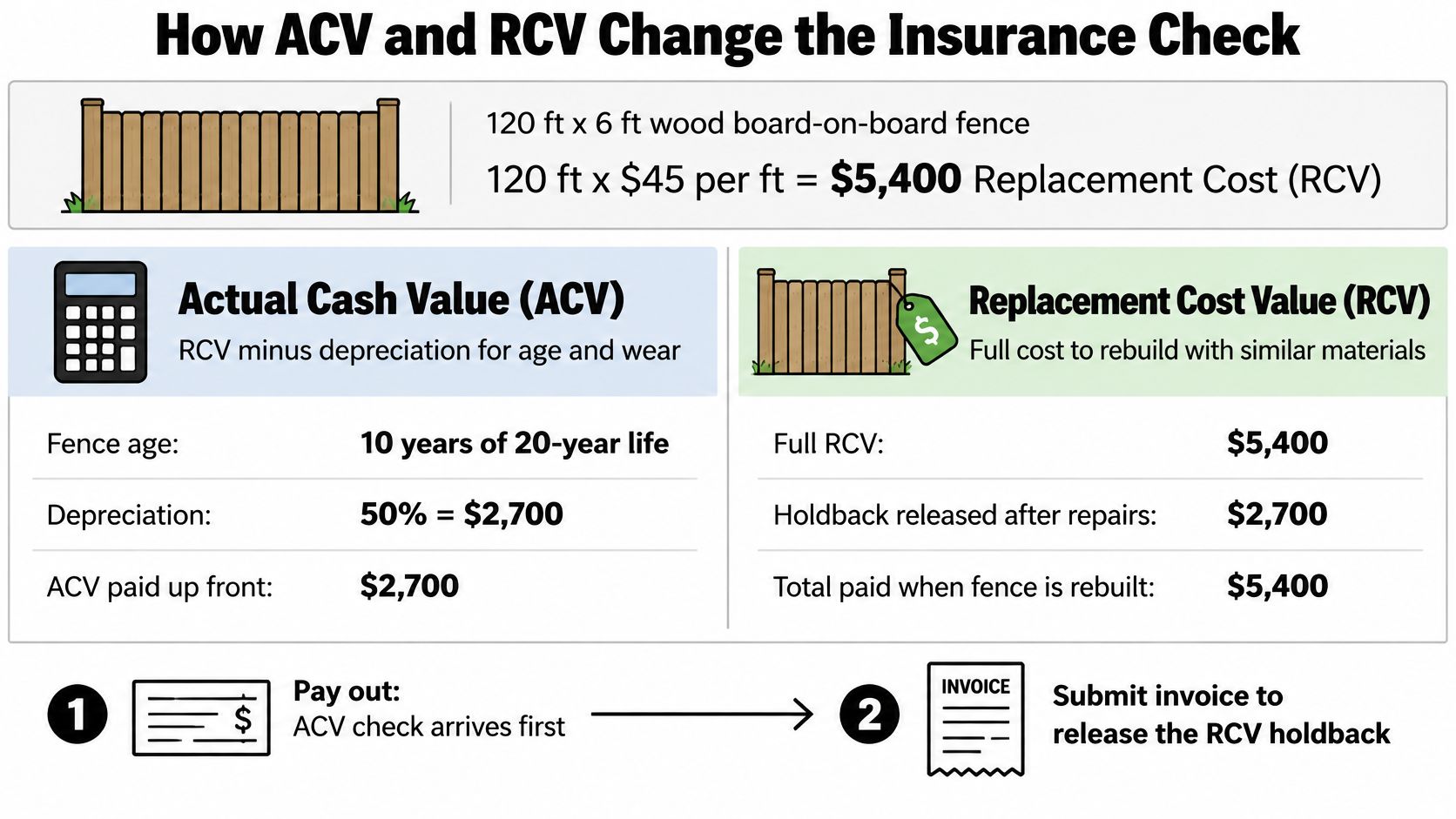
Actual cash value, or ACV, subtracts depreciation for age and wear. Replacement cost value, or RCV, is based on replacing damaged property at today's price without deducting depreciation, subject to the policy's conditions. The Insurance Information Institute hurricane preparation guidance on ACV, RCV, and hurricane deductibles discusses these valuation methods and illustrates a 2% hurricane deductible on a $200,000 insured home, equal to $4,000. Premiums vary by insurer and policy, so compare the coverage terms rather than assuming one valuation method has a standard price difference.
The Worked Fence Example
Consider a 120 foot, six foot wood board on board fence priced at $45 per foot for illustration. Its replacement cost is $5,400. If the example applies 40 percent depreciation for age and wear, depreciation is $2,160, leaving an ACV of $3,240.
Subtract a hypothetical $2,500 deductible. Under an ACV-only settlement, the payment is $740, with no later depreciation payment. Under RCV coverage, the initial payment may also start from the depreciated amount. The insurer may release the $2,160 depreciation holdback after repairs are completed and documented. In this example, total payment then reaches $2,900, the $5,400 replacement cost minus the $2,500 deductible.
| Factor | Actual cash value (ACV) | Replacement cost value (RCV) |
|---|---|---|
| Depreciation | $2,160 subtracted at 40 percent in the example | Not subtracted when replacing at today's price |
| Deductible | $2,500 hypothetical deductible subtracted | $2,500 hypothetical deductible subtracted |
| First payment | $740 | $740 before withheld depreciation is released |
| Final payment | None further after ACV | $2,160 withheld depreciation after completed repairs |
| Total paid | $740 | $2,900 |
These figures illustrate how the calculation works, not a quote or promise of payment. Each policy sets its own depreciation method, limits, exclusions, and conditions for releasing withheld depreciation. Some policies require repairs by a stated deadline and invoices before releasing the remaining amount. That timing affects cash flow: a contractor may need payment before the insurer releases the holdback.
Check the deductible before deciding whether a small fence claim is likely to produce an initial payment. If the ACV is below the deductible, the first payment is zero. For example, a $900 fence loss under a $2,500 deductible pays nothing, even if the cause of damage is covered. A fence-only claim below the deductible may still form part of a larger property claim, but it will not provide funds for the fence repair by itself.
Before demolition, ask the insurer to confirm in writing the valuation method for other structures, the applicable deductible, any fence sublimit, and the documents required to release withheld depreciation. Check whether the damaged fence, gate, and railing fall within the same coverage limit, and whether exclusions or code-upgrade terms affect the estimate. Those answers show how much of the contractor's replacement estimate the policy may pay, and what the owner may need to fund.
How to File a Storm Damage Claim Step by Step
Speed helps only when evidence survives. Rushing a fence into a dumpster can destroy proof of causation, while waiting without temporary security can create pool safety, liability, and HOA problems. The sequence below separates safety work from permanent replacement.
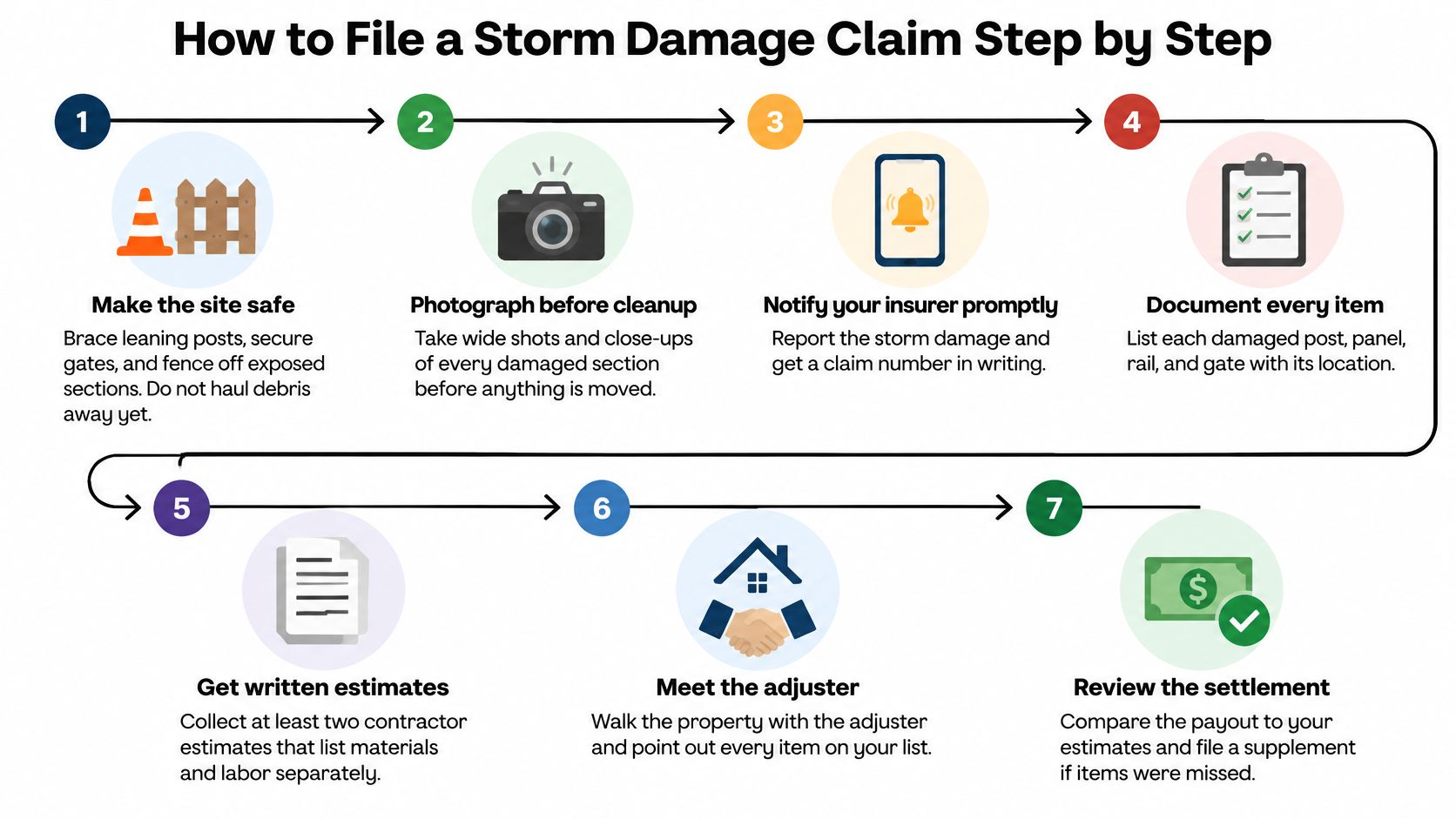
- Make the site safe: Brace leaning posts, secure loose gates, and close exposed pool or yard openings with temporary fencing. Don't haul debris away yet, because the failed components are evidence of the failure mechanism.
- Photograph before cleanup: Capture wide shots of every elevation, close ups of breaks and hardware, and a continuous video of the full run. FEMA's National Flood Insurance Program guidance instructs policyholders to photograph and video structural damage, water levels, and damaged property before moving or discarding items, as set out in FEMA guidance for filing a flood insurance claim.
- Report the loss in writing: Send prompt notice, obtain a claim number, and keep the sent copy with the date. Written notice protects the timing portion of the claim if intake details are later disputed.
- Keep damaged parts: Retain broken posts, bent rails, gates, hinges, latches, and operators until the adjuster inspects them or confirms removal in writing. Discarded parts can't be measured, aged, or matched to an impact point.
- Record the fence facts: Write down height, material, post spacing, gate width, hardware type, footing condition, and the length of each damaged segment. Those facts allow a like for like scope instead of a vague allowance for fence repair.
- Authorize emergency work in writing: Obtain written emergency repair authorization before stabilization begins when the carrier requires it, and keep invoices, permits, and payment records. Emergency stabilization should be priced separately from permanent replacement.
- Walk the adjuster along the fence: Point out pulled out posts, soil scour, water lines, tree impact marks, cracked footings, and undamaged sections that remain plumb. The contrast between failed and intact sections helps establish whether the storm caused the failure or exposed earlier deterioration.
- Log every contact: Keep a dated file for calls, emails, inspections, estimate versions, and promised response dates. A clean log turns a stalled claim from a memory dispute into a documented timeline.
What Each Step Protects
Photographs and retained components protect causation. Measurements, material records, invoices, and itemized estimates protect the amount of loss. Written notice, warning dates, and the contact log protect timing. A weak package often fails on only one of those three points, even when storm damage is obvious to everyone standing in the yard.
For commercial and HOA properties, every affected elevation should be photographed and each damaged segment mapped. Segment mapping lets contractor quantities be reconciled against adjuster line items without recounting the entire perimeter from memory weeks later. Access gates and operators need the same treatment, including power supplies and attached electrical work.
Temporary safety work shouldn't be delayed while paperwork catches up. A pool barrier, school perimeter, or commercial gate can create immediate obligations that a cosmetic fence panel doesn't. The defensible approach is narrow: stabilize, photograph, preserve, notify, and wait for inspection before permanent demolition unless safety requires more.
Reading Contractor and Insurer Estimates Side by Side
Two estimates with the same total can cover very different work. One may rebuild every failed footing, while the other reuses leaning posts and omits disposal. Totals should be compared only after every line is sorted into the same buckets.
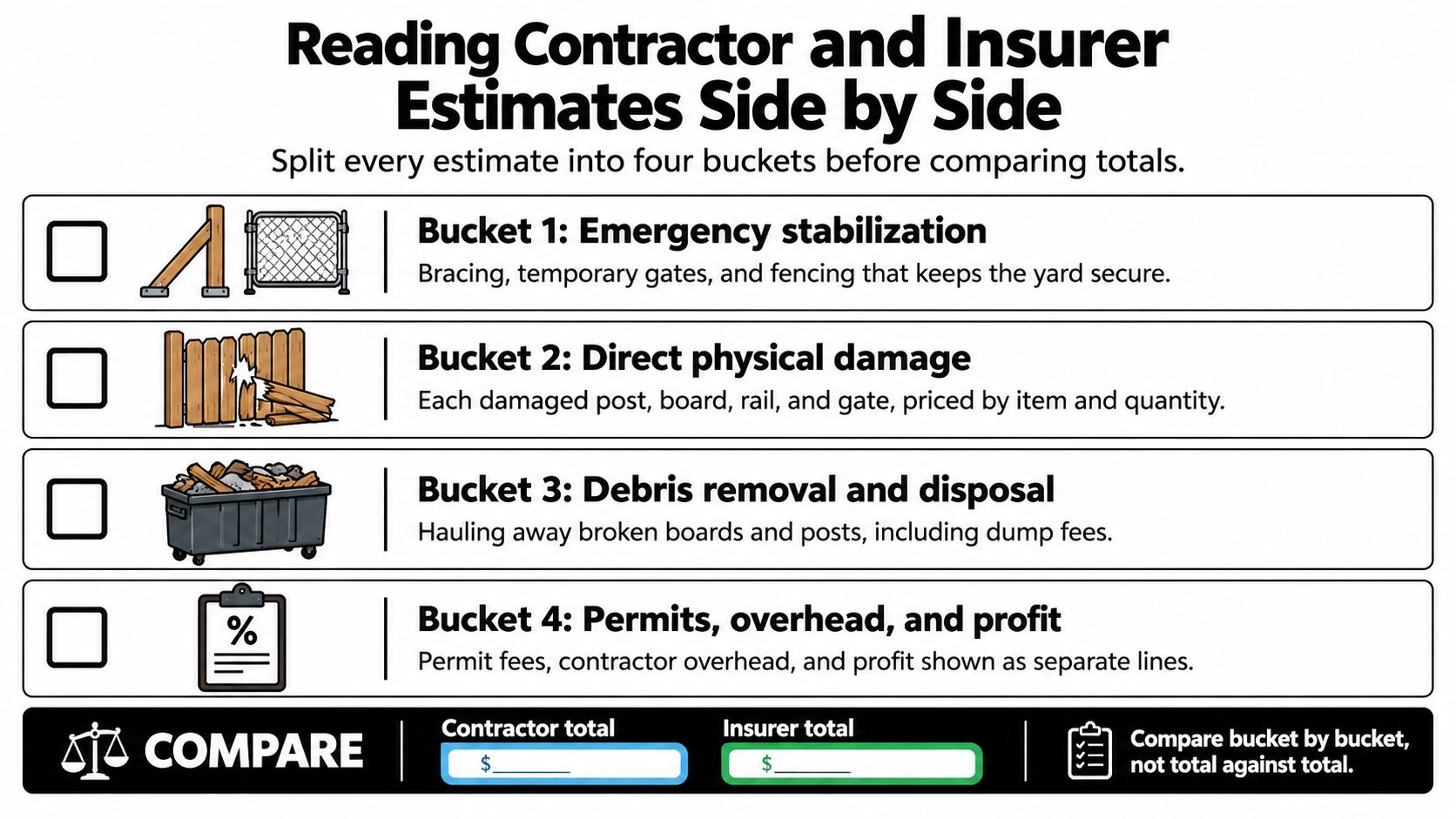
- Bucket one, emergency stabilization: Bracing, temporary panels, temporary gates, and work needed to secure the perimeter. This bucket should carry its own date, invoice, and authorization.
- Bucket two, direct physical damage: Each broken post, rail, picket, panel, gate, hinge, latch, operator, footing, and attached wiring item. Quantities should be counted by segment, not presented as one lump sum for the whole yard.
- Bucket three, code triggered upgrades: Self closing and self latching pool gate hardware, accessibility related railing changes, and other work required because current code applies to the repair. Permit notes and inspector requirements belong with these lines.
- Bucket four, betterment and prior deterioration: Upgrading chain link to aluminum, raising fence height for preference, replacing rotted posts outside the storm footprint, or correcting long standing corrosion. These items may be legitimate project costs, but they shouldn't be disguised as direct storm damage.
Reconciling Quantities Before Arguing Price
Owners should count damaged linear feet by segment and compare post, panel, and gate counts against the adjuster's line items. A missing segment is a scope dispute. A different unit price is a pricing dispute. Separating the two keeps the supplement focused and prevents a carrier from rejecting an entire estimate because elective upgrades were mixed into covered damage.
Removal and disposal also need explicit lines. So do permits, the Notice of Commencement where required, and 811 utility locates before new post holes are dug. If those costs are buried in a single fence price, an adjuster may overlook them or classify them inconsistently.
The InsureFENCE process at Allied Fence and Gate reads ACV and RCV figures in claim documents so owners can see the likely insurer contribution before scheduling permanent work. Details of that document review approach are described in the InsureFENCE AI scope scanner overview. The useful output isn't a promise that a carrier will pay. It's a bucket by bucket comparison showing which lines are covered damage, which are code items, which are upgrades, and which quantities don't match.
Compare bucket by bucket, not total against total.
That discipline also protects the contractor relationship. A contractor can price the full desired project while clearly marking the portion submitted to insurance. The owner then decides knowingly whether to fund betterment, defer a section, or proceed with a like for like rebuild.
What to Do If the Claim Is Denied or Underpaid
A denial or reduced payment should be requested in writing, with the exact policy section, exclusion, or endorsement the carrier relies on. Owners can then compare that citation against the peril and evidence categories established earlier. A citation to flood, wear, or a fence exclusion requires a different response than a disagreement over linear feet.
- Request the line item estimate: Ask for the adjuster's scope and a reinspection of disputed sections.
- Submit a written reconsideration: Reference the claim number, disputed lines, pre cleanup photos, pre storm photos, install records, and the contractor's itemized scope.
- Check the appraisal clause: Many policies include appraisal for disputes over the amount of loss. Appraisal addresses price and scope value, not whether the policy covers the peril.
- Calendar the response deadline: Note the policy deadline for reconsideration or appeal on the day the decision arrives.
- Escalate if the dispute stalls: File a complaint with the state department of insurance so the carrier response becomes part of a formal record.
Owners shouldn't sign a release or accept a payment as full settlement until scope and amount match the documented repair. Where timing forces work before full resolution, fence installation financing information can help an owner evaluate cash flow options without treating financing as a substitute for a valid supplement.
Confirm the Scope Before You Schedule Repairs
A damaged fence creates a separate scope question from the house. Check the policy's other-structures limit, any fence or gate exclusions, and whether code-required upgrades are included. A contractor's estimate is not the same as the insurer's approved scope, and the difference can leave part of the repair bill unpaid.
Pool gates, pool barriers, and safety railings need prompt attention. If a gate no longer latches or a railing is loose, secure the hazard while the claim is pending. Photograph and invoice temporary work separately, then compare permanent repairs with the written scope and applicable code requirements.
Repair or Replace
Repair can make sense when posts remain plumb and secure, footings are intact, and damage is limited to pickets, panels, rails, or gate hardware. Check the rest of the run for rot, corrosion, cracked footings, and loose connections. Fixing a short section can also preserve matching materials.
Replacement may be the sounder choice when posts lean, footings have failed, several rails are bent, or damage affects a large share of the fence. If piecemeal repairs approach the cost of a like-for-like rebuild, they may leave a weaker fence for similar spending. New sections attached to unsound posts can fail later and complicate a future claim.
Time pressure does not remove the need for documentation. J.D. Power's 2025 property claims study reports that longer claim and repair timelines were associated with lower customer satisfaction, as described in the J.D. Power 2025 property claims satisfaction study release. That finding helps explain why owners may want to start immediately. Keep photos and invoices for any urgent work, and avoid undocumented demolition that makes the original damage harder to verify.
Use a clear sequence: secure the site, confirm the written scope, schedule the contractor, and track any supplemental payment through completion. Review storm damage fence repair services to compare repair and replacement options against the documented damage. Before setting a start date, send the claim documents and contractor estimate for an InsureFENCE ACV and RCV review.
AlliedFenceAndGate.com™ provides licensed Florida fence, gate, and railing work, with itemized storm repair estimates, claim documentation support, permitting, and utility locates for residential, HOA, and commercial properties. Homeowners and property managers can review options, request a ballpark estimate, and submit claim documents for an InsureFENCE review at AlliedFenceAndGate.com™.
Related Fencing Services
Need a fence or gate on the Treasure Coast?
Licensed, insured, and bonded. Free estimates across Martin, St. Lucie, Indian River & Palm Beach counties.
Call (772) 530-3127