How Long Does Fence Installation Take? Florida Guide
A typical professionally installed residential fence takes about 1–3 days of on-site work, but the complete project timeline, including permits, utility locates, and inspections, usually runs 2–6 weeks from quote approval to completion. The crew may finish the physical fence quickly, while approvals and site readiness determine when that work can begin and when the project can officially close.
The popular answer, “a fence takes one or two days,” isn't wrong, but it's incomplete. That estimate usually describes labor at the property, not the time between the signed quote and the final inspection. In Florida, a project can also involve HOA approval, permitting, underground utility coordination, material delivery, post-hole inspections, and pool-barrier compliance.
For homeowners in Martin County, Palm Beach County, and the wider Treasure Coast, the useful question isn't only how long does fence installation take. It's also, “What has to happen before the crew arrives, and what has to happen after the last post is installed?”
Table of Contents
- Crew Time vs Calendar Time: The Full Fence Project Schedule
- On-Site Installation Phase by Material Type
- Permitting Delays and Florida Municipal Timelines
- The 811 Utility Locate Bottleneck
- Florida Pool Fences, ADA Railings, and Inspection Requirements
- Sample Project Timelines for Common Fence Types
- What to Ask Your Contractor Before Signing
Crew Time vs Calendar Time: The Full Fence Project Schedule
A fence crew may need only 1–3 days at the property, while the full project takes much longer to reach completion. Crew time covers the physical construction. Calendar time also includes the survey, design decisions, permit review, HOA approval, utility marking, material availability, scheduling, and inspections.
For a typical professionally installed residential fence, a standard project of approximately 100–200 linear feet can often fit within the on-site range when access is clear, the ground is relatively level, and the property does not need major demolition or excavation. The broader schedule, from the initial decision through completion, may extend to approximately 2–6 weeks, according to published residential fence installation timeline benchmarks.
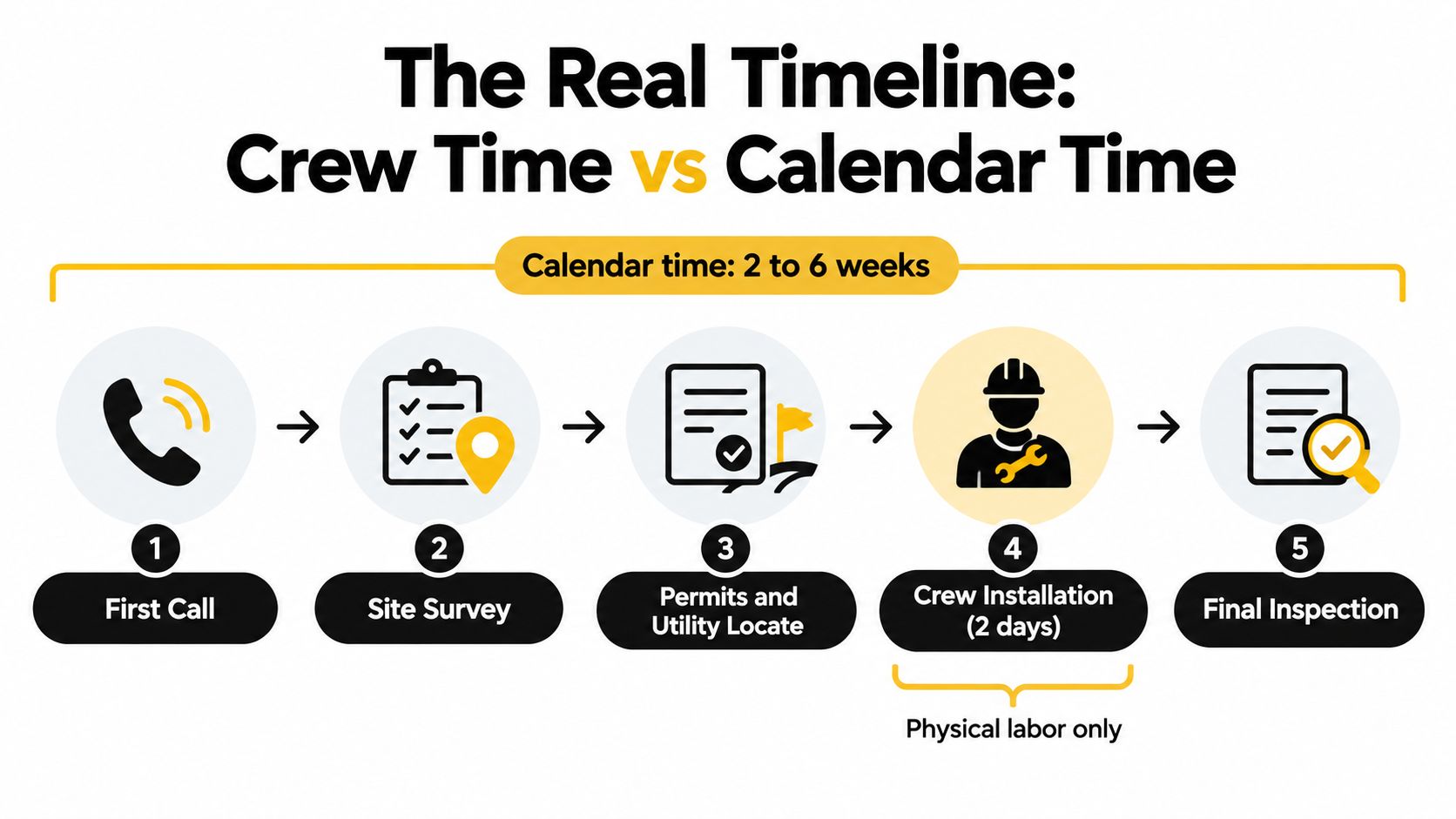
What the two timelines include
When a contractor says “two days,” confirm whether that means field labor only. On a prepared, straightforward yard, those days may cover layout, post-hole work, post setting, rails, panels, gates, cleanup, and adjustments. They do not necessarily include permission to dig or the time required to receive that approval.
The calendar schedule can expand because of an HOA, pool, easement, corner-lot visibility rules, a disputed property line, restricted access, or a material that must be ordered. Inspections may also be required before posts are set or after the fence is complete. These items can delay the start or final closeout even when installation itself remains within the expected field window.
Practical rule: A dependable schedule lists design and survey, permit approval, 811 clearance, installation, and inspection as separate milestones.
The most reliable installation commitment remains conditional. After the site survey, utility clearance, property-line review, and material check, a contractor can provide a realistic field-work window. Before those items are confirmed, promising a specific installation day can lead to cancellations, rushed work, or both.
On-Site Installation Phase by Material Type
Material affects productivity, but it doesn't determine the schedule by itself. A straight chain-link run on level ground can move quickly, while a shorter custom fence with multiple gates, rocky soil, or difficult access may require more field time.
Chain-link fencing is often among the fastest options. A small crew may install roughly 150 feet in about one day when the terrain is workable and the layout is uncomplicated. Wood privacy, vinyl or PVC, and aluminum fencing commonly take 1–2 days for a standard residential run. More complex composite or custom work can extend to 2–3 days, especially when the design requires detailed alignment, custom fabrication, or additional hardware.
The residential fence installation overview provides useful context for comparing materials, layouts, and installation considerations.
Conditions that change the field schedule
The linear footage matters, but post-hole conditions often matter more. Crews may lose time to:
- Rocky or compacted soil: Excavation takes longer and may require different digging methods.
- Slopes and elevation changes: Installers must manage stepped or adjusted layouts while keeping the fence aligned.
- Roots and vegetation: Tree roots, stumps, and dense growth can obstruct the proposed fence line.
- Old-fence removal: Demolition, hauling, and disposal add work before new posts can be installed.
- Restricted access: Narrow side yards or limited equipment access can slow material movement and digging.
- Gates and corners: Each gate requires reinforced posts, hinge alignment, latch installation, and operational testing.
Concrete also affects sequencing. Post setting can create a curing constraint of roughly 24–48 hours before rails or panels are fully loaded, although experienced crews may continue work on other portions of the fence while selected posts cure. The exact sequence depends on the material, design, soil, weather, and the installation method.
Homeowners comparing quotes should ask how many gates are included, whether old fencing will be removed, and whether the contractor has inspected the soil and access. A quote based only on footage can understate the labor required for a property with slopes, roots, or several gate openings.
Permitting Delays and Florida Municipal Timelines
Permit review can create a larger gap between contract signing and installation than the physical fence work itself. The review clock starts only after the jurisdiction receives a complete and acceptable application, so missing surveys, unclear setbacks, incorrect property information, or incomplete notices can push the project back.
Florida timelines vary by jurisdiction. Orlando states that a fence permit application may take two business days to process, while Miami-Dade reports that correctly submitted fence permits are typically issued within one to two business days. Orange County, Florida, states that residential fence review takes four business days. Corrections can add another one to two business days, according to the Orlando fence permit guidance.
Florida fence permit processing times
| County or jurisdiction | Standard processing time | Notes |
|---|---|---|
| Orlando | 2 business days | Application processing benchmark |
| Miami-Dade County | 1–2 business days | Applies to correctly submitted permits |
| Orange County, Florida | 4 business days | Residential fence review benchmark |
These are review benchmarks, not guaranteed completion dates. A permit may require corrections, additional documents, a survey, or coordination with another department. Orlando identifies conditions such as pool barriers, corner lots, easements, commercial properties, and fences taller than six feet as situations that may require permits or additional review.
Post-hole inspections can create a hard pause. Miami-Dade County requires a foundation inspection before posts are set for many non-masonry wood and metal fence permits, as described in its fence and gate inspection requirements. In that sequence, excavation and inspection must happen before the crew can complete post setting.
A Florida building official must issue a certificate of completion or identify deficiencies within two business days for a single- or two-family dwelling after required approvals and documentation are supplied. That close-out step still depends on the installation being complete and inspection-ready.
For homeowners seeking more detail on documents and submittals, the fence permit application guide can help identify questions to resolve before scheduling labor. A complete application moves more predictably than an optimistic application submitted without the required site information.
The 811 Utility Locate Bottleneck
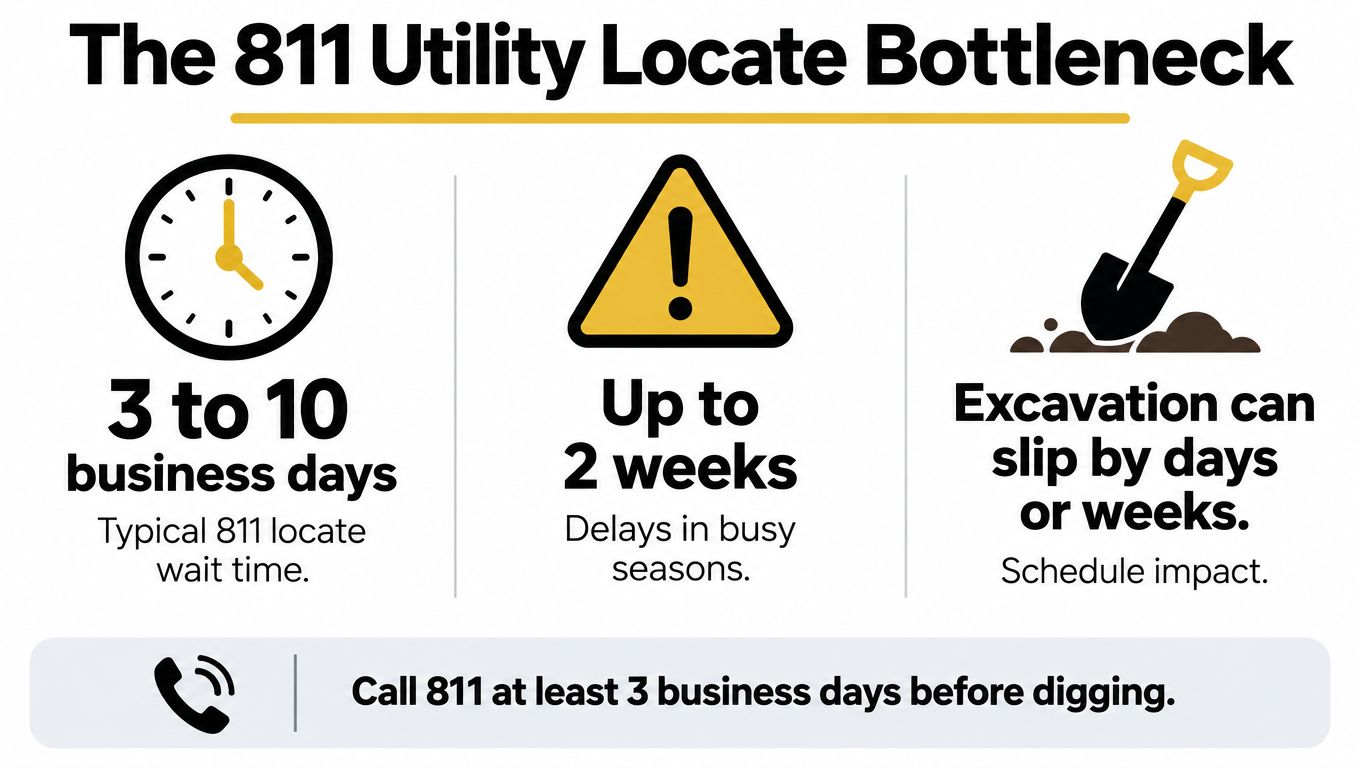
The crew may need only a day or two to install a fence, yet excavation cannot start until the utility locate is complete. The 811 response time depends on location, workload, weekends, holidays, and the accuracy of existing utility records. Treat it as a schedule milestone, not a same-day formality.
An Associated General Contractors survey found that 87% of respondents waited longer than one business day for locators to arrive, while 25% waited five or more business days, according to the AGC utility locating survey summary. The survey also attributed 64% of accidental utility strikes to lines marked more than two feet from their actual location.
Why a cleared ticket doesn't eliminate every risk
Public 811 services generally locate utility-owned infrastructure. Private lines serving outdoor lighting, detached structures, irrigation equipment, generators, or other property features may require separate investigation. The 811 utility marking colors guide explains what each paint and flag color represents before you compare marks with the proposed fence line.
Public guidance also sets a waiting period before digging. Missouri 811 advises excavators to request locates at least three working days before excavation. Colorado 811 likewise instructs residents to wait three business days, as explained in its residential digging guidance. Weekends and holidays may not count as working days.
Before mobilization, a responsible contractor confirms the ticket status, documents the marks, and compares them with the fence layout. A discrepancy may require a design adjustment, hand digging, or additional investigation. The crew should stop rather than guess.
A fence can be physically installable in a day or two and still require a longer project window because safe excavation cannot begin until locating work is complete.
Set the installation date after the locate request, response period, and any correction work are accounted for. Scheduling labor first and hoping the marks arrive later creates avoidable delays. Including the locate allowance in the original calendar gives the homeowner a more honest completion window.
Florida Pool Fences, ADA Railings, and Inspection Requirements
Pool barriers and accessibility features involve more than ordinary boundary-fence layout. They combine physical installation with code-specific dimensions, hardware, clearances, and inspection requirements.
Florida law requires a pool barrier to be at least 4 feet high on the outside and designed to prevent openings or structural features that could allow a young child to crawl under, squeeze through, or climb over. The barrier must be positioned around the pool perimeter. Pool-access gates must open outward, away from the pool, close automatically, and use a self-latching locking device with the release mechanism on the pool side beyond a young child's reach, as set out in Florida Statute 515.29.
Why pool work requires more coordination
A pool fence may look like a short aluminum installation, but the gate can determine whether the enclosure passes inspection. Installers must verify gate swing, self-closing action, latch position, barrier continuity, and the relationship between the fence and the pool deck or surrounding structures.
Miami-Dade County's post-hole foundation inspection requirement for many non-masonry wood and metal fence permits can also split the work into separate visits. The crew excavates, the inspection occurs, and post setting proceeds after the required approval. That sequence can't always be compressed into one mobilization.
ADA railings and ramps introduce a separate design review. Handrail height, gripping surfaces, ramp slopes, landings, stair conditions, and extensions must be considered before fabrication. Commercial, hospitality, education, and healthcare properties may require coordination among the fence contractor, property manager, general contractor, building official, and accessibility reviewer.
Pool fencing and ADA railings should be scheduled as inspection-sensitive construction, not as ordinary posts-and-panels work.
The practical trade-off is straightforward. A standard boundary fence may allow flexible field sequencing, while a pool barrier or ADA project requires more precise documentation and verification. Choosing the material is only one part of the schedule. The design must also be approved, fabricated, installed, and made inspection-ready.
Sample Project Timelines for Common Fence Types
The same crew window can fit very different calendar schedules. The examples below illustrate how site conditions, approvals, and inspections shape the project from signed contract to final walkthrough.
A level chain-link project in Martin County
A 150-foot chain-link privacy fence on a level residential lot with no pool and no HOA requirements may take approximately 3–4 weeks from signed contract to final walkthrough. The physical installation may require 1 day when access is clear, materials are available, and the utility locate and permit process proceed without corrections.
The field work is short because the layout is uncomplicated. The calendar still includes site confirmation, permit handling where required, 811 clearance, scheduling, and close-out.
A vinyl privacy fence in a Palm Beach County HOA
A 200-foot vinyl privacy fence with two gates in a Palm Beach County HOA community may take approximately 4–6 weeks overall. Installation may require 1–2 days, while HOA review and permitting can account for 2–4 weeks depending on the community's process and the completeness of the submission.
The gates add alignment and hardware work. The HOA adds a separate approval path that can't be controlled by crew productivity.
An aluminum pool fence in Orange County
A 100-foot aluminum pool safety fence with ADA-gated access in Orange County may take approximately 3–5 weeks. Field installation may require 1–2 days, but the schedule also includes a post-hole inspection requirement and a pool-barrier compliance inspection.
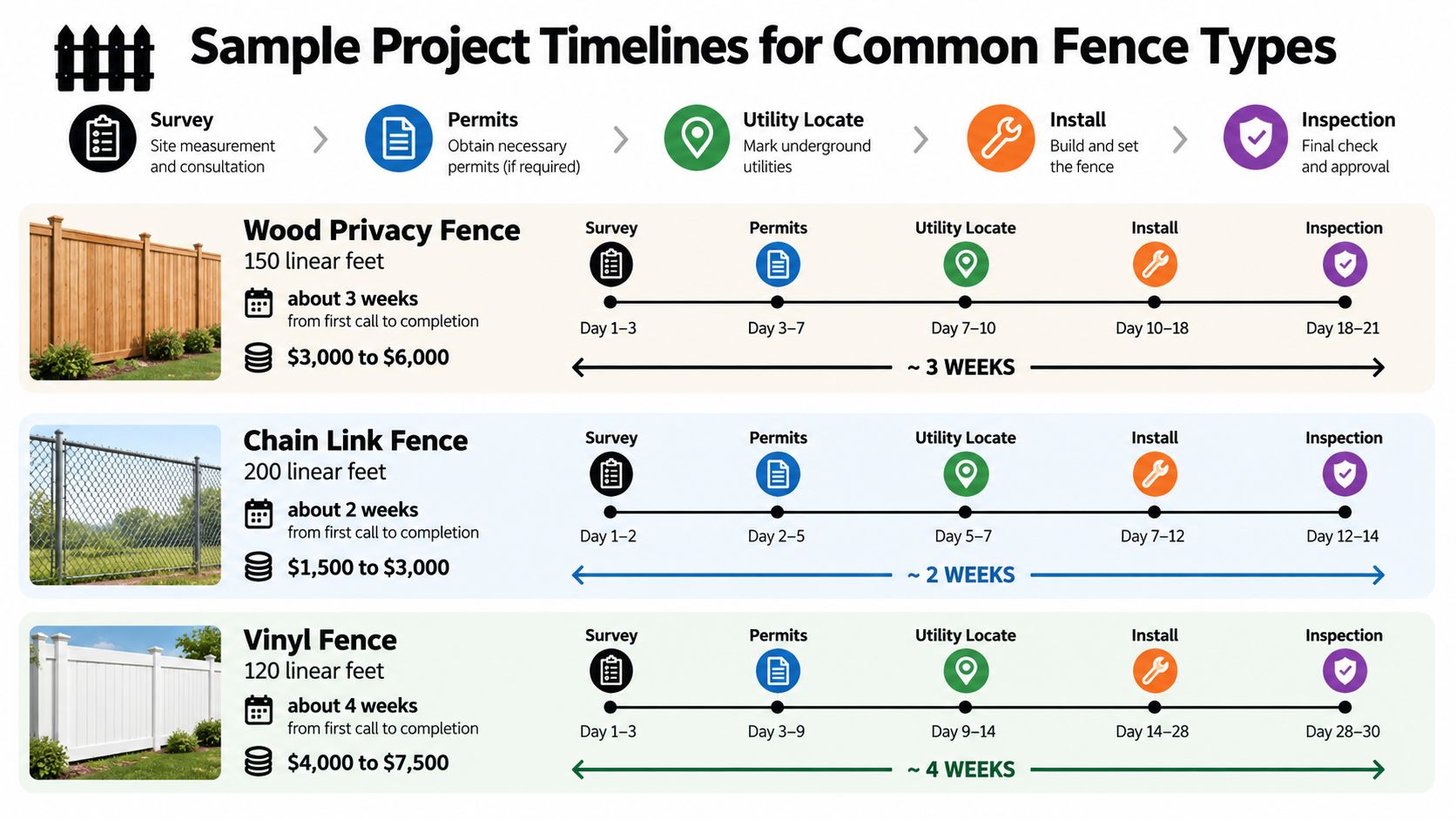
These examples are planning references, not guarantees. Weather, material availability, corrections, property-line questions, private utilities, and access can move any project outside its initial window. The useful comparison is the relationship between field labor and administrative readiness. Two projects with similar installation days can have very different completion dates.
What to Ask Your Contractor Before Signing
A contractor's schedule should explain dependencies, not just promise a start date. Before signing, homeowners and property managers should ask:
- 811 coordination: Does the contractor request the locate, confirm ticket status, and review marks before mobilization?
- Permit responsibility: Who prepares the application, survey information, Notice of Commencement, and inspection requests?
- Inspection sequence: Will a post-hole inspection or pool-barrier inspection create a pause between excavation and post setting?
- Material availability: Are the selected panels, posts, gates, and hardware available, or must they be ordered?
- Site obstacles: Has anyone reviewed roots, slopes, old fencing, access limitations, and potential private utility lines?
- Quote detail: Does the proposal show footage, gates, demolition, permitting, inspections, materials, and exclusions as separate line items?
- Close-out: Who confirms final inspection, corrections, certificate of completion, and cleanup?
A detailed PDF quote is more useful than a vague estimate because it gives both parties a shared record of the scope. Digital tools can also help with early planning. AlliedFenceAndGate.com™ offers a digital estimator for instant ballpark pricing based on installed-cost inputs, while its InsureFENCE process helps clarify insurance claim coverage before work is scheduled.
The right contractor treats the full timeline as part of the commitment. The schedule should identify design and survey, permit approval, 811 clearance, installation, inspection, and realistic contingency instead of reducing the entire project to the number of days a crew expects to work on site.
#MartinCountyFencing #PalmBeachCountyFencing #TreasureCoastFencing #FloridaFencing #PortStLucieFencing #StuartFencing #JupiterFencing #PalmCityFencing #FenceInstallation #PrivacyFence #PoolFence #AluminumFencing #VinylFencing #ChainLinkFence #CommercialFencing #ADARailings
Allied Fence & Gate coordinates residential and commercial fencing, pool safety gates, ADA railings, permitting, 811 utility locates, and inspection scheduling across Florida's Treasure Coast and northern Palm Beach County. For a site-specific schedule and a clearer estimate of the work required, visit AlliedFenceAndGate.com™.
Related Fencing Services
Need a fence or gate on the Treasure Coast?
Licensed, insured, and bonded. Free estimates across Martin, St. Lucie, Indian River & Palm Beach counties.
Call (772) 530-3127