Vinyl Privacy Fence Gate: A Practical Guide

The usual advice about a vinyl privacy fence gate starts with color, height, and low maintenance. That's the wrong order for a Florida property. A matching panel won't rescue an undersized hinge post, and HOA approval won't make an incorrectly configured pool gate pass inspection.
On the Treasure Coast, the better starting point is the opening's purpose, its exposure, and the structure supporting it. Appearance matters, but reliable operation depends on details that rarely show up in a brochure photograph.
Table of Contents
- Why a Vinyl Privacy Fence Gate Is an Engineered Assembly
- The Material Story Behind Modern Vinyl Privacy Fences
- Sizing the Gate Opening, Leaf, and Swing
- Hinges, Latches, Frames, and Reinforcement
- Posts, Footings, and Wind Load on the Treasure Coast
- Pool Codes, Self-Latching Hardware, and Inspection
- Cost Ranges, Budget Line Items, and Where Money Goes
- Putting It Together With AlliedFenceAndGate
Why a Vinyl Privacy Fence Gate Is an Engineered Assembly
An open picket gate lets some air pass through. A solid privacy gate presents a broader surface to the wind, which increases demand on its supporting components. The distinction matters before a homeowner chooses a color or decorative top.
The load path runs from the privacy panel into the gate frame, through the hinges, into the reinforced post, and finally into the footing and surrounding soil. A weak connection anywhere along that path can leave an intact panel attached to a gate that no longer works properly.
ASTM's rigid PVC fencing specification addresses material and profile performance, but explicitly excludes load-bearing performance of completed assemblies. A material-compliant gate therefore still needs an appropriate structural design.
Boundary Gate vs Pool-Barrier Gate
| Requirement | Boundary Gate | Pool-Barrier Gate |
|---|---|---|
| Primary purpose | Property access and privacy | Controlled access through a pool barrier |
| Swing selection | Based on layout and applicable restrictions | Subject to pool-specific requirements |
| Closing and latching | Selected for the intended use | Safety functions must satisfy applicable law |
| Acceptance | Applicable permit and installation requirements | Additional barrier and operational inspection |
| Appearance approval | May involve HOA review | HOA acceptance doesn't establish safety compliance |
The pool-specific requirements appear in Florida's residential swimming-pool safety statute. Boundary and pool-barrier gates shouldn't be treated as interchangeable products.
A useful specification resolves four decisions together:
- Opening size: Provide the access needed, without unnecessary gate span.
- Hardware: Match hinges, latch, attachments, and reinforcement to the assembly.
- Compliance: Establish whether the opening serves a boundary, pool barrier, or another regulated use.
- Budget: Price the complete installation rather than applying fence footage pricing to a moving gate.
Practical rule: The panel provides privacy. The supporting assembly determines whether that privacy gate remains usable.
The Material Story Behind Modern Vinyl Privacy Fences
PVC isn't a recent construction invention. Its history begins with raw synthesis in 1835, followed by practical flexible, plasticized products in the late 1920s; vinyl fencing entered commercial manufacture in the late 1970s and gained moderate popularity during the 1980s, according to the BuildingGreen account of PVC development.
Those milestones describe different materials and applications, not a straight line from laboratory plastic to a finished gate. Flexible PVC helped establish practical uses, while exterior fencing required formulations suited to outdoor exposure.
Early fencing based on basic PVC-pipe technology had shortcomings under ultraviolet exposure. Later systems incorporated protective cap layers and improved formulations. That distinction is why “made from PVC” isn't a sufficient purchasing specification.
Weatherability Is a Specification, Not a Color Choice
The useful comparison is between documented exterior profiles, not between white panels that look alike. ASTM F964's profile requirements cover dimensional tolerances, extrusion quality, weatherability, impact resistance, warping, and dimensional stability.
A weathered impact-resistance benchmark of at least 0.6 inch-pound per mil, following exposure at hot-dry, hot-humid, and temperate sites, provides a more meaningful reference than an unsupported durability label. The same vinyl-fence performance guidance describes roughly 20 years of best appearance and approximately 30 or more years of total service for well-made systems, while emphasizing that actual results vary.
Those are planning estimates, not a promise that every gate component will last equally long. Formulation, exposure, installation, soil conditions, and hardware quality all affect the outcome.
The quote should identify the manufacturer and profile system, with supporting documentation available for review. A homeowner shouldn't have to infer exterior suitability from panel thickness, sales language, or a warranty headline alone.
Sizing the Gate Opening, Leaf, and Swing
The right opening starts with what must pass through it. A pedestrian entrance, mower route, service access, and driveway entrance impose different requirements, even when all use matching privacy panels.
Clear opening and gate-leaf width aren't interchangeable measurements. Hardware occupies space, and the installed gate must operate within its manufacturer's clearance requirements. Measuring only the distance between fence panels leaves too much unresolved.
Gate Configuration Trade-offs
| Configuration | Typical Width | Best Use | Trade-off |
|---|---|---|---|
| Single pedestrian swing | Sized to the required walking and service access | Side yards and routine entry | Limited equipment access |
| Wide single swing | Product- and engineering-dependent | Uninterrupted access through one leaf | Greater demand on the hinge-side assembly |
| Double swing | Shared across paired leaves | Wider equipment or vehicle access | More hardware and center alignment |
| Separate pedestrian and vehicle gates | Independently sized openings | Frequent foot traffic with occasional vehicle access | Additional posts and installation work |
| Sliding assembly | Site- and system-dependent | Layouts where a swing arc won't fit | Requires suitable travel space and engineered support |
Stock width labels aren't a substitute for a site measurement. The estimator should record the required usable passage, the available swing area, and the selected system's allowable dimensions.
Check the Entire Travel Path
On a compact lot, the closed position may fit perfectly while the moving leaf crosses a sidewalk, approaches a pool deck, or strikes rising ground. A tape measure, level, and marked swing path expose those conflicts before excavation.
A double gate can divide a broad opening into narrower leaves, but it introduces a center meeting point and additional operating hardware. A separate pedestrian entrance may be more practical when residents otherwise would open a large vehicle gate for everyday use.
Sliding should be evaluated as a separate engineered option, not a workaround assembled from ordinary swing-gate parts. The final choice should follow the lot geometry and intended use, not whichever configuration looks simplest on a drawing.
Hinges, Latches, Frames, and Reinforcement
A hinge should be selected by its documented capacity and intended application, not by how substantial it looks beside the vinyl. The contractor also needs a compatible attachment method that transfers force into the supporting structure.
A screw fastened through a PVC surface doesn't automatically establish an adequate structural connection. The approved assembly details should show where fasteners engage reinforcement and how the hardware connects to the frame and post.
Select Hardware by Function
- Gravity-operated hinges: Confirm that their closing action and mounting arrangement suit the actual gate and use case.
- Spring or adjustable-tension hinges: Check the manufacturer's application limits and available adjustment. Closing force shouldn't be chosen independently of latch operation.
- Magnetic latches: Evaluate release position, alignment tolerance, and compatibility with the gate's intended safety function.
- Mechanical latches: Verify positive engagement and accessible adjustment rather than relying on the gate's momentum to force closure.
- Drop rods: Specify the receiving arrangement and operating procedure for double leaves, particularly the normally inactive leaf.
The practical differences are covered in the publisher's vinyl fence gate hardware guide. Hardware selection should remain tied to the proposed assembly, not to a generic accessory package.
Reinforcement and Adjustment Serve Different Jobs
An internal metal frame or structurally designed rail system carries loads that the PVC covering shouldn't be expected to carry alone. Adjustment then allows the installer to establish proper gaps, swing, and latch engagement.
Temperature-related movement makes that adjustment range important. A latch set with almost no tolerance may become unreliable as conditions change, even though the gate initially appears straight.
Adjustment is for setting and maintaining alignment. It isn't a substitute for an adequate frame, secure attachments, or a stable post.
The installation record should identify hinge capacity, latch model, frame reinforcement, post construction, and attachment details. Since profile compliance doesn't establish completed-gate capacity, those details need their own documentation.
A pool closer must also work with the finished gate's resistance and latch geometry. Hardware that closes an unloaded display gate may still need careful selection and commissioning on the installed assembly.
Posts, Footings, and Wind Load on the Treasure Coast
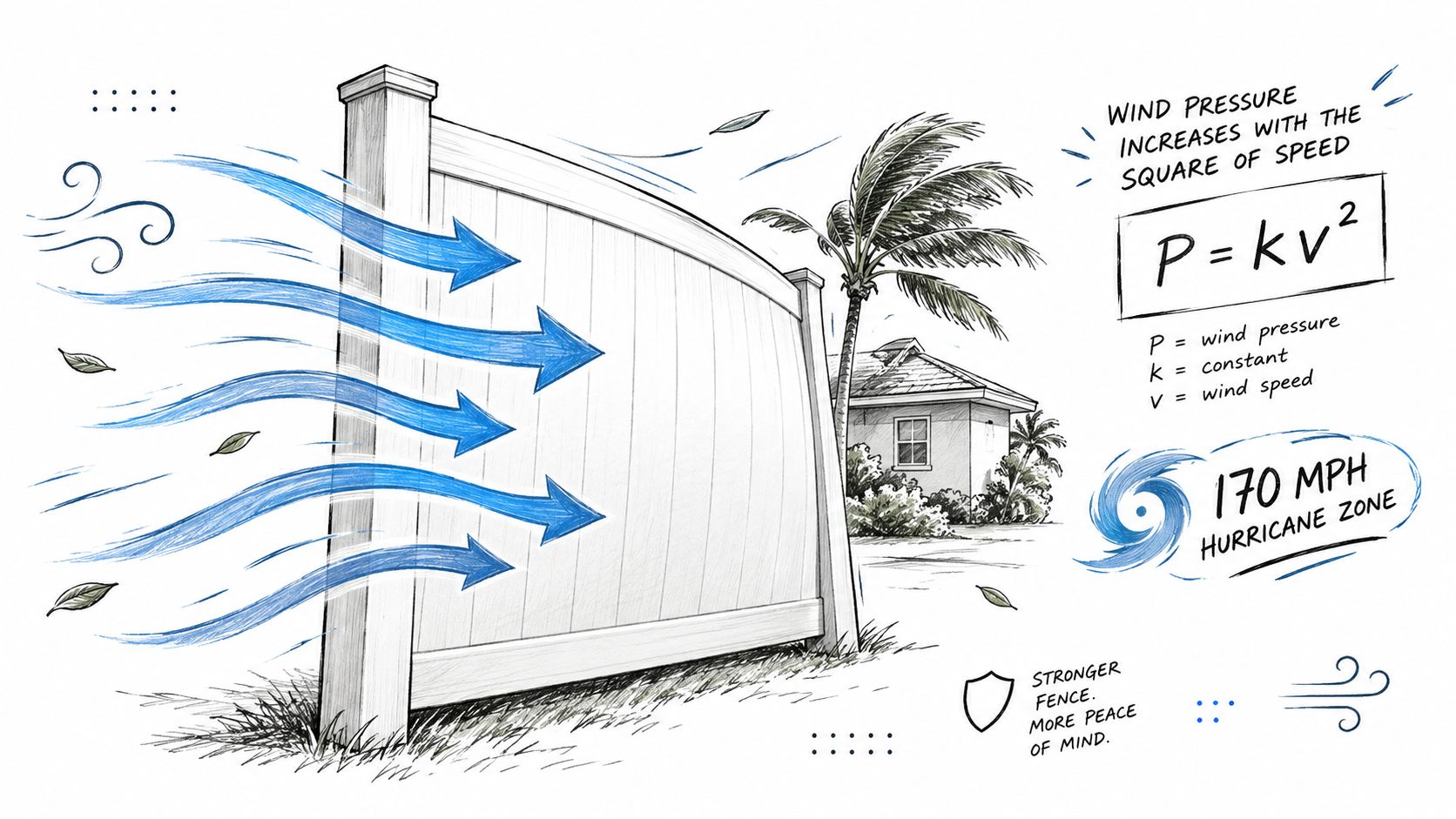
A solid gate acts as a sail, but the important issue is where the resulting force goes. Wind pressure increases with the square of wind speed, so modest-looking changes in design wind can create substantially greater structural demand.
Florida's cited high-velocity hurricane-zone provisions use 3-second-gust velocities of 170 mph in Broward and 175 mph in Miami-Dade, and include provisions for fences no higher than 6 feet, as shown in the Florida Building Code HVHZ fence provisions. Those figures aren't automatic design values for Martin or Palm Beach County properties.
Set Posts to the Project Design
The applicable local criteria, exposure, gate dimensions, and product engineering should determine post reinforcement and footing dimensions. “Deeper concrete” isn't a complete specification, and a gravel layer shouldn't be added automatically if it conflicts with the approved footing detail.
A disciplined installation follows a clear sequence:
- Mark: Confirm the permitted layout, opening, and utility-clearance process.
- Dig: Excavate to the specified footing dimensions and evaluate actual ground conditions.
- Set and plumb: Position the reinforced post, verify its relationship to the opposing post, and brace it securely.
- Pour and cure: Place concrete according to the specified detail and allow the required curing before loading.
- Hang and adjust: Support the leaf with temporary blocks or shims, establish clearances, and commission the hardware.
Avoid Repairs Disguised as Adjustments
Hanging a gate before its support is ready can disturb alignment before regular use begins. Setting posts without checking the finished swing path can produce a gate that clears at the latch but drags elsewhere.
If the hinge post rotates, tightening the latch won't correct the underlying problem. The contractor should diagnose the support, attachment, and frame separately before treating every operating fault as a hinge adjustment.
For Treasure Coast work, the useful question is whether the complete gate matches the project's wind design, not whether the brochure calls the vinyl hurricane-resistant.
Pool Codes, Self-Latching Hardware, and Inspection
An attractive privacy gate can match every HOA detail and still be unsuitable as a pool barrier. Privacy approval concerns appearance and placement; pool inspection also concerns access control, geometry, and reliable operation.
Florida's residential pool-safety law requires a gate to open outward, away from the pool, close automatically, and have a self-latching lock. The statute places the release on the pool side where a young child cannot reach it over or through the gate, and requires an outside barrier height of at least 4 feet, with no openings or structural features that permit crawling underneath, squeezing through, or climbing over, under the residential swimming-pool barrier requirements.
Measure the Release and Surrounding Openings
The cited Florida Building Code language provides an alternative when the release is at least 54 inches above the bottom of the gate: it may be on either side if a child cannot reach it from outside. That language also limits openings within 18 inches of the release to 1/2 inch, according to the Florida Building Code pool-barrier supplement.
Because that supplement is older code language, the permit authority should confirm the currently applicable provision before hardware placement is finalized. A historical code excerpt shouldn't be treated as project approval.
Inspect the Whole Opening
- Swing and closing: Confirm unobstructed outward travel and automatic closure under the required inspection conditions.
- Latch engagement: Verify that the gate positively secures without someone lifting or pushing it into alignment.
- Reach and climbing: Examine release access, nearby structures, and potential footholds.
- Grade and gaps: Measure the completed barrier geometry, including the space beneath the moving leaf.
The self-closing and self-latching gate guide provides additional hardware context. An existing gate may be retrofit-ready, but unstable posts, unsuitable swing geometry, or inadequate attachments can require reconstruction.
Martin County's fence-requirements process identifies permitting requirements and pool-barrier inspection obligations. Allied coordinates permits, applicable Notice of Commencement filings, and inspections across its Martin and Palm Beach County service work, with acceptance determined by the responsible jurisdiction.
Cost Ranges, Budget Line Items, and Where Money Goes
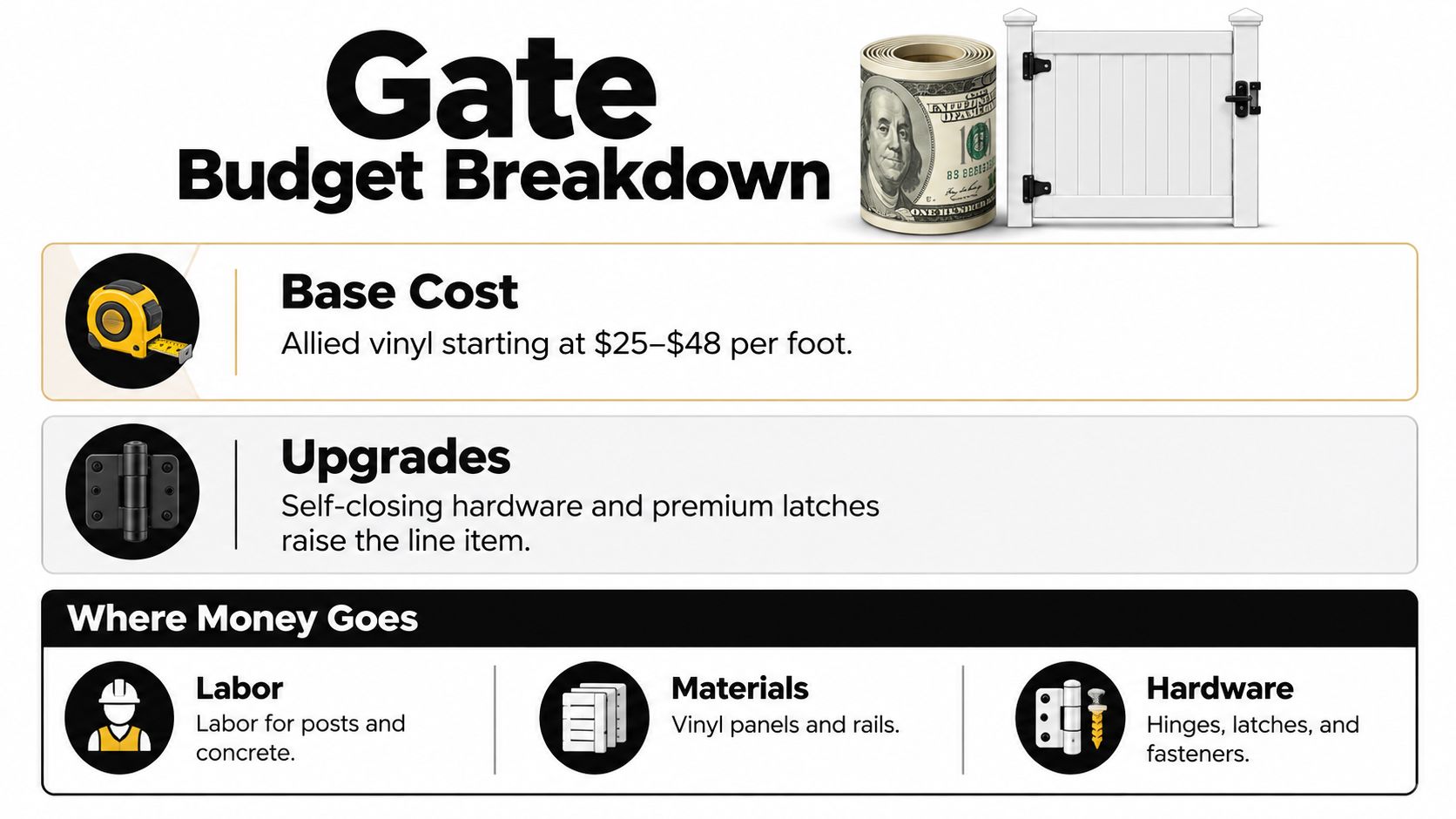
AlliedFenceAndGate publishes starting vinyl-fence pricing of $25–$48 per foot, with a $750 minimum project value and separate charges for gates, hardware upgrades, and site work. That footage figure buys fence line. It does not buy an operating gate.
A gate opening priced at the per-foot rate leaves out the frame, the hinges, the latch assembly, and the heavier posts carrying the swing. On Treasure Coast jobs, the money concentrates where wind and movement do: hinge posts, footing depth, inserts, and closing hardware. The privacy panel itself is usually the cheapest part of the assembly. The quote needs its own scope, even when the surrounding fence runs the same profiles.
Compare Installed Scope, Not Panel Prices
| Gate use | Main budget drivers | Item to verify |
|---|---|---|
| Pedestrian privacy entrance | Leaf, reinforced support, hinges, latch, installation | Required clear opening |
| Driveway double gate | Paired frames, supporting posts, center hardware, foundations | Complete operating and structural details |
| Pool-barrier gate | Safety hardware, compliant geometry, permitting and inspection | Included compliance scope |
The vinyl privacy fence cost guide separates fence-run pricing from project-specific additions. A precise standalone gate price without a site assessment and a selected gate system is guesswork, and contractors quoting one over the phone are guessing too.
Allow for Site and Administrative Work
The written estimate should name survey requirements, permit fees, applicable inspection charges, demolition, and disposal as line items. Root conflicts, stump grinding, and restricted access add labor that belongs in the quote before work starts, not as a change order after the post holes are dug.
Reinforcement is where honest estimates and cheap ones split. Metal inserts, larger supporting posts, deeper footings, and upgraded closing hardware raise the gate line item, and each one should tie back to a stated reason in the design. An unexplained premium is padding. An explained one is engineering.
Budget check: A less expensive gate is a different quote if its supporting posts, hardware, permit work, or inspection obligations are missing from the scope.
The published minimum also matters for small repairs and isolated gate replacements. A scope below that threshold needs a conversation about combining work or meeting the minimum, since a service call for one hinge post rarely schedules cleanly as a standalone project.
Putting It Together With AlliedFenceAndGate
A useful gate estimate begins with a survey, clear property photographs, and an explanation of how the opening will be used. Allied's Digital Fence Estimator and Calculator provides ballpark pricing, while survey and photo uploads support AI-based measurement extraction; those tools inform preliminary planning rather than replace field verification.
The installation workflow includes on-site confirmation, 811 utility locates, permitting, applicable Notice of Commencement filings, and inspection coordination, as described in the publisher's service information. Homeowners comparing contractors should establish who owns each task before signing.
Keep a Written Gate Specification
A comparable quote should identify:
- Use and geometry: Boundary or pool-barrier function, clear opening, leaf count, swing, and ground conditions.
- Structural components: Gate frame, post size, reinforcement, embedment, footing dimensions, and attachment details.
- Operating hardware: Hinges, closer, latch, release arrangement, and any double-gate restraints.
- Approvals and handover: Applicable wind documentation, permit responsibility, inspections, and operating checks.
For storm or accident damage, Allied's InsureFENCE process reviews claim documents to help clarify actual cash value and replacement cost value provisions. Coverage remains subject to the policy and insurer's determination, so insurance review shouldn't be mistaken for a guaranteed payment.
Homeowners in Stuart, Palm City, Hobe Sound, Jupiter, and Palm Beach Gardens can submit the property location for service confirmation within the company's Treasure Coast and northern Palm Beach County coverage. A complete submission should include the survey, photographs of both sides of the opening, and any HOA or pool-barrier requirements.
#TreasureCoastFencing #MartinCountyFencing #PalmBeachCountyFencing #StuartFencing #PalmCityFencing #HobeSoundFencing #JupiterFencing #PalmBeachGardensFencing #VinylFencing #VinylPrivacyFence #PrivacyGates #PoolSafetyGates #FloridaFenceContractor #FenceInstallation
AlliedFenceAndGate.com™ offers vinyl privacy fencing, gate installation, digital estimating, and permit and inspection coordination. Homeowners planning a vinyl privacy fence gate can visit the estimator and submit a survey and opening photographs so the proposed scope addresses access, structural support, and any pool-safety requirements before installation.
Related Fencing Services
Need a fence or gate on the Treasure Coast?
Licensed, insured, and bonded. Free estimates across Martin, St. Lucie, Indian River & Palm Beach counties.
Call (772) 530-3127