Pool Gate Installation That Passes Inspection

A four-sided isolation barrier cuts a young child's drowning risk by 83% compared with three-sided fencing that still lets someone walk from the house to the water, the U.S. Centers for Disease Control and Prevention reports. That gap is why pool gate installation is a life-safety project, not a fencing upgrade. The same CDC guidance treats missing or ineffective fences as a drowning risk and describes proper fencing as a way to keep young children from the water without a caregiver's awareness. The U.S. Consumer Product Safety Commission recommends barriers that completely surround the pool, with self-closing, self-latching gates, as one layer in a wider strategy.
Table of Contents
- Why the Gate Only Works Inside a Real Barrier
- Florida Measurements That Make a Gate Legal
- Audit Every Path Before You Order the Gate
- Choose Hardware That Stays Closed on the Coast
- Set Posts, Swing, and Latch Before Inspection
- Keep the Gate Working After the Inspector Leaves
Why the Gate Only Works Inside a Real Barrier
On a Palm Beach patio the gate can look finished and still leave the pool open to the house. A sliding door, a ceramic planter against the rail, and a fence that dies into the lanai wall are enough. A child doesn't have to beat a latch if the walk from the family room never meets a closed barrier.
Four-sided isolation means the barrier separates the pool from the house and the rest of the yard. A three-sided run treats the home as one side of the fence. That is the layout behind the risk difference above. A property-line fence marks the lot. It doesn't stop a path that starts indoors and ends at the water.
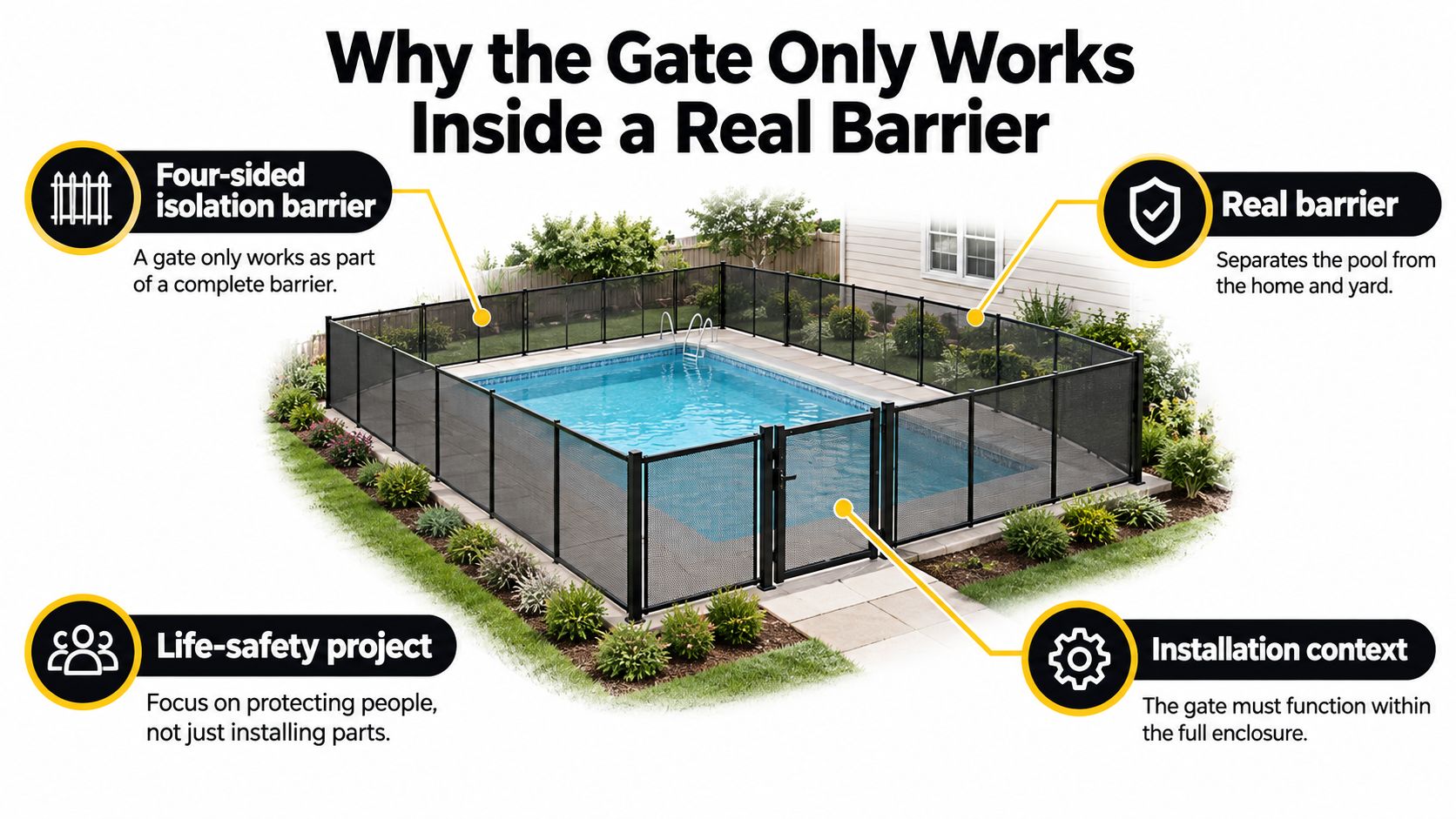
A full surround with a self-closing, self-latching gate is one layer, not the whole plan. Adult supervision, door hardware, and covers still matter. Gate location and an unbroken fence line matter as much as the hinge brand.
A Martin County door that beats the latch
A Stuart remodel shows the miss in plain sight. The leaf is plumb, the closer pulls the gate home, and the latch clicks for a photo. The enclosure still ties into the house, so the sliding door is the path to the water. Four-sided isolation puts the barrier between the home and the pool, so the gate is the controlled opening.
Practical rule: If someone can reach the water from the house without passing a closed, self-latching gate, the enclosure isn't finished.
Homeowners, inspectors, and property managers should ask whether the existing yard fence truly isolates the pool area. A handsome four-foot leaf on the wrong run doesn't.
- House wall used as a side: The door becomes the access point, and the gate never sees the child.
- Planter, bench, or low wall: A climbable object rebuilds a route over a sound panel.
- Broken return: A gap at equipment, a retaining wall, or an unfinished corner leaves a walk-around.
Those are barrier problems. The inch marks, the site audit, coastal hardware, the mount, and the checks after inspection each cover a different job. A closer can't fix a layout that never separated the water from the house.
Florida Measurements That Make a Gate Legal
Florida turned this from a design preference into a regulated installation in 2000, when the Legislature enacted the Residential Swimming Pool Safety Act, later named the Preston de Ibern/McKenzie Merriam Residential Swimming Pool Safety Act. Qualifying new residential pools, spas, and hot tubs need at least one approved safety feature, such as a compliant isolation barrier, a safety cover, qualifying alarms, or protected doors and windows, under Chapter 515.
Where the barrier is that feature, it must be at least 4 feet high. It can't offer openings or structural features that let a young child crawl under, squeeze through, or climb over. It generally goes around the pool rather than acting only as a distant property-line fence. How those rules sit inside a full enclosure is covered in pool fence requirements.
What the inspector measures on a home gate
Residential access gates open outward, away from the water, close automatically, and use a self-latching locking device. The release mechanism is on the pool side and out of a young child's reach over the gate or through an opening.
The Florida Building Code sets the surrounding barrier at least 48 inches above grade. Within 18 inches of the release, openings can't exceed 1/2 inch, as laid out in the Florida Building Code pool materials. If the release is at least 54 inches above the bottom of the gate, it may be on either side, and it still has to stay inaccessible to young children from outside, under the residential barrier text.
A clubhouse or commercial pool isn't on that residential row. Public-pool barriers must be at least 48 inches high and continuous around the perimeter wherever an approved building or structure doesn't already block the area. Access uses a 48-inch-minimum, self-closing, self-latching, lockable gate. The latch is at least 54 inches above the bottom of the gate, or at least 3 inches below the top on the pool side, per the public-pool barrier outline.
Residential and public pool gate rules
| Check | Residential pool gate | Public pool gate |
|---|---|---|
| Barrier | At least 4 feet, around the pool, with no crawl, squeeze, or climb path | At least 48 inches and continuous unless an approved structure already blocks that side |
| Gate action | Opens outward, closes automatically, self-latching lock | At least 48 inches, self-closing, self-latching, and lockable |
| Latch | Pool side and out of reach, or either side only when the high release stays inaccessible from outside | At least 54 inches above the gate bottom, or at least 3 inches below the top on the pool side |
A house in Martin County or Palm Beach County uses the residential column. A community pool, clubhouse, or commercial basin uses the public column. Mixing those rows is a common reason a leaf that "looks legal" fails the wrong inspection.
Audit Every Path Before You Order the Gate
A yard fence, or a neighbor's fence, doesn't automatically count. Florida evaluates the whole access system. An existing neighbor fence may serve as the barrier only when that fence is itself code-compliant. If it's removed, the pool owner has to replace it promptly, which is the practical reading of the residential pool safety statute for owners who borrowed a lot line.
A four-foot gate still fails four-sided isolation when a yard fence, an adjacent door, or a later alteration creates a climbable route. The latch can pass every inch mark and still protect nothing.
Routes that walk around a good latch
Map every approach before anyone orders a hinge.
- Dwelling doors and sliders: A door on the pool deck is a different device from the pool gate. Direct home-to-pool doors need self-closing, self-latching hardware with the release at least 54 inches above the floor, while the gate needs outward swing, automatic closing, and a child-inaccessible latch, under section 515.27.
- Decks, retaining walls, and equipment pads: A wall top or a filter pad can become a step.
- HVAC units, furniture, and landscaping: A condenser, a chair, or a dense shrub against the panel is a climb.
Photograph both faces. From the pool side, shoot the gate swing, the latch, the bottom gap, and anything within reach of the release. From the yard side, shoot the same gate, the neighboring fence if you're relying on it, and every projection a child could use. Note ground clearance in writing. A future fence change, a new planter, or a grade lift can erase a passing layout.
A pool alarm isn't a substitute for the barrier. ASTM's residential pool-alarm specification states that alarms aren't intended to replace adult supervision, fences, gates, or locks.
That ASTM alarm specification is the reason a written barrier audit comes before any hardware purchase. If the audit shows a bypass, fix the line. Don't buy a closer to decorate a gap.
Choose Hardware That Stays Closed on the Coast
The buying decision is three jobs, not one catalog page. A basic self-closing hinge returns the leaf toward the strike. A positive self-latching lock has to engage on its own, including after a partial swing, not only when someone throws the gate wide. A keyed, electronic, or integral combination lock controls who enters. It doesn't replace the child-safety latch.
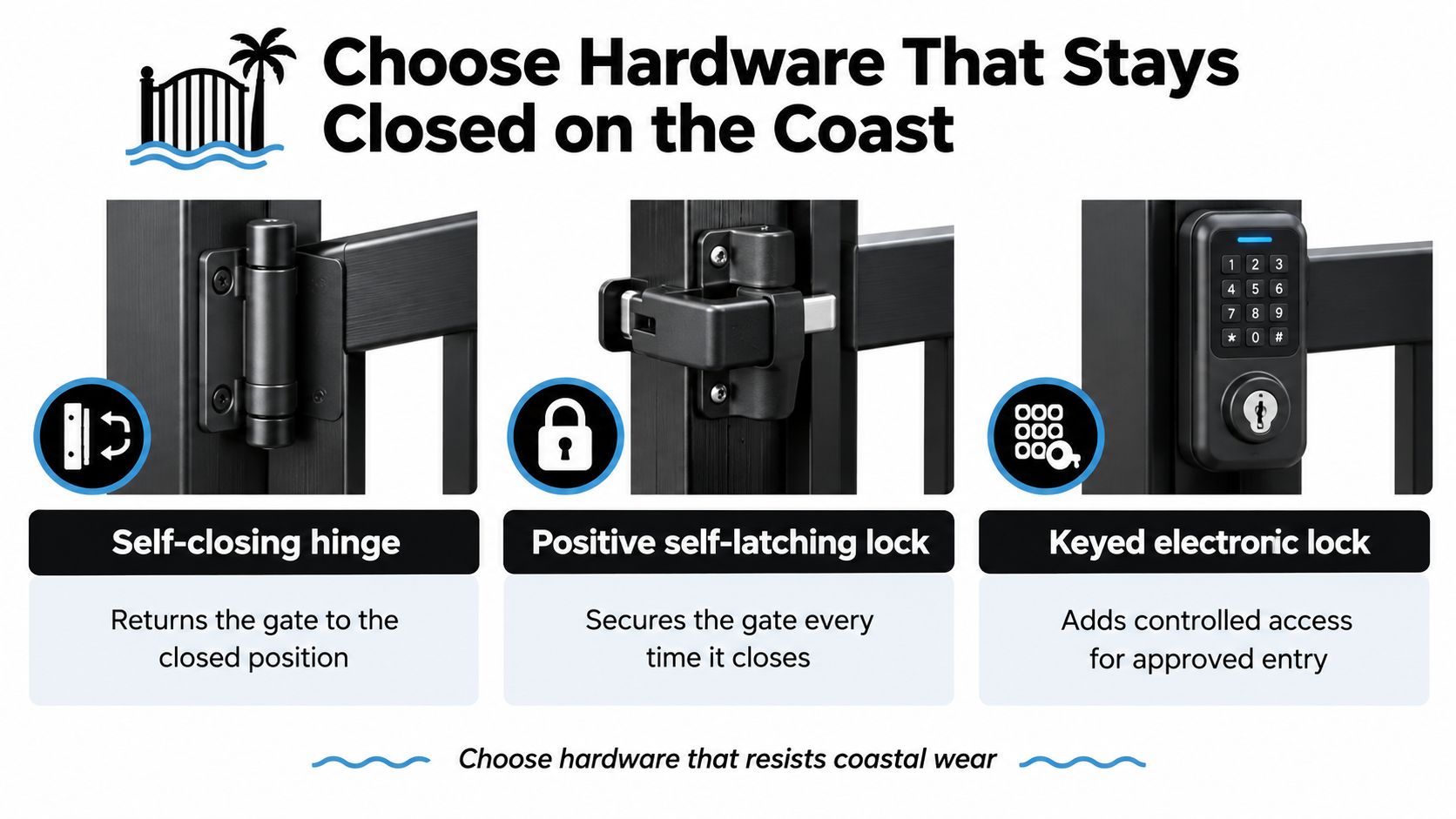
Where the gate is also self-closing, self-latching, and self-locking, the operable parts of a key lock, electronic opener, or combination lock must sit between 34 and 48 inches above the finished floor or ground. That operating zone is separate from the child-safety release placement already set for the gate, per the Florida Building Commission lock comments. Hinge types and how they wear are covered in gate hinges and hardware.
Salt air and who should hang it
Martin County and Palm Beach County jobs need corrosion-resistant hinges, fasteners, latches, and posts. Wet enclosures and coastal air pit ordinary steel. Aluminum pool fencing is the usual low-maintenance choice here because it doesn't rot the way wood does at a splash line and it doesn't invite the climb that chain link often does. Wood can still suit a dry privacy run away from the water. It is a poor default for the wet gate itself.
A homeowner who already has a permitted, plumb opening may only need a hardware swap, if the posts are rigid and the swing is already outward. A property manager usually needs more. Permitting, a Notice of Commencement, 811 utility locates, and inspection coordination sit on that job before the leaf is hung.
Allied Fence and Gate is one concrete option for that wider scope. It's a licensed, insured, and bonded contractor serving Martin County, Palm Beach County, and the Treasure Coast. It installs self-closing, self-latching pool safety gates to the Florida Building Code, with an online estimator, survey and photo uploads, and inspection-ready documentation. Use that scope when the barrier, the permit, and the locates are still open. Stop at a hardware swap only when the opening is already legal and the posts won't sag.
Set Posts, Swing, and Latch Before Inspection
The mount is one continuous job, checked in the same order an inspector walks it. Confirm the permit and the approved barrier plan before a post goes in the ground. Establish finished grade and which face is the pool side. Measuring from unfinished soil, or from the yard face by habit, is a common rejection.
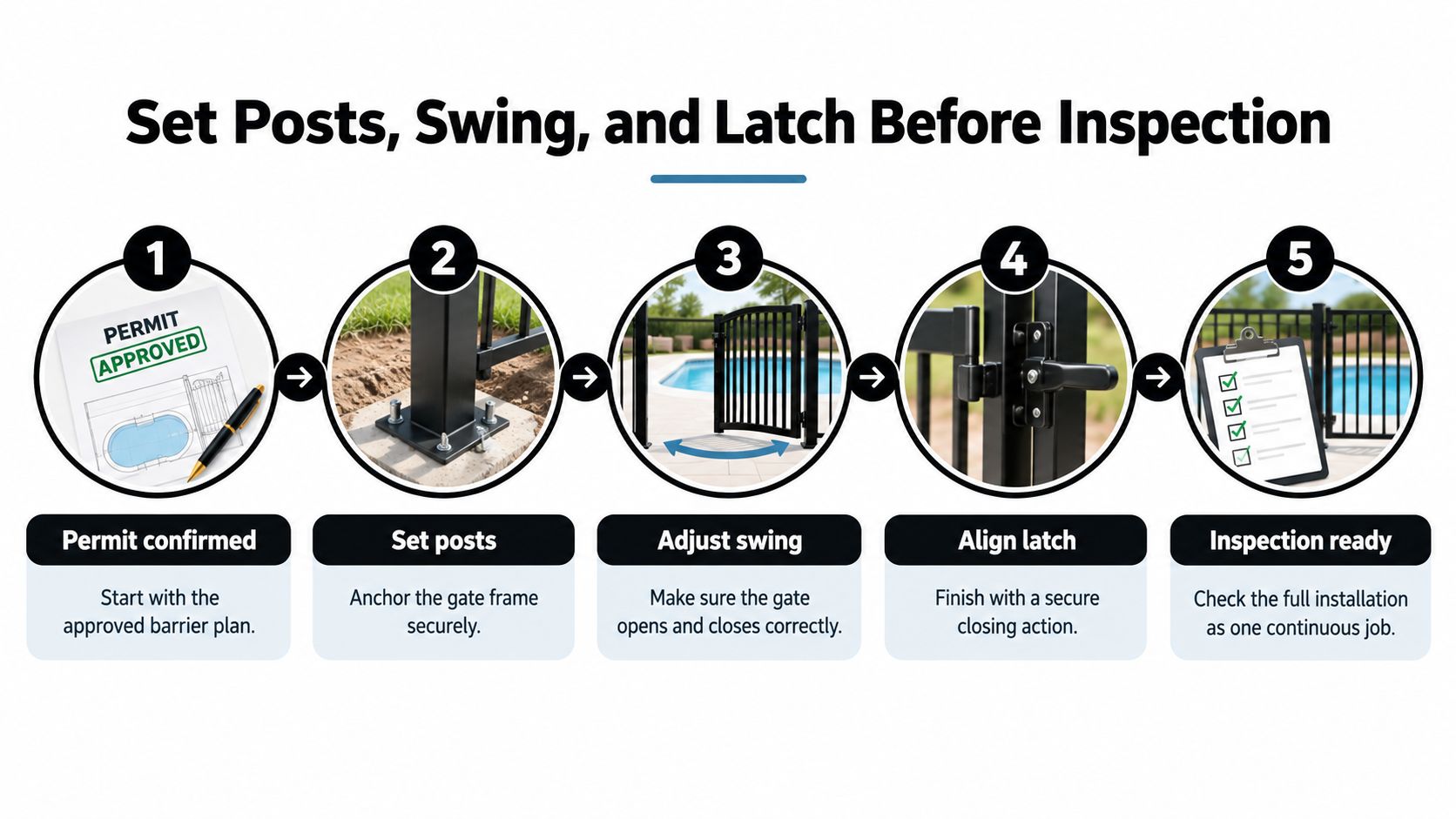
Set the posts plumb and rigid enough that the gate can't sag out of the latch. A closer will not rescue a leaning post. Hang the hinges so the gate swings outward, away from the pool. Fit the self-closing mechanism, then install the positive self-latching or locking device at the height already established for that gate. Latch geometry and why a "click" isn't the same as a positive engage are covered in pool safety gate latch guidance.
Test the way wind and a partial open will
Adjust hinge tension and latch alignment under the gate's real weight, not on a loose leaf held by hand. Release it from several opening angles, including a short partial open. A gate that latches only when thrown fully open isn't inspection-ready. Wind load will show a weak closer the same way.
Measure barrier height and latch height from the finished standing surface, not from a mound of backfill. Check bottom clearance and openings. Look for soil settlement, a paving change, and anything landscaping can push into the swing.
Record the test while the gate is still adjustable. A photo taken after the inspector arrives is a souvenir, not a correction.
What goes in the permit file:
- Photos of both faces, the swing direction, and the release.
- Measurements from finished grade to the barrier top and to the release.
- Hardware specs for hinges, closer, and latch.
- The final test showing the gate closes and latches with no hand on it.
A gate that needs a shove to catch will fail on a breezy afternoon even if it passed a calm morning. Fix alignment before the inspection, not after the red tag.
Keep the Gate Working After the Inspector Leaves
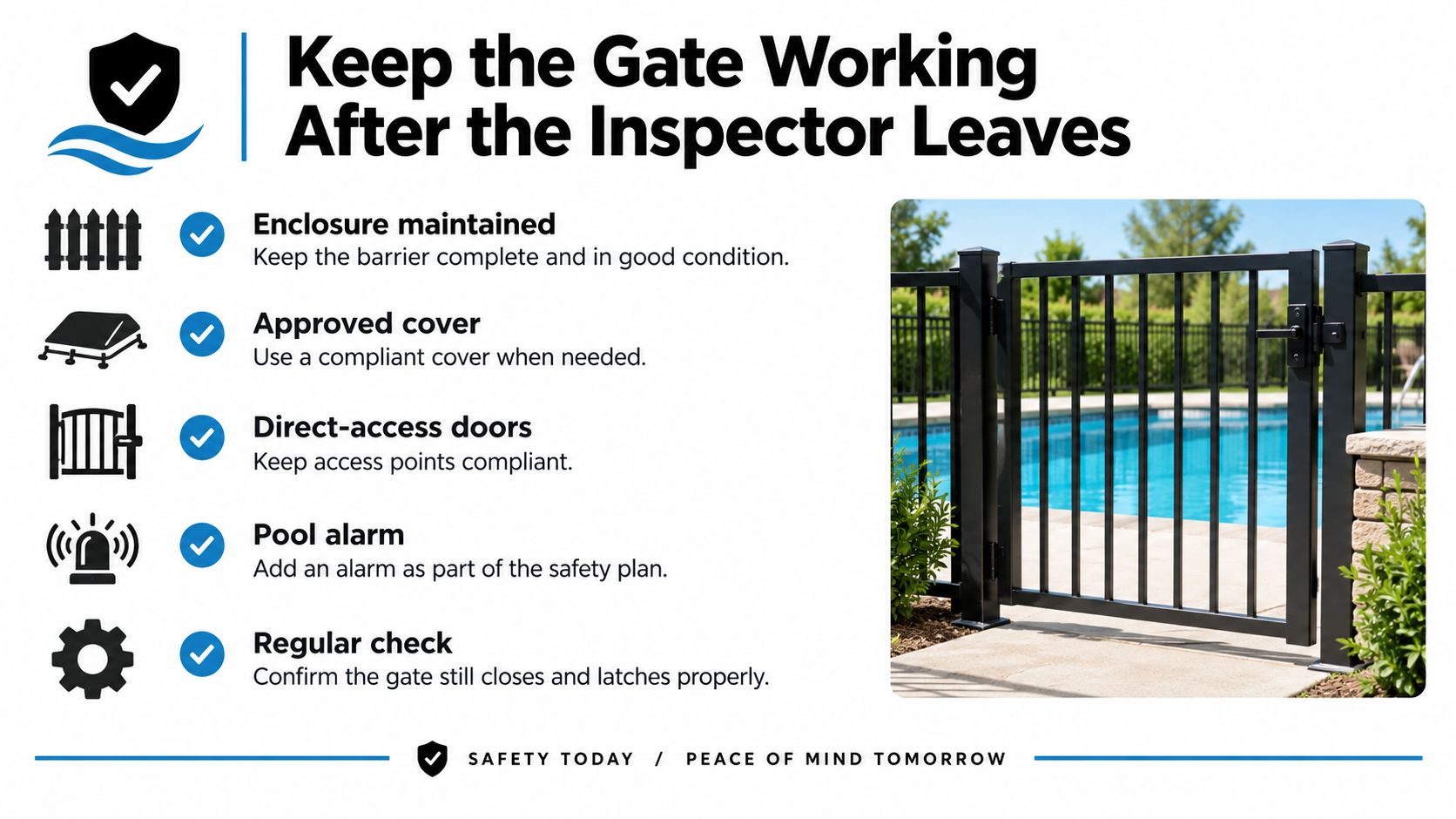
Florida allows an enclosure, an approved safety cover, compliant direct-access doors, or a pool alarm as statutory pathways. Those are compliance routes. They aren't proof of equal everyday protection. A gate can pass and still be propped with a rock. A door can sit ajar. A removable ladder or a patio chair can rebuild a climb the inspector never saw.
A short protocol the owner can actually keep
Run this on a schedule, and write the date down.
- Release from several angles: Let go from a wide open and from a partial open.
- Hands off the leaf: It has to close and latch without help.
- Hardware: Look for corrosion, a dropped hinge, and a latch that misses the strike.
- Clearances: Recheck the bottom gap and nearby projections after landscaping or soil movement.
- After resurfacing or ground movement: Re-test the whole gate. Don't assume yesterday's pass still holds.
Don't treat an alarm as the fix for a bad gate. The alarm spec already says it doesn't replace fences, gates, or locks. Pull furniture and planters off the barrier. Trim plants that block the closer. Coastal weather will loosen what a dry climate leaves alone, so a passing inspection is a starting point, not a permanent state.
When the audit shows a bypass, sagging posts, or hardware that won't stay engaged, upload a lot survey or photos and request a pool-gate estimate from Allied Fence and Gate. The work covers Martin and Palm Beach Counties, coordinates permits and 811 locates, and builds inspection-ready self-closing, self-latching gates.
#MartinCountyFencing #PalmBeachCountyFencing #StuartFencing #JensenBeachFencing #PalmCityFencing #HobeSoundFencing #JupiterFencing #TequestaFencing #PalmBeachGardensFencing #WestPalmBeachFencing #TreasureCoastFencing #PoolGateInstallation #PoolSafetyFence #SelfClosingGate #FloridaBuildingCode #AluminumPoolFence #PortStLucieFencing #SewallsPointFencing
AlliedFenceAndGate.com™ handles pool gate installation for Treasure Coast and northern Palm Beach County properties, including self-closing, self-latching gates built to the Florida Building Code, plus permitting, 811 locates, and inspection coordination. Homeowners and property managers can upload a lot survey or site photos and price the barrier work before anyone sets a post. Visit AlliedFenceAndGate.com™ to start an estimate.
Related Fencing Services
Need a fence or gate on the Treasure Coast?
Licensed, insured, and bonded. Free estimates across Martin, St. Lucie, Indian River & Palm Beach counties.
Call (772) 530-3127