Chain Link Fence vs Wood Fence: Florida Buyer's Guide
A homeowner in Port St. Lucie may be comparing a pressure-treated pine quote with a black vinyl-coated chain link quote while trying to match the neighboring properties and stay within HOA rules. The lower initial price can look decisive, but Florida fences rarely fail because of the material label alone. Salt air, standing moisture, hurricane wind, termites, pool requirements, installation depth, and maintenance habits often decide whether the fence remains an asset or becomes another repair bill.
The practical question isn't whether chain link fence vs wood fence looks better. The useful comparison covers upfront cost, lifetime cost, durability, maintenance, privacy, and security, then tests each material against actual Treasure Coast conditions. A fence that works well for a backyard pool patio may be wrong for a commercial yard, and a fence that satisfies an HOA may not provide the privacy a homeowner expects.
Table of Contents
- What Florida Homeowners Get Wrong About This Choice
- How Chain Link and Wood Fences Are Actually Built
- Head-to-Head Comparison Across Six Real Criteria
- How Florida Weather Changes the Math on Both Materials
- Matching the Right Fence to Your Property and Use Case
- When Upgraded Chain Link Quietly Beats Wood
- Choosing and Hiring With Confidence in Florida
What Florida Homeowners Get Wrong About This Choice
A Treasure Coast homeowner can approve a fence that looks right on the sample board and still buy the wrong system for the property. Chain link is not one product. Bare galvanized mesh, black vinyl-coated fabric, and privacy slats differ in appearance, upkeep, visibility, and cost. Wood varies just as much. A basic pressure-treated pine fence does not carry the same expectations as a properly built cedar or redwood privacy fence.
The next mistake is comparing totals without comparing specifications. A low wood quote may leave out stain, upgraded fasteners, stronger posts, gate hardware, old-fence removal, or labor around roots and uneven grades. A low chain link quote may include lighter fabric, smaller posts, or a finish that will perform poorly near salt air.
The six questions that matter
Review both proposals through the same six filters:
- Upfront cost: What materials, gates, removal, and installation are included?
- Lifetime cost: What will sealing, repairs, replacement parts, and rebuilding add?
- Durability: How will the system handle rain, salt, insects, sun, and hurricane wind?
- Maintenance: What must the owner inspect, clean, seal, or repair?
- Privacy: Does the fence block views, or only mark the property line?
- Security: Does it contain pets, restrict access, and protect equipment effectively?
An upgraded chain link fence with vinyl coating and privacy slats can change the comparison. It may address visibility concerns while retaining chain link's lower routine upkeep. That does not make it automatically superior. Slats add material and wind exposure, and the fence still has to suit the site, gate layout, and HOA requirements.
Service-life estimates should guide the decision, not replace a specification review. Independent comparison guidance places typical chain link life around 20 to 30 years, while wood is commonly listed around 15 to 20 years, unless premium species receive regular care (chain link and wood fence service-life comparison). Actual performance depends on coating, drainage, post installation, wood treatment, maintenance, and exposure.
Practical rule: Select the fence for the property's failure modes, not for a stereotype about either material.
Salt air can corrode unprotected metal. Wood can decay at the ground line, warp through repeated wet and sunny cycles, or attract insects when treatment is inadequate. Hurricane wind, pool-code requirements, and HOA covenants may control height, materials, spacing, visibility, and gate details. Confirm those constraints before choosing the finish or appearance.
How Chain Link and Wood Fences Are Actually Built
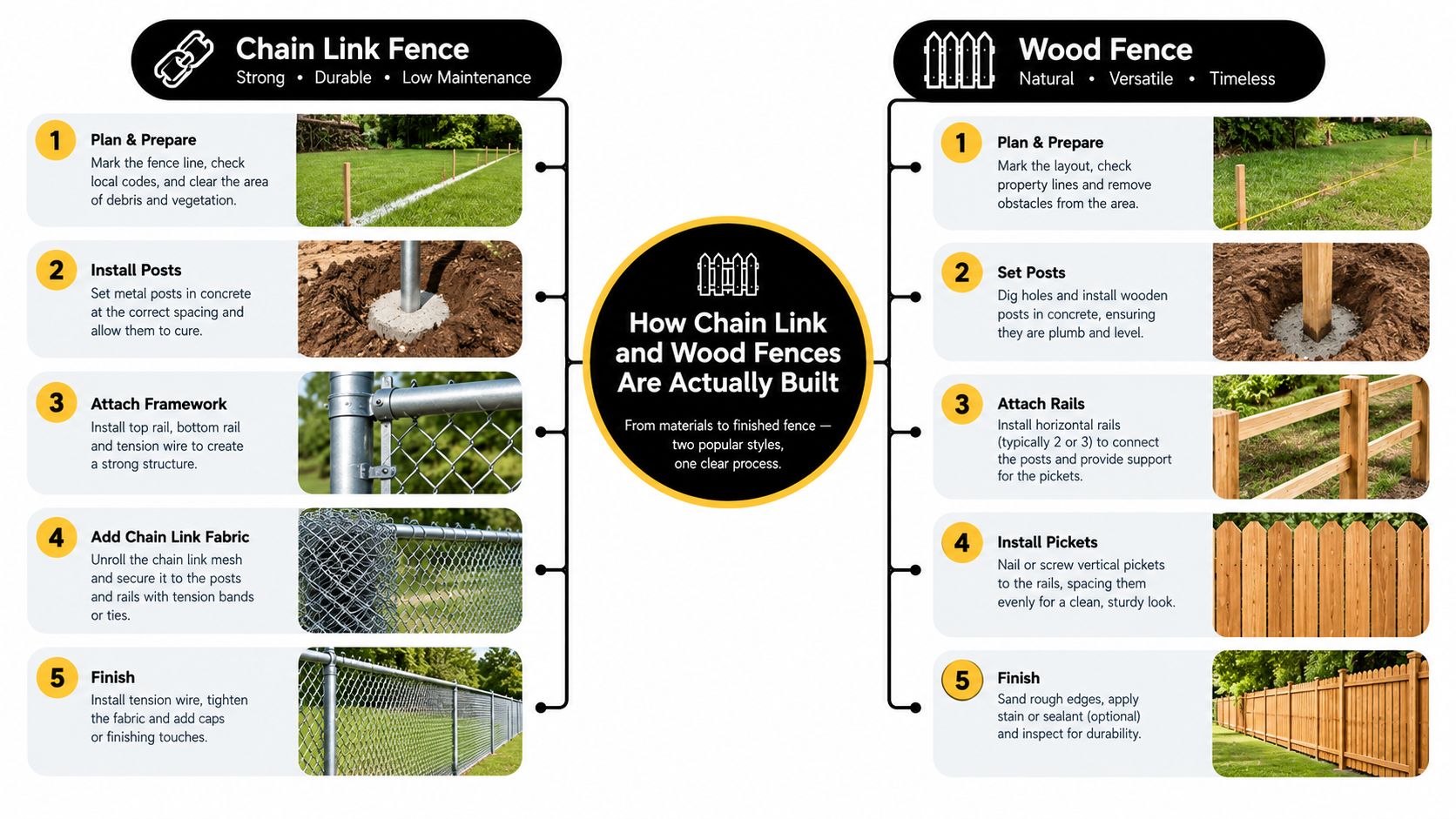
A chain link fence is a steel framework carrying woven wire mesh. The mesh may be galvanized or vinyl-coated, and the system typically includes terminal posts at corners and ends, line posts between them, top rails, tension wire, fittings, and gates. Installers set the main posts in concrete, stretch the fabric tight, attach it to the framework, and adjust the gate so it swings without dragging.
Treasure Coast quotes commonly distinguish between 9-gauge, 11-gauge, and 11.5-gauge fabric, with the lower gauge representing heavier wire. Mesh openings also matter. A 2-inch mesh is a common general-purpose specification, while 1-1/4-inch mesh is used where a tighter opening is needed, including some pool-related applications. The correct specification depends on the fence's purpose, the gate design, local requirements, and the wind exposure at the site.
Homeowners unfamiliar with the installation sequence can review this chain link fence installation guide before comparing proposals. The important point is that the fabric is only one part of the system. Posts, concrete, rails, tension hardware, gate frames, and corrosion-resistant fittings determine how the finished fence behaves.
Wood gives buyers more visible design choices
A wood fence begins with posts, rails, and boards or pickets. The material may be pressure-treated pine, cedar, cypress, or redwood, and the design may be picket, shadowbox, board-on-board, or stockade privacy. Those choices affect both the quote and the way the fence handles moisture and sun.
Post depth and footing quality matter as much as the board species. A contractor must set posts securely, use an appropriate concrete footing, and fasten the rails and boards with hardware suited to exterior exposure. Nails can be economical and quick, while screws generally make later component replacement more controlled. Neither system can compensate for poor layout, shallow posts, weak gates, or careless drainage conditions.
A buyer should ask for a written material schedule rather than accepting “wood fence” or “chain link fence” as a complete description. The schedule should identify the fabric or board type, post size, rails, finish, fasteners, footing approach, gate hardware, and removal work.
Head-to-Head Comparison Across Six Real Criteria
A fair Florida comparison starts with the complete installation, not the material name alone. Height, finish, gate count, access, grade, privacy treatment, and footing requirements can change the quote substantially. For early budgeting, installed chain link generally costs less than wood privacy fencing, while a written proposal should list every included component (Florida chain link and wood cost comparison).
| Criterion | Chain Link Fence | Wood Fence |
|---|---|---|
| Upfront cost | Typically about $15 to $30 per linear foot installed in the Treasure Coast market | Typically about $25 to $45 per linear foot installed for privacy fencing |
| Maintenance | Occasional rinsing, tension checks, and localized rust touch-up | Staining or sealing every 2 to 3 years, plus board and post repairs |
| Durability | Steel does not rot or suffer insect damage, but exposed metal can corrode | Attractive and adaptable, but vulnerable to moisture decay, insects, warping, and treatment failure |
| Privacy | Open mesh unless privacy slats, screening, or another concealment system is added | Solid designs provide the strongest visual privacy |
| Security | Strong boundary control, visibility, and practical commercial options | Solid panels limit visibility but can create wind load and conceal activity |
| Typical service life | About 20 to 30 years for chain link generally | About 15 to 20 years for wood generally, with species and maintenance affecting the result |
Cost and maintenance are connected
Chain link often has the lower entry cost because an open run uses less material than a solid privacy wall and installs efficiently. Galvanized or vinyl-coated steel also avoids the recurring staining and sealing associated with wood. Routine care still matters near the Treasure Coast. Rinsing salt and dirt, checking tension, and treating small rust spots can prevent localized problems from spreading.
Wood carries a higher care commitment, but that expense can buy privacy immediately. A solid fence suits a patio, pool area, or closely spaced neighboring property better than open mesh. The relevant comparison is therefore not the purchase price. A chain link fence with privacy slats may deliver enough screening while avoiding much of the repainting, staining, and board replacement associated with wood.
Maintenance requirements vary with exposure, construction quality, and the chosen finish (maintenance comparison). Ask whether the quote includes removal, gates, caps, concrete, hardware, and privacy additions before comparing totals.
Security depends on the specification
Chain link gives owners clear visibility across the property, which helps with supervision but also allows outsiders to see inside. Heavier fabric, properly sized posts, suitable height, secure gate frames, and reliable latches can create a strong perimeter. Privacy slats reduce visibility, though they also add wind exposure that the installer must account for.
Wood blocks views more effectively, but solid panels catch wind during tropical weather. Post spacing, embedment, concrete, rails, and gate construction determine whether the fence remains stable. Pool enclosures also require the design to meet applicable Florida barrier rules, while HOA requirements may restrict height, color, materials, or street-facing appearance.
Wood wins immediate privacy and traditional appearance. Chain link generally wins routine maintenance and long-term resistance to rot and insects. Upgraded chain link can narrow the privacy gap and may produce the better lifecycle value when the property does not require a fully solid wall. Security comes from the complete system, not the material label.
How Florida Weather Changes the Math on Both Materials
On the Treasure Coast, fence failures usually begin where the material meets the ground, salt, or wind. Florida combines humidity, heavy rain, ultraviolet exposure, insects, salt air, and tropical weather. Posts stay close to wet soil while boards and coatings repeatedly heat, dry, and expand.
Wood often fails first at the posts, end grain, fastener holes, and lower boards. Water enters those openings, termites attack damaged or poorly treated lumber, and sun exposure breaks down the finish. The meaningful question is not a generic lifespan estimate. It is whether the posts can drain, whether the ground-line treatment remains intact, and whether the fence receives timely sealing and repairs. Untreated softwood can deteriorate quickly in these conditions.
Salt air changes the calculation near the coast. Fasteners, hinges, brackets, and cut edges deserve the same attention as the main fence material. A wood fence can look sound above grade while decay advances around a post or lower rail.
Chain link avoids rot and insect damage because its primary structure is steel. It still requires coastal judgment. Salt spray can settle on galvanized surfaces and fittings, especially near the water, and corrosion may start at cuts, scratches, connections, or poorly protected hardware. Vinyl coatings add protection, but they do not remove the need for inspection and occasional rinsing.
| Failure Mode | Wood Fence | Chain Link Fence |
|---|---|---|
| Ground-line moisture | Posts can decay where soil, concrete, and water meet | Posts resist decay, but exposed metal and fittings may corrode |
| Insects | Vulnerable when treatment is poor or damaged | Steel does not rot or provide food for termites |
| Sun and rain cycling | Boards can warp, split, fade, and lose protective finish | Coatings and finishes can weather, while uncoated areas remain exposed |
| Salt air | Fasteners and wood components can deteriorate without suitable protection | Galvanized steel can corrode; coatings and rinsing help manage exposure |
| Hurricane wind | Solid panels act as wind sails and can pull posts from weak footings | Mesh flexes and usually allows wind to pass through |
| Localized damage | Broken boards may require matching and replacing sections | Bent fabric, rails, or posts can often be repaired by component |
Hurricane exposure makes construction quality as important as material choice. Solid wood panels place greater force on posts and footings, while open mesh lets more wind pass through. Privacy slats reduce visibility but increase the load on the chain link system, so post size, spacing, embedment, concrete, and gate framing must match the site.
Wood maintenance works best as a schedule rather than a reaction after the first board fails. This wood fence maintenance guide explains why sealing, drainage, fastener selection, and prompt repairs matter.
Storm lesson: A fence that looks strong on a calm afternoon may still fail if its posts, footings, and gates were not designed for the site's wind exposure.
Inspect both materials after major weather. A loose post, stretched fabric, lifted footing, or damaged gate can worsen quickly under continued tension. Chain link usually allows modular post-storm repairs, while wood may require rebuilding a run when several panels and posts move together.
Matching the Right Fence to Your Property and Use Case
A fence is a tool. The correct tool depends on whether the property needs privacy, pool protection, visual control, pet containment, or a serious perimeter.
Residential privacy and curb appeal
For a backyard patio where neighbors sit close by, a six-foot solid wood privacy fence with cap and trim remains the most direct solution. Board-on-board and stockade styles block views more effectively than open picket designs, and cedar or properly treated lumber can support a finished residential appearance.
The trade-off is continuing care. Wood owners should expect sealing or staining every 2 to 3 years, along with periodic board and post repairs (wood maintenance requirements). The higher initial spend can still make sense when privacy and curb appeal affect how the family uses the yard every day.
Pool and HOA properties
Pool fencing requires more than choosing the most private material. The enclosure must satisfy applicable Florida Building Code requirements, local permitting, gate hardware rules, and the property's HOA documents. Many planned communities also control colors, heights, setbacks, and whether a solid fence is permitted in a required pool area.
A homeowner should submit the proposed design to the HOA before purchasing materials. A tighter chain link mesh, aluminum enclosure, or another approved system may fit the pool boundary better than a tall wood panel. Gates should be designed around pool safety requirements, including self-closing and self-latching operation where applicable.
For Florida-style wood construction, one municipal detail referenced in a state fence-rules summary allows wood fences not exceeding 6 feet to use nominal 4x4 posts, No. 2 grade or better lumber, posts spaced 4 feet on center, and posts embedded 2 feet into a concrete footing 10 inches in diameter and 2 feet deep, with corrosion-resistant fasteners (Florida wood fence detail). Local review remains essential because requirements can vary by jurisdiction and application.
Commercial and security properties
Warehouses, schools, utility yards, and service compounds usually benefit from chain link because owners can secure long runs while preserving visibility. A nine-gauge commercial-grade system, appropriate posts, controlled-access gates, and a barbed-wire option may be more practical than a solid wood perimeter. The final design must account for the site, access needs, safety rules, and local approvals.
Residential chain link can be specified in 4-foot or 6-foot heights, while commercial applications may require a different height or security package. The quote should separate fabric gauge, coating, post dimensions, gate construction, and any top or bottom security treatment.
When Upgraded Chain Link Quietly Beats Wood
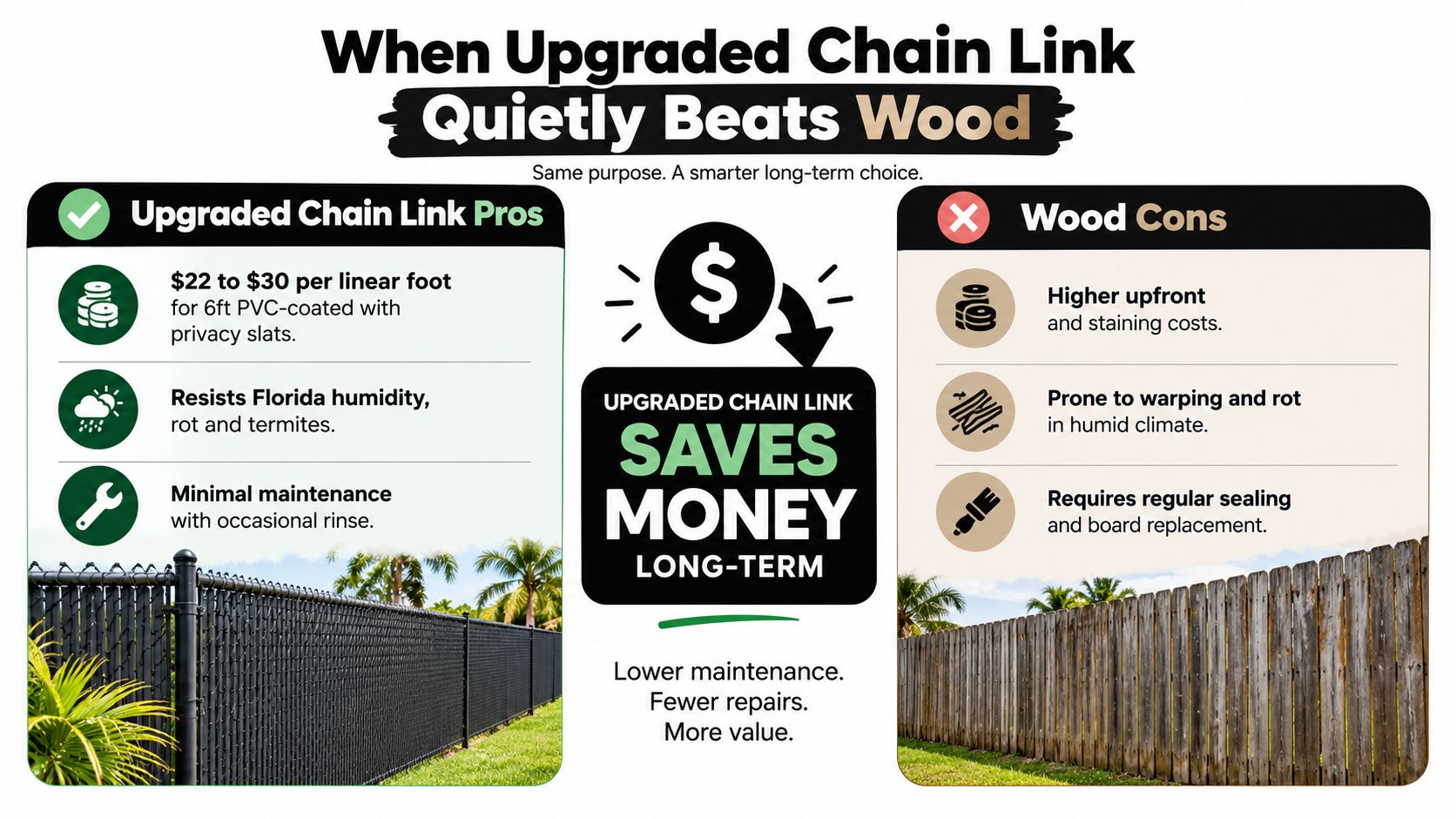
The old shorthand says wood equals privacy and chain link equals utility. That remains broadly true for basic products, but it misses the modern middle ground. A black or vinyl-coated chain link fence with privacy slats can provide concealment, lower maintenance, and a lighter visual profile than a solid wood wall.
This option becomes especially relevant where the owner wants privacy but faces coastal moisture, HOA appearance restrictions, or concern about wind exposure. Slats change the view through the mesh without turning the system into a heavy continuous panel. They also preserve the modular nature of chain link, so a damaged section can be addressed without necessarily rebuilding an entire wood run.
The product selection still needs care. Slat quality, color stability, coating, gate treatment, and attachment details should appear in the written proposal. A homeowner comparing chain link fence privacy options should ask how much concealment the specific slat pattern provides from the street, neighboring yards, and diagonal sight lines.
Where the lifecycle argument changes
Upgraded chain link can be the stronger value when the property needs:
- Privacy with low upkeep: Slats reduce direct sight lines while the steel framework avoids routine staining.
- Coastal resilience: Vinyl-coated or otherwise protected steel resists the rot and insect problems that affect wood.
- Wind permeability: Mesh allows air to pass through instead of presenting a broad solid surface.
- Practical repairs: Fabric, rails, posts, and fittings can be evaluated as separate components.
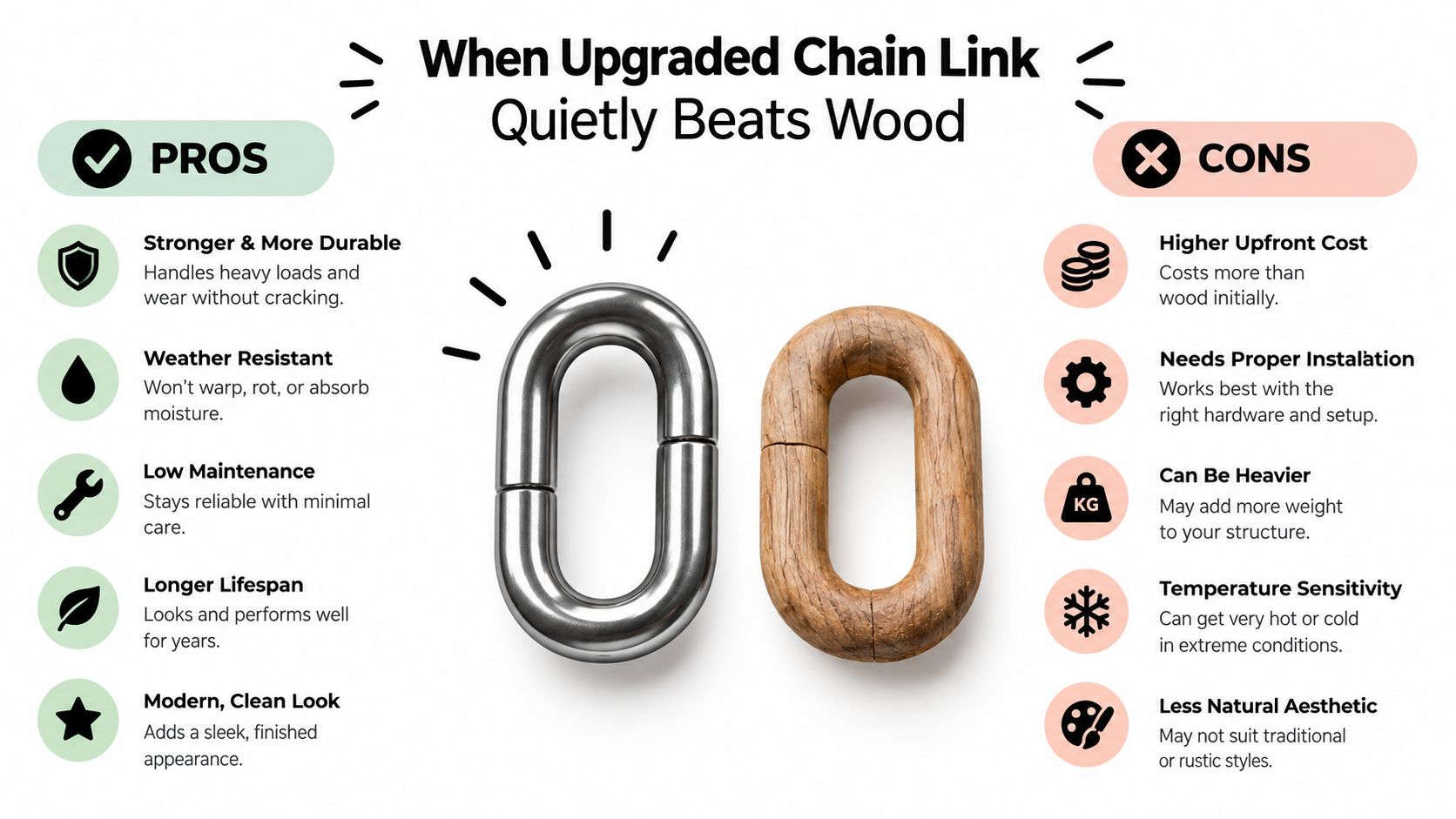
Wood still has the advantage for a traditional neighborhood, a planted backyard, or a patio where the owner wants a warm architectural finish. It also delivers the most complete privacy without inserts. The upgraded chain link choice isn't universally superior. It beats wood when privacy is necessary but not absolute, low maintenance matters, and Florida weather makes repeated wood restoration unattractive.
Choosing and Hiring With Confidence in Florida
A sound hiring decision starts with a site visit and a detailed scope, not a price given from the curb. The contractor should confirm property lines, locate survey pins, identify utilities, review gates and access, and explain which permit and inspection process applies in Martin, St. Lucie, or Indian River County.
Before signing, the homeowner should verify:
- Permit responsibility: Confirm who handles the applicable county or municipal permit, utility locates, Notice of Commencement requirements, and inspection coordination.
- Material separation: Require separate pricing for galvanized and coated chain link, pressure-treated pine, cedar, or other specified wood.
- Wind documentation: Ask for the proposed wind-load rating, with the requested 110 mph minimum documented for both materials where that standard applies to the project.
- Footing details: Confirm at least 18 inches of concrete depth for 4-foot chain link and 24 inches for 6-foot wood, subject to the approved design and local requirements.
- Insurance: Request proof of $1 million liability coverage and workers' compensation.
- Scope clarity: Check whether removal, disposal, gate hardware, finish details, and a one-year workmanship warranty are included.
Door-to-door storm quotes, cash-only deposits above 30 percent, no physical business address, and linear-foot pricing without a property walk are warning signs. Two written bids should describe comparable materials, heights, gates, footings, permits, and cleanup before the homeowner compares totals.
AlliedFenceAndGate.com™ provides estimating, survey and photo uploads, permitting coordination, 811 utility locates, inspection support, and installation options for both chain link and wood fencing across the Treasure Coast and northern Palm Beach County.
AlliedFenceAndGate.com™ can help compare chain link, slatted coated chain link, and wood designs against Florida weather, HOA, pool, and property-line requirements. Visit AlliedFenceAndGate.com™ to request a site assessment and compare written fence options before signing a contract.
#MartinCountyFencing #StuartFencing #PalmCityFencing #PortStLucieFencing #VeroBeachFencing #TreasureCoastFencing #FloridaFencing #ChainLinkFence #WoodFence #PrivacyFencing #PoolFencing #CommercialFencing #FenceInstallation #HOAFencing #StormReadyFencing
Related Fencing Services
Need a fence or gate on the Treasure Coast?
Licensed, insured, and bonded. Free estimates across Martin, St. Lucie, Indian River & Palm Beach counties.
Call (772) 530-3127