Privacy Fence Cost Calculator Guide
Most homeowners are told to multiply linear feet by a per-foot price and treat the result as a budget. That advice is convenient, but it breaks down quickly in Florida. A privacy fence cost calculator can help compare wood, vinyl, aluminum, and chain link, yet the cheapest number on the screen may ignore wind design, pool-barrier hardware, underground utilities, demolition, access, and future maintenance.
A useful estimate does more than produce a price. It identifies whether the proposed fence can be built as shown, what conditions could trigger a change order, and how the material may perform over the ownership period. The calculator should be treated as an early planning instrument, not a fixed-price quote.
Table of Contents
- Why Your Initial Calculator Estimate Will Change
- Gathering the Right Inputs for Accurate Pricing
- Florida Code Compliance and Hidden Site Risks
- Evaluating Lifecycle Costs Beyond the Installation
- Moving From Digital Estimate to Signed Contract
Why Your Initial Calculator Estimate Will Change
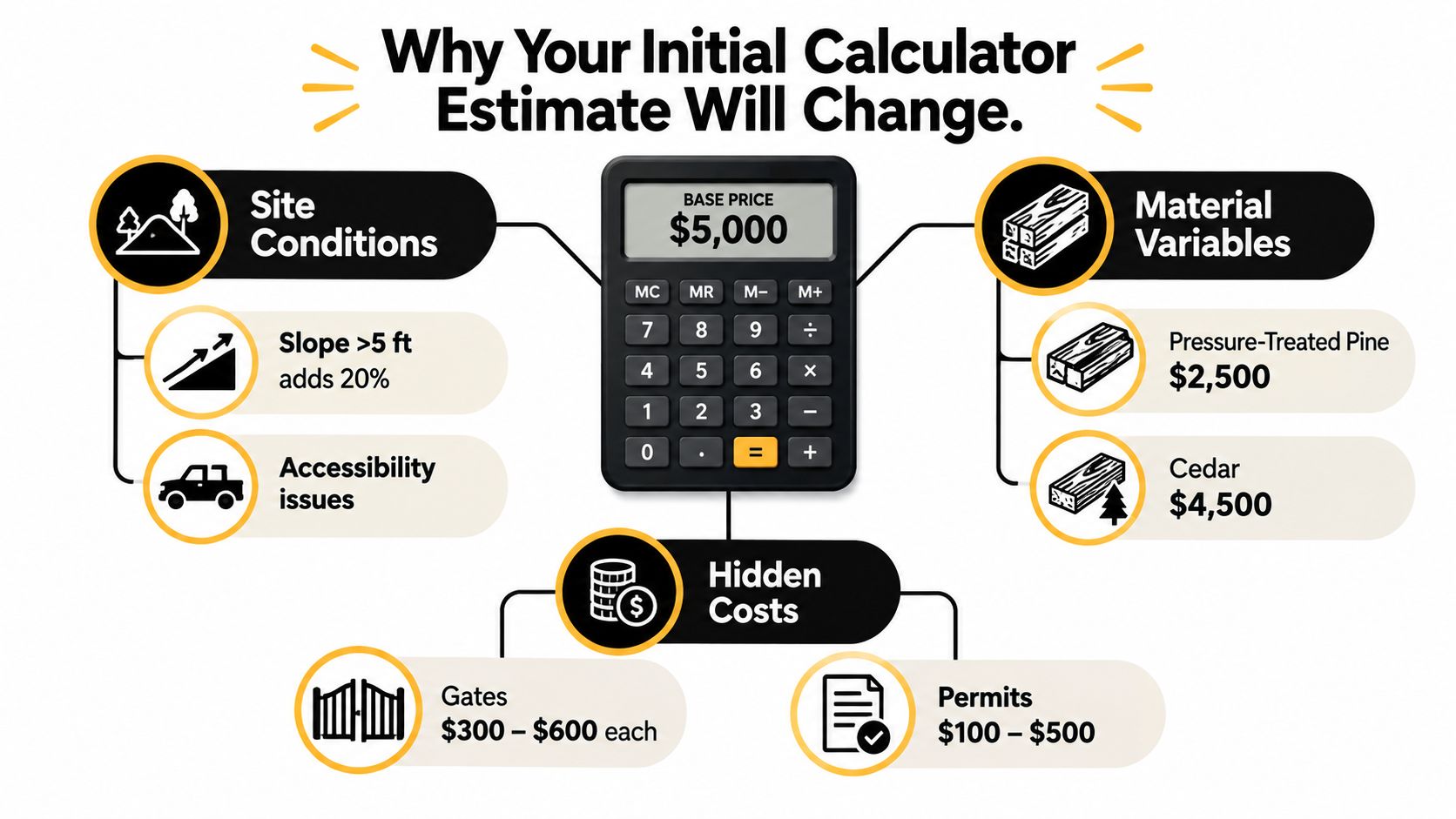
A privacy fence calculator can return one clean number and still be directionally wrong. In Florida, the first estimate often shifts because the job is not priced by footage alone. It is priced by whether the fence can be built on that site, under that code, with that access, and with those material and labor conditions at the time the work is sold.
That is why early pricing and contract pricing do not carry the same confidence. RSMeans' construction cost estimating guide explains that rough-order-of-magnitude estimates are typically accurate to approximately plus or minus 25%, while square-foot estimates are commonly accurate to about plus or minus 20%. Estimates based on finalized designs and quantities can reach approximately minus 5% to plus 10% accuracy when the scope is well defined. In practice, that means a calculator is useful for screening feasibility, then a field visit and takeoff handle the actual budgeting.
For example, a preliminary $10,000 estimate for a 200-foot privacy-fence project could imply a rough range of approximately $7,500 to $12,500 before site-specific changes under a 25% uncertainty assumption. The wide range reflects the limited information available before a contractor confirms the property line, gate layout, grade, soil, access, removal, and code requirements. In Florida, wind exposure, utility locates, and hardware requirements can change post counts, footing needs, and labor time fast enough to make the cheapest calculator result irrelevant.
A range is more honest than false precision
A usable calculator should show a budget range, the estimate date, material assumptions, included work, and exclusions. A national average does not capture regional labor, delivery, disposal, permitting, or the production difference between a flat open run and a tight site with corners, gates, roots, demolition, or limited equipment access.
Material pricing moves too. The U.S. Bureau of Labor Statistics history of the Producer Price Index explains that the index tracks price movement across goods and services, including construction-related categories such as lumber and structural steel. A fence estimate bundles several moving parts, including posts, rails, panels, concrete, fasteners, labor, delivery, disposal, and possible permitting or repair work.
RSMeans also describes a system containing more than 92,000 unit costs, 21,000 assembly costs, and 140 square-foot models, with line items updated annually and City Cost Index adjustments released quarterly. That scale is a reminder that current regional assumptions beat stale national averages.
Practical rule: Use the calculator to decide whether a project deserves a site visit, not to promise a contract price before the scope is verified.
Scope capture matters as much as arithmetic. RSMeans states that 90% of estimating errors can be traced to scope issues. On fence work, that usually shows up as missed gates, unpriced tear-out, utility conflicts, easements, slopes, permit requirements, or site conditions that slow installation and trigger change orders.
Gathering the Right Inputs for Accurate Pricing
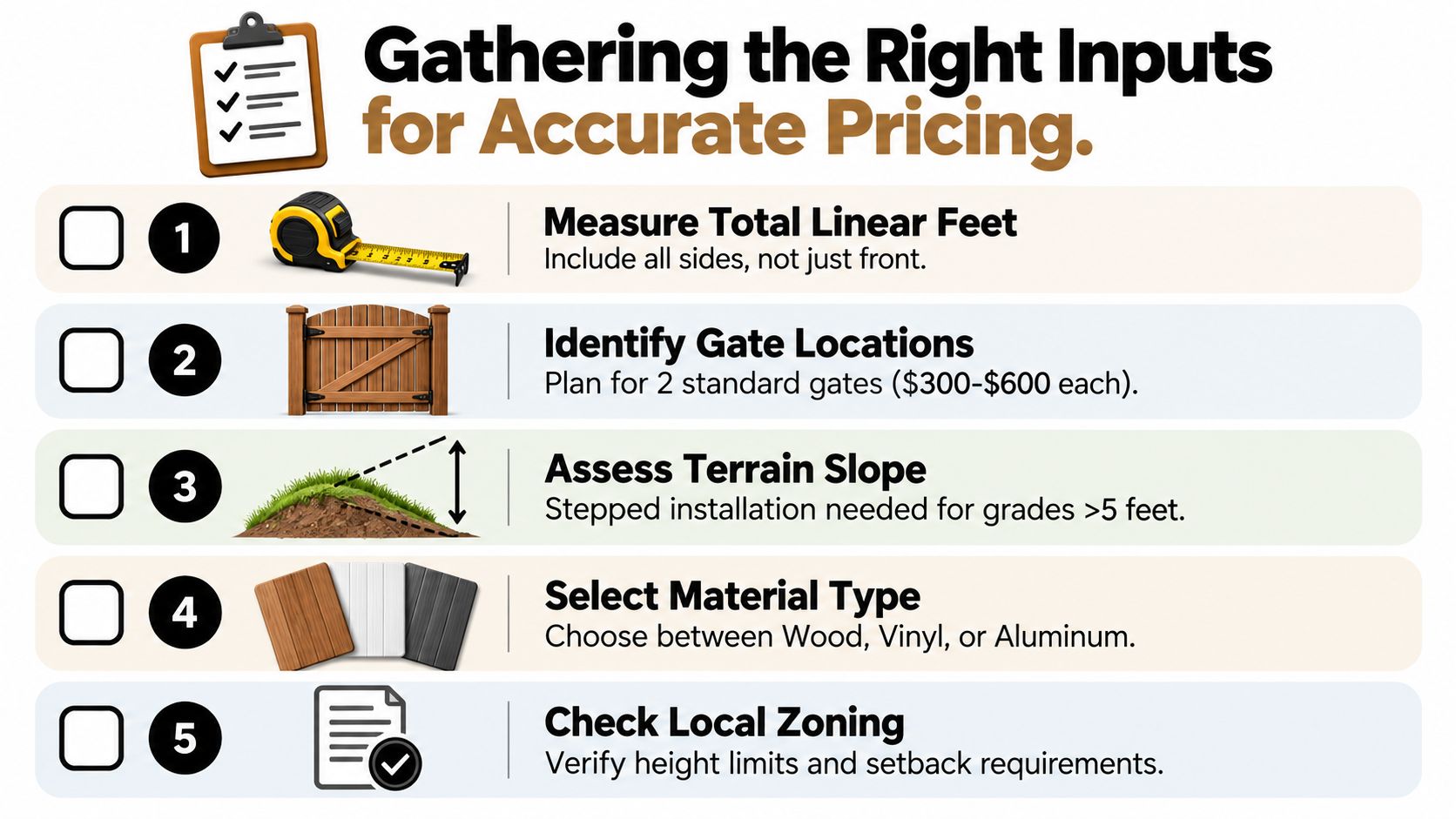
A calculator becomes useful when the homeowner measures the project that exists, not an idealized boundary line. Start with the full fence run. Measure every side that will receive fencing, mark corners and ends, and subtract only openings that will remain open. A sketch with segment lengths is more reliable than one total number because corners, gate jambs, retaining-wall interfaces, and changes in direction affect post quantities and labor.
The estimate also needs the fence height and material. Wood privacy fencing, vinyl panels, aluminum sections, and chain link don't share the same post, rail, fastener, or installation requirements. A material-only estimate can understate the completed project because contractor labor is a separate cost component. One Angi fence installation cost analysis identifies labor as about 50% of total project cost, while another vinyl analysis reports installation labor of approximately $5 to $10 per linear foot in addition to materials.
Record every condition that changes production
Before entering the footage, gather these inputs:
- Total linear footage: Include the front, sides, rear boundary, interior divisions, corners, and ends that are part of the scope.
- Gate count and type: Record walk gates, double gates, access-control gates, and pool gates separately. A gate isn't just an opening. It adds posts, hinges, latches, framing, and adjustment time.
- Height and configuration: Note whether the panels are solid, semi-private, stepped, racked, board-on-board, or custom built.
- Terrain and soil: Identify slopes, elevation transitions, rocky or compacted soil, standing water, roots, landscaping, and retaining-wall connections.
- Existing fence: Measure the fence being removed and identify whether disposal, concrete extraction, stump grinding, or vegetation clearing is required.
- Access: Note narrow side yards, locked gates, long material carries, stairs, nearby structures, and areas where machinery can't operate.
- Property documentation: Gather a survey, lot plan, easement information, HOA requirements, and any known utility drawings.
The calculator should turn these conditions into separate allowances instead of hiding everything inside a generic per-foot price. Current calculator guidance identifies demolition at approximately $2 to $6 per linear foot and difficult terrain at roughly $3 to $8 per linear foot. The published cost discussion from 247PRO treats those items as variables, which is the right approach. They shouldn't be applied automatically to every property, but they shouldn't disappear from the estimate either.
A practical digital starting point is the fence cost estimator calculator from Allied Fence and Gate, provided the result is reviewed against the actual site. A photograph or uploaded plan can support early planning, but it can't always verify a boundary, easement, drainage pattern, or utility conflict.
Florida Code Compliance and Hidden Site Risks
Florida adds feasibility questions that a basic national calculator usually can't resolve. Wind exposure, local jurisdiction, setbacks, easements, pool safety, and property-line conditions can change the design before pricing is finalized. A solid six-foot panel may require a different post layout, embedment, framing approach, or engineered detail than an open-style fence that appears similar from the street.
A Florida municipal permit document distinguishes 75 mph and 90 mph three-second gust design speeds for certain wood fences up to 6 feet high. The Florida municipal fence permit document demonstrates why “Florida” alone isn't a sufficient calculator input. Treasure Coast and Palm Beach properties can have different exposure, jurisdictional review, setback, HOA, and coastal considerations.
Pool fences need their own calculator logic
A pool enclosure isn't an ordinary boundary fence. Florida Building Code educational material states that barrier openings can't allow passage of a 4-inch-diameter sphere, and pool access gates must use a self-latching locking device positioned at least 54 inches above the bottom of the gate. Doors that provide direct access from a home to the pool also require self-closing and self-latching positive mechanical hardware installed at least 54 inches above the threshold. The Florida Building Code pool-safety material shows why gate hardware and geometry belong in the estimate.
For public pools, Florida Building Code educational material specifies a continuous fence at least 48 inches high, with self-closing, self-latching, lockable gates. It also states that a compliant safety cover doesn't satisfy the barrier requirement. The Florida public-pool barrier material further supports asking whether the project is residential or public or commercial before assigning a pool allowance.
Utilities and ground conditions create safety exposure
The fence line may look clear while post holes intersect buried services. A utility-safety report citing 2021 nationwide damage data recorded an estimated 192,745 unique utility-damage instances, with 17% attributed to insufficient notice to the 811 service. A separate industry summary of the same DIRT reporting states that 60% of excavation damages involved professional excavators who hadn't requested an 811 locate, and 66% of strikes involved an invalid request, such as digging before the valid start time or after ticket expiration. The Oregon OSHA utility-damage report supports treating locate timing as a workflow control, not a note buried in the contract.
The estimator should flag post locations near recorded utility paths and allow conditional pricing for hand digging, redesign, utility conflict resolution, roots, rock, elevation transitions, and difficult access.
| Cost Driver | Impact on Estimate | Why It Matters |
|---|---|---|
| Wind exposure and fence configuration | May change posts, embedment, framing, and panel selection | A solid panel can create different wind demand from an open design |
| Pool-barrier requirements | Adds compliant gate hardware and layout constraints | Openings, latches, gate swing, and access doors affect inspection readiness |
| Utility conflicts | May require hand digging, redesign, or schedule changes | A valid 811 locate must be confirmed before excavation |
| Slopes and elevation changes | Can require stepped or racked installation | Panel geometry and labor productivity change along the grade |
| Roots, rock, and compacted soil | Adds excavation effort or equipment | Per-foot pricing can't predict every hole condition |
| Property lines and easements | May require a survey or layout revision | A fence in the wrong location creates a larger problem than a pricing error |
The safest estimate treats uncertain site conditions as visible allowances, not as an arbitrary surcharge.
Evaluating Lifecycle Costs Beyond the Installation
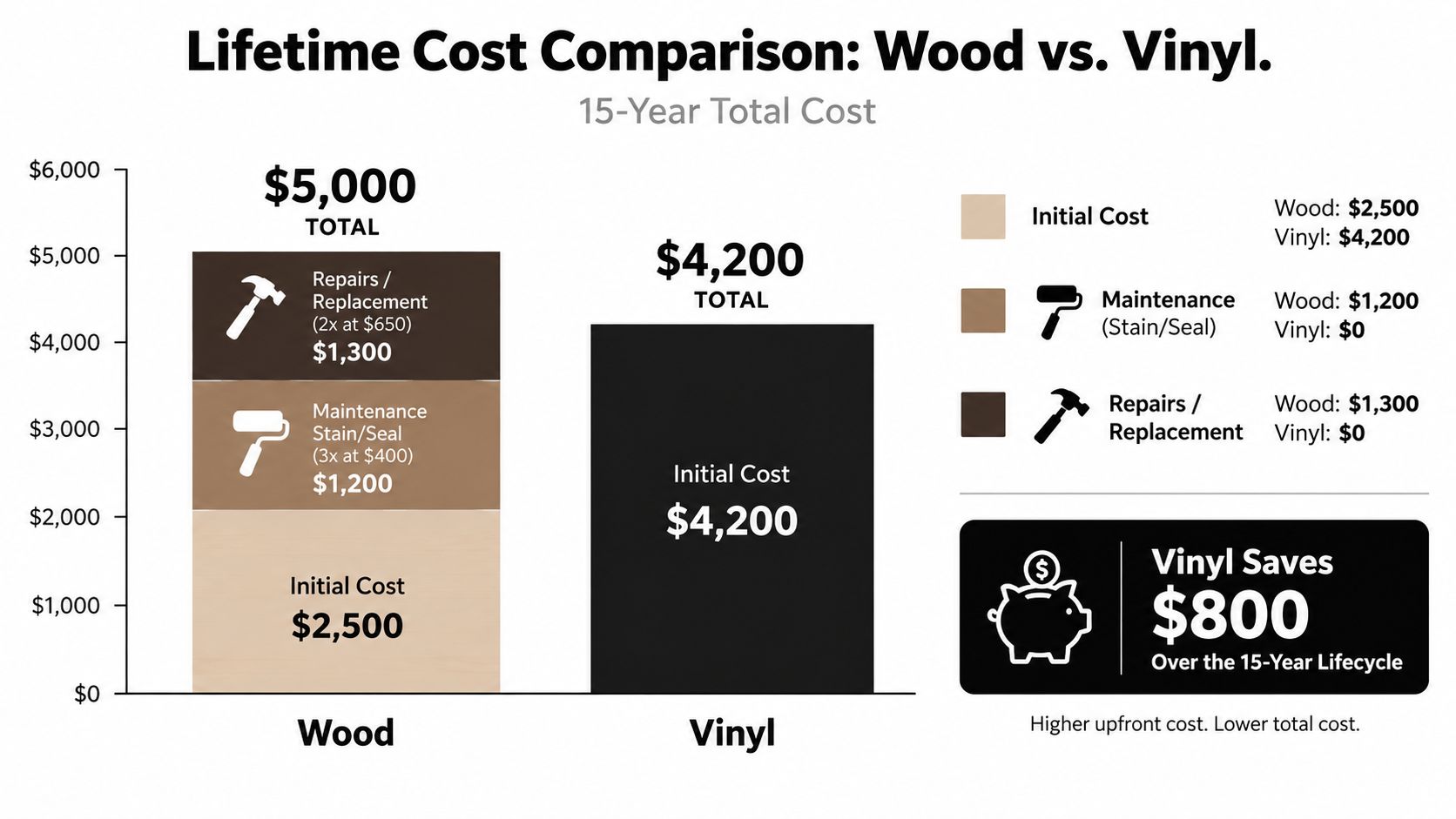
The first invoice doesn't tell the whole financial story. Wood may produce the lower initial calculator result, yet staining, sealing, storm repairs, hardware replacement, and eventual removal can change the ownership cost. Vinyl may cost more at installation but reduce recurring maintenance. Aluminum can be attractive for pool enclosures and corrosion-sensitive locations, although its design, finish, gates, and wind requirements still need review.
The right comparison uses the expected ownership period and local exposure. Florida sun, salt air, storms, irrigation, vegetation, and gate use affect materials differently. A homeowner who plans to move soon may prioritize initial cash flow, while a long-term owner may value fewer maintenance visits and easier cleaning.
Build a lifecycle scenario instead of choosing by sticker price
A useful calculator should display separate scenarios for 10, 15, and 20 years, with assumptions clearly labeled. It should include:
- Wood maintenance: Staining and sealing frequency, cleaning, fastener replacement, and localized board or post repairs.
- Storm exposure: Damaged panels, leaning posts, broken gates, replacement hardware, and emergency access.
- Vinyl upkeep: Cleaning, panel or post replacement, gate-hardware wear, and performance in exposed locations.
- Aluminum ownership: Finish condition, corrosion exposure, gate operation, and replacement of damaged sections.
- End-of-life work: Tear-out, disposal, concrete removal, landscaping repair, and installation of the replacement fence.
The calculator shouldn't claim that one material always wins. A lower upfront wood quote isn't automatically the lower-cost option, and a higher vinyl quote isn't automatically better value. Maintenance willingness, salt exposure, storm history, material quality, fence design, and expected ownership period determine the result.
Compare the trade-offs directly
Pressure-treated wood can make sense when initial budget is the main constraint and the owner accepts recurring maintenance. Vinyl suits owners who want privacy with less routine coating work, but panel availability, color, repairability, and wind design still matter. Aluminum offers a different visual and maintenance profile, particularly for pool and decorative applications, while chain link may solve boundary or security needs without delivering the privacy of a solid fence.
The calculator should also show installation add-ons as scenario risks rather than burying them in a universal rate. Demolition, difficult terrain, tree-root removal, coastal hardware, gate adjustments, and storm-repair reserves deserve their own lines. The privacy-fence replacement cost guide is useful when the project involves removing an existing fence, because replacement work has a different scope from building on a clear site.
The material with the lowest purchase price isn't necessarily the material with the lowest ownership cost.
Moving From Digital Estimate to Signed Contract
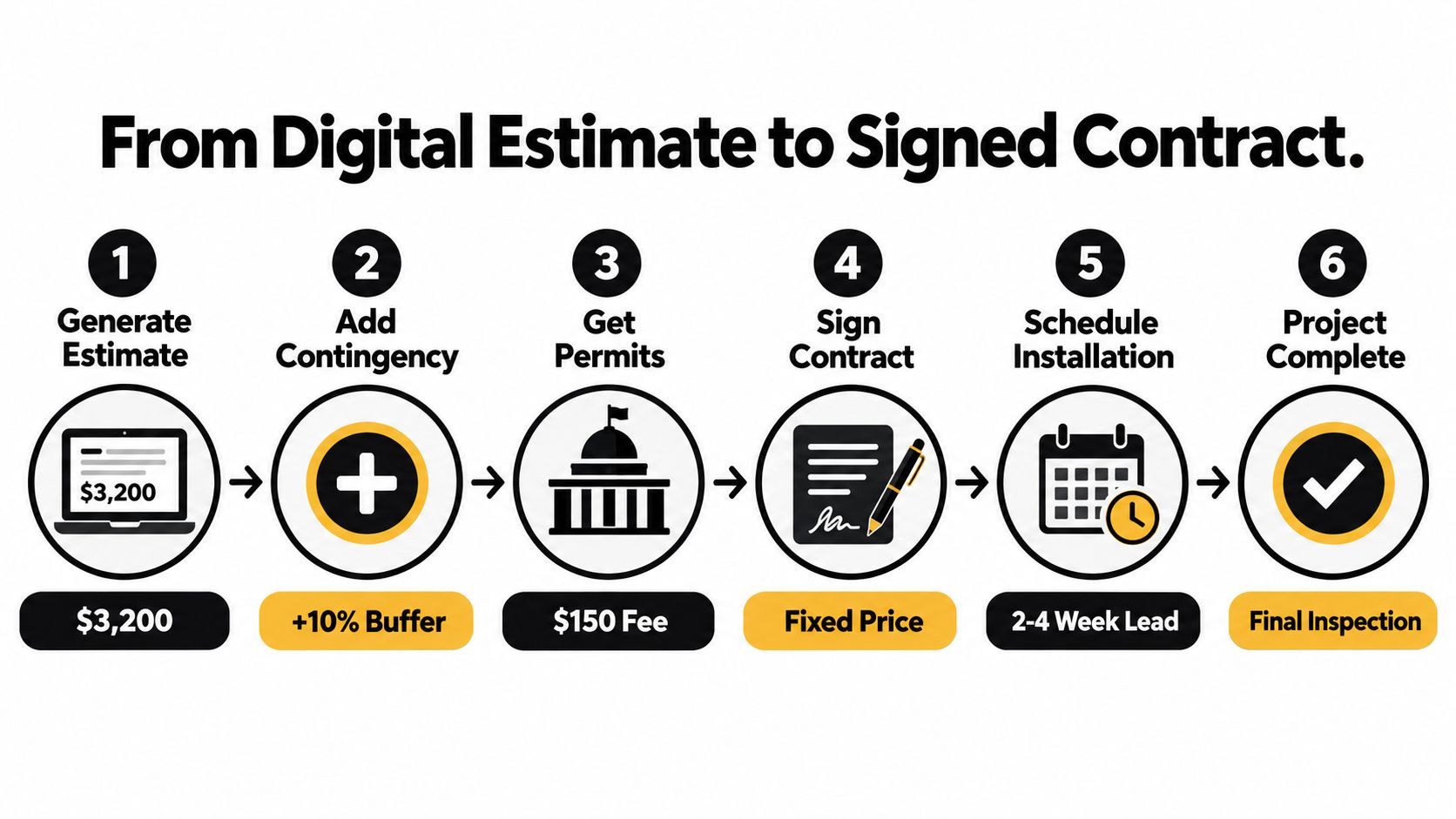
A realistic calculator range gives the homeowner a decision point. The next step is confirming whether the proposed layout fits the property, the code, the HOA rules, and the intended use. A lot survey or uploaded plan can help establish the fence line, but a contractor still needs to review setbacks, easements, drainage, access, pool geometry, and nearby utilities.
The permit path depends on the jurisdiction and project type. The contractor should identify whether a permit, HOA architectural submission, engineered detail, pool-safety review, survey, or inspection applies. For larger projects, the parties should also discuss whether a Notice of Commencement is required and who will handle the filing and inspection coordination.
Confirm the contract details before scheduling
The signed proposal should identify the material, height, post and framing assumptions, gate hardware, demolition, disposal, permits, utility locates, access conditions, exclusions, payment schedule, warranty terms, and change-order process. It should also state what happens if the survey, locate, inspection, or site review reveals a conflict.
Digital signing can shorten the administrative handoff without removing the need for clear scope. Allied Fence and Gate's digital signing option is one example of a tool that can support contract execution after the estimate and project conditions have been reviewed.
Before work begins, the contractor should coordinate the valid 811 locate, confirm materials, verify gate swing and access, and establish the inspection sequence where applicable. Financing can be discussed at the same stage, with deposit, balance, and disclosed terms recorded in the agreement rather than handled informally.
The calculator has done its job when it helps the homeowner ask better questions and the contractor price the actual scope. It hasn't replaced a site assessment, permit review, utility locate, or detailed takeoff.
AlliedFenceAndGate.com™ provides digital privacy-fence estimating, site assessment, permitting, 811 utility locates, inspection coordination, and installation across Florida's Treasure Coast and northern Palm Beach County. Homeowners can compare fence styles, gates, and site conditions before requesting a documented project review, so visit AlliedFenceAndGate.com™ to start with a realistic budget.
#MartinCountyFencing #PalmBeachCountyFencing #TreasureCoastFencing #PalmBeachFencing #StuartFencing #JupiterFencing #PortSaintLucieFencing #VeroBeachFencing #PrivacyFence #PrivacyFencing #FloridaFencing #PoolFencing #VinylFencing #WoodFencing #FenceInstallation #FenceContractor
Related Fencing Services
Need a fence or gate on the Treasure Coast?
Licensed, insured, and bonded. Free estimates across Martin, St. Lucie, Indian River & Palm Beach counties.
Call (772) 530-3127