Purpose of Access Control: What It Is and Why It Matters
Access control decides who or what may use a resource, what they may do with it, and records each decision. That last part matters more than most owners expect, because stolen and shared credentials remain one of the most common ways attackers and intruders get through systems that were otherwise working correctly.
A homeowner on the Treasure Coast has just paid for a new driveway gate with a keypad. The code went to the pool cleaner, the neighbor who feeds the cat, a cousin who stayed for a month, and the lawn crew. Two years later the pool cleaner has moved to another company, the cousin lives out of state, and nobody has changed the code once. The gate still locks. The hardware works exactly as designed. Yet the list of people who can open it has grown, and no one can say who used it last Tuesday.
That gap between a working lock and a working permission list is where the purpose of access control lies. A lock answers one narrow question: does this key fit. Access control answers a longer chain of questions about identity, permission, and evidence. Who is asking, what may they do, and what they did. It keeps answering those questions every time someone approaches the gate, long after the hardware stops being new.
Table of Contents
- Why Access Control Exists and What It Does
- Common Applications From Gates to Digital Accounts
- How Access Control Protects Commercial Properties
- Pool Gates and the Code Rules That Make Them Safe
- Where Access Control Fails and Why
- Plan Access Control for Your Property
Why Access Control Exists and What It Does
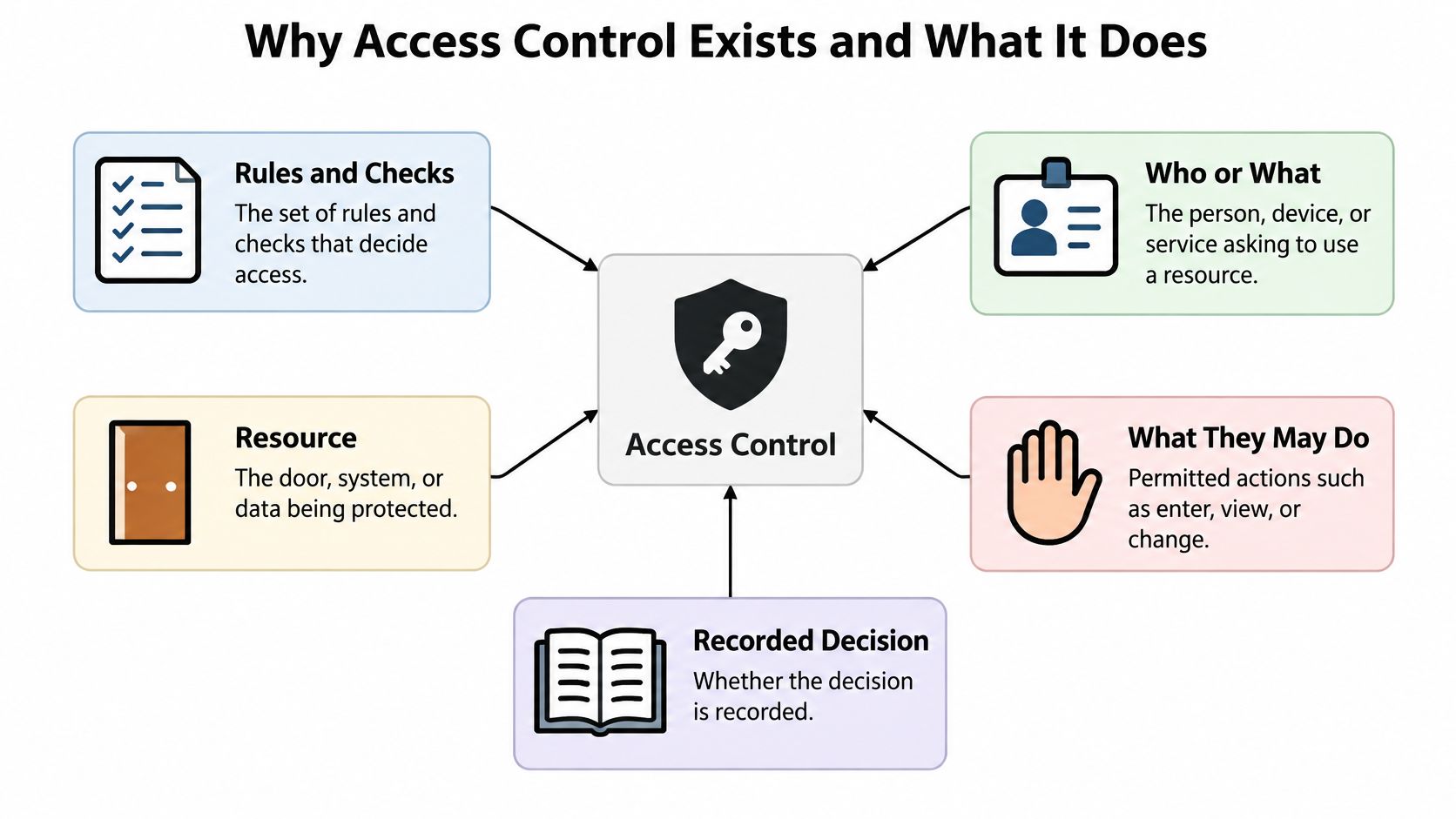
Access control is the set of rules and checks that decide who or what may use a resource, what they may do with it, and whether that decision gets written down. A hotel key card shows all three parts working together. The card claims an identity at the door, the lock checks whether that card belongs to that room on that date, and the front desk system keeps a record of the opening. A guest whose checkout passed at noon holds a card that still fits the reader and still gets refused, because the permission expired even though the plastic didn't change.
The four questions behind every entry
Every access decision, at a gate or inside a payment platform, answers the same four questions. Skip one and a specific failure follows.
| Question | What It Checks | Everyday Example | Failure If Missing |
|---|---|---|---|
| Who is asking? | Claimed identity | Visitor gives a name at the gate | Anyone can claim to be a resident |
| Can they prove it? | Authentication | Gate code, key card or phone credential | Strangers enter with a copied card |
| What may they do? | Authorization | Contractor opens only the service gate | Visitor opens the pool-equipment room |
| What happened? | Audit record | Entry log with time and credential ID | No evidence after an incident |
The diagram below maps those parts to the central idea: rules and checks, the identity asking, the resource being protected, the permitted actions, and the recorded decision.
Two jobs, prevention and accountability
Prevention limits what each authorized party may do. A contractor whose credential opens the service gate shouldn't also be able to edit the access list, add a code, or grant himself entry to the equipment room. Accountability means access can be granted, revoked, and audited later, so a manager can reconstruct who entered and when.
The idea has a documented origin. Under U.S. Air Force sponsorship, MITRE began developing a mathematical model of secure computer systems in 1972, and David Bell and Leonard LaPadula published the resulting work in 1973, turning classifications and clearances into rules that stop information flowing from higher sensitivity levels to lower ones, as described in the Bell–LaPadula model overview. That model treated access as a relationship among a user, a program, and a file rather than a simple user-to-file check, which is exactly the distinction a shared gate code erases.
The modern business case is blunt. Verizon's Data Breach Investigations Report research found that in the 2024 analysis, use of stolen credentials was the leading initial action in breaches at 24%, and across the preceding decade stolen credentials appeared in 31% of breaches. Credentials get stolen. Narrow permissions and prompt revocation decide how far a stolen credential travels.
Practical rule: Before buying any hardware, list every person who holds a key, code, fob, or app credential for the property, then confirm each one still has a business reason to hold it.
Most owners find names on that list they can't explain. Deleting those entries improves security more than a heavier gate ever will.
Common Applications From Gates to Digital Accounts
Access control already runs in dozens of everyday settings, and each one answers the same four questions in a different accent. A driveway keypad proves identity with a code and protects vehicles and privacy. A pool enclosure gate skips identity entirely and relies on mechanics, because the threat is a toddler who can't read a keypad, only reach a latch.
| Setting | Typical Control | What It Protects | Who Usually Needs Access |
|---|---|---|---|
| Residential driveway gate | Keypad or phone entry | Privacy, vehicles, household | Residents and invited guests |
| Backyard pool enclosure | Self-closing, self-latching gate | Children from unsupervised entry | Residents and pool service |
| HOA amenity area | Fob or card reader | Clubhouse, gym, pool deck | Owners with active accounts |
| Multi-family building entrance | Intercom with card reader | Residents and common areas | Tenants and approved delivery staff |
| Warehouse or commercial lot | Automated slide gate with keypad | Inventory and equipment | Staff and approved carriers |
| Office suite | Role-based badge reader | Client files and records rooms | Employees by role |
| Hotel or medical facility | Zoned card access | Guest floors, patient areas, pharmacy | Guests, nurses, authorized staff |
| Cloud and payment accounts | Passwords, MFA and role permissions | Customer data and payment settings | Staff with defined tasks |
Where the settings differ
An HOA clubhouse fob is the closest physical cousin to the hotel key card. The fob identifies the owner, the reader checks whether the account is active and dues are current, and the software logs each opening. When an owner sells, the board deactivates the fob rather than rekeying the building. A multi-family entrance adds a human step: the intercom lets a resident vouch for a visitor, which is a temporary, one-time permission granted by someone who already holds authority.
Driveway and walk gate hardware spans single and double walk gates, swing and slide driveway gates, automated operators, keypads, card readers, and phone entry, and the gate systems options differ mainly in how the credential is presented and how the opening is recorded. A keypad shares one secret among many people. A card reader or phone credential gives each person a separate identity, which is what makes revocation and audit possible.
Digital accounts run the same chain
A cloud account with multifactor authentication and role permissions is a gate with no hinges. NIST SP 800-171 Rev. 3 defines least privilege as allowing only the authorized access necessary for organizational tasks and recommends reviewing assigned privileges, then removing or reassigning them when they're no longer needed. An estimator who builds quotes has no reason to export payment data or change user roles, just as a pool cleaner has no reason to open the mechanical room.
The useful question in any of these settings isn't which lock got installed. It's who should be allowed in, what they should be able to touch once inside, and what happens to their permission the day they leave.
How Access Control Protects Commercial Properties
A commercial property isn't one space. It's a collection of spaces with different consequences if the wrong person walks in, so a single access rule applied to every door either frustrates staff or leaves sensitive rooms wide open. Federal facility guidance sorts those spaces by restriction level, and the sorting is what turns a fence line into a managed checkpoint.
Three zone types on one site
CISA's facility access control best practice treats access control as a complete process covering employee and visitor entry, security screening, and authentication before anyone reaches nonpublic space, and it recommends securing every perimeter entry point so people can't reach the facility without passing an approved entry or screening area. The same guidance distinguishes Controlled areas, which use the least restrictive access, Limited areas, which commonly use role- or subgroup-based permissions, and Exclusion areas, which may require individual authorization.
Translated to a property a manager runs:
- Controlled areas: Lobbies, parking lots, and customer waiting rooms. Open to staff and approved visitors during set hours, with the gate or door defining where that openness stops.
- Limited areas: Maintenance corridors, staff kitchens, storage cages. Permission tied to a job function, so the credential belongs to a role rather than to everyone holding a badge.
- Exclusion areas: Server rooms, cash offices, pharmacy stock. Approval for a named individual, granted case by case and reviewed on a schedule.
Perimeter fencing and an access-controlled gate earn their keep here because they force traffic through one place where identity, authorization, and entry conditions can be checked. A site with six unmonitored side doors and one card reader at the front has a checkpoint in name only, which is why commercial fencing and perimeter design should be planned around the number of openings a property can supervise.
Least privilege, applied to a real staff list
NIST's guidance on least privilege explains that implementing it means identifying a user's job functions, determining the minimum privilege set those functions need, and restricting the user to that permitted domain. Handing every employee the maximum permissions attached to a job category creates unauthorized access, because responsibilities overlap across roles.
Say a shopping center runs three credential types. Management staff open common areas and the office corridor. A paving contractor receives access to the service entrance that expires on the last day of the contract. Maintenance technicians reach mechanical spaces but not the leasing office or the records room. If one of those credentials is stolen or copied, the thief inherits only that narrow slice of the property, which is the containment benefit in plain terms.
Three questions belong on the schedule for every door on the site: who needs it, when do they need it, and under what condition does that permission end.
A door nobody can answer for is a door that should be locked to everyone but a named key holder.
Pool Gates and the Code Rules That Make Them Safe
Pool barriers are the clearest place where the purpose of access control stops being a philosophy and becomes a tape measure. The threat model is unusual: the person trying to get in isn't an intruder with a stolen credential, it's a small child who can't be reasoned with, can't be logged, and won't remember to close anything. So the rules put the decision into the hardware itself.
What the code actually measures
Florida Building Code section 454.1.3.1.9 states that access through a pool barrier or fence from dwelling units must use self-closing, self-latching, lockable gates with a minimum height of 48 inches from the floor or ground, and places the latch at least 54 inches above the bottom of the gate or at least 3 inches below the gate's top, on the pool side. Hotels, apartments, and any property where pool access passes through or near guest or dwelling units sit squarely inside that rule.
Florida Statutes section 515.29 adds the behavioral requirements. As set out in Miami-Dade's pool barrier guidance, gates providing access to swimming pools must open outward away from the pool, be self-closing, and have a self-latching locking device, with the release mechanism on the pool side and positioned so a young child can't reach it over the gate or through an opening or gap. That guidance also identifies a 54-inch minimum location for the release mechanism in applicable residential-pool configurations.
| Requirement | Rule Value | What to Check | Rule Source |
|---|---|---|---|
| Gate height for access from dwelling units | Minimum 48 inches from floor or ground | Measure height at the gate | Florida Building Code section 454.1.3.1.9 |
| Latch placement | At least 54 inches above gate bottom, or at least 3 inches below gate top | Latch sits on the pool side | Florida Building Code section 454.1.3.1.9 |
| Release mechanism reach | 54-inch minimum location in applicable residential configurations | Child cannot reach over the gate or through a gap | Florida Building Code guidance |
| Swing direction | Opens outward, away from the pool | Gate swings away from the water | Florida Statutes section 515.29 |
| Closing action | Self-closing | Gate returns to closed position without help | Florida Statutes section 515.29 |
| Latching and locking | Self-latching and lockable | Latch engages without manual securing | Florida Building Code section 454.1.3.1.9 |
Turning the rules into an inspection
Each row becomes a physical test rather than a glance. Height gets measured at the gate, not estimated from the fence panel beside it. Closing action gets tested by opening the gate to a few inches and letting go, then again from wide open, since weak hinge tension often shows up only at one angle. The latch gets watched while it engages, because a gate that rests against the strike plate without latching is functionally open.
Outward swing deserves a moment of thought. A child leaning or pushing on a gate that opens away from the water pushes it toward the closed position, so body weight works with the barrier instead of against it. Self-closing hinges and a magnetic or mechanical self-latching device in stainless steel or marine-grade aluminum hold that behavior through coastal humidity, and a reviewer walking a property should treat a propped-open gate as a failed control regardless of how new the hardware looks. A detailed walkthrough of pool gate lock regulations helps owners check their own gate before an inspector arrives.
A fence and a lock don't pass. Height, closing action, latch operation, lockability, and release location pass.
Where Access Control Fails and Why
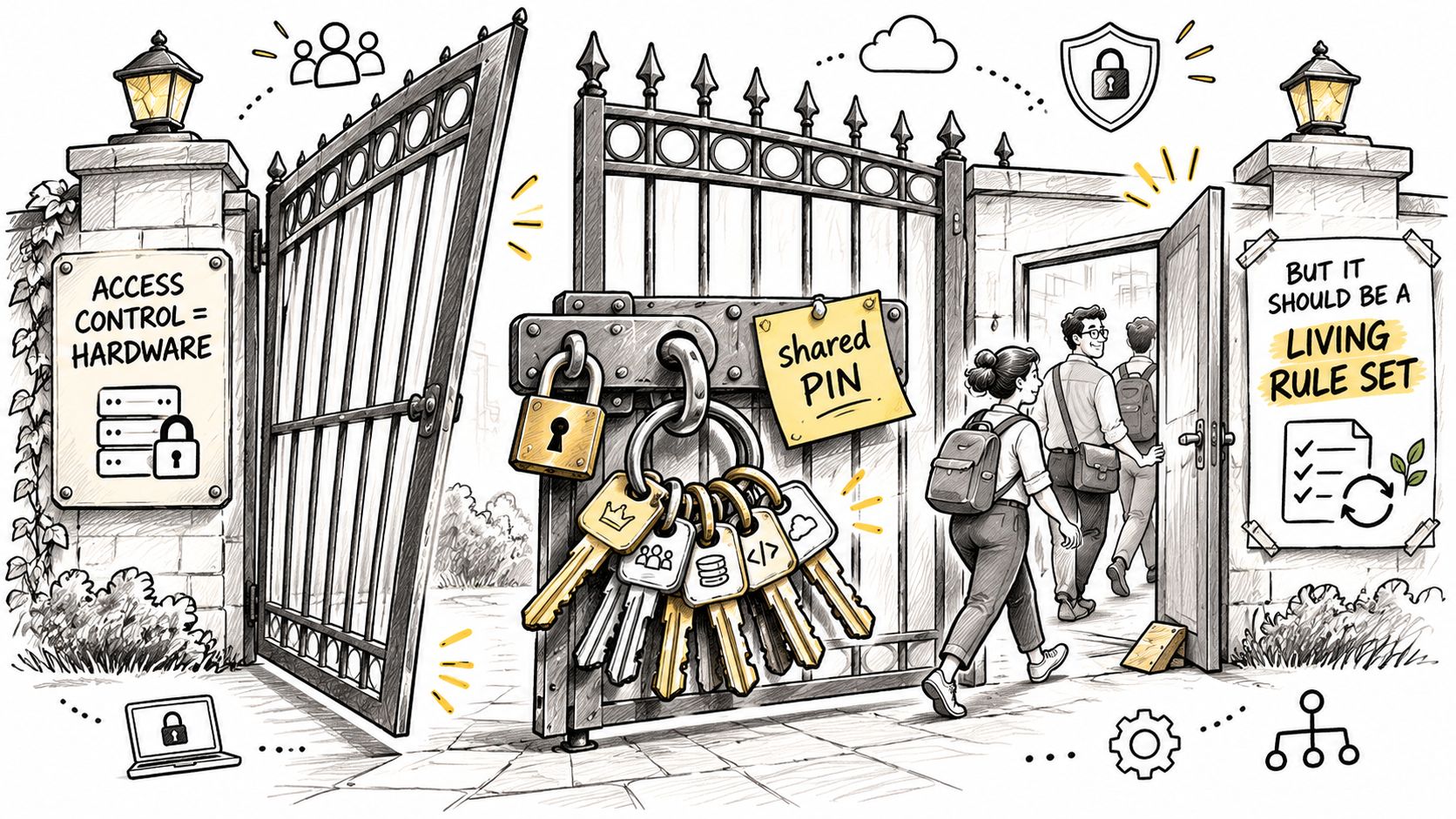
A locked gate frequently fails to prevent an incident, and the reason usually has nothing to do with the gate. The hardware did its job. The permission list, the visitor log, and the emergency plan didn't exist.
The lifecycle gap
NIST SP 800-207 rejects implicit trust based only on network or physical location and requires authentication and authorization before access is granted, with least-privilege decisions applied per request. Standing inside the fence line proves nothing. The practical gaps that follow are unglamorous: credentials shared between three shifts, permissions still active months after a contractor's last day, visitors waved through without a log, and no written answer for how a fire crew gets in at 3 a.m.
Those are lifecycle problems, not equipment problems. Provisioning, reviewing, revoking, and documenting access decide whether a card reader is a security control or an expensive doorbell. The scale of the manual burden is measurable: in Tailscale's 2025 zero trust report, surveying 1,000 IT, security, and engineering professionals in the United States and Canada, 68% of organizations still relied on manual processes to manage network access. Manual revocation is the step that gets skipped when someone is busy, which is precisely why centralized administration and automated deprovisioning matter.
What smart systems add, and what they cost
Securitas's access control trends outlook for 2026 projects mobile credentials, cloud-based management, AI, interoperability, and access data used as business intelligence as the leading developments. Convenience is real. So are the new dependencies: a cloud outage, a dead phone, a revoked credential still cached on an offline reader, a weak vendor integration, a biometric privacy exposure, or a compromised administrator account that can rewrite every permission at once.
Judge any system against four outcomes instead of one demo:
- Security: Can permissions be scoped narrowly and revoked immediately?
- Usability: Will residents and staff use it, or prop the gate to avoid it?
- Resilience: Can emergency responders enter during a connectivity loss, and is there a non-digital fallback?
- Privacy: How long are entry logs kept, who can export them, and when are they deleted?
The strongest answer for most properties is hybrid: solid physical construction, a documented manual override, limited permissions, and an audit trail someone reads.
Plan Access Control for Your Property
A property manager or HOA board can move from hardware thinking to decision-chain thinking in six steps, in this order.
- Map every entrance on the site to a zone: controlled, limited, or exclusion. A side gate nobody classified is the one that stays open.
- List each role and write the minimum access it needs. Residents, cleaners, groundskeepers, delivery drivers, maintenance techs, and board members rarely need the same doors.
- Choose a credential method that matches the zone's risk. Keypads suit low-risk shared entry, while card readers, phone entry, and intercoms give each person a separate identity where accountability matters.
- Write the revocation rule before anyone gets a credential: access ends the day the person leaves the role, and one named person owns that task.
- Define manual override and emergency access before installation, including what happens during a power or internet outage.
- Confirm pool gates meet height, swing, closing, latching, and release-location requirements before the inspection is scheduled.
For owners in Martin and Palm Beach counties, AlliedFenceAndGate.com™ installs access control integration covering keypads, card readers, app-based systems, and intercom integration alongside the fence or gate itself, so the barrier and the permission system get designed together. The company verifies every setback, easement, and HOA restriction before digging the first post hole, which prevents the common outcome of a beautifully automated gate sitting three feet inside a utility easement.
#MartinCounty #PalmBeachCounty #TreasureCoast #StuartFL #PalmBeachGardens #FloridaFencing #GateAccessControl #CommercialSecurity #PoolSafetyGates #HOAGates #AccessControl #FloridaPropertyManagement #CommercialFencing #MultifamilyProperty
AlliedFenceAndGate.com™ designs and installs code-compliant pool safety gates, driveway swing and slide gates, and access-controlled commercial perimeters with keypads, card readers, phone entry, and intercom integration, then handles permitting and inspection coordination so the permission chain and the hardware both hold up. Property owners, HOA boards, and managers across Martin and Palm Beach counties can start with a walkthrough of every entrance and credential on the site. Visit AlliedFenceAndGate.com™ to review gate and access control options and request an estimate for the property.
Related Fencing Services
Need a fence or gate on the Treasure Coast?
Licensed, insured, and bonded. Free estimates across Martin, St. Lucie, Indian River & Palm Beach counties.
Call (772) 530-3127