How Much Is a Fence Permit in Florida? Local Fees Guide
Florida has no single statewide fence-permit price: the applicable city or county determines the fee. Examples include $35 in Pensacola, $123.20 for residential fences in St. Cloud, and $156 for commercial fences in St. Cloud, but these aren't Martin County or Palm Beach County quotes.
What good is a low advertised permit fee if the property still needs zoning approval, a usable survey, and a separate pool-barrier review? For homeowners asking how much is a fence permit in Florida, the useful answer starts with the installation address, not a statewide average.
Table of Contents
- Why Fence Permit Prices Differ
- Florida Sets the Framework but Localities Set Fees
- What Local Fee Examples Actually Tell You
- How Project Details Change the Permit Total
- When a Florida Fence May Not Need a Permit
- The Florida Fence Permit Process
- Documents That Can Add Cost Before Construction
- How to Work With a Permit-Handling Contractor
Why Fence Permit Prices Differ
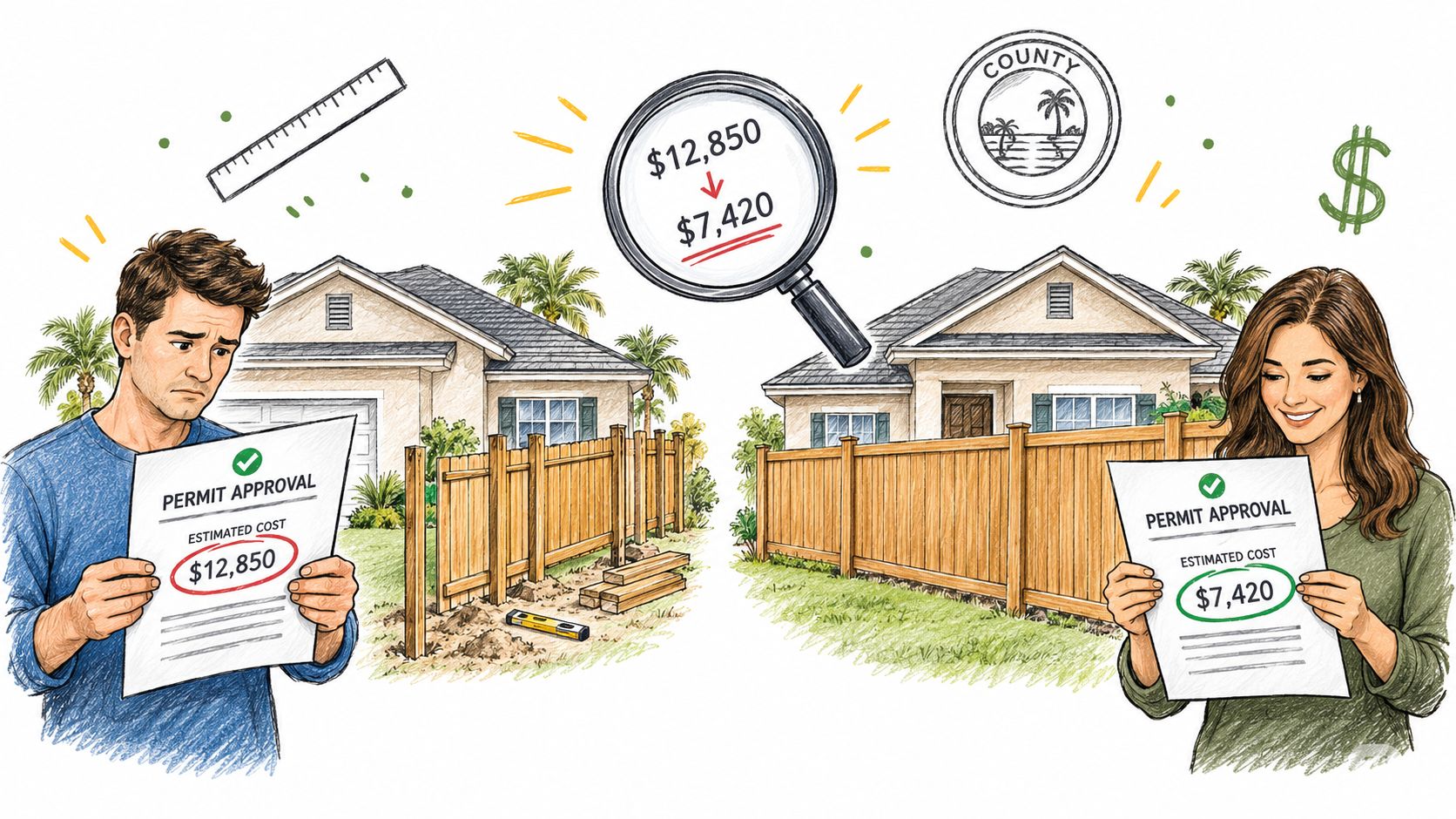
Consider a homeowner comparing a fence proposal with a neighbor's quote. Both projects call for similar privacy fencing, but one property sits inside a municipality and the other falls under an unincorporated county's jurisdiction. The permit allowances don't necessarily match because the issuing offices and project requirements may differ.
That's a budgeting scenario, not evidence that either contractor overcharged. Before comparing totals, the homeowner needs to know which government office will review each installation and what each proposal includes.
Compare the same scope
A government permit charge isn't the same thing as the contractor's complete permitting service. Material, installation labor, gates, documentation, utility-location coordination, HOA submissions, and inspection scheduling belong in clearly identified parts of the estimate.
- Government charges: Identify the application, review, and issuance charges payable to the jurisdiction.
- Contractor services: Separate document preparation, submission management, and inspection coordination from those charges.
- Site preparation: Establish whether survey work, vegetation removal, or layout changes are included.
- Private approval: Clarify who handles any applicable HOA architectural review.
A low permit allowance can mean that the proposal excludes work another contractor included. Conversely, a larger administrative line shouldn't automatically be treated as a government fee.
Practical rule: Compare the scope behind the permit line, not just the amount beside it.
For properties across Martin and northern Palm Beach counties, the sensible starting point is an address-based jurisdiction check. A nearby installation can help explain the process, but its invoice isn't a reliable fee schedule for another parcel.
Florida Sets the Framework but Localities Set Fees
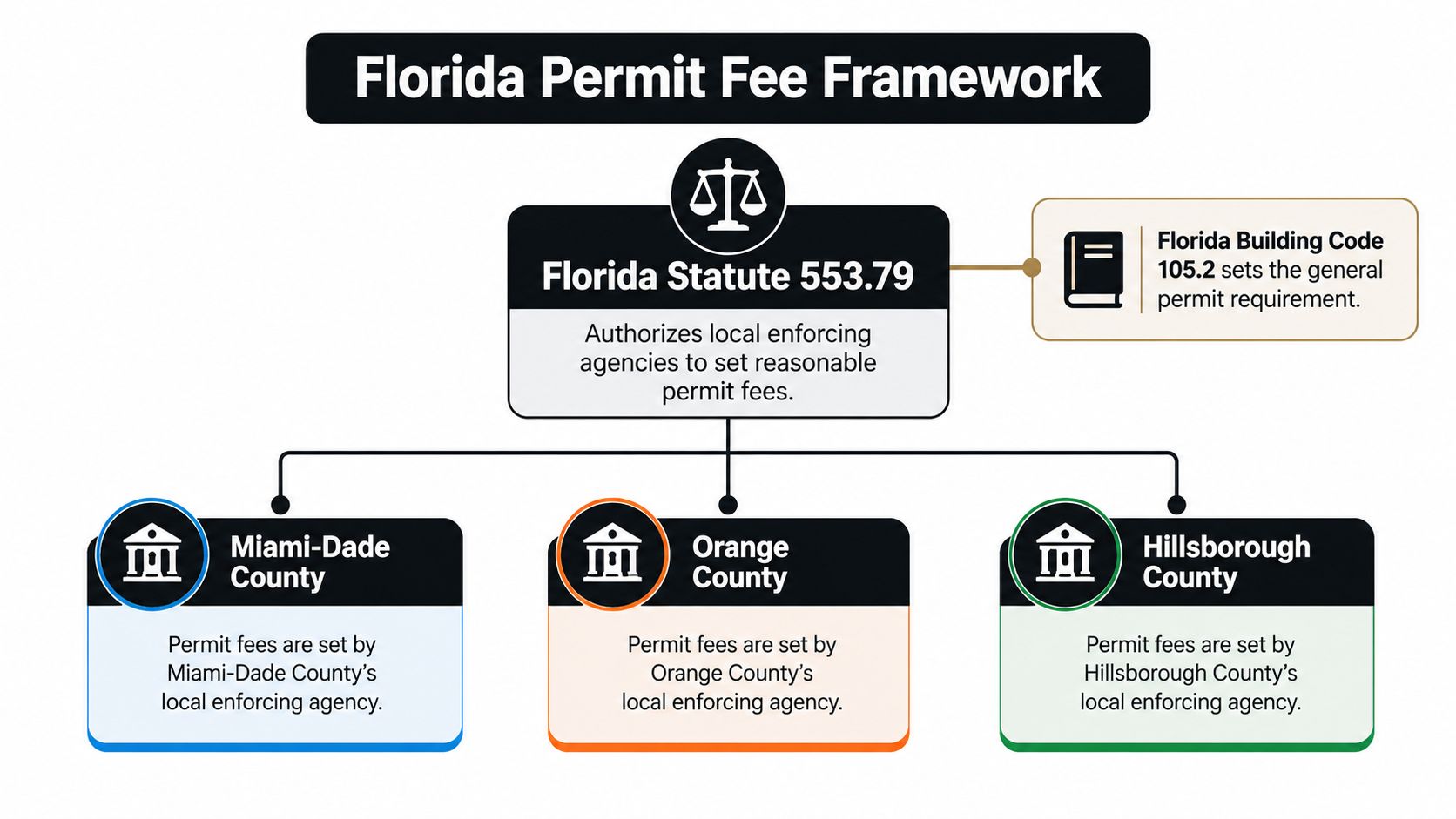
Florida Statute 553.79 authorizes local enforcing agencies to impose reasonable permit fees. It also limits inspection fees: they can't be based on total project cost or exceed the agency's actual inspection costs, as explained in the Florida statute governing permit applications and fees.
That distinction matters when reviewing a quote. A valuation-based building-permit calculation and an inspection charge aren't automatically the same category, and the statutory restriction on inspection fees shouldn't be interpreted as a ban on every valuation-based permit calculation.
Separate regulation from pricing
The Florida Building Code provides the regulatory framework, while the applicable local office determines how the proposed fence moves through its approval process. The homeowner's task is to establish the required approval category before asking for a final price.
A department might identify a building-permit requirement, zoning review, or another applicable review step. The written estimate should identify the actual services being charged rather than grouping everything under an unexplained permit label.
| Budget category | What needs clarification |
|---|---|
| Application | Whether a charge is due at submission |
| Zoning or site review | Whether placement and land-use review are separate |
| Plan review | Whether technical documents require additional review |
| Inspections | Which inspections apply and how charges are assessed |
| Contractor administration | Which coordination services the contractor includes |
The guide to fence laws in Florida provides additional context for separating construction rules from property-use restrictions.
A contractor shouldn't calculate every permit as a fixed percentage of installation cost without checking the local schedule. That shortcut can miss a flat fee, a separate zoning charge, or a project classification that changes the calculation.
The workable mental model is straightforward: state rules establish the framework; the applicable city or county establishes the local charge and workflow.
What Local Fee Examples Actually Tell You
The introductory city examples show why a Florida average isn't a dependable project allowance. The more useful comparison is between fee structures: a flat charge, a zoning-review charge, and a calculation tied to project valuation can produce very different estimates.
Charlotte County illustrates that distinction. Its residential fence permit guidance lists a $30 zoning-review charge, with additional building and surcharge calculations applying when the stated valuation reaches $50,000 or more.
Florida local fee examples
| Jurisdiction | Listed fee | What the example shows |
|---|---|---|
| Pensacola | Flat fence-permit example stated in the introduction | A municipal fee isn't a statewide rate |
| St. Cloud | Separate residential and commercial examples stated in the introduction | Property use can change the charge |
| Charlotte County | Zoning charge and valuation threshold described above | The initial review charge may not be the complete government total |
These examples shouldn't be presented as current quotes for Stuart, Jupiter, West Palm Beach, or an unincorporated parcel. Their value is in showing how local offices structure charges, not in predicting another jurisdiction's invoice.
Match the comparison to the project
A residential boundary fence and a commercial security perimeter aren't interchangeable estimating categories. A multifamily site, masonry feature, powered gate, or pool-related installation deserves its own classification check rather than an assumption that the least expensive residential fee applies.
Corner-lot placement also warrants attention before selecting a design. Even when the base charge doesn't change, resolving placement restrictions can require additional preparation.
- Ask for the applicable category: Residential, multifamily, commercial, or specialty work.
- Request the complete calculation: Include review charges and applicable surcharges, not just the headline fee.
- Tie the estimate to the submission: Provide the address, fence type, proposed scope, and project value.
The most useful response from the jurisdiction is a written project-specific estimate, with any conditions or exclusions identified before the owner accepts a final allowance.
How Project Details Change the Permit Total
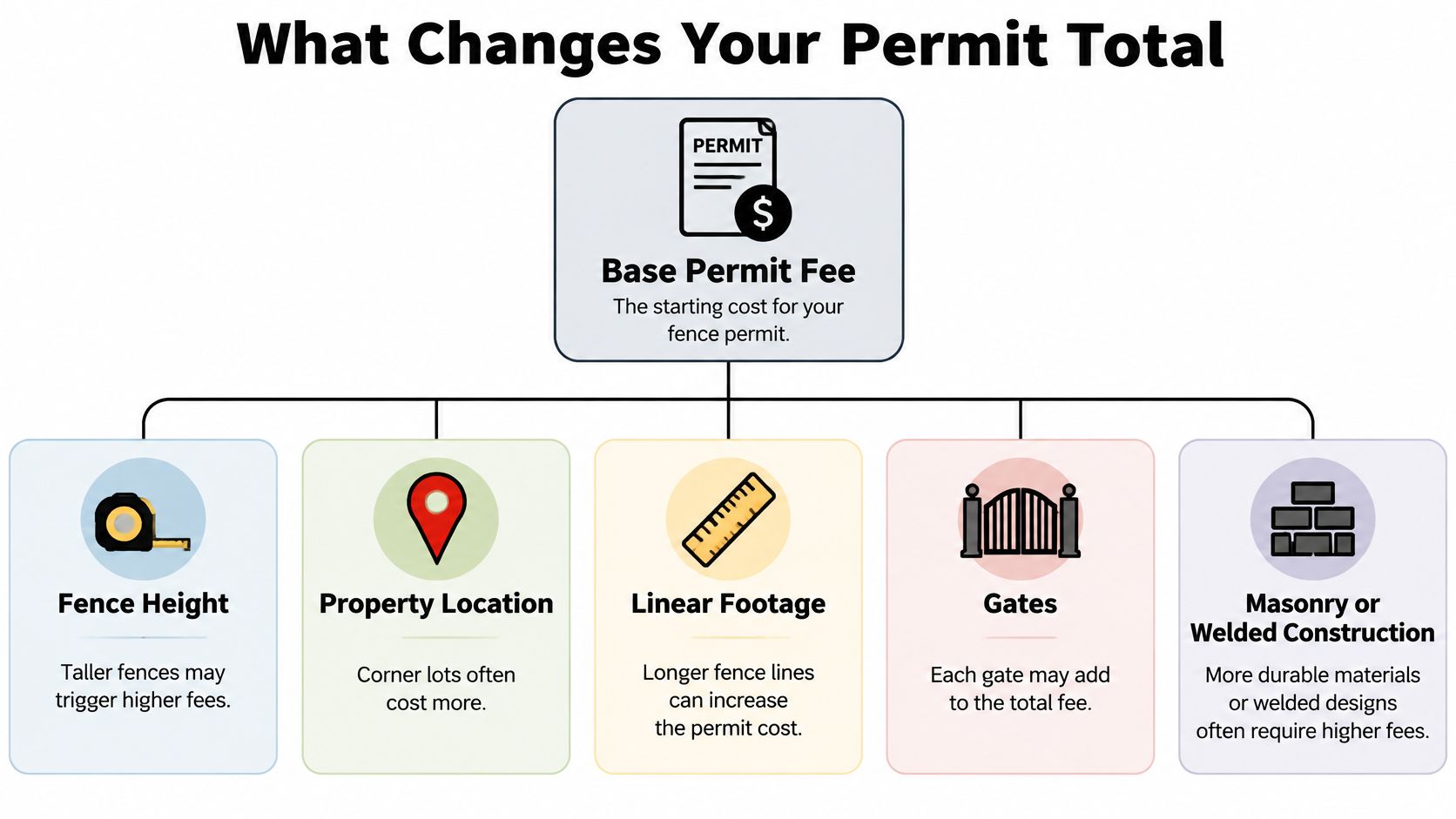
A standard-height fence doesn't automatically mean a standard approval path. Height is only part of the review; placement, construction, gates, and the fence's purpose can be equally important.
Miami-Dade's fence and gate application guidance requires a building-permit application, site plan, survey, and supporting documents, including total linear footage with gates included. Its fee calculation depends on the applicable schedule, fence type, and footage, rather than length alone.
Describe the actual installation
A quote based on a simple boundary fence shouldn't carry over after the owner adds masonry columns or an electrically operated entrance. Welded components, wind-resistant systems, electrical features, pool-safety functions, and commercial use all warrant confirmation of the required review.
Florida's administrative-code material for permit applications and specialty fences addresses application information and additional controls for regulated work, including low-voltage electric fences. A specialty installation shouldn't be budgeted from a basic fence allowance.
- Design information: State height, materials, total footage, gates, and any masonry or welded elements.
- Site conditions: Identify corner placement, easements, and other location constraints.
- Special functions: Disclose pool-barrier use, electrical equipment, and security features before pricing review.
- Cost separation: Distinguish application, zoning, specialty review, contractor administration, and inspection-related charges.
A taller or more complicated fence doesn't justify an invented surcharge. It justifies checking the applicable fee schedule and submission requirements.
These examples explain cost drivers, not promised Martin or Palm Beach County rates. The contractor should revise the permit allowance when the submitted design changes, rather than leave an outdated assumption in the contract.
When a Florida Fence May Not Need a Permit
Building-permit exempt doesn't necessarily mean approval-free. A Florida Building Commission interpretation concerning ordinary fences explains that ordinary fences generally aren't regulated as building structures and that fences 6 feet or less may not require a building permit, while a municipality may still require zoning approval.
That's a conditional starting point, not permission to install anywhere on a parcel. The relevant question is whether the specific project needs a building permit, zoning approval, both, or neither.
Verify the exemption before budgeting zero
Orlando's fence guide and exemption conditions illustrates how narrow an exemption can be. Its qualifying conditions include a one- or two-family residential property, a fence six feet or less where allowed, and a location outside a historic-preservation district; the installation must still comply with city code.
The same guide identifies permit-triggering circumstances including commercial properties, residential sites with three or more dwelling units, taller fences, corner lots, public easements, vehicular or powered gates, floodplain or floodway locations, and required pool or spa barriers.
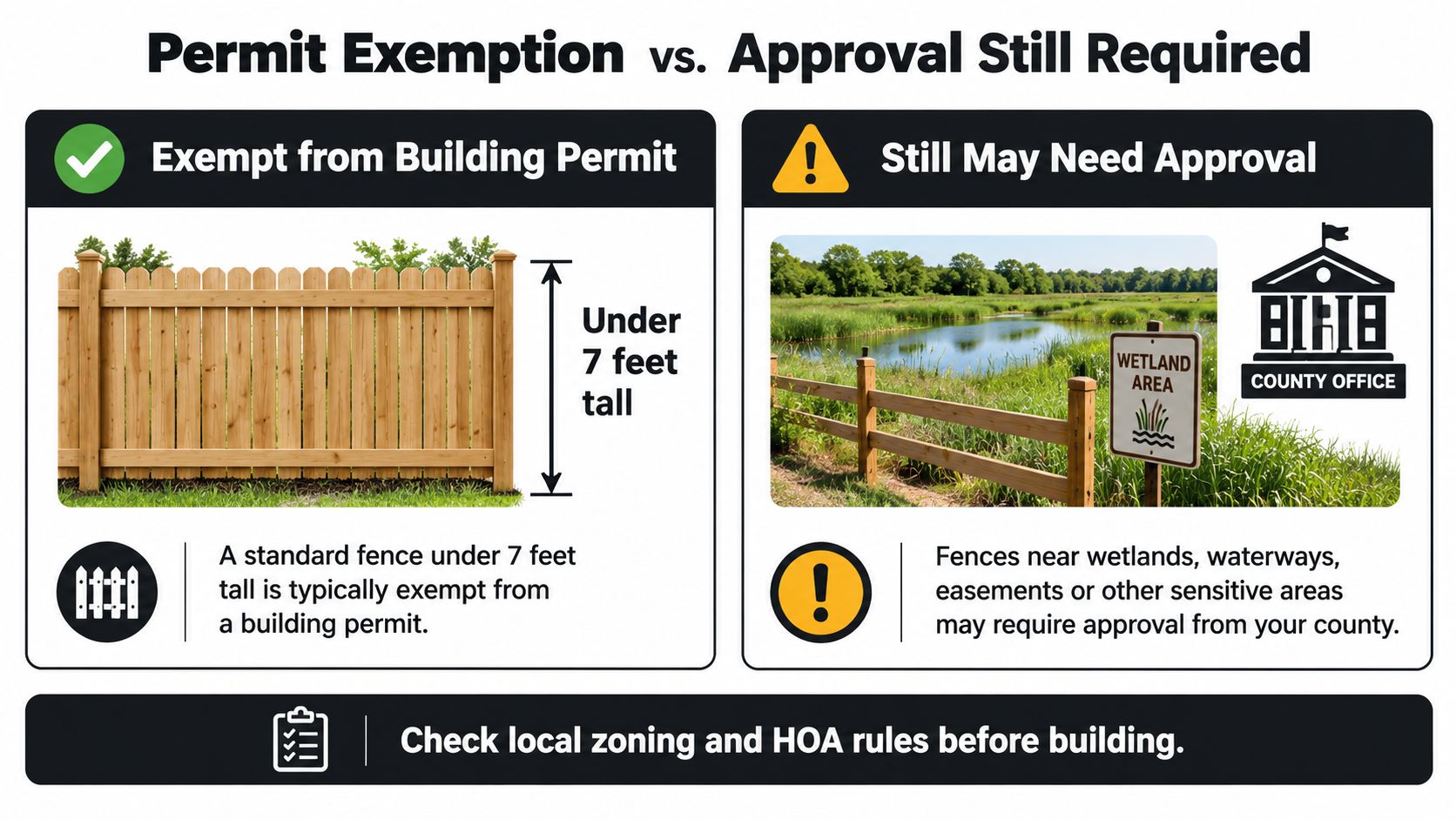
The graphic's height shorthand isn't a statewide exemption rule. The applicable local determination controls, and proximity to wetlands isn't the only location issue requiring attention.
West Palm Beach makes the building-versus-zoning distinction especially relevant locally. Its permit frequently asked questions state that fence, pool-barrier, and driveway permits remain required under its zoning code regardless of changes to building-code exemptions, with regulation of fence height, type, setbacks, and location.
Treat pool barriers as safety-regulated work
Greenacres requires a fence or screen-enclosure permit to accompany the pool-permit submission. Its swimming pool checklist requires a permanent barrier at least four feet high before final pool inspection, a temporary four-foot construction fence during construction, and a barrier when the pool is 24 inches or more in depth.
That checklist also calls for a non-climbable finished barrier and a pedestrian gate that is self-closing, self-latching, and swings away from the pool. Those details affect layout, hardware selection, inspection readiness, and potential correction work; an ordinary boundary-fence assumption isn't enough.
A pool-safety design should therefore be checked before materials are ordered. Gate operation and barrier configuration need to match the applicable requirements, not merely the homeowner's preferred appearance.
Keep private approval separate
HOA review addresses a different approval relationship from government permitting. Where association approval applies, an owner shouldn't assume that city acceptance settles the association's material, color, or layout requirements.
- Confirm government status: Obtain the building and zoning determination for the proposed installation.
- Check private restrictions: Resolve applicable HOA approval before committing to a design.
- Confirm safety functions: Identify whether the fence is part of a required pool barrier.
- Document the outcome: Keep written determinations with the contract and approved layout.
A $0 government approval budget is appropriate only after the jurisdiction confirms that the installation qualifies without a charge. It doesn't mean the fence has no placement restrictions, documentation needs, or private approval obligations.
The Florida Fence Permit Process
An effective application starts with a settled design and a clear property record. Submitting a sketch before resolving the gate location or property boundary can create avoidable revisions, even when the initial application charge looks modest.
The following sequence keeps the application tied to what the contractor intends to build. It's a preparation checklist, not a promise that every jurisdiction uses the same forms or review stages.
Establish the approval path
- Identify the authority having jurisdiction: Use the actual site address to determine whether the city or county handles the application.
- Confirm the approval category: Record the required government reviews and any separate HOA process.
- Assemble the scope: Include the proposed layout, height, materials, footage, gates, and pool or specialty details.
- Identify the applicant: Establish whether the contractor or an eligible owner-builder will submit and respond to comments.
The fence permit application guide offers a useful preparation reference. The reviewing office's current requirements should still control the submission.
Prepare for construction and closeout
After the submission requirements are known, the contractor should identify required credentials and determine whether a Notice of Commencement applies. Utility locating and the approved layout should be coordinated before excavation rather than treated as paperwork to resolve afterward.
The contract should also assign responsibility for review comments. An owner-requested gate change, a missing survey detail, and a technical correction are different issues, and their cost responsibility shouldn't remain ambiguous.
| Project stage | Record to keep |
|---|---|
| Approval | Accepted plans and permit conditions |
| Before excavation | Utility-location coordination and agreed layout |
| During installation | Required inspection requests and results |
| Completion | Applicable final approval documentation |
Before scheduling installation: Confirm that required approvals are issued and any inspection-dependent work sequence is understood.
Processing time depends on the jurisdiction, submission completeness, and project details. A contractor can manage preparation and follow-up, but shouldn't promise a government approval date outside the contractor's control.
Documents That Can Add Cost Before Construction
A modest application charge doesn't guarantee modest preparation costs. An outdated survey or incomplete construction detail can require work before the reviewing office can evaluate the fence.
Miami Shores provides a concrete example. Its horizontal wood fence requirements identify a $50 submittal fee, require two copies of a survey no older than seven years, and call for contractor licensing and insurance documentation or an owner-builder disclosure, fence specifications, and foundation and final inspections.
Establish who supplies the documents
A survey update, site-plan preparation, or engineered design is a separate service from paying the government's application charge. Technical drawing requirements should be confirmed for the selected material and construction method instead of assumed from a different fence system.
The property-line guide for fence projects can help owners understand the preparation involved. A visible existing fence shouldn't be treated as a substitute for the property evidence required by the reviewing office.
- Survey responsibility: Identify whether an existing survey is acceptable and who obtains an update if needed.
- Design responsibility: Establish who prepares specifications, construction details, and any required signed and sealed plans.
- Revision responsibility: Define who pays when the owner changes the layout or the submission needs correction.
- Inspection responsibility: Confirm who schedules inspections and handles deficiencies or return visits.
Evaluate preparation, not just submission
A permit-capable contractor should explain document gaps before ordering material. That conversation may expose an additional cost, but it's preferable to discovering an unusable layout after installation begins.
The strongest proposal identifies both the government allowance and the preparation scope. A promise to submit paperwork isn't equivalent to an agreement to resolve missing surveys, redesign a gate, or manage every revision without additional charges.
How to Work With a Permit-Handling Contractor
A permit-handling contractor should establish the approval path before committing the owner to a final layout. That protects the estimating process from assumptions about where the fence can go, which gate configuration will work, and what documents the reviewing office expects.
For homeowners, the immediate concern may be privacy or pool access. HOA boards and property managers also need consistent records, while commercial owners and general contractors need clear responsibility for specialty features and inspection sequencing.
Evaluate the coordination scope
AlliedFenceAndGate.com™ is one option serving Martin and Palm Beach counties and Florida's Treasure Coast. The company describes itself as Florida-licensed, insured, and bonded, with residential and commercial fencing, ADA-compliant railings, ramps, stair handrails, and pool-safety gates designed to Florida Building Code requirements.
Its services include permitting, Notice of Commencement coordination, 811 utility locates, and inspection coordination. Digital estimating tools, survey and photo uploads, and in-house contract signing support project preparation, but a preliminary digital estimate shouldn't be mistaken for a government fee determination.
Comparable proposals should identify who performs each service. A contractor that handles the application but leaves inspections to the owner offers a different scope from one that manages the approval and closeout workflow.
- Before material ordering: Verify the jurisdiction, proposed placement, and required design documentation.
- At contract signing: Distinguish a permit allowance from a confirmed fee and explain how differences are reconciled.
- When conditions change: Require written communication about revised layouts, added specialty work, or document deficiencies.
- At completion: Identify the required approval records and who obtains them.
Resolve the allowance before accepting it
A compact decision record is more useful than a vague assurance that permits are included. The owner or property manager should be able to answer the following questions from the proposal and supporting correspondence.
| Decision | What should be settled |
|---|---|
| Jurisdiction | Which office has authority over the address? |
| Approval category | Building permit, zoning approval, both, or exempt installation? |
| Property classification | Residential, multifamily, or commercial? |
| Design and location | How do height, footage, gates, pool use, easements, and corner placement affect approval? |
| Private restrictions | Is HOA review required, and who submits it? |
| Documents | Which survey, plans, specifications, and credentials are needed? |
| Inspections | Which stages require review, and who coordinates them? |
| Charges | Are government fees separate from contractor coordination costs? |
The central answer remains address-specific: there's no single Florida fence-permit price. A written local determination, current fee schedule, and project-specific estimate provide a firmer budget than an online statewide average.
#MartinCountyFencing #PalmBeachCountyFencing #TreasureCoastFencing #StuartFencing #JupiterFencing #WestPalmBeachFencing #PalmBeachGardensFencing #FloridaFencePermits #PoolSafetyFencing #PrivacyFencing #AluminumFencing #VinylFencing #ChainLinkFencing #WoodFencing #FenceInstallation
For Martin and Palm Beach County projects, AlliedFenceAndGate.com™ offers fence estimating, permit coordination, utility locating, and inspection coordination. Homeowners and property managers can visit the site to submit their survey, property photos, and proposed fence details, then request a project-specific written estimate and confirmation of the applicable fee schedule before construction begins.
Related Fencing Services
Need a fence or gate on the Treasure Coast?
Licensed, insured, and bonded. Free estimates across Martin, St. Lucie, Indian River & Palm Beach counties.
Call (772) 530-3127